
The Treasure of the Sierra Madre (1948) set in the West – men driven mad by gold fever. Straightforward plot, however, complicated by an avalanche of characters. And for a two-hour running time it seemed perverse to waste the first six minutes on scenery, narration – explaining the Apache legend of a fabulous hidden seam of gold – and theme song.
The real film begins with a shoot-out between Marshall Mackenna (Gregory Peck and an Indian. “You will wish you never saw this map,” says the Indian before he dies, but Mackenna burns the map. That doesn’t go down well with villain Colorado (Omar Sharif), whose gang has taken Inga (Camilla Sparv) hostage. Convinced the lawman has memorized the map, Colorado adds Mackenna to his hostage quotient.

At Colorado’s hideout Hesh-Ke (Julie Newmar) has a hostile reaction to Mackenna. Like Colorado, they have history. Mackenna and Inga bond when he fends off an Indian intent on raping her. As if this isn’t a pretty straightforward set-up, old foes reunited, potential romance brewing, a treasure hunt, further complications arise in the shape of a posse led by Ben Baker (Eli Wallach), not hunting renegades but also chasing gold. As if that wasn’t already a complication too far now we have a Cavalry troop, who confuse the posse with outlaws thus mostly eliminating a complication before it gets too complicated – the pursuing Apaches finish them off.
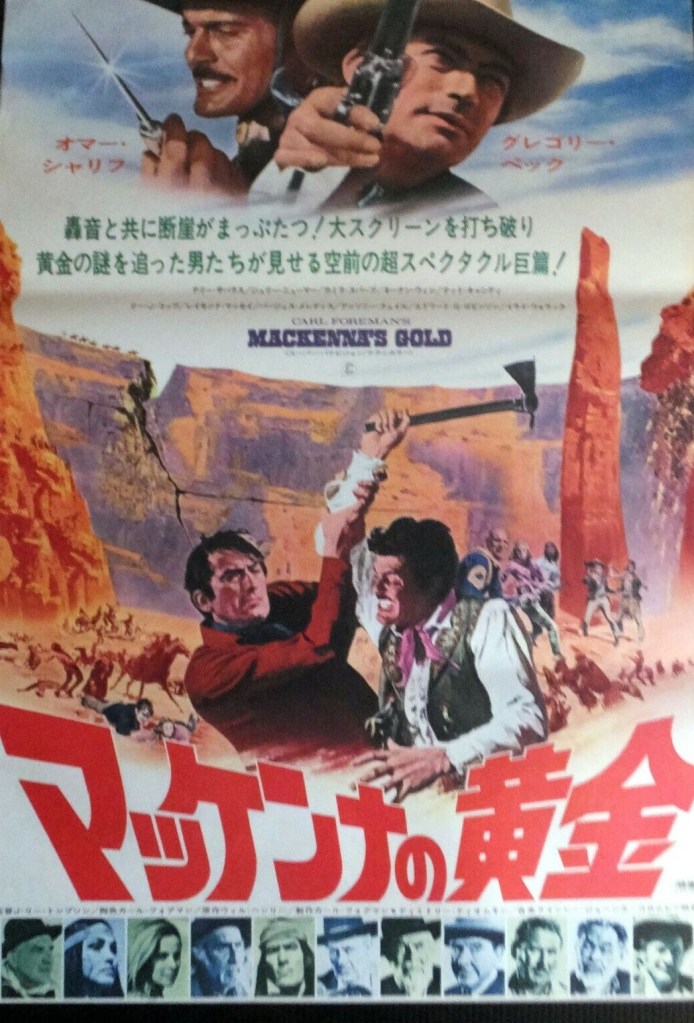
And in a nearby pool, we get a deadly twist on the naked attraction, as Hesh-Ke, first trying to lure Mackenna then trying to drown the woman she views as her romantic rival. When the Cavalry reappear, they have turned rogue, led by Sgt Tibbs (Telly Savalas). So now we’ve got the narrative ironed out it’s three separate groups – outlaws, Cavalry and Apaches – searching for gold with various individual old scores to be settled. And, just in time, they’ve arrived at Shaking Rock, the tall pillar visualized in the poster, and a sunrise worth waiting for. It is a glorious scene.
After a close-up of the rising sun and the pillar, and the screen changing color, the shadow of the pillar creeps across the canyon floor and points to a crack in the canyon wall. The crack is a tunnel entrance and on the other side the sun is shining on a seam of bright gold. And that leaves only the various denouements to be played out. And some surprises – straightlaced Inga succumbing to gold fever, the supposedly barbarous Apaches revealed as good guys – treating pillar (and gold) with reverence – and (would you believe it) an earthquake.
The earthquake might just have been too big a temptation given this was filmed in Cinerama. But it’s the least effective use of the process. A fairly standard western trope, crossing a dodgy bridge, is heightened in Cinerama but it’s still a cliché. Much better is the river crossing, the camera’s dizzying effect echoing the rollercoaster ride in This Is Cinerama and the rapids and runaway train of How the West Was Won (1962), audiences pitched headlong into camera point-of-view, racing water, oncoming rapids, thundering waterfall. The final section is triggered by the Cinerama camera racing for two minutes down the twisting track leading to the gold. So, in Cinerama terms, the audience got its money’s worth.
And there should have been enough conflict to keep the narrative on track – Mackenna vs. Colorado, Hesh-Ke vs. Inga, Inga vs Colorado, Calvary vs. outlaws vs. Apaches, plus various fist, gun, knife and belt fights. The individual conflicts, Inga’s genuine fear over her fate, the romantic triangle and especially ruthless Colorado revealed (ditto Butch Cassidy) as a dreamer, imagining life in faraway lands (swap Butch’s Bolivia and Australia for Colorado’s Paris) were more than enough to be going on with without being drowned out by a simplistic message about greed. This is nothing more – or nothing worse – than a decent western wrapped up in the bloated shadow of a roadshow.
Gregory Peck (Arabesque, 1966) and Omar Sharif (Mayerling, 1969) are both pretty good in roles that play against type, both female roles are well-written and well played by Camilla Sparv (Downhill Racer, 1969) and Julie Newmar (The Maltese Bippy, 1969) but the film is overloaded with way too many cameos. As he had proven in The Guns of Navarone (1961) J. Lee Thompson was excellent at handling large casts especially in scenes featuring a host of characters and his visual and aural skills are superb but not so good at putting writer-producer Carl Foreman in his place.
Take away the Cinerama effects and the roadshow elements, and trim another 20 minutes off the picture, and you would have had a tight character-driven picture.

 The Magnificent 60s
Two hours doesn’t seem that long anymore, particularly with a cast like this. remember seeing this on tv, but think it might have been cut for afternoon showings?
LikeLiked by 1 person
That was a better running time than a proposed three hours. But you could chunks out still with no great harm. Possibly, given the time broadcast, less of the nude swimming.
LikeLiked by 1 person
I caught this on the CBS Late Movie back in the seventies when I was in high school. Pretty rough going in spots with a few genuine bright spots before it becomes an Irwin Allen movie. If you ever wanted to see the Grand Canyon collapse here’s your chance.
As you wrote, there was a good movie buried within but the result was almost more an Indiana Jones western. Still worth checking out.
LikeLiked by 1 person
I saw it in Cinerama when it came out so at least I got the full effect of the process but remembered being bored rigid in parts and even then wondered why the heck there was a narrator droning on.
LikeLiked by 1 person
Found this:
“The 26 Apr 1965 LAT announced that film composer Dimitri Tiomkin joined Highroad Productions as a full-time producer, beginning with an adaptation of Will Henry’s adventure novel, Mackenna’s Gold. He also planned to write the score, but eventually left that duty to Quincy Jones. Mackennas’s Gold marked a reunion of Columbia Pictures, producer-screenwriter Carl Foreman, director J. Lee Thompson, producer Tiomkin, and lead actor Gregory Peck from the 1961 film The Guns of Navarone, according to the 22 Mar 1967 LAT. In addition to Peck, Omar Sharif was signed to play “John Colorado”; according to the 15 May 1967 DV, his schedule would be flexible enough for him to simultaneously star in another Columbia Pictures production, Funny Girl (1968, see entry). Mackenna’s Gold was set to be Foreman’s first production as writer and/or producer on American soil since High Noon in 1952 (see entry), because he had moved to London, England, after being blacklisted by the House Un-American Activities Committee (HUAC). He told the 10 Oct 1966 and 1 Feb 1967 editions of LAT, as well as the 13 Oct 1966 DV, that after scouting locations in Yugoslavia, Bulgaria, Algeria, and the South of France, he initially wanted to shoot Mackenna’s Gold in Spain. (He had filmed The Guns of Navarone in Greece and England.) “But the story is set in Arizona,” he said, “and the film calls for a tremendous number of spectacular backgrounds that were not available in Spain,” including “rapid rivers” and “the Grand Canyon.” Foreman and Columbia projected that shooting in America would cost $3.2 million, which was one million dollars more than it would have cost in Spain. A month later, the 9 Nov 1966 Var reported that the budget was $5 million. Clint Eastwood met with Carl Foreman in London to discuss Mackenna’s Gold, according to the 28 Jul 1966 DV, but was ultimately not involved with the project. The 29 Apr 1967 LAT announced that the film would be shot in the widescreen Cinerama format, beginning 15 May 1967 in Arizona, then moving on to Utah, Oregon, and California. Sam Jaffe and Zero Mostel were listed among the early hires, but they did not remain with the project. Mostel had to bow out because of a commitment to star in Mel Brooks’s The Producers (1968, see entry). An item in the 20 Apr 1967 DV added that Gayle Hunnicutt tested for Mackenna’s Gold, but was not a member of the cast. The 16 Jun 1967, 4 Aug 1967, and 12 Sep 1967 editions of LAT listed film locations as Grants Pass, OR (where filming began on 16 May 1967); Canyon de Chelly National Park and Page, both in Arizona (where shooting took place in Jun 1967); Utah; and “Lovejoy Buttes,” an area eleven miles east of Palmdale, CA. The 17 Jul 1967 DV reported that, while filming on 14 Jul 1967, twenty-six crew members had to be rescued from a flash flood in Paria Canyon, fifty miles from Kanab, UT. While the production was filming in Page, AZ, U.S. Secretary of the Interior Stewart M. Udall and U.S. Senator Robert F. Kennedy and his family separately visited the set, the 23 Jun 1967 and 30 Jun 1967 editions of DV noted. Kennedy was a friend of Gregory Peck’s. The 31 Mar 1969 LAT noted that Omar Sharif’s $400,000 salary from Mackenna’s Gold was tax free, because his native Egypt had declared him a “national resource,” exempt from taxes. The 1 Nov 1967 Var announced that Foreman had “just completed” filming. At the beginning of production, Foreman chose four young film students from the cinema arts departments of University of California (USC) and University of California Los Angeles (UCLA) to make short films of their own about the making of the film. Three of them, George Lucas, Chuck Braverman, and David MacDougal, made a short behind-the-scenes documentary called “6-18-67.” McKenna’s Gold was Raymond Massey’s last feature film. The 4 Dec 1968 Var announced a 15 Feb 1969 world premiere in Phoenix, AZ, and a 20 Feb 1969 opening in New York, but technical problems pushed the release back several months. The 10 May 1969 Phoenix premiere, hosted by the state governor, would benefit a school on a nearby Gila River Indian reservation, the 26 Mar 1969 Var reported. The 19 Jun 1969 NYT review mentioned that the film opened in New York City the previous day. Although Columbia had originally planned a roadshow release in 70mm Cinerama, the picture was released as neither. Critical reception was largely negative. The 25 Jun 1969 LAT decried: “Not in recent years has a western arrived with such advance ballyhoo and landed with a more resounding thud.” NYT called it “a Western of truly stunning absurdity,” found it “lacking in discipline and consistent visual style,” and denounced “the sloppy matching of exterior and studio photography with miniature work for special effects.” Mostly, the reviewer criticized the movie’s “abundance of sound,” stating, “It is sound so stereophonic—so all-surrounding…it dwarfs the screen.” Director of photography J. Lee Thompson had earlier told the 6 Feb 1969 LAT that the movie was “sheer adventure in six-track stereo sound. Absolutely without any ‘other dimension.’” A chart of the 1969 top film rentals in the U.S. and Canada in the 7 Jan 1970 Var listed Mackenna’s Gold as number thirty-one, with rentals of $3.1 million.”
LikeLiked by 1 person
It was a fascinating project and full of twists and turns. Thanks for your digging.
LikeLike