
This impressive Hammer conspiracy-of-silence slow-burner, more thriller than horror, features the triumvirate of Christopher Lee (The Devil Ship Pirates, 1964), Peter Cushing (The Sword of Sherwood Forest, 1960) and Barbara Steele (Dracula, Prince of Darkness, 1966) in untypical roles. Lee and Cushing, of course, had locked horns before, namely in Hammer’s reimagining of the classic Dracula, with the former the charismatic fiend and the latter his nemesis.
Dr Namaroff (Peter Cushing) is a doctor in an unnamed European turn-of-the-twentieth-century police state who knows more than he is letting on about seven inexplicable deaths in five years and the possibility of a 2,000-year-old myth coming to life and taking on a human form. And with quite a human side, jealous when his assistant Carla (Barbara Shelley) falls for a younger man, Paul (Richard Pascoe). Professor Karl Meister (Christopher Lee) appears late in the day to investigate.

Director Terence Fisher, who had shepherded the studio’s Dracula, Frankenstein, the Mummy and Dr Jekyll franchises through the starting gate, builds up the atmosphere with full moons, haunting voices, fog, sudden sounds, drifting leaves and an abandoned castle forever in shadow. The camera is often a weapon of stealth. Shock is kept to a minimum, fleeting ghostly apparitions and a finger falling off a corpse. Given the limitations of special effects in this era, that was a smart move.
Far better to concentrate on fear of impending doom, a man knowing he is turning to stone, a woman living in terror of being taken over by the phantom. The title gives away the story somewhat – even if you didn’t know the Gorgon was a mythical monster with a headful of snakes and the ability to turn people to stone, that is soon explained.
Death remains the trigger for action, the suicide of an artist after he has apparently murdered his pregnant girlfriend bringing his father onto the scene and then his brother accompanied by Lee. But all investigation hits a wall of silence after Inspector Kanof (Patrick Troughton) refuses to instigate detection.
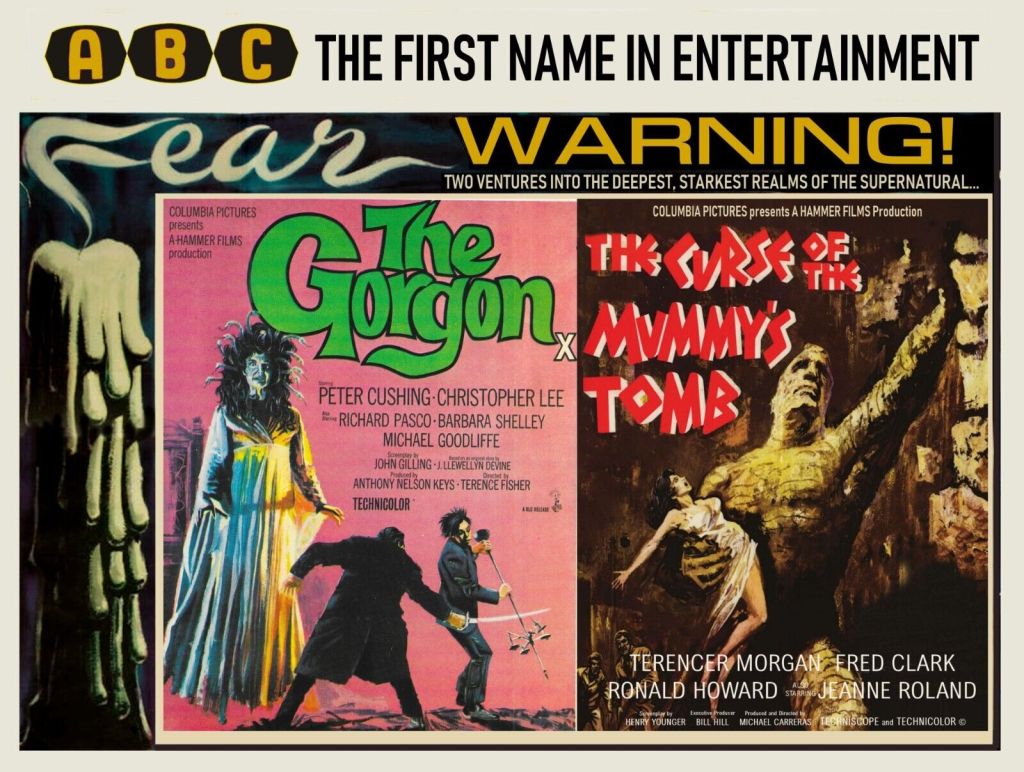
At the heart of all the relationships is betrayal. The artist leading his girlfriend on, Namaroff willing to endanger Carla, whom he professes to love, rather than revealing the truth. Even Carla spies on the brother, with whom she is falling in love, in order to gather information for Namaroff.
Forgive the pun, but Shelley steals the picture. An amnesiac, a victim and finally the lure, she remains enigmatic, a whisper of a woman. It is a haunting portrayal far removed from Hammer’s traditional cleavage queens. This is a very human character who nonetheless must stand guard over herself. Shelleye, here a gentle beauty, initially introduced as merely the love interest, becomes central to the story but without sucking up all the available horror oxygen by over-acting.
Cushing embroiders his character with little touches, smoking a cigarette in a holder, for example, but Shelley’s character, her distrust of herself, shows in every move she makes.
You would need a heart of stone to be unmoved.

 The Magnificent 60s
I caught this on television as a child (American local TV stations were airing a lot of Hammer horror in the afternoons during the late sixties and early seventies) and while the bad Medusa wig really annoyed me the movie still got under my skin enough that I made a point of catching it again as an adult and was even more impressed. It may well be my favorite Hammer film, “Quatermass and the Pit” aside) and I watch it every autumn. Wonderful script, direction, music, acting and perhaps the most chilling atmosphere of all the studio’s fare. A really underrated movie.
LikeLiked by 2 people
Tremendously under-rated, bags of atmosphere and great performances.
LikeLiked by 1 person
In a nutshell, exactly.
LikeLiked by 2 people
Actually Barbara Shelley plays Carla Hoffman.
LikeLiked by 2 people
Thanks for pointing out that embarrassing error.
LikeLiked by 1 person
Cushing smoked with gloves on, didn’t he? I thought he was always trying to avoid nicotine stains on his fingers. I can see why a cigarette holder wourld appeal to him. This film appeals to me; the affects aren’t amazing, but the cast, atmosphere and work ethic are vintage Hammer.
LikeLiked by 1 person