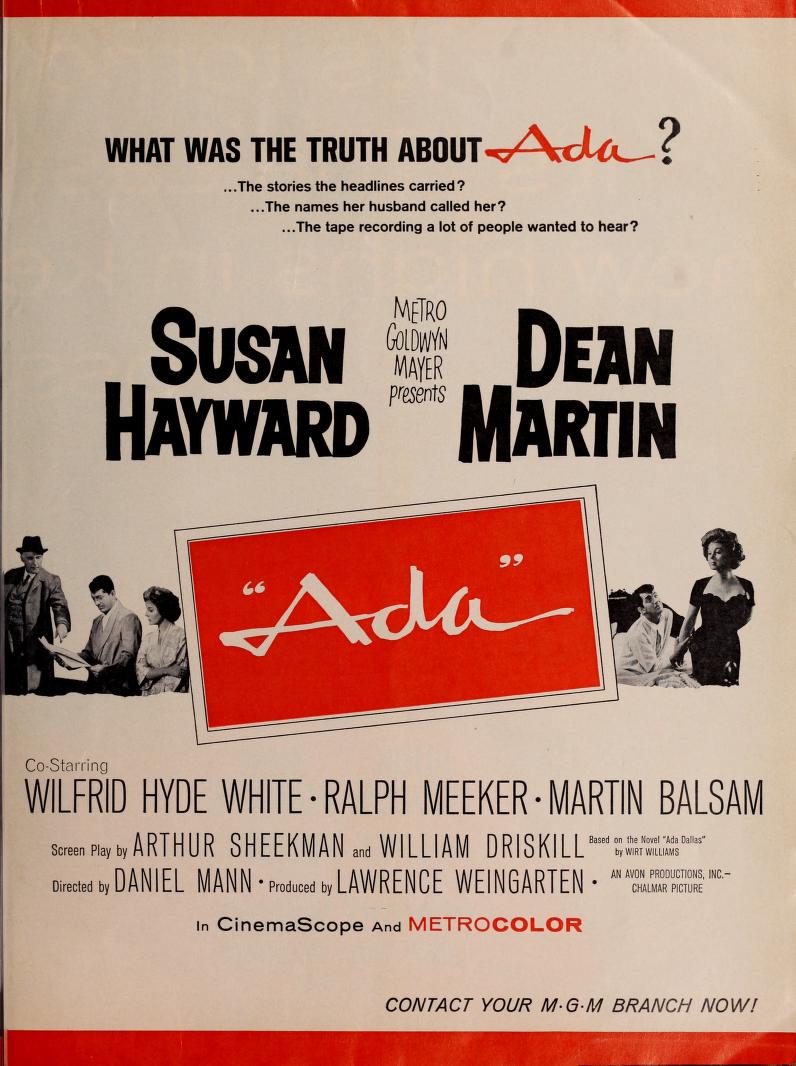
Oddly enough, this shares some elements with Killers of the Flower Moon. For a start Sylvester (Wilfrid Hyde-White), the political fixer, comes over as Robert DeNiro’s benign uncle, both so low-key, charming and persuasive you’d never believe them capable of wicked manipulation. In the second place Bo (Dean Martin) is every bit as charming and baffled as Leonardo DiCaprio.
And just as the latter’s role is to worm his way into wealth and power via marriage, so too that’s the route taken by Ada (Susan Hayward), who would be euphemistically known in those days as a “good-time girl.”
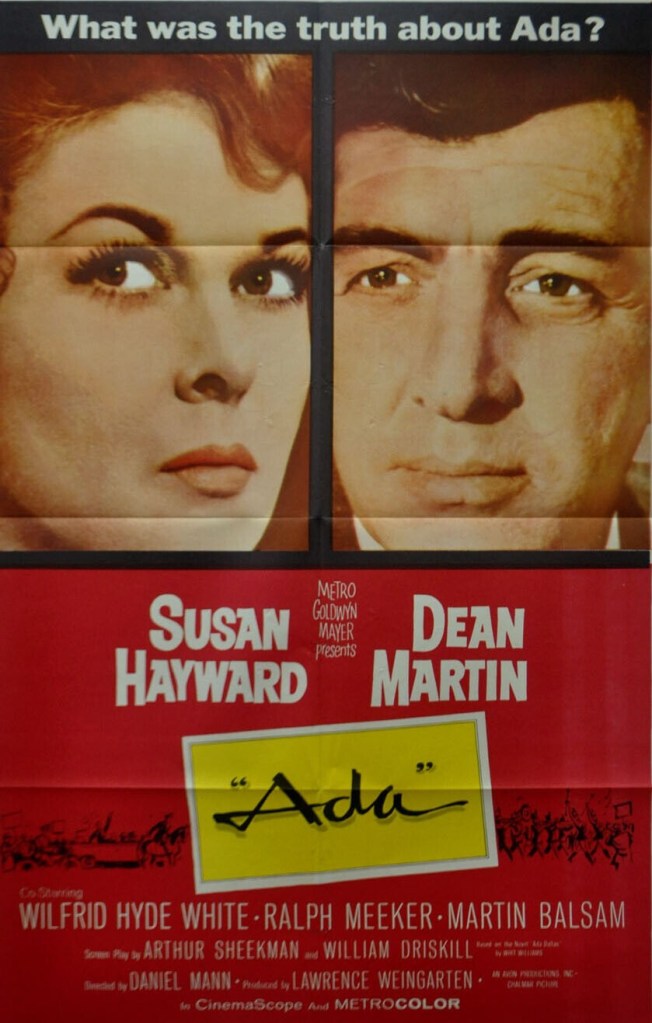
You’d figure this for a mild political satire except for the fact that stooges/buffoons have consistently made their way to the highest political office. As Ada pointedly points out, public appeal is the greatest qualification of any candidate, opportunism a close second. Bizarre as it seems, Bo is a popular local guitar-playing-singer of the Hank Williams variety, a well-meaning dumb-as-they-come sort, whom Sylvester persuades to run for Governor. In the course of the campaign, as “a present in a back-room saloon,” he is served up Ada with whom he unexpectedly falls in love and marries.
His campaign path is smoothed when one of Sylvester’s hacks leaks news that his rival’s wife is an addict, the woman conveniently shooting her brains out. Naturally, Bo soon realizes he’s the sap, his only job to sign hundreds of legal documents every day, pieces of legislation that as it happens fill the pockets of Sylvester and his buddies.
When Bo’s long-time chum Ronnie (Frank Maxwell) threatens to expose the river of sleaze he is quickly eased out. That leaves an interesting vacancy for Ronnie was Lieutenant-Governor, Bo’s deputy. So, Ada, with a good bit more between the ears than her husband, throws her hat into the ring.
She’s to politics born, a particularly wily creature, able to bring into line the society dames who look down their nose on her, and keep tabs on Sylvester. What she doesn’t realise of course is that once you’ve got a very amenable deputy, that person becomes Acting Governor, and in effect Governor, should anything happen to the incumbent. And should she then decide she’s had enough of the sleaze, then a little poking around in her background should bring her to heel.
So, all the corruption you ever dreamt of, all the smart back-slappers ponying up thousands in campaign contributions in order to seek future reward, all that tax-payers money heading in the rich man’s pocket. Not a lot that’s new there.

What makes this stand out are the performances and the narrative arc. Wilfrid Hyde-White (The Liquidator, 1965) is a sensational casting coup. The British actor specialized in characters oozing wry charm, sometimes verging on the dotty, sometimes a tad idiotic, but never an outright swine. There are a couple of scenes where those mellifluous tones turn in an instant into a sharp crack, the avuncular replaced by the sinister.
And I’m not saying DeNiro copies his aging trick, you know the bit later on in Killers of the Flower Moon, when body no longer as sharp as the mind, the actor begins to drag his leg, and with no reference to that impairment. Well, here, similarly, the fit-as-a-fiddle Sylvester later on, still at the height of his mental powers, is seen being transported in a wheelchair.
The performance of Dean Martin (Rough Night in Jericho, 1967) was oddly dismissed at the time. And yet it was bold playing. He goes from ebullient star, enjoying being feted by all, lousy speeches lapped up by an adoring crowd, to withdrawing into himself as he realizes he has been duped. That doesn’t just take some acting skill, but considerable self-belief, to play a character who undergoes the wrong kind of transformation, not the general redemptive kind, nor sinking into some Oscar-worthy illness, but coming to terms with your own lack of ability.
Of course, Susan Hayward (Stolen Hours, 1963) delivers, as always, her screen wattage burns brighter than virtually any other female star of the period. You know the character expects her past to be exposed at any time, but she dives straight in, determined to tackle the sleaze. There’s a wonderful scene where, her background challenged by the hoity-toity society dames, she puts them in their place with a clever piece of political maneuvering.
Ada totally turns on its head the idea of the political do-gooder. She has none of the usual innocence, nor the ability to capture the crowd by seizing upon an ideal, but she’s more at home by dealing with the sleaze-merchants straight-on, taking apart their schemes in the comfort of the government’s back rooms where until now such deals have been dreamt up.
Director Daniel Mann (Judith, 1966) was known as a woman’s director. Under his direction in the Oscar stakes, Elizabeth Taylor had won for Butterfield 8 (1960), likewise both Anna Magnani for The Rose Tattoo (1955) and Shirley Booth for Come Back, Little Sheba (1953), while Hayward was nominated for I’ll Cry Tomorrow (1955). He not only chose grittier dramas but had the knack of encouraging actresses to let loose, without going overboard, on a part.
Considerably overlooked and substantially under-rated, but not only prescient regarding future political candidates and the kind of corruption they got involved in (land deals ring a bell?) but elevated by the role of his career by Wilfrid Hyde-White, an unexpectedly good one from Dean Martin and Susan Hayward in top form.

 The Magnificent 60s
That’s a really good assessment of the movie. I only caught up with it myself a couple of years ago, having heard very little about it and most of that being fairly negative. I ended up enjoying it quite a bit, not only for the political shenanigans and the sideways look at corruption and manipulation, but also for the performances which you rightly draw attention to. Dean Martin’s lid back image leads many to undervalue him as an actor, but he was very good when he had the right material to work with, Wilfrid Hyde White never disappoints me regardless of the role, and Susan Hayward’s all or nothing style when she’s in full flow is excellent.
LikeLiked by 2 people
Glad you enjoyed it. Took me by surprise. I expected Hayward to be in full throttle but Hyde-White and Martin were revelations.
LikeLike
You know, Martin ought to get more credit for his work as an actor. He parodied himself relentlessly and we seem to be left with this image of him as a dissipated Matt Helm. Yet when you watch how crafty and subtle he is in the way he works the screen in Rio Bravo or how he brings such deep pathos to the part of Bama in the sublime Some Came Running, well it becomes clear that this guy could turn it on and off whenever he wanted. I guess it’s just a pity he didn’t seem to want it more often.
LikeLiked by 1 person
To be honest, I don’t think he got the offers. He was top-billed in smaller pictures and second-billed in bigger ones. Really enjoyed Some Came Running.
LikeLiked by 1 person
You may well be right on that.
I feel Some Came Running is the best of Minnelli’s films, and when you bear in mind how many great movies he did make we’re therefore looking at one of the finest pictures to come out of postwar Hollywood.
LikeLiked by 1 person
Great cast too. Minnelli often under-rated for his dramas.
LikeLiked by 1 person
Oh yes, without question. He has been somewhat overshadowed by Sirk in that era, but there’s no need to compare them and they were aiming for different results anyway.
LikeLiked by 1 person
Sirk I remember was suddenly a big thing. Not sure if he is so highly regarded today.
LikeLike
I think he is still, and deserves to be in my opinion. I’m not trying to make a case to elevate Minnelli over Sirk by the way. That would seem pointless, no more than I’d want to pit Mann against Boetticher, Walsh against Ford and so on. It’s enough to value these people for their individual artistry.
LikeLiked by 1 person
Good to hear. I much admired Sirk’s work. and yes, I agree, little sense in pitting one director against the other to argue an academic point.
LikeLike
Agree with the above. Nobody makes any claims for Martin as an actor, but he was a movie star, and he turns up in a lot of big movies and didn’t really become a parody of himself until the 70’s.
LikeLiked by 1 person
I beg to differ. I recognise his acting talent citing this, Rough Night in Jericho where he played the baddie and Five Card Stud.
LikeLike