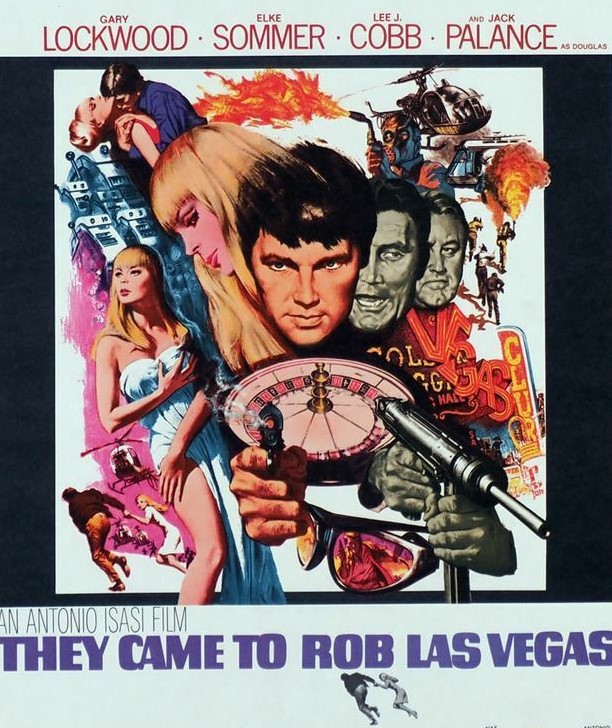
Actually, they didn’t. The thieves planned to pull off a heist of $7 million from a security truck as it travelled through the Nevada desert en route to Mexico. Las Vegas pops into the story every now and then, criminal mastermind Tony (Gary Lockwood) employed there as a croupier in order to romance the girlfriend Ann (Elke Sommer) of millionaire Steve (Lee J. Cobb) who owns the security business being targeted.
The picture’s overlong and a shade complicated but the robbery is terrific, if a bit unbelievable, while the ending is existential and almost Boorman-esque. It’s futuristic, too, with computers programming routes for security vehicles to make them harder to follow, pretty sophisticated visual communications for the era. The trucks are more like armored cars, tough as tanks, steel so thick it’s impervious to an oxy-acetylene cutter, and with machine guns mounted on the roof.
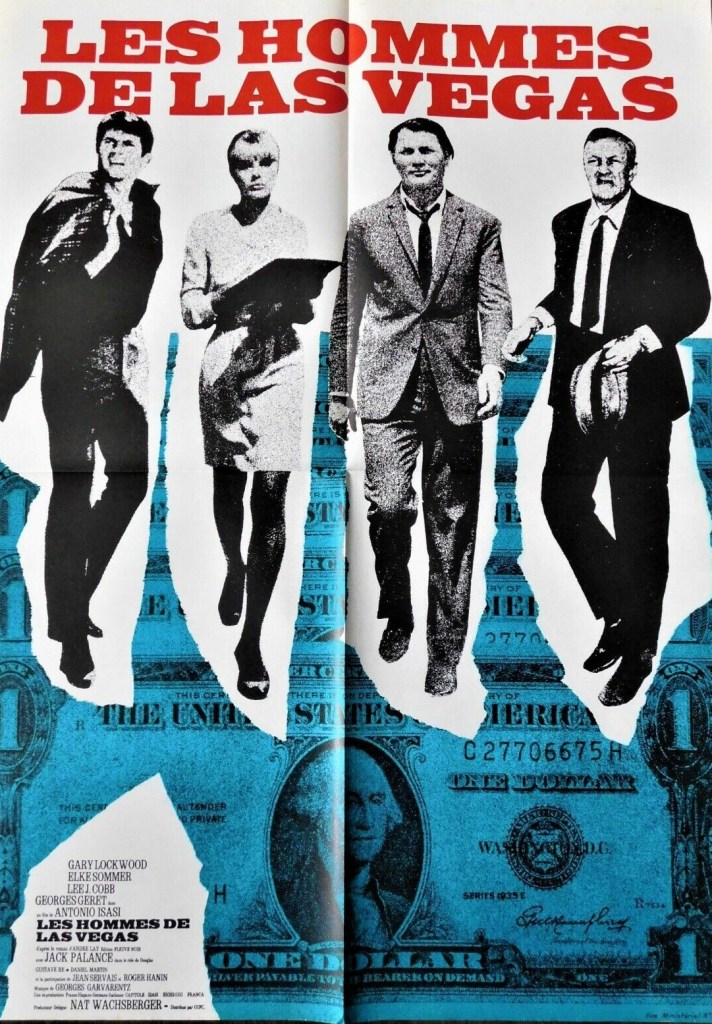
You’ll scarcely have heard of the director, Spaniard Antonio Isasi (That Man in Istanbul, 1965) whose career only spanned eight movies. And while you might be familiar with Gary Lockwood (2001: A Space Odyssey, 1968), Elke Sommer (The Prize, 1963), Lee J. Cobb (Coogan’s Bluff, 1968), and Jack Palance (Once a Thief, 1965) who plays Douglas, an F.B.I. agent investigating Steve’s Mafia connections, you’ll struggle to keep tabs on the myriad other characters who flit in and out of what ends up as a four-way narrative.
So we start out with Tony’s brother (see, I told you it was complicated) who has bust out of jail and wants to go back to old-style heists that involve shoot-outs in the street, nostalgia getting the better of him as he winds up dead. Then we’ve got Steve who wants to quit the underworld. That seems to be a trope of the time, The Brotherhood (1968) and Stiletto (1969) going down a similar route. When the truck is hijacked, Steve comes under suspicion from his Mafia buddies, who reckon he’s looking for an easy way to fund his retirement.
Meanwhile, as well as the $7 million in legitimate cash, the truck is also carrying millions in Mafia loot to be laundered across the border in Mexico, a notion that’s already attracted the attention of Douglas and his team.
Meanwhile, meanwhile, Tony is carrying out some low-grade casino theft, as croupier dealing Ann some very helpful cards and topping up his salary to the tune of $400-$500 a day. Ann, who could as easily be water ski-ing or living the high life in Acapulco with the married Steve, still takes time out of the mistress gig to undertake her ordinary job at the security company’s head office where she is in charge of the seemingly mindless task of feeding route cards into the computer.

While this takes quite a while to get all the wheels in motion and the various sub-plots and characters to fall into line, when finally we get to the robbery, it’s a cracker. Though you might find yourself asking who was funding the heist, with its five-man crew, helicopter, flame-thrower, machine guns, plus what can only be described as a giant vault buried in the desert.
At first, the heist appears patently old-fashioned. Gangsters dressed as guards replace the real guards but once in the back of the truck they have neither access to the loot nor the driver’s cabin. No matter, they know where the truck is headed, out into the desert, where they have made the road impassable with heaps of sand and just in case that didn’t work shoot out a tyre. The flame thrower finishes the job.
Thomas Crown would be impressed by their planning for they have another tyre buried in the sand to swap for the useless one and they also have metal tracks that can be laid over the sand to ease passage. They need the tracks because the truck goes off-road over the top of a dune and is lowered into the vault while the rotary blades of the whirligig serve to cover the top with a layer of sand, returning the desert to its normal pristine condition.
But we’re far from finished. We still have betrayal, underground paranoia, Steve being stalked by Douglas, the Mafia getting uppity with Steve, Steve becoming suspicious of Ann, a hapless motorist caught in the crossfire, squads of cops and goons descending on the hijack spot, and Tony still having to work out how to open the unbreakable truck.
At times, the plot comes together with devastatingly simplicity, but at other times the various strands merely serve to blow the whole thing apart. None of the principals is on their A-game, most appearing overly stiff and clichéd, while you’re still trying to work who all these other characters are.
The heist itself is splendidly done and the twist ending worthy of comment. Most of the time it’s pretty watchable but what should be a relatively seamless narrative is undone by over-plotting.
While the time was ripe for an ingenious heist, the crime thriller had taken one of those periodic leaps into new territory, what with Point Blank (1967) and The Thomas Crown Affair (1968), so it was virtually impossible to accommodate a movie with so many narrative jumps, where motive was unclear, characters diffuse and the tone widely variable.
On the other hand, as I said, the heist had me enthralled and the twist ending had me intrigued.

 The Magnificent 60s
Brian, very accurate ‘long and complicated’ description of this. Read somewhere this was a remake of a very exciting heist movie The World In My Pocket starring Rod Steiger. Antonio Isasi gave a very exciting and action packed That Man In Istanbul starring Horst Bucholz and Sylvia Koscina. Somehow Palance as an insurance investigator did not impress.
LikeLiked by 3 people
I still have to check out the Istanbul film.
LikeLiked by 1 person
Great title and artwork! Nothing like a well planned heist…
LikeLiked by 1 person
Like a military operation.
LikeLike
Spot-on review!
I found this movie awhile back because another reviewer, at the IMDB, pointed out that this film MAY have been the inspiration for the 1972 pilot to BANACEK, which also borrowed from THE THOMAS CROWN AFFAIR (also from 1968). Just today, I noticed that Glen Larson’s 1973 McCLOUD episode “Butch Cassidy Rides Again” ALSO may have borrowed from this, with regard to an inside person at a security company supplying the crooks with the exact location & time of a delivery for them to rob. Hilarious that I should re-watch both stories in the same day! I’m always fascinated with finding out inspirations or influences.
LikeLiked by 1 person
Glad you enjoyed it. Interesting stuff. You often find the source of a commented-upon scene in a major film has been done before in a minor film that nobody noticed. I’ve got two upcoming reviews that do such – the earlier Beyond the Curtain relating to Doctor Zhivago and a scene in Zulu becoming a major plot point in The Godfather.
LikeLiked by 1 person
There’s also Jean Servais as “Gino”, who gets killed pulling the heist at the beginning. His casting has to be a deliberate reference. He was the star of RIFIFI (1955), which also inspired TOPKAPI (1964), 2 of the 4 items I’ve found that inspired MISSION: IMPOSSIBLE.
As I’ve been buying some TV series on disc lately, I’ve also been trying to get ahold of the things that inspired those TV series. One I lucked out on was 21 BEACON STREET (1959), virtually M:I in a half-hour format. There was even a lawsuit involved! The show has never been seen in syndication, and was only just put out on DVD in June 2023. I watched all 13 episodes twice before buying the M:I Blu-Ray set.
One thing that somehow always seems a shame about old heist films… because of the Production Code, they’re never allowed to get away with it. A favorite of mine, the English comedy TOO MANY CROOKS (1959), you really wish they could get away with it, and the way they lose the money at the end is clearly a contrivance. Maybe worse is how in THE LEAGUE OF GENTLEMEN (1960), another M:I influence, the way they’re found out is positively infuriating in its contrivance. It only happens at all because they couldn’t let the crooks get away with the money.
Another armored car heist film near Las Vegas is GUNS GIRLS AND GANGSTERS (1959) with Mamie Van Doren, Gerald Mohr and Lee Van Cleef.
LikeLiked by 1 person
You’ve made some great connections. in the early days the Code even banned gangster films after The Public Enemy etc spurt in the 1930s. Yes, criminals needed to be punished. You have some ace material. Thanks.
LikeLike