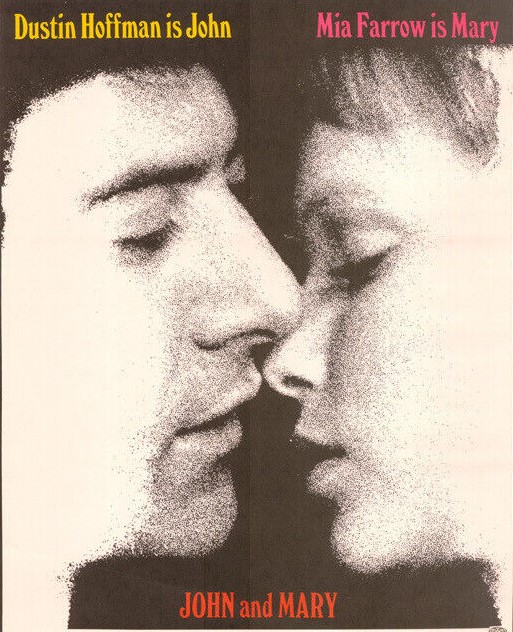
Woefully underrated. Remove the weight of expectation and you’re left with a bittersweet romance. This just wasn’t what critics anticipated from stars Dustin Hoffman, coming off the back of Midnight Cowboy (1969), and Mia Farrow, previous film the coruscating Rosemary’s Baby (1968), and certainly it seemed there was resentment at the audacity of British director Peter Yates attempting to switch from his action roots, best shown in Bullitt (1968). Worse, that Yates was trying to introduce a New Wave vibe.
In the end-up it’s sweet, but getting there is a prickly affair and it’s precisely this unique approach that creates its appeal. Where the standard set-up comprises meet-cute, break-up, back together, for the most part this looks as if actual romance, as opposed to sex, will never get off the ground, the pair smothered by doubt expressed in internal monologue.
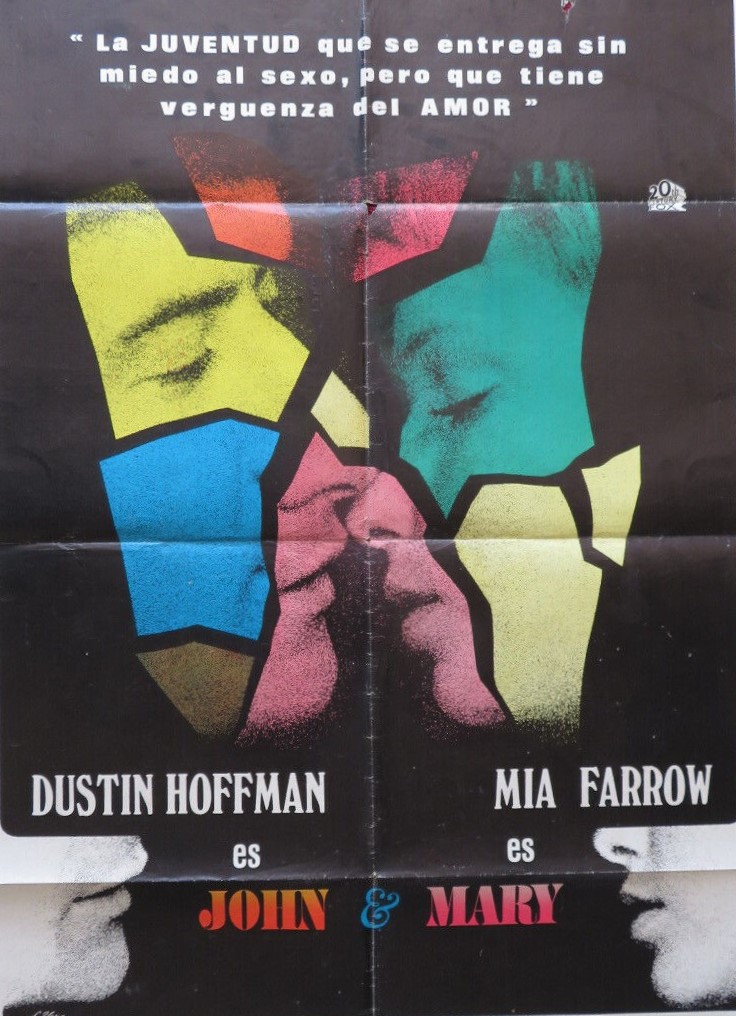
Whereas, in The Fixer (1969), for example, hearing a character speak of their feelings outside of dialogue almost torpedoes the picture, here it works a treat, because it’s dealt with as if it was dialogue of the unspoken variety. Past experience that forces both characters to make suppositions about the other’s intent creates a very amusing and essentially true barrier to progress.
Back in the day, at the dawn of the singles generation, the idea of two young people hooking up for one-night stands filled the moral majority with shock, not just that widespread use of the Pill in avoiding pregnancy invoked promiscuity, but that random encounters immediately ended up in the bedroom rather than the becoming the start of a wooing (and discovery) process. These days, of course, Tinder and other such social media inventions, create umpteen opportunities for attraction to translate into instant sex.
But it doesn’t reduce the type of anxieties that are so well addressed here.
You can start with the basic morning-after notion of “how do I get rid of her?” all the way through to assuming such easy attitudes to sex on either side would destroy an ongoing relationship, and along the way dipping into such minefields as how to get to know another person, does he/she even like me or would they fall into bed with the first person to ask them, are they even as attractive in the cold light of day than when perceptions are muddied by alcohol and excitement, and, of course, the ultimate, was performance up to scratch.
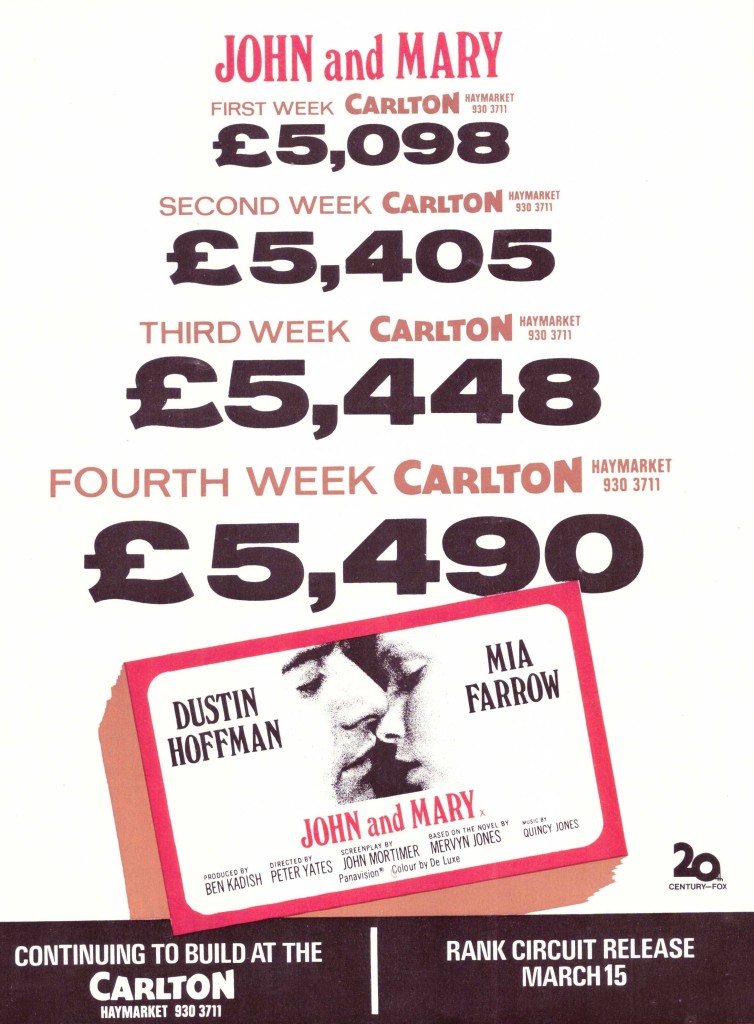
This takes the unusual route of being peppered with flashback while the pair engage in spikier dialogue than you would find in the standard Hepburn-Tracy Hudson-Day romcom. And often what they say is the opposite of what they feel. Setting off in several directions at once – back a year or so, taking in the activity of the previous night and ploughing through the current day – could be off-putting but I found it worked a treat.
Anal retentive domesticated furniture designer John (Dustin Hoffman) hooks up in a singles bar with untidy politically-motivated sometime-actress Mary (Mia Farrow). His first reaction on waking up is to explore the apartment (rather large for New York), wonder when his wife will return, and think of all the deceptions he could pull. His first reaction borders on pure fear: she’s already planning to move in.
That neither has a genuine idea of the other person’s feeling provides the movie’s dynamic and the entire movie consists of them adjusting their expectations against a very contemporary backdrop of protests, politics, cinema verite and sex. Though primarily non-sexist and quite gender-equal, she isn’t looking to become a kept woman, for example, it does touch upon the notion that an easily-available woman is not far short of a whore, whereas, naturally, a promiscuous male is entitled to a free pass.
Her last relationship was with a married man (Michael Tolan), but she dropped him once he started talking about divorcing his wife. For John, girlfriend Ruth (Sunny Griffin) dramatically upped the stakes, arriving at his apartment with luggage, items of furniture and a rampant dog, enforcing on John responsibilities he did not want. Unusually, for the era, he is not politically involved and can cook, both of which attributes/skills we discover are the result of a mother so committed to politics that she neglected her children, never stocked her fridge and left her children to fend for themselves.
Each could press the nuclear button at any time. They’re attractive singles so more sex is just round the corner, going their separate ways the easier option, building a relationship far more difficult.
Dustin Hoffman shakes off a lot of the tics that were already showing and would inhibit later performances in a character far removed in sexual confidence from The Graduate (1967), but in some ways still touchingly naïve, and delivers a very believable performance. That it doesn’t fall into the usual Tracy-Hepburn battle of the sexes with witty put-downs owes much to the highly-nuanced performance of Mia Farrow who isn’t, as you might expect, in the least fragile and expresses her independence and challenges his views in a non-aggressive fashion.
Completely ignored by the Oscars, technically it won plaudits from Bafta, bracketed with Midnight Cowboy for Dustin Hoffman picking up the Best Actor Award, and with Rosemary’s Baby and Secret Ceremony for Mia Farrow in being nominated for Best Actress – such arcane rules later changed.
In small parts look out for Cleavon Little (Blazing Saddles, 1974), Tyne Daly (Cagney and Lacey TV series 1981-1988), Don Siegel’s son Kristoffer Tabori (Journey through Rosebud, 1972) and Olympia Dukakis (Moonstruck, 1987). John Mortimer (Bunny Lake Is Missing, 1965) wrote the screenplay from the Mervyn Jones bestseller.
Cinematically and narratively refreshing, manages to be entertaining and thoughtful at the same time.

 The Magnificent 60s
hello Brian,
Didn’t know anything about this film (it seems it worth more than a look). The title sounds like :
“Johnny’s always runnin’ around
Tryin’ to find certainty
He needs all the world to confirm
That he ain’t lonely
Mary counts the walls
Knows he tires easily…”
Is it something like that ?
😉
LikeLiked by 2 people
That sounds about right.
LikeLiked by 2 people
Never read a positive word about this film until today. Will seek it out on this recommend, thanks. Harry Kellerman in the pipeline?
LikeLiked by 1 person
I’m as wary of Kellerman as you were of this.
LikeLike
Found this:
“John and Mary, based on Mervyn Jones’s 1966 novel of the same name, was originally slated to be shot in London, England, where the novel is set. According to a 29 Jan 1969 Var article, director Anthony Harvey was the first to option screen rights, and later paired with producer Ben Kadish. Two sets of writing teams made failed attempts at adapting the script before John Mortimer was hired. Kadish eventually took over the film option from Anthony Harvey, who was later replaced by Peter Yates, as reported in a 5 Nov 1968 LAT item. In the meantime, Warren Beatty and then girl friend Julie Christie considered starring as “John” and “Mary.” Since the film was without a director at that time, Beatty suggested Jack Clayton, but Clayton had to pass on the project because his mother was ill. Beatty and Christie withdrew their interest, and Kadish subsequently decided to move the setting to New York City. Peter Yates was later quoted in a 28 Dec 1969 LAT article, stating that the location was changed to avoid the recently popularized cliché of “swinging London.” According to the 14 Dec 1969 LAT review, the final film did not adhere closely to Jones’s novel. Mia Farrow’s casting was announced in the 16 Oct 1968 DV. Dustin Hoffman’s agreement to co-star was finalized one month later, the 20 Nov 1968 DV stated. During filming, Hoffman appeared in nightly performances of the stage play, Jimmy Shine, which ran from 5 Dec 1968 to 26 Apr 1969 at the Brooks Atkinson Theatre on Broadway. Principal photography began on 27 Jan 1969, according to the 29 Jan 1969 Var. The picture was budgeted at $3.5 million according to a 4 Jan 1969 NYT article, and was shot in New York City. By the end of the year, the 9 Dec 1969 NYT declared it had been a record year for film production there with forty-five major motion pictures shot in the past twelve months. Although the article claimed John and Mary was filmed entirely in NY, a 21 Apr 1969 DV item reported that the final five days of shooting began that day in the Bahamas. Interiors, including that of “John’s” apartment, were filmed at Biograph Studios in the Bronx, NY. As noted in various contemporary sources including the 23 Feb 1969 LAT and 5 May 1969 NYT, location shooting took place at Maxwell’s Plum singles bar; the Fillmore East concert venue; a church in Greenwich Village; Bloomingdale’s department store; Beekman Place in Midtown East; photographer Milton H. Greene’s studio; a set of tennis courts on Riverside Drive; John F. Kennedy International Airport; Manhattan’s Chelsea neighborhood; “an unheated, untenanted brownstone on East 31st Street” which stood in for “Mary’s” apartment; and Barbizon Plaza, where a political rally was staged. Although Yates stated in the 4 Jan 1969 NYT that he would avoid filming New York clichés, such as the Empire State Building and Central Park, a 26 Feb 1969 Var brief stated that the shooting schedule had been altered to take advantage of snowfall, and a scene between Farrow and Hoffman was slated to be filmed in the snow in Central Park. A news brief in the 18 Dec 1968 Var noted that Johanna Grant would serve as publicity coordinator; a 3 Mar 1969 DV item stated that AFI student Richard Basch would act as Peter Yates’s intern; and the 29 Jul 1969 DV reported that June Foray would record voices for the picture. French singer Claudine Longet was reportedly sought to record the title song but was unavailable, the 29 Oct 1969DV reported. Decca Records released a “single disk” titled “John and Mary,” featuring an instrumental song with “heavy breathing.” As a gimmick, Decca released the record with a tag warning, “This record is rated ‘X’ – suggested for mature audiences.” The risqué song was said to be aimed at “the FM and ‘underground’ stations rather than the AM outlets.” The film opened on 14 Dec 1969 to lackluster reviews. In the 4 Jan 1970 NYT, it was named by film critic Vincent Canby as one of the ten worst pictures of 1969. Likewise, a 2 May 1970 LAT article noted that The Harvard Lampoon named it one of the ten worst movies of the year. An 8 Apr 1970 Var box-office chart listed the film as the twenty-second highest grossing picture that week (in a select 20-24 markets) with a cumulative gross of $2,224,869 in thirteen weeks of release. Actress Tyne Daly made her feature film debut in John and Mary.”
LikeLiked by 1 person
Amazing, thanks once again.
LikeLike