100 Rifles (1969) ****

Highly under-rated but effective western that cemented Raquel Welch’s position as the queen of the genre, established Jim Brown as the first African American action star, scored points for its parallels with Vietnam, and provided the only image of the actress to rival that iconic fur bikini.

Arizona lawman Lyedecker (Brown) arrives in Sonora, Mexico, in 1912 on the trail of half- breed bank robber Yaqui Joe (Burt Reynolds). He finds the Mexican army callously executing Yaqui Indian rebels. To prevent further killing, Joe creates a diversion, which, while failing, permits the captured Sarita (Raquel Welch) to escape. The $6,000 Joe stole buys the titular 100 rifles to help the rebel cause.

Most posters played up the action but here the emphasis is on La Welch.

Helped by Lyedecker, Joe escapes, picking up Sarita on the way. Both Lyedecker and the Mexicans are in pursuit, and the Mexicans soon recapture Joe and Lyedecker, who is now viewed as a rebel. Sarita again escapes. Lyedecker and Joe are returned to the garrison where the Mexicans have taken possession of the rifles. Just as the pair are put in front of a firing squad, Sarita, leading a group of rebels, frees them and steals the weapons.

In retaliation, the Mexicans attack a village, slaughtering the inhabitants and taking the children as hostages. At night, Lyedecker, Sarita, Joe and some rebels capture the garrison before the soldiers return, freeing the children. Lyedecker has been injured in the battle; after Sarita binds the wound, they make love.

When they take the rifles to the rebel stronghold, they discover the rebel leader is dead. For no particular reason, the rebels elect Lyedecker their new “generale.” Seizing a Mexican troop train is pitifully easy once Sarita creates a diversion by taking a shower under a water tower. The empty train is sent cannoning into the town and in the ensuing battle Sarita is killed. Yaqui Joe takes over leadership of the rebels while Lyedecker rides home.

While the capture- escape-chase-capture formula is overdone, the movie’s biggest structural problem is Yaqui Joe, clearly turned into a drunk to avoid becoming a romantic encumbrance for Sarita, leaving the way clear for Lyedecker. His other contributions are to brawl with Lyedecker and try to get the American to give up his quest and stay and help the rebels. There are other unnecessary characters and touches. We know it is a modern western because  a motor car is involved as there would be in The Wild Bunch. The sole purpose of a German military adviser Von Klemme (Eric Braeden) is to act as a sounding board for Gen. Verdugo (Fernando Lamas), whose actions in any case speak louder than words. Railroad magnate Grimes (Dan O’Herlihy) represents equally callous big business. When Americans get drunk in westerns, that usually leads to fisticuffs, but when Indians knock back the liquor in 100 Rifles they act like clichéd drunken Indians, tearing up the town, looting and destroying anything in sight.
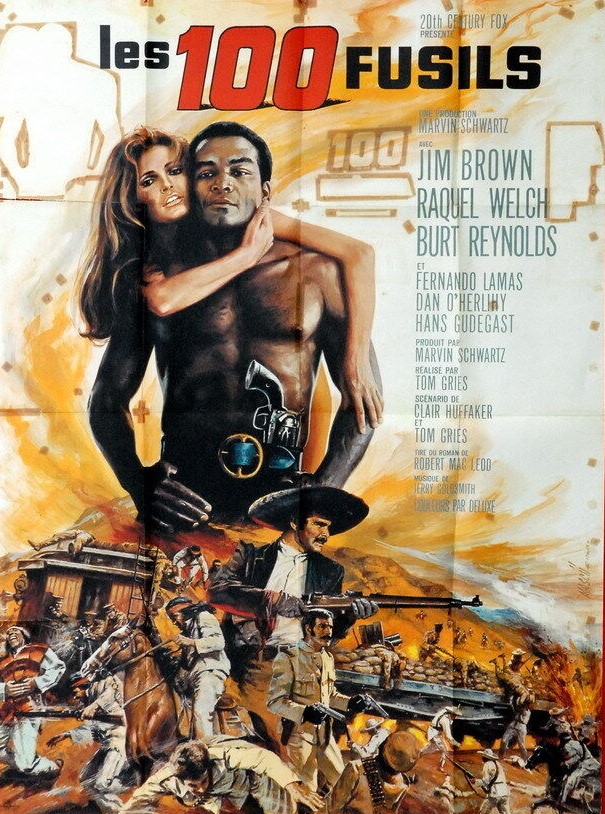
These reservations apart, the film has a great deal to recommend it. On the whole, it is well directed, although without much of an eye for landscape. Sarita, wearing a red headscarf, thus  continuously color-coded, is accorded the greatest emotional depth, haunted by guilt for sacrificing her father in the name of freedom: “I helped him to die.” But she has another weapon at her disposal: her body. When captured, she distracts a soldier with sight of her breasts before stabbing him, the shock in her eyes suggests this is the first time she has killed a man.

Although the narrative advocates her as feisty leader from the start, this scene, and in particular her reaction, suggests otherwise. More than capable of taking care of herself, it is she, and not the two stronger men, who effects an escape. When she organizes the rescue of the two men, she’s more interested in the guns than them. But when it comes to children, they take precedence.

The genocide theme, pertinent both to American treatment of its own indigenous Native Americans and to the current war in Vietnam, is raised. It is more trouble than it’s worth for Gen. Verdugo to clear the Indians from their lands and ship them elsewhere, as the Americans had done when putting Indians onto reservations. Verdugo has few compunctions. Unlike in The Wild Bunch and Butch Cassidy and the Sundance Kid, here the railroad is a tool of control. Trains loaded with troops and guns (including Gatling guns, also seminal to The Wild Bunch) and artillery can travel with ease across alien territory to keep the inhabitants in check. As exemplified by Grimes, railroads also represent the intrusion of big business into politics and ordinary lives, and the railroad man, while concerned that Lyedecker’s possible execution could jeopardize U.S.- Mexican relationships and, by extension, possible halt the American railroad’s expansion, is ultimately more apprehensive about damage to running stock than the cost in human lives of his partnership with the Mexicans.

There’s a nod to seminal Sidney Poitier picture The Defiant Ones (1958) with Lyedecker and Joe chained together, and the American, initially disinterested in rebellion, only takes up the cause after a child he has befriended is slaughtered.

100 Rifles shares with The Stalking Moon, The Wild Bunch, Mackenna’s Gold, and Butch Cassidy and the Sundance Kid the theme of relentless pursuit, of an implacable enemy, often with justice or morality or power on their side, who will never give up, and, in a twist on this, in True Grit Rooster Cogburn is the one in fearless pursuit.

At the time, in male-dominated society, the sexual centerpiece was Raquel Welch in various states of undress, forgetting that women, too, were apt to be partial to the sight of an unclothed muscular male. It is Jim Brown who is first seen shirtless. And it is Sarita who takes control of the scene, kissing him as a reward “for all the bad things I said to you.” (Another gender twist, for usually it is the man making reparation.) A more tender scene between Lyedecker and Sarita, ostensibly of the more traditional kind, feisty female   transformed into docile housewife by cooking her man a steak invited another reading, more in keeping with her character, not, you may notice, clinging to him, desperate for his love, but happy to enjoy the moment and abandon him when it suits (as Katharine Ross will in Butch Cassidy and the Sundance Kid, departing before the outlaws die).

For many, of course, the highlight is Sarita, the leader in all but name, using her body as weapon. As the train approaches the water tower, the soldiers see Sarita standing underneath dressed in only a man’s shirt, taking a shower. The train shudders to a halt for this voyeuristic delight; the camera too, for the audience’s sake, lingering on Sarita’s curves.

Although 100 Rifles is ponderous and improbable in places, with too much emphasis on escape- and-rescue, it certainly achieves its immediate aims, setting up Brown as an action man, giving Welch a role that’s hardly subordinate, ensuring the combination is as sexy as all get-out, while at the same time supplying enough shoot- outs and battle scenes to keep traditionalists happy. As important, director Tom Gries (Will Penny, 1968) is not afraid of using the film to make points, if sometimes a little heavy- handed, about Vietnam and genocide. Clair Huffaker (The Hellfighters, 1968) wrote the screenplay along with Gries based on a Robert MacLeod novel.

All in all, a movie that deserves a good bit more respect.

This review is an edited version of an article that appeared in The Gunslingers of ’69: Western Movies’ Greatest Year (McFarland, 2019) by Brian Hannan (that’s me).

Shoot Loud…Louder, I Don’t Understand (1966) ***

The Raquel Welch picture nobody’s seen. Which is a shame because she demonstrates considerable comedic flair. And there’s a freshness and naturalness – almost a youthful gaucheness – about her that’s lacking in other movies where she was developing her more iconic acting style.

Tania (Raquel Welch) literally bumps into sculptor Alberto (Marcello Mastroianni) when his latest acquisition, an iron gate (locked naturally), blocks a footpath. Intrigued, she enters his Aladdin’s cave of artefacts and is frightened by his mad uncle who communicates via fireworks. With a start like that, you’re either headed for gentle romance between sensible young woman and less sensible artist, the usual on-off on-off scenario, or, this being quirky Italy and the director the even quirkier Eduardo Di Filippo (better known as a playwright – Saturday, Sunday, Monday) it’s going to follow a different route.

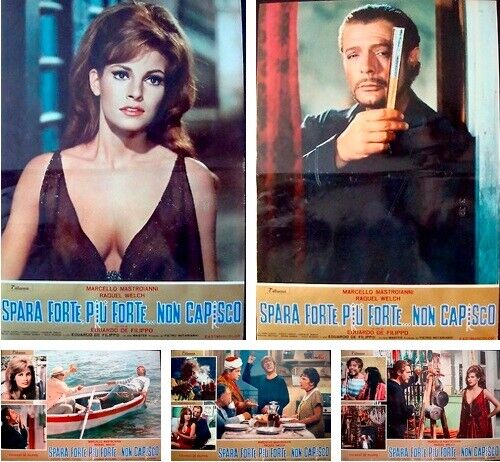
While Raquel Welch is for the most part costumed in alluring dresses she does not wear a bikini as in the poster at the top.

And so it does. Alberto thinks he has witnessed the murder of neighbor Amitrano (Paolo Ricci) – blood-soaked glove one clue – but when he confesses it might have been a delusion, something to which he is prone, he is arrested because the dead man was a gangster.  That sets a surreal tone – chairs raining from the sky, anyone?, a coffin full of potatoes, fortune tellers – and for some reason Alberto (who has received a bang on the head) begins to think Tania is also a figment of his imagination.

You can see where that idea came from, the delectable Tania in cleavage-resplendant form wearing dresses with clasps that appear unwilling to do their job. But on the other hand, he is handsome enough, with an artistic beard, and I doubt it would be the first time he had attracted a beautiful woman.

Tania is certainly a character, driving around in a sports car (with pink drapes) that appears to float rather than drive, containing another receptacle for a blood-soaked glove and with hot food in the glove compartment. In fact, she carries around a goodly supply of this local delicacy in case she might feel hungry in a police station or what have you.

Raquel Welch wasn’t girl of the year when this was made but by the time it was released in the USA in 1968 she had made a name for herself, in particular being named Star of the Year by one of the industry’s exhibiting organisations.

There’s certainly a bunch of dream-like sequences. After he finds a bloody knife and bloodied clothes Alberto gets punched on the head by a turbaned man, only to wake momentarily and fan his face with a fan, the kind of imagery Fellini could have dreamed up in his sleep. But this is set against a realistic backdrop, neighbors screaming at each other in the traditional Italian manner.  

So, what we are left with is a perfectly acceptable comedy where Alberto is accused of a crime he didn’t commit but the film might be too Italian for most tastes. This was made before La Welch achieved screen notoriety through the donning of a fur bikini and critics tended to look on Mastroianni (A Place for Lovers, 1968) as a serious actor rather than someone mixed up in this kind of gentle tomfoolery. I thought he was excellent in the role. But that was par for the course here, everyone dismissed.

De Filippo (Ghosts – Italian Style, 1967) didn’t have the kind of critical following ascribed to the likes Fellini and Antonioni so if this fitted into his normal style nobody was aware of it. But I’ve a feeling that this quirkiness was one of his hallmarks.

If you accept it on face value without looking to insert some kind of meaning then it makes perfect sense. As I mentioned, although her voice is dubbed, Raquel Welch (Bandolero, 1968) comes across very well, especially as, despite the enticing attire, she is not required to be all sexed-up or carry the dramatic weight of the tale, unlike the westerns where she is generally an object of lust and continually attempting to assert independence.

Having said that, this is particularly hard to track down, so you might not think it’s worth the bother. But, of course, if you are a Welch completist, nothing will be too much trouble. However, you’ll need to scour the second-hand markets to find a DVD.

Wild in the Streets (1968) ***

Far more prophetic than you would have ever thought possible in acknowledging the growing power of the young, the pandering of politicians to them, and the unexpected ability of youth to see through politicians and set their own agenda. Plus, Christopher Jones gives the kind of performance that had David Lean rushing to sign him up for Ryan’s Daughter  (1970).

It was prescient, too, of its time, not just the notion that the young could lead the way in opposition to political forces.   

And what top pop star has not believed they could harness their global following for the greater good – Live Aid the classic example – and once you’ve bedded your way through the known female universe and sampled every drug known to man there has to be something else that’s going to grab your attention. And, for once, a movie star makes a very credible pop star.

Max Frost (Christopher Jones), channelling his inner Jim Morrison, is on top of the world, a phenomenon, the biggest thing since Elvis and The Beatles. His rebellious streak emerges at an early age. And where other nutcases would torture animals or pull the legs off spiders or play with matches, he blows up the family car. But he’s something of a statistician and reacts to the notion that there are more young people than old people – 52 per cent of the population is under 25 – by writing a song about it, a song that turns into a protest that segues into a movement.

Aspiring politician Fergus (Hal Holbrook) thinks he can harness what he perceives as a dumb youngster with fans so dumb they will ape his every command. His vote-winning idea is to campaign on a platform of lowering the voting age from 21 to 18, not that revolutionary an idea since ever since American men were shipped off the Vietnam there had been similar calls along the lines of too young to vote but not too young to die.

Max pretends to back him but instead demands the voting age be reduced to 14. This being politics, there’s negotiation, and the compromise is reducing the age to 15. The ever-read Max has songs covering whatever age is agreed.

Bandmember Sally LeRoy (Diane Varsi) is elected and gets a law passed to lower the voting age. Fearing youth and somehow assuming Max will curb their worst excesses, older politicians support his bid for the Presidency (as you may know, anyone in the U.S. can become President even if they lack political experience) but once he gains power he turns on them and forces through a law making retirement compulsory at 30. And goes about, Heaven help us all, doing good, albeit with a dictatorial agenda.

But the fairly straightforward satire, puffed out with endless scenes of public demonstration, works very well, and not just because the power of youth is demonstrated everywhere today, not least among Hollywood mavens who seem unable to make anything that doesn’t appeal to that age group, but because the brain behind the scheme are actually pretty smart. The group is presented as  clever all round, their excessive income down to the business acumen of Billy (Kevin Coughlin) so the band have no chance of ending up penniless, ripped off by everyone in sight. Sally is a former child star so she’s been taken advantage of already and ain’t going to let it happen again.  There’s a clever sting in the tale that takes the campaign to its logical conclusion.

It’s great fun seeing grizzled politicians being outsmarted by Max and his cohorts and for the older population to, unwittingly, get a taste (no pun intended) of what it’s like to be young. Audiences went for this in a big way since it presented an alternative universe, part sci-fi but also with some imminently achievable aims, some of which came to fruition. Hollywood was brought to heel the following year after Easy Rider, only in retrospect anyone realizing that the rescue from box office oblivion of 2001: A Space Odyssey (1968) by spaced-out hippies was a turning point not a one-off.  The voting age was lowered a couple of years later.  These days, of course, nobody needs elected or has to pass a law for changes to be made, and far quicker than if they had to go through the political process. Developments nobody voted for have been forced through by the court of public opinion, though sometimes by the very minorities that were once outside the existing power base.

Christopher Jones (Three in the Attic, 1968) delivers his best performance in what turned out to be a very short career. Shelley Winters (A House Is Not a Home, 1964) gives another scene-stealing turn and on back-up are Hal Holbrook (All the President’s Men, 1976) , in only his second movie, Diane Varsi in her biggest role to date, Millie Perkins (The Diary of Anne Frank, 1959) and an early showing from Richard Pryor.

Barry Shear (The Karate Killers, 1967) directed from a screenplay by Robert Thom (Death Race 2000, 1975).

You could probably go through this ticking off what predictions have come true and it’s more powerful now than it was at the time.

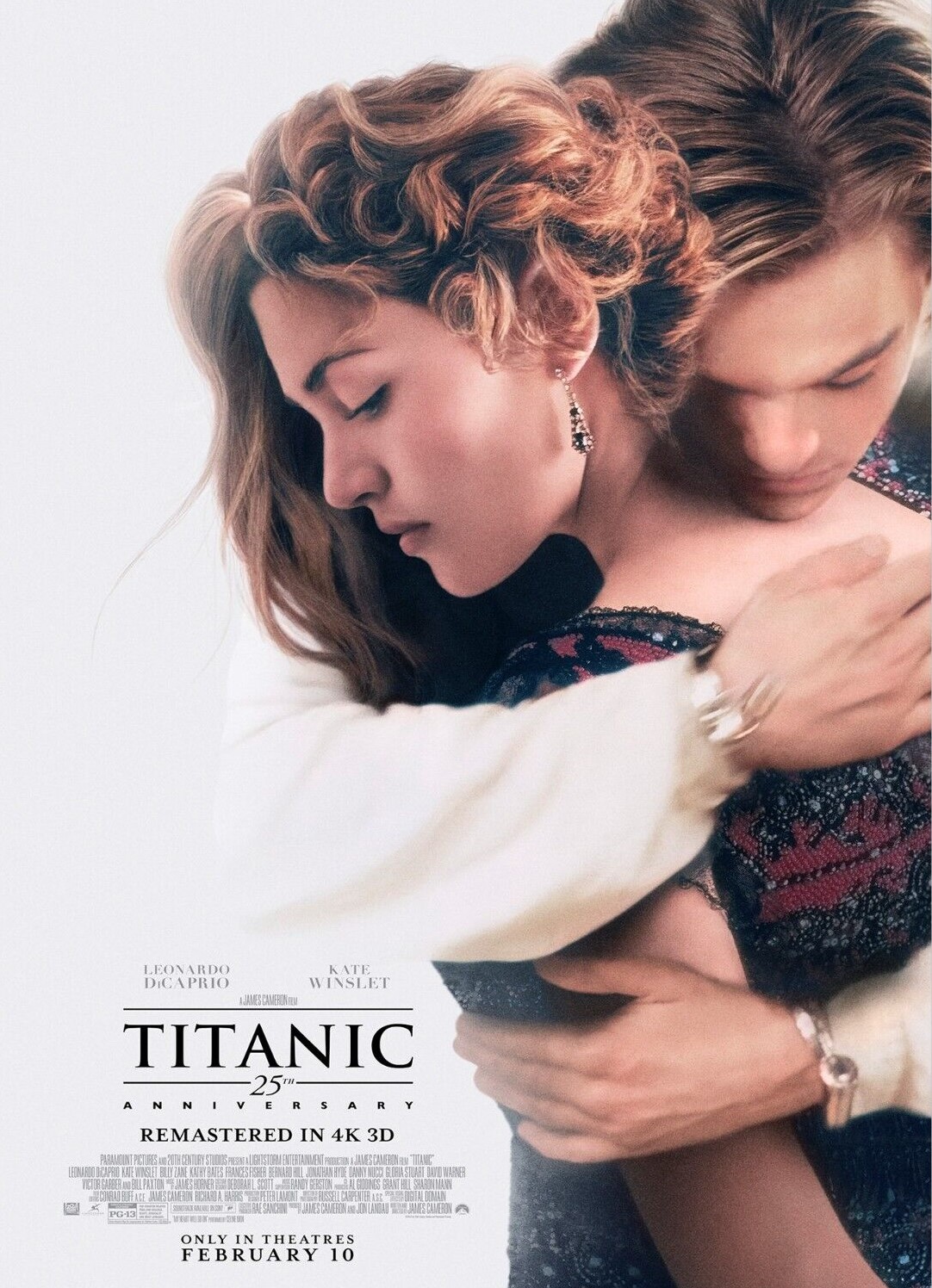
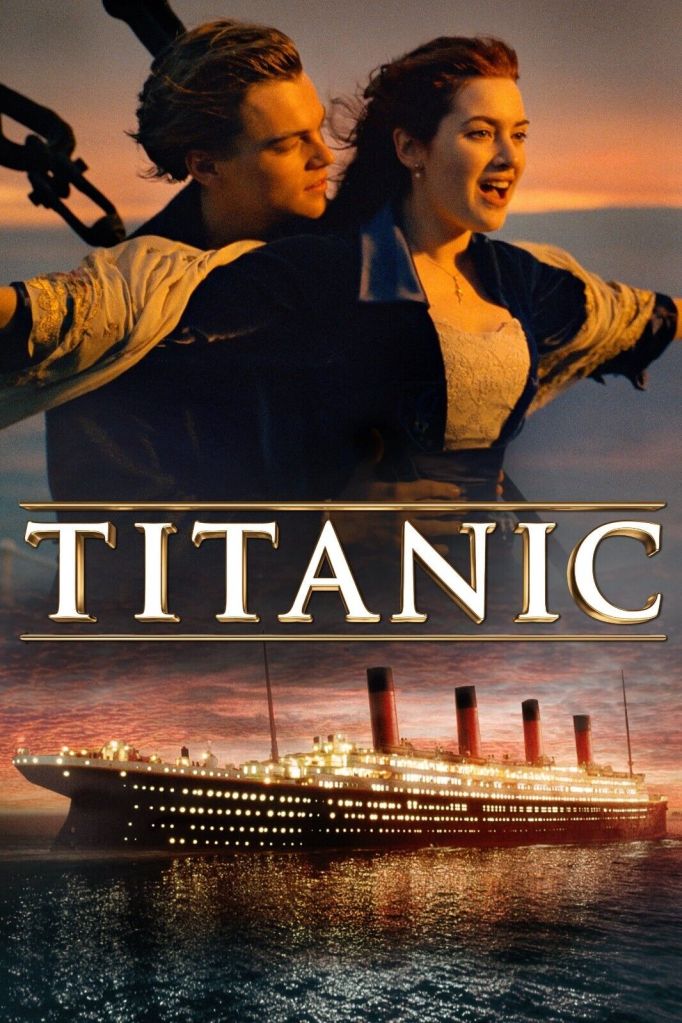
Titanic (1997) ***** – Seen at the Cinema in 3D Imax

You might have thought it the height of Hollywood hubris for James Cameron to assume Titanic could steal the Valentine’s Day crown from Humphrey Bogart-Ingrid Bergman World War Two lovelorn Casablanca (1942). But bear in mind Casablanca had replaced Doctor Zhivago (1965) as the movie’s greatest love story and that, in turn, had superseded Gone with the Wind (1939).

Each followed a similar recipe – cataclysmic event, except Casablanca epic in scope, except Gone with the Wind memorable song,  except Clark Gable introducing relative newcomers, perhaps most of all fabulous screen charisma between the male and female leads. Titanic, of course, has a late twentieth century vibe, more action than drama as the lovers, often pursued, hurtle from one potential disaster to another, and are within a lifejacket and a large enough piece of flotsam of a happy ending.

But where Rhett Butler (Clark Gable) and Rick Blaine (Humphrey Bogart) exhibited world-weary cynicism and Zhivago (Omar Sharif), though his occupation, achieved maturity, Rose (Kate Winslet) and Jack (Leonardo DiCaprio) are little more than blossoms blown on the wind, as innocent as a fresh coat of paint. Jack grows up fast, fast enough to hold his own among the upper class, strong enough to whisk Rose away from a life of servitude to a male ideal.

In some respects, to use the modern idiom, she is the ultimate Final Girl. On several occasions, she rescues him, plunging through the rising torrent to find him and cleave his handcuffs with an axe. She risks far more than he. Vengeful fiancé Cal (Billy Zane) and his ruthless henchman (David Warner) would easily chuck Jack overboard given the chance.

In essence, the story is light. Spoiled brat saved from a half-hearted suicide attempt, Jack embraced by Cal as a means of humiliating him, various attempts to smear Jack, Rose finding a freedom below stairs she never expected, shown a world of opportunity beyond her ken, taking the lead in sexual matters, lightly mocking Jack for blushing at her nudity even as she shamelessly and confidently strips.

And told against the backdrop of a ruthless caste system, where only the “better” people can survive and millionaires see “winning” as the embodiment of entitlement. Cameron holds up a mirror to the supposedly classless America and a world of enterprise where lifeboats are viewed as an obstacle to beautiful design. The two outsiders, Rose’s mother (Frances Fisher) and Molly Brown (Kathy Bates) are opposites, the latter, by dint of inheritance pushing her way brusquely into society, the former meekly trading her daughter for a life of privilege.

And the romance is given a twist when cold-blooded Cal proves to be as obsessed by Rose as Jack, the several times offered safe passage turning it down to pursue her, and not in the end as an object to be collected but as the subject of his restrained passion.

But you would need extraordinary acting to keep you glued to the screen when there were so many other astonishing visuals and even at the distance of a quarter of a century the power of DiCaprio and Winslet just blows you away. Sure, there is a bit of will she-won’t she, but once we’re past that it’s romance as a breath of fresh air, DiCaprio mixes devil-may-care with adoration, Winslet bristles, succumbs and then takes the lead, the sheer exhilaration of it all the bulwark against the drama of the slowly sinking ship.

It’s a fabulous scenario, Cameron careful to allow other elements to float into place, the officers assuming sacrificial stance, the hunt for the mythical jewel that kicks off the tale and provides meaningful coda.

I’m sure it helped that DiCaprio and Winslet were mere rising stars, otherwise I doubt if someone with more box office clout would have stood for the endless hours/days/weeks in freezing cold water (I don’t think you could heat it up even in a studio setting) and without their genuine travails it would not have worked so well.

It’s worth noting that DiCaprio went on to become – along with Brad Pitt – the last of the genuine stars and that he forsook the easy route of romantic lead for more interesting and complex characters and embraced an association with Martin Scorsese that took him to darker places than the likes of Paul Newman or Harrison Ford ever dreamed. Winslet, too, has enjoyed a memorable career, perhaps entranced too often by the arthouse, but you can hardly argue with one Oscar and six nominations.

On a personal note, I realised I had passing acquaintance with two of the actors. When I worked backstage at the Citizens Theatre in Glasgow, I would often come across Jonathan Hyde (the arrogant Ismay). One role he played quite astonished me. Not so much the role (and I can’t remember what it was) but, if you like, the preamble. When audiences entered the theatre they were faced with the sight of Hyde sitting on stage in full costume and in character, as if this was Method Acting taken to an extreme, waiting for the play to begin.

I was at university with Ron Donachie (the master at arms). We both studied Drama at Glasgow University. This course was never intended to produce actors, and mostly it set students on a path to theatre management and the like, including a friend Anne Bonnar who went on to head up Creative Scotland. But, of course, it was always a route into acting if that was your ambition. Ron Donachie and another friend Duncan Bell (British television series Heartbeat) took the opportunity. Needless to say, my stint at the Edinburgh Festival Fringe was enough to convince me that acting was not my forte.  

Sgt Ryker (1968) ***

Universal pulled a fast one with this tidy courtroom drama. The studio resurrected a two-part television piece originally made as the The Case Against Paul Ryker five years before under the Kraft Suspense Theatre brand to capitalize on the unexpected box office success of Lee Marvin, the decade’s most unlikely new star after a straight run of hits from the Oscar-winning Cat Ballou (1965) through western The Professionals (1966) to The Dirty Dozen (1967).

Re-titled and hoping audiences would not notice the sleight of hand, this was thrown out into first run. By normal standards it would be deemed a flop for a star of Marvin’s newfound magnitude but the $1 million notched up in rentals Stateside and more overseas prove a handy cache of found money for the studio. Audiences might have smelled a rat when the star’s name came at the bottom of the opening credits with an “And” billing, which generally denoted guest – rather than main – star.

Still, despite being promoted as an actioner, posters show Ryker with machine gun in hand in the midst of a battle scene – there is such a scene but Marvin plays no part in it – it’s actually a decent drama, especially given the unusual background. Set in 1951 during the Korean War there’s nothing gung-ho about it. The Americans are retreating, evacuating Seoul, when army attorney Capt Young (Bradford Dillman) feels Ryker was short-changed during a trial that condemned him to death as a traitor.

Young and Ryker’s estranged wife Ann (Vera Miles) embark on a deadline-dogged mission – he’s due to be hanged in a couple of days’ time – to clear his name. Strafed by enemy planes during a trip from Tokyo to Seoul, there’s a hint of nascent romance. And when they are later caught together in a clinch, this adds to the murky atmosphere, Young facing court martial accused of the deadly sin of having an affair with a colleague’s wife and deemed a pariah by colleagues. He has another strike against his name – he dug up a grave.

The situation is exacerbated by high command caught between troops needing the morale-booster of seeing a traitor hanged and fearing scandal if they are found after the event to have sent an innocent man to the gallows. And there is the irony that Young, in his capacity as prosecutor, was the man who found Ryker guilty in the first place. He only ends up on the opposite side as punishment for exposing technical irregularities in the defence’s handling of the case.

Ryker doesn’t help himself by initially proving to be an unreliable witness, remembering in erroneous detail minor matters but not the one thing that could clear his name, whether his commanding officer, now deceased, had left a note clearing Ryker. The sergeant, caught behind enemy lines, had claimed he was acting under orders during a counter-intelligence mission.

So the odds are heavily stacked against Ryker, at the re-trial the sheer malevolence of his boss Major Whittaker (Peter Graves), and sex-obsessed pal Capt Appleton (Murray Hamilton) and what seems like ranks of generals barely concealed. The investigation focuses on finding missing items – watch, pen, notebook – of the dead officer, none of which it transpires helps the case.

The courtroom has plenty of the usual twists including a surprise witness proving Ryker fraternised before the war with a Korean general. So, with army politics and a downbeat take on war thrown into the mix it’s a generally absorbing drama.

Bradford Dillman (A Rage to Live, 1965), usually relegated to leading man or supporting star in the credits, one or two places below the star in the billing, gets the chance to shine, essaying both a man standing up for his principles against heavy opposition and a lover guilty of attempting to steal another man’s wife. Appearing in virtually every scene, he gives a better account of his acting skills than in most of his movies, far more than the often one-note performances to which he was consigned. One-time Hitchcock protegee Vera Miles (Hellfighters, 1968) doesn’t bring quite enough of the internal conflict to her role but she’s a reasonable sidekick.

Had any big studio been paying attention, Lee Marvin gave pretty good notice of his potential for star status especially the menace he could impart with just a glance rather than the showy over-acting to which he was inclined in previous villainous outings such as The Man Who Shot Liberty Valance (1962). He’s careful to allow the shiftier and gloomier elements of his character to come into play rather than playing the role as heroic innocent. There’s good back-up from Peter Graves and allowed, a little leeway from their normal movie personas, Murray Hamilton md Norman Fell (both from The Graduate, 1967).

Buzz Kulik (Villa Rides, 1968) directed from a screenplay by Seeleg Lester (Change of Mind, 1969) and William D. Gordon (Cotter, 1973).

At a crisp 85 minutes it doesn’t outstay its welcome as long as you’re not taken in by the still-misleading poster. A good example of the species with excellent performances.

Plus, you can catch if for free on YouTube.

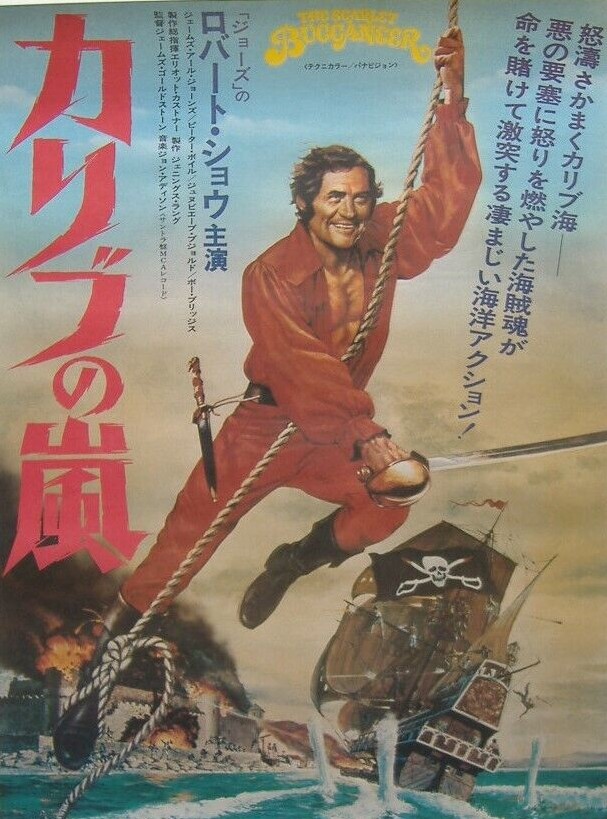
Swashbuckler (1976) **

Red faces all round. Uneasy pirate spoof that misses all its targets, coming close to resembling the kind of movie that gives turkeys a bad name and saved only by a spirited performance by Genevieve Bujold. Uber-producers Jennings Lang (Rollercoaster, 1977) and Elliott Kastner (Where Eagles Dare, 1968) should have known better but were seduced by the tantalizing returns for Richard Donner’s The Three Musketeers (1974) and its sequel which had revived the moribund swashbuckling genre.

Robert Shaw (Custer of the West, 1967) was nailed-on for the leading role since had made his name playing a pirate in British television series The Buccaneers (1956-1957) and was as hot as he was going to get after the double whammy of The Sting (1973) and Jaws (1975). However, the movie takes its cue from one of the chief supporting actors Major Folly (Beau Bridges).

It’s color-coded. In case we can’t tell a good guy from a bad guy, we’ve got the Man in Red, pirate Ned Lynch (Robert Shaw), shaping up against the Man in Black, unscrupulous Jamaican governor Lord Durant (Peter Boyle). Ned is presented as a seagoing Robin Hood, Durant as the wicked Sheriff of Nottingham, his ruthlessness somewhat undermined by his predilection for playing with toy boats in his bath and for getting his hairy back waxed.

Twin narratives quickly unspool. Ned rescues from being hanged shipmate Nick Debrett (James Earl Jones) while Durant jails island chief justice Sir James Barnet (Bernard Behrens) and steals his treasure.

Stolen treasure being fair game, Ned and Nick hijack a coach-load of it, while Sir James’s on-the-run daughter Jane (Genevieve Bujold) ends up in their hands. Not being as black-hearted as his nemesis, Ned puts Jane ashore, but still a bit black-hearted humiliates her in a swordfight, and is disinclined to help her save her imprisoned father.

However, Jane has a trump card. For reasons unknown, Durant is heading back to England with a cargo of 10,000 dubloons, too tempting a target for any pirate. Naturally, nothing goes as planned but, as you might expect, there is a happy ending.

This might have worked, since all the ingredients are there, the laughing cavalier, the spirited woman, the humorous sidekick, the unprincipled villain. You’ve got an historically-accurate pirate ship for once, unlikely romance between high-born woman and charming scallywag, simple rescue-imprisonment-rescue scenario, and ample scope for swordplay.

Except the dialog is awful, the ship too small to accommodate any fighting so the pirates are landlubbers for the most part, and except for the duels between Ned and Jane and Ned and Durant, the swordfights are all kind of bundled together, and every now and then the action stops so we can hear a verse or two of a sea shanty sung by nobody in particular.

Though Ned and Nick trade cringeworthy, and in one case downright offensive, limericks, the best (only) laugh comes when Ned chucks Jane off a roof onto a canopy and follows up with the line “It worked.”  It doesn’t help that Durant’s pederastic tendences are played as a joke. Everywhere you look people are turning cartwheels or are “blithering idiots” or “pawns” and as you might expect there’s a cat-fight and a monkey around to relieve a jailer of his keys. You are just praying for a shark to come along to put the cast out of their misery.

In the midst of this feast of over-acting along comes Genevieve Bujold (Anne of the Thousand Days, 1969) who must think she’s in a different picture. She is a feisty one all right, not above putting a knife to a man’s cojones, or kneeing them in that region, and, given the lawless state of the island, branded a criminal for wounding a rapist.   At least she takes the whole thing seriously rather than as if being in a Mel Brooks picture.

It’s hard to know who to blame: the stars for acting as if enjoying a holiday from more serious fare; director James Goldstone (Winning, 1969) for failing to get the recipe right and employing a jaunty score that undercut everything, or writers Jeffrey Bloom (11 Harrowhouse, 1974) and Paul Wheeler (Caravan to Vaccares, 1974) for making a mess of the ingredients in the first place.

Of course, I am hardly blameless in drawing your attention to this, a sudden enthusiasm for pirate pictures sending me dashing into the wrong decade.

Watch for: Robert Shaw making a bid for the all-time Golden Raspberry; an unrecognizable Peter Boyle (Taxi Driver, 1976); Beau Bridges (Gaily, Gaily, 1969) doing his best Frankie Howerd impression; James Earl Jones (The Comedians, 1967) sounding normal, minus the deep-throated vocal tic on which he made his name; and so many inanities it falls easily into the So Bad It’s Good category.  

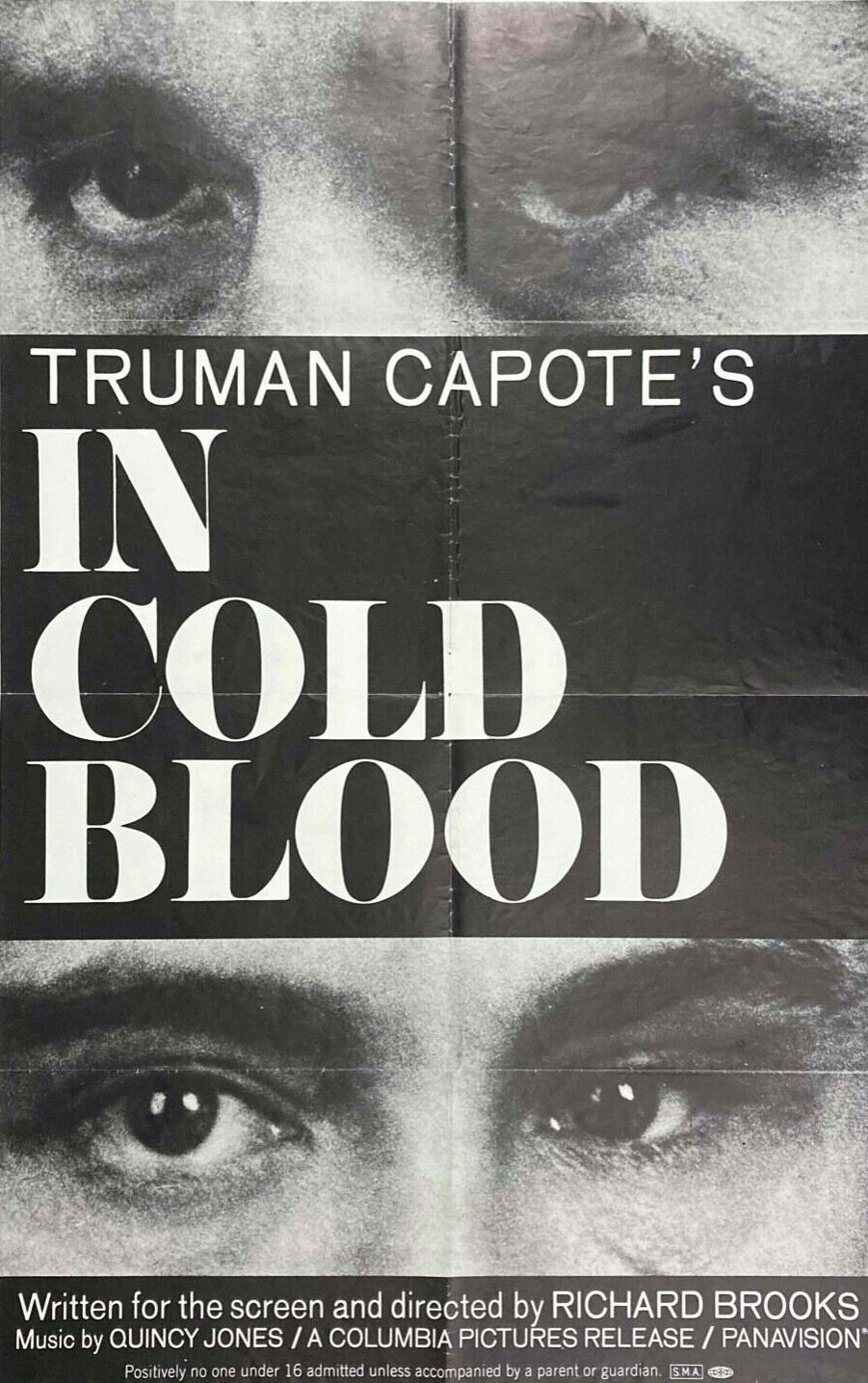
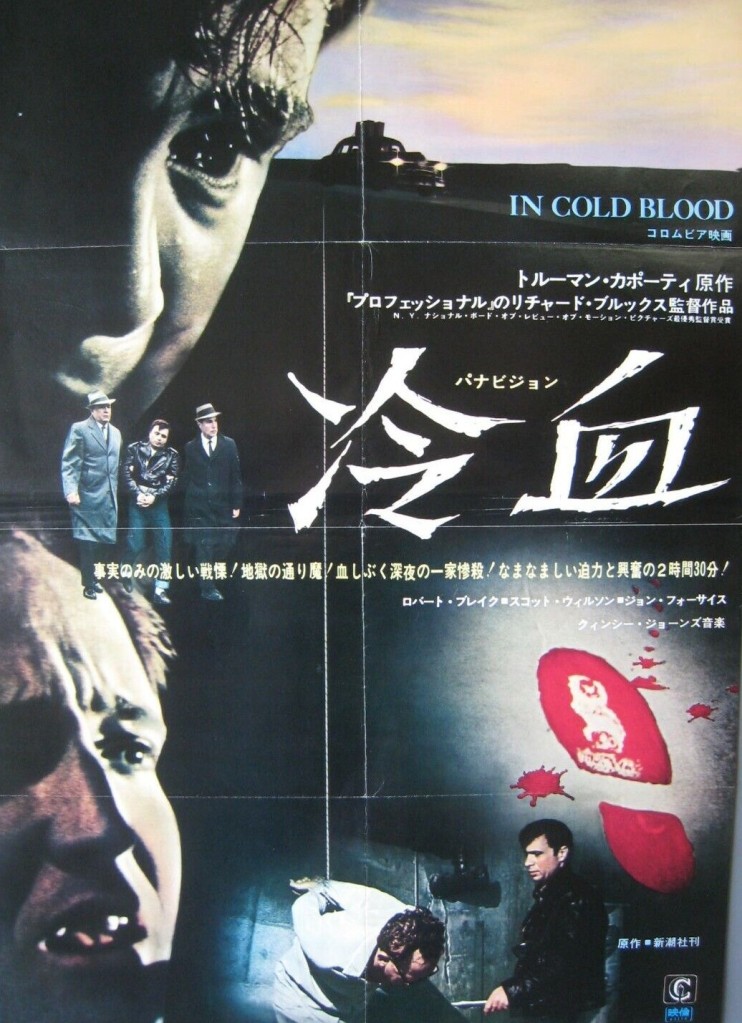
In Cold Blood (1967) *****

Unfairly overlooked in favor of the Coppola/Scorsese grandiose perspective on gangsters, this changed the shape of the crime picture as much as the best-selling book altered the way readers regarded murderers. Neither whodunit, whydunit nor film noir, nonetheless it invites us into the world of the senseless crime, providing an extremely human portrayal of two men if not natural born killers then their pitiful lives always going to lead them in the wrong direction.

Although Perry Smith (Robert Blake) is a fantasist, dreaming of becoming a singing star in Las Vegas, determined to find the lost treasure of Cortez, and convinced a giant bird protected him from vicious nuns in an orphanage, his life did already verge on the fantastical. His mother, a Cherokee, was a star rodeo performer, his father a gold prospector in Alaska, but the mother, an alcoholic, choked to death on her own vomit and the father (Charles McGraw), a hobo in all but name, is astonished that the child he brought up, so he believes, to recognise right from wrong, would stoop to crime. As a child Perry and siblings watched his mother have sex with clients and his father viciously beat her with a belt. Perry is addicted to aspirin to minimize pain from a leg injury, and you can’t help but feel sorry for this otherwise fit young man massaging the massive disfiguring scar, the result of a motorbike accident.

Dick Hickock (Scott Wilson) is a very charming cocky personable con man, leaving a trail of bad checks behind him as he masquerades as a best man who has come out without enough cash to buy a wedding outfit for his buddy and, with his convincing patter, hoodwinking store clerks not just into accepting a check for the goods, later to be sold, but also cashing a personal check. His father, too, is stunned to hear his son had criminal tendencies.

Fatherhood is represented as a holy grail. Hickock enjoyed being a parent until he was caught with another girl and had to do “the decent thing” i.e. abandon existing wife and child. The parents of both boys have wonderful, emotion-filled, memories of loving and being loved by their children.

From another prisoner, Hickock has been told of the “perfect score,” a rich farmer called Clutter in Kansas with $10,000 in his safe. The plan, to which Smith has only momentary objection, is to leave no witnesses. Even muttered in grandiose manner, this phrase surely, in anybody’s mind, conjures up slaughter, Smith’s only saving grace that he prevents Hickock raping the daughter Nancy (Benda C. Currin). Their haul amounting to $43 and a radio, you could imagine the thieves wiping out the family in a fit of fury. But that’s not the case, it’s just cold-blooded thinking, an element of leaving no trace behind.

And that’s just what they do, committing an almost perfect crime, no fingerprints, just the mark of the sole of a shoe imprinted in blood. There’s a red herring – old man Clutter had just signed off on an insurance policy worth $80,000. But detective Alvin Dewey (John Forsythe) has to solve the crime the old-fashioned way, with inter-state cooperation and months (years in reality) of footslogging. Dewey could have been straight out of film noir with his nippy one-liners and epigrams.

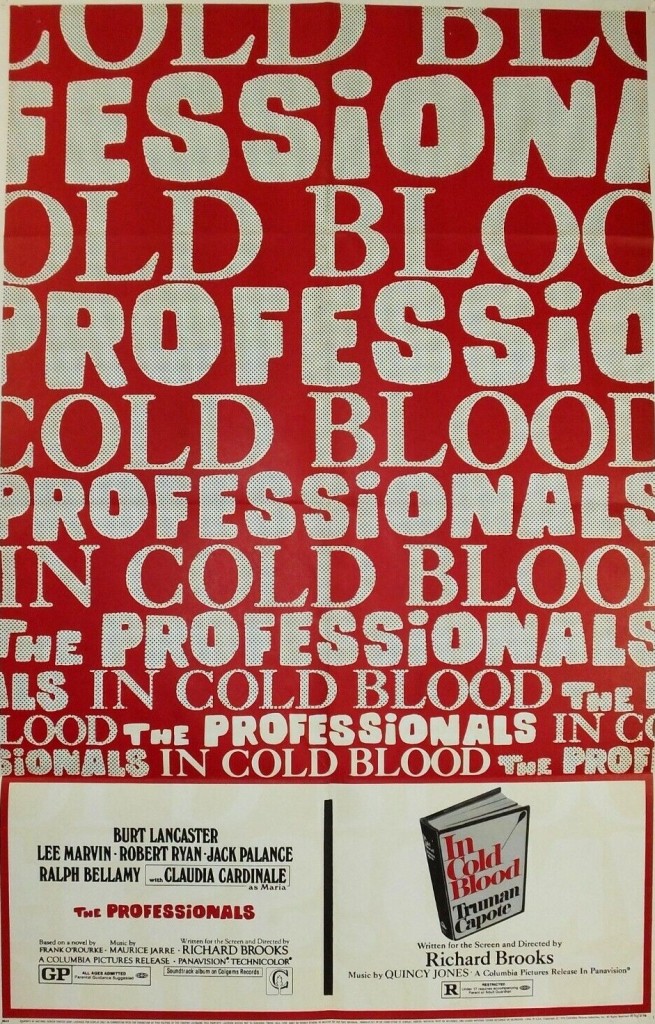
Other than Alfred Hitchcock, it was unusual for a reissue double bill to comprise
two films by the same director.

Unlike the novel which concentrated as much on the aftermath among the shocked townspeople, the film focuses on the manhunt and Dewey’s deft way with newspapermen and colleagues. The four murders occur off-camera, but by that point we already know the outcome. There’s a virtue-signalling coda that shows the inhumane conditions in which murders were kept on Death Row, but that is countered by a marvellous speech by Dewey on the inequities of being a cop: hounded by media and public for letting someone get away with heinous crime, generally getting a tough time over police methods, lambasted after catching them for not doing it quickly enough, and then having to stand by while media and public launch an outcry to prevent the killers being executed.

All shade, the documentary style achieves the contradiction of appearing sparingly told yet with a wealth of character detail (location and time are ignored) and none of the grandeur and faux community spirit invested in gangsterdom by the likes of Coppola and Scorsese. Smith and Hickock would never pass the entry test for the Mafia given that at least required discipline and the ability to follow orders. Minus the killing spree, these characters might have survived a little longer in the underclass before ending up inside again.

All three principals are brilliant in the understated manner demanded. Robert Blake (Tell Them Willie Boy Is Here, 1969) is the pick, tormented by future dreams and past nightmares, but Scott Wilson (In the Heat of the Night, 1967) has the stand-out scene, gulling store salesmen with his finely worked con, and there is a sense of the big brother in the way he looks after his friend. This might well be the best work by John Forsythe (Topaz, 1969).

And it certainly is one of the finest movies made by writer-director Richard Brooks (The Professionals, 1966) who handles a very difficult subject with at times such delicacy it is almost a complete departure in style.

Bank of Dave (2023) *** / No Stars

Take One: A quite superlative courtroom scene sets the tone for this David vs. Goliath clash of a Burnley minibus dealer taking on the might of the British Establishment. In truth, my heart had sunk at the stereotypical opening – posh London lawyer sent “oop north,” his first encounter with natives unintelligible, his client first seen in a pub doing karaoke. And set against the background of the financial crash caused by arrogant and inept big banks, the stall is set out too obviously.

But, gradually, it acquires a different tone, of two outsiders fighting the system, less-than-high-flying corporate attorney Hugh (Joel Fry) trying to gain acceptance in a working-class town, working-class millionaire Dave (Rory Kinnear) battling to gain a foothold in banking circles to put forward his controversial notion of a new bank – the first in 150 years – that dealt only with small businesses.

There’s a toe-curlingly awful romance as Hugh can’t quite put into words his feelings for Dave’s niece Alexandra (Phoebe Dynevor), a Cambridge-educated NHS doctor, and she can’t quite help him along. Banking guru Sir Charles (Hugh Bonneville) has Dave in court on a trumped-up charge. Anyone Hugh trusts in the City does the dirty on him while locals he distrusts are confusingly helpful.

The Banking Powers-That-Be make up the rules as they go along, leaving Hugh with a £12 million shortfall to fill before he can get up and running.

So there’s a lot of ducking-and-diving on both sides, born publicist Dave constantly coming up with entrepreneurial wheezes, the opposition attempting to thwart him at every turn. Business pictures are a hard sell unless the product is drugs or sex, so it’s no surprise this isn’t about setting up a business, even one with righteous credentials (i.e. helping the little guy), but rather about poking a finger in the eye of Big Business, Big Banking, Big Government and anything else that isn’t Little (i.e. good).

Along the way it turns into a warm-hearted feel-good movie with characters you might recognize and situations you might appreciate and although the ending is a tad predictable I was surprised how moved I was. Rory Kinnear (Men, 2022), rarely given anything more than a supporting role, shines as the larger-than-life Dave and Joel Fry (Jasper, if you remember, from Cruella, 2021) goes from romantically inept to courtroom genius and back again while Bridgerton graduate Phoebe Dynevor has a slow-burner of a role. Debut feature of Chris Foggin from a screenplay by Piers Ashworth (Fisherman’s Friends, 2019).

At the high end of streaming material in that it was an enjoyable watch and no complaints about a big film which should have been seen in the cinema.

Take Two: But then I wanted to learn more about Dave and his banking initiative. And lo and behold very little of what you see on the screen is true. The big court case is a figment of the writer’s imagination, which means that however low Big Banking stooped it didn’t stoop this low. And so, it transpired, was the need to raise £12 million. And so was the fundraising concert by Def Leppard and so, too, I guess was the odd million thrown into the kitty at the last minute by Hugh to get Dave over the line.

So, much of Bohemian Rhapsody wasn’t true either and I was always in awe of the bar scene in A Beautiful Mind (2001) in which asking girls to dance is used to demonstrate the Zero Sum theory on which mathematician John Nash made his name, rather than some more complicated explanation. And it’s true, Dave was taking on the Establishment and nobody had set up a bank in 150 years and the financial industry was in crisis and you could ask who were these people to judge who was fit to run a bank when these were the same banking bosses who had squandered gazillions on ill-advised loans. And I’m sure it was a hell of battle. That he didn’t, in fact, win, because the bank Dave did set up is not a bank in the financial meaning of the word.

And, of course, it highlighted the inequities in a system that can reward with bonuses bankers who made a whopping loss.

So I’m really in two minds. I enjoyed it at the time but that enjoyment quickly palled when I realized it was all invention. I just wondered if there was a better and more incisive way to skewer the Big Banks than this.

On Netflix.

The Magic Vault – Return of the Reissue

You are probably aware by now that Hollywood reckons the very movie to fill the Valentine’s Day gap this year is the love story that took Leonardo DiCaprio and Kate Winslet to a watery grave – Titanic (1997). The date might be a surprise but with Avatar: The Way of Water conquering box offices worldwide a re-run of his previous gigantic success was always on the cards.

What might come as a shock is how much Hollywood has come to rely on oldies to fill gaps in the release schedule – so much so that a reissue of a biggie has been slated for every month in the forthcoming year. As you are probably aware from my discursive writings on the subject, the reissue has been a staple of the industry since the 1960s, and as often as not appearing when stocks of new films were at a low ebb.

Covid was an unexpected production disaster and with new films in short supply and audiences falling short of the norm the studios felt it better to hold on to big films until cinemas were back to something approaching normality. Thank goodness someone in Hollywood can count because anniversaries make up a hefty chunk of the excuses to trot out old pictures. Anniversary used to mean a celebration of a classic made 25 or 50 years ago, but that notion has been taken to extremes,  so any year seems fair game, 20th, 45th now pretty common.

But anniversary was not in the main the driving force last year. Some pretty big fish were summoned from the vaults to work their magic. The original Avatar (2009)  brought in another $76 million worldwide – positioning it just outside the global top 50 for 2022. Interstellar (2014) knocked up another $72 million, Harry Potter and the Chamber of Secrets (2002) $45 million, Leonardo DiCaprio in Scorsese’s The Wolf of Wall Street (2013) worth an extra $14.8 million and the original Jurassic Park (1993) added $10 million to the coffers.

What must have seemed like nothing short of frantic experiment clearly struck a chord with audiences, so studios are taking to the reissue on a regular basis.

For a time it was Casablanca (1942) that had been the unexpected filler of the St Valentine’s Day gap. But it could hardly compete with Titanic, but rather than lose the opportunity for another annual outing, this has been re-scheduled for the beginning of March.

In April there will be a further chance – in a genuine 25th anniversary big bang- to see Jeff Bridges and John Goodman in the Coen Bros cult favorite The Big Lebowski (1998). Musical Grease (1978) – 45th anniversary? – with John Travolta and Olivia Newton-John is the May pick. Hardly an unusual notion this, Grease has already had more than its fair share of reissues.

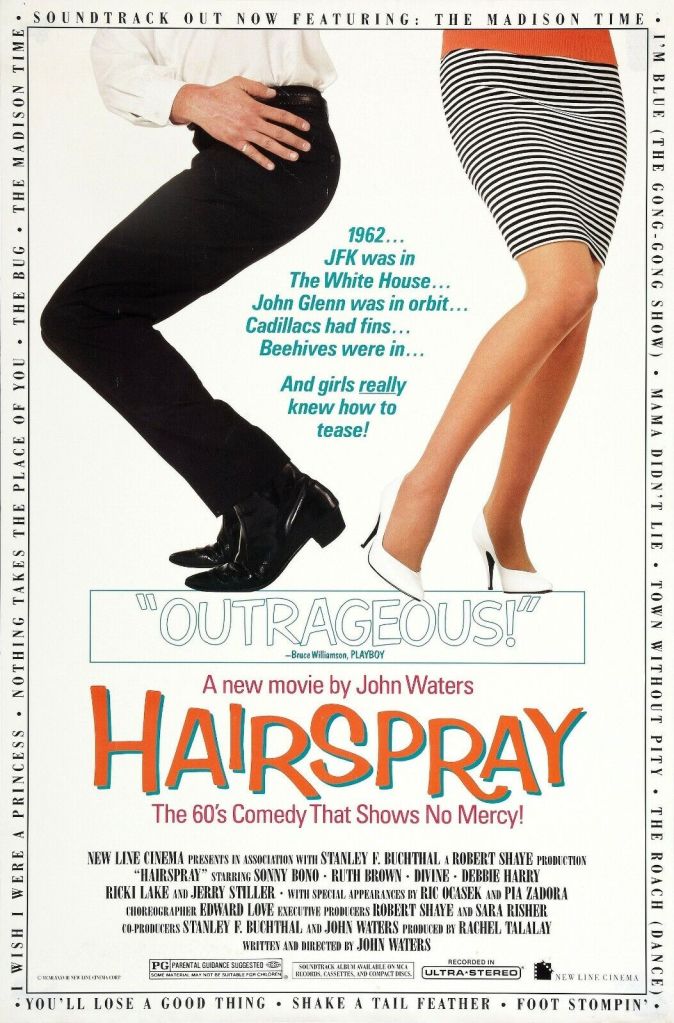
You might think it’s Travolta again in June, in Hairspray (2007), but actually it’s the John Waters original, made in 1988 – 35th anniversary!! – that became the basis of the Broadway musical. It boasts an all-time cracker of a cast – Sonny Bono (of Sonny & Cher fame), Divine (Pink Flamingos, 1972), pop star Debbie Harry (Videodrome, 1983) of Blondie, future talk show host Ricki Lake in her movie debut, and comic Jerry Stiller (father of Ben).

For the holidays what could be better than a 40th anniversary outing for National Lampoon’s Vacation (1983). Chevy Chase and Beverly D’Angelo fire up their engines for July and look out for Eugene Levy, John Candy, Jane Krakowski and Christie Brinkley in small parts.

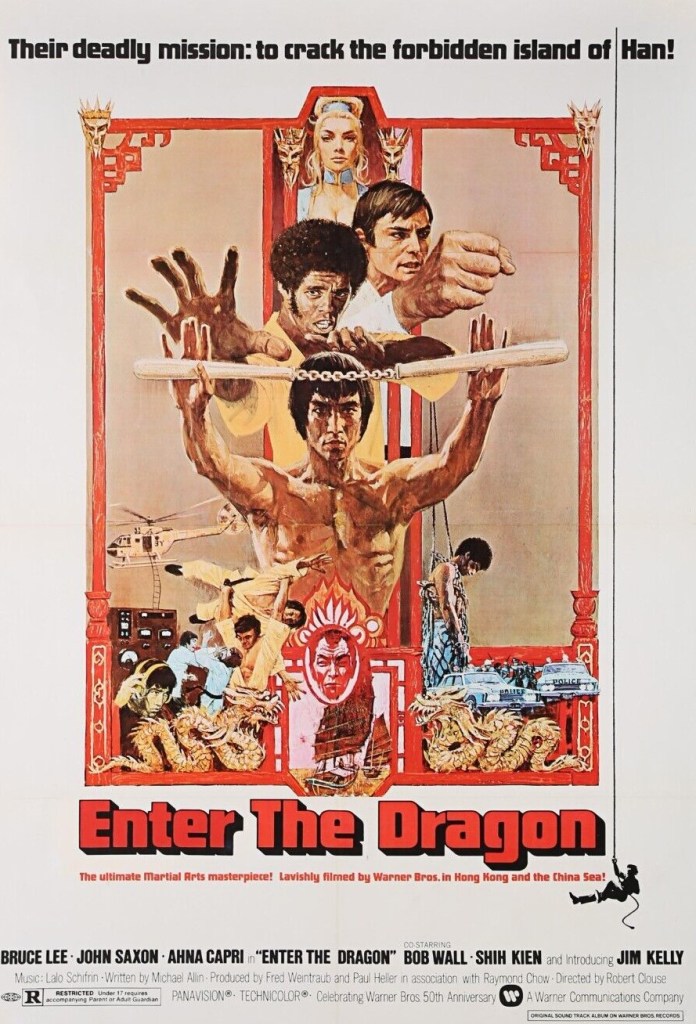
It’s a straight-out 50th anniversary slam-dunk for Enter the Dragon (1973), the kung fu actioner that cemented Bruce Lee’s reputation and sent the world into a brief glorious paroxysm of kung fu exploitation vehicles that even impinged on James Bond. Catch it in August.

You’d never guess it’s 35 years since Rain Man (1988), but don’t worry that will surely form the main plank of the marketing for its revival in September. Tom Cruise is of course still a big noise, less so Dustin Hoffman and director Barry Levinson, but they both won the Oscar, and fans of Hans Zimmer (Oscar nominated) will be more than happy to celebrate the score that brought him worldwide attention.

There’s been more than enough publicity attached to the filming of The Birds (1963), what with Tippi Hedren’s accusations of her treatment, but this 60th anniversary re-release might provide opportunity to reassess what I consider to be Alfred Hitchcock’s greatest achievement. That’s out in October.

Al Pacino’s turn as Cuban gangster Tony Montana in Brian DePalma’s Scarface (1983) – 40th anniversary – was not a huge hit at the time, audiences too easily put off by the violence and the over-the-top performance, but it’s now become a cult classic so expect big numbers to turn out in November.

Rounding out the year, unless someone can come up with something bigger/better before then, is A Christmas Story (1983) – 40th anniversary. You’ve probably forgotten all about this unless you can remember this is where the iconic “tongue frozen to flagpole” idea originated. Directed by Bob Clark, perhaps in reparation for Porky’s (1981), it sees Melinda Dillon (Close Encounters of the Third Kind, 1977) as the mother appalled her son wants a BB gun for Xmas. Wonder how that idea will play out these days!

I am already trawling through any film made in a year ending in 4 or 9 to see what Hollywood can base an anniversary re-showing on for 2024.

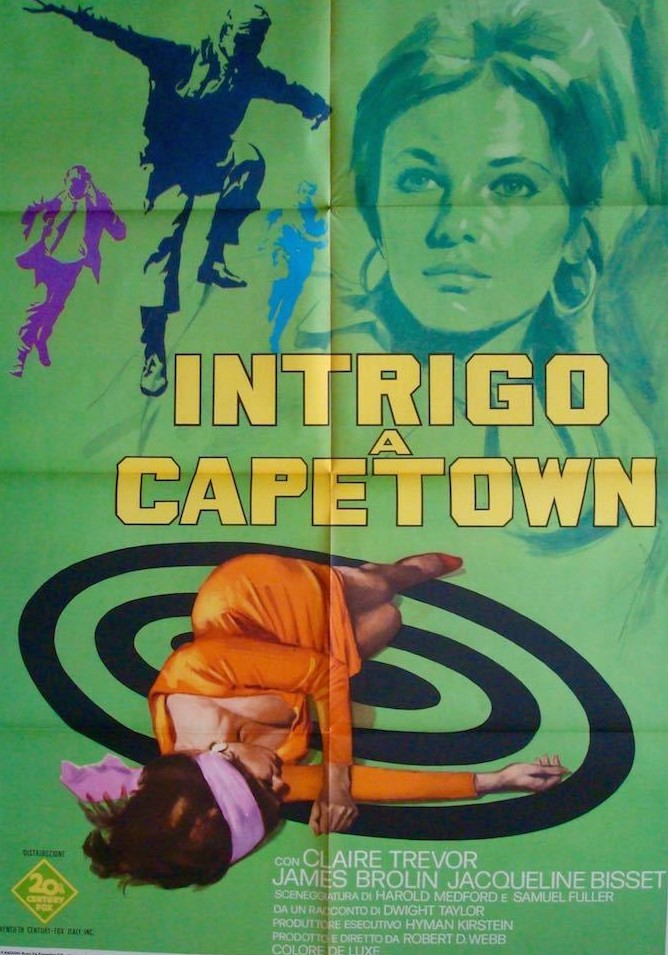
The Cape Town Affair (1967) **

It was too much to hope that a remake of Sam Fuller’s Pickup on South Street (1953) could match the original. Universal had made a decent job of a second bash at Beau Geste (1966) and Madame X (1966) and Twentieth Century Fox should be applauded for having the cojones to even attempt a reimagining of the John Ford classic when it tackled Stagecoach (1966). Generally speaking, remakes were seen as opportunities to feature up-and-coming talent rather than established marquee names.

So it was no surprise that Fox opted for rising stars in James Brolin (The Boston Strangler, 1968) and Jacqueline Bisset (The Detective, 1968), graduates of its talent school, though perhaps more of a stretch to relocate the Fuller classic to South Africa’s  Cape Town. Interestingly, the key role of the informer went to Claire Trevor, star of the original Stagecoach (1939). But while she is a decent replacement for six-time Oscar nominee Thelma Ritter (Move Over, Darling), Brolin was no match for the snarling Richard Widmark (The Bedford Incident, 1964) and Bisset pales when set against Jean Peters (Viva Zapata, 1952).

It’s really the acting that lets it down because it’s virtually the same plot as Pickup on South Street. On a bus in Cape Town pickpocket Skip McCoy (James Brolin) steals a wallet from the purse of Candy (Jacqueline Bisset). Unknown to him, she’s a courier, the wallet containing microfilm of a state secret. Unknown to her, she’s working for the Communists. Unknown to either of them she’s being tailed.

Sometime tie salesman, sometime hooker, sometime police informant Sam (Claire Trevor) identifies Skip as the most likely suspect. Secret service agents investigating his beach shack find nothing. Candy has better luck, Skip a sucker for a pretty face – and a sucker punch. She’s a bit quick in falling in love, he’s a bit too ready to ask for money, but eventually they work together to sniff out the Commies, not that that takes much. The fights are somewhat desultory and the only decent twist comes at the end when, by now loved-up, he is treating her to a romantic dinner, but still up to his pickpocketing tricks purloins the cash to pay from her handbag.

Brolin doesn’t do much but shout and come over like a male model while Bisset turns on the waterworks at the drop of a hat. If it wasn’t for the title, you wouldn’t even know this was set in Cape Town, no focus on city landmarks. There doesn’t look as if there was any budget to speak of.

Robert D. Webb (Pirates of Tortuga, 1961) directed without a hint of the comedy he injected into the swashbuckler. You can’t really blame Harold Medford (Fate Is the Hunter, 1964) for the actors messing up his screenplay.

Worth seeing if you want an example of how a rising star can surmount a debacle. Bisset went straight from this into The Sweet Ride (1968), The Detective (1968) and Bullitt (1968). But Brolin had no such luck. After a supporting role in The Boston Strangler he wouldn’t make another picture for four years and not win another starring role until Gable and Lombard (1976).

I had come at it, as is the undoing of many a movie fan, with the idea of finding a hidden gem, the long lost film of stars at the outset of the careers. Beyond the fact that Bissett looked classy and had a steal of a voice, and Brolin had at least looks, there was little worth finding. But, hey, you might be a completist and think this worth the effort.

Discover WordPress

A daily selection of the best content published on WordPress, collected for you by humans who love to read.

The Atavist Magazine

by Brian Hannan

WordPress.com News

The latest news on WordPress.com and the WordPress community.