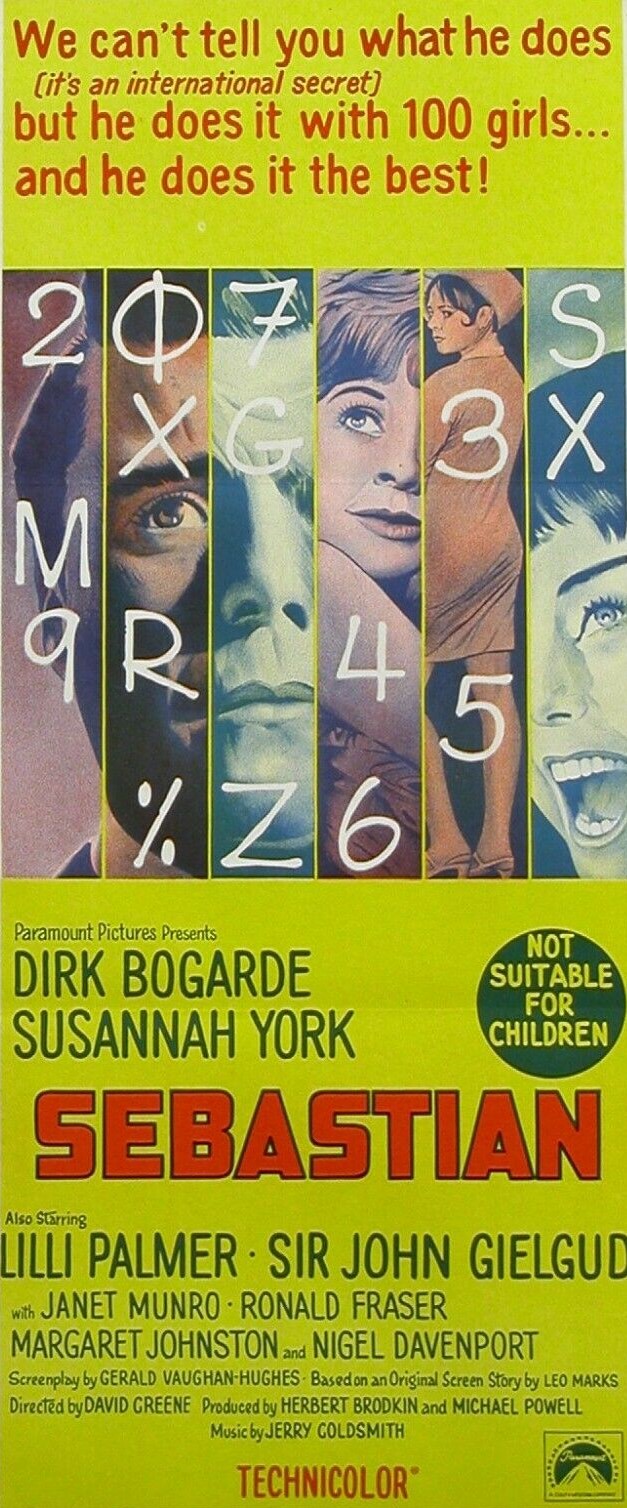
Decoding the emotional life of mathematics professor Sebastian (Dirk Bogarde) lies at the heart of a spy thriller mainlining on loyalty and trust. The presence of a flotilla of potential Bond girls has opened this picture up to charges of being a spoof, but I saw the mini-skirted incredibly-bright lasses as being a reversal of the standard secretarial pool. And a supposed representation of the “Swinging Sixties” would hold true if shot in the environs of Carnaby St rather than the bulk of locations being arid high-rise buildings.
In roundabout fashion, intrigued after literally bumping into him in Oxford, Rebecca (Susannah York) is recruited into an espionage decoding department staffed entirely by gorgeous (but brainy) women. Among the older employees is chain-smoking left-winger Elsa (Lili Palmer) whom security chief General Phillips (Nigel Davenport) suspects of passing on secrets. When romance ensues with Rebecca, Sebastian dumps dumb pop singer girlfriend Carol (Janet Munro) who is already having an affair and spying on Sebastian.
Sebastian and girlfriend.
Although there is no actual beat-the-clock codes to be unraveled, tensions remains surprisingly high as in the best Alan Turing/Bletchley manner, breakthroughs are slow. There’s an undercurrent of electronic surveillance, eavesdropping on recruits, bugs planted in the houses of even the apparently most trusted personnel, seeds of distrust easily sowed, codes shifting from numbers to sounds. The occasional nod to the contemporary, a disco, pop songs, Rebecca doing a fashion shoot in the middle of traffic, is background rather than center stage.
Sebastian, though worshipped by is female staff, is “more whimsical than predatory.” Nonetheless, introspective and often morose, unable to deal with emotions, it falls to Rebecca to take on the task of sorting him out which naturally leads to complications.
Most reviewers at the time complained it was a victory of style over substance, but somehow they managed to overlook the essential questions about trust the picture asked. That said, it does follow an odd structure, the third act dependent on directorial sleight-of-hand.
Rather unique meet-cute: Sebastian, all set to attend a function at Oxford University, gives Rebecca a word-game test.
Dirk Bogarde (Accident, 1966) is always highly watchable and Susannah York (The Killing of Sister George, 1968) Rebecca catches the eye with an impulsive, slightly kooky character who turns out to be down-to-earth. Nigel Davenport (The Third Secret, 1964) bring his usual cynical malevolence to the party but with the twist of not knowing whose side he is really on. John Gielgud (The Shoes of the Fisherman, 1968) is a delight. There’s a brief appearance by a pipe-smoking Donald Sutherland (The Dirty Dozen, 1967). Janet Munro (Bitter Harvest, 1963) decidedly rids herself of her Disney persona. Miss World Ann Sidney is one of “Sebastian Girls”
In his second picture after The Shuttered Room (1967) David Greene’s direction is mostly competent but the opening aerial tracking shots set the precedence for occasional bursts of style. Jerry Fielding supplied the score.
Watching King of the Roaring 20s (1961) and Murder Inc (1960) and struck by the number of similarities to The Brotherhood (1968) that could be found in The Godfather (1972) induced me to examine how well the original novel by Mario Puzo survived the often dangerous transition onto the screen.
There could not be a more textbook example of how to turn a big bestseller into a compelling motion picture. Although director Francis Coppola added texture and style to the bestseller, the film owes far more to the memorable characters created by author Mario Puzo. Apart from some slight structural changes and the elimination of a couple of subplots, the movie follows Puzo’s brilliant structure almost to the letter. And except for a few lines, virtually all the dialogue and many of the most unforgettable lines come directly from the book.
The opening wedding feast is an excellent example of the screenplay approach. The order of the action occasionally alters but the novel’s structure is strictly adhered to. The film’s striking opening line “I love America” by the undertaker is a slight but significant adaptation of that character’s line “I believe in America” in the book. But the screenwriters junk the book’s actual opening section which gives the background to the issues the three characters appealing to Vito Corleone (Marlon Brando) for intervention against perceived injustice from Vito Corleone (Marlon Brando) and goes straight to the book’s wedding. Here, too, the various elements are taken directly from the book with slight changes. For example, to the FBI men taking down car number plates in the novel the screenplay adds in photographers so that, to demonstrate his temper at an early stage, Sonny Corleone (James Caan) can smash a camera.
Straight from the book: fat Clemenza (Richard S. Castellano) dancing, wiping his brow and calling for wine from Paulie (John Martino); Sonny whispering in the ear of bridesmaid Lucy (Jeannie Linero); the frightened undertaker being told off by Vito; the Luca Brasi story Michael Corleone (Al Pacino) tells Kay Adams (Diane Keaton); Sonny and Lucy having sex and being interrupted by Tom Hagen (Robert Duvall); and the screams that greet singer Johnny Fontane (Al Fontane) and the subsequent scene where Vito shouts at the singer to act “like a man.” Additions are slight: in the book Sonny’s wife is in the kitchen not at a wedding table in dumbshow making jokes about her husband’s manhood, and Luca Brasi rehearsing his speech.
Indicative of the ruthlessness with which the screenplay treats the book is the elimination of a moving scene at the tail end of the wedding where Vito goes to see his dying partner Genco. As indicative of the author’s brilliance is that he invented degenerate film producer Jack Woltz (John Marley) and the decapitated horse in his bed. But the storyline, the film’s core, from the attempted murder of Vito, Michael’s assassination of the Turk Solozzo (Al Lettieri) and corrupt cop McCluskey (Sterling Hayden), the exiled Michael struck by the “thunderbolt” falling in love, the ambush of Sonny and the stricken Vito suing for peace, is pretty much exactly that of the book. In some case, it’s clear that actors have drawn from Puzo’s characterizations, the chilling way Michael takes control of the Family, how Fredo goes from useless gangster to hotel dandy.
There are occasional additions. In the book Enzo’s hand outside the hospital is shaking but Michael lighting his cigarette is the movie shorthand to demonstrate his icy calm, Sonny’s “bada-bing” isn’t in the book nor is Luca Brasi sleeping with the fishes, though there is something similar “Luca Brasi is sleeping on the bottom of the ocean.”
Occasionally, in the novel, for technical reasons, Puzo drifts away from the central characters to provide some more background or detail about a subsidiary person and in this manner we enter into the minds of Paulie, Carlo (Gianni Russo), Kay, Clemenza, McCluskey and Albert Neri just as they are about to play a significant role in forthcoming action. Other subsidiary characters featured more prominently in the novel, in particular Johnny Fontane whom the book reveals develops from Oscar-winning actor to successful movie producer and from manic seducer to more considerate male.
Fontane also helps revitalize the career of another singer Nino who does not appear in the movie at all and plays a role in developing the Family’s interests in Las Vegas. Lucy, who disappears entirely from the film after the wedding, is more significant in the book, finding romance after Sonny’s death with a surgeon and there’s a part of their relationship that would only now be permissible to film. Sicilian shepherd Fabrizio, instrumental in the attempted assassination of Michael, also reappears in the book. The book also devotes more attention to Michael’s new breed, Alberto (Richard Bright) and Rocco (Tom Rosqui).
The death of Vito in the garden is almost identical to the book with the grandson present except for Marlon Brando’s improvisation of stuffing his cheeks with orange to frighten the boy. And Michael’s betrayal by Tessio and the subsequent mass murder of all his enemies is also drawn from the book except for Moe Green having been killed earlier (Fabrizio the shepherd slotting into his place in the book’s action). Some slight detail is changed – Barzini (Richard Conte) killed beside his waiting car not on the steps, Tattaglia (Tony Giorgio) murdered in a chalet not an apartment block. Somewhat surprisingly the image of acolytes paying homage to Michael as briefly viewed by Kay has its origins in the book. The two final scenes in the book, both concerning Kay, are excluded from the film, in the first, having run away, she is challenged by Hagen and in the second she prays for Michael’s soul in church just as (in the book) Michael’s mother had prayed for his father
A lengthy chapter on Vito’s beginnings, explaining his early relationships with Clemenza, Tessio (Abe Vigoda) and Luca Brasi, was wisely held over for The Godfather Part II.
Having by now read a number of books that were subsequently filmed, my over-riding impression was that in many cases (The Secret Ways, Arabesque) little survived of the original tale or that characters, locations and timescales (The Detective) were substantially altered. In some instances the book’s length precluded a straightforward adaptation. Occasionally, subjects easily dealt with on the printed page were not so welcome on the screen. But, for whatever reason, change appeared inevitable for a bestseller being translated into a movie.
The Godfather almost stands alone as a novel that made the transition with virtually no alterations. All the main characters are present as described by Puzo and the storyline entirely reflects the book. The bulk of the dialogue was originally written by Puzo. While there is no doubting the Coppola’s achievement in putting the book on film, there is equally no doubt that the book leant itself to easier adaptation than most bestsellers.
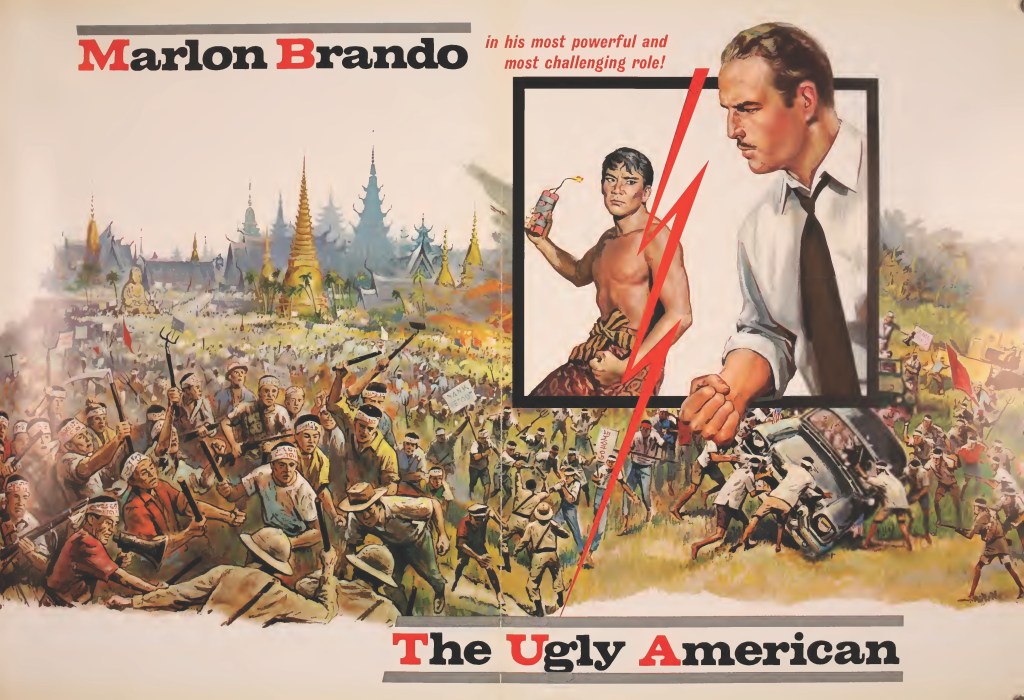
Terrific performance from Marlon Brando saves this prescient but preachy meditation on Vietnam. Harrison MacWhite (Marlon Brando) is the new ambassador, whose political credentials are questioned by many, parachuted into the fictional South-East Asia country of Sarkhan, knee-deep in civil war, communist north versus westernized south. The battleground is the American construction of a “Freedom Road” north to China which dissenters fear will be a conduit for the military. MacWhite owes his appointment to his friendship with Deong (Eeji Okada), a charismatic leader.
On arrival, the ambassadorial car is engulfed in a riot, car rocked, windscreens smashed. MacWhite shakes up a complacent embassy and though articulate and scholarly believes he holds the solution to the tricky situation while unwilling to accept that national self-determination does not necessarily mean complete hatred of the Americans. There is duplicity on both sides, rebels blaming U.S. truck drivers for deaths they caused, the Americans so used to getting their way they don’t stop to think if it is the right way.
Anxious not to be seen as a lapdog for Communism, MacWhite’s actions inflame the situation, while Deong falls victim to internal forces. Construction boss Homer Atkins (Pat Hingle) promotes the clever use of building hospitals along the road, thus encouraging locals to back it, but nobody falls for such honest skull-duggery masquerading as well-meaning intent.
Friends turning into enemies is a decent premise for any movie but this is over-burdened with debate that while interesting and providing a reflection of the times is basically a mixture of virtue-signalling and apportioning blame and, most heinous of failings, doesn’t really advance the story.
First-time director George Englund handles the action sequences well and captures the essence of a country about to explode against a background of growing tension and political machination. Use of Thailand as a location added authenticity.
The movie was based on a controversial novel by political scientist Eugene Burdick (who also wrote a more straightforward cold War thriller Fail Safe) and William Lederer, navy veteran and CIA officer, so it carried the stamp of authority in terms of putting forth the arguments for both sides. However, while the film bore only a “passing resemblance” to the book, according to co-author Burdick, he deemed it a superior achievement on the basis of its more dramatic treatment. Stewart Stern (Rebel Without a Cause, 1955) was the screenwriter who received blame and praise in equal measure.
Marlon Brando (Bedtime Story, 1964) exudes authority, broad shoulders packed into a suit, and brilliantly captures the anguish of a man led into disaster by arrogance. Coming off back-to-back flops One-Eyed Jacks (1961) and Mutiny on the Bounty (1962), this was a considerable change of pace for the actor, the first of several excursions into political territory. Eeji Okada (Hiroshima, Mon Amour, 1958) proves a worth opponent. Pat Hingle (Sol Madrid, 1968), Arthur Hill (Moment to Moment, 1965) and Jocelyn Brando (The Chase, 1966) provide sterling support.
The movie did not just predict what would happen if the U.S. lost the battle for hearts and minds but a similar situation confronting the U.S. Ambassador to Indonesia in 1965 whose appointment was unwelcome in that country.
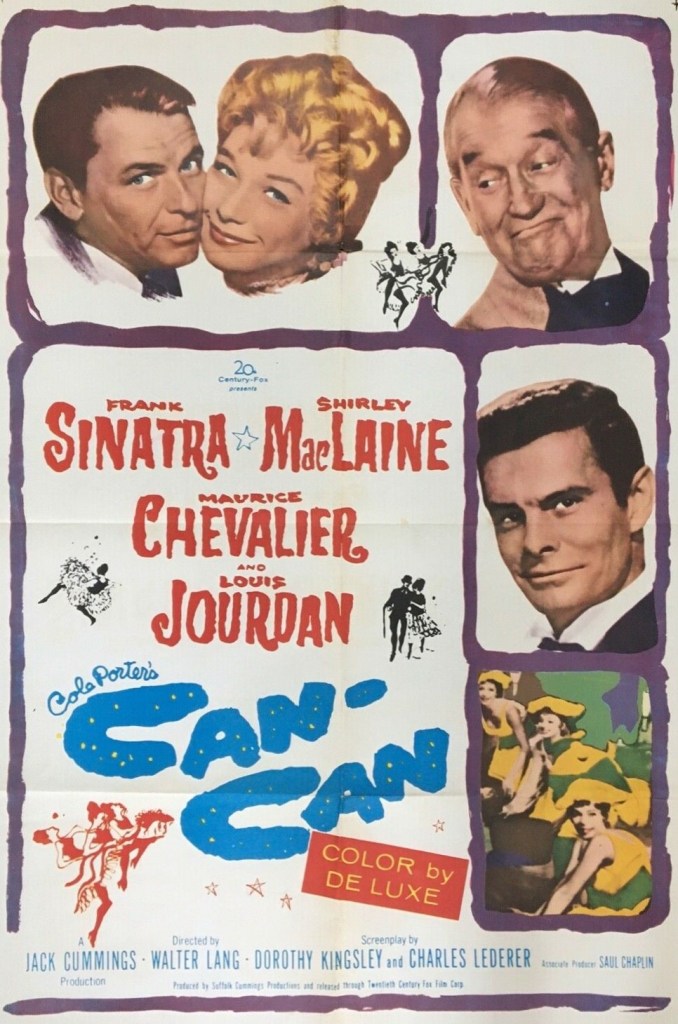
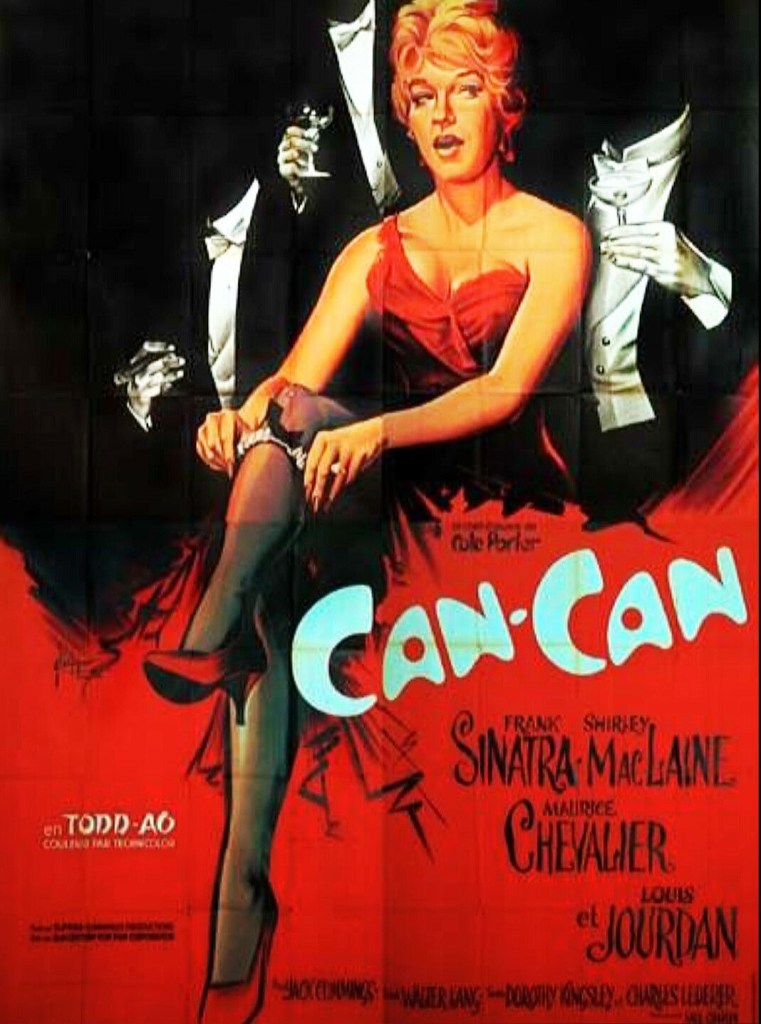
A sterling cast does justice to some great Cole Porter songs in an entertaining musical typical of the period. Apart from appropriating some stock footage, nobody was going to bother to head out on location when a Hollywood-ized version of Paris could be recreated on the set. While the film is ahead of its time in several ways – Simone (Shirley Maclaine) owns the nightclub and the women in the title dance are meant to be minus their panties, hence attempts by authorities to shut it down – the plot features an old-fashioned love triangle.
While the chief magistrate (Maurice Chevalier) turns a blind eye to the lewd dance, his younger colleague Phillippe (Louis Jourdan) does not and ensures Simone is arrested. Complications arise when Philippe falls in love with Simone who already has a lover, the lawyer Francois (Frank Sinatra) who is averse to committing to marriage. The four stars are all very charming and there is gentle comedy and effortless acting as the romantic knots are tightened and then unpicked. Hypocrisy is tested and found wanting. The courtroom scenes are amusing and most of the story focus is on how Phillippe can get round his principles and legal obligations to successfully woo Simone.
But in reality, the audience is here for the music, and to hear classic Porter songs interpreted by Sinatra and Chevalier. While the songs are top-drawer, what captured my imagination most was the “Garden of Eden” ballet with a stunning design and superb dancing by Simone and Claudine (Juliet Prowse). The “Apache Dance” also boasts some singular choreography but otherwise while the “Can-Can” itself is rousing and well-done this is for obvious reasons a censored version.
The Cole Porter contribution includes: “I Love Paris,” “C’Est Magnifique,” “It’s Allright With Me,” “Let’s Do It,” and “Just One of Those Things.”
Walter Lang was a safe pair of hands in this genre having helmed Call Me Madam (1953), There’s No Business Like Show Business (1954) and Oscar-nominated for The King and I (1956). The screenplay was a harder slog. The original Broadway musical was a romance between the judge and the nightclub owner. Adding the lawyer Francois to the mix necessitated major changes to the story. But Dorothy Kingsley also had form, having been responsible for the screenplays of Kiss Me, Kate (1953), Seven Brides for Seven Brothers (1954) and Pal Joey (1957). Co-writer Charles Lederer, although involved in Kismet (1955), had a better grasp of comedy, as seen in Gentlemen Prefer Blondes (1953) and It Started with a Kiss (1960).
Although not universally admired by the critics, it won two Oscars – color costume design for Irene Sharaff and best music for Nelson Riddle. It didn’t hit a home run at the box office either and the finger was pointed at Twentieth Century Fox for committing the mortal sin of inflating revenue figures on its initial launch.
While not one of the all-time great musicals and put in the shade when compared to West Side Story (1961) and The Sound of Music (1965), it’s an enjoyable confection, the easy screen charisma of Sinatra, Chevalier, Jourdan and MacLaine holding it all together.
A gangster trend hit the mean streets of Hollywood at the start of the 1960s. But in the absence of big box office hitters like James Cagney, Humphrey Bogart and Edward G. Robinson, these were all B films with unknowns or low-ranked stars in the leading roles. Whereas Little Caesar (1931), Public Enemy (1931), The Roaring Twenties (1939) and White Heat (1949) were fictionalized accounts of hoodlums, the gun-toting movie spree kicked off by Machine Gun Kelly (1958) and Al Capone (1959) was based on the real-life gangsters who had terrorized America’s big cities in the 1920s and 1930s.
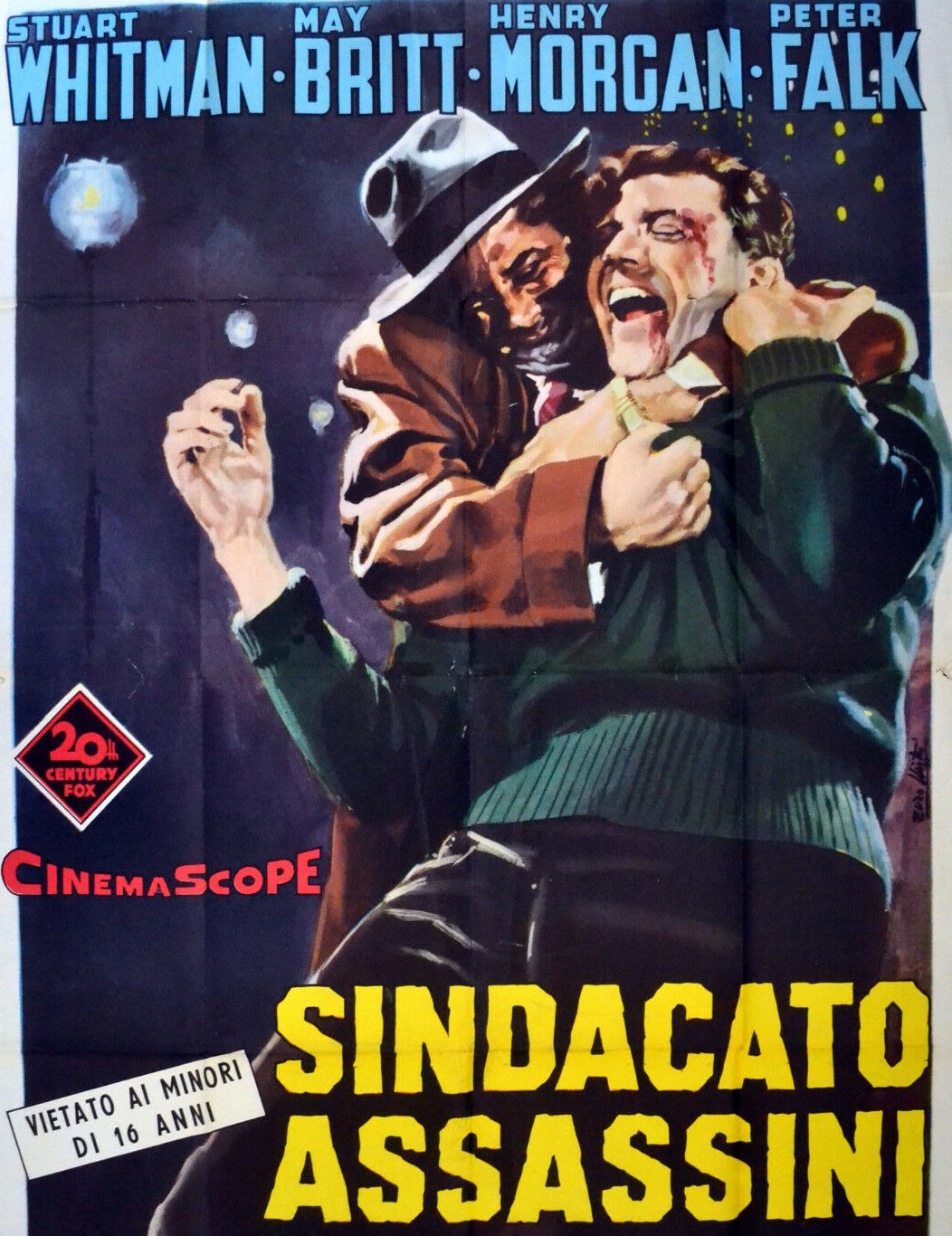
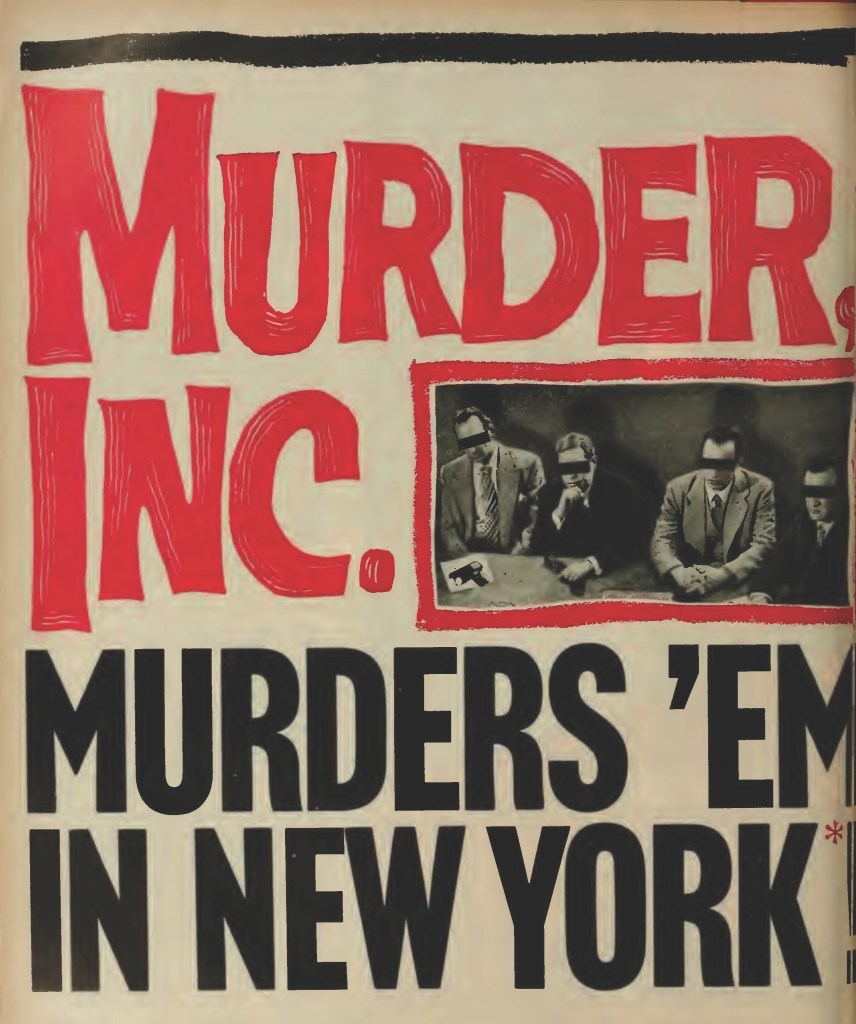
By the end of 1960, moviegoers had been served up an informal history of the country’s best-known mobsters from Ma Barker’s Killer Band (1960) and Pretty Boy Floyd (1960) to The Rise and Fall of Legs Diamond (1960) and Murder Inc (1960). The infamy of the criminals was so comparatively recent that moviemakers assumed audiences had a wider knowledge of their exploits and the context of their crimes.
Murder Inc tells how underworld kingpin Lepke Buchalter – Tony Curtis played him in the more straightforward biopic Lepke (1975) – set up a system of killing dissenters in the ranks for the entire American Cosa Nostra (aka The Syndicate) in a way that prevented those ordering the murders being connected to those committing them, the same kind of protective cell operation used by terrorists. He created a separate organisation of hitmen.
This quasi-documentary, with occasional voice-over narrative, focuses on three characters – the quiet-spoken Lepke (David J. Stewart), hitman Abe Reles (Peter Falk) and singer Joey Collins (Stuart Whitman) who becomes involved to pay off a gambling debt. Later on, the focus switches to Brooklyn assistant district attorney Burton Turkus (Henry Morgan), against a backdrop of massive police corruption, investigating the murder epidemic this deadly enterprise has created. The films jumps around too much to be totally engrossing but it is certainly an interesting watch.
The two main villains could not be more different, Lepke representing the new school, a businessman, ordering killings but never participating, and for such a tough character tormented by a delicate stomach. Reles is old school, relishing opportunities to murder, and raping Collins’ honest wife Eadie (May Britt) in part because she treats him as scum. It’s hard to muster much sympathy for Joey especially as his wife takes the brunt of the violence.
In an Oscar-nominated performance Peter Falk (Castle Keep, 1969) steals the show as the chilling, venomous killer, the kind of nonentity who rises to prominence only through his penchant for homicide. Swedish star May Britt (The Blue Angel, 1959) isn’t far behind with a portrayal of a strong woman saddled with a weak husband. As the milk-drinking hood, David J. Stewart (The Young Savages, 1961) was as scary in his pitilessness as his more overtly violent underling.
Stuart Whitman (The Commancheros, 1961) is almost acting against type for he was later known for rugged roles. Henry Morgan (It Happened to Jane, 1959) gave his portrayal of Turkus similar characteristics to Lepke, appearing as a quiet individual, concerned with details, except that he was incorruptible.
You might spot some interesting names in the cast. Simon Oakland (Bullitt, 1968) is an honest cop, Vincent Gardenia (Mad Dog Coll, 1961) is a lawyer, comedian Morey Amsterdam (The Dick Van Dyke Show, 1961-1964) plays a hotel manager, Sylvia Miles (Oscar-nominated for Midnight Cowboy, 1969) has a bit part and singer Sarah Vaughan is a singer.
For some reason, this movie starred a number of actors in leading roles who made few screen appearances. This was the only movie of the decade for May Britt, David J. Stewart made only three movies during the same period, and Henry Morgan only made three pictures in his entire career, this being the last.
The movie boasted two directors. Stuart Rosenberg (Cool Hand Luke, 1967) was replaced by Burt Balaban (Mad Dog Coll, 1961) when the threat of strike action by actors and writers in 1960 forced the 18-day shoot to be cut by 10 days so it’s hard to say who was responsible for which scenes, although the film does boast some unusual aerial shots.





 The Magnificent 60s