The Thomas Crown Affair (1968) *****

Employs Hitchcock’s trick of having you rooting for the bad guy. The caper picture remade. Steve McQueen (Nevada Smith, 1966) reinvented. Faye Dunaway (The Extraordinary Seaman, 1969) making the most stunning entrance this side of Ursula Andress in Dr No (1962). The technological dream of the split screen. Film noir filmed in bright sunshine with a femme fatale on the right side, only just, of the law.

Takes the insurance agent of Psycho (1960) and switches the gender. Nabs the Hitchcock crown (Notorious, 1942) for the longest screen kiss. Steals from Ingmar Bergman (The Seventh Seal, 1957) the title of best chess scene.

Female sleuth at a time when I don’t think the idea of a female detective crossed anyone’s minds in Hollywood. And one so sexy, stylish and uber-confident that she attracts not one sexist remark. Not dumb enough either like Lila in Psycho to walk into a trap.

And, incredibly, given wealth has been a movie trope since day one, luxuriates in a lifestyle – gliders, dune buggies, polo – never seen before. Not just a mesmerising song (“The Windmills of Your Mind”) but an absolutely outstanding score from Michel Legrand (Play Dirty, 1968). Almost works as a visual greatest hits collection, one memorable scene after another, a cat-and-mouse scenario, twists aplenty and smart, smart dialog.

Ignores back story and dark hidden secrets. Dispenses with the usual robbery cliches of planning the heist and the robbers irritating the hell out of each other. Theft here is carried out with mathematical precision, the crew members never meeting, mastermind Thomas Crown (Steve McQueen) hidden from view at initial interview behind a bank of blinding lights. But the investigation is clever, too, donkey work – tracking everyone who flew to Geneva (where the stolen cash is banked) – coupled with instinct, insurance agent Vicki (Faye Dunaway) choosing Crown as the most likely criminal from his photograph, and a piece of inspiration, offering a huge reward for anyone noticing their spouse had been in Boston on the day of the robbery and been behaving oddly.

Crown is a fabulous invention, savvy businessman, bursting with competitive instinct, unable to prevent himself crowing, his opening line – “you overpaid” – puncturing the triumph of businessmen who believed they bettered him in a deal. But he’s bored, riches and all the toys that brings including sexy girlfriend Gwen (Astrid Heeren) not enough, and he seeks to test himself against the law.

But he’s always testing himself, regardless of how high or how low the stakes. He’s the kind of guy who just bets for the thrill. The only reversal in the whole movie is a golf match where he employs the old sucker punch, double-or-quits routine, to be able to repeat an unexpectedly successful shot. When he loses spouts another brilliant line, “What else can we do on Sunday?”

But he’s up against as steely a competitor. Has any character ever delivered such an immortal line with such panache – “I’m immoral” – as Vicki who has no qualms about invading Crown’s house on a flimsy pretext or  kidnapping the son of one of the gang. “You won that round,” she tells Crown after bringing gang member Erwin (Jack Weston) in for questioning and stationing him in the same room as Crown, hoping to elicit recognition.

You’d hardly be surprised to discover she’s more than capable of using her body as a weapon, but you’d be hard put to work out who is seducing who. For both, part of the attraction must be danger, being up close (and very personal) with your rival. It wouldn’t take much to imagine this is a reversal, that Vicki is being hunted, that in the throes of romance she will give away too much. Or that the arrogant Crown believes he can have his cake and eat it. He doesn’t need the money, he can give it back, avoid arrest and sail off into the sunset with a woman his match in style and intellect.

If there’s one flaw in the spellbinding narrative, it’s here. We all know insurance exists outside the law. Retrieving money for clients is the sole aim, justice not on the agenda. No bank chief executive wants to suffer the embarrassment of being hauled into a courtroom to explain just how fallible their security systems are. Hand back the money, bury the publicity and all’s well. I’m not entirely sure why Vicki had to seek the approval of detective Eddy (Paul Burke), leading the police side of the investigation, when she could as easily have bypassed him and picked up her ten per cent of the money as reward and sailed off into the sunset.

Unless, of course, it’s not a flaw. And that for Vicki, as resolute a competitor as Crown, she requires official recognition of victory and to prove her superiority over the criminal by allowing him to be set free, giving her if you like the upper hand in the relationship.

Director Norman Jewison was on a box office roll after turning conspiracy upside down with The Russians Are Coming, The Russians Are Coming (1966), and exploring racism with In the Heat of the Night (1967). Where most critics prefer directors who reveal thematic consistency, Jewison seemed to be headed every which way – although in the cat-and-mouse stakes you could look at The Cincinnati Kid (1965) – with elan his ace in the hole.

And if you ever sat in a movie theater and thought you could do better than the drivel you were watching, then screenwriter Alan R. Trustman would be your patron saint. A lawyer by profession, he wrote The Thomas Crown Affair in a couple of weeks and, hardly surprising, given its audacity, it found its way to an agent. He went on to write Bullitt (1969), Lady Ice (1973) –  almost a remake of Thomas Crown – and The Next Man (1974) for Sean Connery.

The best fun crime movie since Hitchcock paired Cary Grant and Grace Kelly in To Catch a Thief (1955) and never bettered since.

Dazzling.
Five Card Stud (1968) ****

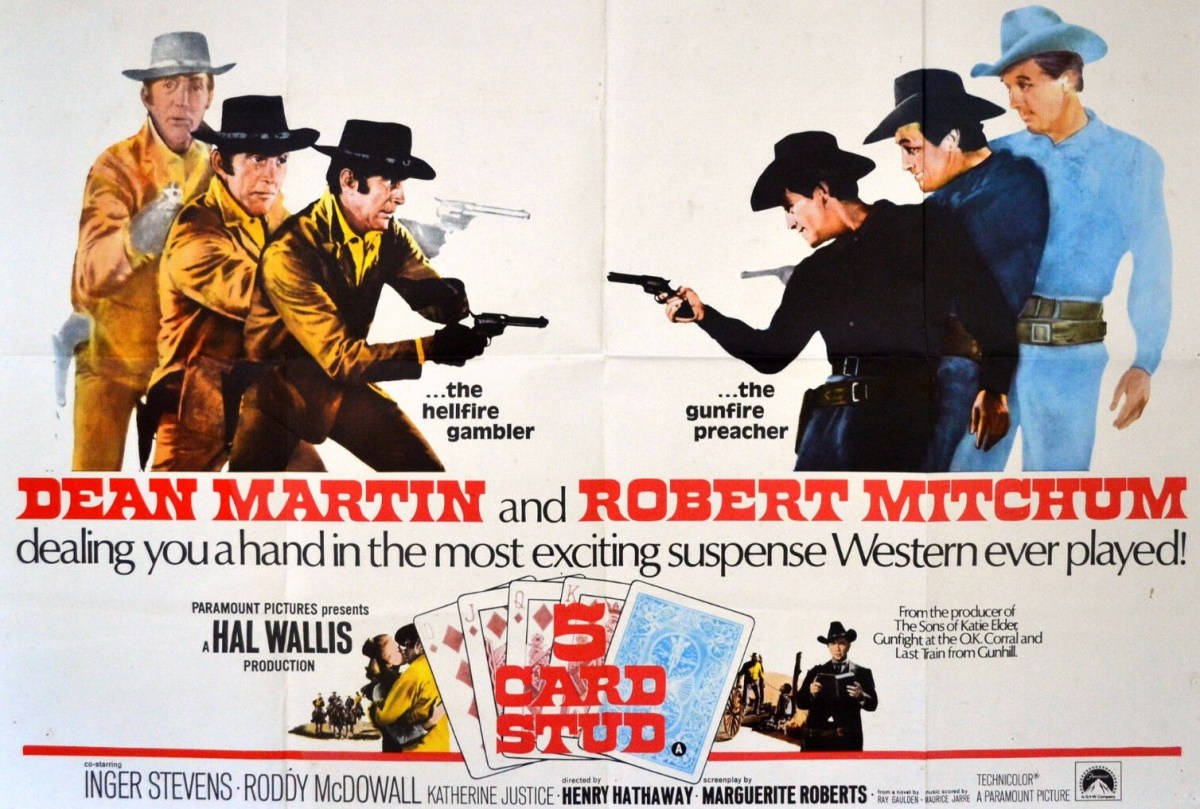
Another western in sore need of re-evaluation. Largely dismissed as a routine oater trading on the gimmick of a whodunit and packed with old stagers, this is in fact about a serial killer, a treatise on law and order, and almost acts as a conduit between the decade’s previous westerns when the good guys and the bad guys are easily defined to the end of the decade when such distinctions were muddied after The Wild Bunch (1969) and Butch Cassidy and the Sundance Kid (1969) invited audiences to root for the bad guys. In this rather well-structured picture, full of action and romance, we don’t know who the bad guy is.

The whodunit, however, is really a MacGuffin. The movie is more concerned with investigating the changing mores and hypocrisies of the West and predicting the inherent dangers in the proliferation of weaponry. It’s worth remembering that the movie came out at time when mass murderers such as Charles Whitman (the subject of Peter Bogdanovich’s Targets, 1968) who went on a killing spree in 1966 were becoming the norm.

A card sharp is lynched for cheating at poker in the quiet town of Rinchon where late-night gambling is the height of entertainment. One of the players, professional gambler Van (Dean Martin), attempts to stop the hanging but is beaten up for his troubles. No surprise then, that he ambles off to Denver. Sometime later the hangmen begin dying off and Van returns not just to solve the mystery but to ensure that his name isn’t on the list. “If someone is out to kill you, you don’t sit around and let him pick the time,” he concludes. With the number of killings, not to mention brawls and shoot-outs, it’s almost continuous action.

On his return, Van discovers, with a gold strike nearby, the incipient boom town has attracted unsavory elements, not just the high murder quotient but a whorehouse and loud music in the saloon. Acting as counterbalance is gun-toting preacher Jonathan Rudd (Robert Mitchum) who announces his presence by spraying bullets in the saloon floor, emerging as the self-proclaimed “conscience” of the town.

For a sometime protector of law and order, Van is rather lax in the morals department, unwilling to commit to main squeeze rancher’s daughter Nora (Katharine Justice) when the likes of Lily (Inger Stevens), the unlikely proprietor of a barbershop-cum-whorehouse, are on hand. Van is an interesting study. Once he becomes aware that the only people likely to end up in an early grave are the six men who played poker with the lynched individual, it doesn’t occur to him to fess up to Marshal Dana (John Anderson) which would ease the fears of the ordinary public. Awareness the only corpses belonged to the guilty would have prevented further outbursts of violence among a disaffected population. Interestingly, too, Dana makes no attempt to investigate the lynching.

At the core of this picture are a couple of amazing scenes as paranoia takes hold. One miner, without the slightest sense of irony, complains that in the old days a gunfight took place face to face, not by a murderer slinking round in the dark. Rudd adds some prophetic advice: “wear a gun and use it fast, wear a gun and use it slow – I say don’t wear a gun and you won’t use it at all.”

Van likes to think he has the measure of women, when in fact they have the measure of him. The story avoids the obvious lure of a love triangle, of jealous women competing for Van’s affections. Both the young Nora and the more mature Lily are pretty well grounded. “One wore-out no-account kiss” is Nora’s dismissive description of Van’s attempts at romance while Lily lets Van know she has taken a shine to him as a matter of convenience, he’s just a man and she hasn’t had one in three years. Expecting to be treated as a pariah, Lily, expressing the notion that “women don’t usually like women who like men,” strikes up a friendship with Nora.

Marshal Dana finds it increasingly difficult to maintain any kind of peace since as the death count mounts, paranoia grows rife, exacerbated by the kind of greed gold fever brings, resulting in citizens determined to challenge authority and take matters into their own hands.

The most antsy character is Nick (Roddy McDowall), Nora’s brother and the leader of the lynch mob. Nick seems to stir up bad feelings, provoking the ire of both his father and Van. The guilty are despatched in original ways, one man “drowns” in a barrel of flour, another strangled by barbed wire, a third wakes the town at night when the church bell to which his neck is attached starts ringing out. It’s not too hard in the end to work out who the killer is, but as I said, that is not the point of the picture, although the ending is satisfactory.

There a mass of small detail of the kind that director Henry Hathaway (True Grit, 1969) tends to work into his pictures. Van is a cut above. He travels to Denver and back by stagecoach not on horseback. Citizens can purchase Pocahontas Remedies and beer from the Denver Brewery. Shaves and haircuts at the Tonsorial Parlor are reasonably priced but “miscellaneous” comes in at $20. After the preacher shoots up her floor, saloon owner Mama (Ruth Springford) smooths out the holes.

And there is some distinctive direction. Rudd’s sermon that lasts nearly 90 seconds is delivered in virtually one take, a fistfight is conducted in silence except for a soundtrack punctuated by grunts and punches hitting their target, a dying man tries to leave a physical clue about the identity of the mysterious killer. And there is a superb main street gunfight with Van trying to rescue the marshal and Rudd striding down the street in old-fashioned gunslinger mode.  

Dean Martin (Rough Night in Jericho, 1967) and Robert Mitchum (The Way West, 1969), both with apparently easy-going but magisterial screen personas, come off well together. Inger Stevens (Firecreek, 1968)  always a great screen presence, an ethereal beauty, is vulnerable and strong at the same time. Katherine Justice (The Way West, 1967) is sassy and independent-minded and has a terrific facial response to coming across the first murder.  John Anderson (The Satan Bug, 1965) leads a fine supporting cast including Yaphet Kotto (Live and Let Die, 1973), Denver Pyle (Shenandoah, 1965) and Whit Bissell (Seven Days in May, 1964).

Screenwriter Marguerite Roberts, adapting the novel by Ray Gaulden, contributes some classic lines. “If that is a Bible, read it,” Van instructs Rudd, assuming the preacher has a gun planted in the Holy Book, “If it ain’t a Bible, drop it.” There’s a nod to a James Coburn scene in The Magnificent Seven (1960). Congratulated on his marksmanship in hitting the spinning wheels of a windmill six times out of six, Rudd protests his shooting was a failure since he was aiming for the spaces in between. It was ironic that her next assignment concerned a lawman who took much the same no-holds-approach to the criminal fraternity (True Grit, 1969) as the killer in this picture.

I was so intrigued by this picture, realizing it had much more to offer than a whodunit, that I watched it again within a few days and was pleasantly surprised by its depths.

Discover WordPress

A daily selection of the best content published on WordPress, collected for you by humans who love to read.

The Atavist Magazine

by Brian Hannan

WordPress.com News

The latest news on WordPress.com and the WordPress community.