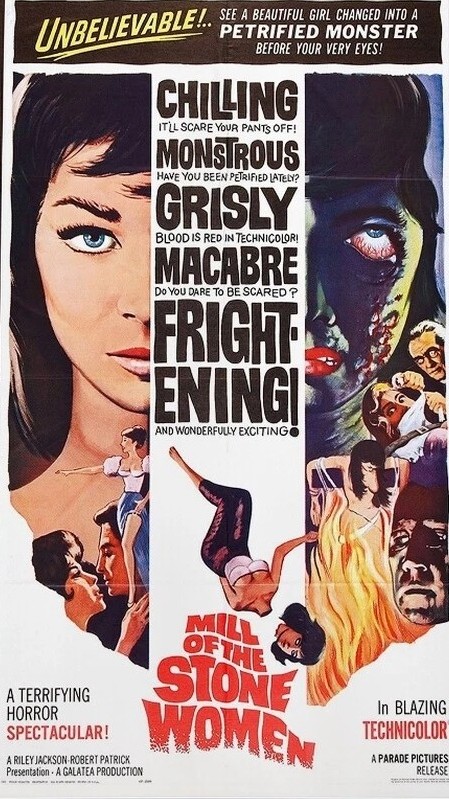
Mill of the Stone Women (1960) ****

Character has generally been replaced by gore or slaughter in the modern horror film. Ever since Hammer ruled the roost, blood-letting has assumed greater and greater significance, and ever since The Exorcist (1973) the genre has traded on shock values. Current box office sensation Sinners (2025) has gone some of the way to re-aligning the balance with its emphasis on character and thematic symmetry.

So it’s somewhat reassuring to discover that prior to those developments there could be an absolute chiller of a tale where nonetheless character, and not just for the two principals, was all. I should tell you right away that there is a vampiric element in the drawing of blood but that is carried out in the more refined scientific manner of medical blood transfusion. And the undead do rise again, just to get that story point out of the way, but it’s not because an evil count refuses to be put to sleep, but out of a father’s love for his daughter.
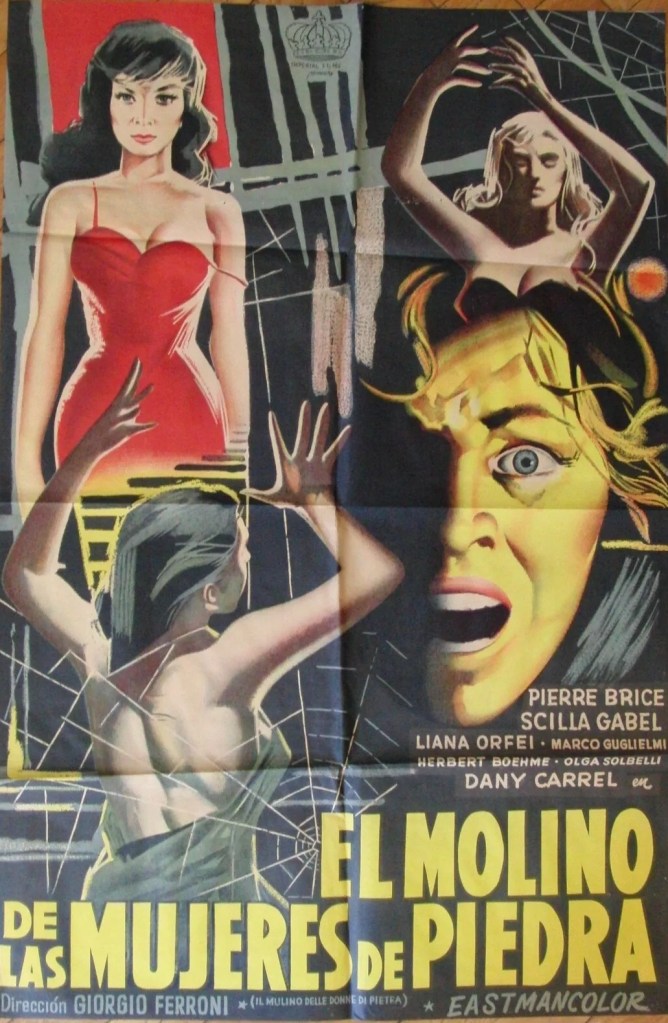
Quite the most fearful element here is the preponderance of unrequited love. The man whose medical skills saves a woman’s life is rejected by her, she in turn is ultimately rejected by an unforeseen suitor while he, in turn, for a time turns his back on his long-term girlfriend. The father also shows he has little loyalty to the man who deserves that most of all.

But let’s start at the beginning. In nineteenth century Holland, land of canals and dykes you will recall,  student Hans (Pierre Brice) arrives at the watermill owned by Professor Wahl (Herbert Bohme) to write a report on the macabre carousel he has devised, a feat of engineering running on levers and gears and wheels, that present a “theater of death” populated by very lifelike inanimate statues. While there, he espies a beautiful woman.

Hans’s girlfriend Liselotte (Dany Carrel) is immediately jealous and unsure whether he loves her as much as she, a childhood friend, loves him. Back at the mill, Hans encounters smug Dr Bohlem (Wolfgang Preiss) who is on constant call to look after the professor’s very ill daughter Elfie (Scilla Gabel), the aforementioned beauty.
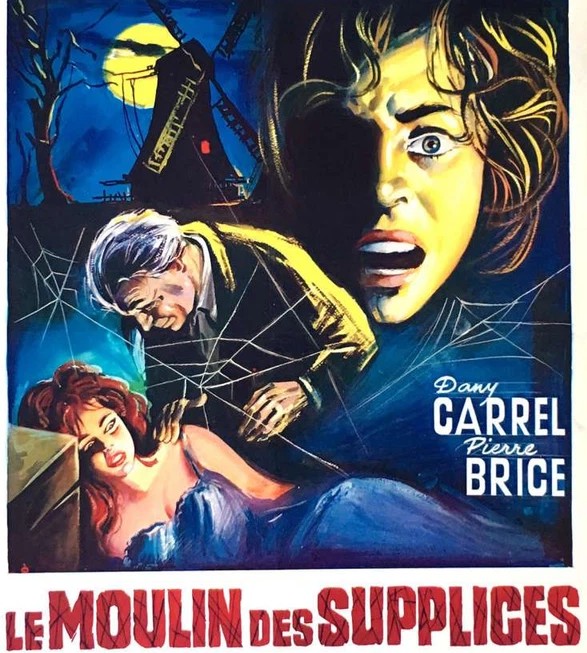
Although for mysterious reasons Elfie’s life depends on the doctor’s ministrations she rejects his overtures with haughty disdain. Meanwhile, she seduces Hans. Although initially smitten, Hans soon realizes the error of his ways. But Elfie, who it turns out has seduced many male visitors, becomes obsessed with him. Before he can break off their relationship, she collapses and dies.

Hans is accused of murdering the girl. Out of his wits, he’s sedated by the doctor and when he wakes up is convinced he has seen Elfie alive and another woman trapped in a room. He is persuaded by the professor and the doctor that he is going mad and he flees the mill, in theory never to return. The professor and doctor have kidnapped local girl Annelore (Liana Orfei), sometime life class model and chanteuse, and revive Elfie via a blood transfusion from the captive. The pair don’t need to get rid of the body, the professor transforming it into one of his very lifelike sculptures by covering it in wax.

Liselotte’s jealousy evaporates when she has Hans all to herself, nursing him back to health, and he asks her to marry him. Though nagged by his visions, he manages to dismiss them until he sees a photo of Annelore, whom he previously never met, and whom he glimpsed tied up in the mill.

Meanwhile, the doctor has discovered a serum by which Elfie can live a proper life, and it only requires one final transfusion. To that end he’s kidnapped Liselotte. But the doctor is determined to extract a price. Knowing that Elfie will no longer be dependent on him, he demands her hand in marriage. Despite what she owes him, she still, as high-and-mighty as before, rejects him. Using the same argument, the doctor appeals to the professor who is even more outraged at the idea, given the doctor was thrown out of his profession for malpractice and is an ex-convict.

The professor is even less grateful than his daughter and kills the doctor. Having witnessed the transfusion so many times, he begins to carry it out himself. But at the critical moment, he can’t find the serum. And it’s gone. When the doctor fell, the bottle of serum in his pocket smashed.

Hans rescues his fiancé while the mill burns to the ground, the wax melting from the sculptures betraying the skeletons underneath.

Most of the horror is left to audience imagination. There’s no gore, no throats slashed, very little blood, not even a scream. It’s the most discreet horror picture you’ll ever see and all the more effective for it. We probably didn’t need the scene of the conspirators gloating and giving away their evil plan but otherwise it works a treat.

All the characters are given clear identities, father and daughter gripped by obsession, doctor by the delusion of marriage as reward, Hans wayward in his affections but sensible enough to recognize stifling love when he sees it, and even Liselotte is best defined as overly jealous.

It’s handsomely mounted too, and the mill interiors have all the eerie trappings of the normal castle. Pierre Brice (Old Shatterhand, 1963) and Scilla Gabel (Sodom and Gomorrah, 1962) are given license to overact, and while Dany Carrel (Delphine, 1969) works through gritted teeth, Wolfgang Preiss (The Train, 1964) and Herbert Bohme (Secret of the Red Orchid, 1962) are the epitome of the cultured villain.

Unable to call upon a vast cauldron of blood to splatter, this is a more intelligent horror picture, directed with measured cadence by Giorgio Ferroni (The Lion of Thebes, 1964) from a script by the director, Ugo Liberatore (The Hellbenders, 1967) and Giorgio Stegani (Death on the Fourposter, 1964).

Rewarding watch.

Anzio / The Battle for Anzio (1968) ***

Seems you couldn’t make a moive about defeat in the 1960s, you had to find something in the story that sounded victorious. Although the Allied landings at Anzio in January 1944 eventually led to the liberation of Rome, the whole operation was a mess. So instead of concentrating on outnumbered American and British troops being pounded to pieces on the beaches, director Edward Dmytryk (Alvarez Kelly, 1966) opts for the men-on-a-mission angle.   

Somewhat bizarre is the insertion of war correspondent Ennis (Robert Mitchum) into the story. Sure, because he’s not going to get busted for insubordination, he can challenge and/or lambast fictional commanding officers General Carson (Robert Ryan) and Major General Lasky (Arthur Kennedy) but it seems odd that he goes around spreading anti-war sentiment when the people escorting him are in serious danger of ebing killed. On the plus side are three sequences depicting the brutal reality of war in a way that no other picture of the period dared.

After landing unopposed Laskey decides not to risk moving forward, leaving his troops open to being trapped by advancing Germans even though Ennis, after commandeering a jeep, managed to reach Rome with encountering any opposition.

A Ranger battalion is sent to scout the surrounding countryside and the movie chooses to concentrate on a small platoon unit within that, headed by Sgt Stimmler (Earl Holliman) and including the fun-loving Corporal Rabinoff (Peter Falk), the kind of guy who spends the night before the landing entertaining three sex workers in the back of stolen ambulance who are of course desperate to learn the words to “Bye, Bye, Blackbird.”

After the Rangers are cut to pieces at the Battle of Cisterna, the unit escapes through a minefield, discovers a massive German construction site, holes up in house with three Italian women, is pinned down by snipers in a field of shell-holes and finally makes it back.

American tropps being slaughtered at Cisterna is a helluva note as the movie switches tack from exposing leadership folly to just getting the platoon out of this mess. Pursued by a flame-throwing Panzer, they pick their way through a minefield using the quite clever device of lobbing onto it large chunks of stone and then walking across on the stones as if crossing a dangerous river.

Wanting to find out more about the mysterious construction work results in Ennis causing the death of one of the gang. When they hide out in the Italian house, eventually killing off investigating Germans, the naïve Ennis wants to take the women with them.

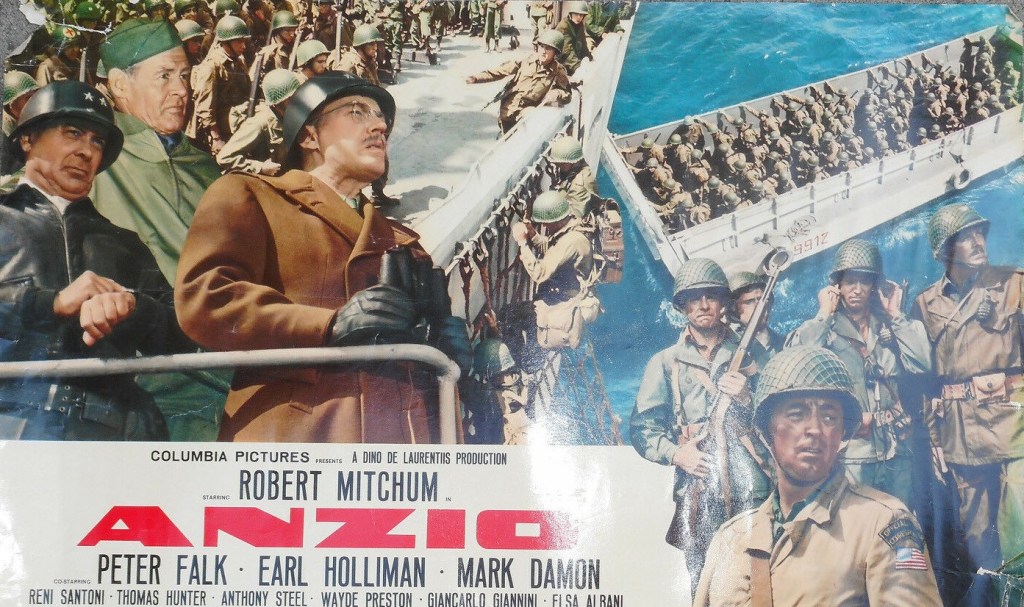
Bit of marketing sleight-of-hand. Slinging a whole bunch of faces at the bottom of a poster was shorthand for all-star cast, which this picture definitely lacked.

Trapped by snipers in open country, they are being picked off one by one with only clever tricks and sacrifice offering a way out. One of the notions is to throw a fake grenade the snipers’ way. The instant reaction to any soldier to an incoming grenade is to get the hell out of the way, turning themselves into a turkey shoot. But the only other way to entice the snipers to reveal themselves is for the soldiers to take turns in presenting themselves as targets.

One of the ongoing themes of the picture is Ennis refusing to bear arms, and although the trailer shows him blasting away with a machine gun that only occurs at this climax when he seizes the weapon from a dead German. Ennis is an odd character for a war picture. None of the soldiers can believe anyone would not just volunteer to participate in a bloody war but carry nothing to defend themselves with. It’s a bit tiresome to hear him being reminded that he doesn’t have to be here, and to turn down the offer or a rifle or a grenade.

And for a non-combatant he’s not exactly uninvolved in strategic matters. A couple of times, as if he’s the most entitled grunt you ever came across, he virtually assumes command, barking orders that the others obey. Admittedly, it’s his cleverness that gets them through the minefield, but it’s his stupidity that gets others killed and to have him pontificating at the end that men go to war “because they like it” is incredibly facile, although in keeping with the anti-Vietnam sentiments of the time (1968, that is, not 1944).

Rabinoff, the only other character about whom we learn anything, is unfortunately on the preposterous side.

While the movie is far from dire, and as I said, very realistic when in portraying war actuality, it’s not the picture I guess audiences expected. While the scene-stealing of Peter Falk (Penelope, 1966) gets in the way, Robert Mitchum (5 Card Stud, 1968) proves an interesting character, although he is also laden down by having to spout a bunch of dumb lines. Arthur Kennedy (Fantastic Voyage, 1966) is the pick, especially at the end facing up to the ignominy of being relieved of command.

This kind of movie is potentially a breakout for the supporting cast. But here, with the exception of Falk, the script lets them down, nobody given the kind of distinctive characterisation that elevated The Dirty Dozen (1967), for example, above the norm. Apart from Earl Holliman (The Power, 1968) and Italian Giancarlo Giannini (The Sisters, 1969) this was not a career-making movie. You can spot Mark Damon (Dead Men Don’t Count, 1968), Patrick Magee (A Clockwork Orange, 1971), Anthony Steel (The Story of O, 1975), Rene Santoni (Guns of the Magnificent Seven, 1969), Wolfgang Preiss (Von Ryan’s Express, 1965)  and Robert Ryan (Battle of the Bulge, 1965).

Edward Dmytryk (Mirage, 1965) does a reasonable job with the materials to hand, and the minefield and sniper scenes are first class. Italian veteran Duilio Coletti (Under Ten Flags, 1960) directed the Italian version though I’ve no idea what that was, or if it differed in any way from the Dmytryk cut. Coletti also had a hand in fashioning the screenplay along with H.A.L. Craig (Fraulein Doktor, 1969), Frank De Felitta (Audrey Rose, 1977) and Giuseppe Mangione (Run, Psycho, Run, 1968).

Discover WordPress

A daily selection of the best content published on WordPress, collected for you by humans who love to read.

The Atavist Magazine

by Brian Hannan

WordPress.com News

The latest news on WordPress.com and the WordPress community.