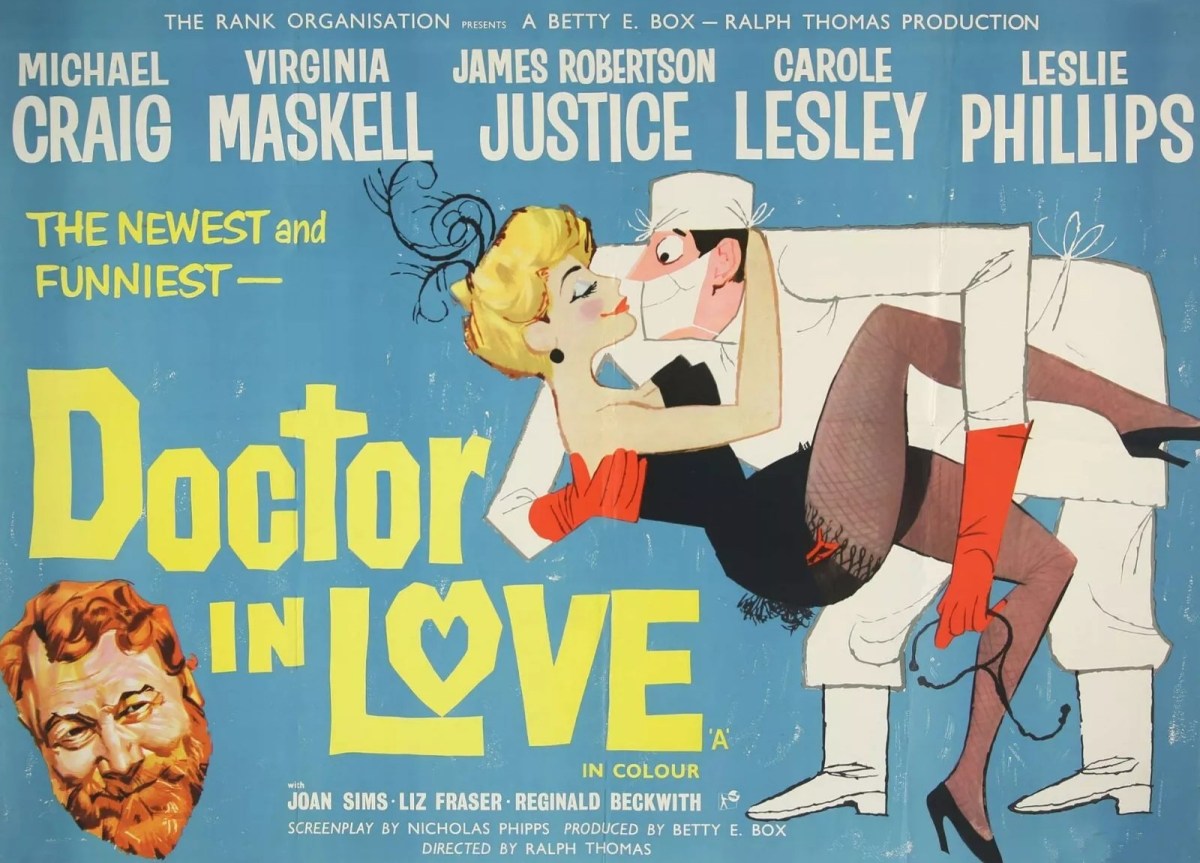
Doctor in Love (1960) ****

Chortled all the way through. You can see why it was the biggest film at the British box office in 1960. Dirk Bogarde had turned up his nose at repeating the character for the fourth time and went off to make more serious pictures like Victim (1961) which, it transpired,  dented his box office appeal. Replacement Michael Craig (Mysterious Island, 1961), while brawnier, passes this particular screen test with flying colors though he has his work cut out to hold his own against such practised scene stealers as James Robertson Justice (Mayerling, 1968) and Leslie Phillips (The Fast Lady, 1962) and once Virginia Maskell (The Wild and the Willing, 1962) enters proceeding her coolness makes the camera her own.

I was surprised how much this relied on innuendo. But this is a gentler exercise in smut than the sniggering guffawing Carry On approach. And there’s little chance of it descending into misogyny since the females hold all the aces. The plot is episodic and none the worse for that and even a diversion into a strip club, which might suggest a narrative clutching at straws,  proves a surprising highpoint.
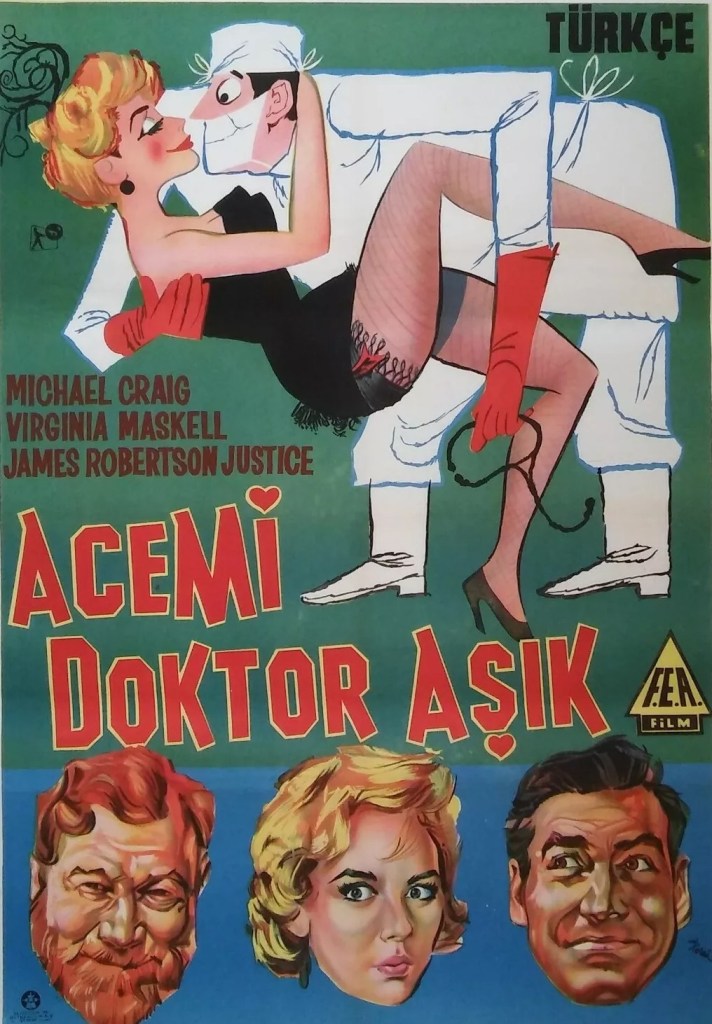
Basic story shifts Dr Hare (Michael Craig) out of hospital and into general practice which provides ample comedic opportunity via patients and colleagues. But, first of all, just to confuse matters and as if the producers were worried the series might not survive outside the boundaries of St Swithins Hospital, the tale begins with him returning to hospital with what turns out to be jaundice.

Cue the booming interventions of Sir Lancelot Spratt (James Robertson Justice) and the first of the love stories wherein Hare and Dr Hinxman (Nicholas Parsons) are rivals for flighty Nurse Sally Nightingale (Moira Redmond), who, in the first of many knocks to the male ego, while playing off one against the other goes off with another man. Before she does, Dr Hinxman takes revenge by prescribing all sorts of medications which will leave Hare so indisposed he is unable to respond to the nurse’s ardor.

Back in civvy street, as a GP, Dr Hare has to fend off predatory female patients and secretary Kitten Strudwick (Carole Lesley) and deal with standard comedic issues such as the boy who gets his head jammed in a cooking pot and the less common task of explaining the facts of life to a 40-year-old virgin. His boss Dr Cardew (Nicholas Phipps) is under the thumb of a wife who has shipped out to California only to summon her husband every now and then. The ever-amorous Dr Burke (Leslie Phillips) fills in and is the prime mover in an episode that involves strippers Dawn (Joan Sims)  and Leonora (Liz Fraser). There’s a particularly good reversal in a drunken scene where the totally inebriated Wildewinde (Reginal Beckwith) completes all the police drunk tests (if that’s what they’re called) with ease.
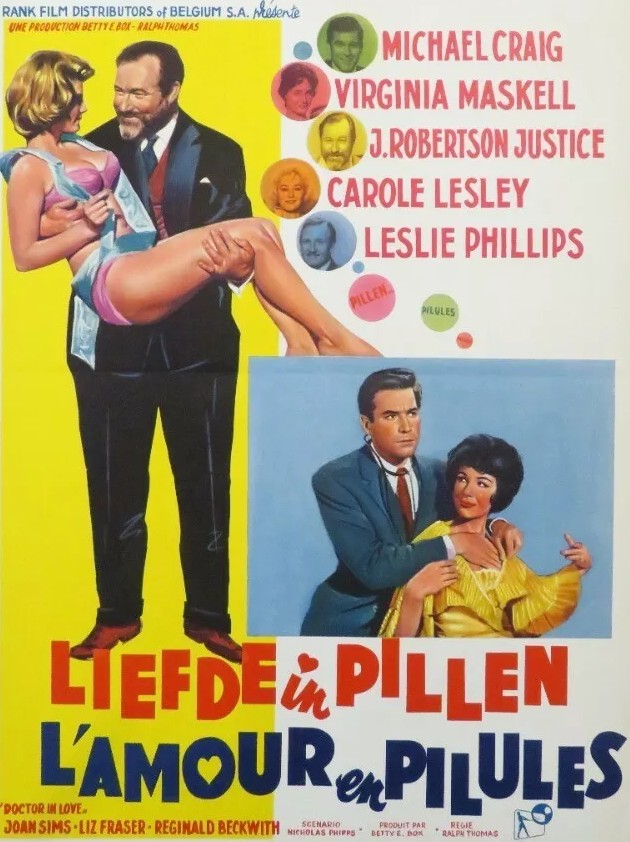
When Dr Burke is incapacitated, his place is taken by Dr Nicola Barrington (Moira Redmond). And that should have been enough of a plot to see the picture through but the movie doubles down on complication. Dr Barrington fends off Dr Hare and when Nurse Nightingale reappears Barrington in due course quits. Dr Spratt is also on board for further scene-stealing duties including ruling the roost in a strip club and undergoing an operation.

The romantic situation is resolved, Dr Spratt is put in his place temporarily and our hero effects a return to the hospital.

I wouldn’t say the writing (by Nicholas Phipps) is of the highest caliber but the jokes come at an assembly line pace and the cast are superb, barely a cast member incapable of stealing a scene. You hire James Robertson Justice and Leslie Phillips at your peril. Without Dirk Bogarde hogging the scenery, this flows much better than others in the series, with the supporting cast being more than just foil to a star who was a major box office attraction at the time. And it helps that the women – Moira Redmond (Nightmare, 1964), Virginia Maskell, Carole Lesley (Three on a Spree, 1961), and Carry On regulars Joan Sims and Liz Fraser –  are even more adept at scene-stealing than the men and not merely foil for misogynist jokes as in the Carry On series.

Director Ralph Thomas (The Wild and the Willing) seems to have found a new lease of life without having to deal with Dirk Bogarde and brings a certain verve to proceedings, especially in tripping up male ego.

Comedy is such an odd one to judge. Many a time I have sat through with scarcely a titter movies I’ve been told are hilarious. Other times I’ve been told to give them a free ride because they are making a point. So I stick to my own rule.

Make me laugh – I don’t care how – and this had me laughing all the way through.
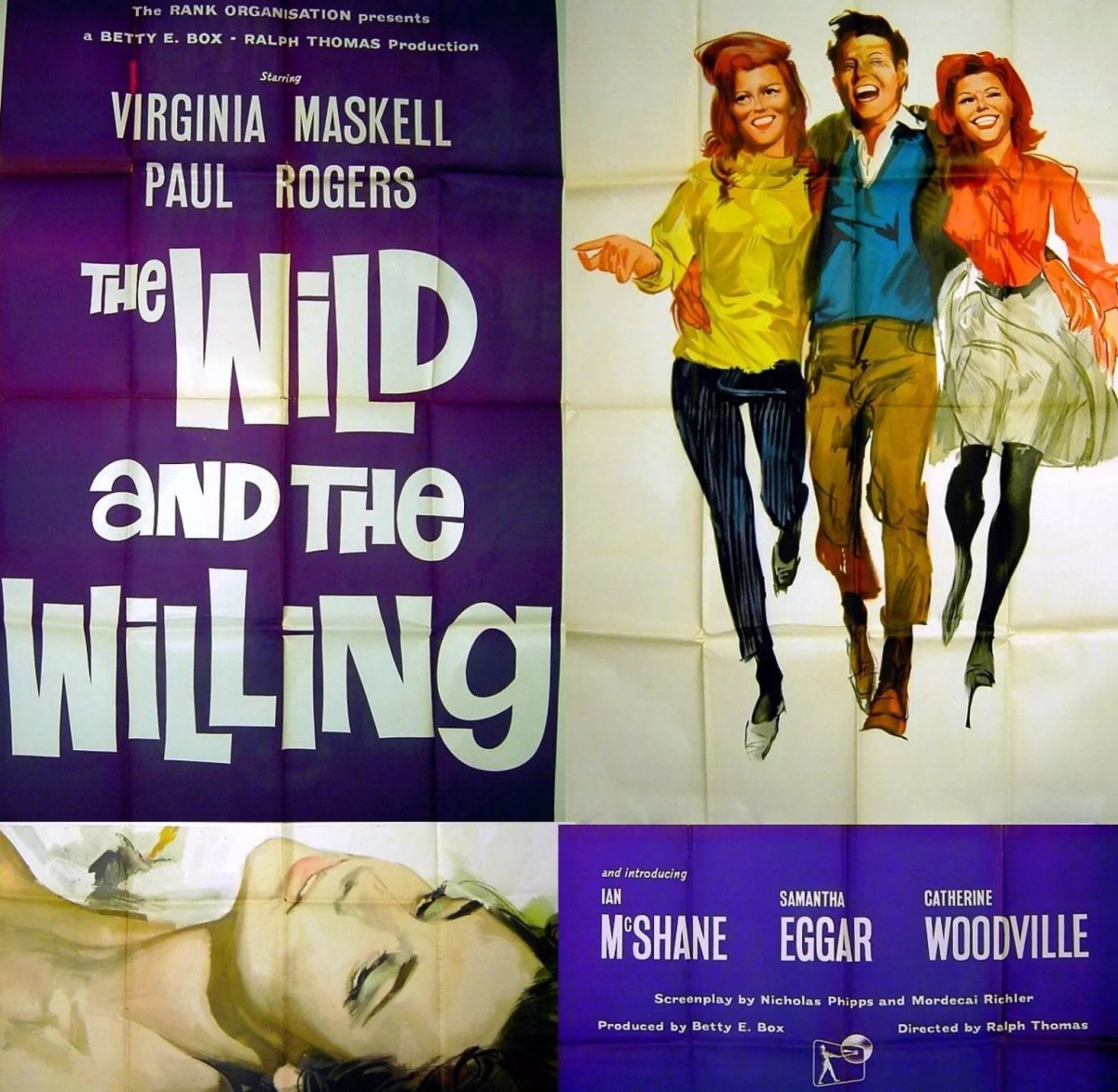
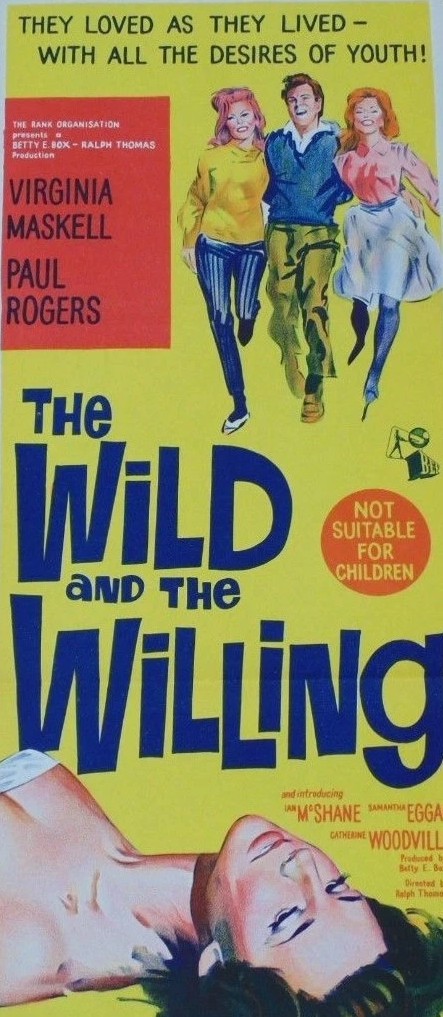
The Wild and the Willing (1962) ***

The problem with showcasing new talent is that it’s a pretty difficult sell given that all audiences have to go on is a studio’s faith in these newcomers. You can’t actually justify which of these will succeed until long after their initial forays.

In fact, this was a pretty good indicator one way or another of the talent the Brits had at their disposal, although some only became major players via television and others like Ian McShane, making his debut, as durable as he was as occasional leading and staunch support and television work (Lovejoy, 1986-1994), really only achieved substantial fame around four decades later via Deadwood (2004-2006) and the John Wick series.

For others, this proved an ideal calling card, Samantha Eggar, another debutante, was the biggest immediate beneficiary, female lead in big-budgeters The Collector (1965) and Walk, Don’t Run (1966). But virtually everyone in the cast had a whiff of stardom at one time or another. John Hurt’s stint as Sinful Davey (1969) didn’t do him much good but his career revived through the likes of television movie The Naked Civil Servant (1975), Midnight Express (1978) and Alien (1979).

This is stuffed with names you might remember one way or another. Jeremy Brett became a television Sherlock Holmes, Johnny Briggs enjoyed one of the longest-running roles in British soap Coronation St. Paul Rogers made headway in Stolen Hours (1963) and was a solid supporting actor. Johnny Sekka made a splash in Woman of Straw (1964) and The Southern Star (1969). Some careers were short-lived, the slightly more established Virginia Maskell’s last picture was Interlude (1968).

The story itself – I’m sure you couldn’t wait till I come to that – is slight, but with sufficient complication for a narrative to flourish. Activity takes place on a university campus. Harry (Ian McShane) and Josie (Samantha Eggar) are an item, at least until his eye wanders to Virginia (Virginia Maskell), the unhappy wife of Professor Chown (Paul Rogers).

Harry’s nerdy pal Phil (John Hurt) has been knocked back by Virginia’s classy pal Sarah (Katherine Woodville) and in trying to become as popular as Harry embarks in a daft adventure that ends in disaster.

As far removed from the kitchen sink drama popular at the time, this is a well-observed piece about the young and ambitious without ever descending into the intensity that other pictures wallowed in. You can forget about the suggestiveness of the title, by today’s standards this is very tame and skirts issues of sexuality that were becoming more predominant.

Ralph Thomas (Deadlier than the Male, 1967) directs from a script by Mordecai Richler and Nicholas Phipps adapting a play The Tinker by Laurence Doble and Robert Sloman, effortlessly seguing away from the stage origins and deftly putting every aspect of the narrative jigsaw in its place.

So, part of the fun here is seeing how well actors established a screen persona, or how they moved on. Ian McShane certainly had the cocky walk, but was still too much of the ingénue, even while playing a bad boy. Samantha Eggar was more instantly recognizable for the charisma she threw off. You would see John Hurt’s nerd again and again.

Interesting for more than archival purposes.

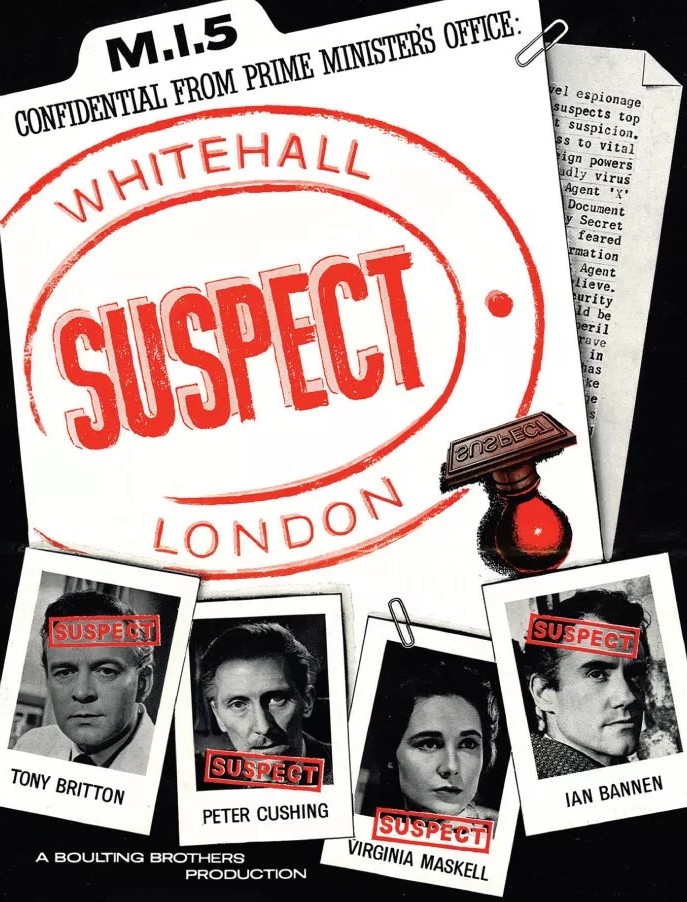
Suspect / The Risk (1960) ****

Marvellous long-forgotten character-driven espionage drama exploring the twin themes of guilt and duty. It would appear to be stolen by two supporting actors, Ian Bannen and Thorley Walters, but in fact both play roles that have significant bearing not only on the narrative but on our understanding of the most important characters. Not only do we have the main plot, but we also have two well-worked sub-plots, one concerning disability and the other of more sinister relevance – a 1984 Big Brother theme.

Basic tale concerns a laboratory that has discovered a bacteria that can cure plague. Hopes of  a celebratory drink all-round and academic kudos on publishing his paper for top boffin Professor Sewell (Peter Cushing) are dashed when the Government in the shape of the pompous Sir George Gatling (Raymond Huntly) steps in, steals the discovery and makes the staff sign the Official Secrets Act.

Romance No 1 – Virginia Maskell and Tony Britton in the lab.

While the revered professor takes it on the chin, colleague Bob Marriott (Tony Britton) is outraged so vocally in public that he attracts the attention of the shady Brown (Donald Pleasance) who suggests to the dupe that there is a way of getting the information out to the wider scientific community, especially to plague-ridden countries.

However, don’t let Sir George’s pomposity fool you. He doesn’t trust this bunch an inch and puts the Secret Service on their tail to assess “the risk” and we dip into the dark kind of web (not that kind of dark web) and the mundane business of deception and betrayal shortly to be explored by the likes of John Le Carre (The Spy Who Came in from the Cold, published in 1963) and Len Deighton (The Ipcress File, published a year earlier).

Rather than this outfit being headed by a version of the prim George Smiley, Mr Prince (Thorley Waters) has a lot more in common with the unkempt Jackson Lamb of the Slow Horses series. His incompetence is an act to make visitors to his shambles of an office under-estimate him.  But he’s got that Columbo knack of asking the most important question just when an interviewee thinks the interview is over.

Also in the background, coming more increasingly into the foreground, is an unusual love triangle between colleagues Bob and Lucy Byrne (Virginia Maskell), who kiss and hold hands in the cinema, and Lucy’s flatmate, the disabled war vet Alan Andrews (Ian Bannen). The fact that Lucy and Alan live together at a time when such a relationship was frowned upon and would be career death in certain circles and that they were once engaged to be married gives it an edge. That Alan has lost an arm and a hand so needs to be cared for – fed (as in food spooned into his mouth),  washed (you can guess that aspect), cigarette lit and removed between puffs, dressed – suggests significant intimacy for an adult.

Obviously, she’s the kind of lass who couldn’t abandon him to the welfare system, and he’s the kind of man who broke off their engagement so she wouldn’t feel tied to him for the rest of her life. But he also hates what he’s become, his desperate reliance on her, what he’s lost, and that’s turned him into not just a bitter individual but a particularly cunning one, who has developed the trick of torpedoing any nascent romance. “You can’t compete,” he gloats to Bob, “because you can’t make her feel good.”

Romance No 2 – Ian Bannen and Virginia Maskell.

But when that doesn’t work, he befriends Bob and surreptitiously eggs him on to betray his country and in so doing, hopefully, kill off the romance.

Mr Prince is a delight. Accorded the best lines, he makes great use of them. When his subordinate Slater (Sam Kydd) abrasively brings Dr Shole (Kenneth Griffith) in for questioning, he reprimands him with the rather coy, “Oh, you haven’t been rough again.” To Dr Shole (Kenneth Griffith), the most susceptible of the professor’s acolytes, he warns, “Tell him (Sewell) not to be a fool or you’ll smack him on the backside.”  Though Dr Shole has a superb retort, “We’re not exactly on those terms.”

Professor Sewell appears mostly on the back foot. While quietly seething at being denied his professional day in the sun, he accepts duty. Even so, he’s smart enough to outwit Prince when the traitor is caught.

The background of the wheels-within-wheels of Government, the silent overseeing of ordinary lives, the authorized level of spying, comes as something of a shock, since despite George Orwell’s best efforts Big Brother was seen as a clever fiction that could not occur in this most democratic and upright of countries where “fair play” was the rule. Visually, this is well done, we see eavesdroppers in mirrors in pubs and, as I said, Prince seems the least effective of operatives but with the kind of personality that you could easily have built a series around.

Disability from war was a constant of post-war British pictures, most often demonstrated by a character with a limp, as with general dogsbody Arthur (Spike Milligan) here. The Oscar-winning The Best Years of Our Lives (1946) was the most effective at dealing with the physical after-effects of the Second World War. But there, the worst-affected soldier, had prosthetic hands. Here, Alan does not, so the scenes of him being tended to by Lucy are emotionally more powerful.

She tends to his emotions, too, and will embrace him and kiss him on the mouth though he’s not dumb enough to read true romantic commitment into those demonstrations of affection. Clearly, there is emotional residue from their engagement, from which you guess she will ultimately be unable to entangle herself, unless he can find a more brutal way of helping her out of the dilemma.

The lab aspect is surprisingly well done. We don’t get any real information on the scientific breakthrough. Mostly, what we view is the grunt work, the laborious checking of thousands of samples for another experiment. At one point Bob thrusts his arm into a contraption packed with buzzing flies as if he was a competitor in I’m a Celebrity, Get Me Out of Here.

Ian Bannen (The Flight of the Phoenix, 1965) is the standout but character actor Thorley Waters (Sherlock Holmes and the Deadly Necklace, 1962) runs him close. Tony Britton (better known later for television comedy) has the least interesting role, but Virginia Maskell (Interlude, 1968) has too much to do without dialog to demonstrate her dilemma. Peter Cushing (The Skull, 1965) is solid as always and Spike Milligan provides light relief.

Joint direction by the Boulting Brothers (The Family Way, 1967), Roy and John. Screenplay by Nigel Balchin (Circle of Deception, 1960) based on his own novel.  

Exceptionally solid stuff. I was very much taken by the unusual approach, the themes and the acting.

Worth a look.

Interlude (1966) ****

Kevin Billington’s debut benefitted from a brief fad for classical music soundtracks, Elvira Madigan kicking off the fashion the year before, 2001: A Space Odyssey, which opened at the same time as Interlude, trumping everything in sight. And as luck would have it, this was not the only movie about an orchestra conductor, Counterpoint with Charlton Heston released in America a couple of months before this one opened in Britain.

What makes the movie so enjoyable is that overlaying the sumptuous love story is the angst of a mistress. It’s sweetly set in wonderful British locations, riverside inns, olde worlde hotels, trendy restaurants, a few flashes of swinging London, luxurious mansions. The solid backdrop for something as fragile as romance.

There could not be two more opposites to attract, the rich Oskar Werner (Jules and Jim, 1962) in full-on arrogant mode, all dark glasses and leather gloves with enough petulance to sink a barge, and journalist Barbara Ferris (off screens since the lamentable Catch Us If You Can three years before) who lives in a bedsit with a goldfish called Rover. He drives a Rolls-Royce convertible, she a Mini. 

There are some very good touches. We first see the characters in mirrors. He plays a “concerto for wine glass and index finger.” There is the very serious British business of whether milk goes in first to a cup of tea.

The screenplay by Lee Langley and Irish playwright Hugh Leonard is sharp and often witty.  “I want to marry you,” says Ferris, before conceding, “I just don’t want to be your wife.” There is clear realization of the nature of his personality in her remark, “Instead of being what you want, I’ll be what you’ve got.”

Even when emotion is expressed there is a feeling that a lot is still suppressed. Ferris goes from high excitement to high dudgeon and carries within the seed of fear, a character who spends as much time in terror as in love. This is exacerbated when she spots of Werner’s wife, stoically played by Virginia Maskell, at the hairdressers and “all of the sudden” the wife who has existed in her imagination “has a face.”

John Cleese and Donald Sutherland have decent cameos, the former in a bit of an in-joke as a PR man wanting to get into comedy (“satire – that’s my field”), the latter as the womanizing brother of Werner’s wife.

Oddly enough, the music – Beethoven, Tchaikovsky, Mozart, Dvorak, Brahms and Rachmaninov – acts in the same manner as Easy Rider the following year, as extensive interludes to the developing drama. Perhaps it is where Dennis Hopper got the idea.

It is very rounded for a romance, the acting excellent and the undernote of despair well-wrought.

Discover WordPress

A daily selection of the best content published on WordPress, collected for you by humans who love to read.

The Atavist Magazine

by Brian Hannan

WordPress.com News

The latest news on WordPress.com and the WordPress community.