The Jackals (1967) **

A hoot. Definitely a contender for that most sought-after of categories – the cult movie.

When I tell you it’s Vincent Price in a western you’ll see how much fun this could be. Price spent virtually a whole decade locked into horror typecasting, those distinctive tones dealing out doom. But like all typecast actors, no doubt he was desperate to show what he could do when the horror shackles were removed.

Trouble is – he does too much. This a lollapalooza performance, so wild and barmy it will have you in stitches, at the same time as wondering what the hell was going on in his head, and why he thought such barnstorming was required, as if he felt he had to steal a picture of which he was the denoted star.

Though effectively a western with all the tropes of that genre, and a remake to boot of Yellow Sky (1948), this, adding further hilarity and extending the cult status, is set in South Africa, with variable attention paid to accent.

Stretch Hawkins (Robert Gunner) is leader of a gang of outlaws robbing banks in the Transvaal during a gold strike. They escape the pursuing posse by heading into desert territory and eventually, parched, exhausted and suffering from heat stroke, seek refuge in a ghost town, former mining town Yellow Rock abandoned except for two inhabitants, Oupa Decker (Vincent Price) and his grand-daughter Willi (Diana Ivarson).

Naturally, on spotting the lone woman, the outlaws get the wrong ideas. But she soon puts them right. When she’s not holding them at bay with a rifle she’s decking Stretch with a neat right hook. Refusing to offer them any hospitality whatsoever seems particularly mean given the poor chaps are starving and this area is bereft of the animal population- lions, elephants, hogs – that had popped up previously in the way of the random stock inserts you found in any picture set in Africa.

So the fellows spread themselves out along the riverbank which provides the only water in the vicinity and where Willi must come calling, leading to further episodes of predatory sexual behaviour. By now Stretch has taken a liking to Willi, which is eventually reciprocated, and he tends to leap to her defence.

For no apparent reason, the outlaws surmise that the only reason the old man and his daughter are still hanging around this deserted spot is because they have found gold. Instead of doing the obvious and holding the younger woman hostage, Stretch attempts to strike a deal, agreeing to take only half the old man’s £20,000 stake in return for letting them go free.

This doesn’t go down so well with the rest of the gang and the shoot-out, when it occurs, sees Stretch siding with the good guys and turning over such a good leaf that he returns the money he stole to the bank.

Despite Vincent Price threatening to ruin the picture with his mugging there are some nice touches. After Stretch’s romantic overtures are derisively dismissed for him being too smelly, he smartens himself up, coming a-courting (or a rough version of it) in fresh shirt, armpits washed and hair combed. Stretch had a touch of religion in the past when a law-observing farmer. And you can tell what a change is wrought in him when at the end he buys rather than steals a pretty hat for Willi.

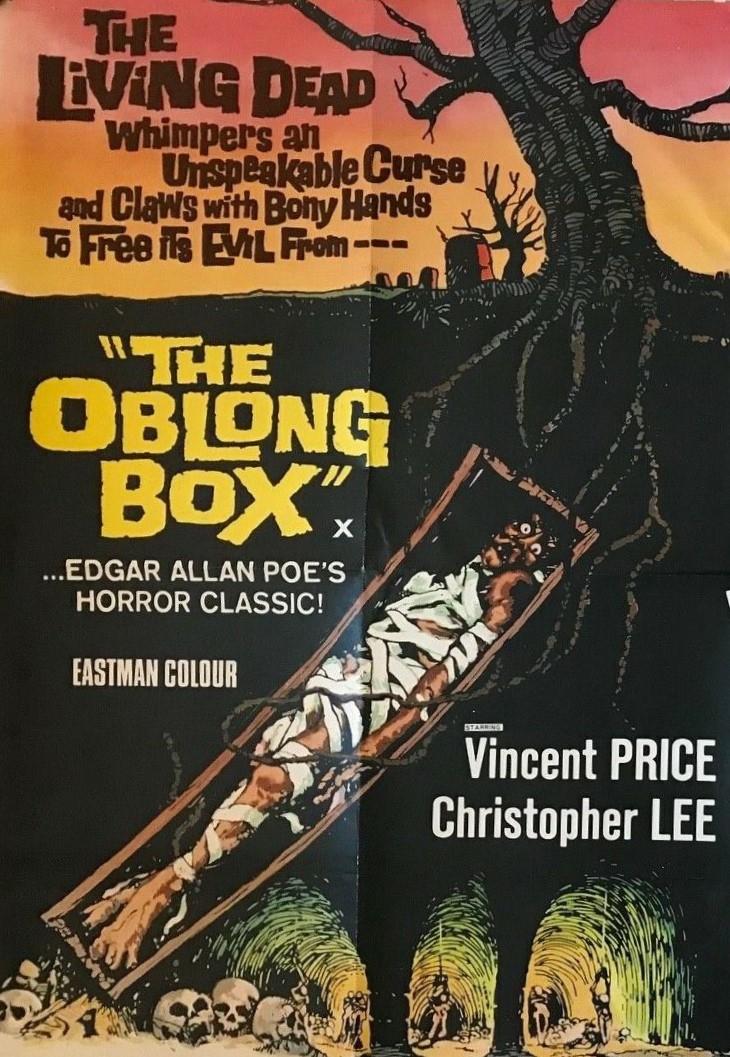
It’s true there is a transformation in Vincent Price (The Oblong Box, 1969). But not for the better. The lugubrious delivery is toned down, the iconic full beard reduced to a wisp, he wears a floppy hat, cackles like a madman and every time he looks at the camera it’s with a one-eyed leer. There’s something of the country bumpkin in his interpretation of the part, and that might just be a show put on to fool the outlaws. Whatever it is, it comes across as the barmiest performance this side of the Razzies.

On the other hand Diana Ivarson (Macho Callahan, 1970), in her debut, makes a pretty good stab at the feisty independent western women, channelling her inner Barbara Stanwyck, or in those tight jeans Jane Fonda in Cat Ballou (1965). She’s a sharpshooter, capable of missing “that close on purpose.” Robert Gunner (Planet of the Apes, 1968) is scarcely a decent substitute for Gregory Peck in the original.

Director Robert Webb (The Cape Town Affair, 1967) can do little to rein Price in. Written by Harold Medford (The Cape Town Affair), adapting the original by Lamar Trotti and W.R. Burnett.

But, really, there’s little to save it from being awful except that cult pictures are judged by different criteria and this has all the making of a cult.

Must-see for all the wrong reasons.

The Oblong Box (1969) ***

Vincent Price and Christopher Lee – two scions of 1960s horror – together, yet anyone expecting a clash of the giants would be sorely disappointed as they only share one short scene. This is a typical American International Pictures venture, based even more typically on an Edgar Allan Poe story, with some stylistic direction – the extreme close-up never more effectively utilized – from Gordon Hessler in his third feature.

Given that German-born Hessler (Catacombs/The Woman Who Wouldn’t Die, 1965) was a last-minute substitute for English director Michael Reeves (Witchfinder General, 1968), he made an exceptionally good job of a complicated plot. The production was even more complicated than that since it was originally intended as a Spanish co-production to be shot in Spain. And at one point writer Lawrence Huntingdon (The Vulture, 1966), who did have form as a director (Death Drums Along the River, 1963), was reportedly also carrying out producer-director duties.

What seems like a mishmash of different stories – African sorcery, grave-robbing, disfigurement, forgery, blackmail, lifetime imprisonment, medical experiment, buried alive, a monster in a scarlet mask – soon comes together in a tense tale of retribution and revenge.

Nineteenth century English aristocrat Julain Markham (Vincent Price) has withdrawn to his country manor, for unknown reasons distancing himself from his fiancée Elizabeth (Hilary Dwyer), but in reality to conceal from the world the fact that he has locked up his own brother, Sir Edward (Alister Williamson). When the brother, a disfigured monster, escapes he embarks on a murder spree.

The various storylines keep the narrative sufficiently entangled to sustain tension. Despite what may appear to a modern audience as primitive special effects, several scenes are bone-chilling largely through directorial manipulation. The Gothic look – graveyards, castles, the village – adds to the atmosphere. The violence was trimmed in America to avoid an “R” rating, but led to the film being banned in Australia.

There is more overt sexuality than normal, a scheming whore Heidi (Uta Levka) tempting a man with her bare breasts, and maid Sally (Sally Geeson) entranced by the monster.

The various plot strands appeared to confuse critics at the time and even now the film receives comments that it is “vague” but at a time when Hammer’s output usually comprised a straightforward – and somewhat limited narrative – I found AIP’s approach to this picture a welcome development. The slowly emerging story set the film up as much as a thriller as a horror.

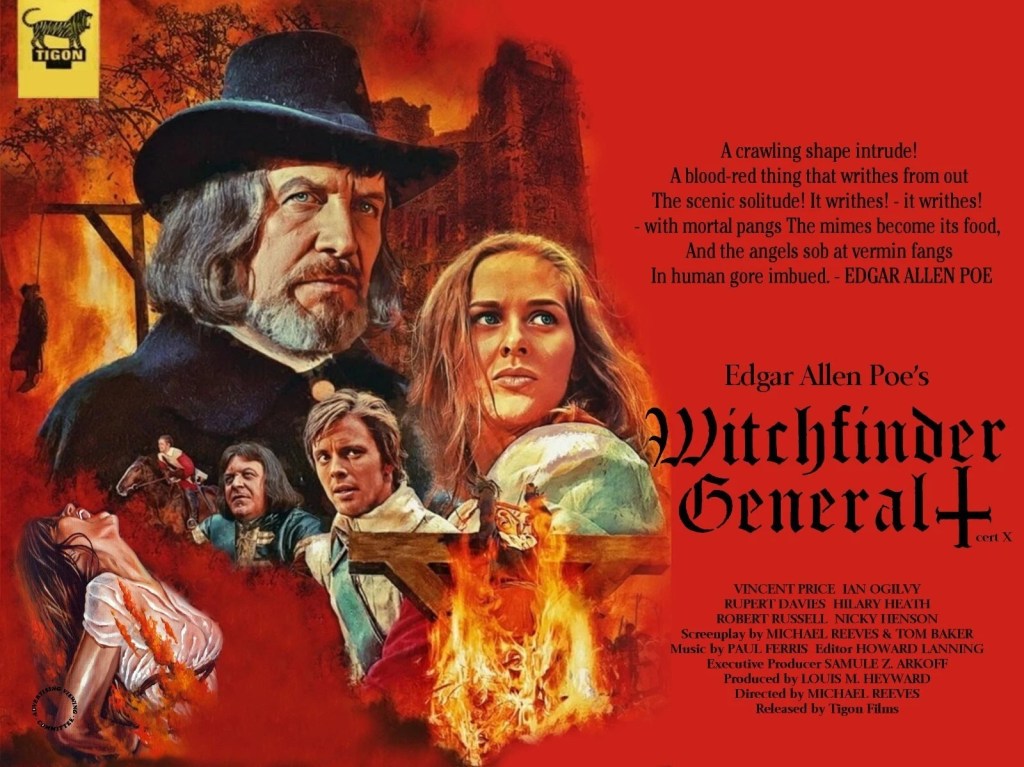
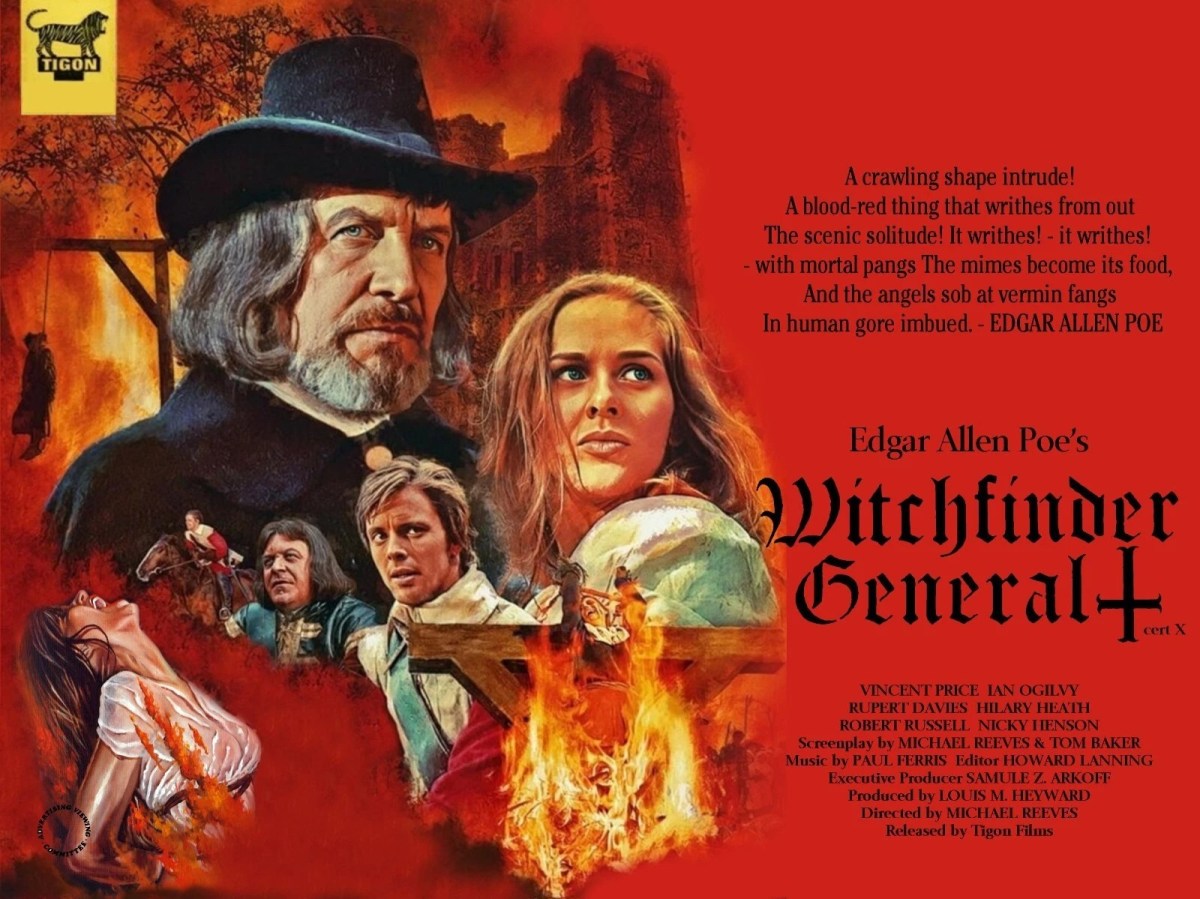
It’s a bit of a reversal for Vincent Price (Witchfinder General, 1968) to be playing the good guy but that works to the movie’s advantage because you spent most of the time thinking this is just a scam and at some point he will show his true colors. Hilary Dwyer (Witchfinder General) is excellent and Sally Geeson (What’s Good for the Goose, 1969) is an example of the type of woman attracted to rather than revulsed by a killer.

Well worth a look if only to enjoy the distinctive Hessler style.

War-Gods of the Deep / City Under the Sea (1965) ***

Hollywood careers rarely end in a blaze of cinematic glory. Sudden death ensured Clark Gable and Marilyn Monroe (The Misfits, 1961) and Spencer Tracy (Guess Who’s Coming to Dinner, 1967) went out with a bang but more likely a  career is just going to tail off and end with this kind of whimper. Director Jacques Tourneur, in any case, was long past a heyday that saw him set the horror genre agog with Cat People (1942), I Walked with a Zombie (1943) and The Leopard Man (1943).

If that wasn’t enough to solidify his credentials he dipped into another genre, the nascent film noir, and helmed gems like Experiment Perilous (1944) with Hedy Lamarr and Out of the Past (1947) with Robert Mitchum. Thereafter came swashbucklers The Flame and the Arrow (1950) headlining Burt Lancaster and Anne of the Indies (1951) plus crime drama Appointment in Honduras (1953) with the ever-dependable Glenn Ford and Joel McCrea western Wichita (1955). Then, miraculously, it was back to horror with Night of the Demon (1957) and the late flurry of The Comedy of Terrors (1963).

You can tell where I’m going with all this. War-Gods of the Deep has nothing on any of these pictures. The backstory is much more interesting than the actual film.

Basically, this is one of those pictures where an unlikely pair, American Ben Harris (Tab Harris) and eccentric Brit Harold Tufnell-Jones (David Tomlinson) get themselves into an unlikely situation and have to get themselves out of it.

Set in the smugglers’ paradise of the British Cornish coast around the turn of the last century, on a hotel on top of a cliff, the duo need to track down another American, Jill (Susan Hart), who has disappeared down a plughole, sorry mini-whirlpool. This leads to a legendary underwater city where smugglers led by Sir Hugh (Vincent Price) have found the secret of eternal life, a paradise now endangered by tremors from a nearby volcano.

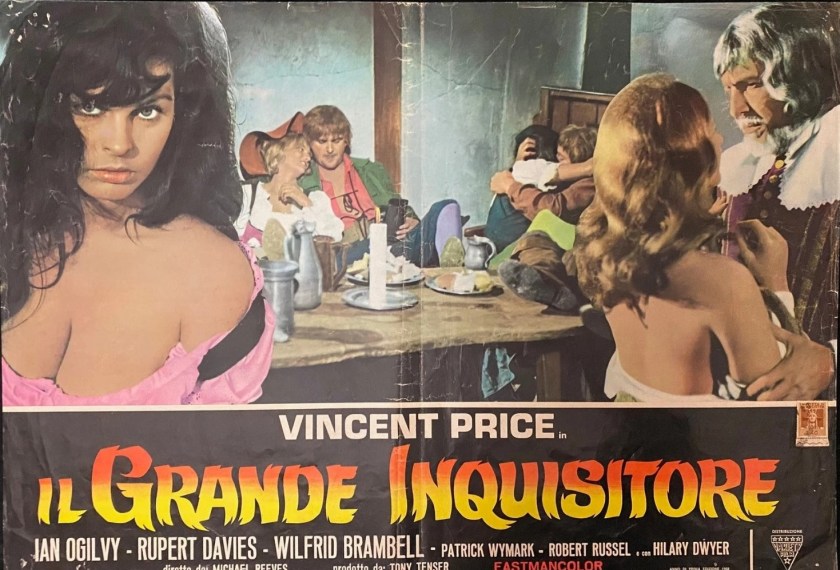
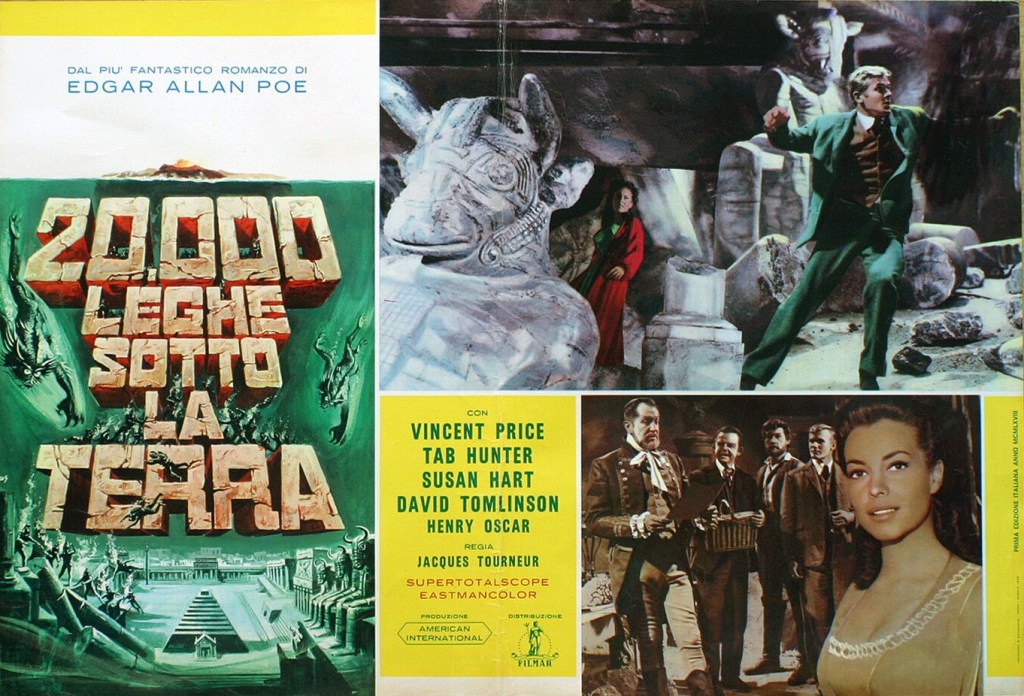
The Italians didn’t fancy the two titles on offer so came up with their own
by purloining the Jules Verne classic.

He sent his enslaved Gill-Men to kidnap Jill in the erroneous belief that she is his dead wife. Bored out of their minds with listening to Sir Hugh prattling on endlessly about how the underwater city came into being and how important he is to the whole affair and what imminent dangers the inhabitants now face, and of course faced with their own imminent demise as sacrificial victims, the pair decide to scoot, having found a willing accomplice.

There’s a chase and whatever, and some undersea adventure, but there’s not much to it.

However, what you do get when you add someone like Tourneur – and to that extent Vincent Price and his ominous tones – to this listless mix is atmosphere. Tourneur can inject eeriness almost just by switching on a camera, despite a very stage-bound picture, and he knows how to add a music score that tremendously aids his enterprise. The opening section by the shore and in the hotel adds the necessary element of mystery to make the whole idea float.

There clearly wasn’t enough of a budget for the Gill-Men to appear as anything but peripheral figures which actually might have helped since, the state of special effects in that time might have made them laughable rather than distantly disturbing.

The best you can say is that Tourneur made the best of a bad job. Vincent Price (Diary of a Madman, 1963) only has to turn up to inject an element of danger. Tab Hunter (Ride the Wild Surf, 1963) and Susan Hart (Dr Goldfoot and the Bikini Machine, 1965) needn’t have bothered turning up for all they bring to the party. And David Tomlinson (Bedknobs and Broomsticks, 1971)  brings far too much, saddled with a pet comic chicken for no apparent reason except to extract a few laughs.

AIP, having made its name in the horror department by raiding the portfolio of Edgar Allan Poe, turned up this source material deep in that vault. But the only connection to Poe is the original idea –  which was not that original, other poets having plumbed those depths prior –  and that appears only in occasional desultory recitations of the poem. But, as a marketing tool, hey, Edgar Allan Poe, that’ll scare their socks off!

So, you are warned, but also you can’t help but warm to this final movie by one of the Hollywood greats as he tries to put a sheen on something that in other hands would have sunk like a stone.

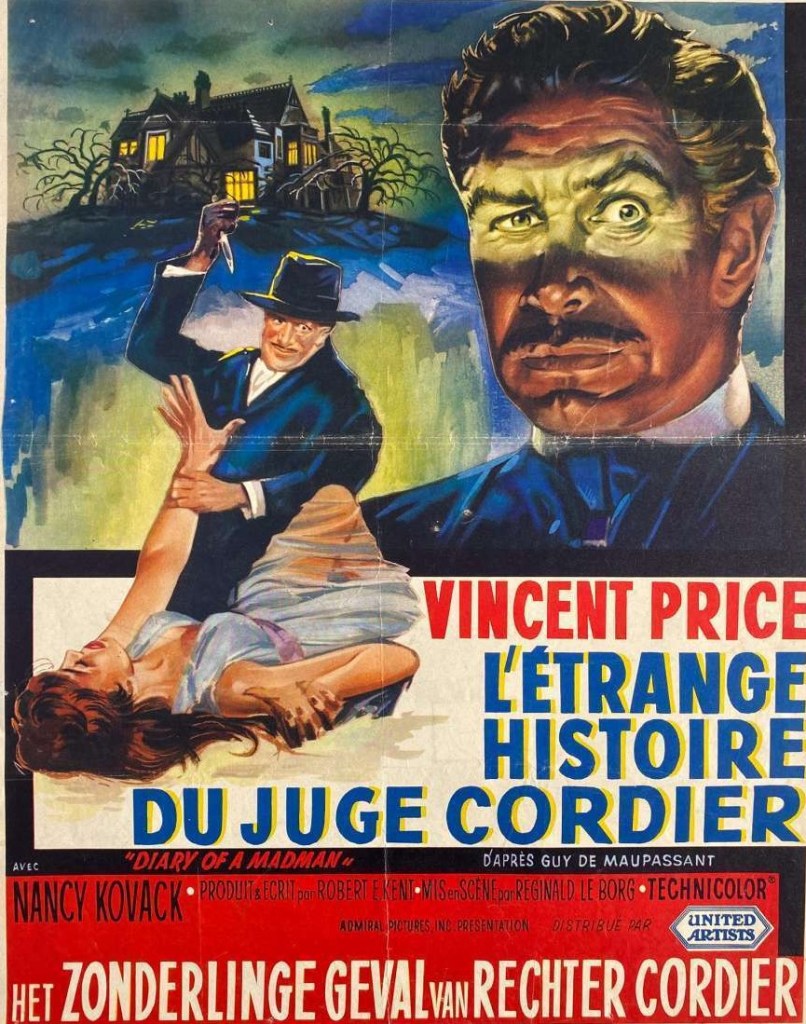
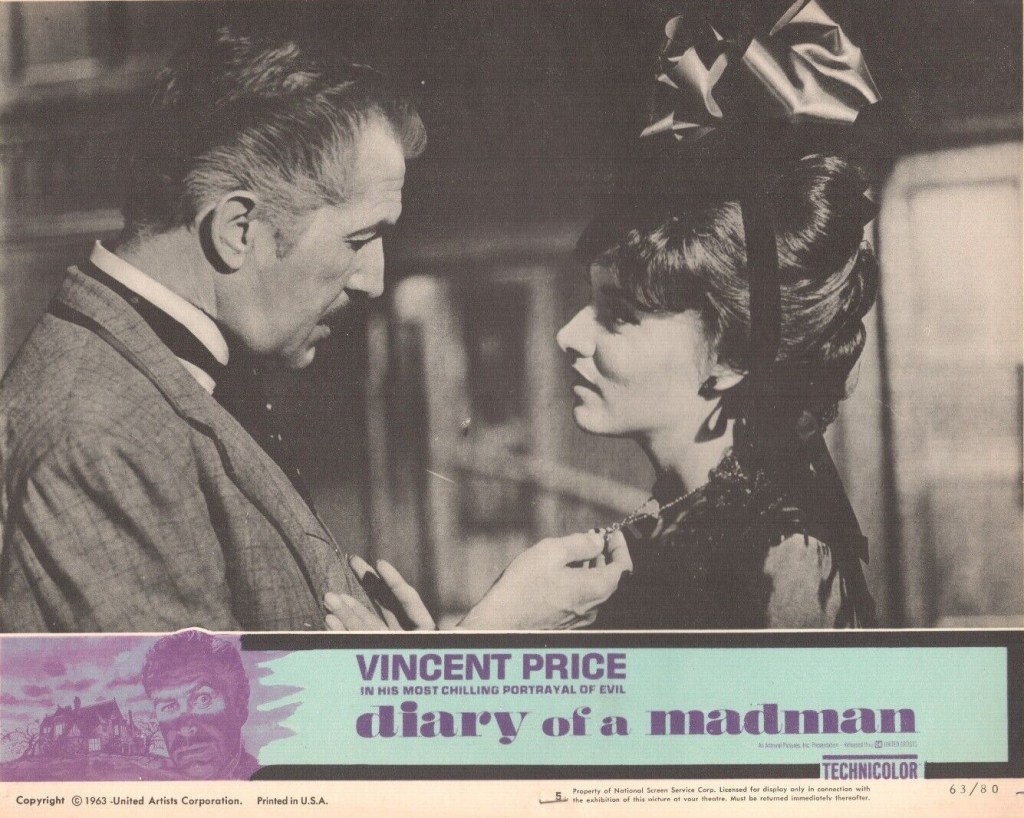
Diary of a Madman (1963) ***

Contemporary perspectives occasionally raise a film in the estimation. Here, our knowledge of the psychology behind serial killers sheds quite a different light. The idea that a killer can blame outside forces over which he has no control was one of the original tenets when the ordinary mind could not take in that some folks just enjoyed the act of murder so much they were inclined to do it over and over again.

Where I come there there’s a saying – “a big boy did it and ran away” – a device used by small boys in big trouble. And that’s pretty much the idea here. The innocent can be taken over by an evil entity, rather than admitting to surrendering to their most heinous desires.

A prisoner condemned to death in 19th century France confides in magistrate Simon Cordier (Vincent Price) that his murdeorus acts were the result of direction by the mysterious and, unhelpfully, invisible “Horla.” Naturally, Cordier dismisses the notion until, in self-defence, he kills the prisoner. Disturbed by his action, he seeks counsel and is advised by a psychiatrist (an “alienist” as such a person was known at the time) to spend more time on his hobby, sculpting.

Although Cordier appears to be a model citizen, there lurks in his past a suicidal wife who killed their child, and the notion that somehow he was responsible. Into his world comes woman-on-the-make Odette (Nancy Kovack) who earns more money as an artist’s model than her husband Paul (Chris Warley) does for his paintings. Unaware  that she is already committed, Simon proposes marriage. It doesn’t take long for him to suspect she is not what she seems and he does away with her only for Paul to become the main suspect and be condemned to death.

Cordier, discovering by accident that the Horla, is frightened of fire, lures the entity into his deserted house (servants sent away) and plans to destroy the entity but in the process the fire melts the door handles and Cordier can’t escape, dying in the process.

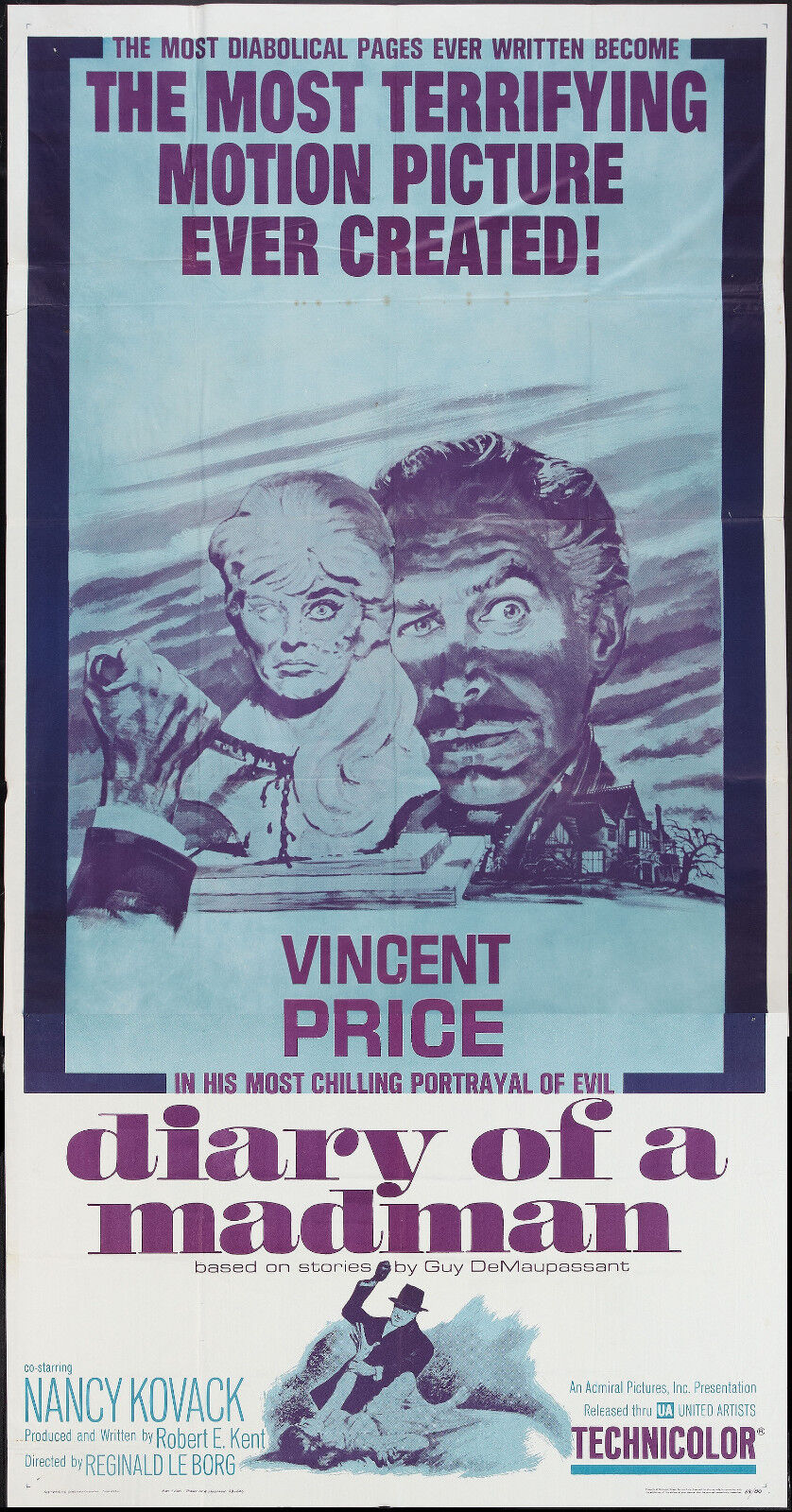
Price and Kovack.

A modern reading of course would set it up a different way, putting greater emphasis on the past, trying to uncover what drove Cordier’s wife to suicide. That he gives in to overwhelming urges might well be followed by periods of guilt until he realises that the only way out is his own suicide.

But the 1960s moviegoer – possibly still recovering from the murderous goings-on at the Bates Hotel, and grateful that it was fiction, and The Boston Strangler only just getting into his stride – was not quite ready to put any faith in a landscape filled with predators and victims, so it would make more sense for outside forces, voices or the like, to be controlling the ordinary person.

An eerie glowing light comes over the eyes of Cordier (and the earlier convict) any time the urge to kill dominates. But if you were going to set this up as a picture of innocence driven to dark deed you would not populate it with Vincent Price (Witchfinder General, 1968), who had form for dastardly deeds. Nor is Price quite able to pull it off, those sepulchral tones always seeming to indicate something lurking, and he’s hardly in the debonair category so at the very least he belongs to the caste of entitled rich taking advantage of a poor woman to press his case for marriage.

Nancy Kovack (Jason and the Argonauts, 1963) is more convincing as the manipulative object of his desire. I half-expected her to turn into a murderer in order to rid herself of her the husband getting in the way of her chance at a new, wealthier, life. Chris Warfield (Dangerous Charter, 1962) is the talentless dupe, whichever way you cut it, and you have to admire his wife for sticking with him for so long.

Given that director Reginald Le Borg’s career dated back to the 1940s and he had been lumbered with the Joe Palooka series and any number of B-movies, it was perhaps surprising that horror, although still strictly on B-movie budgets, became a forte – The Black Sheep (1956) and Voodoo Island (1957). While this one was clearly filmed on a studio backlot, he does a good job of bringing a bit of lushness to the proceedings.

Perhaps the most interesting element is that the idea originated in the mind of famed French short story writer Guy de Maupassant – you might be surprised to learned that nearly 300 movies and television adaptations have been made from his works, a dozen alone in 1963 including Mario Bava’s Black Sabbath. Worth comparing with Maniac out in the same year where the idea of the mad killer is exploited for a different end.

Very old-school, but with passable sfx.

Discover WordPress

A daily selection of the best content published on WordPress, collected for you by humans who love to read.

The Atavist Magazine

by Brian Hannan

WordPress.com News

The latest news on WordPress.com and the WordPress community.