The Limbo Line (1968) ***

Should have been  a classic. The bleakest espionage tale of the decade ends up, unfortunately, in the wrong hands. Betrayal – personal and professional – underlines a sturdy enough narrative of defection, kidnap and rescue, infected with a spread of interesting characters far from the genre cliché.

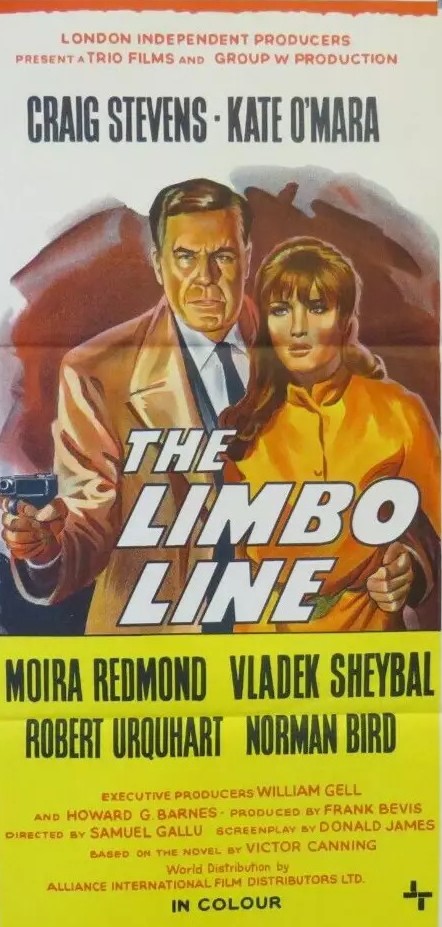
We open with blonde Russian femme fatale Ludmilla (Moira Redmond), as sleek as they come, killing off her lover once she discovers his true intent. She works for the “Limbo Line,” an organization headed by Oleg (Vladek Sheybal) which whisks Russian defectors back to their home country. In romantic fashion, she inveigles herself into the lives of those who may be, for personal gain, about to take a wrong turn in the service of their country.

Richard Manston (Craig Stevens), meanwhile, is an operative of an undetermined secret unit, getting cosy with Russian ballerina Irina (Kate O’Mara), a defector, in the hope that she will become the next target for Oleg and thus lead him to his quarry. Responding to his amorous advances, she has no concept of this ulterior motives.

But he’s not the only one in the two-timing racket. Oleg lives high on the hog, a lifestyle financed by holding back remuneration due his operatives, who not only want better paid for the risks they are taking, but draw the line at murder. Ludmilla, meanwhile, uses intimacy with Oleg as a way of keeping tabs on him for her superiors.

Everyone, however, is operating under a new code of restraint. Arms limitation talks between the Superpowers currently taking place mean that neither side wants to be publicly seen to be working in the shadows. Hence, the no-holds-barred methods of both Manston and Oleg are frowned upon. Manston and Ludmilla have more in common than one would normally find in the spy movies of the period, the end justifying the means taking precedence over any personal interest in a lover.
The dangerous romantic elements would have been better dealt with in the hands of a more accomplished director. As it is, Samuel Gallu (Theatre of Death, 1967) has his hands full keeping track of a fast-moving tale as Irina is whisked by boat, bus and petrol tanker to Germany, hidden in such confined spaces the more cautious operatives fear she will die.

Nor, despite his fists, is Manston as good as you would expect from a heroic spy, battered to bits by his opposite number, himself imprisoned in the tanker, becoming a pawn to be sold to the highest bidder.

It’s in the tanker that Irina realizes her lover is deceitful, only using her as bait. Similarly, Oleg doesn’t realize he is every bit as dispensable to the ruthless Ludmilla who wishes to avoid public exposure and is only interesting in taking Irina back to Russia where she will be “re-educated.” Chivers (Norman Bird) looks like the nicer sidekick for Manston, the type to demonstrate fair play, except when he has to drown a suspect in a bath. He has the best line in the film, an ironic one at the climax.

The action, while overly complicated, is well done, none of the over-orchestrated fistfights taking place in odd locations. Chivers has a knack of turning up in the nick of time, but he’s the cleverer of the two.

An actress of greater skill than Kate O’Mara (Corruption, 1968) would have brought greater depth to the betrayed lover, but she does well enough to stay alert during the helter-skelter action. Craig Stevens (Gunn, 1967) was never going to be the right fit for a character required to show considerable remorse at his own actions.

The hard core of political reality, the constant betrayal of both innocent and guilty, the shifting sands of romance sit only on the surface and a better director would have brought them more into the foreground, eliciting better performances for deception incurred in the line of duty at the expense of the personal life.

It’s never a good sign when the bad guys are the more interesting characters and while you might expect Vladek Sheybal (Puppet on a Chain, 1970) to steal the show, he is usurped by Moira Redmond (Nightmare, 1964). A bigger budget would have also offered better reward, but even so Gallu comes up with more interesting camera angles than you might expect.  Based on the bestseller by Victor Canning (Masquerade, 1965), he was helped in the screenwriting department by television writer Donald James.

You watch this thinking what might have been.
The Scorpio Letters (1967) ***

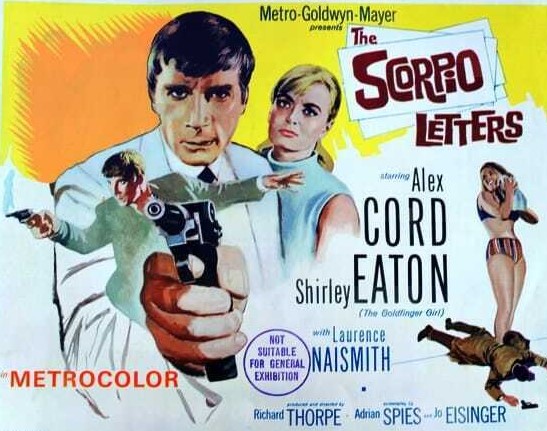
Desultory spy thriller with over-complicated story that’s worth a look mostly for the performance of Alex Cord (Stiletto, 1969). I can’t say I was a big fan of Cord and I certainly didn’t shower him with praise for his role as a disillusioned Mafia hitman in Stiletto. But now I’m wondering if I have been guilty of under-rating him.

Normally, critics line up to acclaim actors if they deliver widely differing performances – Daniel Day-Lewis considered the touchstone in this department after Room with a View and My Beautiful Launderette opened in New York on the same day in 1985. But usually screen persona rarely changes, amounting to little more than a heightened or amalgamated version of the actor’s character or features. Once Charles Bronson, for example, started wearing his drooping mustache he was never seen without.  Actors may grow old, but never bald.

The macho mustachioed Cord of Stiletto is nowhere in sight. In fact, in The Scorpio Letters minus moustache and resisting attempts to reveal his musculature, he is almost unrecognizable. In this picture Joe Christopher (Alex Cord) is flip, resentful, thoughtful, occasionally pedantic, more natural than many of the crop of Hollywood new stars being unveiled at the time, and for once as a transplanted American in London rather scornful of British traditions. There’s a realistic flourish here, too, he is so poorly paid – and on a temporary contract – that he has to take the bus. And although he is an ex-cop fired for brutality, that level of violence ain’t on show here. Virtually the opposite of the character Cord created for Stiletto, I’m sure you’ll agree. So full marks for versatility and talent.

Unfortunately, the rest of the movie is not up to much, at the very bottom of the three-star review category, almost toppling into two-star territory. Christopher is investigating the death of a British agent who was the subject of a blackmail attempt. By coincidence – or perhaps not – another part of British Intelligence is investigating the same death and this brings Christopher into contact with Phoebe Stewart (Shirley Eaton) and eventually they work together to unravel a list of codenames and uncover the conspiracy with a bit of risk to life and limb.

But the pay-off doesn’t work despite all the exposition attempting to build it up and you’re left with a kind of drawing-room drama rather than exciting spy adventure. It’s determinedly London-centric with red buses, red postboxes, Big Ben, and The Horse Guards all putting in an appearance. The scene shifts to Paris and Nice without a commensurate heightening of tension. Despite a couple of neat scenes – a chase held up behind a wedding party, an irate German chef, an interrogation in a wine cellar – it’s much too formulaic.

Cord apart, Shirley Eaton (Goldfinger, 1964) adds some glamour, but her rounded portrait depicts a character with warmth rather than oozing sex. This is the kind of film that should be awash with character actors and up-and-comers but I recognized few names except for Danielle De Metz (The Karate Killers, 1967), Oscar Beregi (Morituri, 1965) and Laurence Naismith (Jason and the Argonauts, 1963).

One-time top MGM megger Richard Thorpe (The Truth about Spring, 1965) was coming to the end of a distinguished career which had included Ivanhoe (1952) and Knights of the Round Table (1953). This was his penultimate film. The appropriately-named Adrian Spies (Dark of the Sun, 1968) wrote the screenplay based on the Victor Canning thriller. Making his movie debut was composer Dave Grusin (Divorce American Style, 1967)

Albeit made on a budget of just $900,000, MGM intended the picture for theatrical release but with a short cinema window to make it available for a speedy showing on ABC TV. It was originally scheduled for a May 1967 theatrical release but MGM, contractually obliged to deliver the picture within a specified time to television, could not fit in an American release. So it made its debut in the “Sunday Night at the Movies” slot on February 19, 1967, and was shown in cinemas abroad. Nor was it shown first on U.S. television because the studio believed it to be a disaster. Reviews were positive. Variety (February 22, 1967, page 42) called it “very hip.”

Discover WordPress

A daily selection of the best content published on WordPress, collected for you by humans who love to read.

The Atavist Magazine

by Brian Hannan

WordPress.com News

The latest news on WordPress.com and the WordPress community.