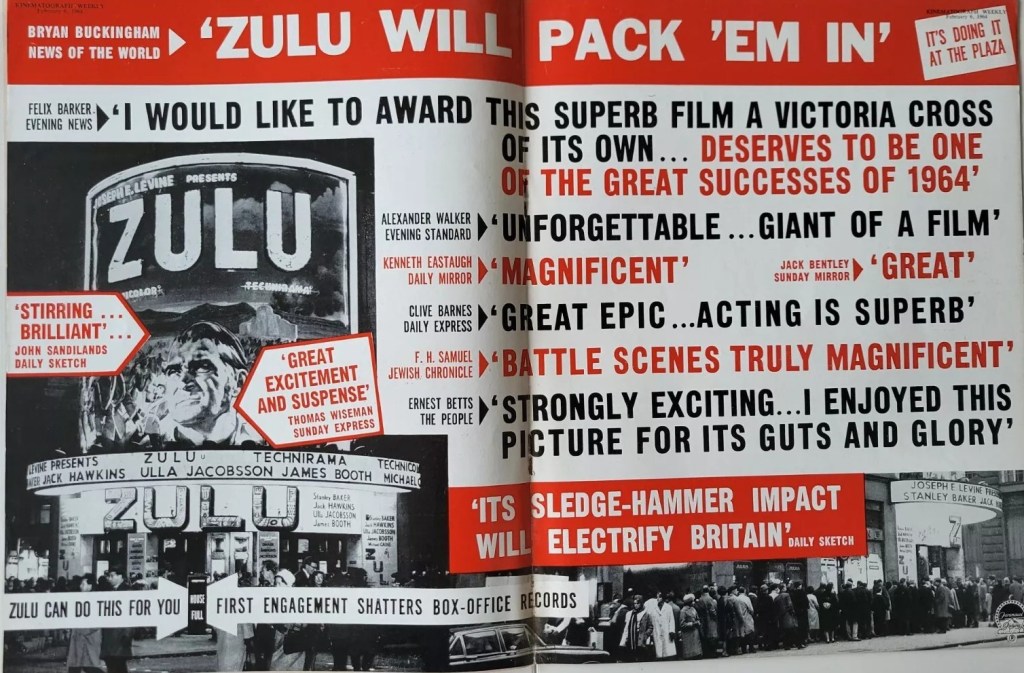
Behind the Scenes: Selling “Zulu” (1964) – The Pressbook

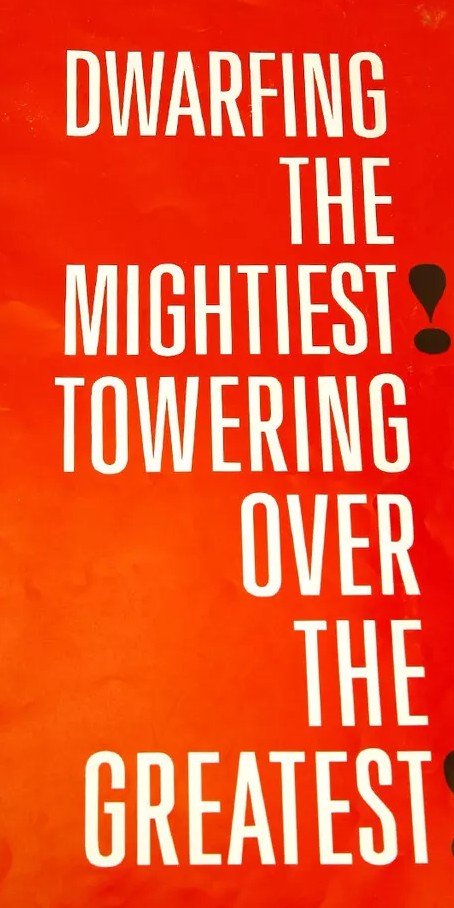
“Dwarfing the Mightiest! Towering over the Greatest!” wasn’t just the movie’s tagline. It could have easily been used to describe the Pressbook. This folded out into a colossal 40 inches wide  by 20 inches high, one of the biggest pressbooks ever produced.

The marketing team produced an impressive list of ideas. Cinema managers were urged to get war correspondents and war heroes involved and to blow up photos of the Victoria Cross. Hanging on the name of the star was a “Baker’s Dozen” competition, inviting people to list the thirteen movies featuring Stanley Baker. Quite how they thought a promotion involving banks would go down is anybody’s guess. Especially as this was the notion: “Zulus are allowed as many wives as they want, provided they can afford to pay for them. The price ranges between six and twenty head of cattle per wife. For an interesting tie-in, get local banks to display money and other barter materials. Give them a montage of still from the picture to display.” Culturally tone-deaf doesn’t cut it.

To attract children there was a coloring-in competition and a school study guide. The movie was available in 70mm Super Technirama so there was a special advertisement linked in to that for cinema going down that route.

Other taglines included: “The supreme spectacle that had to come thundering out of the most thrilling continent!” and “These are the days and nights of fury and honor and courage and cowardice that an entire century of empire-making and film-making can never surpass!”
And in case hyperbole wasn’t enough, one of the ads spelled out the exciting details. “The Massacre of Isandlwana! The Mating Song of the Zulu Maidens! The Incredible Siege of Ishiwane! Night of the 40,000 Spears! Days That Saved a Continent! Mass Wedding of 2,000 Warriors and 2,000 Virgins! Amid the Battle’s Heat…the Flash of Passion!”

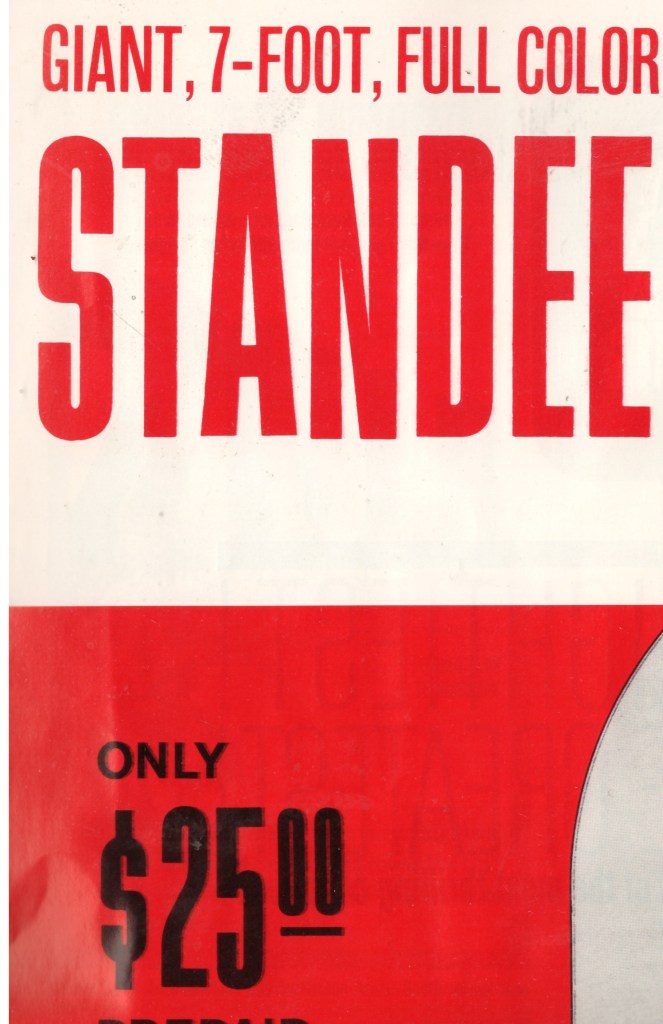
There was a seven-foot high standee and a three-foot 3D illuminated standee.

To help sell the picture to local journalists, little articles were planted that could hook an editor’s interest. For example, when director Cy Endfield glimpsed some soldiers firing their rifles left-handed, he stopped filming, because British soldiers were required to shoot right-handed. The film was shot in the shadows of the Darkensberg Mountains. The river which flowed past Rorke’s Drift was slower than it had been at the time of the battle so the course was altered and dammed to increase the flow. Out of sight of the cameras but essential to filming were the modern villages constructed to house cast and crew, stores, catering and compounds for horses and oxen.

The cast were on set at 6.30am for make-up. The Zulus spent more time in make-up than the British soldiers, as the costume department ensured every aspect of their outfits was historically correct. A total of 100lb of small colored beads was crafted by made by local women for the maidens to wear. A primitive method of making necklaces, strung together with animal sinew and rolled by hand, was employed incorporating a further 100lb of wild syringa seeds which were dyed.

The warrior loincloths of softened animal skins were made the traditional way using stones aqnd animal fat. Shields were also made from animal skin. The teeth of tigers and baboons formed their necklaces. They kept snuff in a small gourd worn round the waist. The purpose of a porcupine quill tucked into their hair was to extract thorns after a long march.

Three cameras were utilized to shoot the blaze that burned down the hospital. “Undress rehearsal” was the name given to the marriage ritual scenes of bare-breasted women.

Though Michael Caine was being touted for stardom, as far as the Pressbook was concerned he was relegated to section below Jack Hawkins, James Booth and Ulla Jacobsen who had smaller parts. The movie was a notable change for Jack Hawkins, who saw action in World War Two. Instead of playing his usual hero, he was a weakling and drunk. It was the second English-language film for Swede Jacobsen after Love Is a Ball / All This and Money Too (1963).

Zulu (1964) *****

The technical excellence is substantially under-rated. Not just the aural qualities – the approaching enemy sounding like a train – and the reverse camera and uplifted faces registering awe that later became synonymous with Steven Spielberg, but the greatest use of the tracking camera in the history of the cinema. So what could otherwise be a rather static movie given it revolves around a siege is provided with almost continuous fluidity.

It’s perhaps worth pointing out, in relation to accusations of jingoism, that the British had relatively few battles to celebrate – Agincourt in the Middle Ages, Waterloo in 1815, El Alamein in 1942. But the Crimean War, in which Britain was on the winning side, was remembered for the disastrous Charge of the Light Brigade. Dunkirk in 1940 was a defeat and in cinematic terms D-Day was seen as heavily favoring of the Americans. Although there had been a corps of British World War Two pictures, these generally focused on individual missions (The Dam Busters, 1955) or characters (Reach for the Sky, 1956). And in fact the defense of Rorke’s Drift was preceded by a resounding defeat at the hands of the Zulus at Isandlwana.

Tactically, too, the Zulus are smarter. Their leader is only too happy to sacrifice dozens of his troops in order to gauge the British firepower, their snipers probe for weaknesses in the British defences, their troops feint to attract fire and waste bullets.  The Zulus are too clever to attack where the British want.

This is not even your normal British army. Rorke’s Drift is a supply station and hospital. Its upper class commander Lt Bromhead (Michael Chard) idles his time away going big game hunting. The more down-to-earth Lt Chard (Stanley Baker) is there in his capacity as an engineer, erecting a pontoon bridge over the river. Neither has been in battle.

It’s surprisingly realistic in its depiction of the common soldier as having other interests beyond fighting. Private Owen (Ivor Emmanuel) is more concerned about the company choir, Byrne (Kerry Jordan) more focused on his cooking than bearing arms, and farmer Private Thomas (Neil McCarthy) spends his time cuddling a calf. Hook (James Booth) is a troublemaker and slacker and surgeon Reynolds (Patrick Magee) inclined to mouth off to his superior officers. The Rev Witt (Jack Hawkins) turns out to be a drunken hypocrite. His pious daughter (Ulla Jacobsen) is shocked when the men try to steal a kiss

Beyond a fleeting glimpse of victorious forces at Isandlwana, the Zulus are introduced in a sequence of harmony, a tribal ritual preceding a marriage ceremony, lusty singing and dancing scarcely setting up what is to come. It’s more like the by-now traditional section where the main characters in a movie set in an exotic land are introduced to aspects of local culture. Various characters attest to their military exploits.

But after that, tension cleverly builds. Witt raises the alarm, a bunch of cavalry irregulars refuse  to stay and fight, the sound of the pounding “train” of the approaching army (an idea imitated for the oncoming unseen German tanks in Battle of the Bulge, 1965) and then the awesome shot of the thousands of Zulus adorning a hilltop make it unlikely the garrison can survive, especially given the inexperience of Chard and Bromhead, the latter of the civil “old boy” old school, and their inherent rivalry. Nor are the commanders typical. Chard may be gruff but he’s not arrogant and the soft-spoken Bromhead is the antithesis of every British officer you’ve ever seen on screen.

As the camera continues its insistent prowl, many sequences stand out – the battle of the battle hymns (“Men of Harlech” from the Brits); the bandage unravelling from the leg of wounded Swiss; the blackened wisps of canvas on the burning wagons at Isandlwana; the trembling voice of Color Sgt Bourne (Nigel Green) in the post-battle roll call; “he’s a dead paperhanger now”; the frantic bayonets digging holes in the walls of the hospital to escape; the final “salute” by the defeated Zulus; the torrential firepower the defenders inflict when three units fire in turn.

There’s a scene you’ll remember from The Godfather (1972) when Michael Corleone and the baker’s son stand guard outside the hospital and the baker’s hand shakes when he tries to light a cigarette whereas Michael notes that his own is perfectly steady. That has its precedent here. Chard’s hand shakes loading bullets into his pistol but later, battle-hardened, it does not.

There’s no glory in war as the surgeon constantly reminds the leaders and Bromhead, expecting to exult in triumph, instead feels “sick and ashamed.”

Terrific performances all round, mighty score by John Barry, written by director Cy Endfield (Sands of the Kalahari, 1965) and Scottish historian John Prebble (Culloden, 1964). The high point of Endfield’s career. Despite his character’s prominence Michael Caine was low down the billing, and despite the movie’s success stardom did not immediately beckon and he had to wait until The Ipcress File (1965) and Alfie (1966) for that.

I hadn’t see this in a long while and expected to come at it in more picky fashion. Instead, I thought it was just terrific.

The Heroes of Telemark (1965) ****

Stellar World War Two mission picture, replete with tension and thrilling ski chases, told with some style, and with a conscience, probing the issue of civilian collateral damage.  Sensibilities were not so inflamed at the time when the US, as demonstrated in Oppenheimer (2023), dropped the atomic bomb on Japan, causing the deaths of hundreds of thousands of non-military personnel. Here, at stake are the 6,000 townspeople who live around the plant housing the German experiments into heavy water, the alternative method for building an atom bomb.

When the safety of the entire world is in the balance, and death is doled out by remote bombers, thousands of feet up, with no close-up of the carnage, it appears far more acceptable than when you are planting a bomb on a ferry boat, knowing you are possibly consigning all the passengers to drowning.

That’s the climax of this well-plotted and well-constructed quite thrilling last picture from director Anthony Mann (The Fall of the Roman Empire, 1964) – he died during the making of A Dandy in Aspic (1967) so that cannot be fully ascribed to him and in any case this is a much better send-off.

Probably old-school British and Hollywood pictures were to blame for depicting scientists as stuffy individuals, allowing work to overrule romance. But as Oppenheimer demonstrated, that was not always the case and here we are introduced to top Norwegian egghead Rolf (Kirk Douglas) when he is stealing an illicit fumble with an employee in the darkroom.

The Germans are racking up production of heavy water, aiming to produce – drip by endless drip – 10,000lb of the stuff in double quick time. Norwegian saboteurs led by Knut (Richard Harris) hitch a ride by boat to Britain to inform the Allies of the danger. The obvious solution is to bomb the hell out of the factory, despite the impact on the civilian population.

But that fails. Plan B, dropping 50 highly-trained British commandos, into snow-covered Norway, comes a cropper when the plane crashes. A beautifully-filmed sequence, by the way, in extreme long shot, with one character at the front to provide perspective, a burst of flame at the far end of the white landscape.

So the saboteurs have to do it for themselves, the reluctant Rolf forced into action since he’s the only one, purportedly, who knows where to place the plastic explosive around the tanks holding the heavy water. The Norwegians shoot themselves in the foot by, in limiting the potential civilian casualties, only aiming to blow up the water tanks not the entire factory. Turns out the clever Germans have their own Plan B, other tanks already assembled which can be quickly fitted in the event of such sabotage.

Now with the plant more heavily guarded, access is impossible, and the only chance to stop the consignment of heavy water reaching Germany is to stop it getting there, by blowing up the train carrying the materiel as it crosses the fjord by ferry. Had this sabotage taken place in Germany, nobody would have given two hoots about the passengers, collateral damage be hanged. But this being Norwegians, Rolf feels duty bound to remain on board rather than escape, and formulate a plan to minimize the casualties.

I’m not sure how true that aspect is, it feels like something intended to present the main characters in a less ruthless light, although in reality the bombs were positioned and timed to help make survival easier.

Although told in semi-documentary style a la the same year’s Operation Crossbow, In Harm’s Way and Battle of the Bulge, with the aforementioned sensibilities to the fore, and the re-firing of romance between Rolf and divorced wife Anna (Ulla Jacobsen), the ruthless Nazi habit of executing hostages any time one of their soldiers is killed or even attacked, a traitor in the camp, open hostility between Rolf and Knut and stunning ski sequences that are the equal of anything in the James Bond canon, this is a riveting watch.

Must have been one of the cheapest music scores and screenplays on record given how often the director dispensed with both dialog and music during the lengthy sabotage scenes. When dialog was permitted, it was often sharp or humorous.

There was no stiffer upper lip in Hollywood than that of Kirk Douglas (The Brotherhood, 1968) though his hard-nosed demeanor is alleviated by romance and his efforts to minimise civilian casualties. Richard Harris (This Sporting Life, 1963) always seemed ready to explode. Ulla Jacobsen (Zulu, 1964) and Michael Redgrave (Assignment K, 1964) bring some class to the supporting roles.

Tremendous piece of direction by Anthony Mann, as adept at the action and building tension as handling the personality clashes between the principals and the intimacy of romance. Ivan Moffat (Tender Is the Night, 1962) and Ben Barzman (The Blue Max, 1966) wrote the screenplay based on a memoir by Knut Haueklid and the novel But for These Men by John Drummond.

A fitting last hurrah for Anthony Mann.

https://amzn.to/3Rz0azh

Love Is A Ball (1963) ***

Three main characters playing against type and a feisty, independent, woman are the main pleasures of this conspiratorial rom-com that takes a while to get going. The main obstacle is the subplot involving the education of a klutz, impoverished French Duke Gaspard (Ricardo Montalban), who needs brought up to speed on the niceties of fine dining, horse-riding and dancing in order to represent a decent catch for American heiress Millie (Hope Lange).

So that keeps ex-racing driver John (Glenn Ford), fallen on such hard times he’ll accept a job as chauffeur, confined to the background for the first third of the movie. That is, until he works out that his employer Etienne (Charles Boyer) is a professional matchmaker who makes a living marrying off poverty-stricken aristocrats to wealthy women. However, he poses as a charmer who happens through his connections to put women in contact with eligible men without letting on that he takes a hefty commission or that his clientele is financially illiterate.

But the cunning Etienne realizes that in order to get close to Millie he has to exploit the  weakness of her over-protective uncle Dr Gump (Telly Savalas) for gourmet food. All these complications create delay in getting on with the will-they-won’t-they romance of Millie and John.

Millie, channeling the adventurous spirit of the likes of Amelia Earhart, is car mechanic, wannabe racing driver and neophyte ballet dancer, so not quite the hapless rom-com female. And she’s pretty good at putting John in his place when he lacks the necessary subservience, giving him a tight deadline to wash her family’s huge fleet of cars, and forcing him to wear a despised chauffeur’s cap.

Meanwhile, Gaspard is causing problems of his own, not just by his complete ineptitude, but by falling for Etienne’s secretary Janine (Ulla Jacobson). So it’s hitches all round especially as Millie and John spend all their time upsetting each other, so much so that, determined to get married to please her grandmother, she’s on the brink of marrying the next clod in Etienne’s line-up.

To be honest, the script is a bit of a mess and in sticking to it director David Swift (The Interns, 1962) hasn’t quite been able to play to the movie’s strengths – and making more of them – rather than trying for what amounts to not much more than an ensemble piece. What lifts the movie is watching the usually steadfast and take-charge Glenn Ford (Rage, 1966) being put through the wringer by the heiress and forced to swallow humble pie any time he has had more than enough.

Next up is Telly Savalas (The Scalphunters, 1968) who totally switches his mean if not downright villainous screen persona to portray a character who dithers over epicurean delights and turns into a happy individual as long as his appetite is sated.  A Jolly Telly is indeed a sight to be savoured.

Lastly, we have Ricardo Montalban (Sol Madrid, 1968), again an actor who errs on the tough-guy side, another of the take-charge fraternity, who always appears completely in command. It’s a bold career move for him to chuck that persona into the mixer and let it spin round a hundred times a minute till he comes out looking frazzled.

Hope Lange (A Pocketful of Miracles, 1961), who had a sporadic career as a female lead, and was at the time involved in an affair with Ford, is excellent as the adventurous headstrong spirit clad in overalls but less convincing as the glamorous heiress especially when simpering.

The screenplay, based on the novel The Grand Duke and Mr Pimm, looks as if it wanted to head in too many heads directions at once, was by Swift and Frank Waldman (Inspector Clouseau, 1968). Farce, at which Waldmann later excelled (he wrote the trio of 1970s Pink Panther films), seems is not a good fit for rom-com.

Worth seeing for Glenn Ford, Telly Savalas and Ricardo Montalban all thumbing a nose at their screen personas.

Discover WordPress

A daily selection of the best content published on WordPress, collected for you by humans who love to read.

The Atavist Magazine

by Brian Hannan

WordPress.com News

The latest news on WordPress.com and the WordPress community.