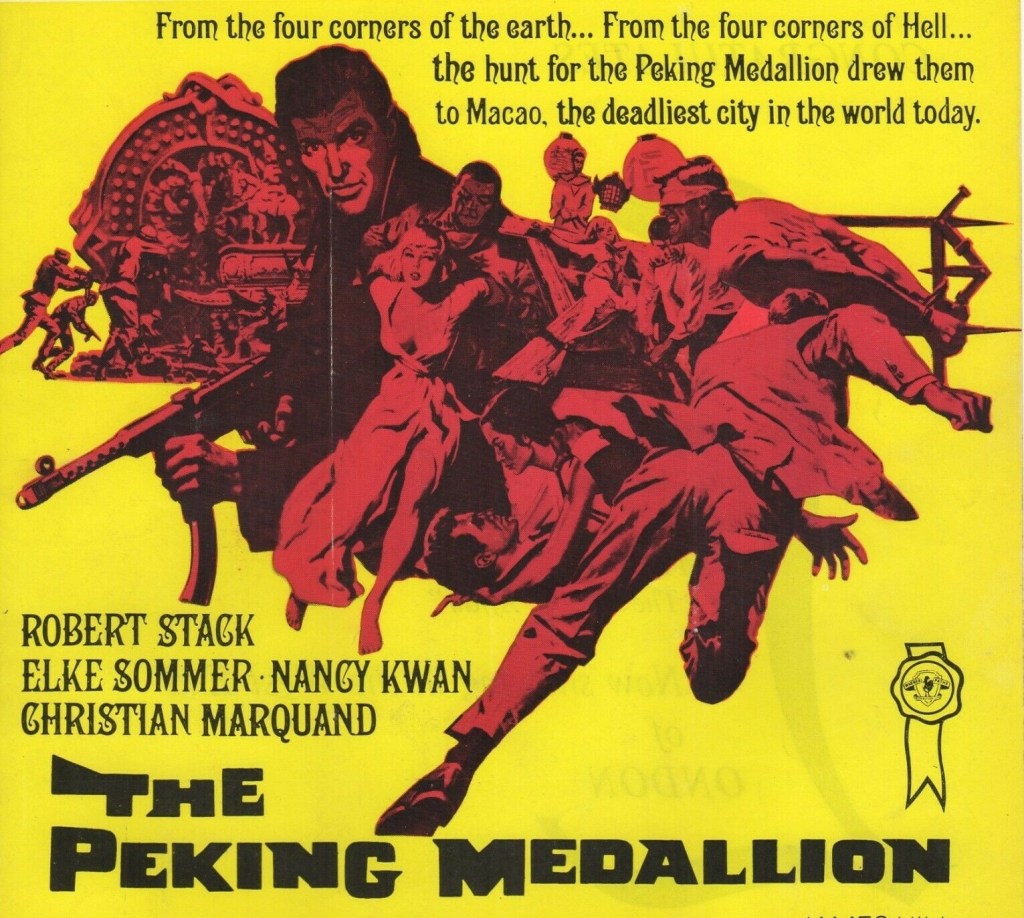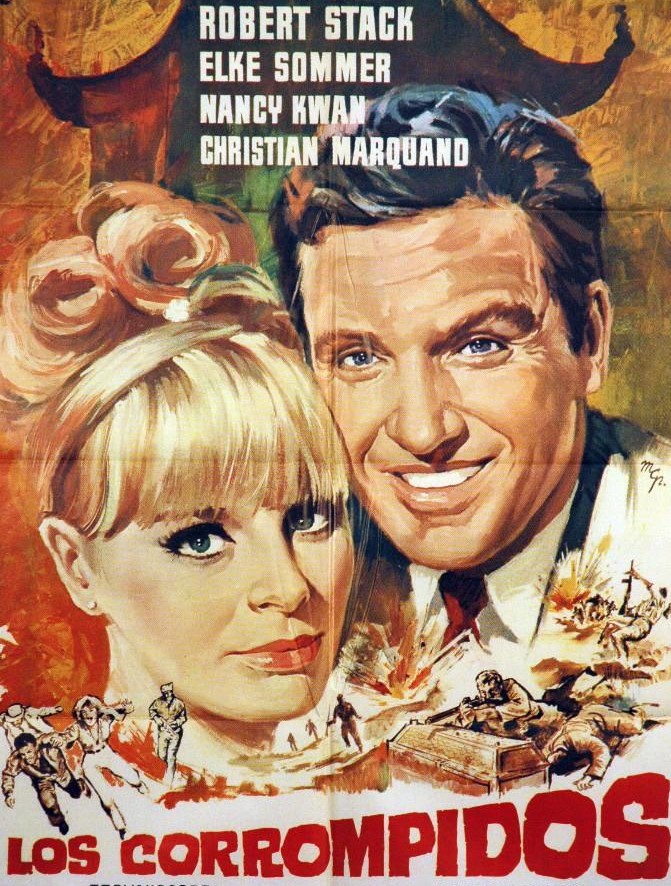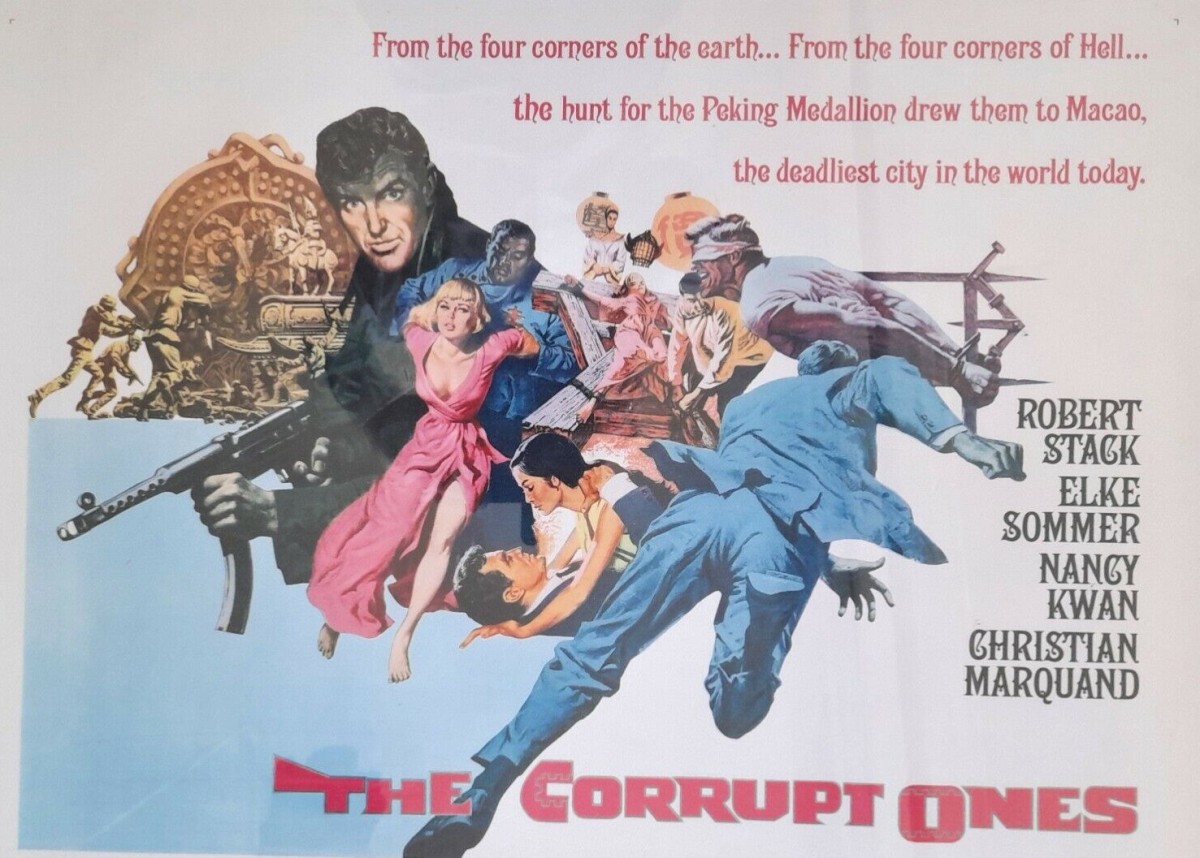
The Corrupt Ones / The Peking Medallion (1967) ****

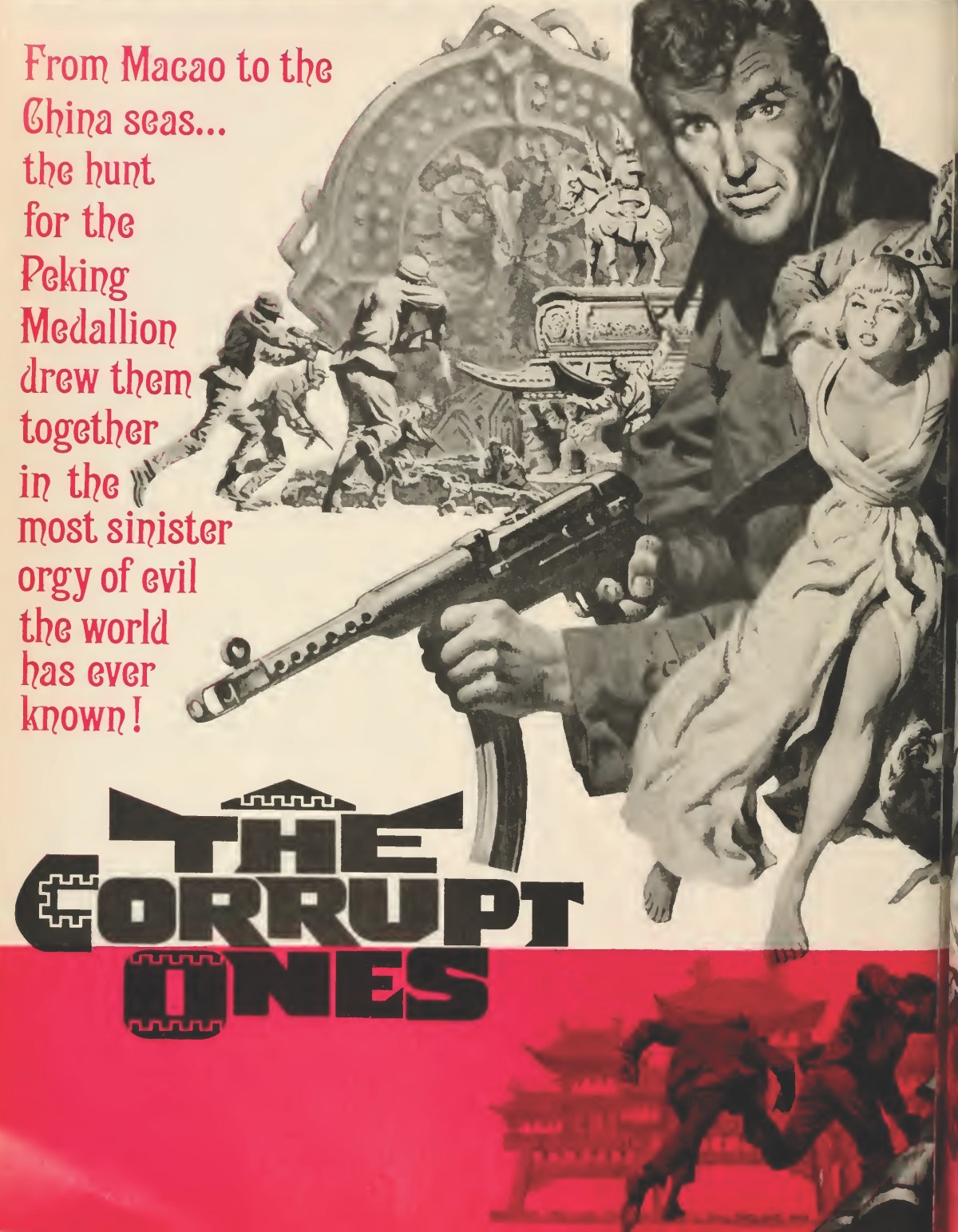
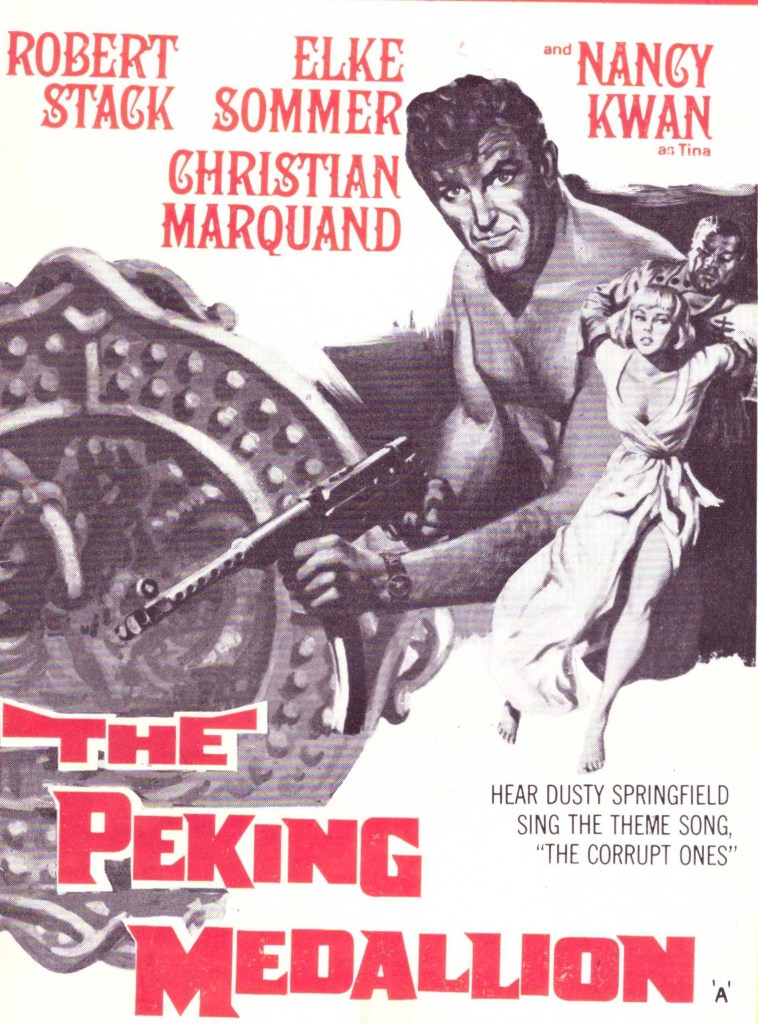
Non-stop action as spy Cliff Wilder (Robert Stack) battles a variety of crooks in Macao on the Chinese border as they seek to recover the legendary Peking medallion. Wilder hails from the James Bond school of espionage, duty bound to kiss every girl he meets. He might wonder at their compliance until he realizes they are only after his knowledge of the missing medallion.

The violence is criminally brutal – punch-ups, gunfights, samurai swordfights, murder and torture by blowtorch and acid and being dragged behind a motorboat. The string of sexy women is matched by handsome men, Brandon (Christian Marquand) and Danny (Maurizio Arena) in addition to Stack. The thriller pitches helter-skelter through nightclubs, casinos, caves, temples and palatial mansions, the pace only slowing down for, naturally, a scene in a stately rickshaw.
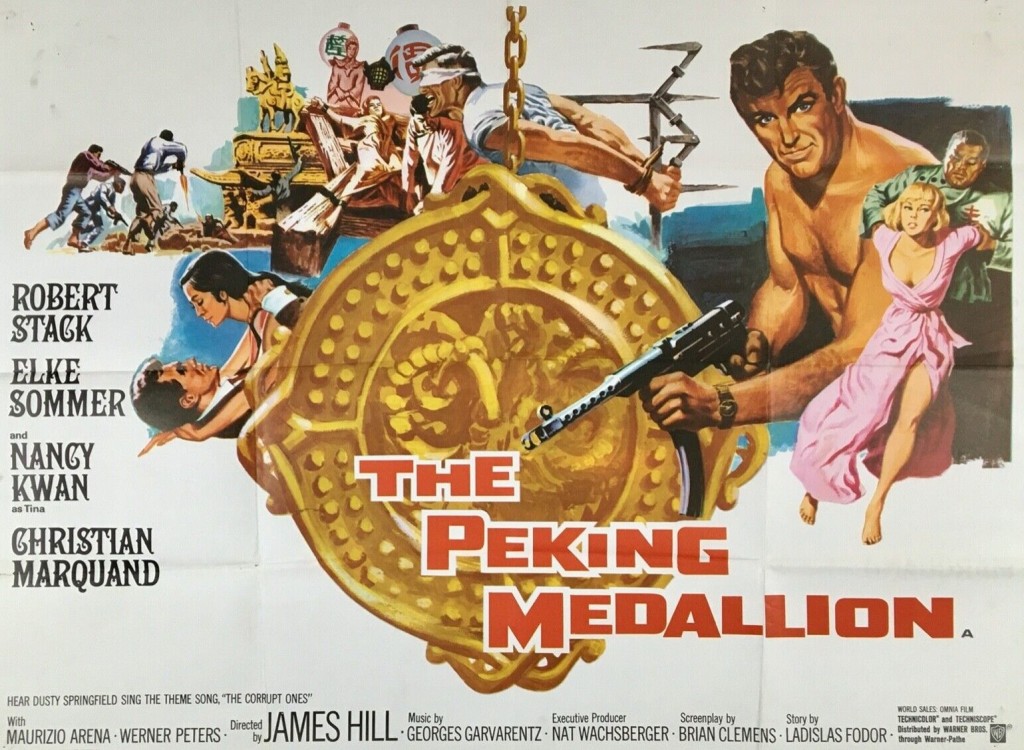
As well as Wilder who briefly – and unknowingly – has the medallion in his hands, others in the hunt include Lilly Mancini (Elke Sommer), wife of Danny who had passed it to Wilder before being killed. Mancini is on the wrong side of the femme fatale equation. Once Wilder  is wise to her seductive charm,s he quips, “Maybe you’re telling the truth but I can’t trust you.”

Also in hot pursuit are gangster Brandon and a Chinese mob headed by Tina (Nancy Kwan) That’s on top of a corrupt cop (“I have never feared death, only poverty” is his mantra) who doesn’t care who wins the prize as long as he gets his share. Double cross is the order of the day, alliances forged then broken. The action never stops long enough for one of those tension-building scenes of which Alfred Hitchcock or imitators like Stanley Donen (Charade, 1963, and Arabesque, 1966) were so fond.

Wilder faces danger with a quip, a kiss or gritted teeth, an old-fashioned tough guy without the James Bond self-awareness. He carries out his manly duties until his brain kicks in and he realizes this isn’t a spy picture after all but a genuine treasure hunt with clues that have to be deciphered. After that, the pictures sidetracks down another route. For a moment, the movie seems to have lost the plot. But then all hell breaks loose and we are back on the safe ground of fistfights, double-crossing and shooting.

Fans of improbable storylines, exotic settings, action, interesting bad guys and twists and turns will love this. How can you fail to love a movie with a samurai vs camera tripod swordfight?

An exemplary cast for this kind of malarkey, a French-Italian-German co-production with English as the mother tongue. Scarcely creditable that Robert Stack, in his biggest picture since The Untouchables tv series (1959-1963), was once Oscar-nominated given subtlety is never required. Nancy Kwan (The World of Suzie Wong, 1960) steals the show as the villainess but she’s run close by Elke Sommer (The Prize, 1963). In supporting roles are Werner Peters (Istanbul Express, 1968) and Christian Marquand (The Flight of the Phoenix, 1965).  

Might seem a considerable change of pace for director James Hill after Born Free (1966) but that’s only if you ignore his work on the equally complicated A Study in Terror (1965).  Screenplay punched out by Englishman Brian Clemens (And Soon the Darkness, 1970), Hungarian Ladislas Fodor (best know for the Dr Mabuse series) and Harald Bloom, his only known credit.

Great fun.

PREVIOUSLY REVIEWED IN THE BLOG: Robert Stack in Is Paris Burning? (1966); Elke Sommer in The Prize (1963), The Art of Love (1965), The Money Trap (1965), The Oscar (1966), The Venetian Affair (1966), Deadlier than the Male (1967), They Came to Rob Las Vegas (1968) and The Swiss Conspiracy (1976); and James Hill’s A Study in Terror (1965); Nancy Kwan in Tamahine (963), Fate Is the Hunter (1964), The Wild Affair (1965).
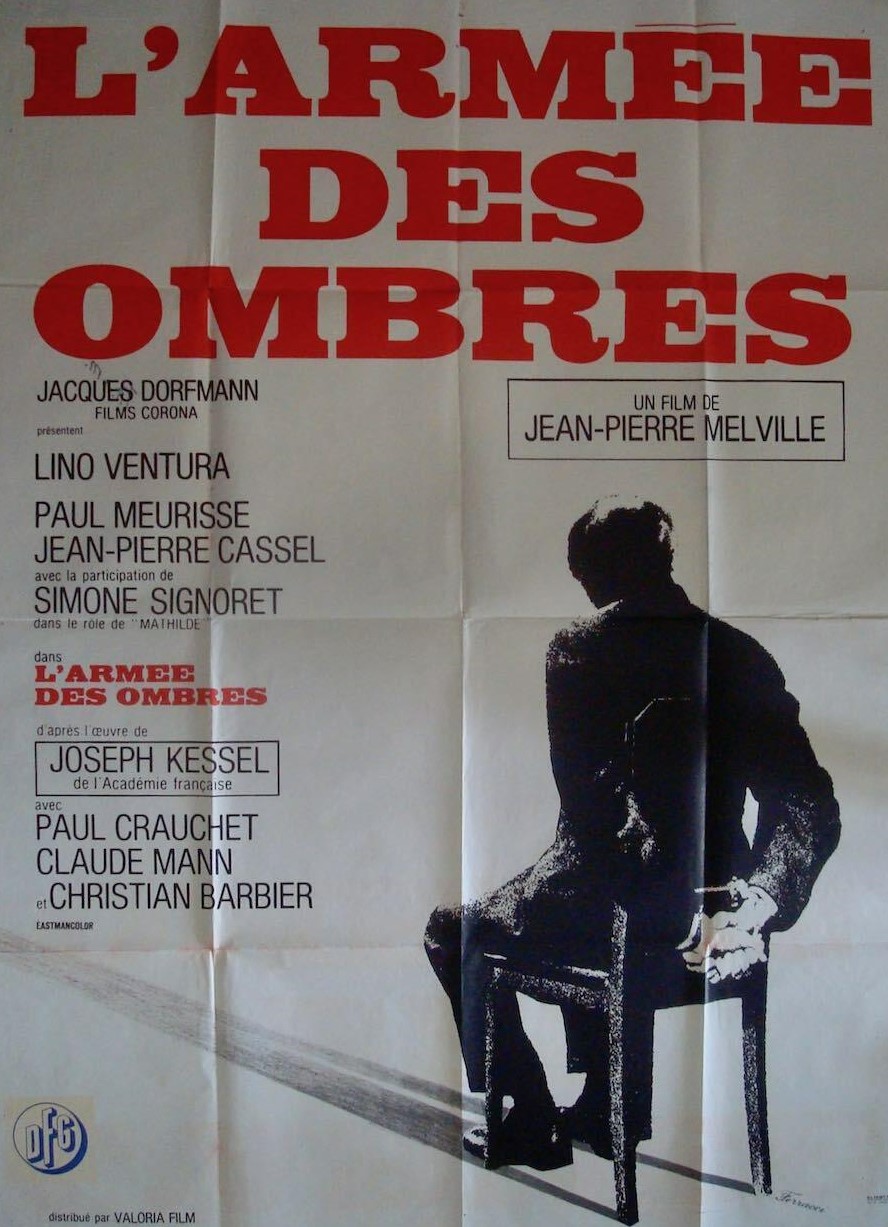
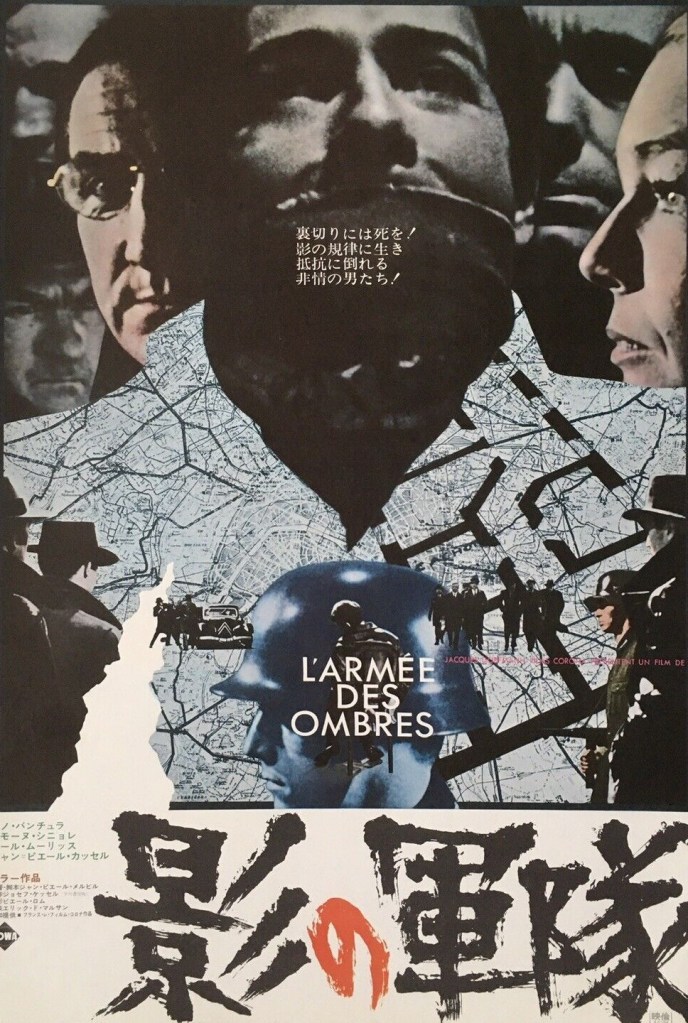
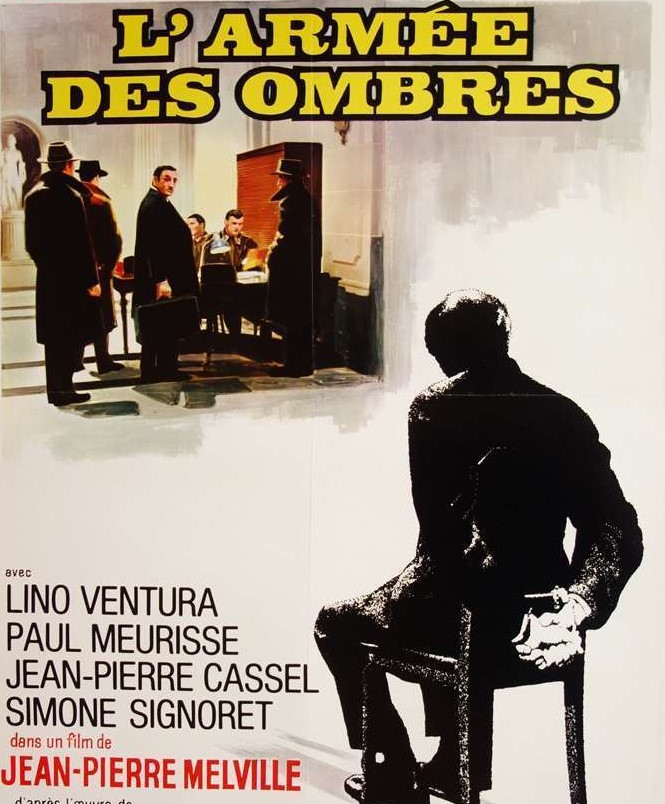
Army of Shadows/ Les Armees des Ombres (1969) ****

The antidote to the gung-ho World War Two picture. Scarcely any action and certainly none of the French Resistance swagger of The Train (1964) or the popular uprising of Is Paris Burning? (1965). Instead, sombre realism as Resistance leader Gerbier (Lino Ventura) dodges capture in a country pitted with collaborators. Nor is the underground portrayed in heroic fashion, their methods of revenge every bit as pitiless as the occupying forces.

Told in documentary style and based on the real-life exploits of characters taking the battle to the enemy, it’s backroom stuff, Gerbier organising his Resistance cell, meeting with other leaders. But his life is fraught with tension, as he attempts to dodge capture, with little success, it has to be said.

The film opens with Gerbier in captivity, an internment camp, where he is betrayed by an informer. While being transported to Paris, he escapes. His first action, revenge. With three colleagues, in an ordinary Marseille house where use of a gun will give them away, they strangle to death an informer. It’s not pretty.

Some join up for the risk like Jardie (Jean-Pierre Cassel), others maintain a more orderly, outwardly uninvolved, almost philosophic, lifestyle, like his older brother Luc (Paul Meurisse) who turns out to be the “Big Boss” of the Resistance, prominent enough to be transported by submarine to London to meet French leader-in-exile De Gaulle.   

Little of what they organise works out. Betrayal a constant, not just from collaborators, but from a fellow member who could be compromised by having a vulnerable child or parent. When one of the Marseille stranglers, Felix (Paul Crauchet) is captured, and likely to crack under torture, Mathilde (Simone Signoret), Gerbier’s assistant, comes up with a daring plan involving Jardie giving himself up so he will be imprisoned with Felix and, at the pessimistic end of expectations, can provide him with a cyanide pill, while the most optimistic outcome is three members disguised as Germans infiltrating the jail and sneaking him away.

The plan fails and Gerbier is subsequently arrested, imprisoned, his execution only denied by a daring rescue attempt – the only kind of typical war picture action. But then Mathilde becomes a liability and is executed.

It’s a cold-blooded kind of film and depicts with far greater realism the endeavors – failure outweighing success  of an underground operation during the Occupation. They don’t have the training for the job and their effectiveness is always open to question. Although British and American films might be filled with characters volunteering for dangerous missions, those are activities in isolation, not a commitment to a lifestyle that most likely would end in torture and death, endanger family and friends and leave you living in a sewer of suspicion. This presents an unvarnished truth. Not only are you expecting at any moment the Germans will pounce, there is a constant dread that the Resistance will be undone by their own actions, a plan too ambitious, someone cracking up, firing squad the most likely result. There’s nary a sniff of glory.

The big budget roadshow – The Longest Day (1962), Battle of the Bulge (1965), The Battle of Britain (1969) et al – while covering in some aspects the dangers of war were for the most part fist-pumping patriotic achievements, not this sneaking around, undercover stuff where missions were low-key, and the protagonists rarely in charge of their own destinies.

As far as French critics were concerned, the release timing was off, the film arriving in the wake of the 1968 riots and with De Gaulle in political trouble due to the Algerian situation. So it flopped with critics and audiences alike, and although it found a receptive audience in the U.K. in the late 1970s, it was denied release in the U.S. until 2006, by which point politics could not cloud opinion, and it earned rave reviews.

Lino Ventura (The Sicilian Clan, 1969) on top form is run close by Simone Signoret (The Deadly Affair, 1967). Jean-Pierre Cassell (Is Paris Burning?) comes closest to comic book heroics but even that is eventually reined in.

Everyone is helped by a screenplay by Joseph Kessel (The Night of the Generals, 1967), himself a member of the Resistance,  that is light on melodrama and overwrought dialog and concentrates on getting done the job in hand, no matter how unsavory. Equally notable is the lack of grandstanding, of glorious finish, of the Hollywood convention of redemption.

Director Jean-Pierre Melville (Le Samourai, 1967) , also a Resistance fighter and with a hand in the screenplay, brings to bear film noir sensibilities and the cold-bloodedness that informed a previous oeuvre tending towards gangster pictures.

A very bold undertaking of the most dour kind that deserves appreciation.

The Corrupt Ones / The Peking Medallion (1967) ****

Non-stop action as spy Robert Stack (The Untouchables tv series) battles a variety of crooks in Macao on the Chinese border as they seek the legendary Peking medallion. Stack hails from the James Bond school of espionage, duty bound to kiss every girl he meets. He might wonder at their compliance until he realizes they are only after his knowledge of the missing medallion.

The violence is criminally brutal – punch-ups, gunfights, samurai swordfights, murder, torture by blowtorch and acid and being dragged behind a motorboat. The string of sexy women is matched by handsome men (Christian Marquand and Maurizio Arena in addition to Stack). The thriller pitches helter-skelter through nightclubs, casinos, caves, temples and palatial mansions, the pace only slowing down for, naturally, a scene in a stately rickshaw.

As well as Stack who briefly – and unknowingly – has the medallion in his possession, others in the hunt include Elke Sommer, wife of the man (Arena) who passed it to Stack before being killed. Sommer is on the wrong side of the femme fatale equation. Once Stack is wise to her seductive charms he quips, “Maybe you’re telling the truth but I can’t trust you.”

The original title of the picture was “Hell in Macao” and that was used in Germany for example. It was called “The Peking Medallion” in the UK, Italy and Mexico and “The Corrupt Ones” in the US, France and Spain.

Also in hot pursuit are gangster Brandon (Marquand) and a Chinese mob headed by Nancy Kwan (The World of Suzie Wong, 1960). That’s on top of a corrupt cop (“I have never feared death only poverty” is his mantra) who doesn’t care who wins the prize as long as he gets his share. Double cross is the order of the day, alliances forged then broken. The action never stops long enough for one of those tension-building scenes of which Alfred Hitchcock or imitators like Stanley Donen (Charade, 1963, and Arabesque, 1966) were so fond.

Stack faces danger with a quip, a kiss or gritted teeth, an old-fashioned tough guy without the James Bond self-awareness. He carries out his manly duties until his brain kicks in and he realizes this isn’t a spy picture after all but a genuine treasure hunt with clues that have to be deciphered. As this causes the movie to sidetrack down another route, it looks like the picture has lost the plot. But then all hell breaks loose and we are back on the safe ground of fistfights, double-crossing and shooting.

The script by Brian Clemens deftly mixes a variety of genres. What might have been a definite change of pace for British director James Hill given his previous effort was Born Free (1966) was anything but since he was responsible for the most recent Sherlock Holmes thriller A Study in Terror (1965).

Fans of improbable storylines, exotic settings, action, interesting bad guys and twists and turns will love this. How can you fail to love a movie with a fight featuring a samurai sword versus a camera tripod?

Many of the films from the 1960s are to be found free of charge on TCM and Sony Movies and the British Talking Pictures as well as mainstream television channels. But if this film is not available through these routes, then here is the link to the DVD and/or streaming service.

Discover WordPress

A daily selection of the best content published on WordPress, collected for you by humans who love to read.

The Atavist Magazine

by Brian Hannan

WordPress.com News

The latest news on WordPress.com and the WordPress community.