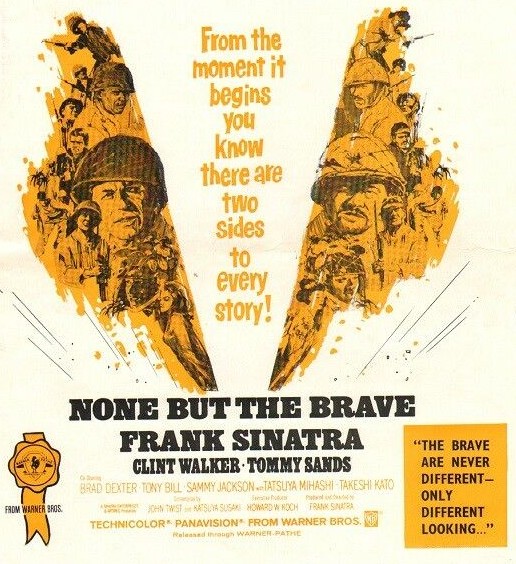
None but the Brave (1965) *****

Frank Sinatra’s sole stab at direction is an astonishing piece of work and deserves to be revisited in a more positive frame of mind than it encountered on original release.  Maybe critical acclaim depends on your name, and most critics were already tearing into Ol’ Blue Eyes because his acting in the 1960s scarcely matched his work in the 1950s – From Here to Eternity (1953), The Man with the Golden Arm (1955), Guys and Dolls (1955), High Society (1956) and Pal Joey (1957).

On the other hand critics were all over themselves when John Boorman and Clint Eastwood went down a similar route in Hell in the Pacific (1968) and the double header Flags of Our Fathers (2006) and Letters from Iwo Jima (2006), respectively, and American audiences griped about the even-handedness of Tora! Tora! Tora! (1970).
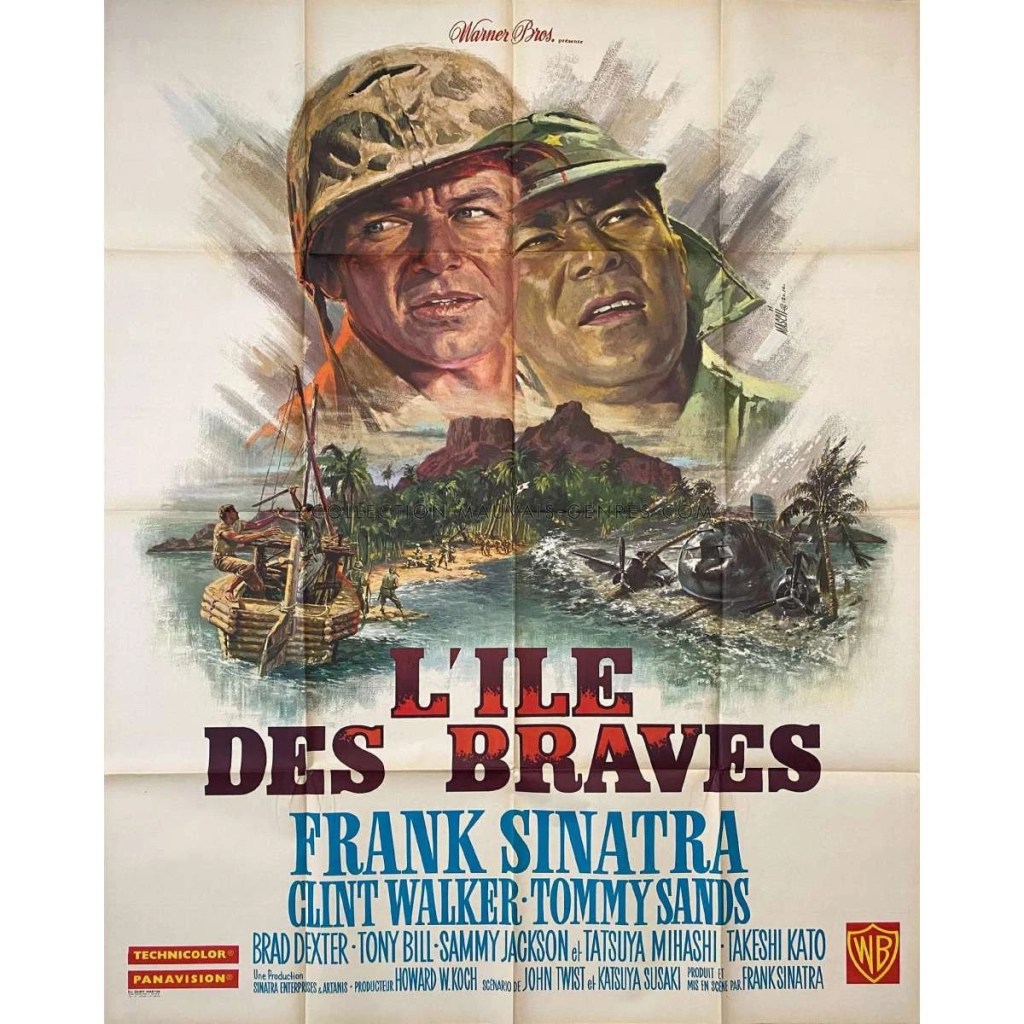
Not only is this primarily presented from the Japanese point-of-view, opening and closing with scenes involving the Japanese, but it is not so much even-handed as presenting the opposing sides in exactly the same manner, so that the “enemy” is never viewed as such but as a rag-tag collection of ordinary men thrust into warfare.

While there’s certainly courage on show, there’s also more than a war movie’s normal share of rashness and stupidity, disobedience, the flouting of orders, the challenging of the line of command and that taboo subject – death from friendly fire. There are clever maneuvers and outwitting the opposition.

The composition of both sides could be echoes of each other. Both have calm leaders in Capt Dennis Bourke (Clint Walker) and Lt Kuroki (Tatsuya Mihashi) who both struggle to keep in line intemperate subordinates, Second Lieut Blair (Tommy Sands) and Sgt Tamuro (Takeshi Kato) who tend to issue orders at a scream and in the latter instance with a slap in the face. Both lieutenant and sergeant, career soldiers, bristle at having to accept orders from less experienced officers.

None of the recruits are worth a button as soldiers. On the Japanese side we have a Buddhist priest, on the American side guys who wouldn’t recognize a trap even when they fell into it. Bourke also has to contend with loudmouth Sgt Bleeker (Brad Dexter), itching to start a fight.
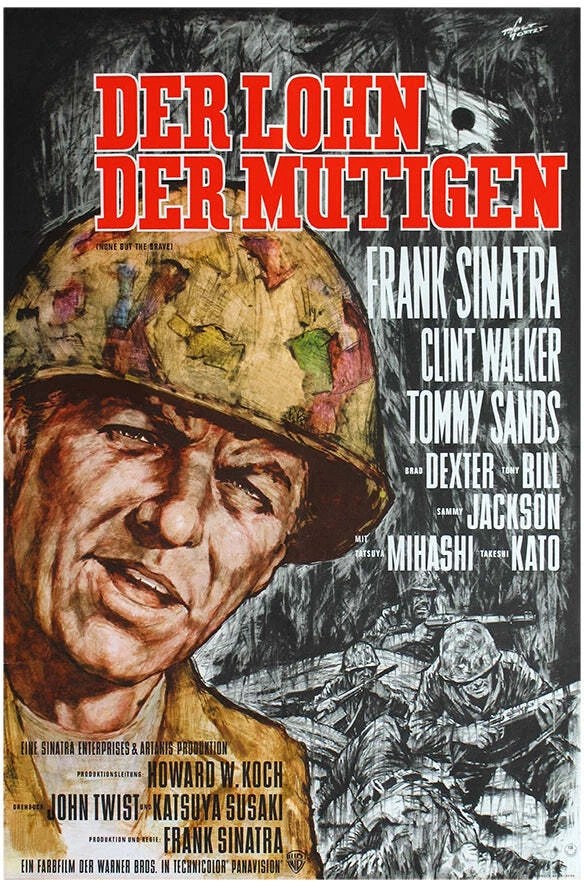
The Americans have one trump card – and it’s not weaponry. They have someone with the medical skill to save a badly wounded Japanese soldier. And although he’s only a pharmacist (Frank Sinatra) he’s got enough knowledge to carry out an amputation. The Japanese have their own trump cards – food and water. And the two leaders effect a truce. You know it won’t last, of course, which leads to a savage ending, though a touching climax.

There’s plenty action, more than you might expect, since generally in this kind of war movie we spend ages getting to know the soldiers long before there’s any reason to fire a shot or explode a bomb. All we know about the Americans is that they shouldn’t be here, they were flying elsewhere when their plane crash-landed on a remote island they believe is unoccupied. All we know about the Japs is that they’re trying to get off the island by building a boat.

Foolish soldiers on either side upset the leader’s strategies so the bullets soon fly. The Japanese on sighting an American warship cruising close by have the cleverest notion, running up a Japanese flag, which the sailors take to mean the island is under Japanese control and begin a bombardment which kills Americans. The Yanks, on the other hand, manage to steal the Japanese boat, but only for a short time before a grenade puts paid to any notions of escape.

In most war movies that pay any attention to the lives of the soldiers, that usually concentrates on sentiment, women left behind, families abandoned and so forth and while this strays into that territory once, the bulk of the time we see character revealed by current action, which is a more difficult thing to achieve, but far more rewarding.

Given his duties behind the camera, Frank Sinatra (Robin and the 7 Hoods, 1964) wisely plays a largely supporting role, restricted to the occasional wisecrack, but allocated one big central scene so that audiences don’t feel they’ve not had their money’s worth. But, actually, he relinquishes the most important scene to someone else. An armed American soldier coming across an unarmed half-naked Japanese who has been catching fish can’t bring himself to shoot him because you shouldn’t shoot a good fisherman.

There’s not much in the way of visuals or composition to write home about, but this film didn’t require such virtuosity, the director more than makes it work by sticking to the knitting, and concentrating on the humanity and refusing to allow the enemy to be portrayed as such.  

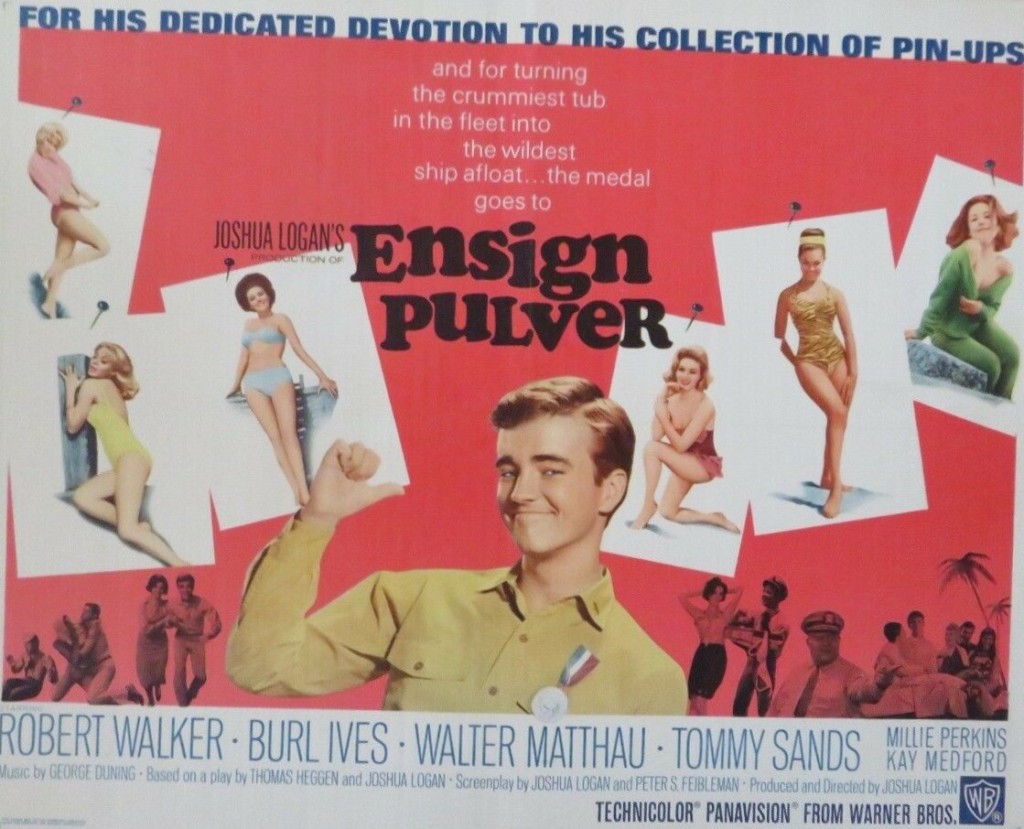
Clint Walker (Sam Whiskey, 1969) and Tatsuya Mihashi (Tora! Tora! Tora!) carry the picture effortlessly while their rebellious underlings, singer Tommy Sands (Ensign Pulver, 1964) and Takeshi Kato (Yojimbo, 1961) do their best to steal the picture. Look out for Brad Dexter (The Magnificent Seven, 1960) and future producer Tony Bill (The Sting, 1973).

Written by John Twist (A Distant Trumpet, 1964), Katsuya Susaki (Way Out, Way In, 1970) and the film’s producer Kikumaru Okuda.

Not to be missed. A war classic.
The Hot Prospects Business – 1960s Style

As difficult as it was to guess which films would hit the box office target and which would turn into irredeemable flops, Hollywood studios and exhibitors stewed as much over the potential of the next generation of stars. This was an era when talent schools still existed, youngsters taken on at modest wages and provided with both standard acting lessons and other important elements of movie education such as riding a horse or sword-fighting as well as breaking in the actors and actresses with small roles. They would be given progressively larger roles until they emerged, hopefully, as genuine candidates for box office glory.

Of course, the studios had their own ideas which of their youngsters was likely to make the grade, the most obvious marker being the types of parts they were handed, but exhibitors helped the process along by taking part in an annual survey organized by trade paper Box Office.

So I’ve chosen a year – 1965, midway through the decade – at random to see how many of the new generation of stars made the grade. According to the Box Office survey the top six males (in order) were Peter Fonda, Robert Walker Jr, Patrick Wayne, Keir Dullea, Doug McClure and Tommy Sands. The top six females were:  Patty Duke, Stefanie Power, Nancy Sinatra, Rita Tushingham, Rosemary Forsyth and Barbara Eden.

You can see from the list that a recognizable name goes a long way, a full one-third of the candidates blessed with a father with a famous name, Peter the son of Henry Fonda, Patrick the son of John Wayne, Nancy the daughter of Frank Sinatra. Robert Walker had never been in that elite class but it appeared his name was still strong enough for his son to capture public attention.

What exactly a rising star embodied appeared to be in the eye of the beholder. Some of the stars already had a decent portfolio, others not so much. (The survey was published in early 1966 so I assuming it took into account acting performances up to the end of 1965.)

On acting talent alone the front runners should have been Rita Tushingham, Patty Duke and Keir Dullea. Britisher Tushingham had won Best Actress at Cannes for A Taste of Honey (1961) and was tipped for a Bafta for The Knack (1965) – she did in fact win. In both films she was top-billed and again for The Trap (1966). Patty Duke had won an Oscar for The Miracle Worker (1962) and been top-billed in Billie (1965) but her popularity surge was largely thanks to her eponymous television show which ran from 1963 to 1966.

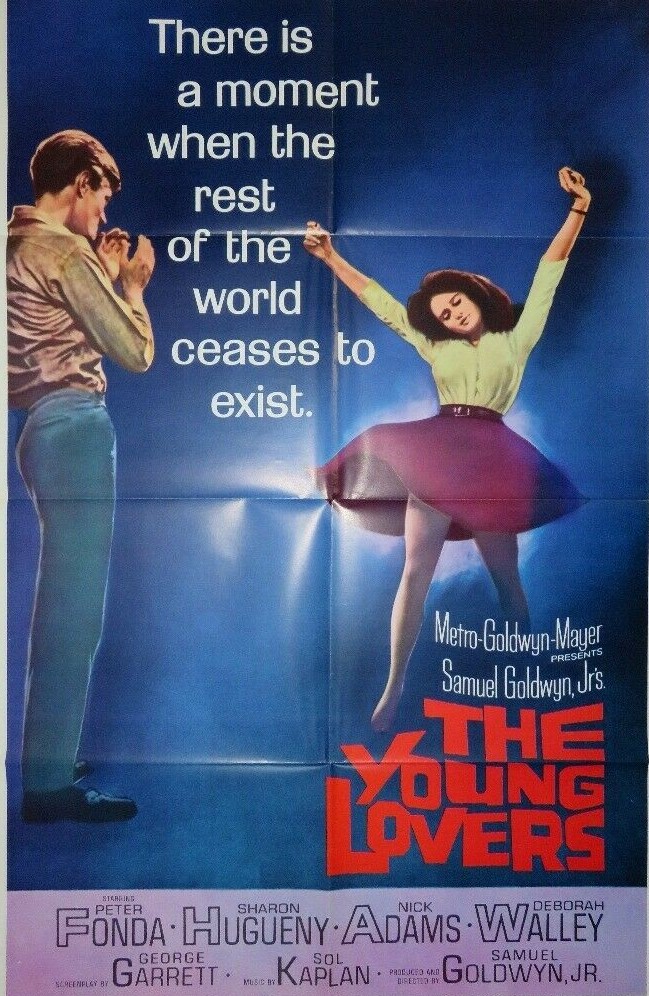
Since starring in David and Lisa (1962). Dullea’s career appeared jeopardized by offbeat choices, The Thin Red Line (1964) and The Naked Hours (1964), in both top-billed, before sliding down the credit rankings for Otto Preminger’s Bunny Lake Is Missing (1965). Peter Fonda appeared to be heading for success as a romantic star after appearing in fluff like Tammy and the Doctor (1963) and his first top-billed role in The Young Lovers (1964). Robert Walker Jr, top-billed in Ensign Pulver (1964), had followed this up with Italian oddity The Touching and Not Touching (1965) thus demonstrating versatility.

Stefanie Powers was clearly a rising star, smaller roles in The New Interns (1964) and Love Has Many Faces (1965) had led to second-billing in Die! Die! My Darling (1965) and her forthcoming role in Stagecoach was expected to solidify her mainstream career. Barbara Eden was dependent on television for her high placing, after I Dream of Jeannie kicked off in 1965. Most heavily dependent on nepotism were Patrick Wayne and Nancy Sinatra. Wayne was by far the least proven, riding very much on his father’s coat-tails, but fourth-billed in Shenandoah (1965) and a leading role in television series The Rounders which had kicked off in 1966. Sinatra was the longest shot, just bit parts so far.

Television’s The Virginian had been the launch pad for Doug McClure but he had since ventured out into Shenandoah (1965) and Beau Geste (1966), second-billed each time. Apart from his reputation as a singer, it’s hard to see why Tommy Sands ended up so favored, with just a couple of bit parts to his name. But you could see why Rosemary Forsyth, after the female lead in The War Lord (1965) was attracting industry attention.

So what happened to the prospects? Were the talent-spotters proved right? As you might expect, yes and no is the answer.

Keir Dullea and Peter Fonda proved the standouts. Dullea followed the offbeat The Fox (1967) with the big-budget big hit 2001: A Space Odyssey (1968). Fonda quickly transitioned to The Wild Angels (1966) and starred in the decade’s most unexpected hit, Easy Rider (1969), and long-term was easily the most successful graduate of the Class of ’66.

Patty Duke was second-billed in big hit Valley of the Dolls (1967) and won outright top billing for Me, Natalie (1968). After The Wild Angels (1966) Nancy Sinatra became a pop star in her own right before sharing the billing with Elvis Presley in Speedway (1968) but that was the highlight of her movie career. Patrick Wayne took longest to find his feet but snagged several top-billed roles, mostly leading with his chin in fantasy pictures such as Beyond Atlantis (1973), The People That Time Forgot (1977) and Sinbad and the Eye of the Tiger (1977). Rita Tushingham starred in a string of films including The Trap (1966) Smashing Time (1968), The Guru (1969) and The Bed Sitting Room (1969) that failed to click with U.S. mainstream audiences.

Doug McClure was second-billed in Beau Geste (1966) and top-billed for swashbuckler The King’s Pirate (1967) and comedy Nobody’s Perfect (1968) before drifting back into television to emerge years later as a credible top-billed star of Hellhounds of Alaska (1973), The Land Time Forgot (1974) and At The Earth’s Core (1976). Stefanie Powers only managed top-billing for Crescendo (1970) and had to wait over a decade to realize her potential, and then in television show Hart to Hart (1979-1984).

Roy Walker Jr.’s career never took off, his biggest success as Young Billy Young (1969) was a flop. Rosemary Forsyth got as high as leading lady on Texas Across the River (1966) and Where It’s At (1967) but then drifted down the credits into the ranks of supporting players. Barbara Eden only managed a few television movies. Tommy Sands’ movie career died the death except for third billing in biker picture The Violent Ones (1967).

Screenwriter William Goldman coined the phrase “nobody knows anything” in relation to movies but it might equally apply to industry expectation of hot prospects, some of whom crashed and burned, and some never were even hot.

SOURCE: “12 most popular players of ’65,” Box Office, February 28, 1966, p76-77.

Discover WordPress

A daily selection of the best content published on WordPress, collected for you by humans who love to read.

The Atavist Magazine

by Brian Hannan

WordPress.com News

The latest news on WordPress.com and the WordPress community.