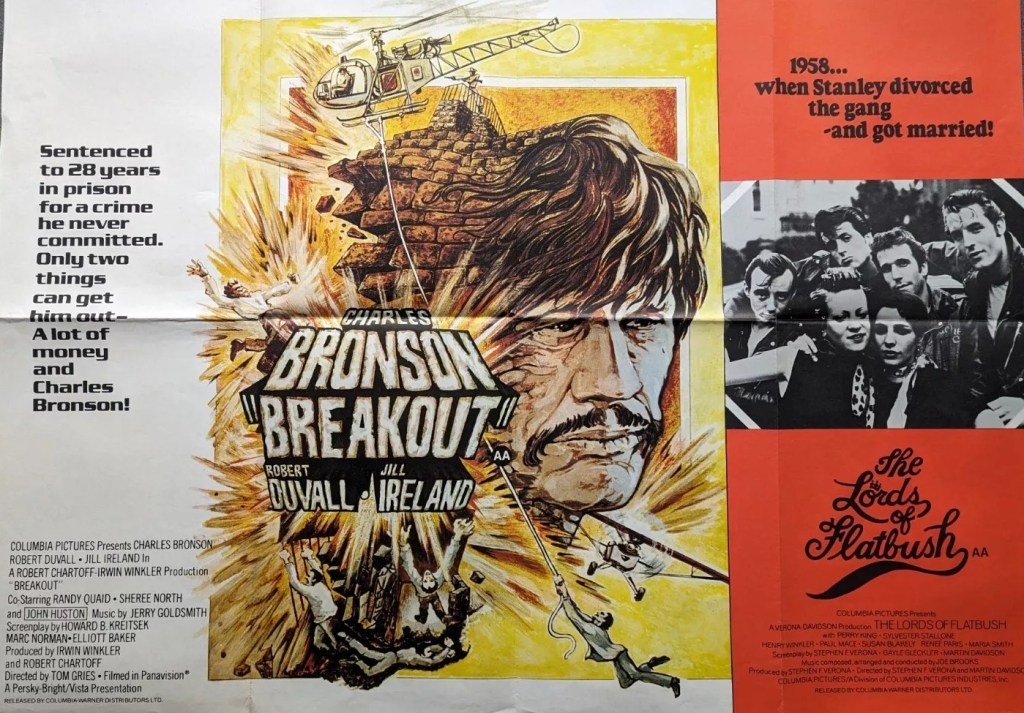
The advertising gurus earned their corn on this one because it must have come as a shock for all concerned, studio and audiences alike, to discover that star Charles Bronson (Farewell Friend, Adieu L’Ami, 1968) was engaged in a rapid reversal of his screen persona, an experiment that ended with the poorly received From Noon Till Three (1976). Sold as an action picture, this struggles to fit into the genre, what with most of the elements of rescue misfiring or D.O.A.
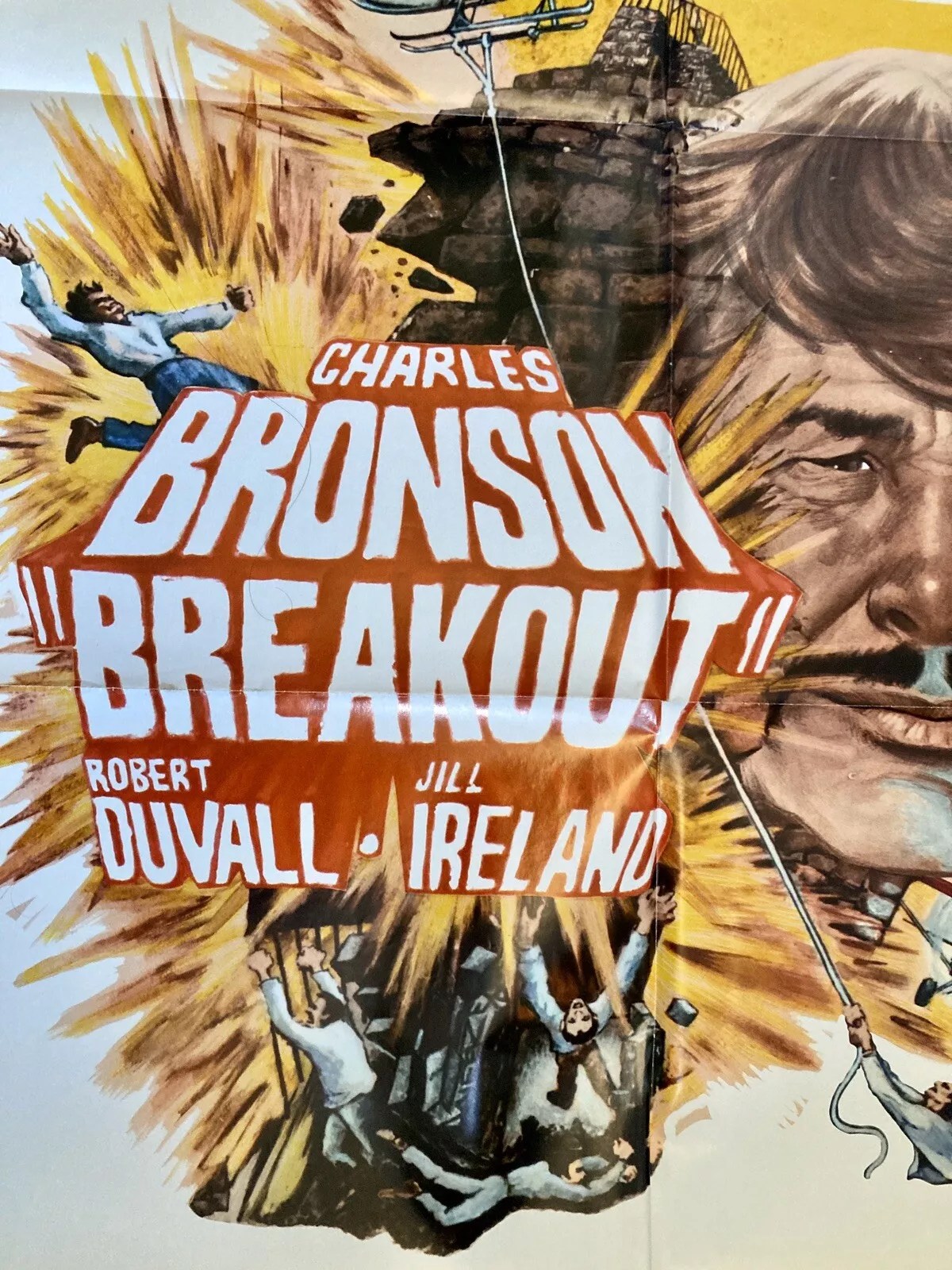
The poster people were so stuck for ways of selling the picture they resorted to using an image of an explosion in a manner that indicated it was key to the actual breakout when in fact it was related to a random incident. The highlight of the picture, the breakout itself, despite the best efforts to generate tension though the application of a 10-second escape window, is as mundane as all get-out, a helicopter basically loitering in a prison courtyard until the prisoner to be rescued saunters out.
Not only does the movie jettison the Bronson tradition of uncompromising tough guy but it sets up constant screen partner Jill Ireland in a more interesting role than normal while skirting a Casablanca-style romance.
The story itself gets off to a mighty confusing start. Nefarious businessman Harris Wagner (John Huston) arranges, for reasons that are unclear, for grandson Jay (Robert Duvall) to be incarcerated in a Mexican prison. Your first double take as an audience is the purported age gap. Huston was, in reality, was just past 70 years of age while Duvall was 44 – and never a chance of that actor playing younger – so you are left wondering how in heck did they contrive to be grandfather and grandson.
Putting that to one side, the first 15-20 minutes of a lean 96 exclude Bronson altogether while director Tom Gries (Will Penny, 1968) builds up the tale of failed rescue attempts by Jay’s wife Ann (Jill Ireland) and the sadistic nature of prison overlord J.V. (Emilio Fernandez) who has a penchant for burying prisoners alive or taking bribes to let them escape before promptly reneging on the deal. Eventually, for reasons unexplained, Ann turns to bush pilot Nick (Charles Bronson) who runs a seat-of-the-pants operation with the kind of plane that looks like it’s held together with string.
Bronson…Stallone…Together! If only Stallone had been bigger at the time.
He’s not your usual monosyllabic grump, but an overconfident wide boy, the bulk of whose schemes fail to work. A modern audience is going to turn up its nose in any case at one plan that involves faking a rape to create a distraction for the prison guards rather than going down the simpler route of Raquel Welch in 100 Rifles (1969) and Marianna Hill in El Condor (1970) of giving the lascivious guards something to ogle.
And another proposal only works because it’s handed a get-out-of-jail-free card when the guards who make a point of groping every female visitor, in theory to check for contraband or concealed weapons, avoid doing so with Nick’s sidekick Hawkins (Randy Quaid) when he dresses up as a woman.
There’s not enough time for any genuine romance to develop between Nick and Ann, a notion that’s undercut in any case by the fact that she’s trying to rescue her beloved husband, but that does allow for more friction than was normal in their pictures. Takes her a long time, understandably, to trust this untrustworthy fella, what with his schemes that rarely work.
For tension we are almost entirely reliant on the bad guys, J.V. indulging in bits of sadism, someone on the inside always knowing of the plans ahead of time, or of Jay being so debilitated by his stay in prison that he seems too out of it to keep his appointment with freedom. There is a quite barmy assumption that should a stray helicopter land in a prison courtyard that none of the other inmates will think to hitch a lift out.
There is some good value here in the Bronson/Ireland partnership trying to shake off what they saw as the shackles of their joint screen persona, or perhaps wanting to re-validate Ireland’s place in the team after Bronson did exceptionally well in her absence in Death Wish (1974). But the story’s an odd one, a kind of discount-store escape, with Bronson essaying the kind of character usually left to such supporting acts as Warren Oates or George Kennedy.
But there’s just not enough that’s new here – the unfairly underrated From Noon Till Three showed how to ring in the changes – to justify Bronson’s inclusion although the Bronson/Ireland dynamic does undergo interesting change. Robert Duvall (The Rain People, 1969) is also acting against type, devoid of the bluster that was his calling card. Randy Quaid (The Last Detail, 1974) has a quirky part.
Tom Gries did well enough in Bronson’s eyes that he was selected for the follow-up Breakheart Pass. Too many hands on the screenplay tiller – Marc Norman (Shakespeare in Love, 1998), Elliott Baker (A Fine Madness, 1966) and Howard B. Kreitsek (The Illustrated Man, 1969) adapting the book by Warren Hinckle, William Turner and Eliot Asinof – suggested nobody really knew how to make this work. And they were right.
Interesting shift in the Bronson persona but a misnomer on the action front.
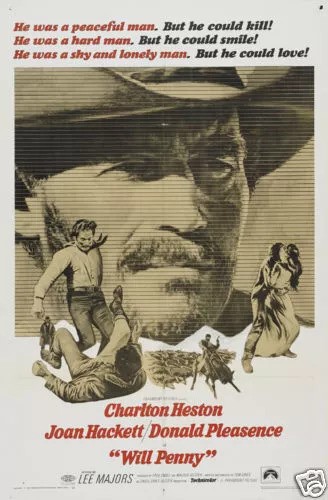
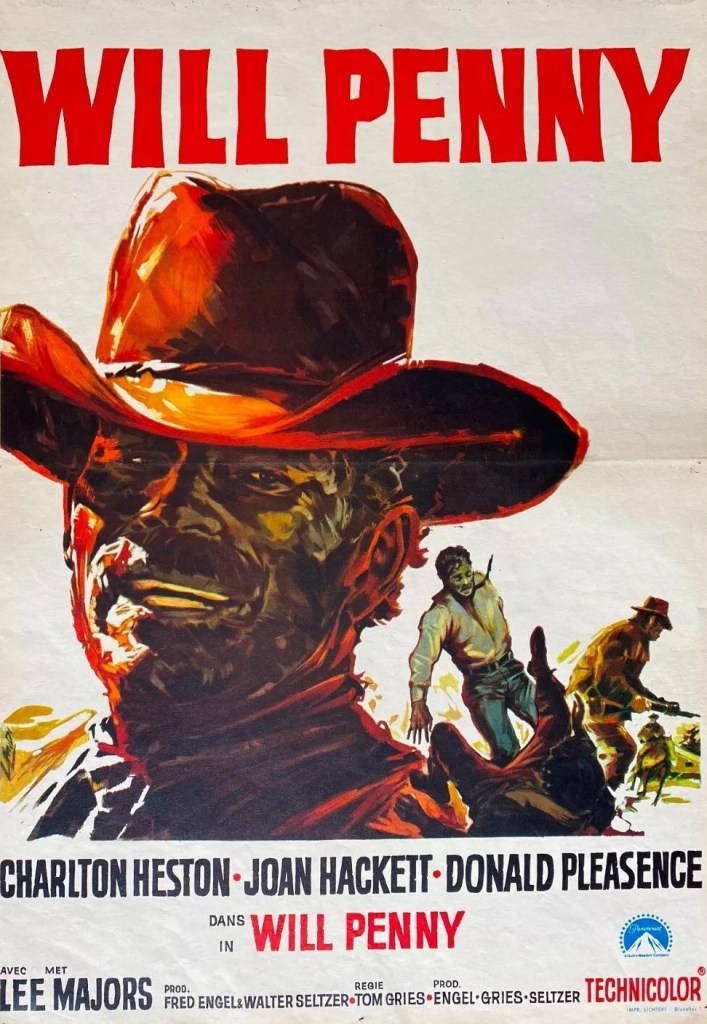
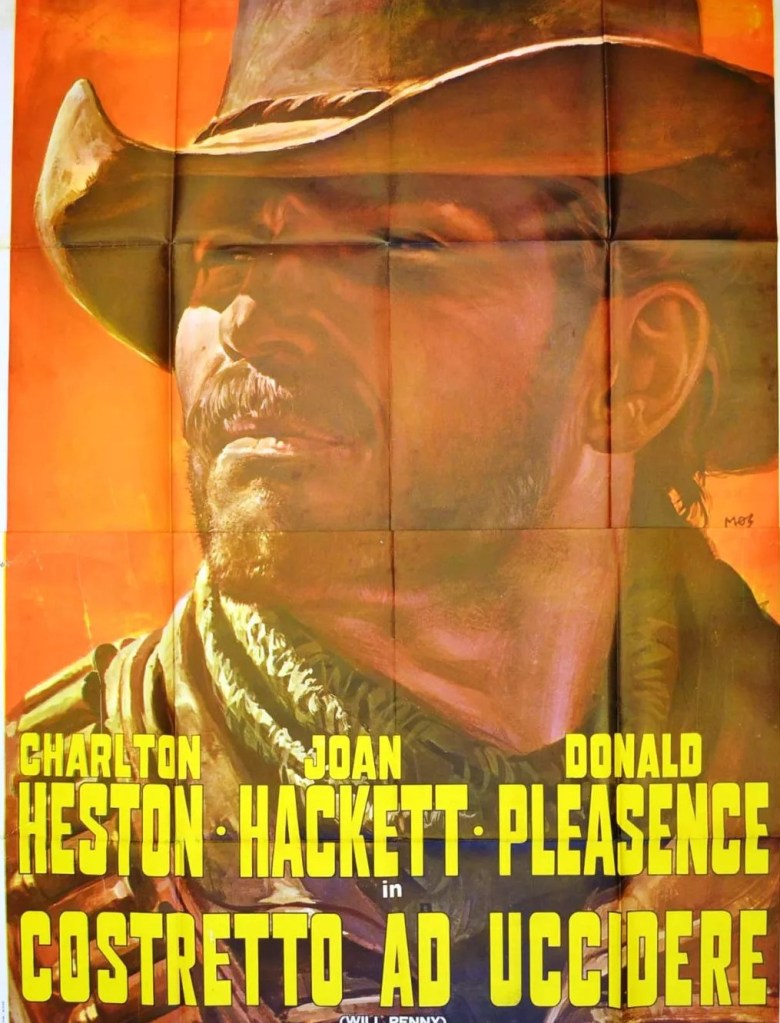
Tale of two westerns. On the one hand two undoubtedly fine performances contribute to an excellent realistic somewhat downbeat cowboy yarn. On the other hand a bunch of loonies jumping in every now and then as plot devices upset the wonderful tone. There had to be some other way, surely, to ensure itinerant illiterate 50-year-old cowhand Will Penny (Charlton Heston) and educated single mother Catherine (Joan Hackett) spend the winter together, other than him being bushwhacked by mad-eyed Preacher Quint (Donald Pleasance) and left to die.
This kind of sub-plot, you know where it’s going to end, even though, in this case, it goes down a few bizarre routes. Luckily, the main narrative continues to surprise in interesting fashion.
Like its modern equivalent The Misfits (1961), this mostly revolves around simple-minded cowboys who enjoy simple pleasures, drinking and fornicating, at the end of a hard trail ride. Will looks no further ahead than his next job. He’s easily the oldest of the cowboys and we’re introduced to him getting a telling off for trying to steal a few biscuits from the trail cook. He’s constantly razzed by the younger guys, though he’s able to take care of himself. At trail’s end, he hooks up with Blue (Lee Majors) and Dutchy (Anthony Zerbe) who, unexpectedly, find themselves in a shooting match with Quint’s family.
Dutchy comes off worst, a bad gunshot wound accidentally self-inflicted. The next few sequences are terrific. Dutchy, thinking he’s going to die, wants to go out drinking gutrot whisky and telling tall tales of heroism to Catherine who they encounter at a tiny trading post. There’s generally a callous disregard for the wounded. Even so, Blue and Will take the wounded, now drunk, man to the nearest town where the Dr Fraker (William Schallert) doubles as the local barber.
Will finds a job tending an outlying herd but finds the cabin that goes with it inhabited by Catherine and son Horace (Jon Gries). Out on the job, he’s attacked, robbed and left for dead by Quint and sons Rafe (Bruce Dern) and Rufus (Gene Rutherford). He manages to find his way back to the cabin and is tended by Catherine. Horseless and not fit for work, he decides to hole up in the cabin, fixing it up to withstand winter.
They’re wary of each other, but he bonds with the boy, and gradually they warm to each other, despite the two-decade age gap. She’s been let down so often by men, husband, trail escort etc, that she clearly finds something admirable in his dependability.
And we would probably be headed for a heartbreak ending. We’ve already seen how easy it is to be injured in the cowboy game, and how unemployable that renders a man, so the prospects of an ageing cowhand, who knows no other existence, settling down with an idealistic younger woman seem remote.
In any case, there’s a ways to go before that time comes since at Xmas the Quints reappear, beat Will up again and tie him up. You’d expect them to have their way with Catherine but there’s a twist in that Preacher has sized her up as a wife for one of her sons. While they are fighting over her, Will escapes.
Luckily, his old buddies come looking for him and he’s got a sack of sulphur (purpose never explained) so he smokes out the bad guys and they all get shot, leaving Will and Catherine with their heart-breaking moment.
As I said, two quite dfferent movies at odds with each other. Charlton Heston (Number One, 1969) is transformed. His trademark screen persona disappears under this quite different, diffident, awkward, character and there’s an argument to say this is his best-ever performance. The scenes where he tries to cover up his illiteracy, shies away from learning a Xmas tune, and explains his theories on the frequency of bathing are outstanding.
If you only know Joan Hackett from Support Your Local Sheriff (1969) you wouldn’t recognize her here, contained and watchful, rather than somewhat crazy in the James Garner picture.
While this pair gell, Donald Pleasance (Soldier Blue, 1970) et al stand out like a sore thumb as if they’ve decided to try and hijack the picture with some pointless over-acting. An excellent supporting cast includes Lee Majors (The Six Million Dollar Man) in his debut, Ben Johnson (The Undefeated, 1969), Slim Pickens (Rough Night in Jericho, 1967), Clifton James (Cool Hand Luke, 1967), Bruce Dern (They Shoot Horses, Don’t They, 1969) – in full chipmunk-teeth mode – and Anthony Zerbe (Cool Hand Luke).
Tom Gries (100 Rifles, 1969), as writer and director, makes an excellent impression.
The cowboy and homestead sections work incredibly well, what passes for action and plot drag it down. Still, on balance, well worth seeing.
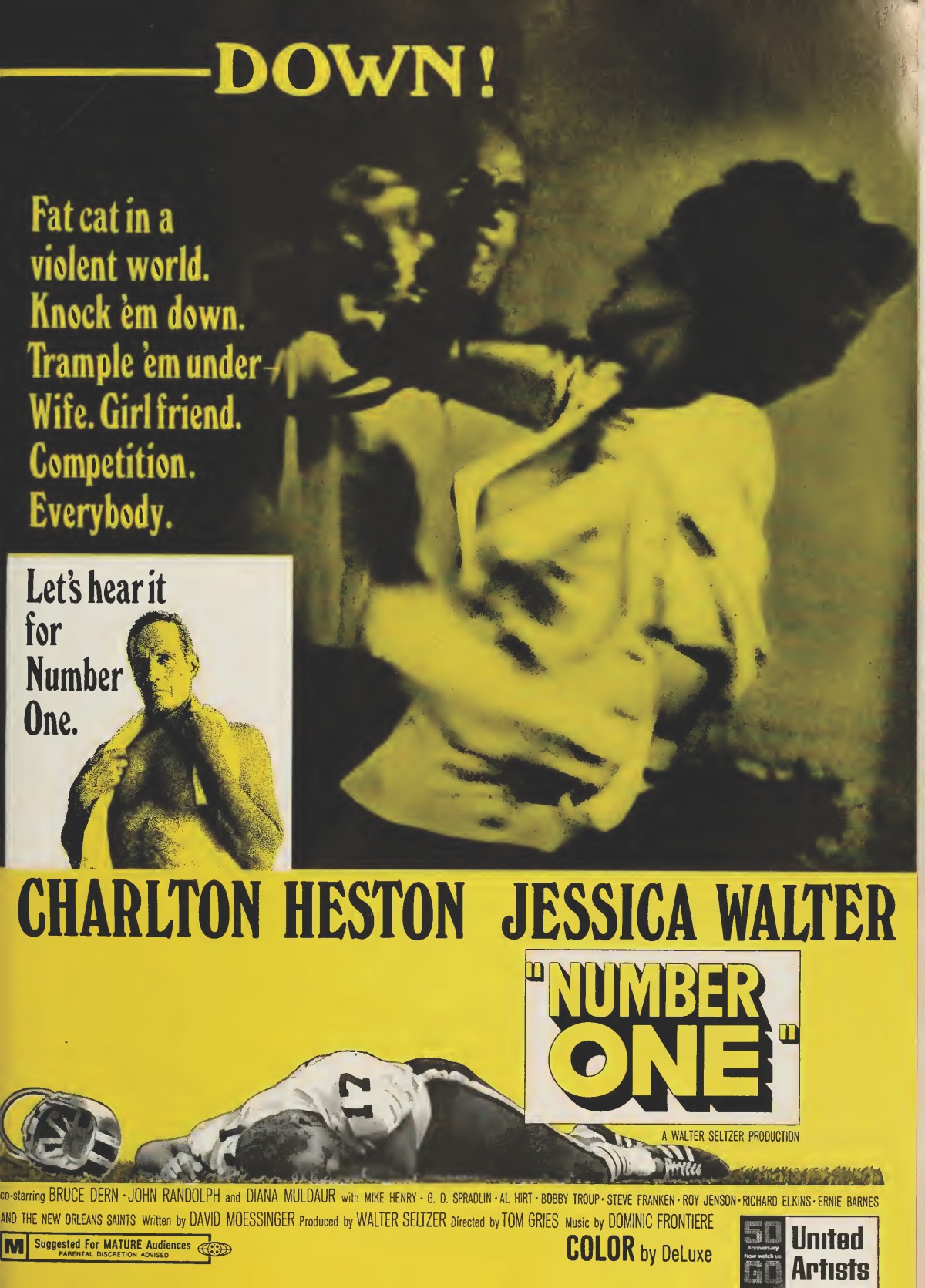
Apart from Ben-Hur and El Cid, most of Charlton Heston’s movies in the 1960s were domestic box office disappointments. Despite this, he was deemed to be still flying high at the marquee, placed seventh in the annual star rankings just as negotiations began in 1967 for Pro (the title changed to Number One just a few months before release). Given there was little interest in American sports in the rest of the world, it was deemed a gamble. That was not just reflected in the budget – a miserly $1.15 million- but in Heston’s salary of $200,000. He and director Tom Gries (Will Penny, 1968) agreed to “work at substantially lower incomes in exchange for a bigger percentage.”
But to make any decent money, of course the movie had to be a big hit. Compare that to the $750,000 he stashed away for The Hawaiians (1970), admittedly after Planet of the Apes (1968) hit the jackpot, but still. From The War Lord, Heston had “learned actors should not put their own money into scripts,” but taking a pay cut appeared a more sensible route.
The movie was a long time coming to fruition. Initially, the idea had been rejected by National General and Martin Ransohoff of Filmways who worked with MGM. By April 1966, Heston was dejected. “Nothing stirring on Pro,” he recorded in his journal. But he understood the need not to “peddle the project” since “it tarnishes my image as an eminently in-demand actor.” Franklin Schaffner (Planet of the Apes) was initially keen, but dropped out after United Artists insisted on smaller fees against a bigger back end, star, director and producer to share 75 per cent of the profits, the kind of deal you get offered “when you want to make a film more than a studio does.” Tom Gries (Will Penny, 1968) was the next directorial target.
By June 1967, the deal was done for Heston, Gries and Selzer. ”I’m damned if know who will write the script,” noted Heston, “No one very expensive, I guess.” In July, he was in San Diego “investigating pro footballers in their natural habitat.” The NFL agreed to allow the New Orleans Saints to participate. David Moessinger had written two screenplays, Daddy-O (1958) and The Caper of the Golden Bulls (1967), but struggled to meet Heston’s expectations.
The actor felt the writer hadn’t “succeeded in dramatizing the most difficult and the most important element of the story. Why Caitlin feels as he does.” His wife, Lydia, agreed. “If women’s can’t relate to the story, then it’s just a picture about a football player and we’re in trouble.” UA had set a deadline and the screenplay would decide whether it was a go or no. Heston planned to get Gries to work on the script, and he subsequently nailed the vital scene.
Even when UA gave the go-ahead there were problems integrating the shooting schedule with that of the Saints which would require filming training camp in summer 1968 and the rest in the fall. Bob Waterfield was teaching Heston how to quarterback. Soon he would have “delusions of adequacy.” But the training took its toll in the shape of a pulled muscle. In his first proper game, he was “blitzed” 16 times. He ended one day “taped and doped, in the traditional bed of pain.”
Meanwhile, casting proceeded. Heston had “mixed feelings” about Eva Marie Saint (The Stalking Moon, 1968) and Joanne Woodward (Big Hand for a Little Lady, 1966). Suzanne Pleshette (A Rage to Live, 1965) was considered as well as Jean Simmons (Rough Night in Jericho, 1967) – “I think she’d be good for it,” noted Heston. Finally, he pushed for Jessica Walter (Grand Prix, 1966) – “old enough to be plausible as the wife, young enough to manage the flashbacks” – only to find Gries not so keen and preferring Anne Jackson (How to Save a Marriage and Ruin Your Life, 1968). When the situation was resolved in favor of Walter, Heston discovered she was being lined up for a television drama about pro football. The second female lead went to Diana Muldaur.
Meanwhile, Heston was having trouble with Gries. “His attitude towards this film…is very questionable…perhaps it has to do with his recent achievements as a director in theatrical films…he’s finding the wine a bit heady.” Gries fell behind schedule, but finished ahead of it, saving about $30,000. An important scene showing Walters and Heston in bed before the wedding didn’t work and was cut.
Keeping tabs on the budget was producer Walter Selzer, who had worked with the star on The War Lord (1964) and Will Penny, and, would team up with him again for The Omega Man (1971), Skyjacked (1972), Soylent Green (1973) and The Last Hard Men (1976). “You have to be realistic about the subject matter,” said Selzer. “Every story has a certain price and if you try to cheat on your requirements it shows on screen.” That said, he was king of the penny pinchers. “We didn’t use a single piece of new lumber,” he boasted, meaning they didn’t built a single set, instead adapting or re-using old ones.
On location, he negotiated “locked-in” costs, “a flat pre-arranged price” for variety of elements which had a tendency to become variable, increasing costs, such as space on a sound stage, equipment and the editing suite. Cameraman Michel Hugo had to agree to shoot in any weather. “This is very important. Very often a cameraman will refuse to shoot if the weather is questionable, claiming the shots won’t match and then you have the whole company idle for a day when on location.” He nailed down composer Dominic Frontiere (Hang ‘Em High, 1968), paying him a flat fee, with Frontiere left with the task and cost of hiring an orchestra and rehearsal and recording space.
Despite showing his rear end in Planet of the Apes, Heston was touchy about the sex scene. “It’s not really a nudie scene but an intensely sexual scene,” he explained, “There’s not a bare breast seen.” Heston had enough controversy elsewhere. As president of the Screen Actors Guild he appeared not to note the irony that while he was pocketing hundreds of thousands of dollars a picture, he could complain that extras were the cause of the “major increase in costs” of movies.
He was also accused of being hypocritical, signing for Eagle at Escombray, directed by Alexander Mackendrick, to be made by CBS while at the same time, as union leader, pressurizing the Department of Justice to prevent television companies such as ABC and CBS entering the movie business. (It was never made.) For that matter, he shouldn’t have been trying to get National General to fund Pro either, since it owned a cinema chain, and that, too, went against previous Department of Justice rulings.
While Heston like the movie – “some of the best contemporary work I’ve done” – UA did not. The title changed to Number One. By the time the movie appeared, in August 1969, Heston couldn’t have been hotter, thanks to the unexpected success of Planet of the Apes. So the world premiere in New Orleans was allocated a full array of razzamatazz – in the parade were the New Orleans football team, its mascot, cheerleaders and a stream of antique cars, but there was a fire in Heston’s hotel.
Box office was less rosy. There was a decent $179,000 from 32 in New York, a “big” $9,000 in Washington, a “hotsy” $24,000 in Baltimore (and $20,000 in the second week), a “neat” $12,000 in San Francisco and a “trim” $27,000 in St Louis but mostly the figures were “mild”, “okay”, or “fair.” Outside of first run it couldn’t run up any juice. Estimated rentals were $1.1 million, so just about break-even, but United Artists, understandably despite Heston’s contention that it was about a man not American football, refused to give it any meaningful release overseas.
SOURCES: Charlton Heston, The Actor’s Life, Journals 1956-1976 (Penguin, 1980); “All-American Favorites of 1966,” Box Office, March 20, 1967, p19; “Charlton Heston Denies Conflict Between Eagle Role, SAG Policy,” Box Office, January 15, 1968, pW3; “Sports, Flop-Prone Theme Still Dared,” Variety, September 25, 1968, p2; Army Archerd, “Hollywood Cross-Cuts,” Variety, December 18, 1968, p22; Army Archerd, “Hollywood Cross-Cuts,” Variety, February 5, 1969, p34; “Number One Parade To Precede Premiere,” Box Office, August 18, 1969, pSE5; “Falling Stars,” Variety, September 3, 1969, p70; “Critics Wrap Up,” Variety, September 24, 1969, p26; “Variety Box Office Charts Results 1969,” Variety, April 29, 1970, p26. Weekly box office figures – Variety, 1969 : August 27, September 3, September 10, September 17, September 24
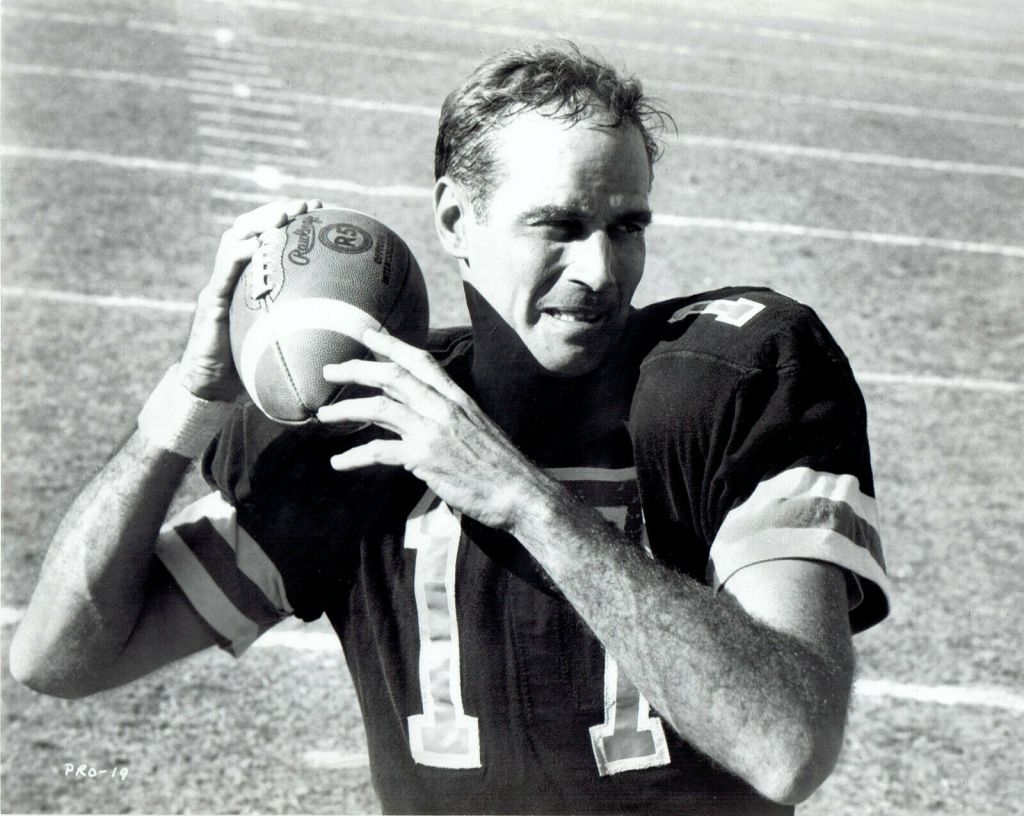
Quite possibly Charlton Heston’s best performance – as an ageing pro footballer refusing to bow down to the inevitable. Ron Catland (Heston) has much in common with Ned Merrill (Burt Lancaster) in The Swimmer (1968) as characters who believe they have been let down by the American Dream. And like that picture, plot is in short supply, it’s mostly a character study with sideswipes at the realities and inanities of American football.
An injury puts star quarterback Catland’s career in doubt. The media write him off, a younger quarterback Kelly (Richard Elkins) is waiting in line, while former colleague Ritchie Fowler (Bruce Dern) offers him a job in his car leasing business, or he could opt for a second career in computers, but Catland wants the only life he has ever known to go on forever.
There’s nothing inherently likeable about Catland. In fact, he’s downright mean most of the time, in part because of the falsity of his profession, management buttering you up when it’s contract time, then on your back once you have re-signed. He’s got a hero’s arrogance, has ignored from the outset the coach’s instructions, at odds with independent fashion-designer wife Julie (Jessica Walter), no children to shore up their marriage. Hardly surprising he drifts into another affair, “an occupational hazard” his wife calls it, this time with the fey Ann (Diana Muldaur) who owns a tennis shop.
You are probably familiar with the kind of football picture which climaxes with a last-minute touchdown or the more realistic movies like North Dallas Forty (1979) or the superlative Any Given Sunday (1999) where nonetheless the focus is on winning and characters are ramped up for dramatic effect. Or you might imagine Hollywood had been routinely churning out football movies like Knute Rockne All-American (1940) and Jim Thorpe All American (1951) for decades. But strangely enough the movie industry had not focused on this particular sport for well over a decade until the NFL documentary They Call It Pro Football (1967) and comedy Paper Lion (1968).
Number One sets out to set the record straight on the reality of being a football hero. And it’s by far the most realistic of the species. For every good-looking gal wanting to pass him a note on a napkin in a restaurant there are plenty fans turning on him for refusing to sign an autograph. For every sports reporter writing a puff piece, there are others tearing him to pieces in print.
The documentary-style approach by director Tom Gries (100 Rifles, 1969) serves the film well. This is a different kind of football team to the later fictional depictions. It’s a lonely life for a start. The players are rivals, not comrades. There’s little camaraderie. The dressing room is like a morgue. No practical jokes and tomfoolery. No over-the-top team talk by the coach and thank goodness no padre who pretends to walk every aching mile in their shoes. Any exhortation is almost a plea. Injury is mostly ignored. Legs are constantly strapped up. And when your career is over you might be reduced to bumming a loan from a current star. The politics are brutal.
New Orleans Saints cooperated with the production so the game scenes come across well though not obviously with the razzamatazz of Any Given Sunday and Heston has the physique for a sportsman. Primarily a television writer, David Moessinger (The Caper of the Golden Bulls, 1967) only crafted two films in the 1960s and this, the second and last, was an unusual effort, as the character twists and turns trying on the one hand to escape the cage of his career and on the other determined to squeeze the last drop out of his golden imprisonment.
Catlan still sees himself (at the age of 40, no less) as the best quarterback in the business and simmers with anger that his body is letting him down and that he has nothing in place to fill the gap that abandoning the game will create. Underneath the volatility is a hole of pain. There’s no sense either that he has enjoyed his time at the top, just that it has always one way or another been a struggle.
Although the movie was marketed with Heston as an aggressive individual, in fact it calls for a far wider range of emotions from Heston, and for this part he delivers in spades. Jessica Walter (Grand Prix, 1966) gives as good as she gets, Bruce Dern (Hang ‘Em High, 1968) as the fast-talking salesman and Diana Muldaur (The Swimmer, 1968) are excellent. But this is Heston’s film. It’s more of a reflective piece, none of the dramatic highs and lows of other football pictures.
Contemporary audiences will find much to admire. Perhaps unintentionally, certainly unusual for the era in which it was made, this is driven by a strong feminist streak and the problems of fusing different new cultures – Chinese and Japanese – on an island already dominated by white immigrants. In some respects a companion piece to Diamond Head (1962), which also starred Charlton Heston, but in reality a sequel to epic roadshow Hawaii (1966).
Nyuk Tsin (Tina Chen) has been kidnapped from her village in China with the intention of selling her into a brothel in Honolulu. But when her gender is discovered on board the ship, captained by Whip Hoxworth (Charlton Heston), transporting Chinese laborers to Hawaii, a fight breaks out, her owner is killed and she is taken over by Mun Ki (Mako). He fully intends, on making land, to sell her and keep the money but at the docks Whip’s wife Purity (Geraldine Chaplin) intervenes and the couple are offered jobs as husband-and-wife.
“Hawaii” (1966) was not such a big box office hit abroad as it was in the United States hence the decision not to rely on the U.S. title “The Hawaiians” for the sequel. In fact, unlike the U.S. poster the novel is not so upfront.
Mun Ki’s entrepreneurial spirit is obvious from the minute she reaches Whip’s plantation, as she starts planting seeds in a tiny area in front of the hovel that is their dwelling. That turns into a vegetable garden and eventually she has a side business feeding laborers. Her gardening skills encourage Whip to entrust to her to grow the seed pineapple plants he has stolen from French Guiana, a continent away in South America.
When that proves successful, and Whip manages to find an artesian well through the lava bed, he embarks on a career as a pineapple farmer, and as a reward, deeds her land.
Meanwhile, Nyuk Tsin discovers she is wife only in terms of procreation. Mun Ki already has a wife back home, so Nyuk Sin can only officially become an aunt to the five children she bears him, each named after a continent (Asia, Africa etc) and who do, it must be said, come in handy for her farming business. She is wealthy enough that attempts are made, as much from envy and fury at her success as anything else, to steal her property.
While officially disbarred from the position of wife, her feelings for her husband are so strong that when he contracts leprosy she accompanies him to the island of Molokai and looks after him until rescued by Whip. Now with a prosperous farm, and remaining unmarried, she is rich enough, and clever enough, to send one son to America to train as a lawyer. Through her own endeavors and willpower she becomes not the slavish wife, dependent on her husband and his whims, but a strong independent wealthy woman, and leader of her expanding clan.
Theoretically, this is a subplot in the film, but in reality director Tom Gries (Number One, 1969) affords it as much time as the supposedly main narrative which, in contrast to Diamond Head, sees Whip as the black sheep of the family, disinherited and left only with land that is useless until the cultivation of pineapples makes it viable. His wife, while ostensibly weak, is also of a feminist disposition, abandoning her husband after the birth of her only son Noel (John Philip Law) to return to her Hawaiian roots.
When the Japanese arrive on the island Whip takes as a mistress the educated self-sufficient Fumiko (Miko Mayama). The circle of interbreeding and cultural infusion is complete when Noel marries Mei Lei (Virginia Lee), Nyuk Tsin’s only daughter.
It’s a lot more melodramatic than that, to be sure, Whip at odds with his family, Purity sending him bananas by denying him sex after Noel’s birth, and then withdrawing from his life. Various characters flit in and out, like the alcoholic well-digger Overpeck (Don Knight), and the tale embraces, like Diamond Head, the period when the United States annexed Hawaii.
Allotting so much screen time to Nyuk Tsin can’t have been accidental, maybe it was just visionary, but taking her as the focal point pivots more on her single-minded nature than the haphazard character of Whip, who achieves success through luck, theft and brutality. It’s remarkable that Nyuk Tsin has understood its importance of land ownership, the bedrock of any country’s institutional hierarchy, and strives so hard to achieve that footing and becomes in essence the family breadwinner. If the foreign title had been changed to Mistress of the Islands it would not have gone far wrong.
Fans of the second-billed John Philip Law (Hurry Sundown, 1967) will perhaps be disappointed that he appears so late in the proceedings, essentially to ensure the narrative can embrace the generations, but also to show how attitudes can change for the good from one generation to another.
I’m aware I’m asking you to watch the movie from a different perspective from that advertised but it’s far more rewarding.
Charlton Heston is good, especially when transitioning from commander of all he surveys while on board ship to a mere family footnote on dry land. He can rant with the best of them, for sure, but underneath the fury you can detect the pain, cast aside by family and wife. The scenes where he fails to reignite sexual relations with Purity reveal how great an actor he is. We more often associate Heston with the lower half of his face, the jutting jaw, the flashing teeth, the dominance of his words, rather than the upper half where his eyes are so revealing of inner torment. There’s a sea-change in the standard Heston performance that runs through Planet of the Apes, Number One and here of a powerful man drained by circumstance.
But Tina Chen (Three Days of the Condor, 1975) is the standout, moving from humiliation to pride, often called upon to mutely absorb pain, but fiercely protecting husband and brood, and clever enough to calmly negotiate her way past husband and Whip to potential success.
Tom Gries, in his third picture with Heston, manages to create an epic feel to a picture whose limited running time sabotages that aim. His sweeping tracking shots provide the bravura but that is underpinned in the more intimate moments by sensitivity to character emotion shown in a look rather than expressed in dialog.
Screenwriter James R. Webb (How the West Was Won, 1962) had the job of chiselling another cinematic chunk from James Michener’s door-stopper of a novel and turning this sub-plot into a gem.
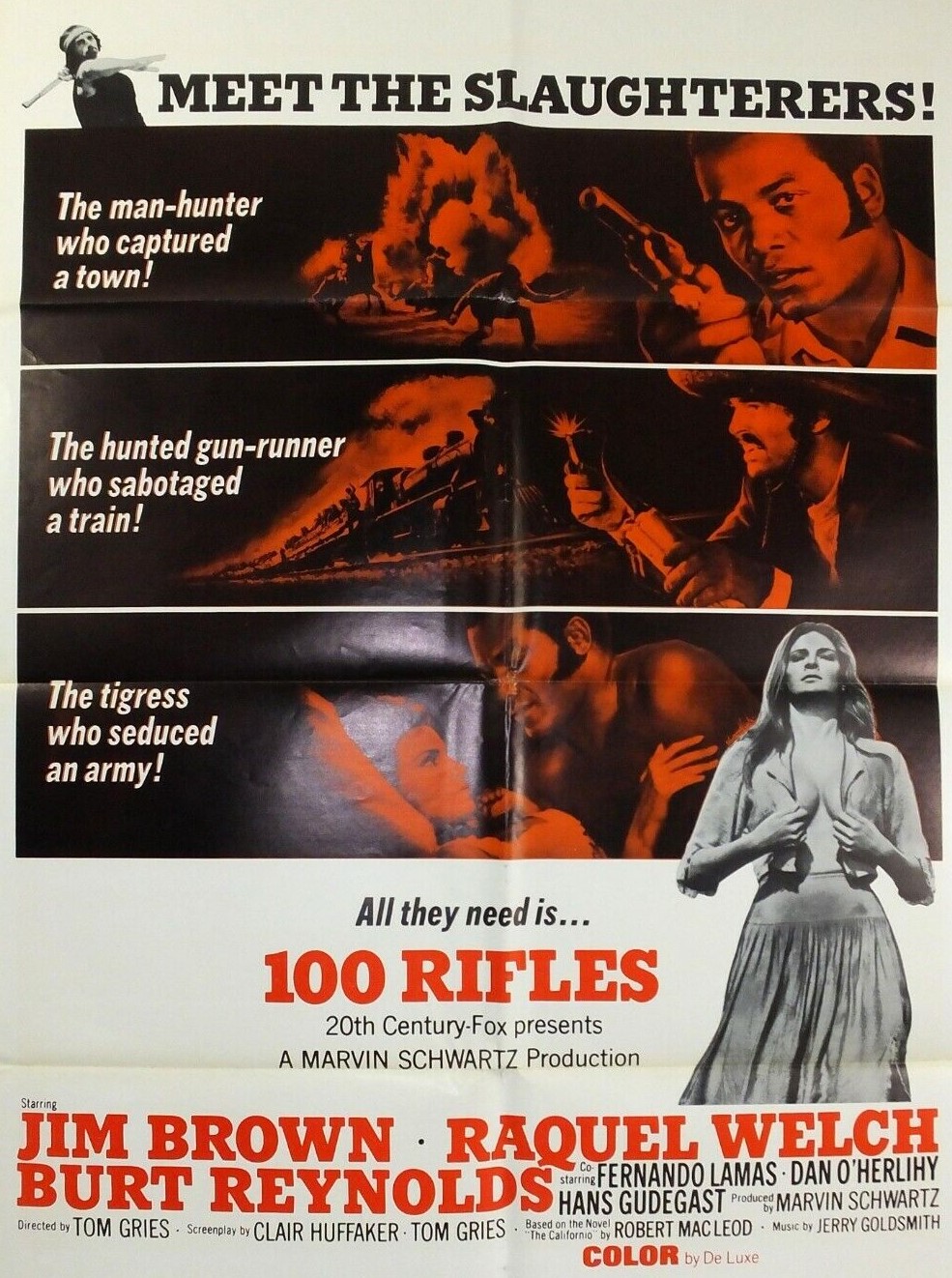
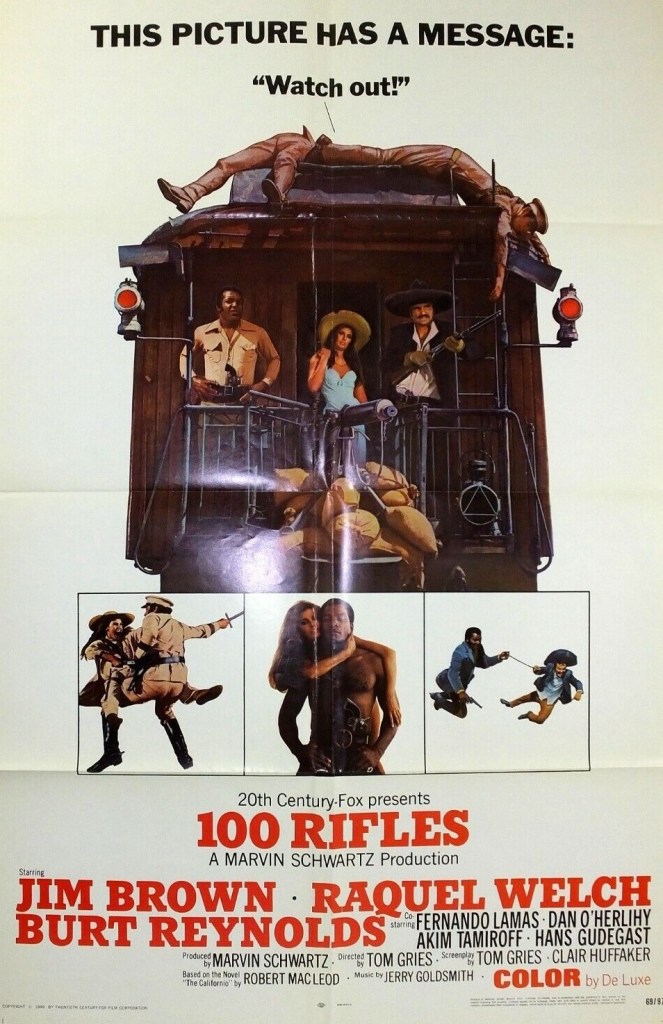
100 Rifles was easily the most underrated film of the year. Even if the sum of all its parts did not add up to greatness, it had a lot more going for it than has generally been attributed. For a start, there was the attempt to build Jim Brown into a mainstream African American star. Secondly: the return of the bold female character that had largely disappeared since the heyday of Barbara Stanwyck, and Joan Crawford. Thirdly: the conjunction of these first two elements in a sex scene raised the issue of miscegenation that Hollywood had otherwise sought to avoid.
Fourthly, and perhaps most hard- hitting of all: the issue of genocide, the mass slaughter of the Yaqui Indian population providing an uneasy parallel not just to the United States treatment of its own indigenous Native American population but also to its actions in Vietnam.
But there was a danger that, without both incisive direction and potent performances, the movie would spiral downwards into another simple case of “When Beefcake (Jim Brown) Met Cheesecake (Raquel Welch).” Since nobody had expected Sidney Poitier to ascend the Hollywood ladder so fast, and in so doing set a trend, the industry had nobody lined up to ride in his wake and exploit what now appeared to be, at the very least, acceptance of African Africans as stars in their own right, with an audience ready to embrace a new kind of hero. Although MPAA president Jack Valenti called for more African Americans in more African American films, the number of highly touted big- budget African American–oriented pictures that offered stardom potential rarely made it out of the starting blocks.
But there was one potential crossover star waiting in the wings: Jim Brown. While lacking Poitier’s acting chops, he had the physique, looks and charisma. Cleveland Browns football legend with strong supporting roles in The Dirty Dozen (1967), Dark of the Sun (1968) and Ice Station Zebra (1968), top-billing had been limited to low-budgeters like Kenner (1968), The Split (1968) and Riot (1969).
But Variety had singled him out at the start of 1969 as one of its “new stars of the year” and judged him “the strongest contender to inherit some of Sidney Poitier’s earning power.” 100 Rifles had double the budget of any of his previous pictures.
Raquel Welch was in a similar situation to Jim Brown regarding Hollywood acceptance. However, she was not in a minority as far as female stars were concerned. The 1960s had been dominated by the likes of drama queen (in more ways than one) Elizabeth Taylor, comedy queen Doris Day and musical queen Julie Andrews, not to mention Audrey Hepburn, (Breakfast at Tiffany’s, 1961), Italian import Sophia Loren (El Cid, 1961), Jane Fonda (Cat Ballou, 1965), Natalie Wood (Sex and the Single Girl, 1964) and Shirley MacLaine (Sweet Charity, 1968). There was also an overabundance of new talent in Julie Christie (Doctor Zhivago, 1965), Vanessa Redgrave (Blow Up, 1966), Lynn Redgrave (Georgy Girl, 1965), Mia Farrow (Rosemary’s Baby, 1968) and Faye Dunaway (Bonnie and Clyde, 1967).
But those stars had more to offer than mere beauty, whereas Welch, having made her name primarily as a pin- up and as eye candy in movies like One Million Years B.C. (1966) and Fantastic Voyage (1966), had trouble shaking off the idea that she won more parts on the basis of her body than for the acting skills, appearing in a dry bikini in Fathom (1967) and a wet one in Lady in Cement (1968).
However, like Jim Brown, she was actively looking to fill a niche, and set out her stall as a player of dramatic intensity, and she found it in the most unlikely of places: the western. That she chose 100 Rifles was interesting given her other choices. She was offered the Katharine Ross part in Butch Cassidy and the Sundance Kid when the lead roles had been offered to Steve McQueen and Warren Beatty and again when Paul Newman came into the frame. She was also up for the Faye Dunaway role for The Crown Caper (title later changed to TheThomas Crown Affair), again with McQueen, and a film with Terence Stamp (which was never made). But she clearly felt those roles were more decorative.
At one time, the female western star had been a staple. Claire Trevor was the star of Stagecoach (1939) and Texas (1941). Gene Tierney made her name with The Return of Frank James (1940) and Belle Starr (1941). Barbara Stanwyck carved out her own niche as a western icon after taking top billing in Union Pacific (1939), California (1947), The Furies (1950), Cattle Queen of Montana (1954), The Maverick Queen (1956) and Forty Guns (1957). While Maureen O’Hara took second billing in Rio Grande (1950), McLintock! (1963) and The Rare Breed (1965), she was the star of Comanche Territory (1950), The Redhead from Wyoming (1953) and The Deadly Companions (1961). Yvonne De Carlo headlined Black Bart (1948), The Gal Who Took the West (1949) and Calamity Jane and Sam Bass (1949). Rhonda Fleming had the female lead in The Redhead and the Cowboy (1951), The Last Outpost (1951), Pony Express (1953) and Gunfight at the O.K. Corral (1957). Johnny Guitar (1954) achieved classic status largely on the performance of Joan Crawford.
There had even been modern precedent: Inger Stevens had nearly cornered the recent market after A Time for Killing (1967), Firecreek (1968), Hang ’Em High (1968) and 5 Card Stud (1968) while Claudia Cardinale went from a supporting role in The Professionals (1966) to top billing in the forthcoming Once Upon a Time in the West.
Raquel Welch set out to follow suit. In Bandolero (1968) she proved capable not only of holding her own against veterans James Stewart and Dean Martin but as adept on the pistol- packing side of things. While Welch professed herself “no Anne Bancroft,” she was pleased that she was not “running around half- naked all the time.” After that punched a hole in the box office, she was offered the female lead in 100 Rifles to be directed by Tom Gries who had made his name as a director with his unflinching portrayal of the cowboy in Will Penny (1968).
The basis of the film was Robert MacLeod’s The Californio, published in 1966, and the essence of the story concerned a “reckless stranger” who refused to turn the other cheek while innocent people were being killed. After Clair Huffaker turned in his screenplay, Gries wrote two further drafts. It is safe to assume that the casting of Jim Brown came after the Huffaker script had been handed in. When Huffaker did not like the way his work had ended up on screen, he insisted on using the pseudonym Cecil Dan Hansen, as he had done on The Second Time Around.
For 100 Rifles, he was so upset at the end result that he demanded either his name removed or the pseudonym installed, complaining that the finished product “bears absolutely no resemblance to my script.”
The story of The Californio bears little resemblance to 100 Rifles. Not only is the hero of the book, Steve McCall, white, he is a rawboned young man and not a lawman in his 30s. He is not a gunman either, being more proficient with the lasso. In fact, when forced into bloody action, he discovers that he abhors violence. The book could more aptly be described as a “rite of passage” novel where a young man, sent south “on legitimate business in the interests of the (U.S.) Federal Government,” leaves home for the first time, becomes a man, loses his virginity and kills his first man.
Nor is Yaqui Joe a bank robber in the book, and after meeting up with McCall, they embark on further legitimate business. Maria, named Sarita in the film, is most like her feisty movie counterpart, and although in the MacLeod version she is married, that does not prevent her taking Steve’s virginity. Of the villains, Verdugo (the name means “Hangman”), while not elevated to general, is still as ruthless, but the foreign adviser is not.
Most of the film’s action was invented by the screenwriters, including the concept of the 100 Rifles, Sarita’s sexy shower as a way of stopping the troop train, and the children being taken hostage (although in one episode in the book, children are shot). Trying to reshape the book to suit the new requirements of the characters makes the picture unnecessarily complicated. Burt Reynold’s solution was simpler: “Keep his shirt off and her [Raquel Welch’s] shirt off and give me all the lines,” he reportedly advised producer Marvin Schwartz.
The movie was shot over a ten- week period in Spain beginning in July 1968. Although that country had become a viable alternative for westerns looking to keep budgets low, in part in 1968 due to the devaluing of the peseta against the dollar, the volume of films shot there had declined by nearly a third compared to the previous year.
Despite the popularity of the location, Almeria, the actual area of countryside where most spaghetti westerns were shot, was very small. This resulted in a limited variety of available landscapes compared with films shot in the U.S. such as The Stalking Moon. The actors had to contend with extreme heat, and Gries was laid low for three days after contracting typhus. Gries decided to get the sex scene out of the way on the first day of shooting, probably to ensure that tension about the content was not allowed to linger until later in the shoot. However, it had the opposite effect. Neither Brown nor Welch had been given time to get to know one another nor to adjust to different styles of acting and to understand the perspectives of each other’s characters. Welch was not happy with the scene and tensions between the two stars continued throughout the film, some press reports putting this down to squabbles over close- ups, others to unresolved sexual tension. Welch later complained that scenes edited out of the picture had reduced audience understanding of her motivations. The MPAA also did some judicial trimming, axing Welch’s shrieks during lovemaking.
Critical reception ranged from sniffy to downright hostile. Perhaps like The Stalking Moon, advance publicity, although not this time pointing in the direction of the Oscars, had served to put critics off what sounded like an exploitative film. For the western traditionalist, sex scenes were off- putting, and although naked breasts had started appearing in a handful of movies, there were precious few full- on sex scenes, never mind one that featured miscegenation. Variety judged it a “routine Spanish- made western with a questionable sex scene as a possible exploitation hook.” On the plus side, Welch’s performance was “spirited” as was the Jerry Goldsmith score; Brown and Reynolds were just “okay.” The Showmen’s Servisection took a different view: “Fast pace, fine performances lift western several notches above the ordinary.” Roger Ebert in the Chicago Sun- Times called it “pretty dreary.” Howard Thompson, the New York Times’ second- string reviewer, said it was a “triumphantly empty exercise.”
Twentieth Century–Fox had been affected by recent financial disasters such as Doctor Dolittle (1967) and Star! (1968); the former collecting $6.2 million in domestic rentals on a budget of $17 million, the latter $4.2 million in rentals after costing $14.5 million. To counter mounting exhibitor panic about production being slashed, Fox had drawn up an ambitious program for 1969, promising one new movie every month. The program kicked off with a $7.7 million adaptation of the Lawrence Durrell classic Justine with Dirk Bogarde (January), followed by Michael Caine and Anthony Quinn in the $3.77 million film of the John Fowles bestseller The Magus (February) and the trendy $1.1 million Joanna from new director Mike Sarne (March). British star Maggie Smith in the $2.7 million The Prime of Miss Jean Brodie (April) came next with 100 Rifles (May) and another Marvin Schwarz production, Hard Contract starring James Coburn, costing $4 million (June). Summer highlights were Omar Sharif in the $5.1 million biopic of Che! directed by Richard Fleischer (July) and Gregory Peck in the $4.9 million Cold War thriller The Chairman (August). Come fall it was the turn of Paul Newman and Robert Redford in the western Butch Cassidy and the Sundance Kid coming in at $6.8 million (September), Richard Burton and Rex Harrison as aging homosexuals in The Staircase costing $6.3 million (October) and Warren Beatty and Elizabeth Taylor in George Stevens’ $10 million The Only Game in Town (November). The year ended with John Wayne and Rock Hudson in the $7.1 million Civil War western The Undefeated (December).
The studio needed several box office home runs because the following year it was already committed to three roadshows—Tora! Tora ! Tora!, Hello, Dolly and Patton—costing over $60 million. By spring it was clear that the first two movies in the schedule had been major flops, Justine bringing in only $2.2 million in rentals, The Magus $1 million. Income from Joanna and The Prime of Miss Jean Brodie barely exceeded costs.
By the time 100 Rifles swung into action with two largely untried leads and a director making only his second major picture, the pressure was on. “
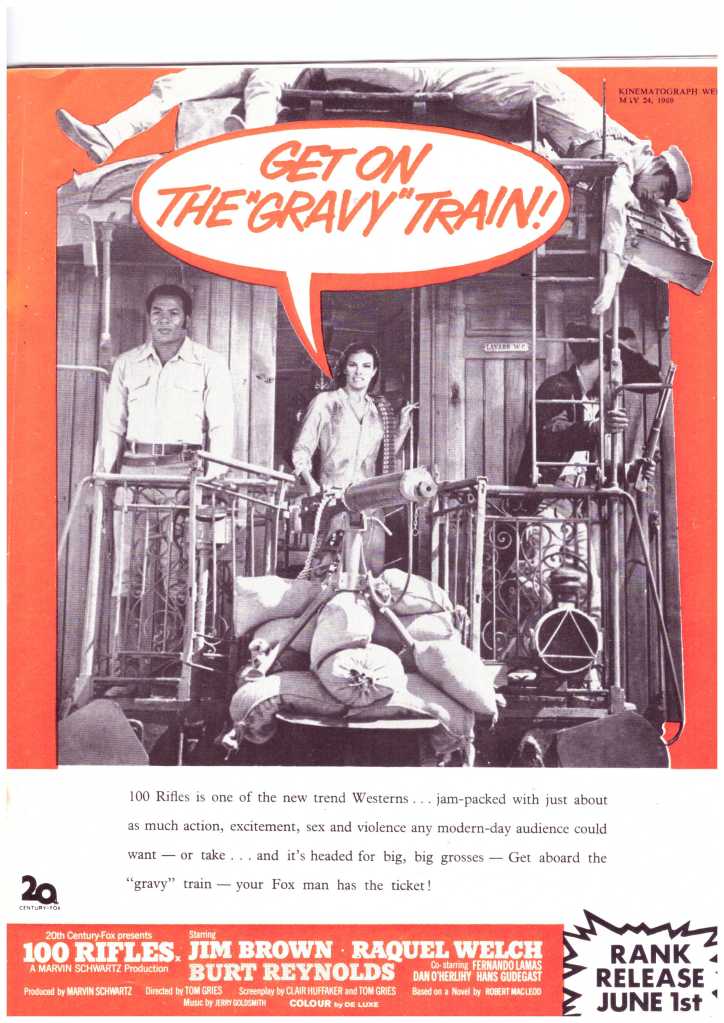
At the box office 100 Rifles got off to a great start and Twentieth Century–Fox reported with delight that it had outgrossed Bandolero! by 40 percent in Washington (and by 500 percent in the ghetto areas), and by 300 percent in Philadelphia. In Baltimore it grossed $50,000 from a single theater compared to $80,000 from eight for Bandolero! and in Atlanta first run it had been $61,000 for the new film compared to $38,000 for the previous one. However, while Brown and Welch fans were out in force in certain areas, that did not make up for less interest in regions where westerns were associated with bigger or more traditional names. Ultimately, 100 Rifles fell short of expectations given the budget. U.S. rentals amounted to $3.5 million, and it registered in 29th position on the annual chart— the sixth highest- grossing western of the year and ahead of Mackenna’s Gold, The Stalking Moon, Paint Your Wagon and Once Upon a Time in the West.
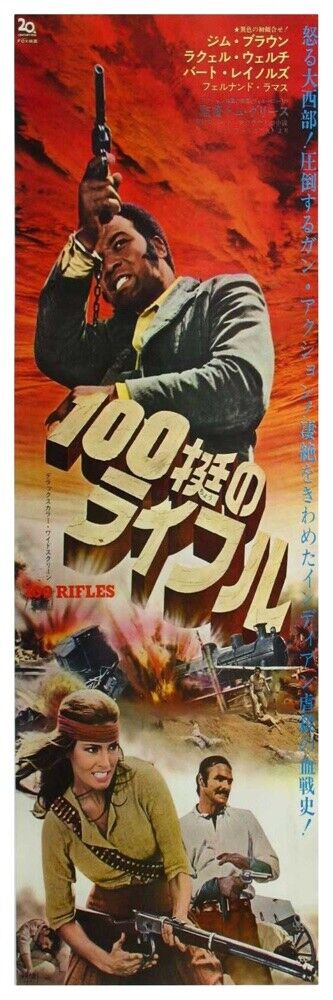
But, of course, the domestic performance did not take into account the popularity of westerns overseas and the distinct following Raquel Welch had accumulated. So where some of the studio’s major dramas stumbled in the global market, 100 Rifles hit the ground running.
SOURCES: This is an abbreviated version of much longer chapter devoted to the film that ran in The Gunslingers of ’69: Western Movies’ Greatest Year (McFarland, 2019) by Brian Hannan (that’s me). All the references mentioned can be found in the Notes section of that book.
Quite possibly Charlton Heston’s best performance – as an ageing pro footballer refusing to bow down to the inevitable. Ron Catland (Heston) has much in common with Ned Merrill (Burt Lancaster) in The Swimmer (1968) as characters who believe they have been let down by the American Dream. And like that picture, plot is in short supply, it’s mostly a character study with sideswipes at the realities and inanities of American football.
An injury puts star quarterback Catland’s career in doubt. The media write him off, younger quarterback Kelly (Richard Elkins) is waiting in line, while former colleague Ritchie Fowler (Bruce Dern) offers him a job in his car leasing business, or he could opt for a second career in computers, but Catland wants the only life he has ever known to go on forever.
There’s nothing inherently likeable about Catland. In fact, he’s downright mean most of the time, in part because of the falsity of his profession, management buttering you up when it’s contract time, then on your back once you have re-signed. He’s got a hero’s arrogance, has ignored from the outset the coach’s instructions, at odds with independent fashion-designer wife Julie (Jessica Walter), no children to shore up their marriage. Hardly surprising he drifts into another affair, “an occupational hazard” his wife calls it, this time with the fey Ann (Diana Muldaur) who owns a tennis shop.
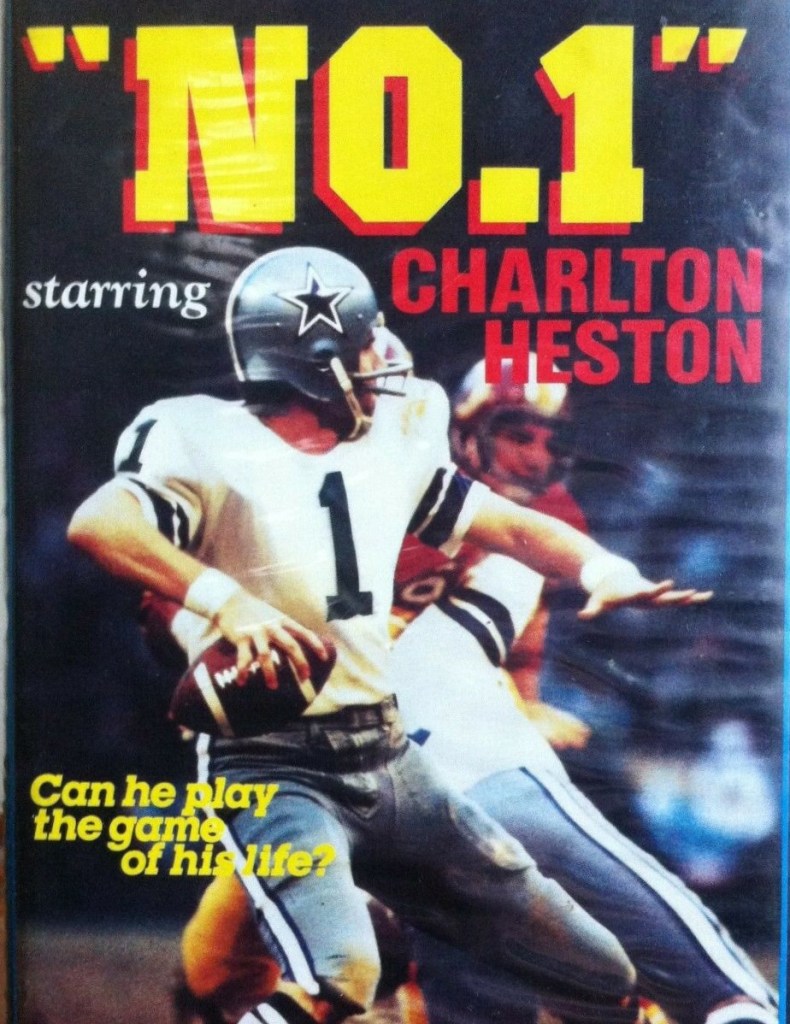
VHS cover
You are probably familiar with the kind of football picture which climaxes with a last-minute touchdown or the more realistic movies like North Dallas Forty (1979) or the superlative Any Given Sunday (1999) where nonetheless the focus is on winning and characters are ramped up for dramatic effect. Or you might imagine Hollywood had been routinely churning out football movies like Knute Rockne All-American (1940) and Jim Thorpe All American (1951) for decades. But strangely enough the movie industry had not focused on this particular sport for well over a decade until the NFL documentary They Call It Pro Football (1967) and comedy Paper Lion (1968).
Number One sets out to set the record straight on the reality of being a football hero. And it’s by far the most realistic of the species. For every good-looking gal wanting to pass him a note on a napkin in a restaurant there are plenty fans turning on him for refusing to sign an autograph. For every sports reporter writing a puff piece, there are others tearing him to pieces in print.
The documentary-style approach by director Tom Gries (100 Rifles, 1969) serves the film well. This is a different kind of football team to the later fictional depictions. It’s a lonely life for a start. The players are rivals, not comrades. There’s little camaraderie. The dressing room is like a morgue. No practical jokes and tomfoolery. No over-the-top team talk by the coach and thank goodness no padre who pretends to walk every aching mile in their shoes. Any exhortation is almost a plea. Injury is mostly ignored. Legs are constantly strapped up. And when your career is over you might be reduced to bumming a loan from a current star. The politics are brutal.
New Orleans Saints cooperated with the production so the game scenes come across well though not obviously with the razzamatazz of Any Given Sunday and Heston has the physique for a sportsman. Primarily a television writer, David Moessinger (The Caper of the Golden Bulls, 1967) only crafted two films and this, the second and last, was an unusual effort, as the character twists and turns trying on the one hand to escape the cage of his career and on the other determined to squeeze the last drop out of his golden imprisonment.
Catlan still sees himself (at the age of 40, no less – but younger than today’s legendary Tom Brady) as the best quarterback in the business and simmers with anger that his body is letting him down and that he has nothing in place to fill the gap that abandoning the game will create. Underneath the volatility is a hole of pain. There’s no sense either that he has enjoyed his time at the top, just that it has always one way or another been a struggle.
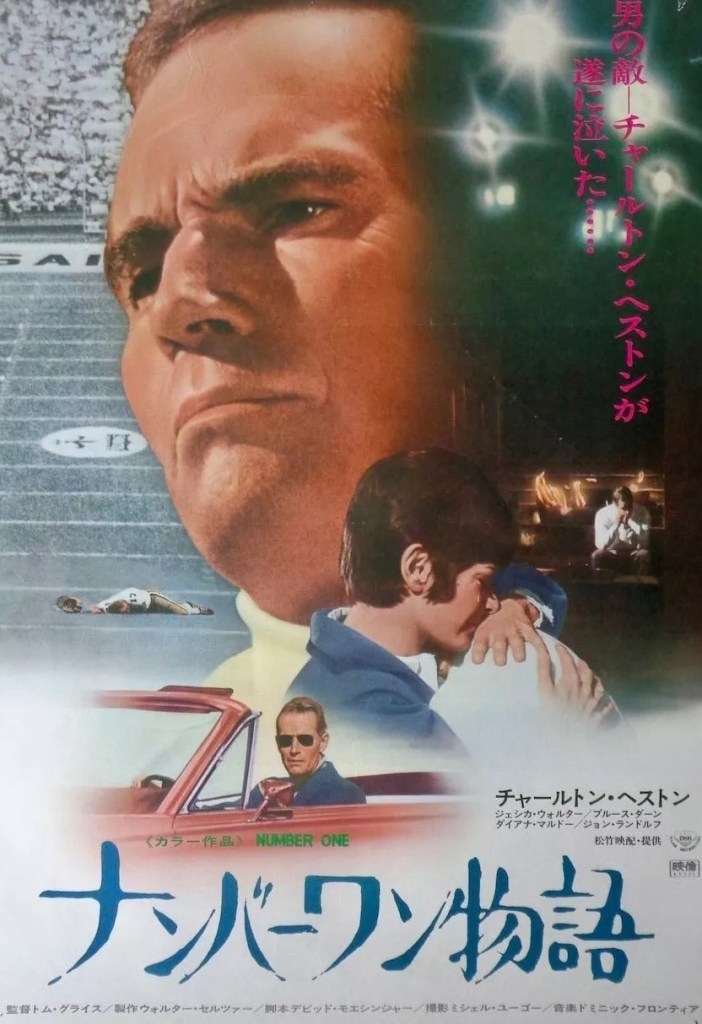
Heston and Gries took a different approach to the western Will Penny (1968) and here they do the same to the sports picture. Although the movie was marketed with Heston as an aggressive individual, in fact it calls for a far wider range of emotions from Heston, and for this part he delivers in spades. Jessica Walter (Grand Prix, 1966) gives as good as she gets, Bruce Dern (Hang ‘Em High, 1968) as the fast-talking salesman who got out of the game in good time and Diana Muldaur (The Swimmer, 1968) are excellent. But this is Heston’s film. But it’s more of a reflective piece, none of the dramatic highs and lows of other football pictures, instead it is true to the cynicism and human exploitation of the game.







 The Magnificent 60s