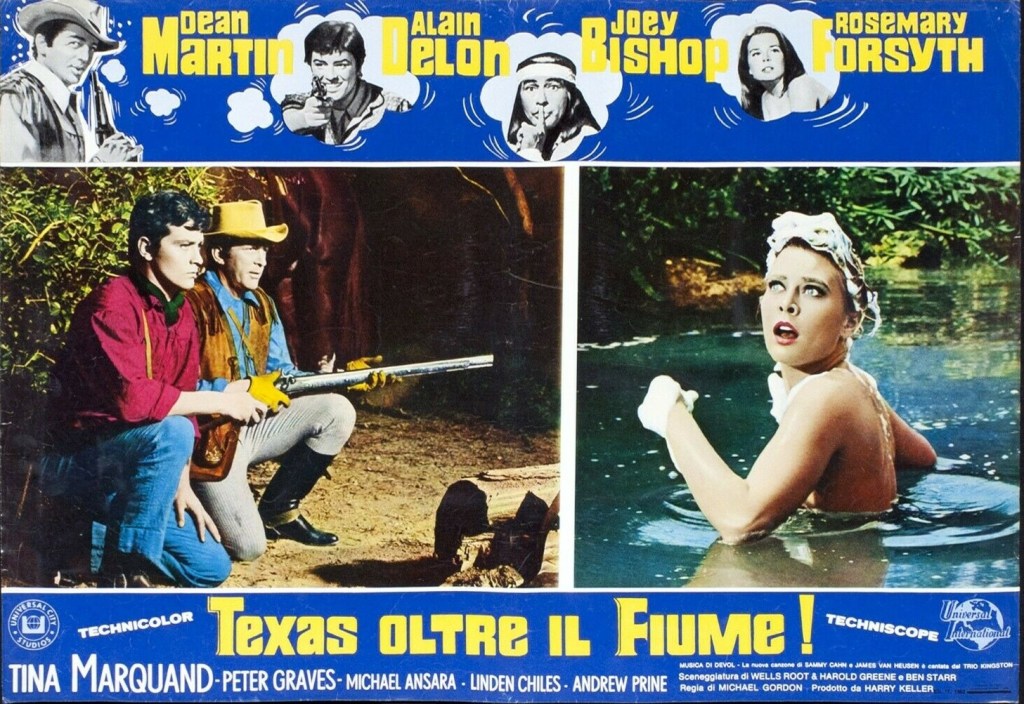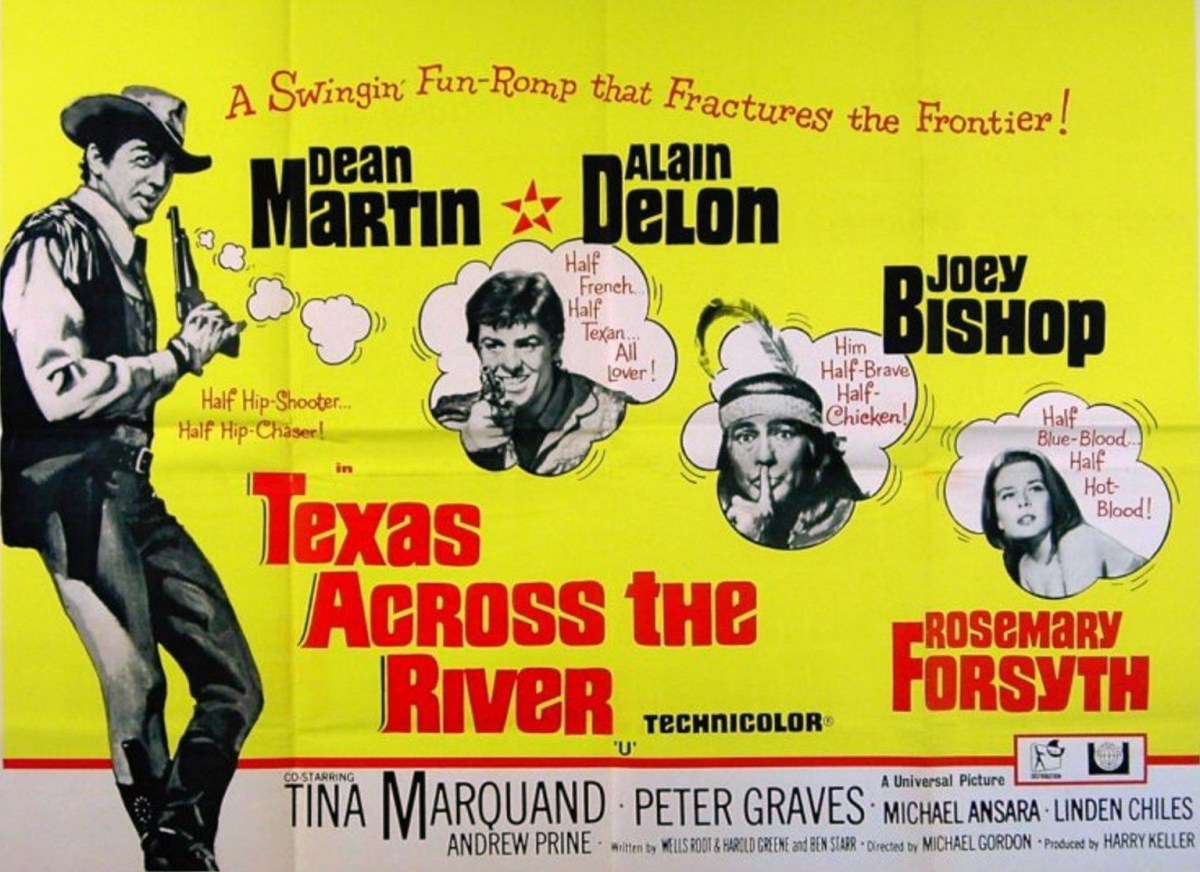
Texas Across the River (1966) ****

Excellent comedy western mixing dry wit and occasional slapstick to joyous effect. The wedding between Spanish duke Don Aldrea (Alain Delon) and Louisiana belle Phoebe (Rosemary Forsyth) is interrupted by her previous suitor Yancy (Stuart Cottle) who is killed in the resulting melee. Escaping to Texas, Don Aldrea’s marksmanship leads settler Sam (Dean Martin) to recruit him to help fight raiding Comanches. Romantic entanglement ensues when the Don rescues Native American Lonetta (Tina Marquand) and Sam has more than a passing interest in Phoebe.

It is so tightly structured that nothing occurs that doesn’t have a pay-off further down the line. Bursting with terrific lines – including a stinger of a final quip – and set pieces, it pokes fun at every western cliché from the gunfight, the cavalry in hot pursuit, and fearsome Native Americans to the snake bite and the naked bathing scene. Incompetence is the order of the day – cavalry captain Stimpson (Peter Graves) issues incomprehensible orders, chief’s son Yellow Knife (Michael Linden) cannot obey any.
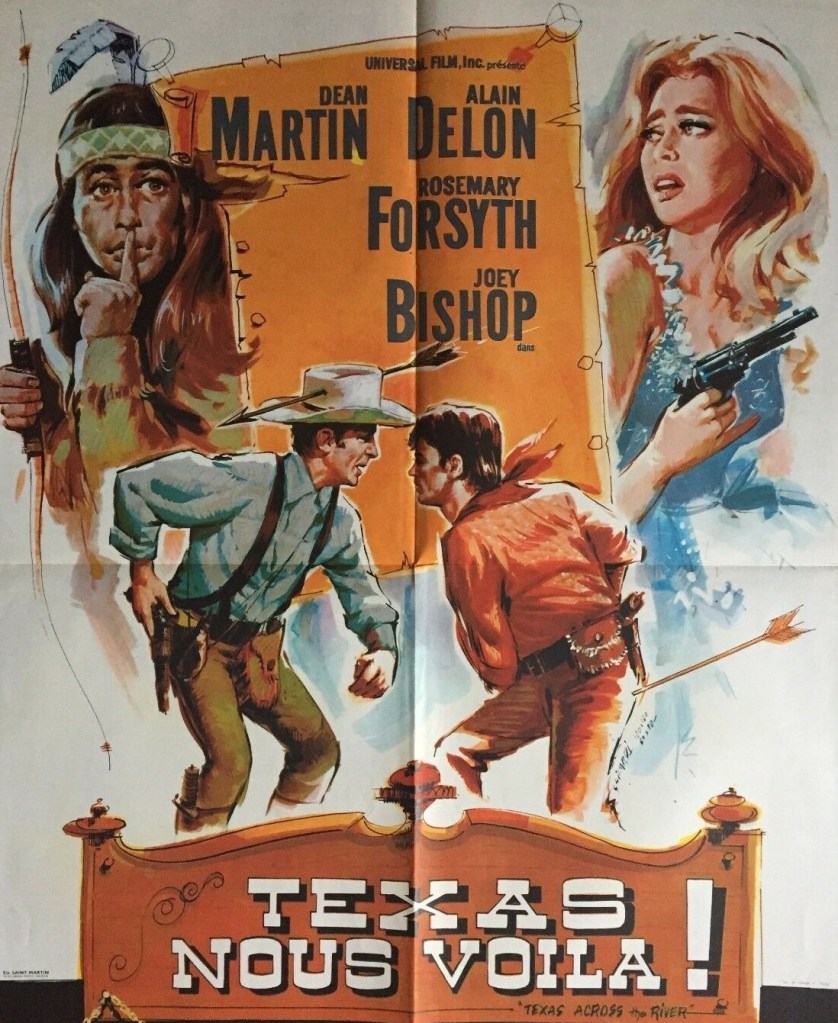
The Don, with his obsession with honor and his tendency to kiss men on the cheeks, is a comedy gift. Despite his terrific head of hair, he is stuck with the moniker “Baldy” and every time he is about to save the day he manages to ruin it. Sam is the kind of guy who thinks he is showing class by removing his spurs in bed while retaining his boots. His sidekick Kronk (Joey Bishop), a mickey-take on Tonto, mostly is just that, a guy who stands at the side doing nothing but delivering dry observations.

Lonetta is full of Native American lore and has enough sass to keep the Don in his place. “What is life with honor,” he cries to which she delivers the perfect riposte, “What is honor without life?” Phoebe is a hot ticket with not much in the way of loyalty.

Two sequences stand out – the slapping scene (whaat?) and a piece of exquisite comedy timing when Sam, Phoebe and the Don try an iron out a complicated situation.

Good as Dean Martin (Rough Night in Jericho, 1967) is the picture belongs to Alain Delon (Once a Thief, 1965) and I would argue it is possibly his best performance. Never has an actor so played against type or exploded his screen persona. Delon was known for moody, sullen roles, cameras fixated on his eyes. But here he is a delight, totally immersed in a role, not of an idiot, but a man of high ideals suddenly caught up in a country that is less impressed with ideals. If he had played the part with a knowing wink it would never have worked.
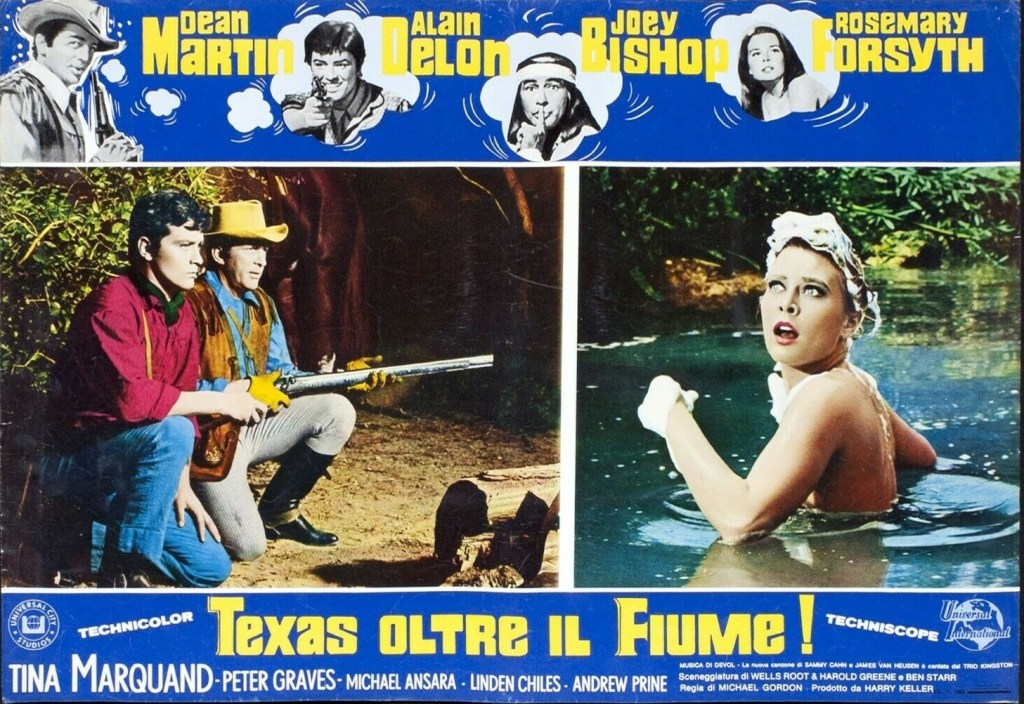
Martin exudes such screen charm you are almost convinced he’s not acting at all, but when you compare this to Rough Night in Jericho it’s easy to see why he was so under-rated. Joey Bishop (Ocean’s 11) is a prize turn, with some of the best quips. Rosemary Forsyth (Shenandoah, 1965) is surprisingly good, having made her bones in more dramatic roles, and Tina Marquand (Modesty Blaise, 1966) more than holds her own. Michael Ansara (Sol Madrid, 1968) played Cochise in the Broken Arrow (1956-1958) television series. Under all the Medicine Man get-up you might spot Richard Farnsworth. Peter Graves of Mission Impossible fame is the hapless cavalry leader.

Director Michael Gordon (Move Over, Darling, 1964) hits the mother lode, the story zipping along, every time it seems to be taking a side-step actually nudging the narrative forward. He draws splendid performances from the entire cast, knowing when to play it straight, when to lob in a piece of slapstick, and when to cut away for a humorous reaction, and especially keeping in check the self-indulgence which marred many Rat Pack pictures – two of the gang are here, Martin and Bishop. There’s even a sly nod to Sergio Leone spaghetti westerns when the electric guitar strikes up any time Native Americans appear. Frank De Vol (Cat Ballou, 1965) did the score. Written by Wells Root (Secrets of Deep Harbor, 1961), Ben Starr (Our Man Flint, 1966) and Harold Greene (Hide and Seek, 1964).

Terrific fun.

Modesty Blaise (1966) ***

You might well enjoy this if a) you are in a very good mood, b) you love psychedelia, Pop Art and the Swinging Sixties, c) you fancy a spy film spoof or more likely d) you are a big fan of one or all concerned. Otherwise, you might be well advised to steer clear because it either takes the mickey out of a number of genres, not just espionage, or plays merry hell with narrative and character and is only loosely based on the source material by Peter O’Donnell.

Bear in mind it originated in a comic strip – later turned into a series of novels – that had more in common with the likes of Danger: Diabolik than the more straightlaced adventures emanating from DC Comics or Marvel. In particular, Modesty had a neat habit of distracting the villains by appearing topless in moments of crisis – a trick adopted in movies like 100 Rifles (1969) and El Condor (1970).

Fans of the comic strip/book may have been left indignant by the audacity of the filmmakers to introduce romance between Modesty and her sidekick Willie Gavin since in the book their relationship was strictly platonic. There was no place, in either comic strip or book, for the musical numbers that pepper the movie. And – check out The Swinger (1966) – for the notion of a character acting out a fictionalized version of herself.

You should be aware that Modesty is a very rich version of the gentleman sleuth, an idea that belonged to the old school, of a person, such as The Saint, bored with wealth, who takes on dangerous assignments in the eternal battle between good and evil.

Anyways, on with the story.

Modesty Blaise (Monica Vitti) is hired by the British government in the shape of MI5 chief Sir Gerald Tarrant (Harry Andrews), in return for immunity for her previous crimes, to deliver a secret shipment of diamonds, part-payment for oil imports, to Sheik Abu Tahir (Clive Revill). Modesty happens to be the sheik’s adopted daughter. Meanwhile, criminal mastermind Gabriel (Dirk Bogarde), believed to be dead, has his eyes on the consignment.

Meanwhile (again), Modesty upsets current lover Hagen (Michael Craig), Tarrant’s aide, by hooking up with old flame Willie Garvin (Terence Stamp). Meanwhile (again again), Garvin hooks up with another of his old flames, magician’s assistant Nicole (Tina Marquand), who has information on Gabriel.

Various assassins employing a variety of methods are sent to kill Modesty so a good chunk of the picture is her avoiding her demise. Gabriel is a pretty touchy employer, so upset by failure that he assigns his Amazonian bodyguard Mrs Fothergill (Rosella Falk) to eliminate all such assassins. Gabriel, however, is something of a contradiction, very sensitive to violence. And just in case you are not keeping up with the plot, conveniently, the bulk of the conversations between Tarrant and his superior (Alexander Knox) will fill you in.

Through a whole bunch of clever maneuvers on Gabriel’s part, Modesty and Willie are forced to steal the diamonds themselves. And, meanwhile, Hagen is on their tail, infuriated at being jilted.

In between the umpteen shifts in plot, which basically lurches like a ship in a storm, the screen is ablaze with color. Nobody complained much when Raquel Welch found it necessary to change her bikini ever few seconds, or that a musical required continuous costume changes, and Modesty here seems to have fallen into the same pattern, the changes in outfit often so swift you imagine she has a disorder.

And be warned, this is a poster film for Pop Art, so if it’s not clothes that are being swapped, it’s décor. You might put Terence Stamp’s blond barnet in the discordant category. You can’t really complain about the plot because espionage storylines are usually something of a conjuring trick with the impossible little more than a standard mission. There’s much to enjoy if you’re of a mind and subscribe to one of the four ideas outlined in the opening paragraph and like the idea of the otherwise critical darling Joseph Losey (Accident, 1967) giving way to stylistic overkill.

Monica Vitti (Girl with a Pistol, 1968) inhabits the role with the necessary verve though Terence Stamp (The Collector, 1963) looks as if he has walked into a spoof and Dirk Bogarde (H.M.S. Defiant / Damn the Defiant!) appears still in experimental mode, having dumped the British matinee idol, unsure of what his screen persona should be. Evan Jones (Funeral in Berlin, 1966) is generally to be blamed/praised for the screenplay.

A movie for which the word confection was invented.

Texas Across the River (1966) ****

Excellent comedy western mixing dry wit and occasional slapstick to joyous effect. The wedding between Spanish duke Don Aldrea (Alain Delon) and Louisiana belle Phoebe (Rosemary Forsyth) is interrupted by her previous suitor Yancy (Stuart Cottle) who is killed in the resulting melee. Escaping to Texas, Don Aldrea’s marksmanship leads settler Sam (Dean Martin) to recruit him to help fight raiding Commanches. Romantic entanglement ensues when the Don rescues Native American Lonetta (Tina Marquand) and Sam has more than a passing interest in Phoebe.

It is so tightly structured that nothing occurs that doesn’t have a pay-off further down the line. Bursting with terrific lines – including a stinger of a final quip – and set pieces, it pokes fun at every western cliché from the gunfight, the cavalry in hot pursuit, and fearsome Native Americans to the snake bite and the naked bathing scene. Incompetence is the order of the day – cavalry captain Stimpson (Peter Graves) issues incomprehensible orders, chief’s son Yellow Knife (Linden Chiles) cannot obey any.

The Don, with his obsession with honor and his tendency to kiss men on the cheeks, is a comedy gift. Despite his terrific head of hair, he is stuck with the moniker “Baldy” and every time he is about to save the day he manages to ruin it. Sam is the kind of guy who thinks he is showing class by removing his spurs in bed while retaining his boots. His sidekick Kronk (Joey Bishop), a mickey-take on Tonto, mostly is just that, a guy who stands at the side doing nothing but delivering dry observations.

Lonetta is full of Native American lore and has enough sass to keep the Don in his place. “What is life with honor,” he cries to which she delivers the perfect riposte, “What is honor without life?” Phoebe is a hot ticket with not much in the way of loyalty.

Two sequences stand out – the slapping scene (whaat?) and a piece of exquisite comedy timing when Sam, Phoebe and the Don try an iron out a complicated situation.

Good as Dean Martin (Rough Night in Jericho, 1967) is the picture belongs to Alain Delon (Once a Thief, 1965) and I would argue it is possibly his best performance. Never has an actor so played against type or exploded his screen persona. Delon was known for moody, sullen roles, cameras fixated on his eyes. But here he is a delight, totally immersed in a role, not of an idiot, but a man of high ideals suddenly caught up in a country that is less impressed with ideals. If he had played the part with a knowing wink it would never have worked.

Martin exudes such screen charm you are almost convinced he’s not acting at all, but when you compare this to Rough Night in Jericho it’s easy to see why he was so under-rated. Joey Bishop (Ocean’s 11) is a prize turn, with some of the best quips. Rosemary Forsyth (Shenandoah, 1965) is surprisingly good, having made her bones in more dramatic roles, and Tina Marquand (Modesty Blaise, 1966) more than holds her own. Michael Ansara (Sol Madrid, 1968) played Cochise in the Broken Arrow (1956-1958) television series. Under all the Medicine Man get-up you might spot Richard Farnsworth. Peter Graves of Mission Impossible fame is the hapless cavalry leader.

Director Michael Gordon (Move Over, Darling, 1964) hits the mother lode, the story zipping along, every time it seems to be taking a side-step actually nudging the narrative forward. He draws splendid performances from the entire cast, knowing when to play it straight, when to lob in a piece of slapstick, and when to cut away for a humorous reaction, and especially keeping in check the self-indulgence which marred many Rat Pack pictures – two of the gang are here, Martin and Bishop. There’s even a sly nod to Sergio Leone spaghetti westerns when the electric guitar strikes up any time Native Americans appear. Frank De Vol (Cat Ballou, 1965) did the score.

Discover WordPress

A daily selection of the best content published on WordPress, collected for you by humans who love to read.

The Atavist Magazine

by Brian Hannan

WordPress.com News

The latest news on WordPress.com and the WordPress community.