Birdman of Alcatraz (1962) ****

It always helps a prison picture if your character has been wrongfully convicted (The Shawshank Redemption, 1994) or is incarcerated through an unfortunately set of circumstances including self-destructive tendencies (Cool Hand Luke, 1967). Whatever the case, the malevolence of the wardens or the emergence of his own engaging personality will ensure that your character is sprinkled with enough sympathy to transform into our hero.

But that’s not the case here and it takes a strong chunk of bravura acting from Burt Lancaster (Elmer Gantry, 1960) to pull this off.
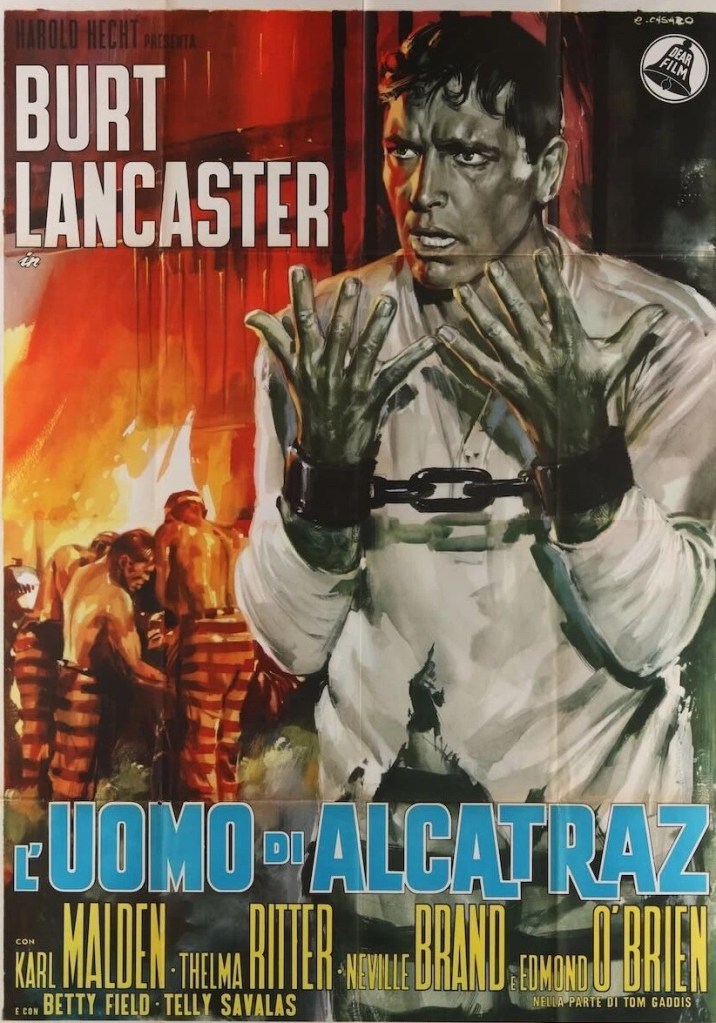
Oddly, this works in the main not because it’s your typical prison picture with endless confrontations with guards and preventing your dignity being sliced and diced by a ton of humiliating actions. Walt Disney couldn’t have done a better job of hooking the audience with its nature true-life approach. I guarantee you will be chuckling to watch a newborn chick trying to shuck off the top half of its egg.

Robert Stroud (Burt Lancaster), a pimp, was certainly no innocent, a two-time killer, who only escapes execution through the efforts of his mother (Thelma Ritter) in persuading U.S. President Woodrow Wilson to commute his sentence. However, there is an evil Catch-22 which infuriated prison governor Harvey Shoemaker (Karl Malden) invokes. While awaiting sentence, and assuming execution is inevitable because he murdered a prison guard in front of hundreds of witnesses, the local judge has decreed that Stroud should be kept in solitary confinement.

Shoemaker, nettled by Stroud’s defiance, interprets that as being able to keep the prisoner in solitary confinement for the rest of his term – which amounts, as it happens, to 40 years. None of this bugs Stroud that much. He’s averse to human companionship, as likely to bully a cellmate and cause ructions elsewhere, and certainly not ever going to give in to the prison system with its endless rules.

The marketeers have taken some liberties with the title. But Alcatraz is certainly a bigger lure to moviegoers than Leavenworth. By the time Stroud reaches Alcatraz he’s devoid of birds. All the breeding activity takes place in Leavenworth.

And while there are aspects of Stroud’s character you will never warm to, he’s got us hooked the minute he embarks on the bird breeding, in part because it’s the antithesis of his character to be so humane, and in part because the dedication involved in painstakingly building cages or other toys (a little wooden chariot a bird is taught to drive) from nothing but wooden boxes with rudimentary tools he has fashioned himself is wondrous to behold. That section of the movie is just enthralling.

Although he’s rescued a chick from a broken nest that lands in the prisoner courtyard during a storm, it takes him a while to cotton on that the bird needs fed, which he does with his version of a toothpick. He coaxes the frightened bird to fly and eventually starts breeding the damn things, persuading a new governor to allow him to buy birdseed and encourages his hobby, so much so that after extensive study Stroud becomes a noted ornithologist with a couple of publications to his name. His case became widely known after a bird researcher Stella Johnson (Betty Field) publicizes his activities and eventually marries him.

But when he’s shifted to Alcatraz, he encounters Shoemaker who forbids the birds. So Stroud starts to write a history of the U.S. penal system. Despite being prone to violence, he is instrumental in ending a prisoner uprising. He is never released, despite various petitions.

So while there’s no happy ending it’s an absorbing picture. Burt Lancaster is at the top of his form, winning another Oscar nomination. Telly Savalas (Crooks and Coronets, 1969), playing another prisoner, was also nominated. Karl Malden (One Eyed Jacks, 1961) is an excellent foil and any time Thelma Ritter (A New Kind of Love, 1963) pops up she steals the show.

While it’s on the long side for a prison picture and lacks the epic quality that the 150-minute running time would suggest, director John Frankenheimer (The Manchurian Candidate, 1962) takes an almost documentary approach to his subject. You might call it an intimate epic. Screenplay by Guy Trosper (The Spy Who Came in from the Cold, 1965) from the book by Thomas E. Gaddis.

Standout show from Lancaster.
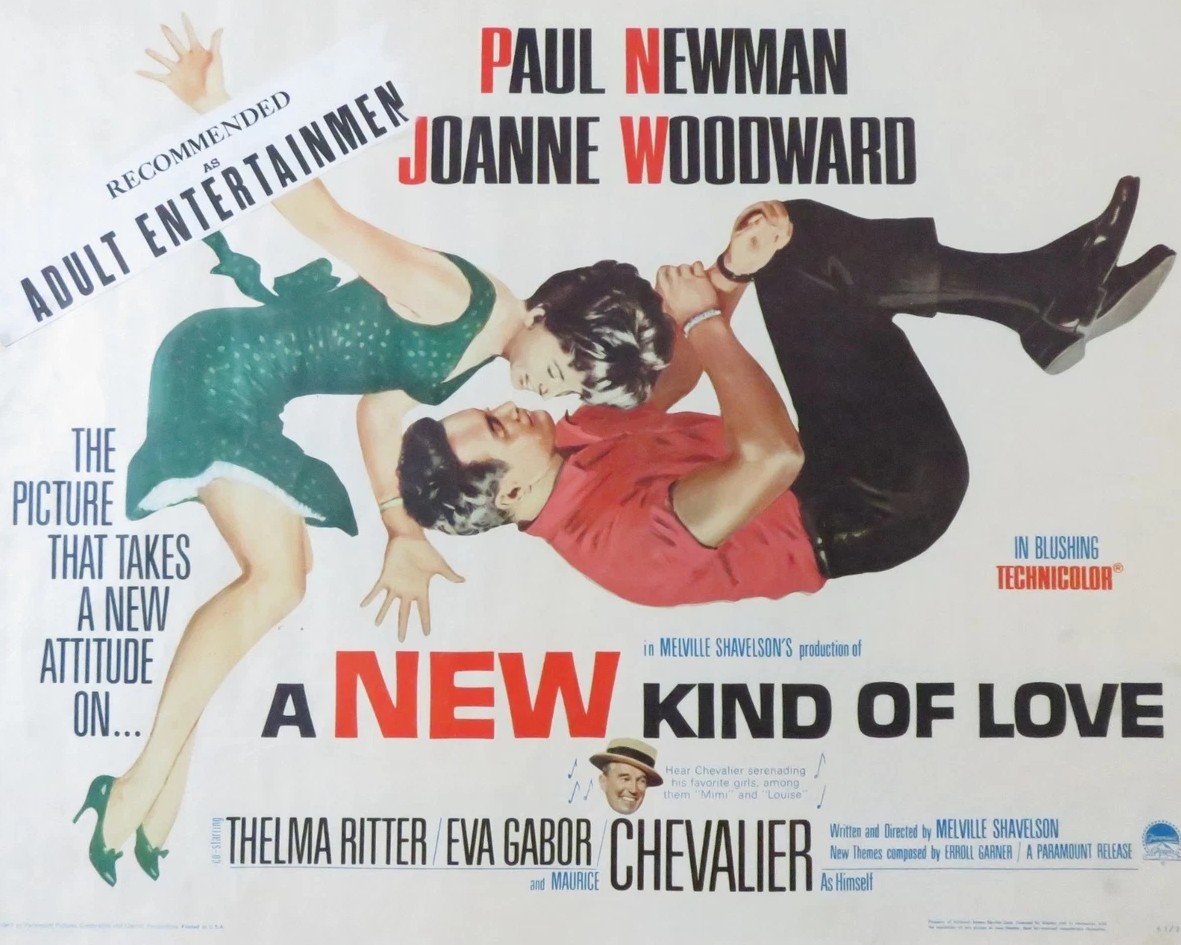
A New Kind of Love (1963) ***

Just about scrapes by, small thanks to Paul Newman’s atrocious Texan accent, Joanne Woodward’s frightful blonde wig – more Lady Penelope than classy Parisian – and Maurice Chevalier serenading a horde of drunken women. Maurice Chevalier? Well, of course this is Paris and Chevalier always sings regardless of being peripheral to the story.

Suffers, too, from being a smart-ass picture, in the vain hope of hitting the satirical bullseye taking swipes at everything in sight, from women barging into a sale to haute couture, airline stewardesses, journalism and even Paris. And there’s a string of fantasy sequences that might (or might not) have worked at the time but fail to gell now. Takes forever for the principals to even be brought close enough together to envisage romance and it doesn’t help that that supposedly most eagle-eyed of creatures, the reporter, can’t see through a simple disguise.

Tomboy Sam Blake (Joanne Woodward) is a pirate. Not the swashbuckling kind, leaping through the rigging, which would be worth seeing I’m sure, but the industrial kind, stealing the designs of better designers for a New York department store.

Steve Sherman (Paul Newman) is piratical, stealing other people’s wives. When his latest conquest turns out to be married to his boss, he is shifted off to Paris as – punishment? Yep, you can see the awry thinking behind this one.

Meanwhile, Sam and a gang from her store, boss Joe (George Tobias) and colleague Lena (Thelma Ritter), are off to Paris on a spying expedition to the annual fashion shows. Lena has her eyes on romance with the boss but is beaten to that prize by the glamorous Felicienne (Eva Gabor). Sam isn’t interested in romance. She’s a career woman, or in the parlance of the day, a “semi-virgin” (though I suspect that description was a screenwriter’s invention). Neither is Steve, for that matter, at least not of the long-lasting kind, he’s happily tearing around with a woman on each arm, enjoying the more nefarious sights of the French capital while Sam is knee deep in work.

After Sam gets a makeover, complete with long cigarette-holder Lady Penelope style, resulting in the bouffant hair style and is sitting in a café, she is approached by Steve who, assuming she is a high-class courtesan, attempts to interview her for the article he hopes will save his job. They’ve bumped into each other, she disdaining his obvious approaches, a couple of times but then she was rigged out in a short haircut and dark glasses. And this is such a complete transformation he doesn’t recognize her. And, in order to make this movie work, the audience has to play along.

As does Sam, keeping up the pretense of being a high-class hooker in order to get her revenge on the man she despises. The fictions she dishes up, of dalliances with powerful men, are published in his column and their success ensures he’s not fired. Felicienne is edged out of the way, revealed as previously a sex worker, so Lena can make her play for Joe.

Before that ploy can work, Steve sets up Sam with Joe who sees through the disguise. There’s a whole bundle of other unlikely shenanigans before we reach the compulsory happy ending.

Hollywood was fairly enamored with the sex worker or goodtime girl – Never on Sunday (1960), Butterfield 8 (1960), Irma La Douce (1963), for example, with the Oscars chipping in to show their support – and another (yes, this had been done before) comedic twist seemed to offer potential especially with two big stars going all risqué.

Paul Newman (The Prize, 1963) never quite worked out how to manage comedy until Butch Cassidy and the Sundance Kid (1969) where he maintained his usual persona and just delivered the lines rather than trying to wring laughs out of them. He also has a bad habit of trying to demonstrate character by fidgeting, so his face, eyes and hands are all over the place.

Joanne Woodward (A Big Hand for the Little Lady/ Big Deal in Dodge City, 1966) is better value initially but when she takes on the disguise there’s too much of the knowing wink. Six-time Oscar nominee Thelma Ritter (Boeing, Boeing, 1965) has a better idea of how to play comedy by just sticking to the knitting.  

Writer-director Melville Shavelson (The Pigeon That Took Rome, 1962) just about makes it work and when it doesn’t throws in sufficient distraction.

Not the Newman-Woodward team’s finest hour.

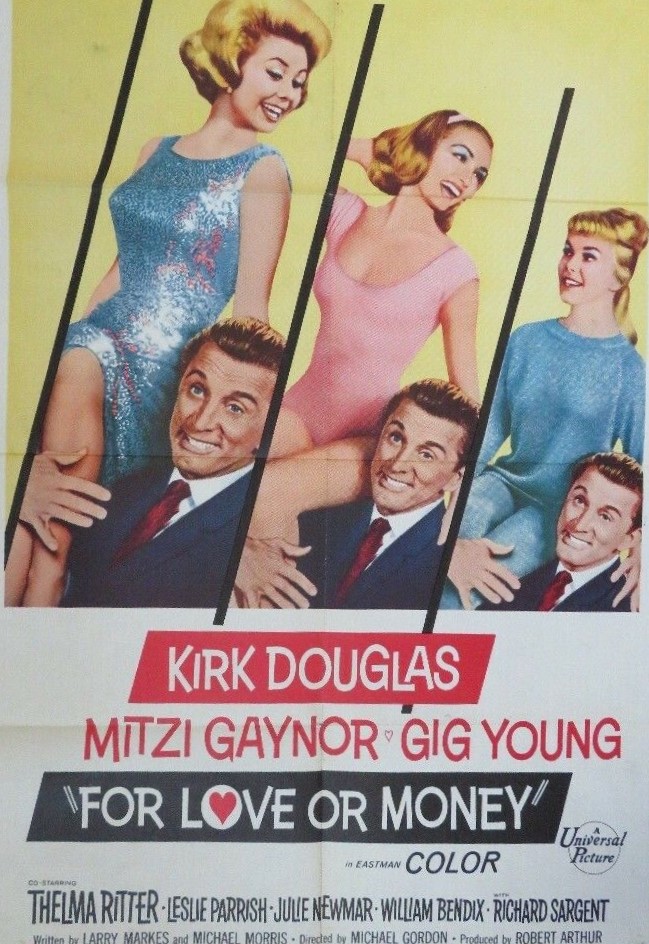
For Love or Money (1963) ***

Kirk Douglas (The Brotherhood, 1968) had been so intent on establishing his dramatic credentials as a Hollywood high flier that he hadn’t appeared in a comedy in six years when he was second-billed to Susan Hayward in Top Secret Affair (1957).  

So after all the sturm und drang of heavyweight numbers like Strangers When We Meet (1960), Spartacus (1961), and Lonely Are the Brave (1962) it was always going to be interesting to see if he could drop the commanding persona long enough to hit the laugh button. He’s helped by a screenplay that while suggesting he is in control shows him run ragged by a quartet of females.

Millionaire widowed mother Chloe (Thelma Ritter) hires singleton lawyer Deke (Kirk Douglas) for $100,000 – enough to pay off his debts –  as some kind of matchmaker, not given the task of finding suitable husbands for her daughters, but to make sure that trio of spoiled women get hitched to men chosen by her.

The plan is for the Kate (Mitzi Gaynor), the most organized, to marry rich playboy Sonny (Gig Young), health nut Bonnie (Julie Newmar) to take up with child love Harvey (Richard Sargent) and hippie art lover Jan (Leslie Parrish) to be landed with dull taxman Sam (William Windom). Sonny is Deke’s best friend, they share a yacht.

Nothing tuns out the way it should in part because Deke is more attractive than any of the other males on offer and in part because the heiresses are disinclined to do what anyone tells them. Deke spends all his time getting into hot water, dashing into another room to take phone calls that inevitably create further confusion, while manfully trying to ensure that the male suitors present their most attractive sides to their potential brides.

There’s not a great deal to it. It’s not exactly farce, but given the daughters live on top of each other, quite easy for Deke to race from one apartment to another, and say the wrong thing at the wrong time. The juggling act is never going to work out, especially as Kate is love struck by Deke, though if she could see how easily he flirts with her siblings she might be less keen. There’s finale on a boat or, should I say, in falling off a boat.

I wouldn’t say it’s a hoot but it’s an excellent lightweight concoction that comes to life by inspired casting. None of the women is your typical Hollywood fluff, all present interesting characters, leaders in their own ways, and with a lifetime of standing up to their domineering mother unlikely to fall over at the sight of any decent male.

Thelma Ritter (Boeing, Boeing, 1965) is easily the pick. The six-time Oscar nominee, generally seen in dowdy parts as a maid or similar, is dressed to the heavens, all glammed up as the millionairess without losing any of her trademark snippiness or drollery. Mitzi Gaynor (South Pacific, 1958), in her final screen role, has a well-written part as an efficient businesswoman and proves more than a match for Deke.

Julie Newmar (The Maltese Bippy, 1969) is a delight as the health nut whose physical demeanor is proof of her regime while Leslie Parrish (The Manchurian Candidate, 1962) bounces along with a coterie of artists.  Gig Young (Strange Bedfellows, 1965) can do this kind of role in his sleep but he’s no less effective for having acquired that skill of the guy who never gets the girl. And there’s a rare sighting of Hollywood tough guy William Bendix (The Blue Dahlia, 1946) in a comedy.

But none of this would work without Kirk Douglas. And it works because he plays it straight. He doesn’t give in to the temptation of mugging to the camera, eye-rolling and pratfalls. You could easily get the idea the actor thought he was in a drama, especially as he’s the one in the kind of quandary that we’ve seen him ignore before, when ambition trumps morality or romance, as with Ace in the Hole (1951) or Strangers When We Meet. In some senses, the casting relies on audiences being aware of that sneaky side of his screen persona, the one where he doesn’t always do the right thing. And here, you could easily see him opting for the loot over the girl.  

Director Michael Gordon (Texas Across the River, 1966) is adept at winkling out the comedic moments in stories that are played straight. The team of Larry Markes and Michael Morris (Wild and Wonderful, 1964) wrote the screenplay with the emphasis on situation comedy rather than farce.

Good, clean fun and great performances.

Boeing Boeing (1965) ***

Farce is particularly difficult to pull off on screen. What is so effective on stage where the audience has full view of doors opening and characters appearing/disappearing and can often view, like a pantomime, circumstance changing ahead of the characters, grinds to a halt when the camera has to cut between various characters.

A speeded-up Tony Curtis (The Boston Strangler, 1968) doesn’t help though lack of his usual zaniness provides Jerry Lewis (The Nutty Professor, 1963) with the opportunity to present a more grounded character. To some extent, there’s little director John Rich (Wives and Lovers, 1963) needs to do than to keep the ample supply of balls rolling.

The movie displays its sexist credentials – listing the measurements of the female stars – not just in posters such as the one above but also in the film’s credit.

Though it sticks to the normal formula of girls falling out of the woodwork at inappropriate times, the Parisian set-up is a beaut. Journalist Bernard (Tony Curtis) has three girls on the go, all airline stewardesses, all believing themselves to be his fiancée, and by dint of assiduous study of flight schedules ensures that their paths never cross. His acidic housekeeper Bertha (Thelma Ritter) keeps the love machine well-oiled by switched around framed photos are changed and relocating underwear to suit the next imminent arrival.

Things go awry when American airline Boeing introduces a faster model, meaning that his lovers return sooner than anticipated. Stakes are raised when reporter rival Robert (Jerry Lewis) queers his pitch. So mostly it’s Bernard trying vainly to keep all his balls in the air without being rumbled while Robert attempts to sabotage the operation.

There’s not much more to it than that, the girls’ consternation at finding another woman in the apartment, Bernard gamely finding excuses for their presence.

Nor is it as risqué sex-wise as you might expect. The period didn’t allow for the hostess trio to actually be engaging in hanky-panky with Bernard. They are all allocated separate bedrooms so it will seem to a modern audience that all his frantic energy is wasted, though the initial stage audiences would accept the bedroom shenanigans as long as conventions were respected. Amorality goes only as far as keeping three girls on a string rather than actually taking them all to bed.

Of course it builds up into a riotous outcome but the farce remains forced.

Tony Curtis mugs his way through the entire thing, face twisted a  million ways, eyeballs rolling so much you think they are going to bounce clear of the sockets, and delivering dialog so fast he can hardly get to the end of one thought before another has interjected. Jerry Lewis is better value as the straight man, not relying on the physical comedy of previous roles, nor any obvious mugging, and creating a sly believable character intent on getting revenge.

Suzanna Leigh (The Pleasure Girls, 1965) is the pick of the hostesses but that’s not saying much since each has tumbled straight out of the cliché barrel. Dany Saval (Moon Pilot, 1962) flies the French flag while Christine Schmidtmer (Ship of Fools, 1965) is the dominating German.  

The biggest joke is on producer Hal Wallis (The Sons of Katie Elder, 1965). A past expert at choosing properties, he purchased the rights to the successful stage play by Marc Camoletti when  it was enjoying a hugely successful run in London’s West End. But when the production transferred to Broadway it was a resounding flop, leaving the movie with none of the usual hit play hype to build upon.

With only A Girl Named Tamiko (1963) in his portfolio as evidence of his familiarity with comedy (and that gentle in nature), Edward Anhalt (The Sins of Rachel Cade, 1961) was an odd choice for the screenplay except that he had recently adapted for Wallis hit Broadway play Becket (1964). (As a footnote, you might be interested to know that Mark Rylance won a Tony for playing Robert in a Broadway revival.)

Lightweight matinee material, but worth it for Jerry Lewis playing against type.

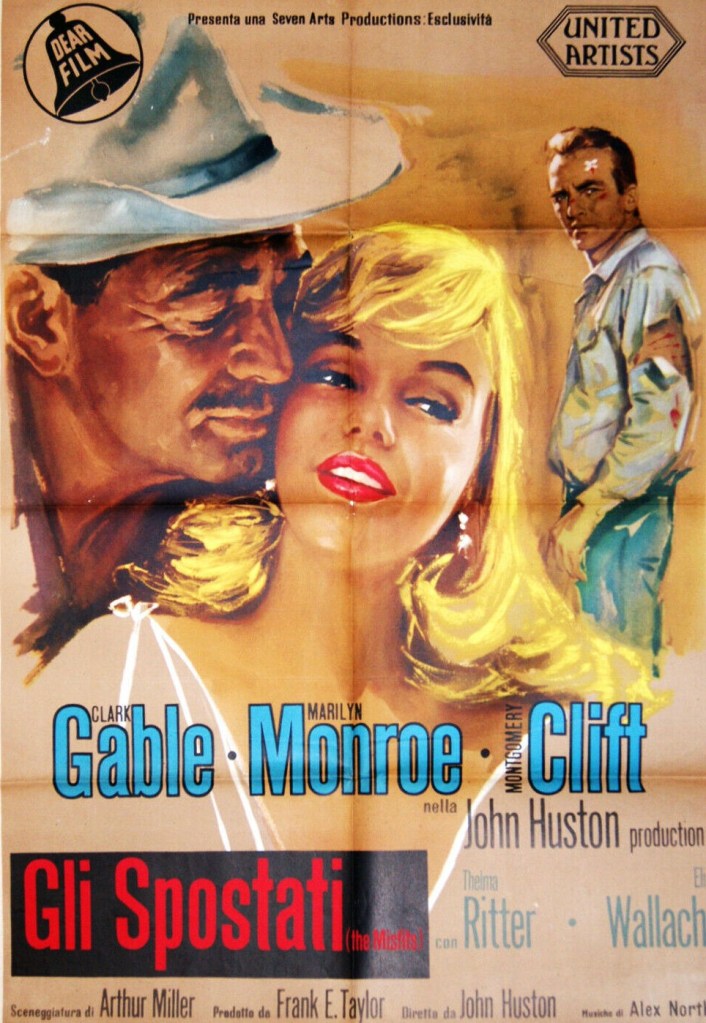
The Misfits (1961) *****

A knockout. Stone cold five-star gold label classic. It’s rare for a non-western to turn into one of the greatest westerns of all time. Forget The Wild Bunch (1969) and Once Upon a time in the West (1969) and every other paean to the dying of the Old West. This is all you need. A true insight into just what is left for the cowboy once civilization and modernization have run their course.

What’s perhaps most astonishing is that three major Hollywood stars plus a top director and  one of the three greatest American playwrights of all time combined to make an indie. There’s no high drama of the kind Hollywood usually requires, no love dashed, no death or murder, nothing dramatic enough to be called narratively gripping. Made today, it would be the kind of picture that would traipse from film festival to film festival, hoping for a break at Sundance. The cast would be no-namers unless a star, fed-up with actioners, wanted to gain some artistic credibility.

This is as misleading a tag line as you could get. Admittedly, selling the movie’s core sadness
in the early 1960s would have been tough.

By some freak of Hollywood magic this was greenlit. There’s plenty good dialog but nothing that’s going to make it into the Classic Line Hall of Fame and there’s only a handful of finely wrought scenes. So beyond the astonishing mustang sequence, what reverberated was the acting, with each big star producing a scene of the highest quality, for pure emotional impact possibly unsurpassed in their entire careers.

The story itself is pretty slim. Roslyn (Marilyn Monroe) in Reno to get a divorce hooks up with washed-up cowboy Gay (Clark Gable) and grieving car mechanic Guido (Eli Wallach). They repair to Guido’s cabin in the country, unfinished after his pregnant wife died because he didn’t have a spare tire. They are joined by hard-drinking man-hungry Isabelle (Thelma Ritter). Roslyn shacks up here with Gay, brightening up the place with decorative ideas and planting vegetables.

At the rodeo they stake drunken Perce (Montgomery Clift), a tough guy with mother issues, self-destructing one rodeo at a time. At various times the trio nurse and console each other, but mostly they get drunk. The three men take Roslyn along to show off their cowboy skills, catching wild mustangs. This is less old-fashioned than you might imagine. It’s more like tracking down the great white shark in Jaws (1975), a primeval battle between man and beast. Man has the advantage of being able to use Guido’s biplane to drive the horses down to Gay and Guido waiting with lassoes.

And tires.

What are the tires for you might well ask? Well, they fulfil the same function as the barrels in Jaws, to weight down the animals so they are easier to track, perhaps exhausting them so much they might just topple over and die. So the odds are not exactly even.

The guys are further disadvantaged by Roslyn’s presence. When she learns of the horses’ fate – not as you might expect to become working horses on a ranch like current television series Yellowstone – she is horrified. The critters will end up as pet food. So much for the Wild West.

This is an absolutely fantastic sequence and I’m surprised it doesn’t turn up on critical lists at all as one of the great western segments of all time. It says more about the end of the West than all the violence of The Wild Bunch or operatic fervour of Once Upon a Time in the West. And it’s a companion piece to The Old Man and the Sea, man, for all his endeavors, ending up with virtually nothing.

There’s a few twists and turns to this sequence so I won’t spoil it for you except to say it is one of the very few sections in movies where character plays out in action.

And this isn’t even Gable’s greatest scene. The moment when, drunken out of his skull already, he bleats in the street about his kids carries awesome power. What he’s saying doesn’t even make a great deal of sense, which is the beauty of it, because what drunk ever makes sense, most of the time he’s effectively addressing the demons inside.

Clift has a horrifically comic scene. His brain is as washed away as his body. He wakes out of a drunken stupor and can’t remember why he has a huge bandage round his head and proceeds to unravel it, again with a monologue that reveals his inner catatonic state.

Monroe is mute in her best scene. She just stares in horror at the mustang incident unfolding. And she has another terrific scene, probably the most ordinary thing she ever did in her screen career, battering a ping-pong.

The title is actually a rodeo term apparently for, unsurprisingly, a horse that was too small or weak to work. I would have preferred something less obvious because it’s quite clear from the outset all the characters are misfits.

This is probably the closest Monroe got to playing a character who reflected her inner turmoil. Roslyn’s beauty brightens up lives but mostly she is depressed, thinking that even when you win you lose, too fragile to cope with reality, and inclined to need consoled as much as she is willing to nurse the others. Gay is a superb creation, who despises men who earn “wages,” that is have a regular job and lose their freedom. Even if freedom means no female companionship and being reduced to catching horses for the few bucks they will bring in from pet food manufacturers, he would rather do that. Perce is just so battered by life he hasn’t a clue what he’s doing. The self-serving Guido whines.

Put all these characters together and they still live in world of their own, and although they occasionally cross the border into another’s existence by and large it is without understanding.

Without John Huston’s empathetic direction it would be unbearably sad, but with virtually nothing in the way of real plot he draws us inexorably in to their small lives. Given its budget and the box office potential of the stars, it was a flop on release. Now it’s a masterpiece.    

However tragic or premature, few Hollywood stars could have gone out at the top with a picture of this quality as did Gable and Monroe. Possibly as a result of his exertions on the film, Gable died a few days after shooting completed, Monroe eighteen months later, but what a final legacy.

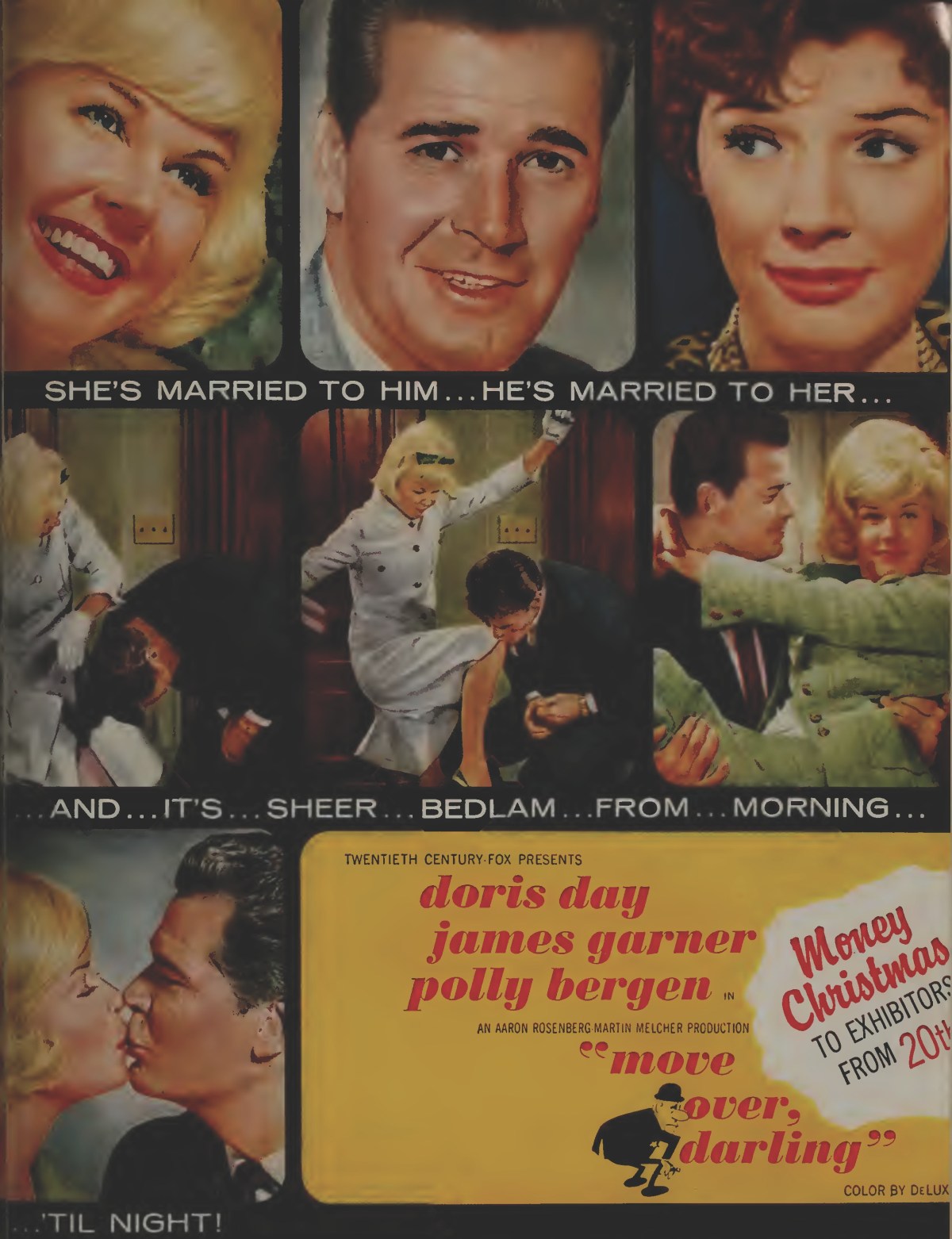
Move Over, Darling (1963) ***

Doris Day never quite replaced Cary Grant or Rock Hudson in her romantic comedy ventures. This is her second outing with James Garner – The Thrill of It All had appeared earlier the same year. Ironically, it’s based on a Cary Grant film, My Favorite Wife (1940) with Irene Dunne. Having been lost at sea for the requisite five years, this version kicks off with Day being pronounced legally dead in court to pave the way for Garner to marry Polly Bergen (Cape Fear, 1962). Naturally, she turns up on the day of their wedding and the first part of the movie is Garner trying to keep the women apart. Cue comic pratfalls, double takes, diving in an out of bedrooms, but Day and Bergen seem to be trying to out-screech each other. The idea of bigamy, scandalous at the time, has lost its power to shock.

While Day spent much of the picture in hysterics, I didn’t, and wished they had moved quicker to the complication which was that she had shared her desert island with a hunk (Chuck Connors). The pace picks up a bit after that as Day has to pretend that it was nerd (Don Knotts) with whom she was stranded while Garner knows the truth. There is some good reversal, her kids, who naturally don’t recognize her, complaining about her singing. A number of set pieces save the day – two court scenes with an exasperated judge (Edgar Buchanan), Day disguised as a Swedish masseuse giving Bergen a savage work-over and Day trapped in car wash.

Michael Gordon had helmed Pillow Talk (1959) but missed the mark here. Don Knotts, prior to his incarnation as The Incredible Mr Limpet (1964) show his potential as the shoe salesman recruited by Day to impersonate Connors. Accomplished comedienne Thelma Ritter holds back on the comedy instead playing a straight role as the meddling mother-in-law. Fred Clark as the alternately bemused and suspicious hotel manager gets the best of the double takes. Garner, unfortunately, has little opportunity to exhibit his sly sense of humor or the laid-style that worked a treat in Support Your Local Sheriff (1969).

Hal Kanter, who worked on the George Gobel and Milton Berle television shows and scripted Blue Hawaii (1961) fashioned the screenplay along with the more versatile and sometime director Jack Sher (Paris Blues, 1961).

When it was known as Something’s Got to Give, George Cukor was set to direct a cast that included Marilyn Monroe, Dean Martin, Cyd Charisse, Tom Tryon and Phil Silvers from a script by Nunnally Johnson and Walter Bernstein. Monroe had nixed working with Garner and Knotts. When Monroe was fired, Kim Novak and Shirley Maclaine refused offers to replace her. Dean Martin refused to continue without Monroe and although re-hired she died before production recommenced.

Discover WordPress

A daily selection of the best content published on WordPress, collected for you by humans who love to read.

The Atavist Magazine

by Brian Hannan

WordPress.com News

The latest news on WordPress.com and the WordPress community.