New York Showcase: 1969 Box Office Race

In the days before computerised box office figures and the internet permitting easy access, fans of the sport had to make do with the weekly tallies in the “New York Showcase” section run every week in Variety. The “Showcase” was an early version of the wide release but instead of the 3,000-4,000 cinemas involved today in an opening week launch, movies would hit the Big Apple in 23-60 theaters. No matter the low theater count, it was still considered the most accurate prediction of how a movie would fare nationwide.

Some films opened straight into the showcase format, others ran day-and-date with a glossy opening on Broadway or a prestigious arthouse, and for a few this was the first step in general release after a roadshow run.

The same rules applied as today. A movie was retained for a further week only if the picture hit the target. Long runs were rare, two weeks the standard. As we shall see, some were movies making their 1969 debut while others were going wide after opening the previous year, the delay accounted for by holdover success in first run or Oscar recognition.

Just over 200 theaters took part in the showcase splurge, divided into five main strands generally through circuit or distributor affiliation plus one that brought together suburban arthouses. Not all the streams were in full-time operation, some weeks saw four new releases others six. Movies could count on losing theaters after the first week.

And, as with now, while overall receipts were the main factor, the per-theater gross could also offer up some indication of future performance.

The best single week’s take in 1969 was achieved by Dustin Hoffman comedy The Graduate which took $760,000 from 43 houses (per-theater average: $17, 674) followed very closely by Ali McGraw debut Goodbye, Columbus  with $757,000 from 44 ($17, 204 per theatre). Steve McQueen thrill-ride Bullitt nabbed $684,000 from 45 ($15,200). In fact all three pictures placed twice in the single-week top ten.

Others flying high, at least for one week, were: Whatever Happened to Aunt Alice ($540,000 from 48), True Grit ($531,000 from 49), Joanne Woodward in Rachel, Rachel ($522,000 from 42), psychedelic outing The Trip ($520,000 from 49), sexploitationer Fanny Hill ($506,000  from 42), The Boston Strangler ($481,000 from 38) and I Am Curious Yellow ($480,000 from 40).

By contrast, at the other end of the heap, Marlon Brando in Night of the Following Day could only manage $125,000 from 31, The Assassination Bureau scraped up $82,000 from 22, Elliott Gould in Ingmar Bergman’s The Touch hit $48,000 from 26 while Michael Caine performed abysmally, Play Dirty knocking up just $91,000 from 24, The Magus $80,000 from 20, The Battle of Britain tumbling stratospherically from $366,000 from 32 one week to $101,000 from 27 the next.

But the showcase system also breathed life into arthouse hits attempting to break out into a wider marketplace. John Cassavettes’ Faces rocked up $469,000 in three weeks, Luis Bunuel’s Belle de Jour $329,000 over the same period, Brian De Palma’s Greetings $263,000 in a fortnight while one week of Robert Downer Snr.’s Putney Swope registered $205,000.

Reissues were also prime fodder to stoke up a distribution system creaking at the seams due to lack of new product. Gone with the Wind (1939) was the plum, $658,000 in three weeks. Disney’s Swiss Family Robinson (1960) chopped down  $418,000 in two and Clint Eastwood pair A Fistful of Dollars/For a Few Dollars More – both released Stateside in 1967 – $279,000 in a fortnight. More usually, reissues lasted just a week, filling a gap in the annual program.

Even so, they could pull in some decent numbers: Peter Pan (1953) grossing $300,000, Sidney Poitier double bill Guess Who’s Coming to Dinner (1967)/To Sir, With Love (1967) $272,000, perennial favorite The Sound of Music $230,000, Rosemary’s Baby (1968)/The Odd Couple (1968) $215,000, James Bond dualer Goldfinger (1964)/Dr No (1962) $162,000, another Eastwood pair The Good, The Bad and the Ugly (1967)/Hang ‘Em High (1968) $155,000 and a lengthy coupling of Planet of the Apes (1968)/ Those Magnificent Men in their Flying Machines (1965) $115,000.

The overall winner in the annual New York Showcase stakes was The Graduate which over a five-week run grossed $2.24 million. Bullitt was the runner-up with $1.99 million over six weeks, though the last sally was in a double bill with Bonnie and Clyde. Goodbye, Columbus came third with $1.95 million over four weeks. Romeo and Juliet lasted a record eight weeks to pocket  $1.69 million. Fifth was Swedish sensation I Am Curious Yellow on $1.28 million after five weeks.

After playing first run for the best part of six months Rachel, Rachel hit the showcases following an Oscar nomination for Joanne Woodward, bringing in $1.08 million over three weeks. Another anomaly was I Love You, Alice B. Toklas, such a flop the previous year it was ranked 78th in the annual box office race, but now emerging as a showcase front-runner with $1.03 million over five weeks.

Eighth spot went to The Boston Strangler ($932,000 in three weeks) followed by Charly – Oscar win for Cliff Robertson – on $910,000 for six weeks. Butch Cassidy and the Sundance Kid was tenth with $900,000 in two weeks – the western had launched at the tail end of the year and did so well it ran for another five weeks in 1970 to capture an extra $1.5 million.

Filling out the top twenty were, in order, Easy Rider, Ice Station Zebra, The Night They Raided Minsky’s, The Wild Bunch, Popi, On Her Majesty’s Secret Service, True Grit, Oliver!, Whatever Happened to Aunt Alice and Fanny Hill.

In general terms, New Yorkers response to showcase releases was mirrored throughout the country.  The majority of the high-flying films mentioned ending up in the annual box office top 20. But there were some anomalies. Rachel, Rachel had finished the previous year in 37th place in the annual chart, hardly suggesting it was prime candidate for an exceptional showcase run. The Night They Raided Minsky’s came only 32nd in the 1969 chart. Whatever Happened to Aunt Alice did not earn enough around the country to qualify for inclusion on the annual chart. And, frankly, I’m mystified as to why I Love You, Alice B. Toklas did so well.

By contrast Paul Newman racing picture Winning performed so indifferently in the New York showcase that for the final two weeks of its three-week run it was bolstered by John Wayne oil adventure The Hellfighters, yet it ran out 16th for the year. Three in the Attic (18th in 1969) and Support Your Local Sheriff (20th) failed to match expectations in New York.

A Cold Wind in August (1961) ***

Touching low-budget B-movie shot in black-and-white of a young man receiving his sexual education from an older woman. Motherless Vito (Scott Maxwell), the son of an apartment block super, is seduced by the older Iris (Lola Albright), a three-time divorcee looking for a son to mother.  

This is not the transactional sex of The Graduate, and seduction is too strong a description for the yearning Iris whose advances are sensual and romantic, stroking Vito’s head, trapping his hand with her foot, and there is nothing clandestine about their affair either, no false names on a hotel register. They dally in the park, eat hot dogs, he buys her flowers.  

But as he experiences love for the first time, he also experiences more difficult emotions like jealousy and finds it difficult not just to cope with what seems like another man in her life, the wholesaler Juley (Herschel Bernardi), but the fact that she treats Juley with such contempt. Spoiler alert – well, not really, because you know from the off this is not going to turn out well – the affair ends when he discovers she is a stripper. And while she is left bereft, he now appears more attractive to girls his own age.

In contrast to the powerful emotions stoked up when the pair are together, director Alexander Singer (Pysche ‘59, 1964) fills us in on the rest of Vito’s humdrum life, working for his father during the school holidays, goofing off with his pals, and generally failing to make headway with girls his own age.  But Iris’s life is not humdrum. Although she has a rule not to work in her own geographical area, she breaks that to accommodate her estranged husband, whom she seems to tolerate, while at the same time drinking herself into oblivion to avoid any moves from Juley. Nor is she ashamed of her profession. It is an act, a job like any other, and provides her with a nice apartment. Small wonder she treats men with contempt. Perhaps what she falls in love with is untainted innocence. In some senses she is adrift, at other times in full command. And her love for Vito is convincing.

It is full of incidentals. He gulps down ice-cream, she teaches him to drink one sip at a time, without being patronizing the father (Joe De Santis) tries to educate him to honor his inner feelings.

Lola Albright (Peter Gunn television series) carries off a difficult role very well indeed. Without laughs to help him out as it did Dustin Hoffman in The Graduate Scott Maxwell is believable both as the youth growing into adulthood and the youth wanting to remain a youth with no adult responsibilities. The low-key performance of Joe De Santis is worth a mention.

While the picture no doubt attracted attention for the risqué material, which would have certainly given the Hays Code pause for thoughts, it provided a more rounded picture than was normal at the time of a woman working in the sex industry, even if only in the stripping department. Iris did not fall into any of the cliches. She is presented as a woman first and foremost rather than a stripper.


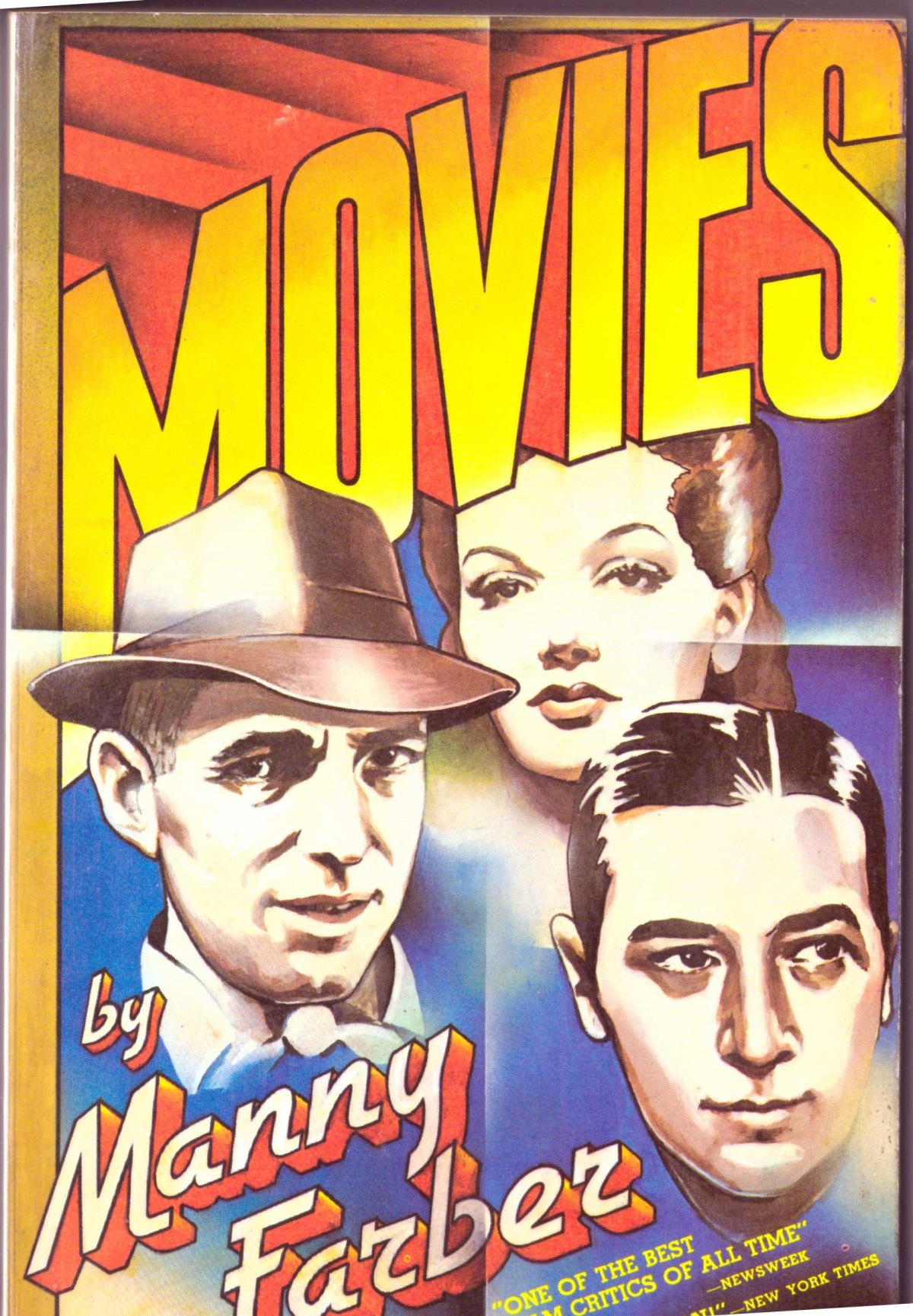
Manny Farber, Critic’s Critic

Gunning for You – Manny Farber

You wouldn’t want to pick a fight with Manny Farber, generally considered along with Andrew Sarris, the godfather of serious film criticism. “Visceral” was the word most commonly associated with his writings.

He came to movies from an unusual perspective. He was a painter, one of the most celebrated still life artists of his generation. He never worked for a big paper like the New York Times or a stylish magazine like the New Yorker. Instead, his work appeared in Film Culture, Artforum, The Nation and men’s magazine Cavalier.

An early advocate of the work of Howard Hawks, Anthony Mann and Raoul Walsh, he was also inclined towards lean B-films over more profligate big-budget pictures.

Chances are you will disagree with everything he said, especially when he was slicing-and-dicing one of your favorites, but it is equally guaranteed that you will marvel at his prose. His work had punch and clarity and it might just make you laugh.

Here are some of his musings on the 1960s movie scene:

Easy Rider (1969): “Dennis Hopper’s lyrical, quirky film is better than good in its handling of death…The death scenes, much more heartbreaking, much less programmed than Peckinpah’s (The Wild Bunch), come out of nowhere…The finality and present-tense quality of the killings are remarkable: the beauty issues from the quiet, the damp green countryside and a spectacular last shot zooming up from a curving road and a burning cycle.”

Lawrence of Arabia (1962): “The most troublesome aspect of Peter O’Toole’s Lawrence is that the story moves faster and further than the actor who is not unlike the Tin Woodsman of Oz (O’Toole starts with a springing outward movement, to walk over the world, then turns into a pair of stilts walking in quick, short strides.)”

On Albert Finney: “The Big Eat is a growing factor in films, in effect probably invented by Finney in his Saturday Night. In his case, it was a combination effect, involving a big chomp, heavy breathing, slashes of braggadocio, a side swivel, and baring of teeth. This emphasized eating has been fined and slowed down in his latest work, but within the timespan of four Finneyfilms it has taken hold, cementing a new convention for giving an underside, the animalistic traits, to character.”

The Ipcress File (1965): “This is a Chandleresque thriller that has no thrills, with an antihero who is more like a sugary flavor than an actor doing a Philip Marlowe…the only suspense is how slowly a knight (non-played ‘superbly’ by Michael Caine) can put dimes in a parking meter, crack eggs in a skillet or flatfoot his way through a library.”

The Rounders (1965): “Fonda’s entry into a scene is of a man walking backward, slating himself away from the public eye. Once in a scene, the heavy jaw freezes, becomes like a concrete abutment, and he affects a clothes-hanger stance, no motion in either arm.”

Who’s Afraid of Virginia Woolf (1966): “The most famous scene is an erotic nondancer, which is neither erotic nor dancelike, in which Elizabeth Taylor suggests a gyrating milk-bottling mechanism.”

The New York Film Festival 1968: “In the category called Bloody Bores, the Festival offered Capricious Summer, Hugo and Josefin and Twenty Four Hours in a Woman’s LifeHugo and Josefin is life as seen through the eyes of a Kodak camera ad.”

On Rita Tushingham: “An even worse example of megalomaniac star who can make the simplest action have as many syllables as her name. The myth that a director makes or breaks a film is regularly disproved by this actress who…carries on a war of nerves against the other actors.”

The Graduate (1968): “Benjy…leads a split life on screen; half the time he’s hung up between Mrs. and Miss Robinson; the other half he’s at half mast; a flattened silhouette…Dustin Hoffman is laid out like an improbably menu. People are always darting into his periphery to point him out as a boy wonder…Benjamin, as it turns out, is Bill Bradley crossed with Denny Dimwit.”

It is unlikely you’ll get hold of this book Movies at a decent price since it is long out-of-print and a collector’s item but you can easily find Farber on Film, a whopping 800-page tome which covers his compete writings.

Goodbye Columbus (1969) ****

Despite being made at the opposite end of the decade to Loss of Innocence – for no deliberate  reason I watched these two films back-to-back –  this has a number of similarities to the earlier picture.

In the main there is a star-making turn, this time from Ali McGraw in her debut. Though playing a slightly older and much wealthier character, she is also a woman in transition, from puppy love to true love, not entirely in control of her emotions and not willing either to accept responsibility for her actions.

Richard Benjamin, in his first starring role, plays the sometimes gauche, much poorer object of her affections. He’s only connected by religious upbringing to The Graduate’s Dustin Hoffman, far more relaxed with women and comfortable in his own persona.

The camera loved McGraw the way it did Susannah York, but in these more permissive times, and given the age difference, there was much more the screen could show of the star’s physical attributes. I was surprised by McGraw’s performance, expecting much less from a debutante and ex-model (and studio boss Robert Evans’ fiancée) but she is a delight, supremely engaging as a confident character enjoying a life of privilege and engaging in witty repartee with Benjamin.

He plays a more down-to-earth character who doesn’t know what to do with his life except not get stuck with a money-making job. He would much rather help a young kid who likes art books.

It’s not a rich girl-poor man scenario but more a lifestyle contrast and both families are exceptionally well portrayed, Jack Klugman drawing on a lifetime’s exasperation as her father and Nan Martin as the uptight mother with terrific cameos from Michael Meyers as her oddball brother and especially Lorie Shelle as the spoiled-brat younger sister.

It’s a lyrical love story well told. The zoom shot had just been invented so there’s a bit over-use of that but otherwise it zips along.

A major plot point provides a reminder of how quickly men took advantage of female emancipation, the invention of the Pill dumping responsibility for birth control into the woman’s lap, leaving the male free to indulge without the risk of consequence. In other words, it was still a man’s world. Of course, without the Pill, it would be a different kind of story, romance tinged with fear as both characters worried about unwanted pregnancy and stereotypical humor as the man purchased – or fumbled with – a prophylactic.

Acting-wise McGraw is pretty game until the final scene when her inexperience lets her down. I’m not sure I went for the pay-off which paints McGraw in unsympathetic terms and lets Benjamin off rather lightly, but all in all I was surprised how much I enjoyed it. 

https://www.amazon.co.uk/Goodbye-Columbus/dp/B07R7Y38SH/ref=sr_1_3?crid=1QTJFY213DHTI&dchild=1&keywords=goodbye+columbus+dvd&qid=1592640377&sprefix=goodbye+columbus%2Caps%2C149&sr=8-3    

Discover WordPress

A daily selection of the best content published on WordPress, collected for you by humans who love to read.

The Atavist Magazine

by Brian Hannan

WordPress.com News

The latest news on WordPress.com and the WordPress community.