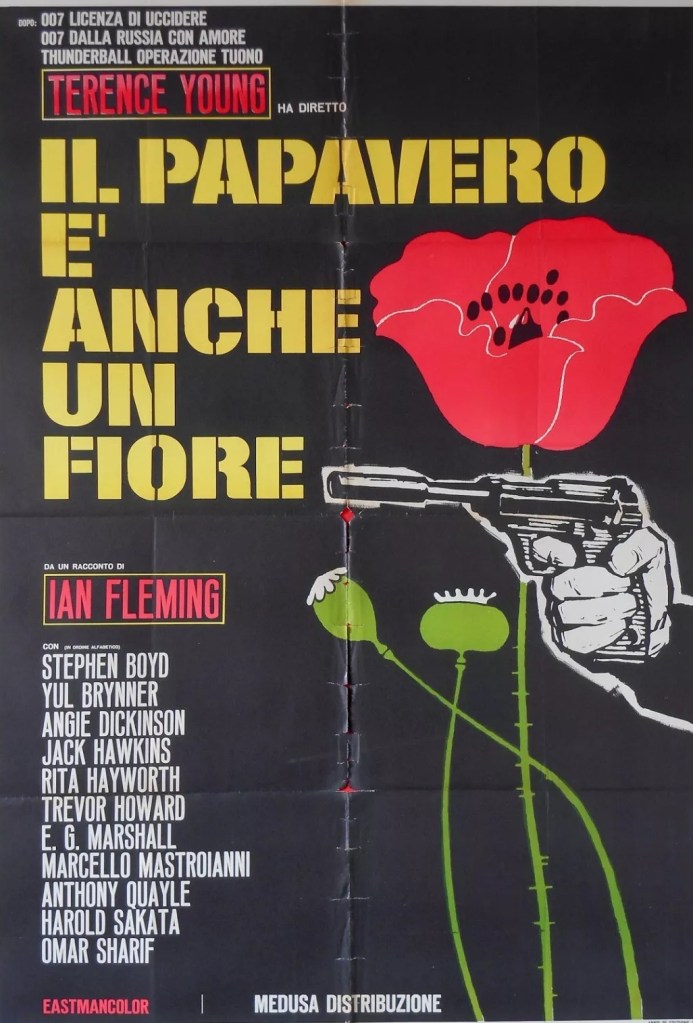
The Poppy Is Also A Flower / Danger Grows Wild (1966) ***

Audiences were likely disgruntled to discover that out of a heavyweight cast boasting the likes of Omar Sharif (Doctor Zhivago, 1965), Yul Brynner (The Magnificent Seven, 1960), Rita Hayworth (Circus World/The Magnificent Showman, 1964), Senta Berger (Cast a Giant Shadow, 1966) and Stephen Boyd (Genghis Khan, 1965), that the heavy lifting was done by a couple of supporting actors in Trevor Howard (Von Ryan’s Express, 1965) and E.G. Marshall (The Chase, 1966).

Most of the all-star cast barely last a few minutes, Stephen Boyd’s character killed in the opening sequence, Senta Berger and Rita Hayworth putting in fleeting appearances as junkies. Like many of the gangster pictures of the decade, it’s set up as a docu-drama, giving the down’n’dirty, courtesy of United Nations which funded the picture, on the international drugs trade.
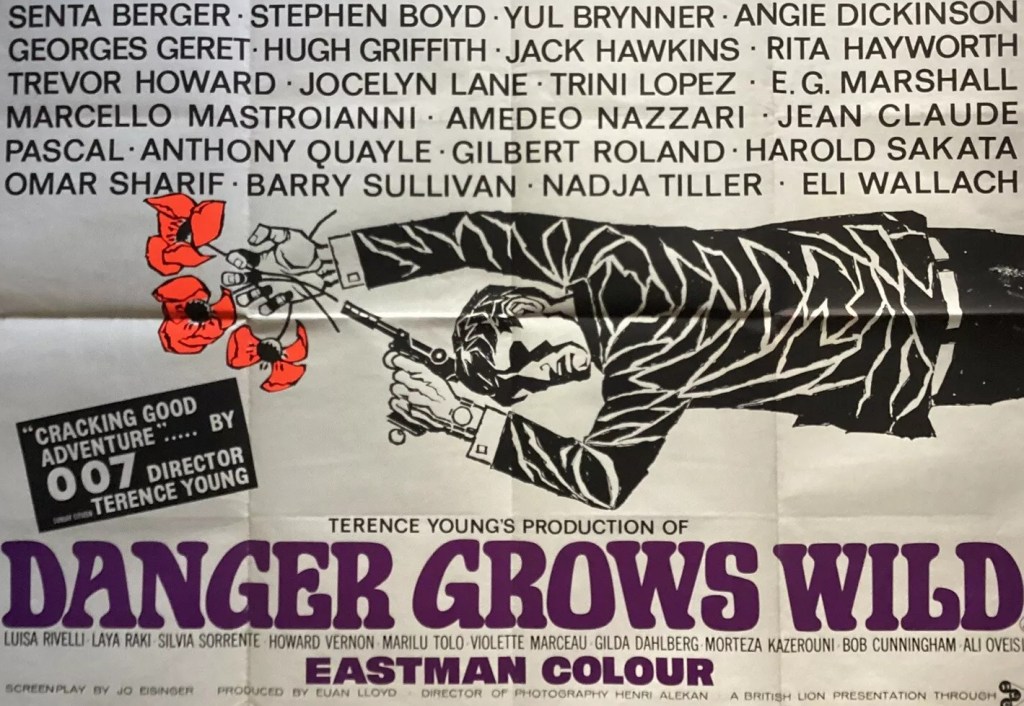
Benson (Stephen Boyd) heads up an infiltration operation targeting drug suppliers in Iran, where poppies “grow wild as weeds.” Though quickly bumped off, and the goods he’s purchased stolen, he’s replaced by Col Salem (Yul Brynner) who has the Bond-esque notion of enriching the opium with radiation and then tracing it using Geiger counters.

When that scheme fails, it’s down to agents Sam Lincoln (Trevor Howard) and Coley Jones (E.G. Marshall) to hunt down the drugs. Considering themselves unlikely lotharios, they compete over women and play a neat game of stone-scissors-paper to decide who is assigned which task, varying from chatting up Linda (Angie Dickinson), the gorgeous widow of Benson, or searching her room. Linda isn’t all she seems, not least she may not be a widow, carries a gun, and turns up in too many unsavory dives to be on the side of the angels.

Given drug-dealing was not the rampant business it later became, audiences might not be so shocked to discover that opium was transported by cargo ship and refined in Naples before being shipped all over the world. Possibly as interesting is the use of ancetic anhydride in the refining process. As Sam and Coley trudge across half of Europe, from Naples to Geneva to Nice, the audience is filled in on the details of the drug business and they latch on to a Mr Big, Serge Marko (Gilbert Roland).
There’s a hard realism about the project – though not to the levels of The French Connection (1971) -: nightclub dancer needing make-up to hide the tracks on her arms; Marko’s wife (Rita Hayward) stoned out of her skull; director Terence Young (Dr No, 1962) pulling a fast one Hitchcock-style in killing off Sam; and, despite a climax which sees Coley collar Marko, it ends with a pessimistic air – “someone else to take his place.” There’s a good fistfight on a train, and you’ll have guessed what Linda is up to. But there’s an odd softer centre, the movie taking a couple of breaks to highlight the singing of Trini Lopez and female wrestlers.

Before virtue-signalling was invented this was a do-gooder movie, the cameo players signing up for a buck, Grace Kelly on hand for the introduction. These days it stands as an almighty alarm that was scarcely heeded, not as the drug-fuelled counter-culture was about to burst onto the world, and with middle-class drop-outs championing the illicit there was little chance of the warning being heeded.

More like The Longest Day (1962) than Lawrence of Arabia (1962) in its use of the all-star cast. Still manages to make its points with the least amount of lecturing and hectoring.

Terence Young comes into his own in the action highpoints. Written by Jo Eiseinger (Oscar Wilde, 1960) and Jack Davies (Gambit, 1966) from an idea by Ian Fleming.

The Oscar (1966) ****

Don’t you just love a really good bad movie? Where redemptive character is outlawed. When over-acting is the key. In which everyone gets the chance to spout off about someone else, generally to their face, and then is permitted, in the cause of balance, a quiet moment of bitter self-reflection. And even the most minor character gets a zinger of a line. Welcome to Hollywood.

Tale of an actor’s rise and not exactly fall because we leave Frank Fane (Stephen Boyd) at a pinnacle of his career, though, don’t you know, he’s empty inside and deserted by all his faithful companions. Lucky Frank has some kind of charisma or that he just fastens onto losers who see in him what they need because from the outset he is one mean hombre, living off stripper girlfriend Laurel (Jill St John), so dumb she switched to him from his so dependable best pal Hymie (Tony Bennett – yes, that Tony Bennett, the singer).

He hooks up with Kay (Elke Sommer), a designer who happens as a sideline to make costumes for off-Broadway productions. When King of Lowlife Punks Frank shows a pusillanimous stage actor what you do in a knife fight he strikes a chord with theater producer Sophie (Eleanor Parker), who happens to have a sideline as a talent scout for the movies.

She fixes him up with an agent Kappy (Milton Berle – yes that Milton Berle, the loudmouth comedian) and together they sell him to studio boss Regan (Joseph Cotten). The only good deed Frank does in the entire movie is to stand witness – not for marriage, but for divorce – for an ordinary couple, private detective Barney (Ernest Borgnine) and Trina (Edie Adams), he meets at a bullfight, huge fans, and thank goodness that action comes back to bite him.

The picture goes haywire in the third act. Fane’s career is crumbling in the face of audience indifference, exhibitor displeasure and, don’t you know it, a chance for revenge for Regan, who was stiffed in a previous contract. But instead of taking the traditional tumble into the forgotten category, his career is revived by an Oscar nomination.

From top to bottom – a fully-clothed Stephen Boyd, then in various states of undress, Elke Sommer, Jill St John and Eleanor Parker. That’s how to sell a picture apparently.

But that’s not enough for the ruthless Fane. Earlier in his life a corrupt sheriff had stuck him with charges of pimping. Using Barney, who seems to have the ear of the media, he plants a story about himself, hoping that Hollywood being the cesspool it is, everyone will assume one of his rivals did the dirty. “I can’t rig the votes,” rationalizes our poor hero,”  but I can rig the emotions of the voters.”

What a scam. I was chortling all the way through this section and almost laughing out loud when it transpires Frank had misjudged how deep the cesspool is, because Barney then blackmails him. This gives everyone he has treated heinously over the years the chance to stick it to him. Nobody will lend him the dough to get this grinning monkey off his back. Salvation comes in the oldest of Hollywood maneuvers. Trina, who has always wanted to get into pictures, and is the kind of person who embodies A Grievance Too Far, supplies the information that will sink her ex-husband, in exchange for Frank using his influence to get her a small role.

There’s a brilliant climax. I should have said spoilers abound but I can’t resist telling you the ending it’s such a cracker. So there is Frank at the Oscars with Bob Hope (yes, that Bob Hope) as master of ceremonies and the audience studded with real stars like Frank Sinatra (yes, that…). Like an evil chorus – you can almost hear them hissing under their breath and they all fix him with baleful looks – are all those he treated badly.

The winner is announced. “Frank…” Assuming victory, Fane gets to his feet. “Sinatra.” The only way he can rescue his embarrassment is to make it look as he is giving the winner a standing ovation. But when the rest of the audience follows suit, he slumps to his chair, and in the only true cinematic moment in all the sturm and drang the camera pulls back from him sitting bitter, twisted and defeated in his seat.

Stephen Boyd (Shalako, 1969) is terrific because even when he was top-billed he tended to over-act and when he became a co-star or supporting player he was an inveterate scene-stealer, of the sharp intake of breath / vicious tongued variety. Here he shows both his charming and venomous side. If he was playing a gangster he couldn’t be more menacing – or charismatic. It’s a peach of a role – he can dish it out, dump women at will, and still embrace victimhood as “170lb of meat.”

Luckily, most of the rest of the cast take the subtle route. Although all disporting in various negligible outfits at one time or another, Jill St John (The Liquidator, 1965), Elke Sommer (The Prize, 1963) and Eleanor Parker (Eye of the Cat, 1969) and giving Frank his comeuppance wherever possible – St John slings him out – the performances are generally nuanced, Parker in particular evoking sympathy.

Tony Bennett is miscast, especially as he has to do double duty as an unwelcome voice-over, filling in bits of the narrative that, thankfully, has been skipped. But Milton Berle is pretty good as  a quiet-spoken agent.

In the over-the-top stakes, Boyd has his work cut out to hold his own in scenes with Ernest Borgnine (The Wild Bunch, 1969) who revels in his scam, and Edie Adams (The Honey Pot, 1967) who is anything but a dumb blonde and delivers the most stinging of zingers.

Doesn’t tell us anything we didn’t know about Hollywood except in one delicious scene where, early in his career, Frank has to squire around a female star who relishes putting him in his place.

It’s not badly made just pell-mell and over-the-top. Russell Rouse (The Caper of the Golden Bulls, 1967) directs from a screenplay by himself and Harlan Ellison (yes that Harlan Ellison, the sci fi author) from the bestseller by Robert Sale.

An absolute hoot.   

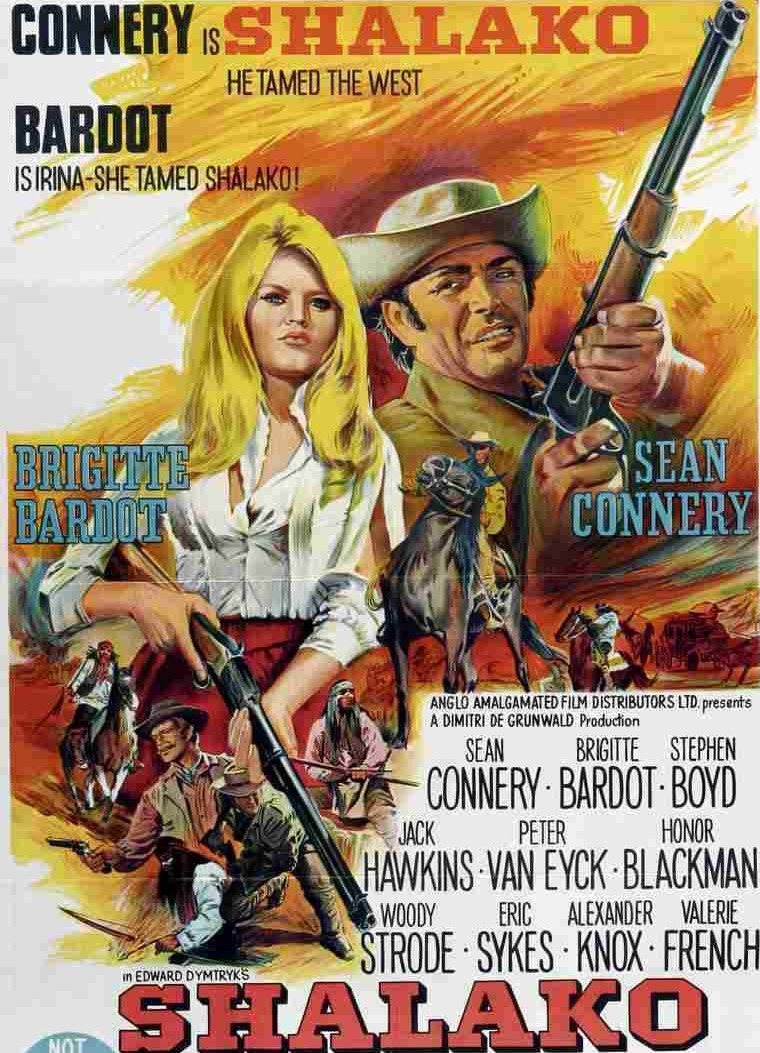
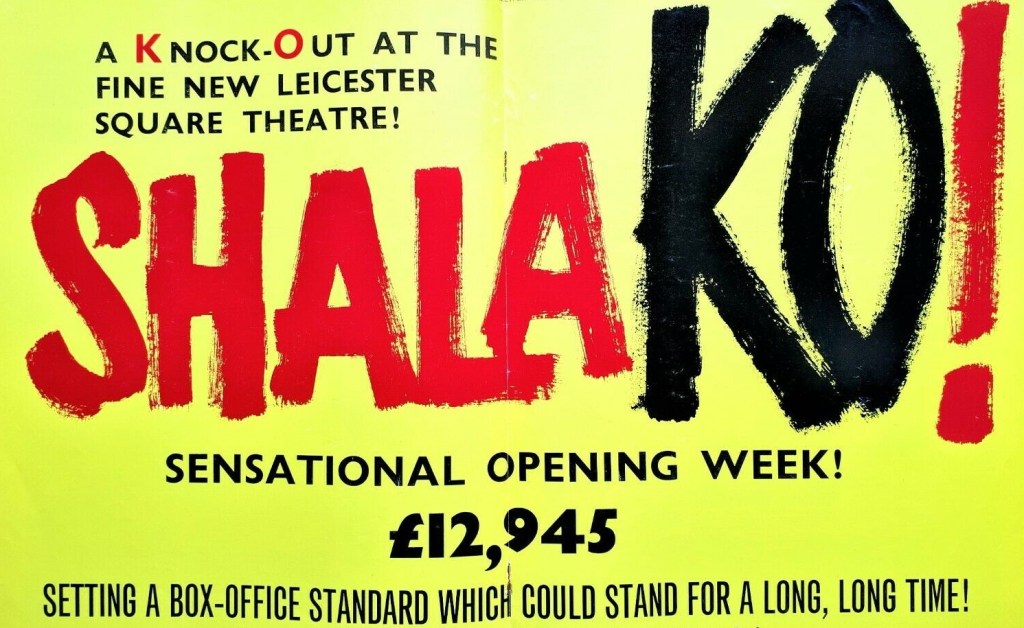
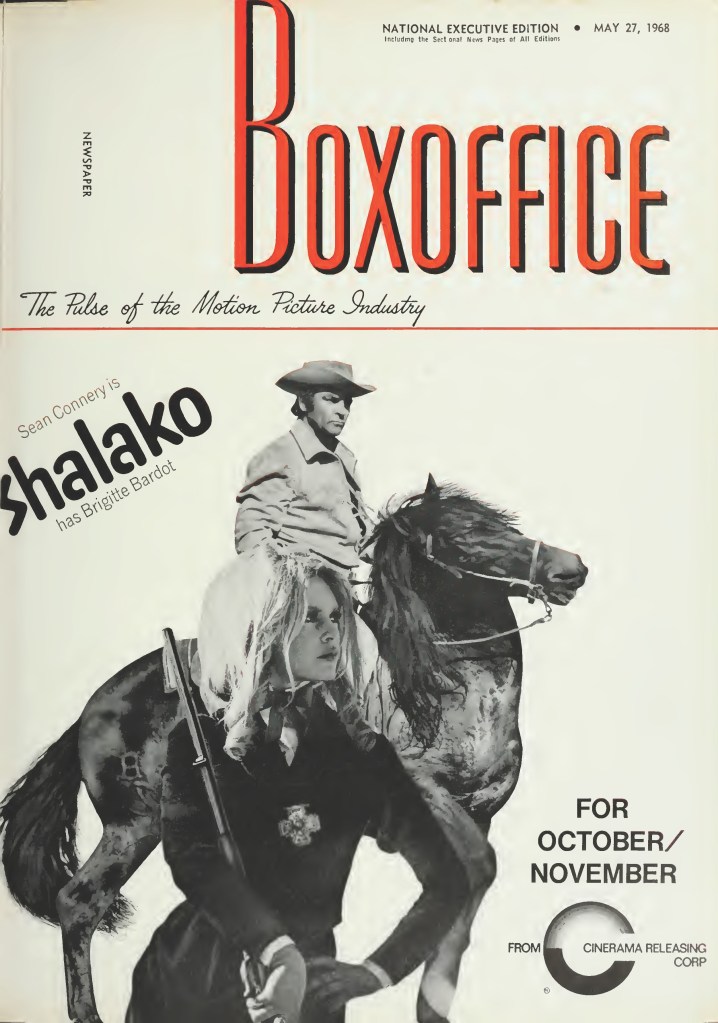
Shalako (1968) ***

It’s a gripping and unusual opening. The jangling noise of metal beating upon metal. A trapped mountain lion surrounded by a posse of unkempt men. The beast driven into a killing zone. The camera ends up on a classy blonde in a top hat, Irina (Brigitte Bardot), drawing a bead on the animal. But as she shoots so does rugged cowboy Bosky (Stephen Boyd) and you can be sure his aim is more deadly. It wouldn’t do to have an upper-class European lady to be mauled to death by a vicious creature just because her ego got the better of her.

Except that’s not the opening. Instead, that’s sacrificed for a dumb theme tune and a few minutes over the credits watching titular hero Shalako (Sean Connery) doing what exactly? Nothing exciting that for sure. We see him riding I guess to prove he can sit as tall in the saddle as the stars of the genre like Alan Ladd, John Wayne, Gary Cooper, James Stewart, as if nobody expected James Bond to be able to complete such a transition. There’s a bit of waking up, more riding, drinking from a dirty stream, and more riding while composer Jim Dale struggles to find lyrics that rhyme with Shalako.

There’s a bit more exposition before Shalako does anything meaningful. We are introduced to a fistful of Europeans on a hunting party complete with butler (Eric Sykes) and guzzling champagne and escorted by a bunch of mean-looking cowboys looking on in envy though I doubt any would acquire a taste for champagne.

Then the real action starts. A bit’s been missed out explaining just why Irina took off on her own with just one man as escort to continue hunting and nobody thought fit to warn her this was Apache country. We know she’s in trouble because her escort is just about dead and Apaches are gathering. Enter Shalako to save the day. The first piece of dialogue between the most handsome man in the world and the screen’s most beautiful woman, a movie made just so Connery, at his Bond peak, and Bardot, in her most expensive picture, could strike sparks off each other,  is hardly something to treasure. It’s almost priceless for its mundanity. “You all right?” grunts Shalako. “Yes,” replies the breathless heroine.

But trust the British to bring that epitome of British moviemaking, the class war, to that most democratic of movie species, the western. It’s ironic that in the country where freedom is a given  – slavery long since abolished in the period this movie was set – members of the hunting party are fettered. Irina is little more than bait. You might as well have staked her out, hoping to snare German aristocrat von Hallstatt (Peter van Eyck). Marriage would cure the financial woes of her debt-ridden sister Lady Daggett (Honor Blackman) and husband Sir Charles (Jack Jawkins). Von Hallstatt doesn’t believe in making romantic overtures, it would be, like so many aristocratic marriages, a contract of convenience; he acquires beauty, she gets wealth.

To complicate matters Lady Daggett has a roving eye which has settled on Bosky, and to complicate matters even further, nobody should be firing rifles, even if only for sport, in Apache territory. It’s not long before the Apaches take umbrage and launch an attack. And it takes even less time for Bosky and his buddies to take off, leaving their charges poorly defended in a makeshift fort.

It takes way too long to sort out all these plot machinations and get to the meat of the story which is finding a way of putting Connery and Bardot together and when they are not the movie trundles along without much in the way of screen sparks. It could have done with an entirely different scenario. Something akin to Soldier Blue (1970) would have worked a treat, with roles reversed of course back to the traditional of experienced male tending the inexperienced female as they battle through enemy territory.

You needed to get this pair together – and quick – for the movie to find any steam at all. As it is, it’s somewhat laborious. While the action sequences are well done and Shalako scores in the western lore department, you wouldn’t have thought a mountaineering subplot could have produced so few thrills, its only purpose, plot-wise, to ensure that von Hallstatt acquires some credibility (he’s the mountaineer) and that the group can reach a plateau whose main attraction, as lovers of westerns will already be aware, is a pool where in the great Hollywood tradition a woman can disport herself half-naked. Shalako, in sneaking up on her, comes across like a bit of a peeping tom.

Sean Connery (The Hill, 1965) is convincing enough as a cowboy. He certainly doesn’t look out of place on a horse but it takes far too long for the expected romance to begin. Brigitte Bardot (Viva Maria!, 1965) is better than you might expect as a sharpshooter, but not quite in the fiery class of a Claudia Cardinale (The Professionals, 1966) or even Maureen O’Hara (The Rare Breed, 1965) and she’s not really given the dialog necessary to fully establish the independence of her character.

Director Edward Dmytryk (Mirage, 1965) does his best with an overly-complicated script and some cumbersome set-pieces and it would have worked far better if a few characters and reams of sub-plot had been chucked aside to bring the stars together quicker. While Connery does the riding and shooting well enough he lacks the grizzled lived-in face of his famed western predecessors and I get a sense of him trying too hard. And, as I said, it wouldn’t have taken much to pep up Bardot.

Having complained about the subsidiary characters, they are all well-drawn. Stephen Boyd (The Big Gamble, 1961) makes on helluva mean cowboy, Honor Blackman (Moment to Moment, 1966) is excellent as a predatory female. Aristocratic pair Peter van Eyck (Station Six Sahara, 1963) and Jack Hawkins (Masquerade, 1965) are the kind of actors who can denote fallen status with facial expression rather than requiring lumps of dialog. But Eric Sykes (The Plank, 1967) is really a British in-joke.

James Griffith and screenwriting partner Hal Hopper had previously worked on Russ Meyer epics like Lorna (1965). The original story came from  a novel by Louis L’Amour (Catlow, 1971).

Out-with his guise as James Bond, Connery – excepting Robin and Marian (1976) and Cuba (1979) – was not one of the screen’s great lovers so this would have been the perfect chance  to hone those particular credentials. But like the entire picture this was a missed opportunity. When the best scene is the brutal suffocation of Honor Blackman and not the two stars canoodling, you can see the target was missed by miles.

Genghis Khan (1965) ****

Hollywood was never reined in by the strictures of history, much preferring fiction to fact for dramatic effect, and that’s largely the case here, although the titular hero’s real life remains shrouded in myth.

If you do catch this surprisingly good feature, make sure it’s not one of the many pan-and-scan atrocities on the market. I watched this in the proper Panavision ratio which meant it occupied only one-third of my television screen, but in that format it’s terrific. It’s a bit of an anomaly for a decade that churned out high-class historical epics like El Cid (1961) because this clocks in about a hour short of other films in the genre and there’s no star actor or director to speak of and no Yakima Canutt to handle the second unit action scenes.

Omar Sharif’s marquee value at this point was so low that if you check out any of the original posters you’ll note that his name hardly rates a mention and he also comes at the very end of the opening screen credits. Although this is post-Lawrence of Arabia (1962), it’s pre-Doctor Zhivago (1965), suggesting nobody had a clue how to market his talents.

Director Henry Levin was a journeyman, fifty films under his belt, best known for not a great deal except for, following this, the second and third in the Matt Helm spy series. Given this film was critically ignored on release and since, and a flop to boot, it definitely falls into the “Worth a Look” category. Although there are few stand-out scenes of the artistic variety such as pepper Lawrence of Arabia or El Cid, this is still well put together and Levin shows an aptness for the widescreen.

The narrative breaks down into three parts – the first section describing enslavement of Genghis Khan (Omar Sharif) by nemesis Jamuga (Stephen Boyd – the picture’s star according to poster and screen credits) – before banding together rival tribes in revolt; the second part a long trek to China; and the third encompassing a final battle and hand-to-hand combat with Jamuga. For a two-hour picture it has tremendous sweep, not just the scenery and the battle scenes, but political intrigue, romance, a rape scene and even clever comedy. Genghis Khan  believes his glory is predestined, but he has very modern ideas about the role of women.

The best section, oddly enough, is set in China where Genghis engages in a duel of wits with the distinctively contradictory Emperor (Robert Morley), but that’s not to detract from the film’s other qualities, the action brilliantly handled, especially the chaos of battle, the romance touching, and the dialog intelligent and often epigrammatic.

Unlike James Mason (Age of Consent, 1969) who makes a calamitous attempt at a Chinese accent, Robert Morley (Some Girls Do, 1969), costume apart and looking as if he has just walked out of an English country house, but his plummy tones belie a very believable character. Stephen Boyd (Assignment K, 1968) shines as the villain of the piece. Telly Savalas (Battle of the Bulge, 1965) and Woody Strode (The Professionals, 1966) have decent parts as Khan’s s sidekicks, the former unexpectedly bearing the brunt of the film’s comedy. French actress Francoise Dorleac (Billion Dollar Brain, 1967) is effective as Sharif’s wife.

Hitchcock stole one of his most famous ideas from Genghis Khan. About the only scene in Torn Curtain (1966) to receive universal praise was a killing carried out to a soundtrack of nothing more than the grunts of assailant and victim. But, here, where the score by Yugoslavian composer Dusan Radic was extensively employed, the rape scene is silent and just as stunning. If the only prints widely available are of the pan-and-scan variety I’m not surprised the film has been for so long overlooked, but if you can get hold of one in the preferred format you will be in for a surprise.      

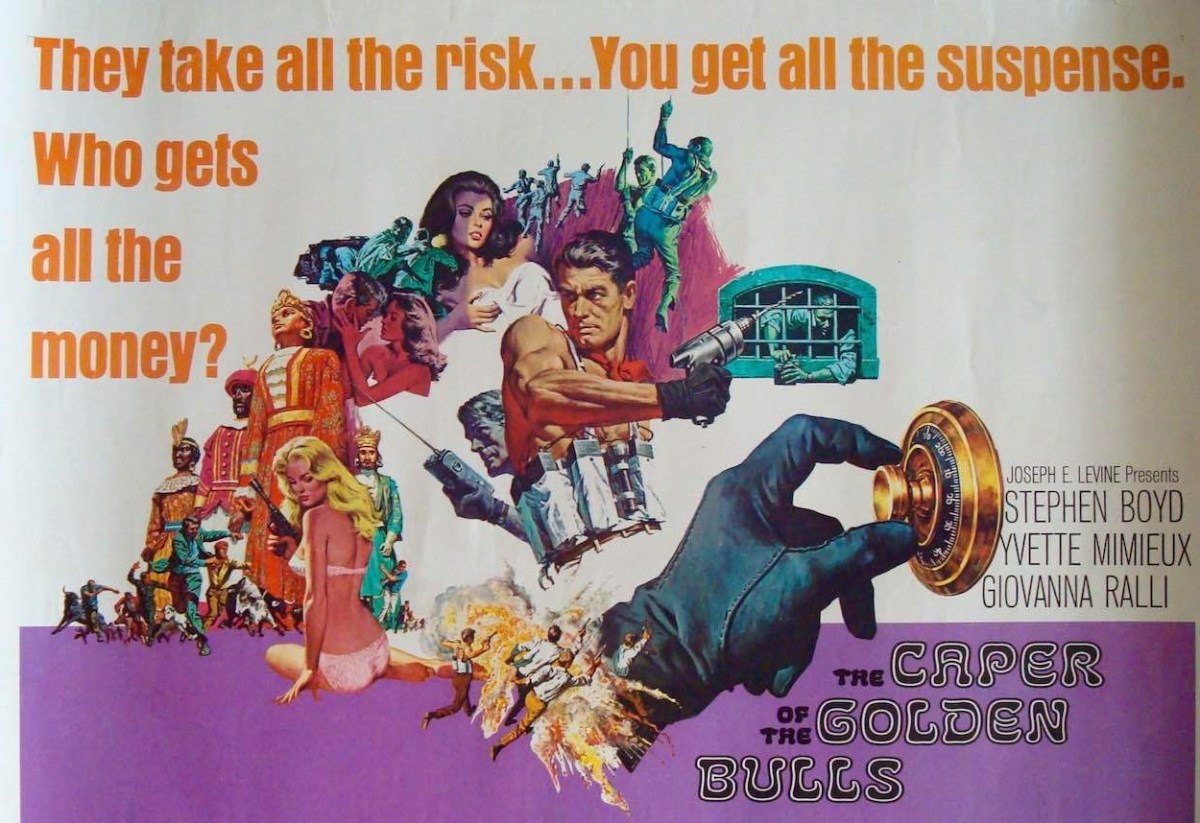
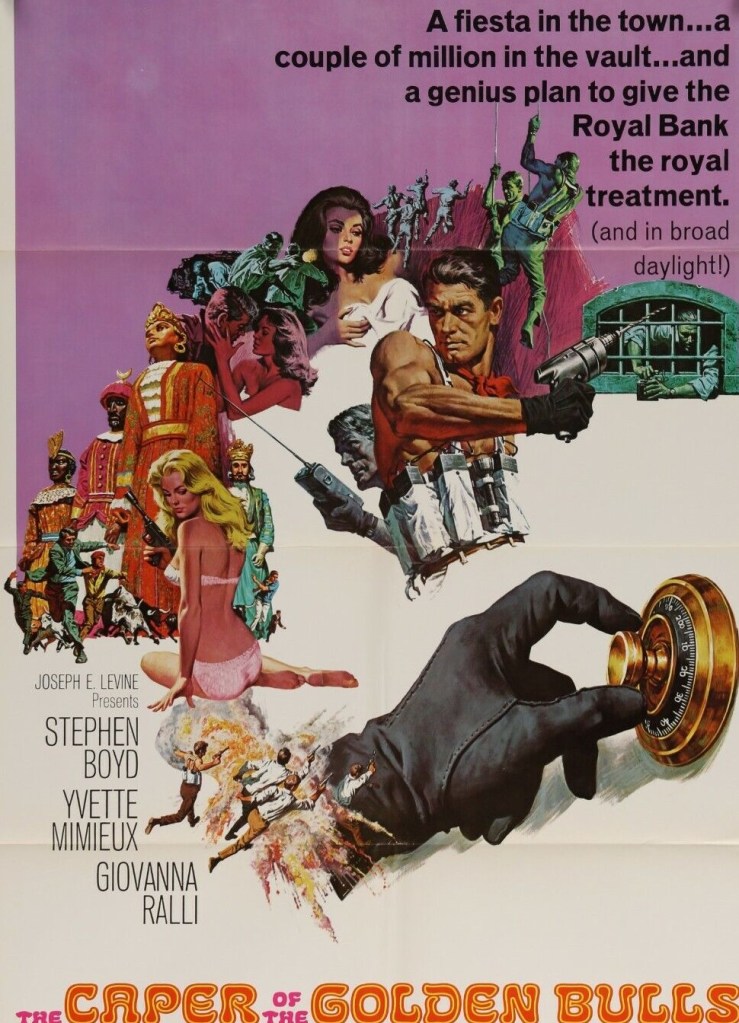
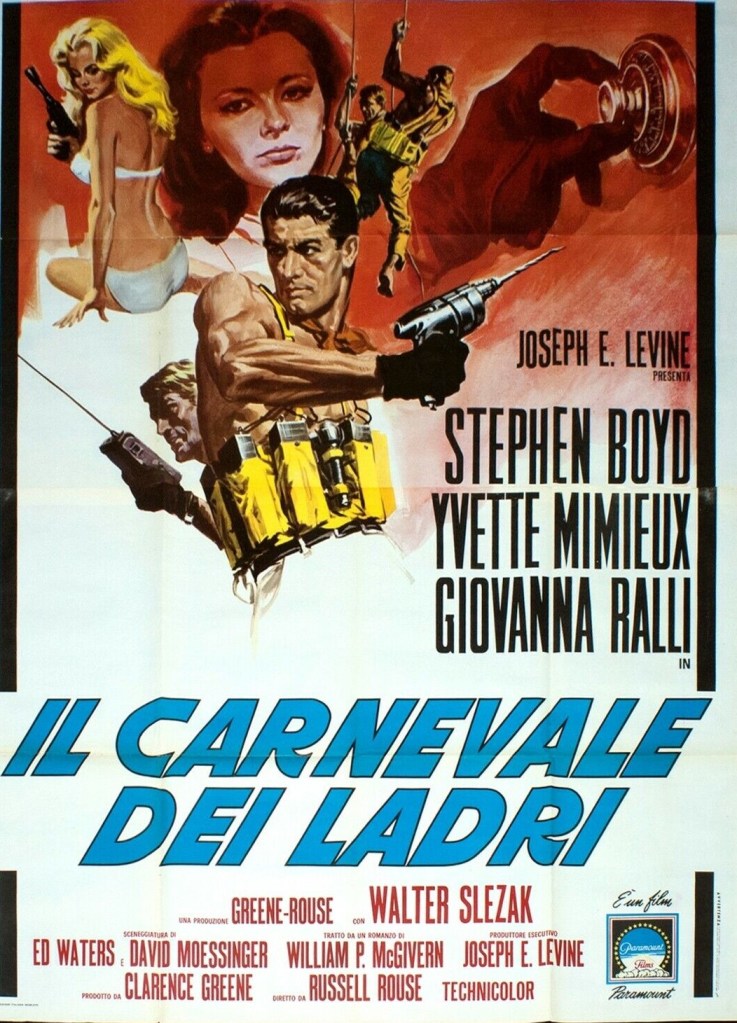
The Caper of the Golden Bulls / Carnival of Thieves (1967) ***

Just to be clear. Nobody is stealing a golden bull, though the annual running of the bulls in Pamplona in Spain is a plot element. No, this gang, led by former bank-robber Churchman (Stephen Boyd) is only going to break into an impregnable bank (par for the course) and steal priceless royal jewels.

There’s an audacious, certainly unorthodox, plan, tension throughout between Churchman’s  sexy former lover Angela (Giovanna Ralli) and current more demure squeeze Grace (Yvette Mimieux), a couple of unexpected comedy sequences, a silent heist and a superb final twist.

Just to be clear – there’s no bikini blonde with a pistol.

Churchman is not your ordinary robber. He only hit banks to make reparation for, while a World War Two pilot, mistakenly dropping bombs on a French cathedral, donating the loot to the reconstruction. Angela, with no such ideals, has spent her share of the dosh and intent on a financial top-up  blackmails Churchman, now a respected businessman, into the one-final-caper scenario.  

Key to getting the jewels out is becoming involved in the annual fiesta, of which the bull-running is a minor part. The bull-running, too, shifts the dynamic of the job, and what appears an irrelevant sub-plot of former resistance fighters hunting a traitor provides an essential pay-off.

When moral Grace uncovers the plot she is inveigled to participate, ensuring some spicy bitchy dialog between herself and the more obviously immoral Angela.  Unwittingly helping out is Spanish cop (Walter Slezak) and with Churchman committed the only person Angela needs use her wiles on is a giant, friendlier by the minute as he responds to her seductive smiles.

While this lacks the panache, guile or gloss of a Topkapi (1964) or Gambit (1966), it’s certainly well-done enough. It’s one of those films you appreciate more after you’ve watched it than during, the structure of the screenplay most of all, as all the little pieces of a finely-tuned jigsaw lock into place.

There’s a couple of excellent reversals, an ambush where firecrackers pass for bullets, imminent discovery of explosives thwarted by a quick-thinking Grace, and some split-second timing.  Explosives, timed to match the firing of a cannon, allow a bystander cop to remark, “that cannon gets louder every time.” At first the fiesta appears standard time-filling tourist-fodder but both the parade and the bull-running are allocated genuine spots in the narrative.

The sensuous, devious Giovanna Ralli (Deadfall, 1968) is the pick, a femme fatale straight out of film noir, with a knowing twist in her main seduction scene. Fans of Stephen Boyd (Assignment K, 1968) will enjoy seeing him dally with conscience rather than rely on a straight down the line hardman, albeit with more than an ounce of charm. What Yvette Mimieux (Dark of the Sun, 1968) ultimately brings to the occasion is hidden until the end so her character has more depth than initially surmised.

There was a sense here, though, of three stars still trying to make their mark on Hollywood, establishing their marquee credentials. Although Boyd had enjoyed box office success in Fantastic Voyage (1966) and The Bible (1966) he was not seen as the main element in those film’s hitting the target. Other films relying on his star potential to pull in an audience had flopped.

Outside possibly of Disney confection Monkeys, Go Home! (1967) and The Time Machine (1960) Yvette Mimieux had yet to enjoy a proper hit. Giovanna Ralli was the latest in a string of European imports, a low-level gamble since they were cheaper than Hollywood alternatives even though most never made the grade or did so only fleetingly.

You wouldn’t pick this picture to put either of the trio back on the very top since for the sake of later twists the screenplay plays around with motivation and the very lack of gloss limits the movie’s potential. But although we’ve seen much of this before, it’s still suspenseful enough.

Russell Rouse (A House Is Not A Home, 1964) directs from a screenplay by David Moessinger (Number One, 1969) and Ed Waters, who had form in this area with Man-Trap (1961).

An engrossing enough matinee.

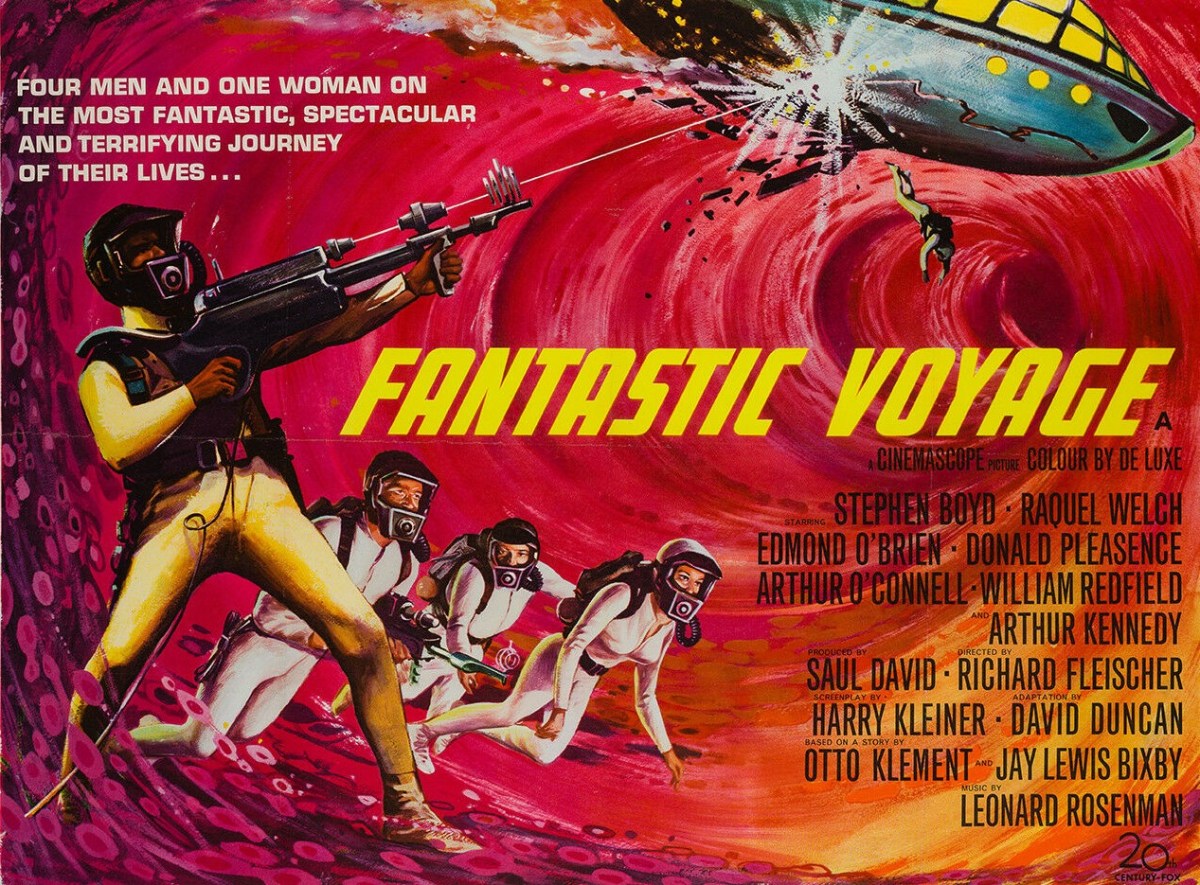
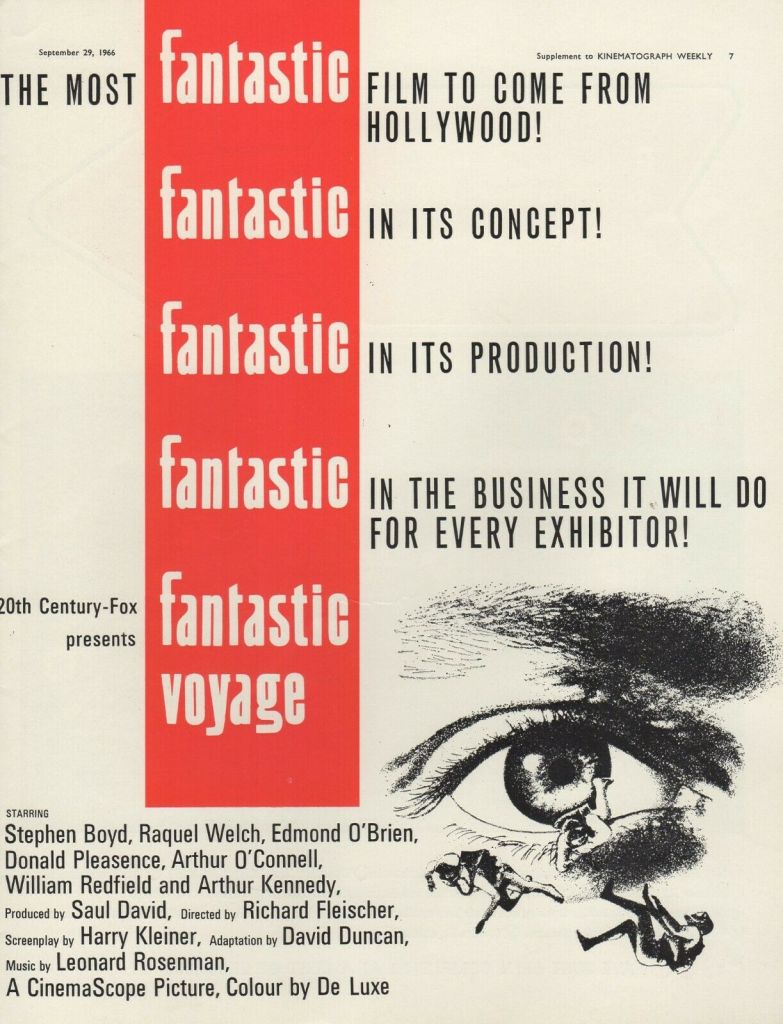
Fantastic Voyage (1966) ****

If this had appeared a couple of years later after Stanley Kubrick had popularised the psychedelic in 2001: A Space Odyssey (1968), and with his budget, it might have been a bigger hit. As it is, the ground-breaking sci-fi adventure, going in the opposite direction from Kubrick, exploring the mysteries of the body rather than the universe, is a riveting watch.  

Before we even get to the science fiction, there’s a stunning opening 15 minutes or so, a thriller tour de force, the attempted assassination of scientist Dr Jan Bedes (Jean Del Val), vital to the development of embryonic new miniaturization technology, baffled C.I.A. agent Charles Grant (Stephen Boyd) transported to a futuristic building (electronic buggies, photo ID) where he is seconded to a team planning invasive surgery, entering the scientist’s bloodstream and removing a blood clot from his brain. They only have 60 minutes and there’s a saboteur on board.

Heading the mission are claustrophobic circulation specialist Dr Michaels (Donald Pleasance), brain surgeon Dr Peter Duval (Arthur Kennedy) and lovelorn assistant Cora (Raquel Welch). Backing them are up Captain Bill Owens (William Redfield) who designed the Proteus submarine.  

The high concept is brilliantly delivered with ingenious improvisations, of the kind we have come to expect from the likes of Apollo 13 (1995) and The Martian (2015) that save the day. I’ve no idea how accurate the anatomical science was but it sounded very convincing to me. There’s a brilliant sequence when the scientist’s heart is slowed down and the heartbeat is reduced to a low thump but when the heart is reactivated the sub literally jumps.

The bloodstream current proves far stronger than imagined, taking them away from their planned route. After unexpectedly losing air, they need to literally suck air in from the scientist’s body. Swarms of antibodies attack. Claustrophobia and sabotage up the ante, not to mention the anxious team overseeing the operation in the control room, the minutes ticking by.

It’s not a fantastic voyage but a fantastic planet, the visualisation of the human interior – at a time when nobody could call on CGI – is as fascinating as Kubrick’s meditations on outer space. They could have landed on a distant planet judging by what look like rock formations. It’s wondrous. Sometimes the world takes on a psychedelic tone. The special effects rarely fail, the worse that occurs is an occasional flaw in a process shot, and a couple of times the actors have to fall back on the old device of throwing themselves around to make it look like the vessel was rocking.  The craft itself is impressive and all the gloop and jelly seems realistic. There’s a gripping climax, another dash of improvisation.

The only problem is the characters who seem stuck in a cliché, Grant the action man, Duval blending science with God, Michaels the claustrophobic, an occasional clash of personality. But given so much scientific exposition, there’s little time for meaningful dialogue and most of the time the actors do little more than express feelings with reaction shots. Interestingly enough, Raquel Welch (Lady in Cement, 1968) holds her own. In fact, she is often the only one to show depth. When the process begins, she is nervous, and the glances she gives at Duval reveal her feelings for him. It’s one of the few films in which she remains covered up, although possibly it was contractual that she be seen in something tight-fitting, in this case a white jump suit.

If you are going to cast a film with strong screen personalities you couldn’t do worse than the group assembled. Stephen Boyd (Assignment K, 1968), five-time Oscar nominee Arthur Kennedy (Nevada Smith, 1966) ), Donald Pleasance (The Great Escape, 1963), Edmond O’Brien (Rio Conchos, 1964) and William Redfield (Duel at Diablo, 1966) aren’t going to let you down.

But the biggest credit goes to Richard Fleischer (The Big Gamble, 1961, which starred Boyd) and his Oscar-winning special effects and art direction teams. While not indulging in wonder in the way of Kubrick, Fleischer allows audiences time to navigate through the previously unseen human body simply by sticking to the story. There are plenty of set pieces and brilliant use of sound. Harry Kleiner (Bullitt, 1968) created the screenplay based on a story by Otto Klement and contrary to myth the only part Isaac Asimov played in the picture was to write the novelization.

A joy from start to finish with none of the artistic pretension of Kubrick. This made a profit on initial release, knocking up $5.5 million in domestic U.S. rentals against a budget of $5.1 million according to Twentieth century Fox expert Aubrey Solomon and would have made probably the same again overseas plus television sale.

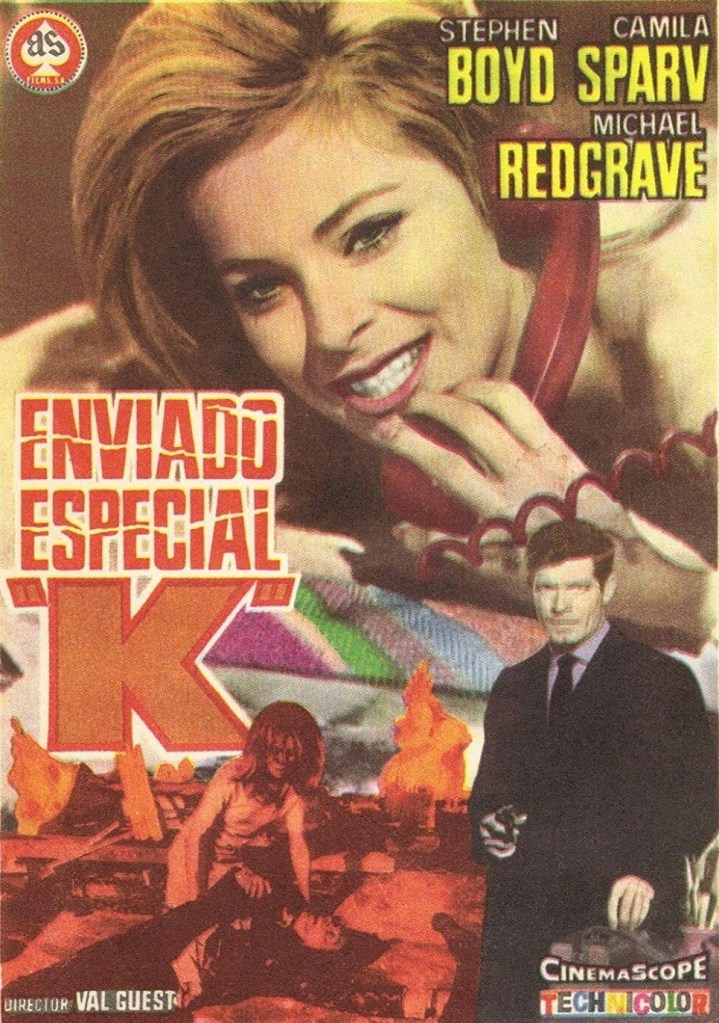
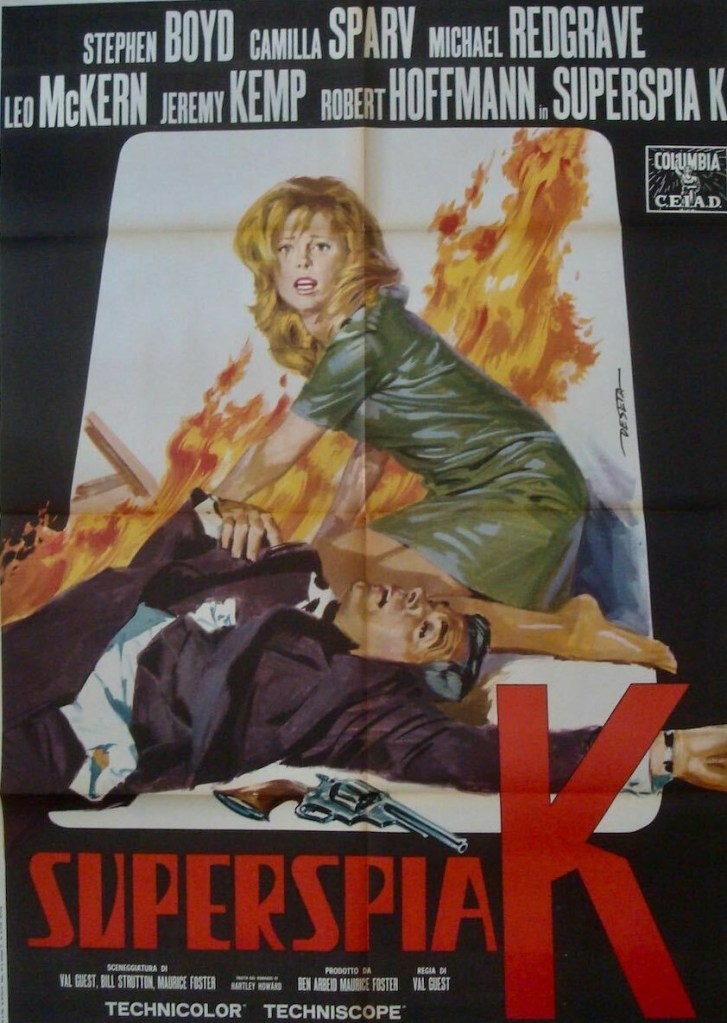
Assignment K (1968) ****

A good notch above the routine spy thriller, this deserves another look. By the mid-1960s the screen was awash with spies so other than trying to invent a new hero in the Matt Helm/Derek Flint vein or revamping older characters such as Bulldog Drummond  or sending up the entire genre in the style of Casino Royale (1967), it was difficult to find a fresh angle.

Assignment K does in some measure succeed, in part by going down the grimy  route of The Spy Who Came in from the Cold (1965), in part by stuffing the picture full of glorious scenery – the Austrian Alps – and in part by turning Stephen Boyd into the kind of spy who has begun to question the entire business. For reasons unspecified, former racing driver turned toy salesman Boyd (The Big Gamble, 1961) is running his own spy operation loosely linked into British intelligence but when the network is compromised his life and that of new love interest Camilla Sparv (Nobody Runs Forever/The High Commissioner, 1968) endangered. Things get trickier when she is kidnapped and he has to save her while not compromising his own agents.

There is enough mystery to keep the plot, uncoiling like Russian dolls, ticking along and the entire effort is underwritten by some decent tradecraft, dead letter drops, microfilm hidden inside cigarette filters and so on. Tension is surprisingly high. And Boyd is surprisingly human, falling properly in love for one thing, not just treating women in the James Bond/Matt Helm fashion as notches on a bedpost, not ice-cool under pressure either, face knotting in fury on occasion, and not so accomplished in the old fisticuffs department. There is less reliance on just sticking out his chin and looking handsome and this is a more assured performance than in The Big Gamble.

Michael Redgrave (The Hill, 1965), Leo McKern (Nobody Runs Forever) and a pre-Please, Sir John Alderton provide decent support though Jeremy Kemp (The Blue Max, 1966) is somewhat subdued. But Boyd is a revelation. Here, his screen charm and charisma are at their best and while he was never going to attract the attention of the Oscar fraternity is entirely believable as a spy coming to wonder at decisions taken.

Sparv, too, is much better than I have ever seen her. Unlike her turn in Murderers Row (1966), her role is not merely decorative and the unfolding romance would work perfectly well just as a love story never mind tucked away in the guise of a spy thriller. There is a lovely demonstration of her acting skill, although an odd one to describe, as she pulls on a bathrobe and shimmies out of the towel underneath; I can’t believe that was ever scripted, but if you watch it you will see what I mean.  Swedish Sparv was often viewed just as another of the decade’s ubiquitous European starlets but in fact she shows genuine acting ability.  

Director Val Guest was usually labelled a “journeyman” despite a repertoire that included The Quatermass Xperiment (1955) and its sequel, Yesterday’s Enemy (1959) and sci-fi The Day the Earth Caught Fire (1961) and he had previous form in this genre with Where the Spies Are (1966) which played more to the comedy gallery and did some work on Casino Royale to boot. Guest was also involved in the screenplay along with two first-timers Bill Strutton and Maurice Foster, the former primarily a television writer, the latter a producer. Guest’s work here falls into the efficient category, but it does zip along at the same time as allowing Boyd and Sparv to develop their characters and make their relationship believable. All in all quite enjoyable.

CATCH-UP: The Blog has reviewed Camilla Sparv in Dead Heat on a Merry-Go-Round (1966) Nobody Runs Forever/The High Commissioner (1968) and Downhill Racer (1969). Stephen Boyd pictures reviewed so far are The Big Gamble (1961), The Fall of the Roman Empire (1964) and The Third Secret (1964).

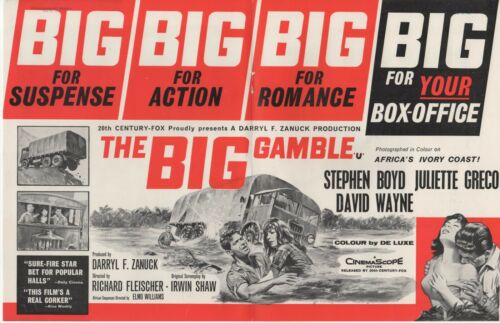
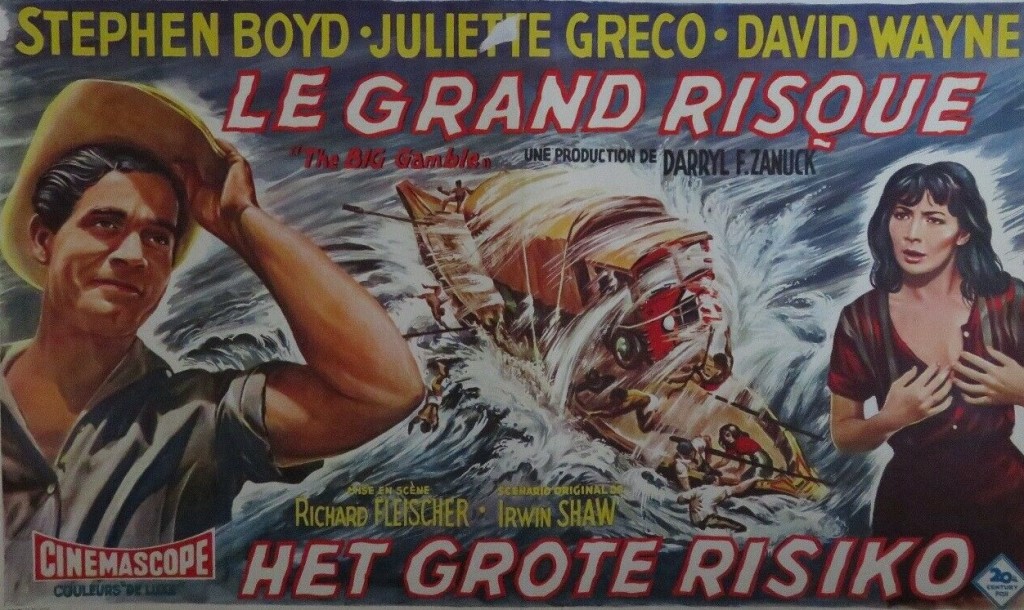
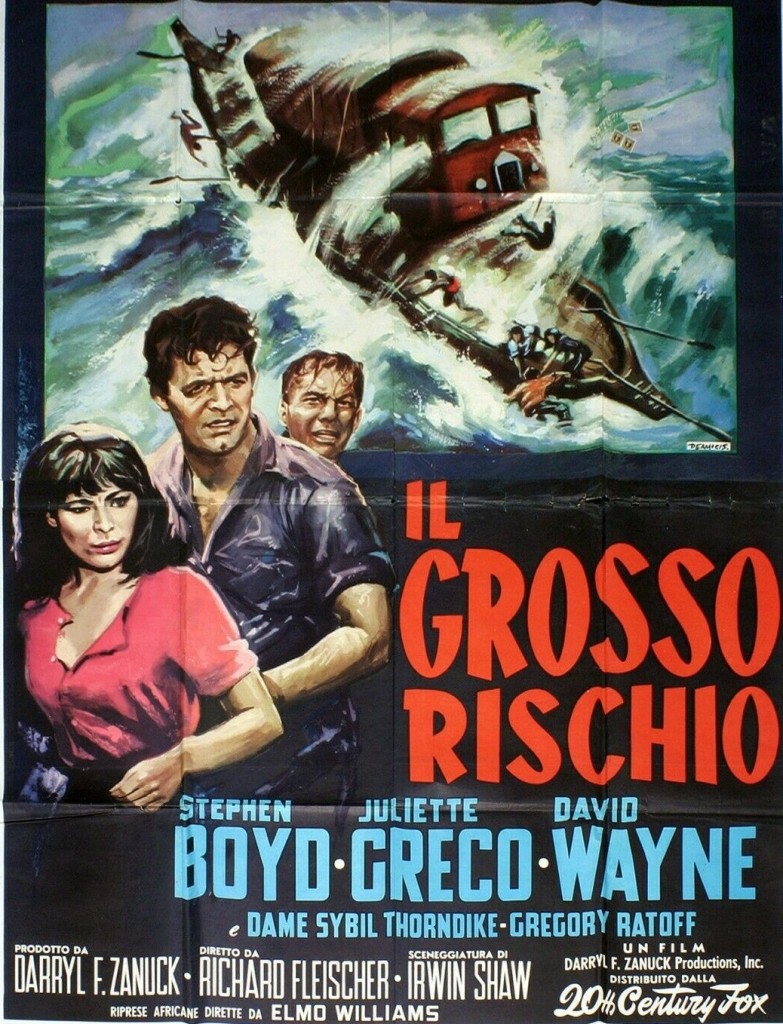
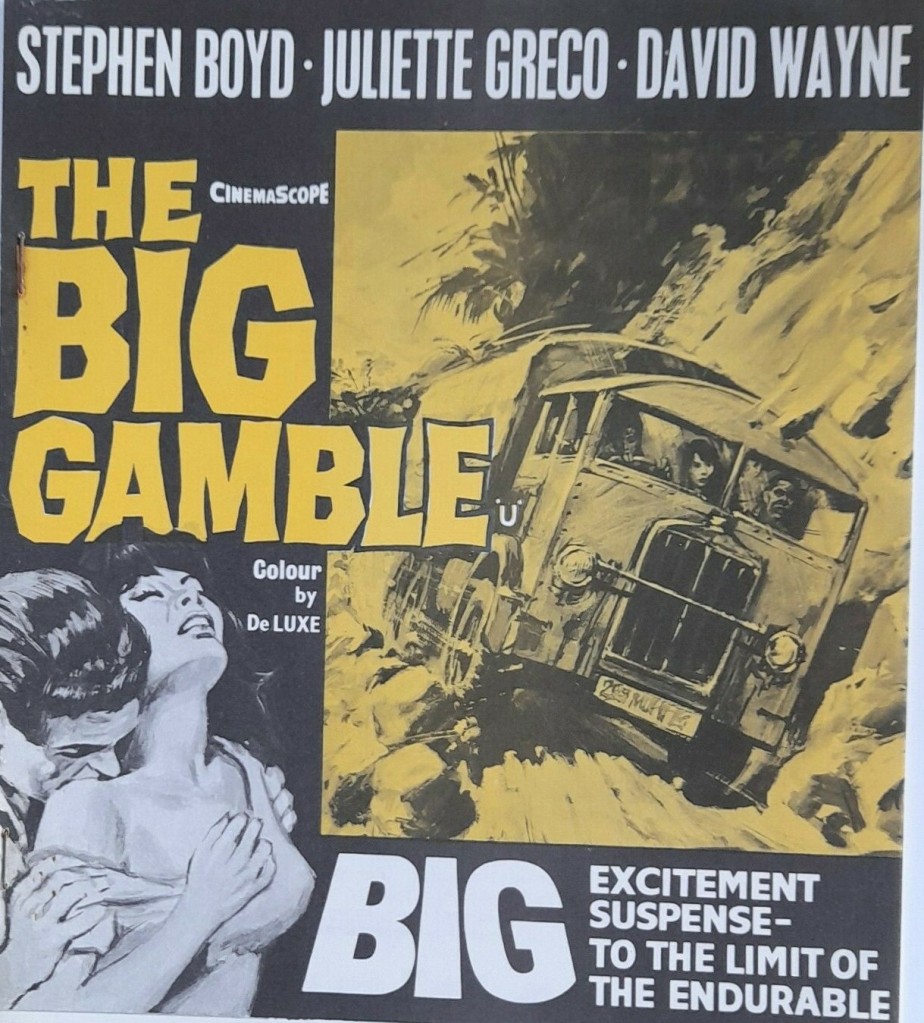
The Big Gamble (1961) ***

If only there had been some serious money put behind this picture it would have been an absolute cracker, custom-made for the likes of Cinerama which didn’t go down the dramatic route until a few years later. It’s a bit “Hell Drivers or Wages of Fear Goes to Africa” but with some really quite stunning sequences.

Whatever French chanteuse Juliette Greco (Crack in the Mirror, 1960) had to offer on stage and in a personal capacity – lovers included Miles Davis and this film’s producer Darryl F. Zanuck – never seemed to translate to the screen in this particular role and the most we get is a kind of tomboyish perkiness. It’s a medium-grade cast, the lead taken by Northern Irishman Stephen Boyd (here playing a Dubliner). David Wayne (The Three Faces of Eve, 1957) is the sad sack brother who joins the other two in a bold plan to set up a haulage business on the Ivory Coast in Africa.

The opening sequence demonstrates the dreary Irish life Boyd is trying to escape with a sparkling cameo from Sybil Thorndike (Shake Hands with the Devil, 1959) as the family matriarch before the African sequences kick in. Apart from scenes shot at Ardmore Studios in Bray, Ireland, the rest is clearly filmed on pretty dangerous locations if the unloading of a lorry onto what looks like little more than a large canoe is anything to go by. After an unpromising start, the intrepid trio (well, two are bold, Wayne is not) set off into the wilderness.

There are two edge-of-the-cliff sequences that would have The Italian Job fans frothing at the mouth, a runaway lorry in the best Cinerama tradition and an astonishing section crossing a swollen river where clearly the actors did their own stunts (and Boyd was in reality saved from drowning by his co-star). In between we have snippets of genuine Africa, especially canoeists braving the surf and an African funeral party. Emotionally, beyond Boyd sticking out his chin as much as possible, the main drama focuses on fraternal rivalry with Wayne trying to pull himself together in the face of a mission he believes doomed to failure.  Their plans are further hit by sabotage by the German Kaltenberg (Gregory Ratoff in his final role).

While some of the posters highlight the river crossing, others focus on the cliff-top sequences.

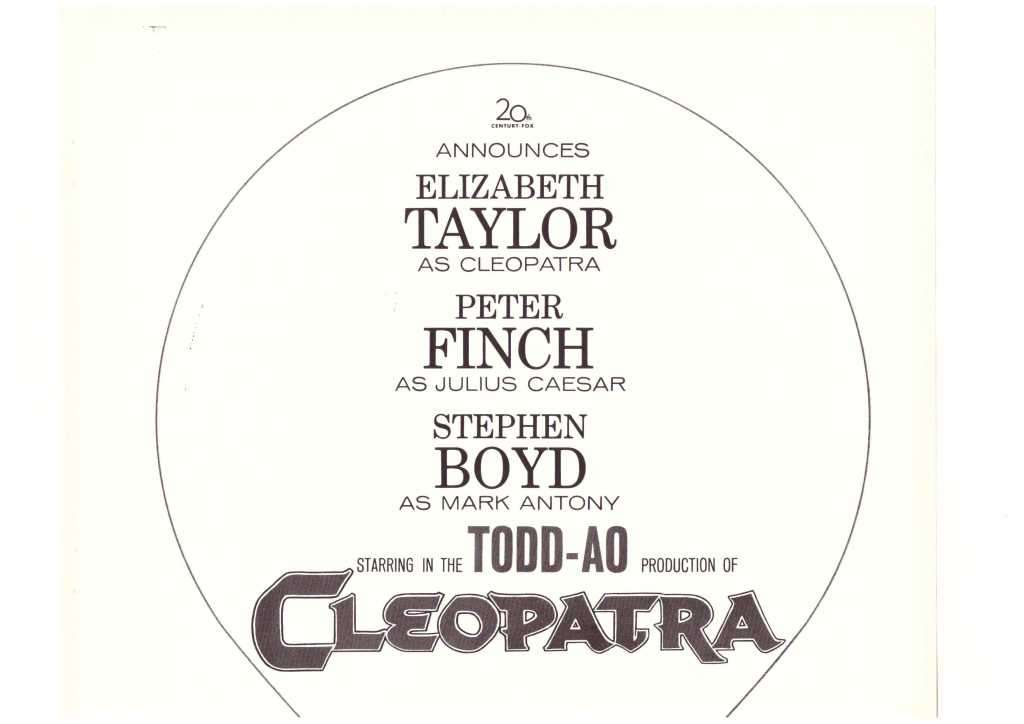
This was Boyd’s bid for stardom. Five years into a seven-year contract with Twentieth Century Fox, he had worked his way up the ranks at that studio to become male lead to top-billed females like Susan Hayward (A Woman Obsessed, 1959) and Hope Lange (The Best of Everything, 1959) before his career received a massive boost after a loan-out deal to MGM for Ben-Hur (1959). He might have been hotter yet had Fox not abandoned its first Rouben Mamoulian-directed version of Cleopatra in which he played Mark Anthony, a role that later brought Richard Burton worldwide fame and a new wife. Boyd would be hot at various times during his short-lived career (he died at 45) while equally never making the transition to major star.

One of the great Hollywood what-ifs – how would Boyd’s career have developed
if he had followed up “Ben-Hur” with “Cleopatra.”

Directed by the underrated Richard Fleischer, best known for 20,000 Leagues under the Sea (1954), Compulsion (1959), Crack in the Mirror (1960) and later The Boston Strangler (1968) and here with some help for the African sequences from Elmo Williams (The Longest Day, 1962) – the nerve-wracking clifftop sequences and river crossing were actually shot in France – it has a decent enough script from novelist Irwin Shaw (The Young Lions).

All-in-all this tight little film more than does justice to its miserable budget with some genuinely exciting sequences.  Filmed in CinemaScope, this is one of the films of the era which does justice to the widescreen. As a wee bonus, if you listen hard to Maurice Jarre’s score you will hear strains of some themes that turned up in Lawrence of Arabia.

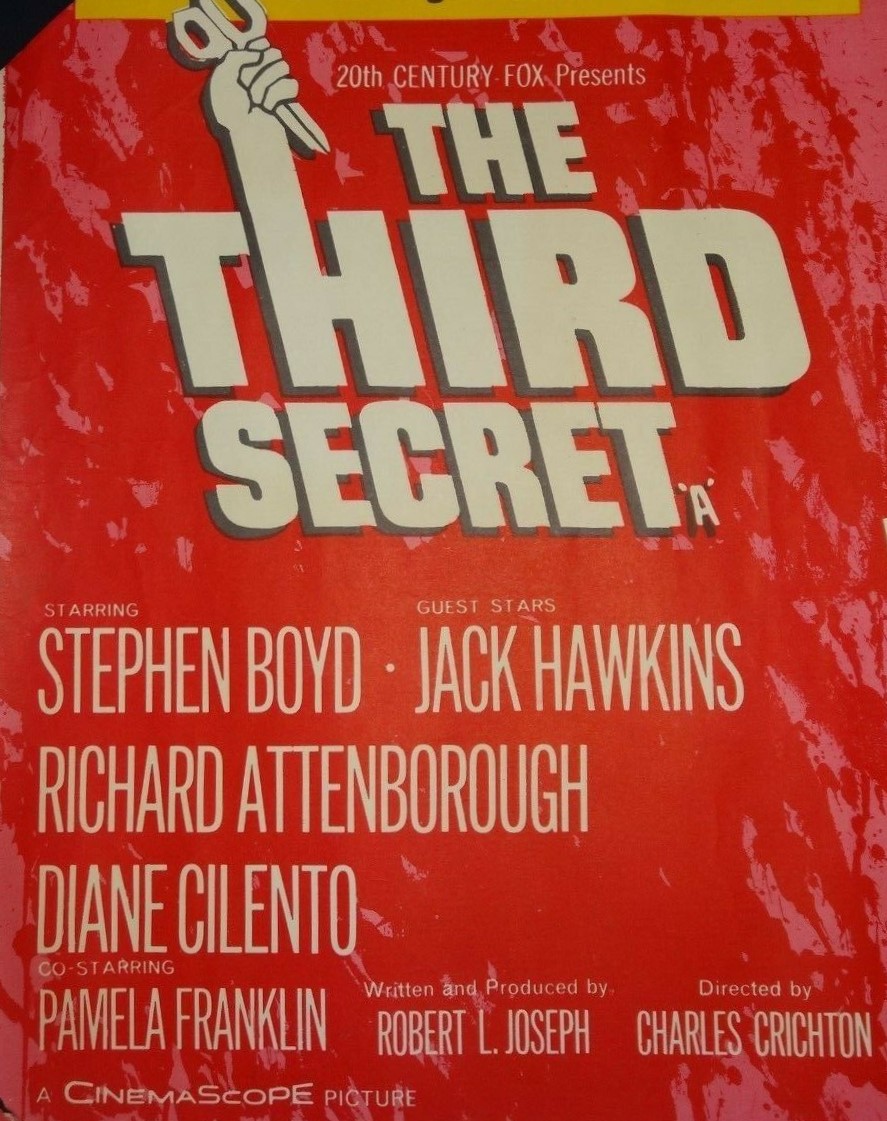
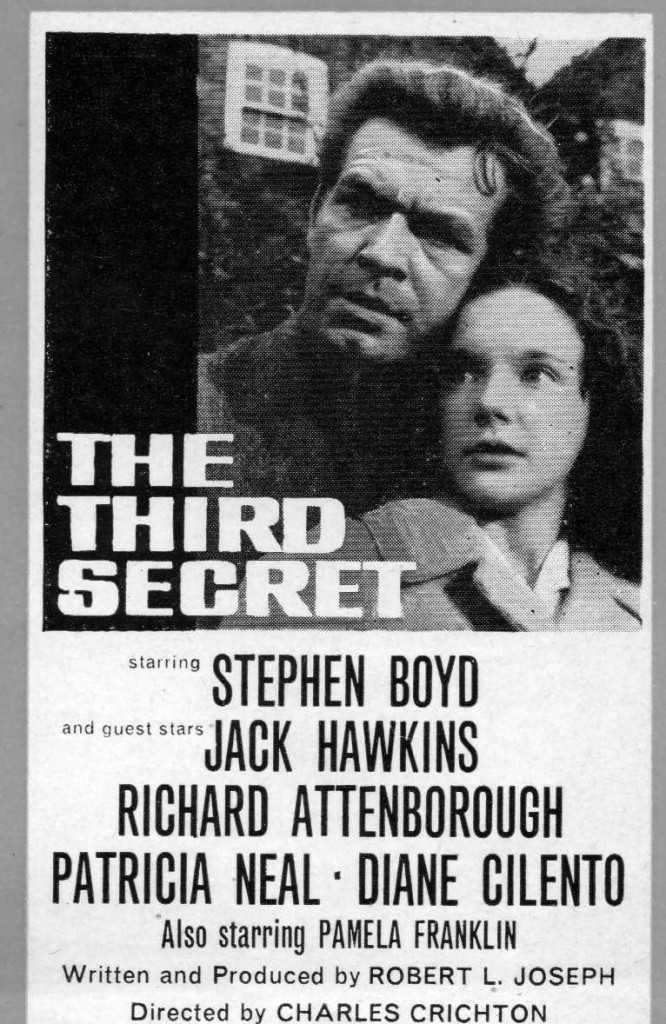
The Third Secret (1964) ***

Non-exploitative films about the psychologically vulnerable were thin on the ground during the 1960s and although The Third Secret is a bit talky nonetheless it does explore issues normally dealt with in heavy-handed fashion. Catherine Whitset (Pamela Franklin) the young daughter of a famous psychiatrist convinces television journalist Alex Stedman (Stephen Boyd) to investigate her father’s supposed suicide. Whitset needs the murder verdict because otherwise she will lose her home (no insurance payout on suicide). Stedman, Whitset’s patient, wants a similar outcome because his world would be turned upside down if the psychiatrist had committed a deed which he appeared steadfastly opposed.

The main suspects are all patients of the dead doctor – judge (Jack Hawkins), gallery owner (Richard Attenborough) and secretary (Diane Cilento). Although all outwardly successful socially-functioning upstanding members of society each is mired in mental agony – anger management, sexual inadequacy, depression, low self-esteem among problems addressed – defenses against which are perilously thin. Under sustained pressure each of the individuals will crack to reveal the cowering creature underneath.

But are they the killer or just condemned to torment? With the one man who could keep them sane removed from their lives, who knows what carnage they can self-inflict. All, even Stedman – given to bouts of terrible rage and drunkenness – seem capable of murder and there is every likelihood (as any viewer will guess) that his investigation could lead back to himself.

Director Charles Crichton (The Lavender Hill Mob, 1951) might have been suffering from low self-esteem himself having been unceremoniously dumped from The Birdman of Alcatraz (1962) and certainly the atmosphere is one of severity, not just characters teetering on the brink, but the black-and-white photography rendering London a wasteland, the tide on the Thames always out so the shore is just mud. However, his compositions do have style. The title’s explanation by the way is that the first secret is what you keep from the public, the second is what you hide from yourself, but the third is the truth.

Boyd (Ben-Hur, 1959) and Franklin (The Innocents, 1961) appear often on the point of hysteria, the girl’s high-pitched voice set against his growling outbursts. Attenborough (fresh from the heroics of The Great Escape, 1963) plays against type as a hand-wringing wannabe artist stuck in a role he despises. Hawkins, too, more used to heroic roles, is convincing as a man trying to escape his past. The neurotic Cilento has the best scenes, touching in her efforts to cling to normality. Judi Dench makes her debut in a bit part. The investigation takes the form of character analysis rather than “where were you on the night of…” which gives the picture an unique flavor, but best to know that going in rather than complain about the slow pace. If the psychological does not keep you hooked, there are sufficient twists to keep you watching.

Genghis Khan (1965) ****

Hollywood was never reined in by the strictures of history, much preferring fiction to fact for dramatic effect, and that’s largely the case here, although the titular hero’s real life remains shrouded in myth.

If you do catch this surprisingly good feature, make sure it’s not one of the many pan-and-scan atrocities on the market. I watched this in the proper Panavision ratio which meant it occupied only one-third of my television screen, but in that format it’s terrific. It’s a bit of an anomaly for a decade that churned out high-class historical epics like El Cid (1961) because this clocks in about a hour short of other films in the genre and there’s no star actor or director to speak of and no Yakima Canutt to handle the second unit action scenes.

Omar Sharif’s marquee value at this point was so low that if you check out any of the original posters you’ll note that his name hardly rates a mention and he also comes at the very end of the opening screen credits. Although this is post-Lawrence of Arabia (1962), it’s pre-Doctor Zhivago (1965), suggesting nobody had a clue how to market his talents.

Director Henry Levin was a journeyman, fifty films under his belt, best known for not a great deal except for, following this, the second and third in the Matt Helm spy series. Given this film was critically ignored on release and since, and a flop to boot, it definitely falls into the “Worth a Look” category. Although there are few stand-out scenes of the artistic variety such as pepper Lawrence of Arabia or El Cid, this is still well put together and Levin shows an aptitude for the widescreen.

The narrative breaks down into three parts – the first section describing Sharif’s enslavement by nemesis Stephen Boyd (the picture’s star according to poster and screen credits) before banding together rival tribes in revolt, the second part a long trek to China, and the third encompassing a final battle and hand-to-hand combat with Boyd. For a two-hour picture it has tremendous sweep, not just the scenery and the battle scenes, but political intrigue, romance, a rape scene and even clever comedy. Sharif is excellent as a leader who believes his glory is predestined, but who has very modern ideas about the role of women.

The best section, oddly enough, is set in China where Sharif engages in a duel of wits with Robert Morley’s distinctively contradictory emperor, but that’s not to detract from the film’s other qualities, the action brilliantly handled, especially the chaos of battle, the romance touching, and the dialogue intelligent and often epigrammatic. Unlike James Mason who makes a calamitous attempt at a Chinese accent, Morley, costume apart, looks as if he has just walked out of an English country house, but his plummy tones belie a very believable character. Telly Savalas and Woody Strode have decent parts as Sharif’s sidekicks, the former unexpectedly bearing the brunt of the film’s comedy. French actress Francoise Dorleac is effective as Sharif’s wife.

Hitchcock stole one of his most famous ideas from Genghis Khan. About the only scene in Torn Curtain (1966) to receive universal praise was a killing carried out to a soundtrack of nothing more than the grunts of assailant and victim. But, here, where the score by Yugoslavian composer Dusan Radic was extensively employed, the rape scene is silent and just as stunning. If the only prints widely available are of the pan-and-scan variety I’m not surprised the film has been for so long overlooked, but if you can get hold of one in the preferred format you will be in for a surprise.      

Discover WordPress

A daily selection of the best content published on WordPress, collected for you by humans who love to read.

The Atavist Magazine

by Brian Hannan

WordPress.com News

The latest news on WordPress.com and the WordPress community.