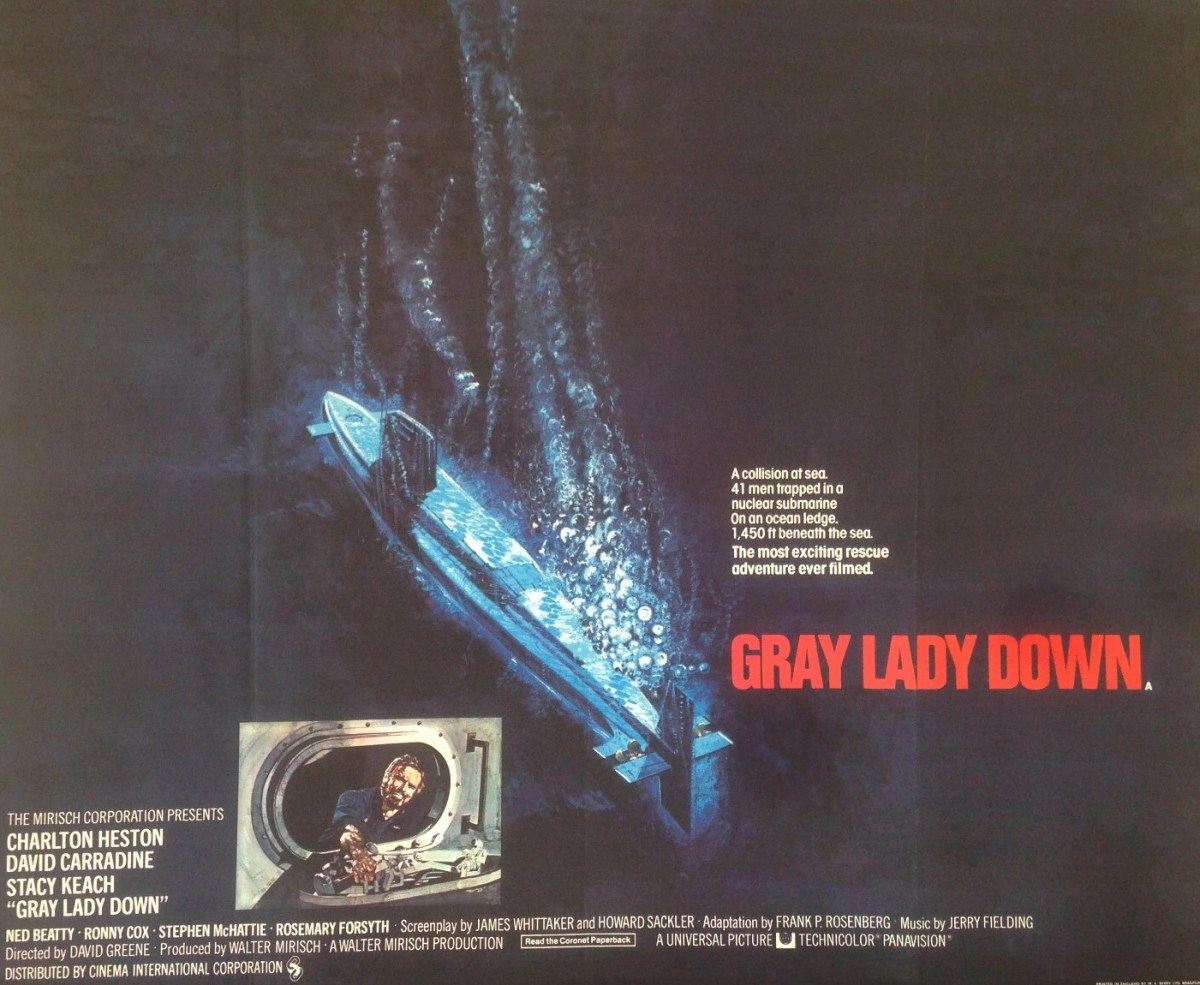
Producer Walter Mirisch could have afforded to rest on his laurels – he’d won the Oscar for In the Heat of the Night and been responsible for classics like The Magnificent Seven (1960) – and three sequels – and The Great Escape (1963). The 1970s had proved tougher, resulting initially in a string of pot boilers before hitting a home run with Mr Majestyk (1974) with Charles Bronson and knocking the ball out of the box office park with war picture Battle of Midway (1976), the former pulling in $20 million in rentals on a $2 million budget, the latter $50 million in rentals on a $7 million budget.
He had parted company with United Artists after nearly two decades in partnership and tied up a five-year deal with Universal. With Midway under his belt, he was the go-to producer for pictures on a naval theme. He had been sent a screenplay by James Whittaker about a submarine stranded at the bottom of the ocean. However, it turned out there was already a novel on the same subject, Event 1000 by David Lavallee, which result in various negotiations to determine the screenwriter credit, especially after playwright Howard Sackler (The Great White Hope, 1970) had completed a rewrite.
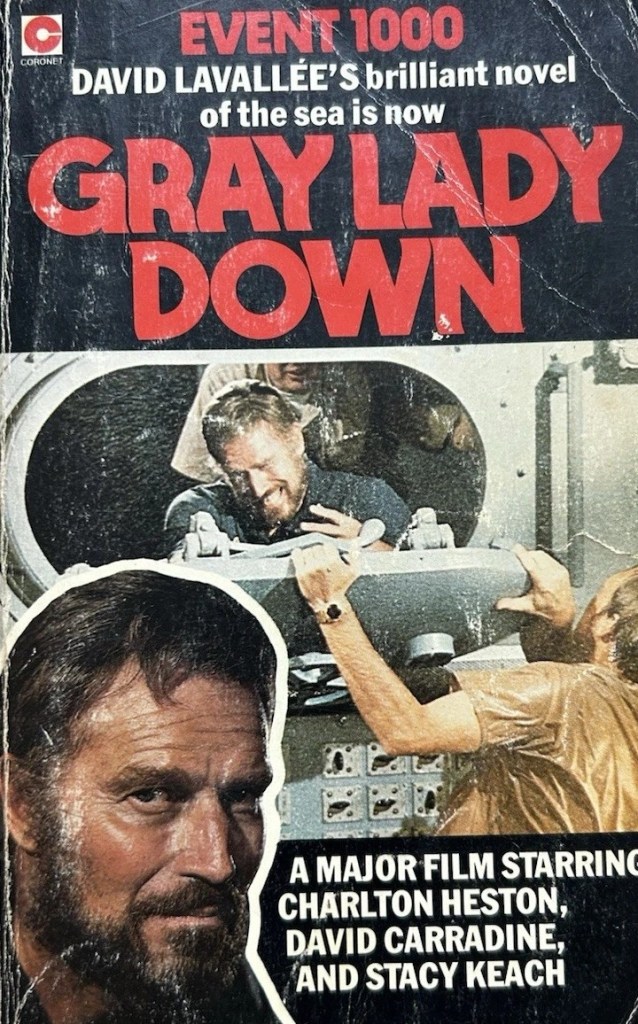
Charlton Heston, on a box office roll after Airport 1975 (1974), Earthquake (1974), Battle of Midway and Two Minute Warning (1976), was the obvious choice for the lead. But Mirisch had originally contemplated teaming Heston with Sidney Poitier (In the Heat of the Night). “He’s now backing away” from the idea, noted Heston in his diary in February 1976, “though I’m not sure why, save the cost of having us both in the film.” Heston was in strong demand, and turned down The Omen (1976) and The Pack (1977).
The film was slow coming together, “not much progress on the script…casting still slow” and there was the possibility of further delay to “mull” over the project. No director had been assigned by the end of February 1976. Following the Battle of Midway, the U.S. Navy was only too delighted to be involved. As well as following a disaster picture template, the movie was also tech heavy, featuring up-to-date ideas on rescue at sea.
The interior of the submarine, the main set, was constructed on a gimbal so that it could be tilted to achieve the effect of the sailors being thrown about as the sub sunk to the bottom and rolled over on a deep sea trench. Howard Anderson oversaw special effects work with models in a 44ft deep water tank which was filmed at CBS. Exteriors were shot at Universal with some work aboard a Navy escort vessel. Some material was also repurposed from Ice Station Zebra (1978).
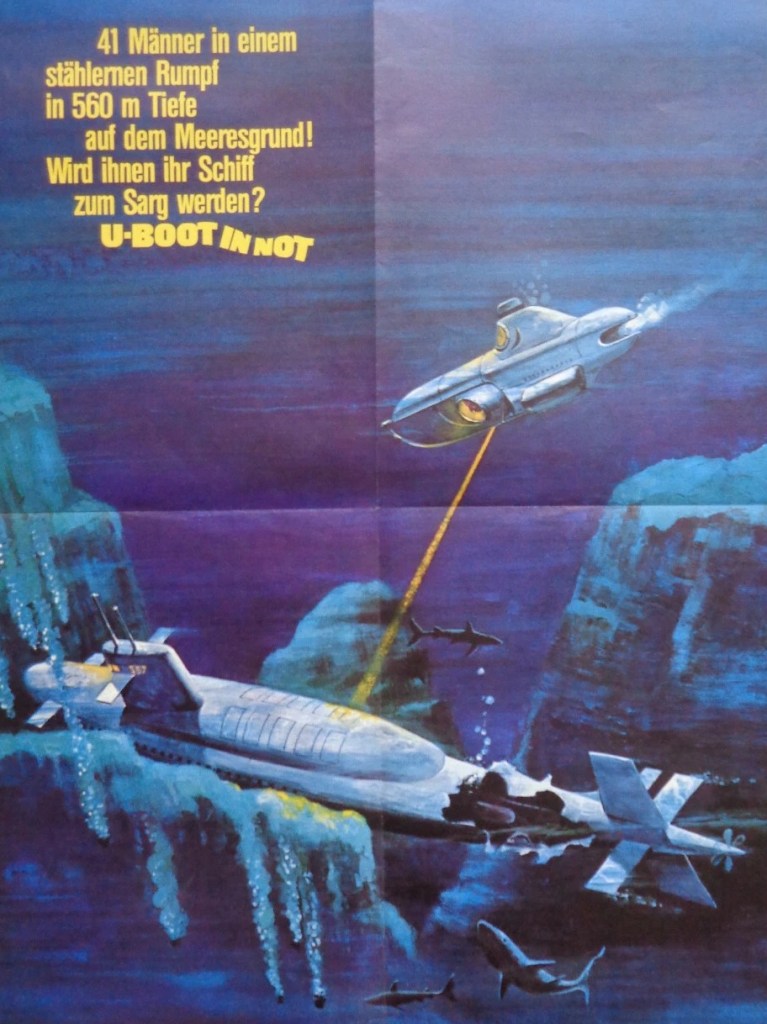
To soak up the atmosphere of a real nuclear sub, Heston spent the day on USS Gurnard under the Pacific off San Diego. “I got a lot of useful little stuff,” commented Heston, “about the look and sound of submarine officers at work…the kind of thing nobody could tell you.” The sub contained a “vast array” of disparate and complex technology. “It was a very strange feeling to spend hours charging about under the ocean running mock torpedo attacks on surface vessels.” The experience also included drills for fire and flooding.
As shooting approached, Mirisch still had not done a deal for second lead Stacy Keach (Fat City, 1972). He was, however, “anxious” to recruit Ronny Cox (Deliverance, 1972). Ned Beatty, also form that film, came on board. David Carradine (Bound for Glory, 1976) and future Superman Christopher Reeve were added. Michael O’Keefe (The Great Santini, 1979) also made his movie debut.
Filming began on September 11, 1976. “I had very little to do,” noted Heston, “which was just as well, breaking in on a new film.” He played his only scene with Keach, “the tag of the picture and a key scene.” British director David Greene (Sebastian, 1968) was applauded for being as meticulous as William Wyler. More importantly, “he gives the actors a great deal and I find myself stimulated by almost all the suggestions he makes,” commented Heston. At one point, Greene decided to reshoot a major scene, bringing back offstage actors Heston thought he could do without. On the minus side, “he runs a rather loose ship.” Of his own contribution, the actor said, “I became preoccupied with giving an efficient performance rather than a creative one. The pressures I feel to be a consummate professional make me focus on getting it right.”
Filmed on a budget of just $5.25 million, it proved a huge hit, pulling in $19 million in rentals.
SOURCES: Walter Mirisch, I Thought We Were Making Movies, Not History (University of Wisconsin Press, 2008) p339-341; Charlton Heston, The Actor’s Life (Penguin, 1980) pp464-481.


 The Magnificent 60s