Shadow of Treason (1963) **

Tracking down forgotten B-pictures it’s easy to convince yourself you’re going to uncover an under-rated gem. Sadly, despite mixing film noir with espionage and a treasure hunt, this fails dismally at getting over the line.

And that’s a shame because the credits roll over a background of long shadows, recalling instantly to mind not a film noir trope but the later famed poster of The Wild Bunch (1969). And there’s an excellent repetitive theme by Martin Slavin (Sherlock Holmes and the Deadly Necklace (1962), an interesting striptease involving a bear, and a superb chase sequence where the pursuer is in a wheelchair. Otherwise, it’s got such a convoluted storyline you wished someone could get on top of it sooner rather than dragging the audience from Trieste to Dubrovnik to Somaliland.

Femme fatale No 1 Anita West literally in a hole with John Bentley.

In his final movie British star John Bentley, who brought to life both Paul Temple and The Toff, plays Steve, a drifter of unspecified means, who saves cabaret singer/stripper Tina (Anita West) from  assassination. Hired by her as bodyguard/detective, he learns her father was a German spy who has left her a list of names and a map to hidden treasure and strangely enough she has been receiving regular anonymous donations of cash. It soon becomes obvious to Steve that blackmail is the source of this unexpected bounty. And that he is caught in the middle. Some people want to pay him off, others to kill him off.

It doesn’t help that he is seduced by both Tina and Nadia (Faten Hamamah), daughter of Litov (Vladimir Leib), one of those being blackmailed but now confined to a wheelchair.

Along with Mario (Ferdy Mayne) and Michel (John Gabriel) they are all soon convinced that the solution to all their problems will be joining Steve on a trip to Somaliland to find the hidden treasure, cash the father was reportedly carrying to pay his team of spies.

Femme fatale No 2 Faten Hammamah looking disgruntled. You could say the same about Bentley.

Usually, with any kind of picture involving hunting for treasure, the audience is invited to be baffled by various clues, but here none are offered and the audience simply remains baffled. Once in Africa, of course, the action hots up, courtesy of stock footage of stampeding elephants and a variety of dangerous animals and by the double-crossing that appears essential to such schemes. Eventually, they end up in a cave, where the only bit of treasure detecting actually takes place. Assume more double cross and you’re just about there.

Director George P. Breaksaton (The White Huntress, 1954) must take full responsibility for this mess since he was also the writer and producer. Apart from the various sequences previously mentioned, he has little idea of narrative drive or even narrative. None of the characters connect with each other and certainly not with the audience.

John Bentley does his best but that’s mostly down to frowning and grunting and trying to get a share of everyone’s spoils. He’s intended as some kind of James Bond lounge lizard given the movie begins simply because he follows an attractive woman in a nightclub. But he really has very thin material to work with. Neither of the femme fatales, Anita West (Shadow of Fear,1963) and Egyptian star Faten Hamamah, has enough in the smouldering department and if they did weren’t inclined to waste it on the likes of Steve.

Hardly a fitting end to Bentley’s career. More of a curiosity than an entertaining watch.

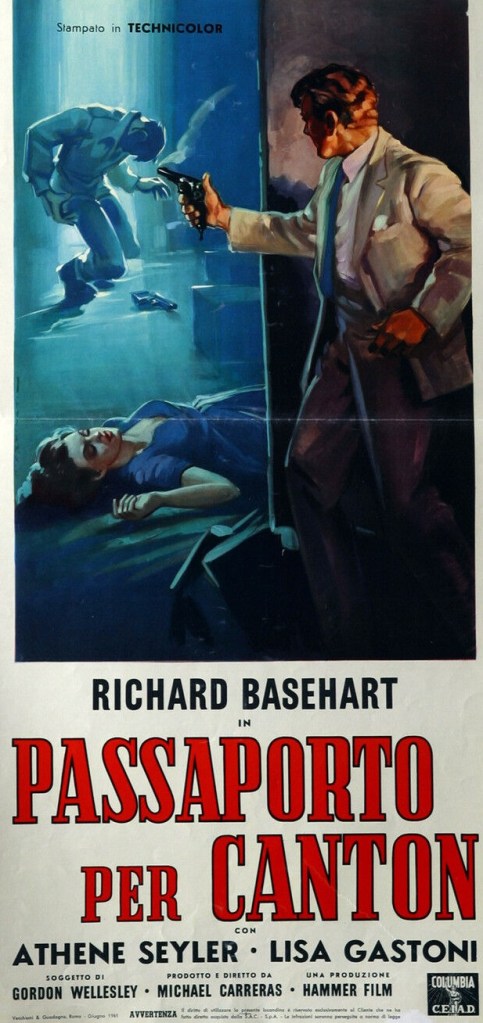
Passport to China / Visa to Canton (1961) **

Marked down for sheer laziness. Another Hammer “thriller,” this time with fading American star Richard Basehart and Italian glamor puss Lisa Gastoni. But mostly a hodge-podge travelog of stock footage with dialog taking the place of action, a tedious voice-over far removed from the snappy one-liners we are accustomed to getting from Chandleresque investigators. And let’s forget the red-eyed Chinese replete with drooping moustaches who pepper the picture.

A plane has gone down in Red China with an American courier carrying vital “scientific” information, Approached to help by US government personnel, snappily-dressed Hong Kong travel agent Benton (Richard Basehart) refuses. But when he discovers the pilot is Jimmy (Burt Kwouk), a member of a Chinese family he has befriended during World War Two, he mounts his own rescue mission. Which consists, by the way, of nothing more than floating a sampan up a river, avoiding a few bullets and whisking the lad away.

But he is blackmailed into rescuing the courier when Hong Kong police imprison Jimmy. So off he trots to Macao and then Canton aided along the way, in the opulent back room of a casino, by Chinese businessman Kong (Eric Pohlmann) who you might mistake for a James Bond villain such is his fondness for being surrounded by women – or such is his girth mistake him for a Robert Morley lookalike. Kong happens to be a Russian spy.

No sneaking into China by parachute or perhaps motor boat is required, Kong simply furnishes him with the visa of the title. Benton, vaguely assisted by a maker of fake porcelain, has clues –  Three Fishes, The Stream of the Willows.

In his hotel bedroom sits the courier, blonde Lola (Lisa Gastoni), held prisoner. But no sooner have they kissed, as you might expect of any self-respecting travel agent doubling as a spy, than they are interrupted by Kong. She disappears. Naturally, Benton finds her easily enough. She doesn’t have papers, instead a photographic memory.

But she’s not working for the Americans. She’s an espionage freelance, working for the highest bidder. She does it for the danger, perhaps like a certain James Bond, danger is the drug, heightens her senses.

But she’s also pretty damn clever. Knowing Kong is a double agent and can’t just snatch her out of China, she starts an auction for her information. Benton offers more. Therefore she is his property. To get over the tickly issue of Kong, in revenge, keeping her prisoner in China, he is conveniently accidentally shot.

So now they have to escape. But in the shoot-out at the docks (in a barn full of hay for some reason she gets shot) so the movie suddenly turns into one of those post-Bond thrillers where all that effort has been expended for no result.

But you might have thought a producer (Michael Carreras) would have introduced Lola much earlier in femme fatale fashion. But then this producer who, as it happens was also the director, seems to think that voice-over will solve all the tedious problems of actually creating a screenplay that works.

You shouldn’t have cared less about a snappy-suited character such as the one played by Gene Barry in his informal espionage trilogy – Maroc 7 (1967), Istanbul Express (1968) and Subterfuge (1968) – he’s about on a par as an actor as Basehart. But those movies at least had proper stories that made sense and were not just a series of jumps explained by voice-over, the hero neither having to undertake any shamus digging or go into harm’s way, or battle his way out of perilous situation.

It’s not even bad enough to eventually win over a cult audience. The problem is it’s well-made up to a point and the story is intriguing up to a point, but that mark is very low.

Richard Basehart (The Satan Bug, 1965) isn’t called upon to do much except act as the storyteller he’s okay and Lisa Gastoni (Maddalena, 1971) isn’t accorded sufficient screen time to really make a mark. Which is the biggest shame because an amoral spy like her would have made a brilliant femme fatale had she been introduced early on and then turned out to be the mercenary she was.

The rest of the cast are caricatures, though interesting to see Burt Kwouk in pre-Pink Panther persona but cringe-worthy to see Bernard Cribbins (You Must Be Joking, 1965)  mangle a foreign accent. Clearly Carreras learned a lesson from this implosion of talent and story because two pictures on he directed taut thriller Maniac (1963).  

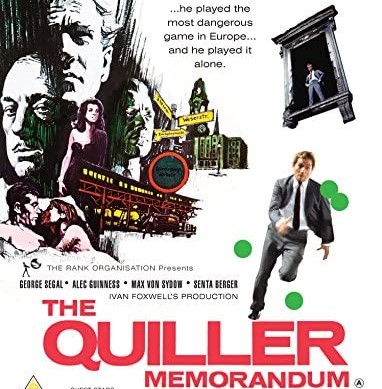
The Quiller Memorandum (1966) ****

The Quiller Memorandum (1966) ****

Stylish cat-and-mouse thriller that fits into the relatively small sub-genre of intelligent spy pictures. George Segal was a difficult actor to cast. He had a kind of shiftiness that lent credibility to a movie like King Rat (1965), a cockiness that found a good home in The Southern Star and an earnestness ideal for Who’s Afraid of Virginia Woolf (1966). But Quiller fit his screen persona like a glove. The part called for charm to the point of smarminess and courage to the point of callousness. A lone wolf for whom relationships were a means to an end, he adopted identities – journalist, swimming coach etc– as the occasion suited.

Quiller’s undercover mission is to expose a neo-Nazi organisation. But just as he sought to discover the location of this secret enterprise, so his quarry was attempting to find out where his operation was based. 

Michael Anderson (The Dam Busters, 1955) had just finished his first spy effort, Operation Crossbow (1966) and that film’s documentary-style approach was carried on here but with a great deal more style. There is consistent use of the tracking shot, often from the point-of-view of one of the protagonists, that gives the film added tension, since you never know where a tracking shot will end. Although the film boasts one of John Barry’s best themes, Wednesday’s Child, there was a remarkable lack of music throughout. Many chase scenes begin in silence, with just natural sounds as a background, then spill out into music, and then back into silence.

But much of the heavy lifting was done by playwright Harold Pinter (The Servant, 1963) in adapting Adam Hall’s prize-winning novel. Hall was one of the pseudonyms used by Trevor Dudley-Smith who wrote The Flight of the Phoenix (1965) under the name Elleston Trevor. The Quiller Memorandum involved wholesale change, from the title (the book was called The Berlin Memorandum) onwards. The book is set against the background of war crime trials; Quiller a British wartime rescuer of Jews now tracking down war criminals; the main female character (played in the film by Senta Berger) had, as a child, been in Hitler’s bunker; and there is a subplot concerning  a bubonic plague; there was a preponderance of obscure (though interesting for a reader) tradecraft; plus the Nazi organisation was named “Phoenix.”

Book jacket for film tie-in for what was originally entitled “The Berlin Memorandum.”

While retaining the harsh realities of the spy business, Pinter junks most of this in favour of a more contemporary approach. Instead of meeting his superior (Alec Guinness) in a theatre, this takes place in the Olympiad stadium. Guinness’s upper crust bosses, played by George Sanders and Robert Flemyng, are more interested in one-upmanship. Berlin still showed the after-effects of the war and Pinter exploited these locales. Senta Berger is an apparently innocent teacher in a school where a known war criminal had worked. And, of course, Segal is an American, not British, drafted in from the Middle East.

But the core remains the same, Segal prodding for weaknesses in the Nazi organisation, the Nazis hoping to reel him in and force a confession from him, Segal planning on roping them in by getting close to them. Despite receiving second-billing Alec Guinness has a minor role, but Max von Sydow as Segal’s adversary more than makes up.

There is still a lot of tradecraft: “do you smoke this brand” (of cigarettes) is the way spies identify themselves; Segal being followed on foot turning the tables on his quarry; Segal poisoned after being prodded by a suitcase; and the use of word associations Segal employs to avoid giving real information. Having flushed out his adversaries, Segal is now dangerously exposed. But that’s his job. He’s just a pawn to both sides. He’s virtually never on top unlike the fantasy espionage worlds inhabited by James Bond, Matt Helm and Derek Flint.

The structure is brilliant. Segal spends most of the picture in dogged bafflement. Guinness at his most supercilious flits in and out. Segal is stalked and stalks in return. There are exciting car chases but the foot chases (if they can be called that) are far more tense. But the core is a bold thirteen-minute interrogation scene where Segal is confronted by von Sydow, head of the shadowy neo-Nazis. And as an antidote to the thuggery and danger to which he is exposed, Segal becomes involved with Senta Berger.

Berger is hugely under-rated as an actress. She was in the second tier of the European sex bombs who came to prominence in the 1950s and 1960s, the top league dominated by Brigitte Bardot, Sophia Loren and Gina Lollobrigida. On screen she is not as lively as those three, but the quiet intensity of her luminous beauty draws the camera in. Here, she is utterly believable as the innocent women who, in falling for Segal, is dragged into his dangerous world.  She was criminally under-used by Hollywood, often in over-glamourous roles such as The Ambushers (1967) or as the kind of leading lady whose role is often superfluous.

Segal is a revelation, grown vastly more mature as an actor after Who’s Afraid of Virginia Woolf (1966) for which he was Oscar-nominated, confident enough to abandon the showy carapace of previous pictures. This is a picture where he sheds layers, from the opening brashness to the sense of defeat in surviving the interrogation ordeal, knowing the only reason he is still alive is to lead the enemy to his own headquarters, buoyed only by inner grit. He hangs on to his identity by his fingertips.

A must-see for collectors of the spy genre.

Discover WordPress

A daily selection of the best content published on WordPress, collected for you by humans who love to read.

The Atavist Magazine

by Brian Hannan

WordPress.com News

The latest news on WordPress.com and the WordPress community.