
There’s a whole book to be written about poster deception. But this plays with audience expectation in an unusual manner. Here it’s a case of duping by billing. The top-billed Richard Attenborough (Only When I Larf, 1968) disappears in the last third, John Gregson (The Frightened City, 1961) spends most of the time out of it and the bulk of the heavy lifting is done by fifth-billed Eddie Constantine (The Great Chase, 1968).
That’s no bad thing because Constantine, self-deprecating tough guy in the Lee Marvin mold, does pretty well in this survival picture, airplane crashing in the Pacific, a motley bunch stranded on an island. And with the bonus of Attenborough and Gregson, typically of the English stiff-upper-lip persuasion, playing against type.

Alcoholic Jack (John Gregson), piloting a seaplane on its last legs, is ferrying wanted smuggler Mark (Eddie Constantine), handcuffed to cop Petersen (Clifford Evans), along with shifty witness Whitey (Richard Attenborough), stewardess Teresa (Pier Angela), physicist Krauss (Gunnar Moller), sparky spinster Miss Shaw (Jean Anderson) and the “loaded with sin” Maria (Eva Bartok).
When Mark attempts to put out an electrical fire on board he accidentally kills co-pilot Willy (Cec Linder) and with Jack out cold the plane heads for the drink. Luckily, there’s a deserted island nearby. Unluckily, it’s next door to a nuclear test site.
Meanwhile, Mark, emerging as the hero, is soon fighting off the attentions of Maria and Teresa, Jack’s girlfriend. Whitey, who pointed the finger at Jack and not wanting to be stranded on the same island as him, steals the cop’s gun, puts a hole in one of the two dinghies and sets off to sea on the other. On discovering lead-lined housing, Krauss is able to work out the nuclear issue. With barely five hours to detonation, Mark elects to swim two miles in shark-infested water to the tiny island housing the nuclear device, armed only with a few rudimentary tools.
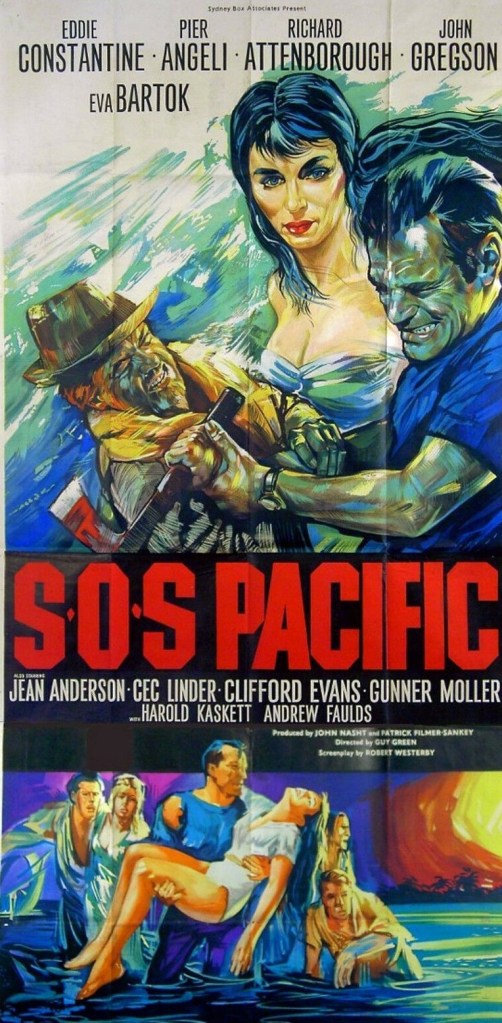
There’s a surprise waiting for him of course. Should he succeed in his enterprise, there’s reward too because Jack, in best Scott of the Antarctic form, has sacrificed himself to the sharks to give Mark a chance.
There’s some good stuff here, namely seeing Attenborough as a snivelling spiv complete with dangling cigarette, and Gregson as a self-pitying drunk, killing his career one bottle at a time, an airsick cop, the doughty Miss Shaw still fancying herself as a femme fatale, some well-scripted dialog between bad guy Mark and bad girl Maria, and a host of twists.
Contemporary audiences will feel let down by the ending. If only it was as easy to prevent nuclear catastrophe. But on the other hand it is one of the first films to take the issue of the atom bomb seriously, Jack’s self-destruction the result of witnessing at first hand the devastation of Hiroshima.
Yank Eddie Constantine, hightailing it to France to improve his career prospects in the 1950s, and becoming a B-movie star, was still largely an unknown quantity. He had top-billed in French and German pictures and was the male lead to Diana Dors in Room 43 (1958). This should have kick-started a Hollywood career or at least a British one.
A potential inheritor of the Humphrey Bogart mantle, the tough guy with a soft centre, snappy with the one-liners, in this outing willing to go with the flow, confident he will end up back on his feet, if not at least enough appeal to have dames falling at his feet. But, probably, he would have had to work his way up again, which might be a slow business, whereas in France scripts were being written to suit his screen persona. If you’re interested check out his turn as Lemmy Caution in Your Turn, Darling (1963) and his outings as secret agent Jeff Gordon and private eye Nick Carter.
Eddie Constantine played by far the most interesting character here, and except for Jean Anderson (Solomon and Sheba, 1959) the women were underwritten, Pier Angeli (Battle of the Bulge, 1965) and Eva Bartok (Blood and Black Lace, 1964) there mainly to polish the hero’s ego.
Robert Westerby (Dr Syn, Alias the Scarecrow, 1963), television writer Gilbert Thomas and Bryan Forbes (Station Six Sahara, 1963) had varying hands in the screenplay.
Director Guy Green (The Magus, 1968) does a good job of marshalling his box of tricks, keeping tensions – whether romantic, criminal or survivalist – high especially as he had to find a way round the unexpected climax, and once you accept that neither Attenborough nor Gregson are going to leap to the rescue quite easy to get on the Eddie Constantine wavelength. Not in the class of The Flight of the Phoenix (1965) or Sands of the Kalahari (1965), and lacking their character complexities, but not far off.
 The Magnificent 60s