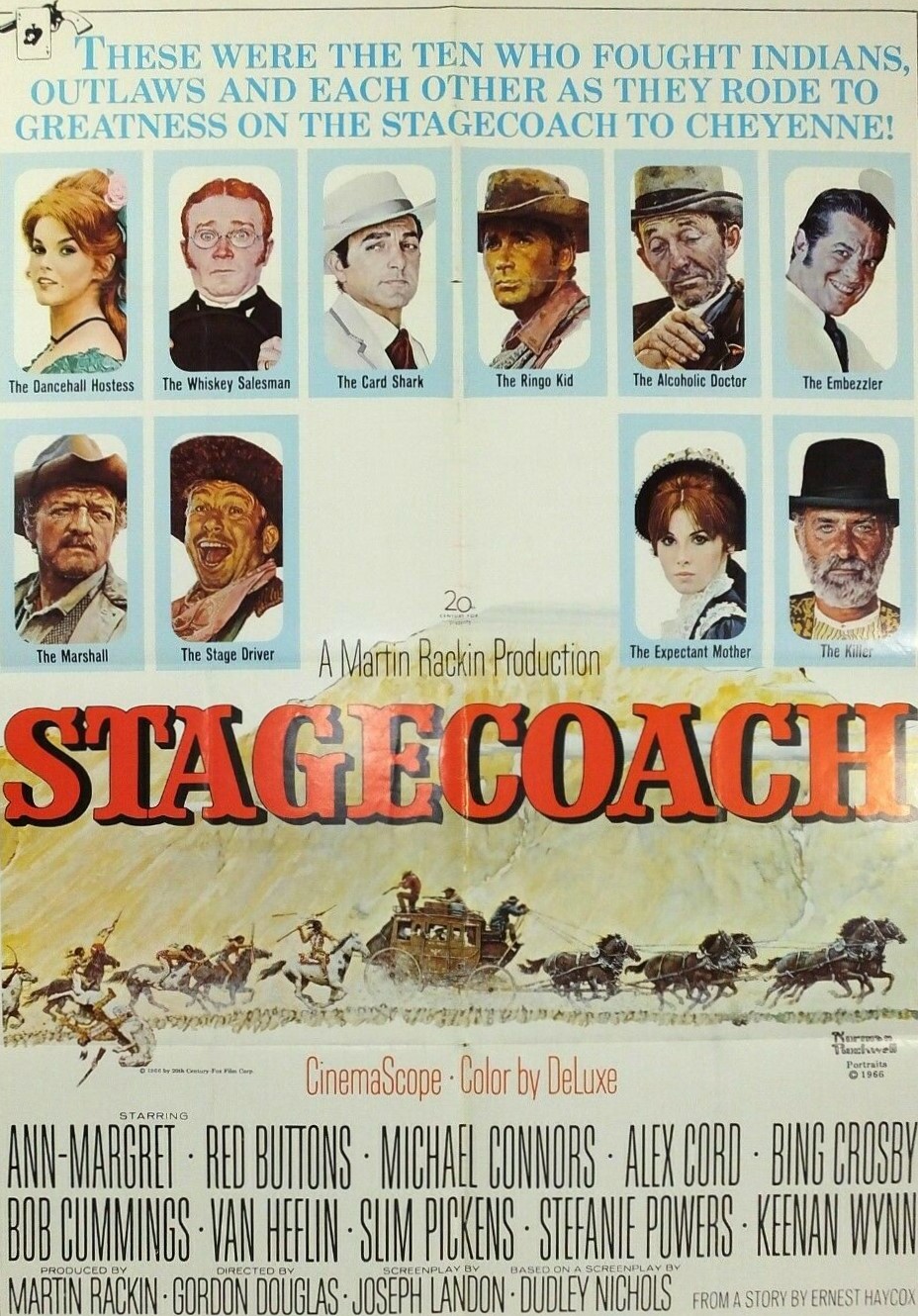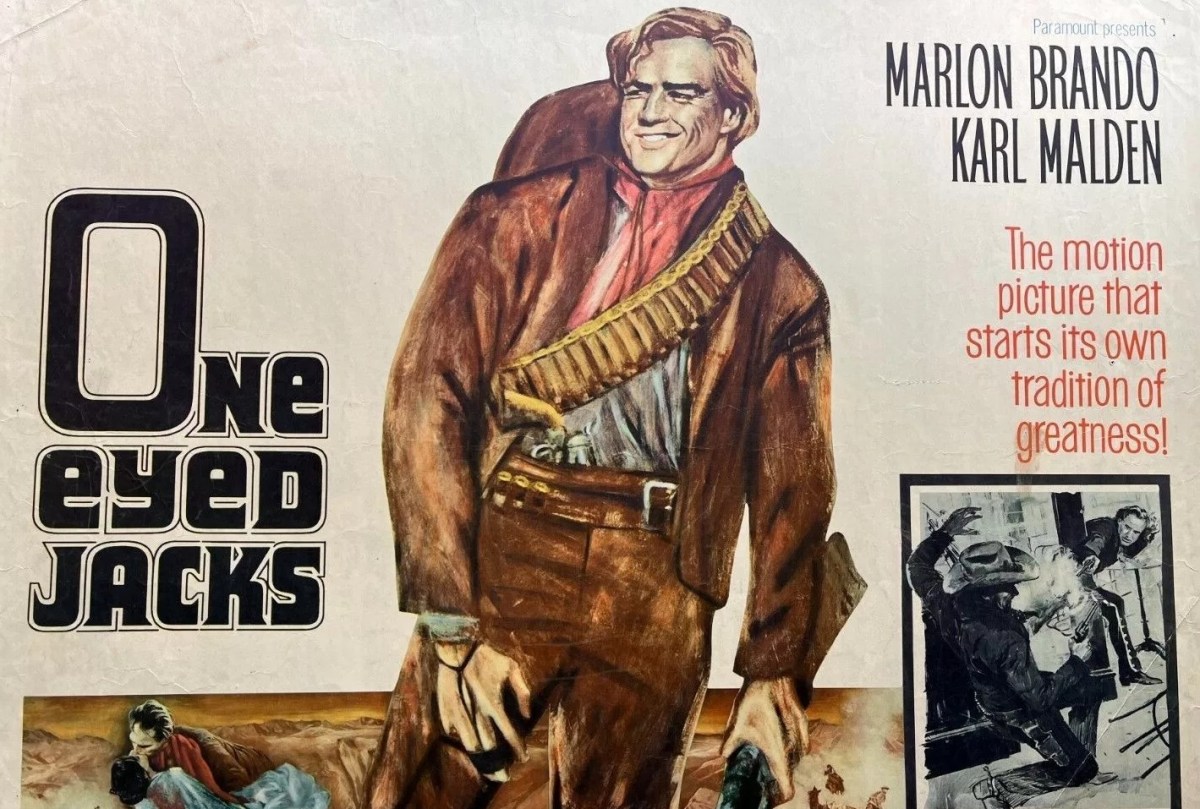
One-Eyed Jacks (1961) ****

Sets the tone for the later Sergio Leone, Sam Peckinpah and Clint Eastwood westerns in which the bad guys are the good guys and we find ourselves rooting for bounty hunters, gunslingers and bank robbers. Except this is more of a drama than a western. Shooting is kept to a minimum and instead it’s a character-driven drama about outlaws. Ostensibly, it’s a simple revenge tale and also totes around that later cliché of the honor code and principles that The Wild Bunch (1969) in particular put so much faith in.

But, in reality, it’s an in-depth look at two fascinating characters, both very human, both sly, self-indulgent, constantly attempting to reinvent themselves, cheat their way to a better life or to get what they want. There’s no sense of redemption, just obsession.

Rio (Marlon Brando) and Ben (Karl Malden) are bank robbers, the former a notorious gunslinger to boot and also partial to stealing pieces of jewellery to assist his practiced seduction routine whereby he claims a ring or necklace was a family heirloom, and he’s a good reader of the reluctant female because that tends to open the bedroom doors. Pursued after pulling off a job in Mexico, down to one exhausted horse and trapped by a posse, Ben is sent to get fresh horses but instead of coming back heads off with the loot. The captured Rio does a five-year prison stretch before escaping and seeking revenge.

Ben, meanwhile, has gone straight. He’s picked up a peach of a job as a lawman, a marshal no less, in Monterey on the California coast, where he’s made no secret of his past so he’s not prey to blackmail. He thinks Rio believes his story that he did all he could to return to aid his friend. We know different.

Rio has alighted on this town by pure accident, hooking up with a band of thieves led by Bob (Ben Johnson) who are set on robbing the bank here. Their plans are put in disarray when Ben takes revenge on Rio seducing his stepdaughter Louisa (Pina Pellicer) by subjecting him to a savage whipping and breaking his gun hand. It takes ages for the hand to heal and for Rio to even manage to whip out the gun let alone fire it with any speed or accuracy. He fesses up to Louisa that he’s not a secret Government agent, his usual cover story, but a bank robber and that the heirloom he gave her did not belong to his mother.
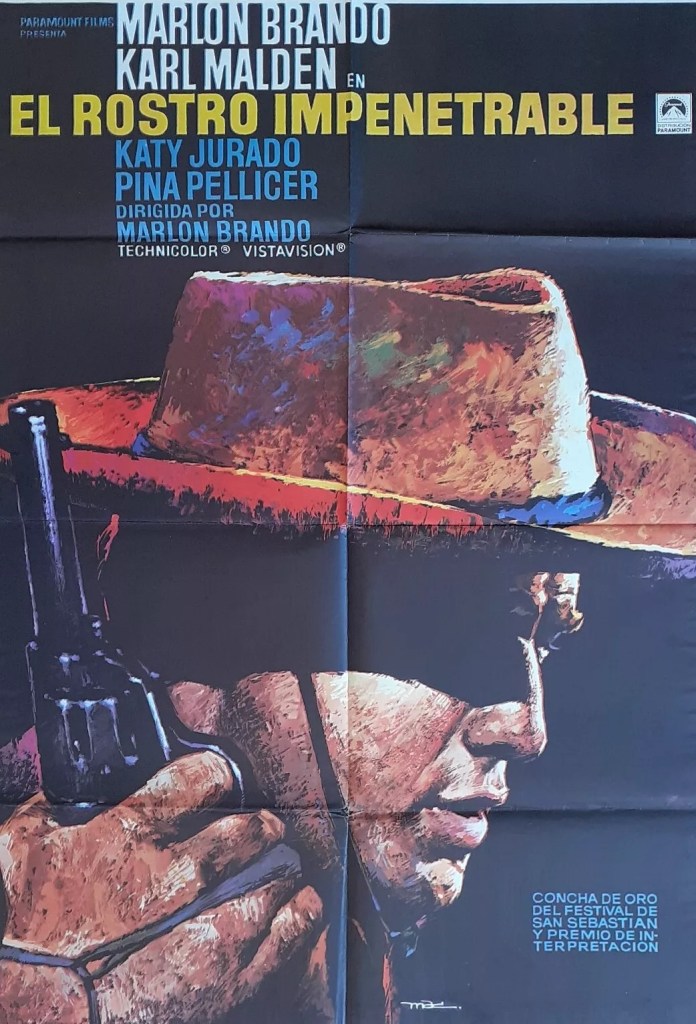
Bob gets fed up waiting, tries to pull off the bank job with one other accomplice, but the robbery goes wrong and a girl is killed. Ben pins the blame on Rio, arrests him and prepares to hang him. Louisa, who has initially rejected Rio after his confession and aware of his revenge plan, helps him escape.

The final shoot-out isn’t built up with the intensity of High Noon (1962) or Once Upon a Time in the West (1968) but with a resigned inevitability. Rio could have skipped out with Louisa and made a new life in Oregon. That would, in some senses, be revenge enough, stealing away the stepdaughter, one of the two main planks of Ben’s newfound respectability.

Don’t come here looking for honesty or upstanding individuals. Respectability is feigned – even Ben’s wife Maria (Katy Jurado) had a child out of wedlock. Everyone lies, even Maria – to protect Louisa from the stepdad’s wrath at losing her virginity.

In other words, a totally human cast of characters, shuffling the truth like it was a deck of cards. You wouldn’t trust any of them an inch. It doesn’t take much for cruelty to creep through the cracks, the cruel whipping, deputy Dedrick (Slim Pickens) handing out a beating to Rio in retaliation for being rejected by Louisa, Bob taking great delight in shooting dead an unarmed accomplice.  

Ben isn’t alone about lying about the impossibility of coming to Rio’s aid, Bob does it too. Wife and stepdaughter lie to Ben. Ben lies to Rio. Rio lies to Louisa. Where this fits into one of Dante’s circles of Hell is anyone’s guess.

Cinematically, there’s only really one standout scene, when Ben calls out of hiding all the men who are going to surround Rio. But there are bold visuals. I thought I was watching a dud DVD because the image was so washed out for the opening sequences then I realized it was just the glare of the white desert sand and deliberate. And the backdrop of crashing waves suggests a different sensibility.

You can see the impact of Brando’s direction – he was making his directing debut – more with the leeway he allows actors to carry out little bits of business that only another actor would appreciate. A shoeless Ben dances over the hot sands, when he picks up the coins he has dropped he remains on the ground longer sifting through the sand in case he has missed one, Rio reacts to Dederick sweeping ash in his direction.

This is Marlon Brando (The Nightcomers, 1971) still in his pomp.

Written by Calder Willingham (The Graduate, 1967) and Guy Trosper (The Spy Who Came in from the Cold, 1965) from the book by Charles Neider.

An exemplary work from a novice director.
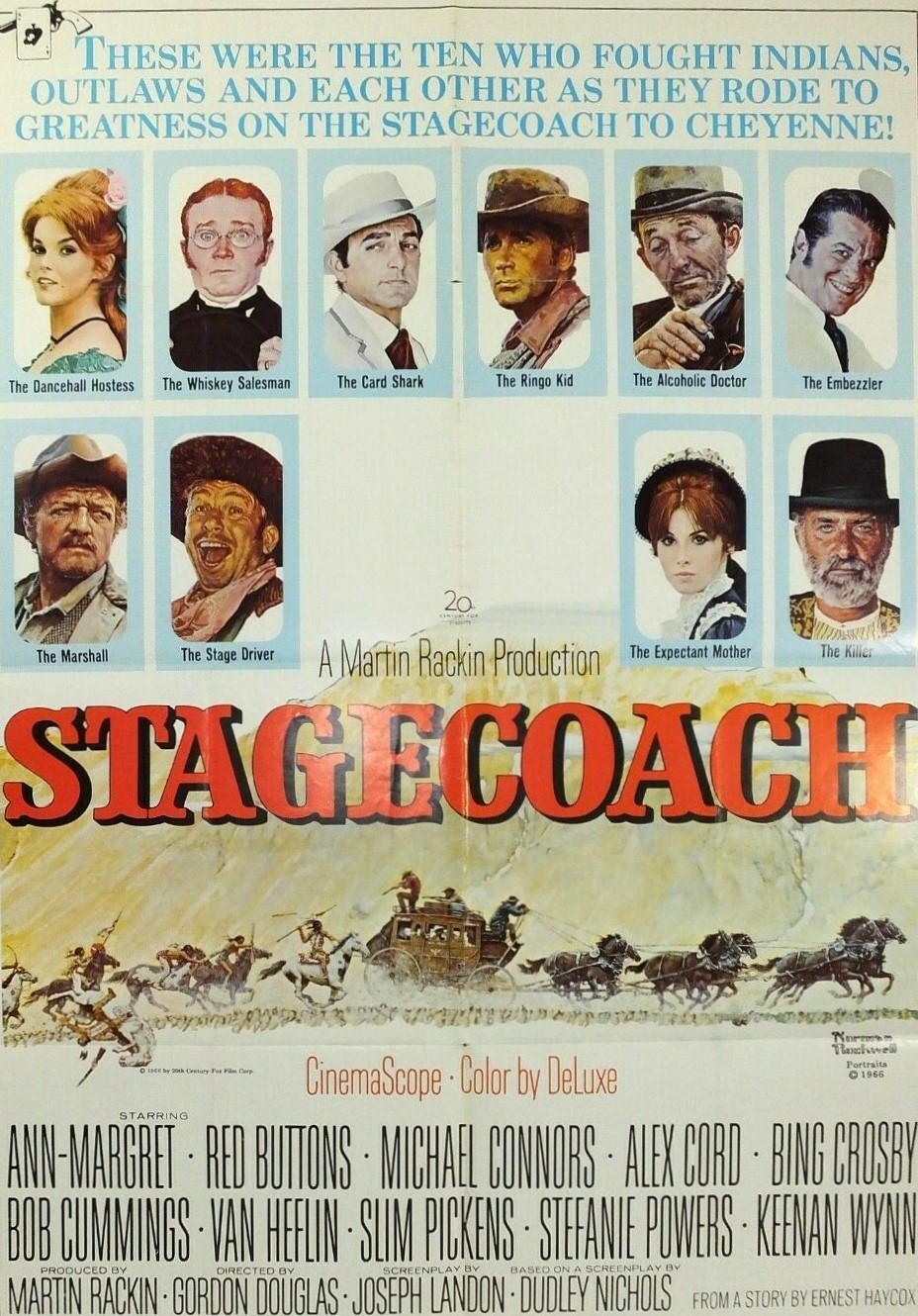
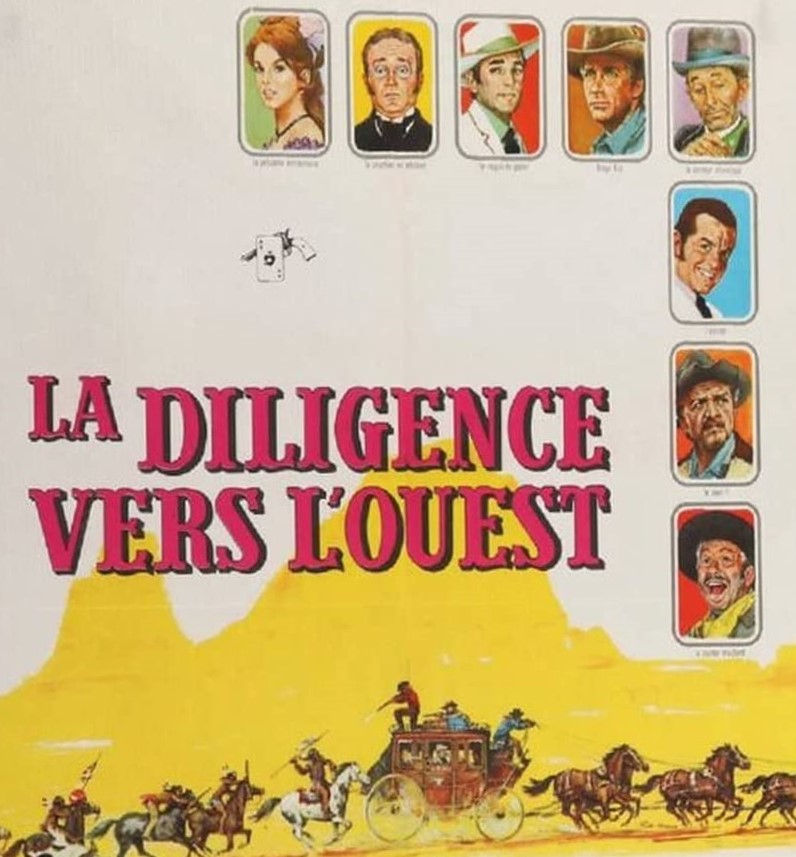
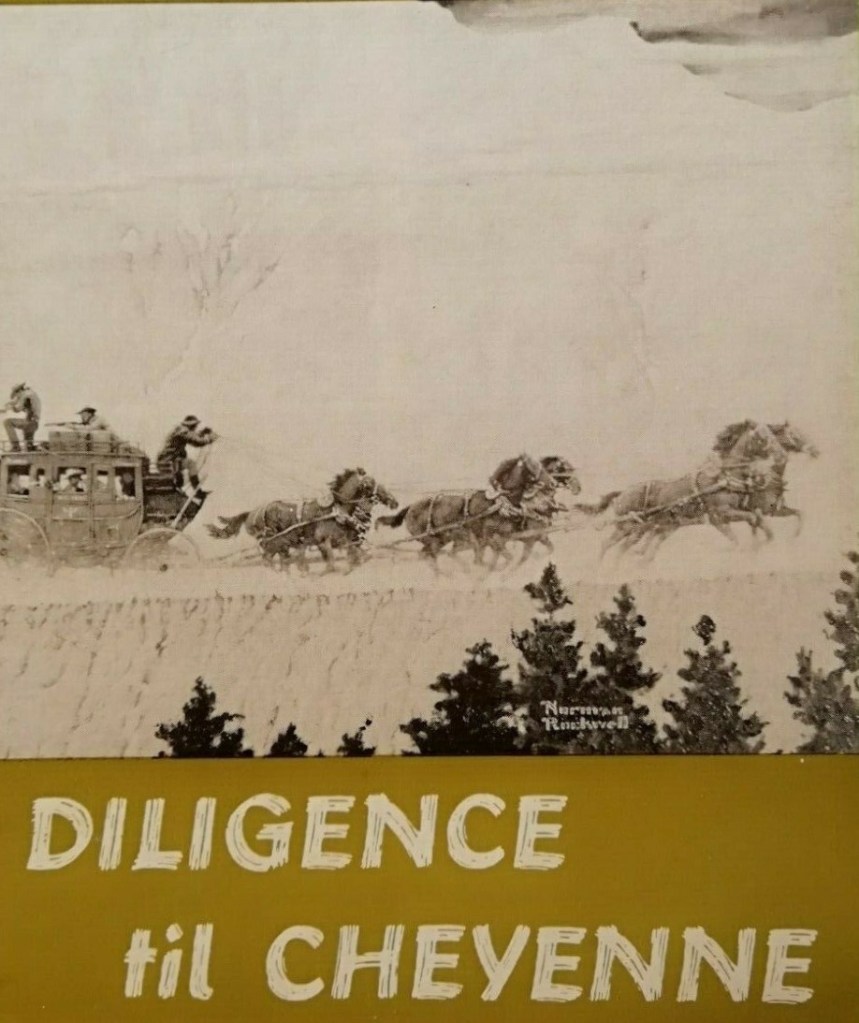
Stagecoach (1966) ****

It’s probably sacrilege to admit that I quite enjoyed this. Also it’s been so long since I’ve seen the John Ford original that I could remember very little of the specifics and I haven’t seen the remake before so this was just like watching a new movie. Basically, it’s the story of a group of six passengers taking the stagecoach to Cheyenne for different reasons who are joined by an escaped murderer and shepherded along by the driver and a town marshal. There is some excellent action but mostly it’s a relationship picture, how the characters react to one another and their response to crisis.

Good-time girl Dallas (Ann-Margret) is on the run, banker Gatewood (Bob Cummings) is hiding a stash of stolen money, alcoholic doctor Boone (Bing Crosby) is penniless, liquor salesman Peacock (Red Buttons) is a coward, gambler Hatfield (Mike Connors) has Civil War secrets, pregnant Lucy Mallory (Stefanie Powers) is meeting her cavalry husband in Cheyenne. The ornery Buck (Slim Pickens) is the driver and Curley (Van Heflin) is riding shotgun and when he comes upon stranded escaped murderer the Ringo Kid (Alex Cord) promptly arrests him.

The passengers have heard rumors of the Sioux on the warpath. The audience knows it’s not a rumor because the picture starts with the Sioux slaughtering camped cavalry. Soon enough, the passengers know it, too, coming across a patrol dead at a staging post, and of course they are soon battling for their lives when ambushed.

The drama unfolds as the characters confront each other or their own weaknesses. Dallas, who has a high old time as a saloon girl, is way out of her depth in respectable company, feeling out of place even dining with the others, hiding the secret of her affair with the married Gatewood. Ringo coaxes her along, bringing her out of her shell, giving her back self-respect, and of course falling in love. Curley, with his eyes on the $500 reward for bringing Ringo in, has no intention of letting the gunslinger take his revenge in Cheyenne on Luke Plummer (Keenan Wynn) who killed his family. Boone and Peacock are the most fun, the doctor spending most of his time separating the salesman from his cargo of booze.

There are endless permutations with a story like this, the kind of material that was mined in the disaster movies of the 1970s like Airport (1970) and The Towering Inferno (1974), a group of disparate characters forced to battle for survival. The action is only part of the deal. The picture only truly works if the characters are believable. For that, you need a heap of good acting. The audience could certainly rely on old dependables like Bing Crosby (The Road to Hong Kong, 1962) in his big screen swansong, Van Heflin (Shane, 1953), Red Buttons (Oscar-winner for Sayonara, 1957), Robert Cummings (Saboteur, 1942) and cowboy picture veteran Slim Pickens to put on a good show. But the main dramatic load was to be carried by relative newcomers Ann-Margret and Alex Cord.

Ann-Margret has made her name with sassy light-hearted numbers like The Pleasure Seekers (1964) and had only just stepped up to the dramatic plate with Once a Thief (1965). This was Alex Cord’s sophomore outing after Synanon (1965) and he was stepping into some mighty big boots, the odds stacked against him playing the role John Wayne made famous – and which turned John Wayne into a star. 

Amazingly, the casting works. Ann-Margret moves from feisty to restrained, meek to the point of being cowed, and for most of the film, far removed from the false gaiety of the saloon, seeks redemption. The trouble-making minx emerges only once, to knock the wind out of Mrs Mallory, but, after taking a tumble down the humility route, gradually steers her way towards a better self, preventing Gatewood from causing chaos, nursing Mallory and inching her way towards true feelings for Ringo. As in the best movies, it’s not for her to open up about her woeful life but for another character, in this case Ringo, to identify her flaws: “What you doin’ about your scars, you got ‘em even if they don’t show…when you goin’ to stand up and stop crawlin’?” When they finally kiss it is one of the most beautiful tender kisses you will ever see and most of that is down to Ann-Margret’s reaction.

I had already taken back all my reservations about Alex Cord’s acting skills that were mostly due to his moustachioed performance in Stiletto (1969) after seeing him in The Scorpio Letters (1967) and this is another completely different portrayal. As much as he can deliver on the action front, it’s in the dramatic scenes that he really scores, gentle, vulnerable, caring. He certainly matches the Duke’s trademark diffidence in terms of romance. There’s a point where the camera just holds on their faces to nine depth of expression and we are not disappointed.

Gordon Douglas (The Detective, 1968) is the director who had the gall to take on the remake, and he delivers a character-sensitive picture shaded with action. Written by Joseph Landon (Von Ryan’s Express, 1965) based on the original by Dudley Nichols and Ernest Haycox.

Pretty damn good effort.

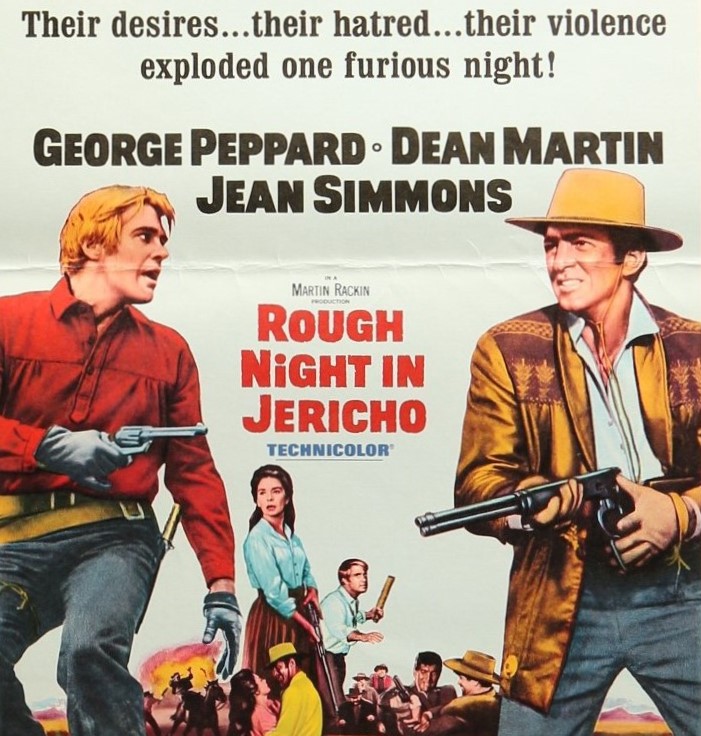
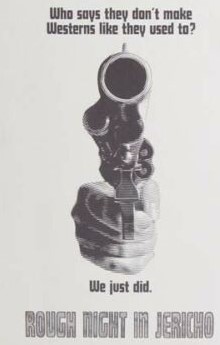
Rough Night in Jericho (1967) ****

Woefully under-rated western with three A-list stars at the top of their game in a taut drama with an explosive ending. Not surprising it was overlooked at the time with John Wayne duo El Dorado and The War Wagon, Paul Newman as Hombre and an onslaught of spaghetti westerns garnering more attention at the box office. Though a rewarding watch, be warned this is more of a slow-burn drama than a traditional western and both male leads play against type.

Former lawmen Dolen (George Peppard) and Ben Hickman (John McIntiyre) have invested in a stagecoach business owned by twice-widowed Molly Lang (Jean Simmons), just about the only business in Jericho in which Alex Flood (Dean Martin) does not have a controlling interest. Dolen’s first reaction on surmising Flood’s power is to quit, “stepping in’s a habit I outgrew.” And it’s not a bad approach given that Flood is judge, jury and executioner and apt to leave victims strung up to dissuade dissent.

Dolen and Flood have a great deal in common, moving from ill-paid law enforcement into business, Flood, having cleaned up the town, staying on the reap the profit. While Dolen avoids confrontation, Molly aims to stir up opposition, invoking ruthless reaction.

What’s unusual about this picture is it’s mostly a duel of minds, Dolen and Flood testing each other out, neither backing down even while Dolen intends quitting and when he happens to win a bundle in a poker game with Flood you have the notion that was somehow an inducement to help him on his way.  It’s a power game of sorts, too, between Dolen and Molly, she determined to give no quarter to the point of drinking him under the table.

But when violence occurs it is absolutely brutal, Flood’s knuckles bloodied raw as he batters a man foolish enough to challenge his rule of law, Dolen taking an almighty whipping from Yarbrough (Slim Pickens), Molly viciously slapped around by Flood for daring to look at Dolen. When Dolen does move into action it is with strategic skill, gradually reducing the odds before the inevitable shoot-out between respectable citizens and gangsters.

A good half century before the notion took hold, this is a movie as much about entitlement, about those doing the hard work receiving just reward, Flood, having risked his life to tame the town, deciding he should be paid more than a sheriff’s monthly salary. And the western at this point in Hollywood development had precious few female businesswomen in the vein of Molly.

Cover of the Pressbook

Both Dean Martin and George Peppard play against type. An unexpected box office big hitter through the light-hearted Matt Helm series, Martin explodes his screen persona as this vicious thug, town in his thrall, contemptuous of his victims, turning politics to his advantage, but still happy to hand out a beating when charm and chicanery fail. This is one superb, and brave, performance.

For Peppard, this picture is the bridge between the brash persona of The Blue Max (1966) and Tobruk (1967) and the thoughtful introspective characters he brought to life in P.J. / New Face in Hell (1968) and Pendulum (1969). Perhaps the most telling difference is a little acting trick. His blue eyes are unseen most of the time, hidden under the shade of his wide-brimmed hat. He is not laid-back in the modern sense but definitely unwilling to plunge into action, movement both confined and defined, a man who knows his limits and, no longer paid to risk his life, unwilling to do so.

Jean Simmons (Divorce American Style) is in excellent form, neither the feisty nor submissive woman of so many westerns, but clever and determined, perhaps setting the tone for later female figures like Claudia Cardinale in Once Upon a Time in the West (1969) and Raquel Welch in 100 Rifles (1969).

And this is aw-shucks Slim Pickens (Major Dundee, 1965) as you’ve never seen him before. John McIntire had spent most of the decade in Wagon Train but he punches above his weight as a mentoring lawman. If you are trying to spot any other unusual figures keep an eye out for legendary Variety columnist Army Archerd  who was a walk-on part as a waitperson.

More at home in television, director Arnold Laven took to the big screen on rare occasions, only twice previously during the decade for Geronimo (1962) and The Glory Guys (1965), but here he handles story and character with immense confidence and considerable aplomb. The direction is often bold – major incidents occur off screen so he can concentrate on the reactions of the main characters. There is a fabulous drunk scene, one of the best ever – plus an equally good hangover sequence –  the violence is coruscating, all the more so because it is not delivered by gun.

The screenplay by Sidney Boehm (Shock Treatment, 1964) and Marvin H. Albert (Duel at Diablo, 1966) swings between confrontation and subliminal menace.

Stagecoach (1966) ****

It’s probably sacrilege to admit that I quite enjoyed this. Also it’s been so long since I’ve seen the John Ford original that I could remember very little of the specifics and I haven’t seen the remake before so this was just like watching a new movie.

Basically, it’s the story of a group of passengers taking the stagecoach to Cheyenne for different reasons who are joined by an escaped murderer and shepherded along by the driver and a town marshal. There is some excellent action but mostly it’s a relationship picture, how the characters react to one another and their response to crisis.

Good-time girl Dallas (Ann-Margret) is on the run, banker Gatewood (Bob Cummings) is hiding a stash of stolen money, alcoholic doctor Boone (Bing Crosby) is penniless, liquor salesman Peacock (Red Buttons) is a coward, gambler Hatfield (Mike Connors) has Civil War secrets, pregnant Lucy Mallory (Stefanie Powers) is meeting her cavalry husband in Cheyenne. Ornery Buck (Slim Pickens) is the driver. Curley (Van Heflin) is riding shotgun and when he comes upon stranded escaped murderer the Ringo Kid (Alex Cord) promptly arrests him.

The drama unfolds as the characters confront each other or their own weaknesses. Dallas, who had a high old time as a saloon girl, is way out of her depth in respectable company,  concealing the secret of her affair with the married Gatewood. Ringo coaxes her along, bringing her out of her shell, giving her back self-respect, and of course falling in love. Curley, with his eyes on the $500 reward for bringing Ringo in, has no intention of letting the gunslinger take his revenge in Cheyenne on Luke Plummer (Keenan Wynn) who killed his family. Boone and Peacock provide the fun, the doctor spending most of his time separating the salesman from his cargo of booze.

There are endless permutations with a story like this, the kind of material favoured in  disaster movies like Airport (1970) and The Towering Inferno (1974) where disparate characters battle for survival. The action is only part of the deal. The picture only truly works if the characters are believable. For that, you need a heap of good acting. The audience could certainly rely on old dependables like Bing Crosby (The Road to Hong Kong, 1962) in his big screen swansong, Van Heflin (Shane, 1953), Red Buttons (Oscar-winner for Sayonara, 1957), Robert Cummings (Saboteur, 1942) and cowboy picture veteran Slim Pickens to put on a good show. But the main dramatic load was to be carried by relative newcomers Ann-Margret and Alex Cord.

Ann-Margret has made her name with sassy light-hearted numbers like The Pleasure Seekers (1964) and had only just stepped up to the dramatic plate with Once a Thief (1965). This was Alex Cord’s sophomore outing after Synanon (1965), the odds stacked against him making any impact in the role which turned John Wayne into a star. 

Amazingly, the casting works. Ann-Margret moves from feisty to restrained, meek to the point of being cowed, and for most of the film, far removed from the false gaiety of the saloon, seeks redemption. The cocky trouble-making minx emerges only once, to knock the wind out of Mrs Mallory, but, after taking a tumble down the humility route, gradually steers her way towards a better self, preventing Gatewood from causing chaos, nursing Mallory and inching her way towards true feelings for Ringo. As in the best movies, it’s not for her to open up about her woeful life but for another character, in this case Ringo, to identify her predicament: “What you doin’ about your scars, you got ‘em even if they don’t show…when you goin’ to stand up and stop crawlin’?” When they finally kiss it is one of the most tender kisses you will ever see.  

My reservations about Alex Cord’s acting skills were based on his moustachioed performance in Stiletto (1969) but I reversed my opinion after seeing him in The Scorpio Letters (1967) and this is another revelation. As much as he can deliver on the action front, and sports on occasion a mean-eyed look,  it’s in the dramatic scenes that he really scores, gentle, vulnerable, caring. He certainly matches the Duke’s trademark diffidence in terms of romance. That the camera can mine depths of expression from both faces proves the calibre of their acting.

If director Gordon Douglas (Rio Conchos, 1964) had more critical standing, his bold long opening aerial tracking shot over rugged forest, mountain and plain before reaching the stagecoach would have received the acclaim accorded Stanley Kubrick for a similar shot in The Shining (1980). The opening also makes it clear how far removed this is from the original, not just in colour obviously, but (although filmed in Colorado) in a different locale, Wyoming, rather than the arid Arizona of Monument Valley. After a brief glimpse of the stagecoach, Douglas switches to a cavalry troop making camp. A soldier going into a wagon is met by a hatchet in the head. The camera tracks the corpse’s blood as it flows down a stream where it alerts another soldier washing clothes. Before he can raise the alarm, he gets a lance in the back.

Where the passengers have heard rumors, quickly dismissed (“nobody got scalped by an old rumor”) of the Sioux (Apaches in the original) on the warpath, the audience has seen the cavalry troop slaughtered, so (in effectively a Hitchcockian device) provides the movie with the tension the on-screen characters initially lack The passengers soon grasp reality when they come across another patrol dead at a staging post, and eventually are battling for their lives when ambushed. But prior to that there is a tense sequence of leading the stagecoach across a narrow mountain ridge during a storm.

There’s a clever reversal before the Sioux onslaught. The passengers think they have seen soldiers approaching, but it is the Sioux wearing cavalry uniforms. There is no river to cross as in the original, but the chase along a mountainous path is breathtaking, aerial and tracking shots given full rein, ending in a shoot-out without (as in the original) the cavalry riding to the rescue.

Douglas has his work cut out with the drama, as various characters confront their issues, and his staging is superb, characters always given reason to move. Screenwriter Joseph Landon (Rio Conchos) borrowed material from the Dudley Nichols original but added and subtracted quite a bit.

At the time critical deification of John Ford had not begun and Hollywood was in a cyclical remake mood – new versions of Beau Geste and Madame X appearing the same year – so Gordon Douglas didn’t quite face a critical backlash, although praise was generally sparse. Judging by the box office it received an audience thumbs-up – as it does from yours truly.

You can rent this on Amazon Prime.

Discover WordPress

A daily selection of the best content published on WordPress, collected for you by humans who love to read.

The Atavist Magazine

by Brian Hannan

WordPress.com News

The latest news on WordPress.com and the WordPress community.