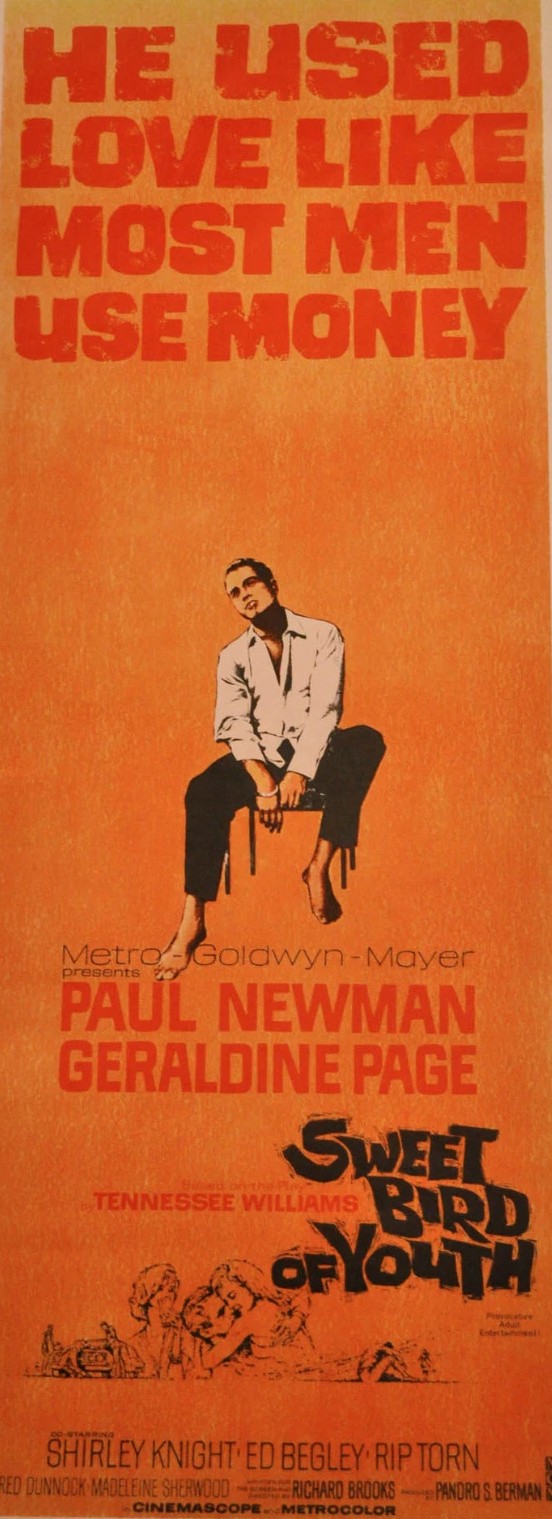
Behind the Scenes: “Sweet Bird of Youth” (1962)

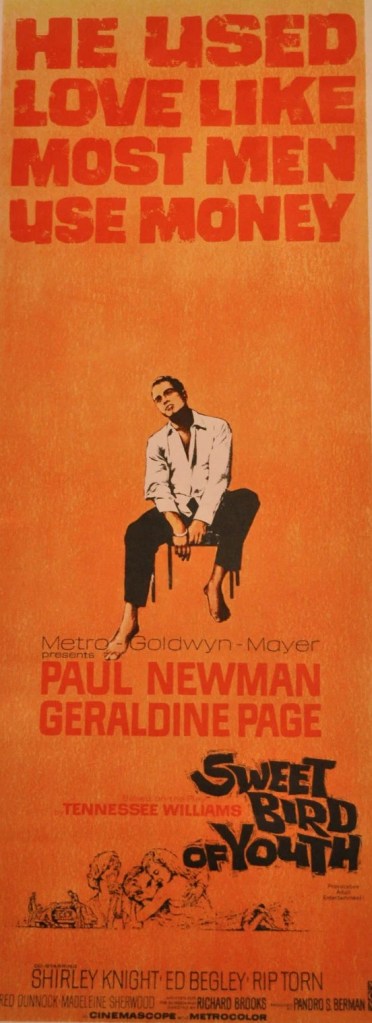
Writer-director Richard Brooks had built a reputation adapting heavyweight literary works – ranging from Dostoevsky’s The Brothers Karamazov (1958), Tennessee Williams play Cat on a Hot Tin Roof (1958) and Sinclair Lewis’s evangelism opus Elmer Gantry (1960) – the last two box office and critical hits –  and though he had Joseph Conrad’s Lord Jim in his sights he had a hankering after more simple fare. He planned to go out on his own and had paid $30,000 to acquire Arthur Woolson’s Goodbye, My Son focusing on mental health and $70,000 on The Streetwalker, written anonymously by a sex worker, and more nitty-gritty than the current stream of high-end good-time-girl pictures. The Streetwalker would take a semi-documentary approach. Brooks aimed for budgets around the $700,000 mark.

But in the end, he fell for the blandishments of producer Pandro S. Berman, for whom he had made Cat on a Hot Tin Roof, one of MGM’s biggest hits, and Paul Newman, who had played the part of Chance in the original Broadway play. It had run for nearly a year and the cast included Geraldine Page, Rip Torn and Madeleine Sherwood who reprised their roles in the film. Ed Begley had worked with Brooks on Deadline USA (1952).
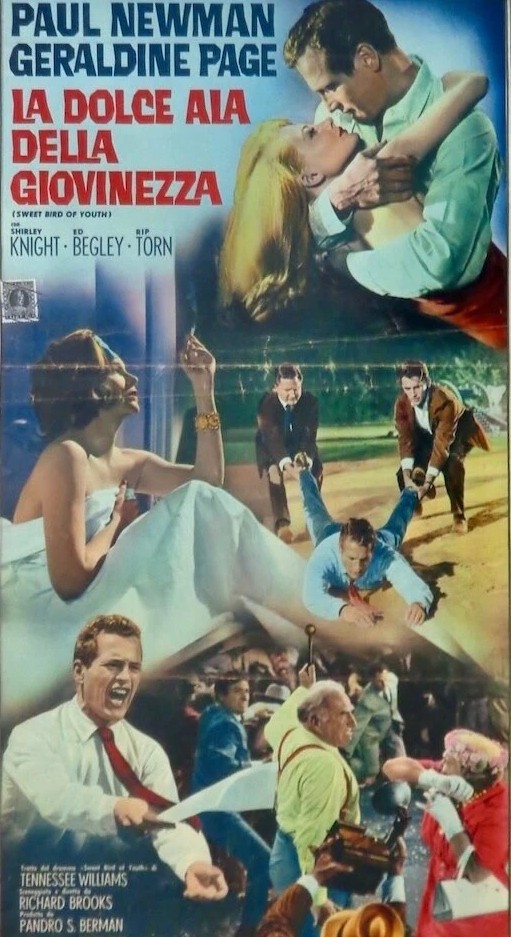
By this point Newman was rid of the shackles of his Warner Bros contract and spread his wings artistically and commercially, following up Exodus (1960) with Martin Ritt’s Paris Blues and the first of his iconic roles in Robert Rossen’s The Hustler. Newman was paid $350,000, half the total sum allocated to the cast. The play cost a total of $600,000 against a budget of $2.8 million. Even so, Newman’s stock was not as high as later in the decade and even with his name attached a film based on John Hersey’s The Wall about the Warsaw Uprising failed to get backing.

Brooks was reluctant to get back into the ring with Tennessee Williams, still smarting from the “repeated sniping” that followed Cat on a Hot Tin Roof. Brooks recalled that “during filming I talked with Tennessee on the phone a number of times and all was peachy.” But later the author complained Brooks had “butchered” the play. He was especially incandescent because Williams pocketed $1.4 million while the director made do with just $68,000. Brooks demanded “a signed letter written by Williams and published in Variety to the effect that he (Williams) liked the film version” before he agreed to helm Sweet Bird of Youth.
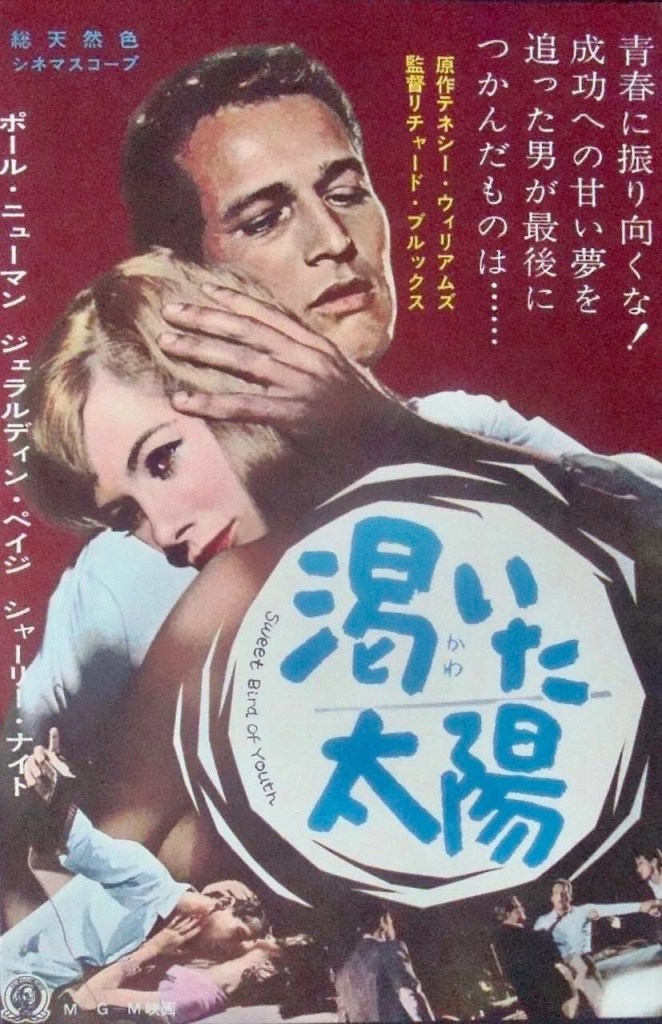
There’s no sign that Williams acquiesced and Brooks proceeded with his version which turned into flashbacks some of the incidents dealt with on stage through dialog.

“Most people go out to Hollywood with a seven-year contract to work,” noted female lead Geraldine Page, wryly, “It looks like I had a seven-year contract to stay away.”  A rising star when selected for the female lead for John Wayne 3D western  Hondo (1954), she didn’t make another movie for seven years, largely as the result of not being considered photogenic enough. For Hondo, a scene had been added, “in which she was called upon to acknowledge that she was not beautiful,” and that designation, although intended purely to reflect a self-deprecating character, stuck. Although another explanation for her absence was that she was blacklisted for her association with Uta Hagen, but it’s unlikely that noted right-winger Wayne would have employed her in the first place has that been the case.

Despite an Oscar nomination for Hondo, she made her way on the stage instead, to critical approval, New York Drama Critics Award and Tony nomination for Sweet Bird of Youth. After an Oscar nomination for another Williams adaptation Summer and Smoke (1961), her career was revived, after the industry “found out how to employ one of the top performing talents of the last decade.” No surprise, however, that she wasn’t MGM’s first choice. The studio preferred the likes of Ava Gardner, Lana Turner and Rita Hayworth, who would be doing little acting to portray themselves as fading stars.

“When I saw how they fixed me up (for Sweet Bird),” said Page, “I said, look at me I’m gorgeous.” Brooks made her get rid of “those fluttering gestures” that he reckoned “subconsciously were efforts to cover her face.”

Shirley Knight didn’t have to audition. She and Brooks met at the Oscar ceremony. All he asked of her was that she lighten and grow her hair.

“He was a man who really knew what he wanted,” recalled Knight, “He wanted you to do a certain thing and was clear about the look of it.” She was so in thrall to the director that she followed his instruction to the steer a boat in one direction even though she knew it would lead her to smash straight into a dock.

Given the controversial nature of the play, there were concerns the entire project would be blocked by the Production Code, the U.S. censorship body. But Berman was quick with the reassurance. He claimed it would be “the cleanest picture ever made…clean as any Disney film.”  To achieve that would require considerable trimming as the play involved abortion, hysterectomy and castration. Berman ensured these elements were eliminated. Brooks changed the ending.

Commented Williams, “Richard Brooks did a fabulous screenplay of Sweet Bird of Youth but he did the same f…ing thing (as Cat on a Hot Tin Roof.) He had a happy ending. He had Heavenly and Chance go on together which is contradictory  to the meaning of the play. It was a brilliant film up to that point.”

Actually, Brooks was undecided about the ending. He wanted to shoot two endings, one as unhappy as the play. “But once the ending was on film – the one the studio wanted – production was shut down.”

Newman was more relaxed about any changes. “You have to make peace with the idea when you make a motion picture version of a play, it’s so difficult and it’s no sense struggling with things that were in the play.” With enough controversy riding on the picture, the studio banned the actors from talking to the media.

Initially, box office expectations were high when the movie hit first run. A $72,000 first week take in New York was considered “boffo.” It scored “a lusty” $28,000 in Chicago, a “bang-up” $15,000 in Buffalo, a “brilliant” $28,000 in Los Angeles, a “lush” $14,000 in Pittsburgh, a “bright” $16,000 in St Louis, and a “wow” $17,000 in Detroit. It generated a “loud” $4,500 in Portland, a “wham” $15,000 in Minneapolis and was “sockeroo” in Washington DC with $21,000.

But once it left the rarified atmosphere of the big cities, it stumbled. There was precent, the touring production of the play had also flopped once it left the environs of Broadway. Variety reckoned the timing was to blame as audiences showed “more aloofness to this type of fare” than they did a couple of years before.

The movie limped to $2.7 million in rentals – and a lowly 30th spot on the annual rankings – at the U.S. box office though foreign was more promising, ninth overall in France and 10th in Italy.

SOURCES: Douglass K. Daniel, Tough as Nails, The Life and Films of Richard Brooks (University of Wisconsin Press). pp146-154; Daniel O’Brien, Paul Newman (Faber and Faber, 2005), pp86-7; Shawn Levy, Paul Newman, A Life  (Aurum Press, 2009), pp169-171; “Folks Don’t Dig That Freud,” Variety, May 9, 1960, p1; “Metro Hot for Brooks,” Variety, June 15, 1960, p2; “Sweet Bird of Youth Will Be Ok for Kiddies,” Variety, September 13, 1961, p5; “Brooks Prostie and Psycho Indies,” Variety, September 13, 1961, p4; Vincent Canby,  “Seven Years After Her Film Discovery, Geraldine Page May Be Accepted,” Variety, November 15, 1961, p2; “Picture Grosses”, March-May 1962, Variety; “Fun-Sex Plays, ‘Sick’ Slowing,” Variety, August 8, 1962, p11; “Big Rental Pictures of 1962,” Variety, Jan 9, 1963, p13; “Yank Films,” January 23, 1963, p18.
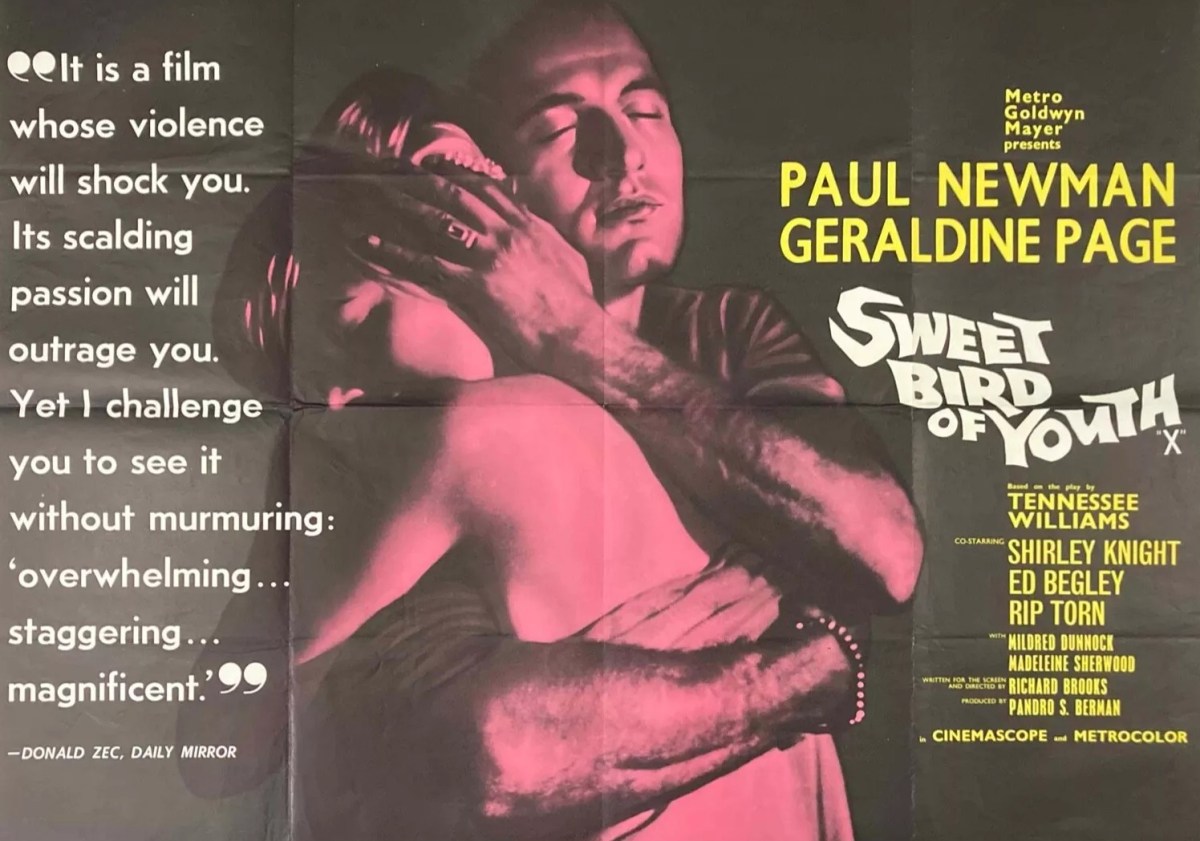
Sweet Bird of Youth (1962) ***

Tennessee Williams wrote better parts for women than he did for men. You can start with Vivien Leigh, Oscar-winner for A Streetcar Named Desire (1951) – Marlon Brando only nominated – and Anna Magnani Oscar-winner for The Rose Tattoo (1955) with Maria Pavan nominated and star Burt Lancaster left out of gong consideration. Carroll Baker and Mildred Dunnock were nominated for Baby Doll (1956) with star Karl Malden ignored. Paul Newman did receive an Oscar nomination for Cat on a Hot Tin Roof (1958) as did Elizabeth Taylor.

Montgomery Clift was frozen out of Oscar consideration for Suddenly, Last Summer (1959) while both Elizabeth Taylor and Katharine Hepburn scored nominations.  Marlon Brando received no Oscar recognition for The Fugitive Kind (1960). Ditto Laurence Harvey for Summer and Smoke (1961) though Geraldine Page and Una Merkel received nominations. Lotte Lenya was recognised with a nomination for The Roman Spring of Mrs Stone (1961).

So the omens were not particularly good for Paul Newman when he repeated the role he had essayed on Broadway of Chance Wayne in Sweet Bird of Youth. In the stage version, while he received respectable notices, it was Geraldine Page who picked up the glory, winning the New York Drama Critics Award and nominated for a Tony.

So it was going to be a long shot that Newman could outshine her in the film version, even though he received considerably more screen time – Page and Shirley Knight were nominated, Newman was not.

The flaws in the tale are more obvious in the screen version. On stage, sheer force of personality can win over an audience, on screen that’s more difficult. And in truth Chance was another of Williams’ male losers. The main difference between Williams’ male and female characters is that not only are the women more reflective and aware of their shortcomings while the men simply bulldoze ahead but they are more able to express their feelings without dialog.

Chance is a failed actor turned gigolo taking advantage of alcoholic over-the-hill movie actress Alexandra Del Lago (Geraldine Page), running away from what she believes will be her final and calamitous movie, who half the time doesn’t know where she is or who he is. Chance has dreams of using her to hustle his way into the movie business, blackmailing Del Lago over her drugs abuse to front a new picture, and begins knocking on doors, but long-distance, since he’s returned to his home town in the hope of winning back his childhood sweetheart Heavenly Finley (Shirley Knight), planning to set her up as a movie star.

Expectations that there might be a welcome for a young man made good are dashed when everybody continues to treat him as the waitperson he once was or wants to run him out of town. To protect his daughter from such an unworthy suitor, the town’s most prominent citizen and political heavyweight Tom Finley (Ed Begley) had previously managed to pay Chance to leave town. His son Tom Jr (Rip Torn)  shares his father’s aspirations.

Despite the odds Chance determines to woo Heavenly but his Hollywood dream is scuppered when Del Lago realizes that her last picture looks like becoming an unexpected success and she can once again write her own ticket rather than rely on a con man like Chance.

It doesn’t end well though, for reasons best known to him, writer-director Richard Brooks tacked on a happy ending – the play had an unhappy ending – that doesn’t ring true.

There’s nothing wrong with Paul Newman’s acting even if it didn’t attract the attention of the Oscar voters, but there’s not enough meat on the character. On the other hand, Geraldine Page and Shirley Knight (The Group, 1966) in part excel because their characters are better written. Rip Torn (Beach Red, 1967) develops his screen menace. Ed Begley’s (Warning Shot, 1966) over-the-top performance snagged him an Oscar.

The story’s just too thin and the hard edges of the play have been trimmed back so it was less appealing to an audience.

Lacks the usual Tennessee Williams bite but the female performances are well worth a watch.

I’m doing a Behind the Scenes article tomorrow so look out for that.

The Dark at the Top of the Stairs (1960) ****

Surprisingly frank, for the times, exploration of a failing marriage that tackles sexuality, racism, bullying, teenage angst. In those days there was no such concept as midlife crisis, so the general attitude of grin-and-bear-it results in a melancholy that suffuses the picture. Adapted from the Broadway hit by William Inge (Splendor in the Grass, 1961), provides more insight into American family life than the more souped-up soap operas of the Peyton Place variety. Except for crisis escalating action, could well have been misery memoir.

Opens with a surprisingly tender scene that’s again pretty raw for the period. In the morning, salesman husband Rubin (Robert Preston) strokes the arms and face of waking wife Cora (Dorothy McGuire), clearly hoping to initiate sex, when she abruptly rebuffs him. Before he sets off on a week-long business trip he tries to toughen up bullied friendless overly-mothered son Sonny (Robert Eyer), afraid of the dark, and bolster the flagging confidence of inhibited teenage daughter Reenie (Shirley Knight), only succeeding in inadvertedly punching his son in the face and triggering a row with his wife.   

But, without warning, he’s fired from his job and not equipped to compete in the employment arena with a flood of younger people with college degrees and greater stamina. Pride prevents him owning up to Cora, rejection sends him to the bottle and a lady friend, hairdresser Mavis Pruitt (Angela Lansbury) who scandalizes the town by (and this dates it) always leaving the top button of her blouse open. Cora plans escape, hoping to go and live, temporarily until she can find a job, with bossy sister Lottie (Eve Arden) in Oklahoma City.

Meanwhile, following an accidental meeting, the hesitant shy Reenie strikes up a rapport with the more outgoing confident Sammy (Lee Kinsolving). Lottie isn’t so keen to help out her beleaguered sister. When Rubin finally returns after a four-day absence it’s to a welter of home truths.

He still can’t bear to admit the loss of his job. The uneasy truce is shattered when Sammy is chucked out of a party he attends as Reenie’s escort at the country club for being a Jew. Subsequently, he attempts suicide and dies, leaving Reenie in shock. Cora determines to find out for herself the rumors concerning Rubin’s affair. But it turns out, although Mavis is deeply in love with Rubin, they’ve never slept together, providing Cora with a second chance to make her marriage work.

What distinguishes the movie is the revelatory dialog you’d expect from an award-winning playwright like Inge. Characters reveal their inner selves, not always with prompting, and not always in argument, and such lines often bring characters to life. Included in that are some of the subsidiary characters.

For example, Ralston (Ken Lynch) whom Rubin openly dislikes because he successfully got away with an insurance scam that turned him into a millionaire, hides away in the back room of a pharmacy, drinking away his guilt. “I know what I am. Who I am,” says Ralston, “the town scandal.” And you think this is maybe just a passing character, but this is the guy, guilt or no guilt, who enforces the country club ban on admitting Jews.

The controlling Lottie suspects her husband’s need for a long walk in the evening is to get away from the sound of her voice. Unusually, the sisters broach the subject of intimacy. Lottie confesses, “I never enjoyed it the way most women say they do.”

What’s keeping Cora and Rubin apart is their lack of intimacy, caused by their battles over money, the husband refusing to get into debt to satisfy his wife’s yearnings not necessarily for the finer things of life, but to avoid the endless scrimping and saving, getting maximum wear from a dress for the growing Reenie by turning it into a skirt.

Rudin laments, “Was a time you liked what I had…If you can’t remember sowing all those wild oats with me, I just plain give up.” Finally, they get to the crux of the matter (again bold language for the times). Rubin asks, plaintively, “How come you don’t enjoy sleeping with me any more?” Retorts Cora, “I can’t fight with you all day and then go to bed with you at night.”

If there is a flaw it’s some attitudes that will jibe with contemporary audiences. “If I had a real wife,” argues Rubin, “I wouldn’t have to go high-tailing it to Mavis Pruit.” And I winced at this particular line: “I wished someone loved me enough to hit me,” says a wistful Lottie hearing that, for the first time in his life, Rubin slapped his wife. Lottie clearly equates manliness and ardor with such violence.

But on the whole, the dialog is a cut above. I’m not sure how much came directly from the play itself and how much was added by screenwriters Harriet Frank Jr and Irving Ravetch (Hud, 1963). The opening certainly, such a situation might be mentioned in the play but a bedroom scene like that would never be staged.

More at home in the theater than on screen Robert Preston (he only appeared in five pictures the whole decade including The Music Man, 1962) exudes such energy as the salesman that you can see how denial of sex would destroy his self-confidence. Dorothy McGuire (Swiss Family Robinson, 1960) is excellent as the wife trying her best not to end up as a put-upon stereotype. Shirley Knight (Petulia, 1968) was Oscar-nominated, Angela Lansbury (The Manchurian Candidate, 1962) came across as too wise to be a loose woman, and Eve Arden (in her only movie of the decade) impresses as the bossy sister.

With such terrific material and an excellent cast, Oscar-winning director Delbert Mann (Buddwing/Mr Buddwing, 1966) doesn’t need to do much to guide this one home.

Well worth a look.

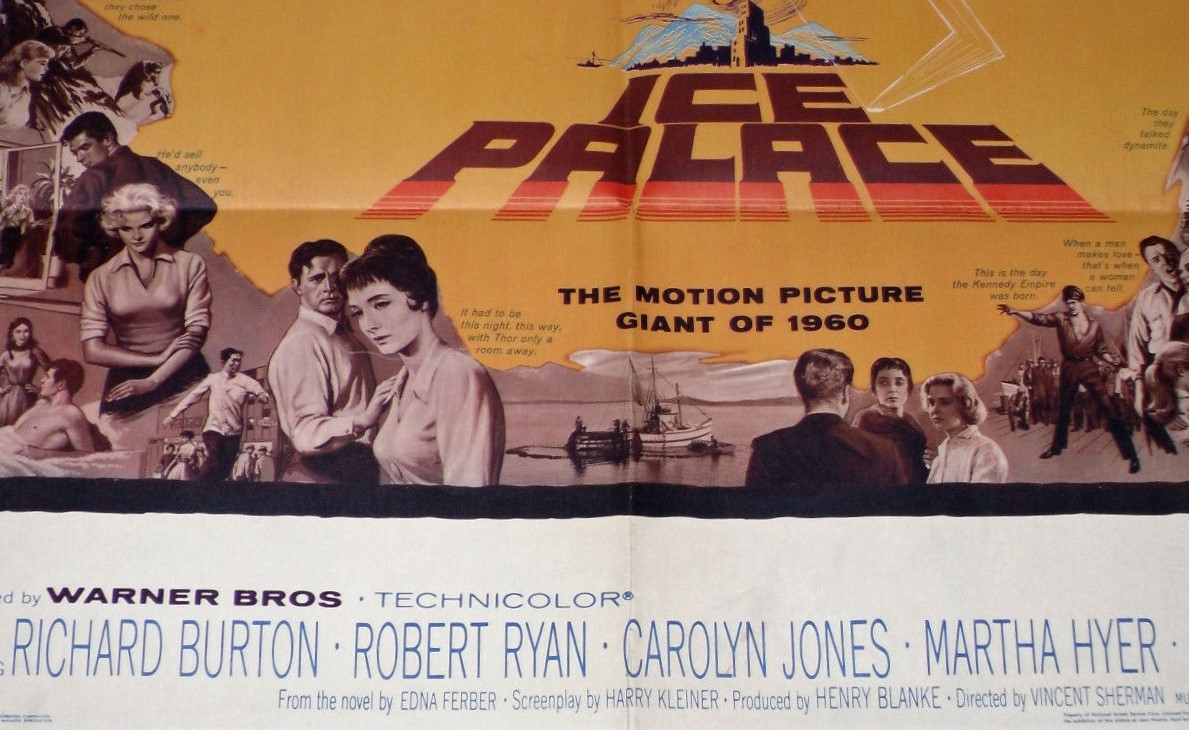
Ice Palace (1960) ***

Adaptations of sprawling novels require a firm hand at screenplay stage. Exodus (1960), for example, excised the first couple of hundred pages depicting the first two millennia  relating the history of the Jews in the Leon Uris bestseller. Hawaii (1966) sliced the James Michener epic in two, the sequel The Hawaiians (1970) taking up the slack. Otherwise, like here, you end up with a multi-generational sprawl.  

The producers clearly felt that the endzone – two grandfathers warring over a grand-daughter that was also  somehow a metaphor for the battle for Alaskan statehood – was too good to miss. Except author Edna Ferber (Giant, 1956) had already dealt with that problem, in her book beginning at the end, where feminist icon Christine Storm is given a voice and the story unfolds in flashback. Instead, it’s Christine who has to wait ages to make an appearance and scarcely in the manner outlined by the novelist.

Initially, ex-World War One soldier Zeb (Richard Burton) and Alaskan fisherman Thor (Robert Ryan) become friends after the latter saves the former from drowning, Zeb having lost his job in a cannery for fancying boss’s daughter Dorothy (Martha Hyer). The pair then decide to go into business together, Thor catching the salmon, Zeb canning them. But illicit love tears the incipient partnership apart, Thor’s fiancée Bridie (Carolyn Jones) falling for Zeb.

Finding banks are against funding a nobody, Zeb hits the mother lode in capitalizing his business by marrying the wealthy Dorothy, while a distraught Thor hits the snowy wastes and returns with an Eskimo son. Bridie hangs around long enough to sew the seeds of suspicion and take a hand in bringing up the baby, though holding back on the marriage that might seal the deal.

So then we are quickly onto the second generation. Thor’s son Einer (Barry Kelley) and Zeb’s daughter Grace (Shirley Knight) elope to the snowy wastes where, guess what, she gets pregnant, but, guess what, he is killed by a bear and she dies giving birth to Christine (Diane McBain).

So that takes us to the final act, Dorothy now also conveniently dead, grandfathers sharing custody, and the metaphor for the birth of Alaska in full swing. Zeb, now  a greying ruthless industrialist who finds it easier to feed his multiple canneries by catching fish in traps as they exit the Alaskan rivers, opposes statehood, fearing legislation will curb his entrepreneurial tendencies and that, more to the point, he will be hardest hit by the taxation required to fund the government apparatus. Thor, meanwhile, has turned greying politician, fighting Zeb every inch of the way, Christine now mere collateral damage.

An Australian daybill hence the date “1961” rather than “1960”
the date it appeared in the U.S.

It’s certainly a full-throated melodrama, and might have worked better if it had skipped a generation and got to the warring grandparents sooner, or worked the love triangle up to a higher pitch, but that might have felt like the bloodbath required to kill off Dorothy, Einer and Grace would have looked even more calculated. And it could have done with more actual high drama, fishermen battling mighty waves on the high seas, for example, as in The Perfect Storm (2000), and to be honest watching caught salmon shooting along cannery travelators is no substitute.

The other problem is that neither Richard Burton (Becket, 1964) nor Robert Ryan (The Wild Bunch, 1969) has settled into their screen persona. In the former’s case it’s the voice. Except in fleeting instances, we are deprived of his whisky-sodden sonorous tones. In the latter it’s the stillness, all the work done with the eyes or a grimace instead of an overworked marionette, body jumping, arms pumping. In both cases, and with the entire cast for that matter, there’s over-reliance on flashing eyes, a mainstay of overwrought melodrama.

If you’re searching out subtlety you’d have to watch the women, the look on Dorothy’s face on first meeting Bridie and recognizing a rival, the various expressions on Bridie’s face – for virtually the whole picture – as she observes the unobtainable Zeb grow even more distant, and Grace as she realizes she is being duped into a marriage of political convenience. And with so much story to pack in, the best scene in the picture just whizzes by, when, in the absence of the town doctor, Bridie is called upon to be  midwife to Zeb’s child, knowing that it should, if only she had the courage at the time, be hers.

The Alaskan statehood element was, I imagine, lost on non-American audiences, the statehood metaphor probably lost on everyone except discerning critics, and as far as I can work out from the box office nobody anywhere gave two hoots for the picture. Bear in mind Richard Burton was far from a major star, having burned his boats after star-making roles in The Robe (1953) and Alexander the Great (1956) failed to provide the necessary glue to bind actor and moviegoer.  In fact, Burton was so little in demand he was scarcely making a movie a year – and only The Robe entered positively in the box office balance sheet – until Cleopatra (1963) revived his career.

So with a cut-price Burton and an over-extended Robert Ryan there’s little the women can do to rescue the picture, though Carolyn Jones (How the West Was Won, 1962), Martha Hyer (The Sons of Katie Elder, 1965), the debuting Diane McBain (Claudelle Inglish, 1961) and Shirley Knight (The Group, 1966) put in more heartfelt performances.

Vincent Sherman (A Fever in the Blood, 1961) directed from a screenplay by Harry Kleiner (Bullitt, 1968). One look at the gem George Stevens created from Giant and all you can see here is missed opportunity.

The Group (1966) ***

The ensemble picture provided a showcase for new talent. But consider the gender imbalance at work. Only Candice Bergen proved a breakout star of any longevity compared to a flop  like The Magnificent Seven (1960) from which six relative newcomers – Steve McQueen, James Coburn, Charles Bronson, Robert Vaughn, Eli Wallach (only his fourth movie) and Horst Buchholz – became top-billed material.

Part of the problem was Hollywood itself, not enough good roles for actresses who weren’t destined for spy movies or to become a decorative supporting player, and who could not headline a western, war picture or (with the exception of Bonnie and Clyde) a hardnosed crime movie. But part of the problem was the structure of The Group. Yes, there’s a 150-minute running time, but there are eight main characters to contend with.

And the story doesn’t have a central focus like The Magnificent Seven where characters are built in asides to the main action but has to meander in eight different directions. Luckily, it still remains a powerful confection, tackling, as if setting out to shock audiences,  contentious issues like mental illness, leftwing politics, birth control and lesbianism. What could easily have descended into a chick flick or a glorified soap opera instead pushes in the direction of feminism.

A bunch of wealthy privileged university female graduate friends sets out in the 1930s to change the world only discover, to their amazement, that the male-dominated dominion  chews them up and spits them out.

Only Lakey (Candice Bergen), who prefers the company of women, appears to find fulfilment but that’s mostly from running off to the more liberated Paris at the earliest opportunity to study art history though the Second World War puts an end to that.

Kay (Joanna Pettet) seems to have made the best marriage, with a wannabe alcoholic writer (Larry Hagman), but she ends up in a mental asylum. Dottie (Joan Hackett) also views life in the art world, marrying a painter, as the best option only to later prefer a more mundane husband.  Priss (Elizabeth Hartmann), the strongest-minded of the octet, lands a man of a stronger, controlling, character.  

Polly (Shirley Knight) is the most sexually adventurous. Ostensibly, Helena (Kathleen Widdoes), a renowned traveller, and Libby (Jessica Walter), a successful novelist, appear to achieve the greatest independence and success but come up short in that most important of endeavors, romance. The men, you should be warned, are all one-dimensional scumbags.

The movie focuses mainly on Kay, Polly and Libby. Lakey shows up at the beginning and the end.

At its best, it’s an insight into the world of women, on a grander scale than any of the tear-jerkers of previous decades. But it suffers from too many characters and too little time. It might have been better as a mini-series, though that, obviously, was not an option at the time. The Sidney Buchman (Cleopatra, 1963) screenplay fails to match the intensity of the critically-acclaimed source novel by Mary McCarthy, a huge bestseller.

It’s a surprising choice for Sidney Lumet (The Pawnbroker, 1964), more mainstream than his general output, but while he clearly presents the characters in sympathetic fashion, his hallmark tension is missing.

Mostly, it works as a time-capsule of a time-capsule, a movie about the 1960s optimism of 1930s optimism, and the obstacles faced by both.

Only Candice Bergen (Soldier Blue, 1970) approached the level of success achieved by The Magnificent Seven motley crew, achieving top-billed status in a number of films and her screen persona, possibly as a result of this movie, was often independence. Leading lady in Will Penny (1968) and Support Your Local Sheriff (1969) was the height of success for Joan Hackett.

Already twice Oscar-nominated as a Supporting Actress, Shirley Knight was the best-known of The Group, but was only thereafter top-billed once, in the low-budget Dutchman (1966) although she won critical plaudits for The Rain People (1969).

An Oscar nominee for her debut A Patch of Blue (1965), Elizabeth Hartmann was top-billed in You’re A Big Boy Now (1967) and then fell into the supporting player bracket. Never top-billed, Joanna Pettet was a strong co-star for the rest of the decade but that was marked by flops like Blue (1968) and The Best House in London (1968) and she drifted into television.

Best known for Number One (1969) and Play Misty for Me (1971) Jessica Walter failed to achieve top-billing. Though, as a result of this review, it has been pointed out to me (thanks Mr Film-Authority) that I glossed over her brilliant performance in television show Arrested Development (2003-2019); in fact, if your search for her on imdb that TV series is the one that pops up first.

Most of the actresses did have long careers, sustained by leading roles in television or bit parts in movies but when you consider the success visited upon the group known as The Magnificent Seven  you can’t help thinking this was a whole generation of talent going to waste because they could not be accommodated by the Hollywood machine and did not fit the industry prototype.

For another example of gender disparity you could compare the consequent comparative success of the stars of Valley of the Dolls and The Dirty Dozen, both out the following year.

Flight from Ashiya (1964) ***

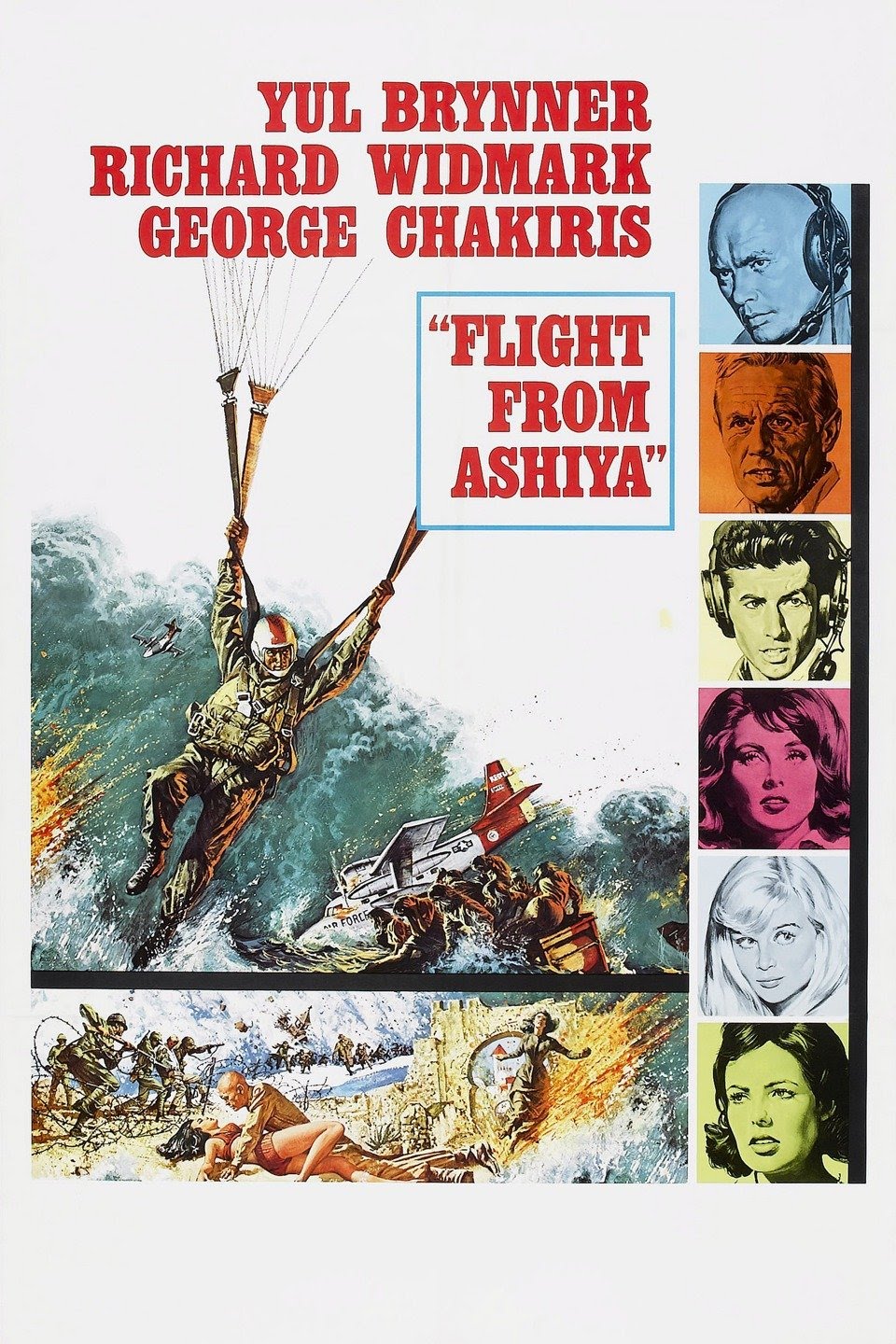
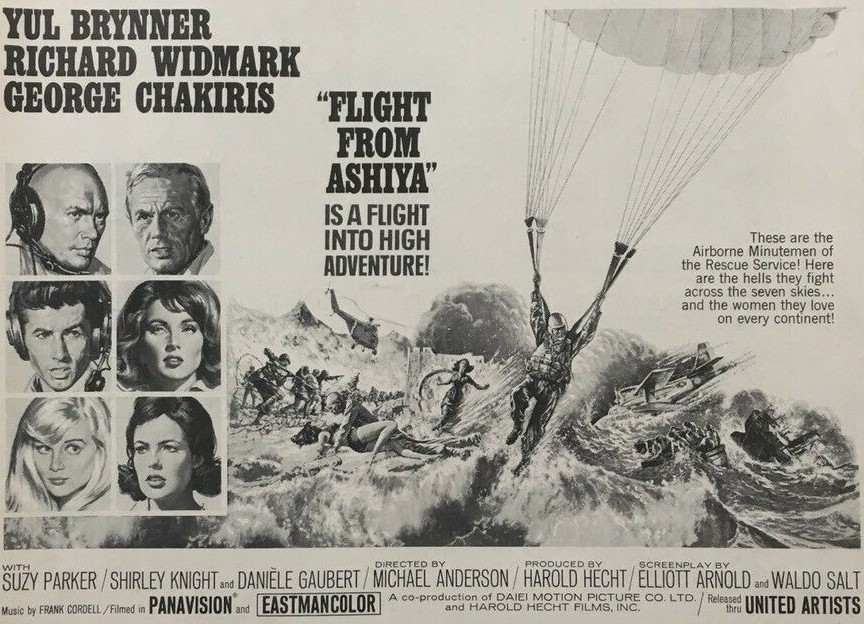
A post-WW2 operation to save a handful of Japanese adrift at sea in a storm is endangered when three members of the U.S. Air Force Air Rescue Service confront conflicts from their past. Despite tense rescue action, this is basically a three-hander about guilt and how men deal – or fail to deal – with emotions. Extended flashbacks illuminate the tangled relationships between Yul Brynner, Richard Widmark and George Chakiris.

So really it’s like one of those portmanteau films that were occasionally popular – like Trio (1950) made up of Somerset Maugham short stories or the more recent The VIPs (1963) or The Yellow Rolls Royce (1964). Each of the episodes stands up in its own right, actions taken in the past having a direct bearing on the present situation. Chakiris is haunted by causing an avalanche after flying his helicopter too close to a mountain and by having to leave behind many of the victims, due to restricted capacity on board, and now he is terrified of flying solo. 

As a consequence, Widmark has no faith in abilities as a pilot. Widmark has an ongoing hatred of the Japanese – colleague Brynner of Japanese ancestry also bears his wrath – because his ill wife (Shirley Knight) and child died in a Japanese prisoner-of-war camp where medical supplies were reserved for the Japanese. Faced with rescuing Japanese, he is enraged.  For his part, Brynner, as a paratrooper during the war, inadvertently caused  the death of his Algerian girlfriend.

It’s not so much an examination of tough guys under pressure as about their inability to deal with the consequences of action. There’s certainly a sense that the only way men like these have of dealing with trauma is to throw themselves further into harm’s way. Unusually, at a time when product was in short supply and for a film boasting a strong cast, the picture was shelved for two years after completion. Michael Anderson (Around the World in 80 Days, 1956) directed.

The title’s a bit of a misnomer, suggesting someone is trying to escape from Ashiya when, in fact, that is just the name of the air base where the rescue team are located. Critics complained it was neither one thing nor the other, but in fact I found it a perfectly satisfactory combination of action and drama, especially as it dealt with rarely-recognised male emotions.

Many of the films from the 1960s are to be found free of charge on TCM and Sony Movies and the British Talking Pictures as well as mainstream television channels. But if this film is not available through these routes, then here is the link to the DVD and/or streaming service.

Discover WordPress

A daily selection of the best content published on WordPress, collected for you by humans who love to read.

The Atavist Magazine

by Brian Hannan

WordPress.com News

The latest news on WordPress.com and the WordPress community.