Behind the Scenes: Sherlock Holmes and Other Stories, Thumbs Up or Thumbs Down, United Artists 1966 – Part Two

Although Billy Wilder had written a script based on The Life of Sherlock Holmes, he was not considered as its director. Mirisch was looking at a budget in the region of $2 million, which would rule out any big star. However, there were issues with the Conan Doyle Estate which was in the process of firing up other movies based on Sherlock Holmes, A Study in Terror (1965) being the most recent. That had been the brainchild of Henry Lester and perhaps to general astonishment these days Mirisch had  agreed Lester would be allowed to make more Sherlock Holmes pictures as long as they remained very low-budget, on the assumption, presumably, that the marketplace would treat them as programmers rather than genuine competition.

However, Mirisch and UA retained the upper hand as regards the Conan Doyle Estate and “could cut him (Lester) off at such time as we have made definite plans to proceed.”

There was another proviso to the deal. The Estate would agree to forbid any further television productions unless Mirisch decided it wished to go down the small screen route itself. It was odd that Mirisch had eased Billy Wilder out of the frame given the mini-major had enjoyed considerable success with the director on Some Like it Hot (1959) and The Apartment (1960), a commercial partnership that would extend to The Fortune Cookie (1966).

Instead, Mirisch lined up British director Bryan Forbes who would be contracted to write a screenplay based on the Wilder idea. The sum offered – $10,000 – was considered too low, but it was intended as enticement, to bring Forbes into the frame as director. If Forbes refused to bite, “the only other name suggested and agreed upon was that of John Schlesinger.”  Although David Lean was mooted, UA were not in favour. Mirisch didn’t want to risk paying for a screenplay before there was a director in position.

The offer of the Sherlock Holmes picture was seen as a sop to Forbes. At this meeting, Mirisch had canned The Egyptologists, a project which Forbes believed had been greenlit. And why would he not when he was being paid $100,000 for the screenplay. In bringing the project to an untimely close Mirisch hoped to limit its financial exposure to two-thirds of that  fee. Should Forbes balk at Sherlock Holmes, he was to be offered The Mutiny of Madame Yes, whose initial budget was set at $1.5 million, plus half a million for star Shirley Maclaine. Another Eady Plan project, this was aimed to go before the cameras the following year. If Forbes declined, then Mirisch would try Norman Jewison with Clive Donner and Guy Hamilton counted as “additional possibilities.”

As for Billy Wilder he had much bigger fish to fry. He was seeking a budget of $7.5 million to adapt into a film the Franz Lehar play The Count of Luxembourg to pair Walter Matthau and Brigitte Bardot. Should Matthau pass, Wilder would try for Cary Grant (whose retirement had not yet been announced) or Rex Harrison. Both sides played negotiation hardball. UA currently in the hole for $21 million for The Greatest Story Ever Told (1965) and Mirisch, having pumped $13 million into the yet-to-be-release Hawaii (1966), didn’t want to commit to another unwieldy expensive project. So Mirisch insisted the project advance on a “step basis” allowing UA to reject the project after seeing the screenplay. Wilder countered by insisting that if it went into turnaround he, rather than the studio, would have the right to hawk it elsewhere (generally, studios tried to recover their costs if a movie was picked up by another studio). But Wilder was also in placatory mood and even if UA rejected this idea he was willing to work with the studio on a Julie Andrews project called My Sister and I.

However, UA and Mirisch were all show. “After Billy left the meeting,” read the minutes, “it was agreed we would not proceed with The Count of Luxembourg since we did not want to give Billy the right to take it elsewhere if United Artists did not agree to proceed.” Harold Mirisch was detailed to give Billy the bad news, but use a different excuse.

Mirisch was also on the brink of severing links with Blake Edwards. Negotiations for a new multiple-picture deal were to be terminated, which would mean the director would only earn his previous fee of $225,000 for What Did You Do in the War Daddy? It was also sayonara for Hollywood agent Irving Swifty Lazar, whose current deal was not working out to the studio’s satisfaction.

Other long-term deals with directors were under discussion. While its previous John Sturges movie, The Hallelujah Trail (1965), had flopped, UA was still keen on the Mirisches pursuing a long-term deal with the director, feeling that he was a “good picture-maker with the right project.” To that end, it was suggested Mirisch reactivate Tombstone’s Epitaph, but emphasising Stuges had to bring the cost down.

At this point nobody knew Norman Jewison was embarking on all almighty box office roll – The Russians Are Coming, The Russians Are Coming set to hit the screens, In the Heat of the Night at screenplay stage, so Mirisch was prescient in trying to put together a long-term deal with the director. Wind on Fire and Garden of Cucumbers were seen as tentpoles for a multi-picture deal. Mirisch had already agreed a $50,000 producer’s fee for Wind of Fire, payment of one-third of which was triggered for supervising the screenplay.

The meeting also gave the greenlight to Death, Where Is Thy Sting-A-Ling, a project that would be later mired in controversy with shooting ultimately abandoned. The go-ahead was given with the proviso the Mirisches secured the services of Gregory Peck or an actor of his stature.  Budget, excepting Peck’s fee, was just over $3 million and it was another one hoping to take advantage of the Eady Plan.

This kind of production meeting was probably more typical than you would imagine, studios trying to keep talent sweet while not committing themselves to dodgy product. It’s perhaps salutary to note that of the projects under discussion, only a handful found their way onto cinema screens. Garden of Cucumbers (as Fitzwilly), How To Succeed in Business, having met budget restraints, and Tombstone’s Epitaph (as Hour of the Gun) with James Garner all surfaced in 1967 and Inspector Clouseau the following year. Neither of the Steve McQueen projects survived nor the pair proposed by Billy Wilder. High Citadel, Saddle and Ride, The Narrow Sea, The Great Japanese Train Robbery, and The Cruel Eagle failed to materialize. Billy Wilder eventually made The Private Life of Sherlock Holmes under the Mirisch auspices but not until 1970. 

Sherlock Holmes and the Deadly Necklace (1962) **

Sir Arthur Conan Doyle would be turning in his grave. Workmanlike at best, awful at its worst, or a “so-bad-it’s-good” candidate? Christopher Lee goes through the motions, there’s an oddly inserted heist, the continuity goes haywire, and the deduction would not have troubled a child. Even the great sleuth having to match nemesis Moriarty in cunning fails to lift this turgid tale. Despite being made in Germany, all the actors, save Senta Berger, appear injected with a fatal dose of stiff upper lip.

A corpse in the water alerts Sherlock Holmes (Christopher Lee) to the presence of Moriarty (Hans Sohnker) who is hunting Peter Blackburn (Wolfgang Lukschy) who has appropriated Cleopatra’s necklace from an archaeological dig. This takes them to Hampshire where corpses abound but the necklace is gone. Holmes burgles Moriarty’s apartment and steals back the necklace which is sent, in heavily protected police van, to an auction house. Holmes outwits Moriarty by infiltrating the heist the villain has planned.

The best scene comes at the beginning when boys throw stones at something floating in the Thames only to discover it’s a corpse. After that, you can choose from any number of bad scenes. Where do you start? The disguises? Holmes is first seen wearing a false nose to pass himself off as dock worker. An eyepatch is enough to convince Moriarty’s henchmen that Holmes in one of their kind. Bare-handed, Holmes kills an obviously plastic snake. To find out what Moriarty is up to, they listen down a chimney!

The deduction is so awful Dr Watson (Thorley Walters) could have done it. A dying man who manages to whisper one word is unable to whisper two and instead still has the strength to flap his hands in a way that any child in the audience familiar with shadow play would have known signaled a bird. Holmes follows bloody footsteps over grass in the darkness. The hands of a corpse are too calloused to be a high-class gentleman. And that’s as much of the detective’s genius as is on show. Moriarty, who is meant to be ever so bright, offers Holmes £6,000 a year to enter into a criminal partnership with him.

Did I mention the continuity? Holmes, in docker’s disguise, turns up outside his apartment lying on the pavement calling for help. Wounded, perhaps? A bit of a joke? We never find out. Once inside, he just turns back into Sherlock Holmes. In the middle of the Hampshire countryside,  Scotland Yard’s Inspector Cooper (Hans Neilsen) turns up in a trice.

The film has also been dubbed so the performances are all flat except that of Ellen Blackburn (Senta Berger), the only character who injects emotion into the picture. Everybody else is wooden. Christopher Lee bases his entire interpretation of Holmes on his costume, deerstalker prominent and always puffing on his pipe. Austrian Senta Berger at least shows promise and manages to project some personality into her small part.

Made in a Berlin studio, with some location work in Ireland, this German-made movie has a screenplay by Curt Siodmak (The Wolf Man, 1941), purportedly based on the Conan Doyle tale The Valley of Fear. British director Terence Fisher (Sword of Sherwood Forest, 1960) is generally assumed to have helmed this project but the actual credits on the picture have him sharing duties with Frank Winterstein, so perhaps Fisher can be absolved of the complete blame.  

The so-bad-it’s-good category had obviously not been invented in the early 1960s so this picture was shelved in Britain for six years, although shown in Germany and France before then.

CATCH-UP: If you’ve been tracking the often subtle performances – for a glamour queen – of Senta Berger through the Blog, you can also check out my reviews of The Secret Ways (1961), Major Dundee (1965), Cast a Giant Shadow (1966), The Quiller Memorandum (1966), and Bang! Bang! You’re Dead (1966). If you’re a Berger fan or fast becoming one to can see one of her later performances in Istanbul Express (1968) which, by coincidence, is reviewed tomorrow.

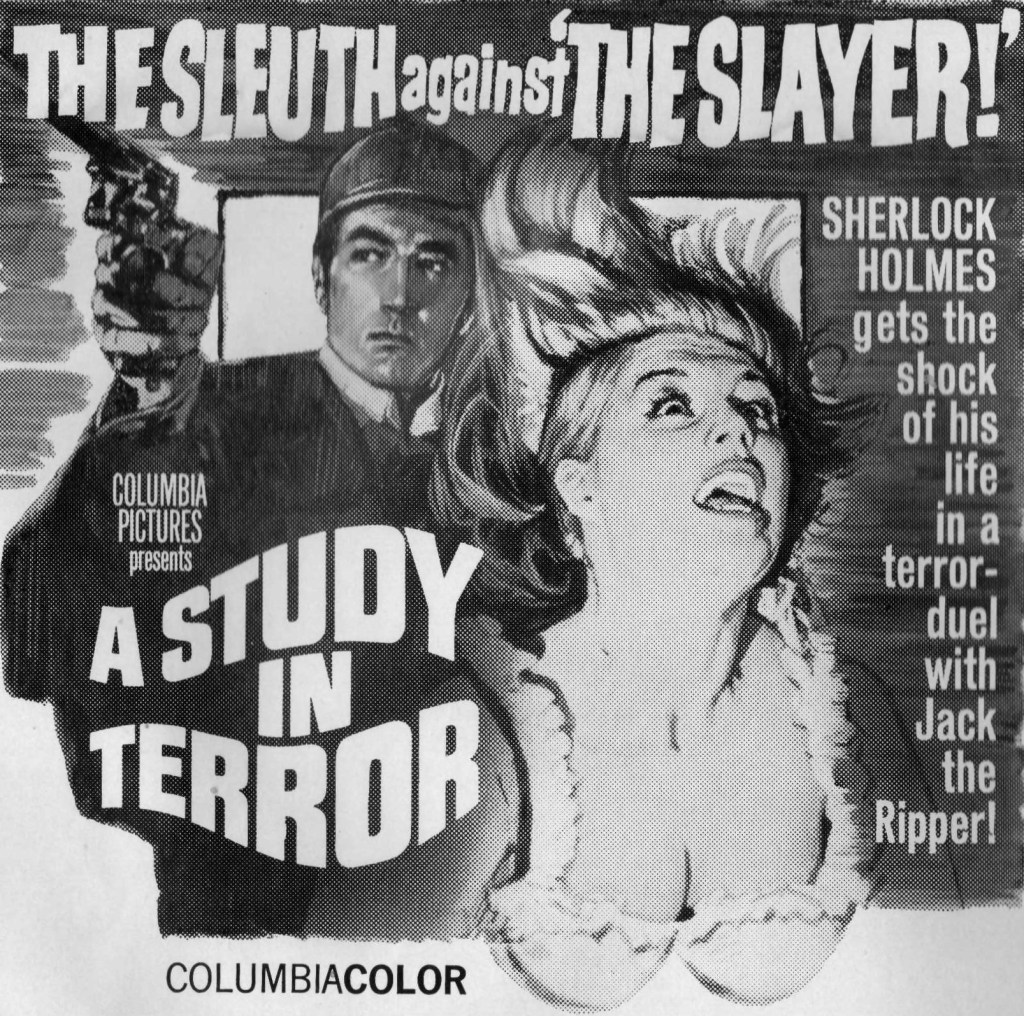
Selling Sherlock Holmes – The Pressbook for “A Study in Terror” (1965)

This is one of my favorite pressbooks because the marketing concept is so wacky and clearly an ill-advised attempt to cash in on the crime-busting efforts of television’s latest sensation Batman which had aired on the small screen in January 1966 and on the big screen in July of that year, a month before A Study in Terror found its way into U.S. theaters.

Rather than merely adapting the British exhibitors manual – the film had been released in Britain in October 1965 – Columbia, clearly deciding the movie was too old hat for American audiences, aimed to hijack some of the ideas currently being used for the Twentieth Century Fox television series/movie.

So potential moviegoers were treated to bizarre taglines such as “here comes the original camp-counsellor-in-a-cape” and “Flyaway Batman!” complete with the “Bam!” “Biff” and “Crunch” opticals that had become synonymous with the Batman television series. Not  content with that, the advertising team invoked Superman as well with a spoof tagline: “faster than a speeding computer…able to leap tall tales in a single stroke of genius.” A third  famous character was drawn into proceedings – “He’s James Bond in a cape.”

Also referenced was a famous movie campaign from two decades before. “Sherlock Holmes is Back and Jack the Ripper’s Got ‘Im” echoed the legendary tagline that welcomed Clark Gable back to the movies after his war stint “Gable’s Back and Garson’s Got Him.”

Interestingly, although exhibitors were supplied with a choice of several taglines, the core advertising image – a pistol-packing Holmes above a busty screaming victim – remained the same, contrary to the normal practice of devising a number of advertisements that allowed the exhibitor to choose the one most relevant to their customer base.

Outside of the spoof Batman ads, the campaign focused on the clash between the master sleuth and the villain. Other taglines spelled it out: “Sherlock Holmes takes on Jack the Ripper” / “Sherlock Holmes meets Jack the Ripper in a mad, mad thriller” / “Sherlock Holmes strikes back at the foulest fiend of them all, Jack the Ripper” and “The sleuth versus the slayer.”

Supplementary taglines were occasionally included: “girl after girl, he gives a new twist to the world’s oldest profession” / “the most savage killer of the century and the screen screams with suspense” / “the battle of wits is as terror sharp as the murder weapon.”

With copyline writers doing overtime, the Pressbook clocked up over 15 separate adverts. Pictorially, the emphasis appeared to be on cleavage and brutal murders of women.

With a virtual cast of unknowns, the Pressbook writers had to work hard to summon up interest in the principals. John Neville for example had been originally approached for a musical Baker Street and he fitted in shooting the film with his work in the theatre. Adrian Conan Doyle, son of the famed author, proclaimed that Donald Houston was “completely, utterly. right for the part.” The role of a disfigured girl was considered a “professional risk” for Adrienne Corri and Barbara Windsor announced she was going to turn brunette and concentrate on drama rather than comedy.

Another famous writing team was called into the promotional whirl, bestselling authors Ellery Queen writing the novelization of the screenplay.

On the basis that the detective was well-known, the marketeers felt safe enough exhorting exhibitors to persuade local libraries to hold a Sherlock Holmes Week and approaching bookstores to feature the other books in the series as well as the novelization. Another suggestion was a competition to name all ten stars who played the character. Sherlock Holmes fans were known as Baker Street Boys and “there may be a member or two in your community…who may prove tremendously helpful in radio/newspaper/television promotion.”

Another promotion focused on deerstalker hats and the hero’s interest in the violin and pipe-smoking lent themselves to tie-ups with retailers of such products.

Discover WordPress

A daily selection of the best content published on WordPress, collected for you by humans who love to read.

The Atavist Magazine

by Brian Hannan

WordPress.com News

The latest news on WordPress.com and the WordPress community.