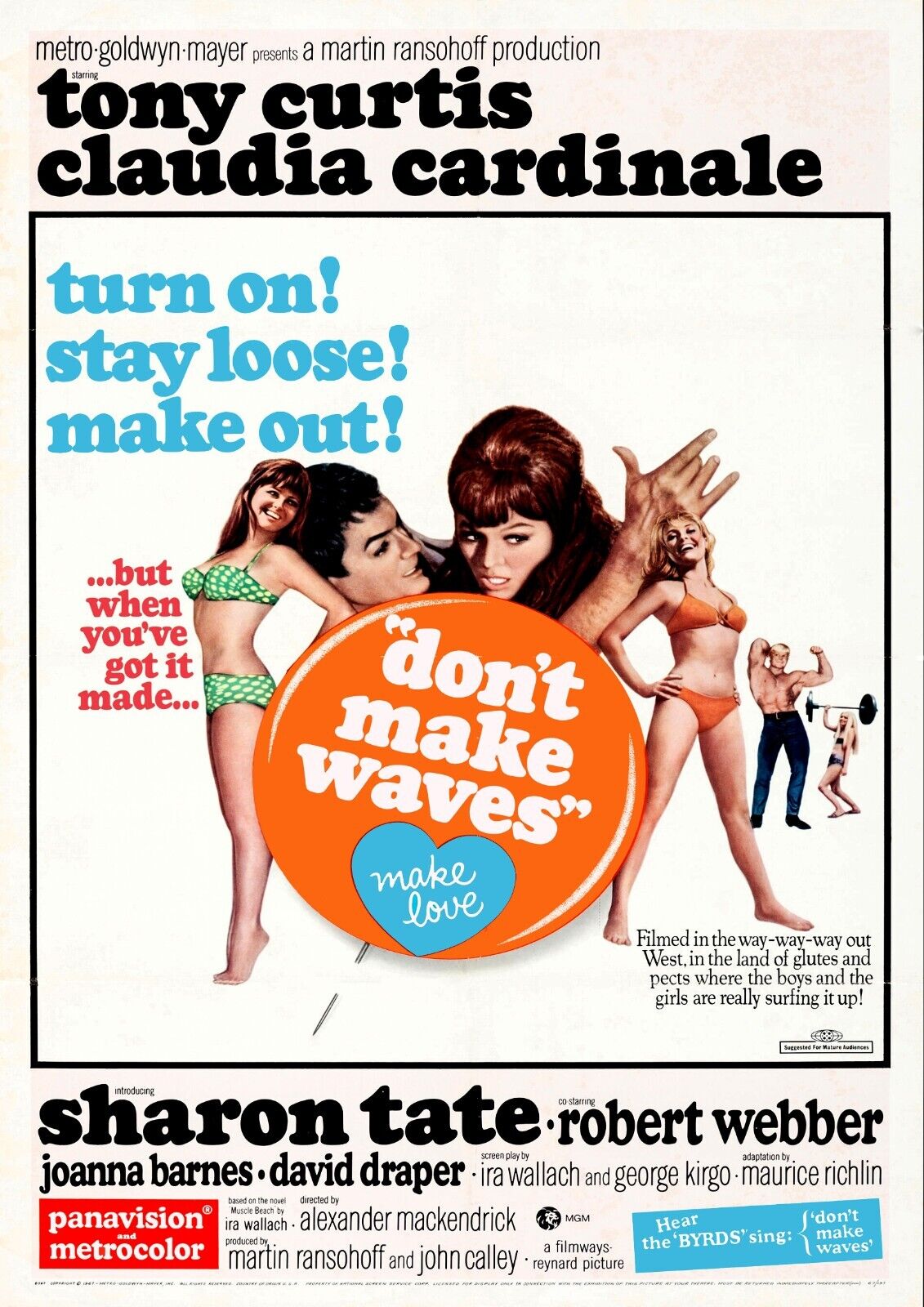
Don’t Make Waves (1967) ****

Unfairly maligned on release. Part throwback screwball comedy, part farce, part satire and in low-key fashion the first disaster movie. Oddly enough, that wild combination hits the mark. Tony Curtis makes amends for Boeing Boeing (1965). Claudia Cardinale on top form as a ditzy brunette. Last hurrah for Ealing Comedy grey eminence Alexander Mackendrick (A High Wind in Jamaica, 1965). Plus Sharon Tate as a sky-diver. What’s not to like?

Hardly surprising though at the time it got the thumbs-down from critics and the cold shoulder from audiences. A very late arrival to the short-lived beach movie cycle and unlikely to compete with the harder-edged satires like The Russians Are Coming, The Russians Are Coming (1966) and Divorce American Style (1967) or the latest off the Neil Simon conveyor belt Barefoot in the Park (1967).   

Marvelous opening with sight gags galore sees vacationer Carlo (Tony Curtis) wrestling with a runaway car then seeing hapless wannabe artist Laura (Claudia Cardinale) accidentally setting fire to the vehicle. To make amends for destroying all his belongings, she invites him to stay the night. Unfortunately, her married lover Rod (Robert Webber) turns up, cueing a whole layer of farce, traditional bedroom-style here but later even better in the office, properly done this time compared to Boeing Boeing.

The next day Carlo is rescued from drowning by Malibu (Sharon Tate) with whom he promptly falls in love and attempts to separate her from her hulk of a boyfriend Harry (David Draper), all muscle but little brain and prone to easily-exploited bouts of depression.

Carlo is the smarter younger brother of the character in Boeing Boeing, managing to muscle in on Rod’s swimming pool business and demonstrating his sharp salesmanship skills. Except that Laura is so shrill and a kept woman, you’d expect him to be more interested in her than Malibu, but then where would be we be without a love triangle. In an odd sub-plot involving an astrologer (Ed Bergen), Carlo manages to win over Malibu. Meanwhile, Rod’s smarter wife Diane (Joanna Barnes) infiltrates her husband’s cosy love nest.    
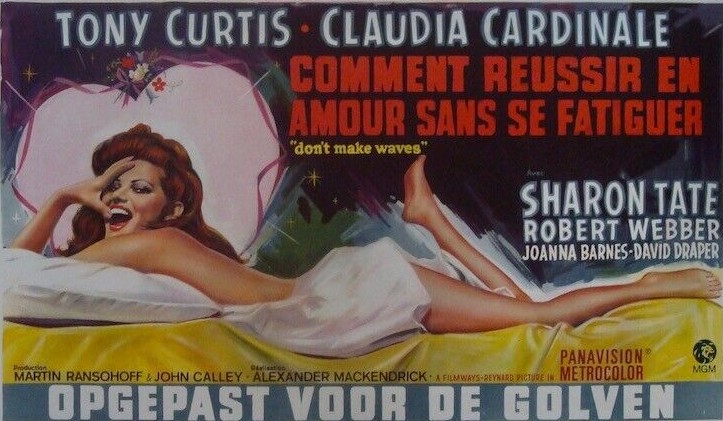
Although Carlo is effectively set up as somewhat shifty hero he undergoes a series of humiliations, brought down to earth by being repeatedly picked up and carried like a doll by Harry, and being drowned in mud. Other times he lives high on the hog, realizing he could make a killing here.

There’s no great plot, just the usual misunderstandings, but, unusually, characters are given moments of self-reflection and self-deprecation, and the satire focuses on the self-involvement of the beautiful people. There’s a fair bit of ogling but the camera is gender-equal, the toned bodies of the muscle men given as much attention as any passing female in a bikini.

I found myself chuckling all over the place, mostly at the antics of Carlo. This is a pretty good performance by Tony Curtis, mugging kept well under control but adept at physical comedy. And Claudia Cardinale (Once Upon a Time in the West, 1968) is equally game, drenched for a good chunk of time, and hit by sudden self-awareness as the tale unfolds. You might balk at her high-tempo performance but otherwise the set-up wouldn’t work. If she wasn’t so annoying why would Carlo look elsewhere for romance?

The disaster element involves a runaway clifftop house, a situation created by the unlucky Laura, and it doesn’t take much to see what elements The Poseidon Adventure filched, playing it for drama rather than comedy.

While not in the same category Mackendrick classics The Man in the White Suit (1951), The Ladykillers (1955) or even The Sweet Smell of Success (1957) – co-starring Curtis – this is not to so far off. Mackendrick excels at building the comedy, confidently marshals the farce, but, more importantly, doesn’t lose sight of the characters in the ensuing chaos.  

Producer Marty Ransohoff tries to pull a fast one by slapping an “introducing” credit on Sharon Tate, conveniently ignoring her performance in the previous year’s Eye of the Devil (1966). She’s less iconic here – unless you imagine that with her bronzed face she’s a distant cousin of George Hamilton – but she’s far from the dizzy blonde, much more pragmatic, the one who switches electricity back on after the blackout, and with her own oddball ways. Trivia note: they modelled “Malibu Barbie” on Tate.

Worth a look.   

Behind the Scenes – “Eye of the Devil / 13” (1966)

It would have been a different movie entirely with Kim Novak (The Legend of Lylah Clare, 1968) in the lead and directed by Sidney J. Furie (The Ipcress File, 1965). He was one of three directors – the others being Arthur Hiller (The Americanization of Emily, 1964) and Michael Anderson (Operation Crossbow, 1965) – to pass on the picture (then known as 13) before it ended up in the lap of J. Lee Thompson (Return from the Ashes, 1965). Terry Southern (Dr Strangelove, 1964) also hnded the screenwriting torch over to Robin Estridge (the author under a pseudonym of source novel Day of the Arrow) and Dennis Murphy.

Possibly because of the potential involvement of Hiller, and that Martin Ransohoff, producer of The Americanization of Emily, was funding this film through his Filmways shingle, Julie Andrews was mooted for the lead. Instead, the part went to Kim Novak, who had just finished another British production The Amorous Adventures of Moll Flanders (1964). She had signed a three-picture deal with Ransohoff who was firming up productions with a number of Hollywood studios  

According to co-star David Niven (The Extraordinary Seaman, 1969), Novak was insecure about acting the part. “I don’t think I’m betraying any confidences,” said Niven, betraying her confidence to a reporter, “if I said that Kim often told me ‘I think I’m not right for this part. I think I’m a sex-pot.’ ” Given she was playing a mother-of-two, it’s doubtful that she was intended to be overtly sexy, although that would certainly provide a different reading for the role.

Some of Novak’s concerns could be ascribed to any Hollywood-trained actress. “While highly professional,” observed Niven, “Kim worried about her looks, her scenes, her individual lines, everything.” Novak’s professionalism included arriving at the studio at 4.30am and often doing her own make-up accompanied by an “entourage of dialog coach, press agent and personal secretary, with whom she rehearsed her lines before going on set.” (I’m sure she practiced her lines with her dialog coach rather than secretary.)  

As if British actresses prepared for a movie with ease and turned up on the set without a care in the world. However, that was Niven’s conclusion. As if little preparation was involved, “Deborah Kerr,” said Niven, “just walked before the camera and did them (her lines); stand-in Esmee Smythe would occasionally hear her lines – very occasionally because she always knew them – and once in a while would help out if the dresser was not on the spot.”

Four-fifths of the picture was completed when Novak pulled out. The standard reason given was because of a back injury. Initial filming had taken place in fall 1965 in France at the main location of Chateau de Hautefort in Dordogne before Novak fell from her horse. Production was suspended for two weeks. But the actress proved unfit to rejoin the unit.

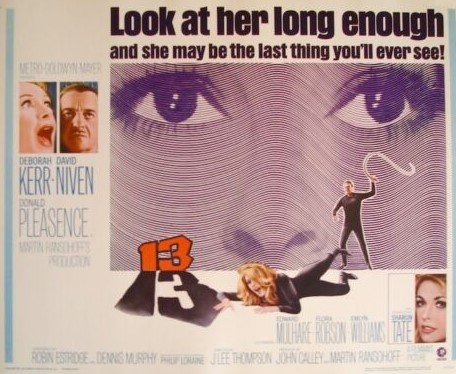
Title changed to “13.” It’s worth noting that the main images of the poster refer to Sharon Tate. It’s her eyes that are hypnotic
and she’s the one being whipped.

Supporting star David Hemmings (The Charge of the Light Brigade, 1968) offered a different reason for her departure. This was the actor’s first big-budget international full-scale picture. His career was in reverse, from starring in Be My Guest (1964) he had tumbled to fourth billing in Two Left Feet (1965). As if forever destined to be the ingenue, here he was billed eighth.

Hemmings knew the director from No Trees in the Street (1959) and had worked with Donald Pleasance in Wind of Change (1961). He recalled “the comparatively unknown but totally ravishing Sharon Tate who was the same age and had done about as much as I did.”

Given his lack of knowledge of American television it was understandable he believed he was in the same bracket as Tate. In fact, she was such a hot prospect, coming off a role in the wildly successful series The Beverly Hillbillies she was given an “introducing” credit and had far the superior part.

“ I loved the setting and my part which demanded skills in riding and toxophily (archery),” said Hmmings. He found all the time wasted in playing darts in pubs assisted him in his archery training. “But I found it quite odd that a young lad of 24, dressed in black leather and riding a white horse, albeit with my toxophilic advantages, should have been thrown together with such a distinguished cast.”

The fact that he presented such a visual treat in his blonde curls and black leathers appeared not to occur to him. “The older actors were astonishingly kind to me. Niven’s charm was profound and genuine.”   

One of the older stars who reached out to him proved to be Kim Novak. Although only eight years older she had been a star for more than a decade, leading lady to William Holden in Picnic (1955), Frank Sinatra in the Man with the Golden Arm (1955) and Pal Joey (1957), James Stewart in Vertigo (1958) and Bell, Book and Candle (1958) and Kirk Douglas in Strangers When We Meet (1960) while in most of her films in the 1960s she had received top billing ahead of the male star.

When Hemmings took to riding his white horse through the French countryside Novak became his companion. “We would stop somewhere to sit and chat. Easily and at great length almost about everything…and to begin with no hint of physicality…after a while I began to detect that strangely attractive wicked look in her eye that an experienced woman gives to an inexperienced man.”

One day, though staying in different hotels, she asked to meet him in a large park in the centre of Brive. “It wasn’t a suggestion, it was a command,” he recollected, “and being the young man it was a command I knew would lead inevitably to possibilities.” The assignment in the park led to a short affair conducted in her hotel room.

Shorty afterwards, at a press conference, “I can’t recall what Marty (Ransohoff) said to upset Kim or if it justified her reaction but I have an indelible vision of her stubbing out a cigarette in his one good eye which led to an ugly scene…and Kim being sacked.”

But it would be hard to convince the completion guarantee bonding companies and the insurance company that a back injury had been faked to cover the embarrassment of the producer. Original budget of £1 million was supplemented by another £600,000 from the insurers to complete the movie. Deborah Kerr had been holidaying at Klosters in Switzerland when she received the call and began work as a replacement at the Borehamwood studio in Britain over Xmas 1965.

Since Novak had not been in every scene, the opening scenes and the beguiling of the children by Sharon Tate, for example, it wasn’t a case of starting completely from scratch. And the director and cinematographer would have the advantage of already having made  decisions regarding camera placement, while the other actors would be well-rehearsed. However, weather for the previous filming had been cold so there would have been a worry about matching exteriors since conditions in France in January-February 1966 were “like summer.”

It was Niven who had suggested Deborah Kerr as the replacement. This was the third of the five pictures they made together, preceded by Bonjour Tristesse (1958) and Separate Tables (1968),  followed by Casino Royale (1967) and Prudence and the Pill (1968). Niven welcomed her presence. “Playing opposite Deborah is as delightful an experience as an actor can have,” he said. “I’ve always felt I won my Academy Award (Best Actor Oscar for Separate Tables) because she made me look so good. That sort of thing makes for a warm and relaxed screen relationship.” Niven was clearly ignoring the fact that, although happily married, the relationship of the couple on Eye of the Devil was tense and strained.  

But the France reshoot took place at a different location, Brives Les Gaillards in Perigord, an overnight train journey from Britain. Perhaps in a bid to save money, Esmee Smythe was eliminated from the personnel intended to be shipped abroad. After a few words from Kerr –  who otherwise would effectively be acting as her own stand-in for scenes involved horse-riding, driving and standing on the parapets – Ransohoff changed his mind. Despite the pressures to complete and ensure that Kerr’s work – a “daunting job of re-shooting” – would fit in with what had come before, shooting was deemed “pleasant.” Kerr again stood up to the producer when informed further work in Borehamwood would begin immediately on the morning of the overnight train journey home.

The original stars were paid twice, for Hemmings “the most lucrative job I’d ever done.” Nonetheless, there was clealry doubt about its box office potential and, unsually for a film with denoted stars, it sat on the shelf for over a year.

Despite MGM’s best marketing efforts the movie fizzled out in the United States where it opened in fall 1967. Prospects proved poor. It waited another  seven months before a British premiere at the Ritz in London’s West End in March 1968, that showing possibly the result of the unexpected success for MGM with David Hemmings’ breakout movie Blow-Up (1966).

But the West End opening counted for nothing when it came to general release it the UK. On the ABC circuit it was only the supporting feature to The Heroin Gang (1968) starring David McCallum and Stella Stevens. It might have done better had it been delayed further and taken advantage of the successful comedy pairing of Kerr and Niven in Prudence and the Pill.

Like many a horror movie, the production was considered jinx. Filming on Prudence and the Pill was delayed when Kerr, who “had never had a day’s illness in her life,” was diagnosed with labyrinthitis, a condition which destroyed her sense of balance. While she recovered, others involved in Eye of the Devil were not so fortunate. Not only was Sharon Tate slaughtered by the Manson gang but a member of the location crew was crushed by a car and the chateau burned down a few years later.

SOURCES: Eric Braun, Deborah Kerr (WH Allan, 1977) p198-202; David Hemmings, Blow-Up and Other Exaggerations (Robson Books, 2004) p123-126.

Eye of the Devil / 13 (1966) ***

Shades of The Innocents (1961), The Wicker Man (1973) and The Omen (1976), but lacking the suspense of any, leading roles woefully miscast, supporting roles, conversely, brimming with inspired casting including the debut of Sharon Tate (Valley of the Dolls, 1967) and a mesmerising role for David Hemmings (Blow-Up, 1967)  Any attempts at subtlety were dumped when the original more intriguing title of 13, which turns out to have more than one meaning, was dumped (except in some foreign markets) in favor of the giveaway designation of Eye of the Devil. Despite embracing a web of sinister legend, it lurches too quickly into full-on demonic horror.

French count Phillippe (David Niven) is called away unexpectedly from the Parisian high life to deal with a crisis in his vineyard. When his son Jacques (Robert Duncan) starts sleepwalking in his absence, his wife Catherine (Deborah Kerr) decamps with daughter Antoinette (Suky Appleby) to the family pile, a huge millennium-old castle. The count’s sister Estell (Flora Robson) fears her arrival. Villagers fear Phillippe, doffing caps when he passes.

Meanwhile, Catherine encounters or witnesses strange goings-on. Archer Christian (David Hemmings) shoots dead a dove which is later offered to unknown gods by his sister Odile (Sharon Tate) in a chamber filled with men in black robes. Later, Odile changes a toad into a dove and hypnotises Catherine into almost falling off a parapet. A quietly spoken priest (Donald Pleasance) offers no succor. The number thirteen could refer to the day of an annual local festival or a ceremony involving thirteen men, twelve of whom dance around the other. In a forest Catherine is trapped by men in black robes, then drugged and imprisoned.

Meanwhile, her husband remains grimly fatalistic, gripped by torpor, except when roused to whip Odile. Generation after generation, going back over a thousand years, the head of the household has come to a sticky end and without explanation it appears Phillipe expects a similar outcome. .

It doesn’t take you long to realise devilry is afoot. It’s a pagan castle, it transpires, a “fortress of heresy.” After three years of poor grape harvest, the earth demands a sacrifice. Where the victim in The Wicker Man is an innocent outsider lured to a remote island, the count accepts his destiny even as his wife struggles to prevent his death. Dramatically, the later film has the edge, the victim struggling against fate rather than a mere observer. That Catherine is powerless somehow doesn’t bring the dramatic fireworks you might expect.

What the posters conceal is that the film was made in black-and-white – the last MGM picture not to be in color – and this is a photo of Sharon Tate as she appeared in magisterial and beguiling form.

There’s a curiosity about the casting of Deborah Kerr (The Gypsy Moths, 1969). This most repressed of actors, as if a veil has been lifted, empowered to scream and batter against doors and race around, seems to drain the movie of energy. She just seems laughably bonkers rather than intense and empathetic. For someone whose performance is generally minimal, who exists in the margins, it seems almost perverse to force her to go so over-the-top.

Perhaps such unusual verbal and physical activity was deemed essential to counter the inactivity, the virtual sleepwalking, of the rest of the cast. While looking pained, David Niven (The Extraordinary Seaman (1969) can’t quite capture the intensity, the personal devastation, the role requires. David Hemmings as the silent archer and especially Sharon Tate as the trance-inducing magician, steal the show, investing their characters with little emotion, and yet, visually, as if mere costumed performers, present the most vivid incarnations.

From an audience perspective, it’s hard to root for Catherine since it’s obvious she is in no mortal danger. Like The Wicker Man, the audience is there in an observatory capacity, but unlike the Scottish policeman the victim attracts little sympathy. There’s not real

It’s a surprising backward step for director J. Lee Thompson after the superb Return of the Ashes (1965) which was chock-full of suspense and interesting characters. After an atmospheric opening, it turns uneven as he falls into the trap of following the wrong character. Screenwriters Dennis Murphy (The Sergeant, 1968) and  Robin Estridge (Escape from Zahrain, 1962) adapted the latter’s acclaimed novel Day of the Arrow, written under the pseudonym Philip Loraine. So perhaps he can be blamed for shifting the investigative focus from Catherine’s ex-lover to Catherine herself.

I was surprised to see Deborah Kerr take on such a role and that is a story in itself which I’ll address tomorrow.

Behind the Scenes – “The Cincinnati Kid” (1965)

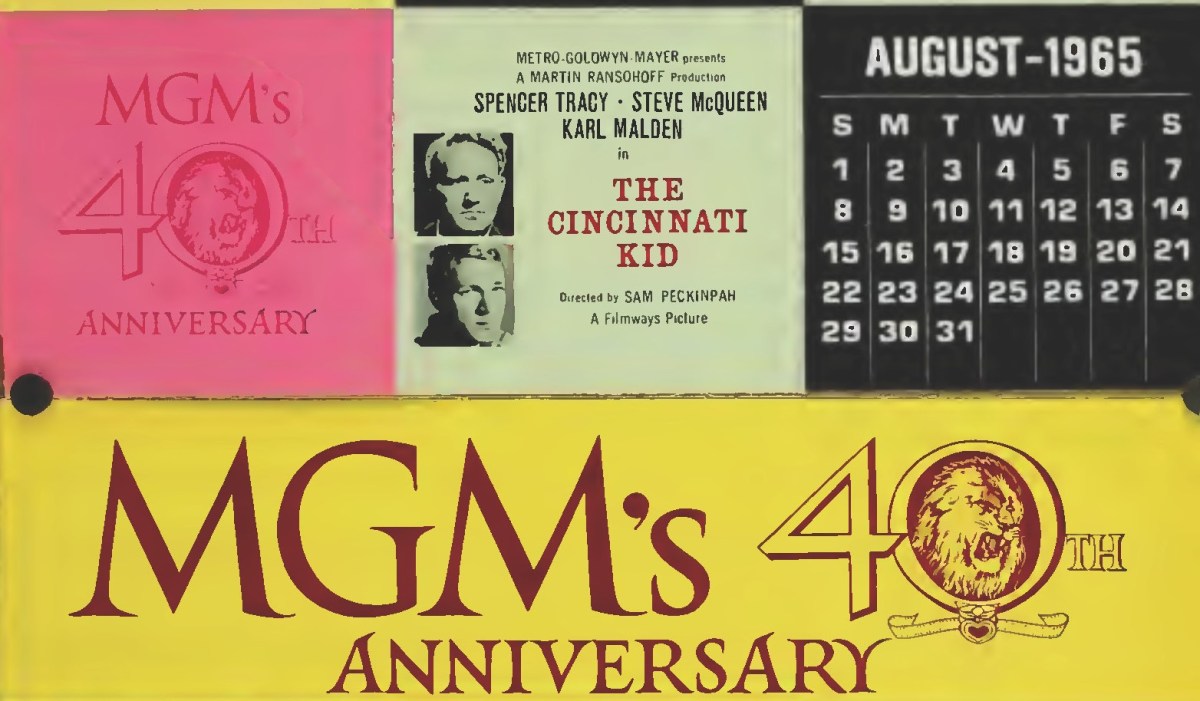
As you can see from the advertisement above, this was originally intended to be quite a different film, directed by Sam Peckinpah and starring Spencer Tracy in the role of ageing poker champ Lancey. The director had just come off one troubled shoot, Major Dundee (1965), and was seeking Hollywood redemption. Two-time Oscar winner Tracy was also hoping to revive his career. Except for what amounted to little more than a extended cameo on It’s A Mad, Mad,, Mad, Mad World (1963) he had not worked since Judgement at Nuremberg (1961). Also initially on board in a small role was Sharon Tate (Valley of the Dolls, 1967)

This was also a big gamble for industry outsider Martin Ransohoff who had moved to the forefront of independent production after The Americanization of Emily (1964) with Julie Andrews and James Garner and The Sandpiper (1965) starring current top-billed royalty Elizabeth Taylor and Richard Burton. He had wheeled and dealed with top studios – MGM, Columbia and United Artists – desperate for quality product. He was planning the biggest movie of his career having purchased the rights to the Alistair MacLean bestseller Ice Station Zebra. Ransohoff was a marketing innovator and long before Robert Evans pumped tens of thousands of Paramount dollars into advertising the book of Love Story (1970) to ensure it rode high on the bestseller charts and thus increased public awareness, Ransohoff had pulled off the same trick for Richard Jessup’s novel The Cincinnati Kid.

Tracy was first to quit, infuriated that he was denied script approval. Essentially, he wanted his role beefed up. But Ransohoff “would not expand his role in any way” and angered at the prospect of playing second fiddle to McQueen the actor walked out, to be replaced by a star with considerably less marquee appeal, Edward G. Robinson.

At least Tracy was able to depart with head held high. Peckinpah was ignominiously fired after shooting had begun. The intemperate director had already locked horns with the producer over a story which had now taken the efforts of four screenwriters – Oscar-winner Paddy Chayefsky (The Americanization of Emily), Oscar-winner Ring Lardner Jr. (Woman of the Year, 1943), Oscar nominee Terry Southern (Dr Strangelove, 1964) and newcomer Charles Eastman (Little Fauss and Big Halsy, 1970) – to knock the book into a workable screenplay without the extra bother of Peckinpah adding his own scenes.

Trade newspaper Variety reported: “Peckinpah’s problems stemmed from his filming of a nude scene that wasn’t in the script but which the director wrote on his own. Last Friday (November 4, 1964) he reportedly excused the featured cast and began to lense the nudie scene using an extra from the cast.” Whether this was indeed Sharon Tate, of whom Peckinpah was reported to have filmed in a flimsy shirt without a bra so that her nipples were showing, is unclear. And although there is an undertone of sex in the actual picture, as delivered by Ann-Margret, it was considerably more discreet.

Strangely enough, Ransohoff was no stranger to the benefits of nudity in his pictures and had fought a losing battle with the all-powerful MPAA, the industry ruling body in matters of censorship, to have nude scenes included in The Americanization of Emily. The nude statue of Elizabeth Taylor in The Sandpiper was permitted, however, and Ransohoff sent hundreds of miniature statues out to influencers as a gift.

Peckinpah did not have final cut so Ransohoff could easily have excised any nude scenes from the finished movie. What was considerably more alarming was that Peckinpah was shooting in black-and-white. Later, Ransohoff would contend that he was outraged by this notion but he surely must have signed off on it at the outset. Whatever the reasons, and some believed fisticuffs were involved, Peckinpah was sacked, leaving a $750,000 hole in the budget.

Production closed for over a month while Ransohoff scrambled for a new director. McQueen was pay-or-play, so if the film was cancelled, the actor was due his entire fee. McQueen had signed on for a fee of $200,000 – or $350,000 depending on who you believe – and $30,000 a week in overtime plus 25 per cent of the profit and a host of extras. McQueen had been initially lined up for a Ranoshoff remake of Boys Town to co-star James Garner, but that proved little more than a publicity flyer.

Replacement Norman Jewison had no reputation for hard-line drama – more at home with light comedy such as Send Me No Flowers (1964) – but was available and more likely to toe the Ransohoff line. However, initially he demurred. It was against the rules of the Directors Guild to step in in such a manner and Jewison required reassurance that Peckinpah was indeed out of the picture, and the film had been shut down, before accepting the job. Theoretically, Jewison received more control of the final cut than Peckinpah. His contract called for him to be in sole charge of the completed picture until after the third public preview. If it wasn’t working by that point, Ransohoff had the right to take over. Jewison exerted control in other ways, denying actors a chance to look at the rushes

Theoretically, McQueen had conceded top billing to Spencer Tracy, but that was not reflected in the artwork MGM put out – the illustration at the top of the Blog appeared in the trade press prior to production. To keep McQueen sweet during the layoff, Ransohoff handed him $25,000 to play the tables in Vegas. Edward G. Robinson had the same worries as Spencer Tracy, fearing his part would be cut to build up the star. In reality, McQueen welcomed going head-to-head with an older star, a situation he had not experienced since The Magnificent Seven (1960) with Yul Brynner.

But if the male stars, under the confident direction of Jewison, gave no trouble, that was not the case with the female contingent. Tuesday Weld came with a heap of personal issues related to becoming, as a child model,  the family breadwinner at an early age – nervous breakdown at nine, alcoholic at ten, suicide attempt at twelve. She had never quite achieved stardom, in part as a result of turning down roles like Lolita (1962)

Ann-Margret was the opposite. She could earn nearly as much as McQueen – her fee at some studios was $250,000. However, Twentieth Century Fox was holding her to an earlier four-picture deal which paid a miserly $25,000 per movie, forcing her to lose out on a $150,000 payday in Europe for The 10th Victim (1965) with Marcello Mastroianni – known at the time as The Seventh Victim, Ursula Andress her replacement – in order to take up a contracted role in the remake of Stagecoach (1966). Her over-sexed screen persona had caused playwright William Inge to remove his name from Bus Riley’s Back in Town (1965).

One of the hottest young stars in the business, she intended to stay that way, and her portrayal of Melba in The Cincinnati Kid pretty much fitted in with audience expectation. She was in such demand that she was under contract to make a total of 17 pictures for five separate studios plus Frank Sinatra’s independent production company. Her deals were with Universal (six pictures), Fox (four), MGM (three), Columbia (three) and United Artists (one). But after dropping out of Marriage on the Rocks (1965) with Sinatra her output for the rest of the decade comprised one movie apiece for Paramount, MGM, Fox and Columbia and four independent pictures in Italy.

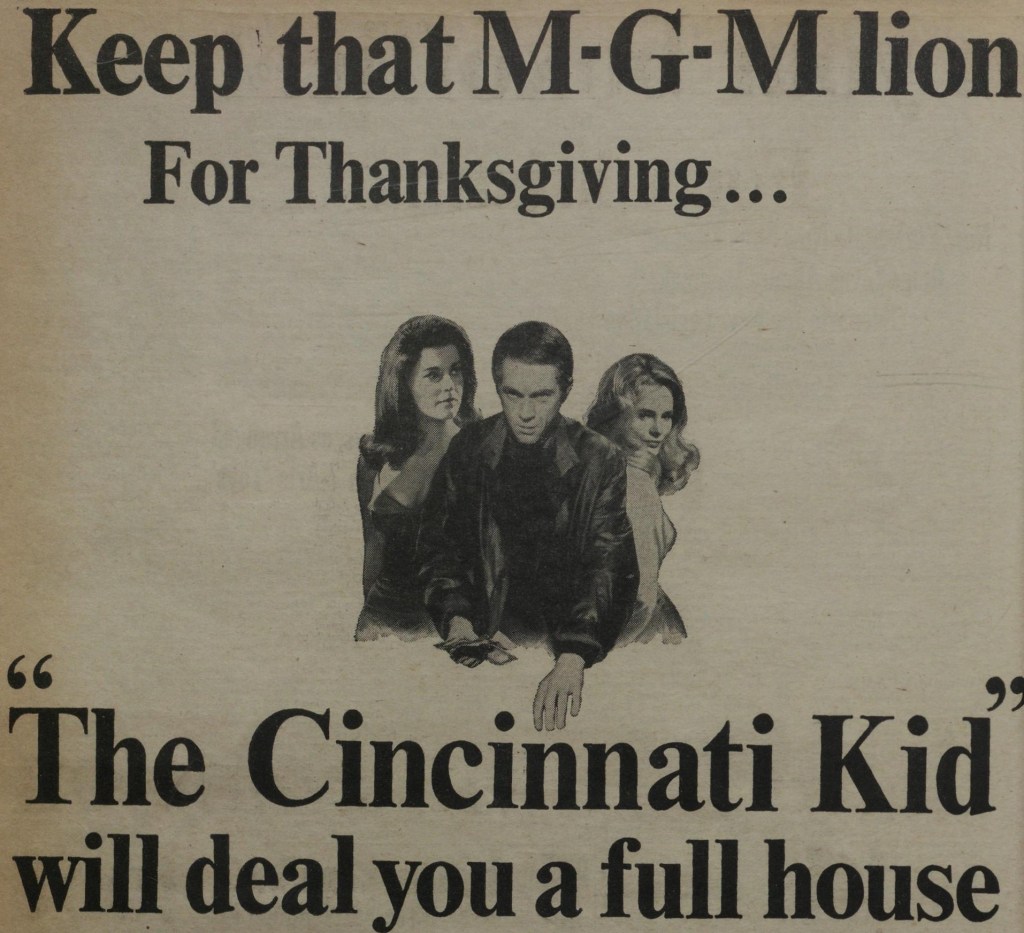
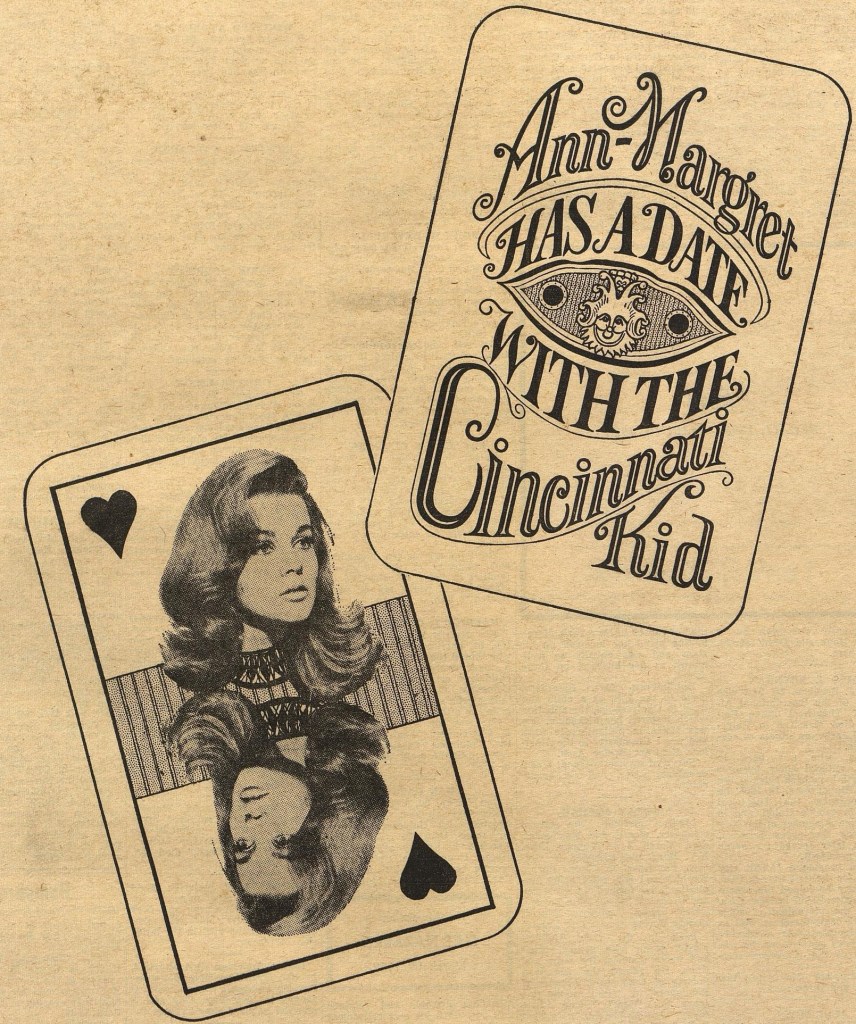
MGM spent big bucks promoting the picture and, in particular, the Ann-Margret connection. The studio had put a marker down on Thanksgiving 1965 for the launch date, but was marketing the movie more than six months ahead, the kind of exposure that was normally only allotted to roadshow features.

SOURCES: Christopher Sandford, McQueen: The Biography, Harper Collins paperback (2002) pages 165, 170-176; Penina Spiegel, Steve McQueen: The Untold Story of a Bad Boy in Hollywood,  Collins, 1986, p162, 169-173; “Ransohoff To Start Five Films in 6-Month Period,” Box Office, June 17, 1963, p27; “Marty Ransohoff To Seek Code Changes,” Box Office, November 25, 1963, p6; “Ann-Margret Into The Cash Splash,” Variety, July 22, 1964, p5; advert, Box Office, October 9, 1964, p9; “More Cincinnati Kid Books,” Box Office, October 24, 1964, pW-5; “Refuse Spencer Tracy Xincy Kid Script Okay So Actor Takes Powder,” Variety, November 11, 1964, p24; “Jewison Replacement for Sam Peckinpah,” Variety, December 9, 1964, p24; Advert, Variety, March 10, 1965, p80; “Fear Ann-Margret Going Wrongo In Her Screen Image,” Variety, March 24, 1965, p5; “Fox Holds Ann-Margret To Stagecoach, Denying Her For Mastroianni,” Variety, April 14, 1965, 4; Advert, Variety, May 19, 1965, p20.

Books – Behind the Scenes of “Valley of the Dolls” (1968)

Behind-the-scenes books generally benefit from as much scandal as possible. Using that criteria, Dolls! Dolls! Dolls! by Stephen Rebello leaps to the top of the list. Rebello had been primarily responsible for turning Valley of the Dolls (1968) into a camp classic by hosting repeated showings of the picture from the 1990s onwards and making it number one in his book Bad Movies We Love.

The novel Valley of the Dolls by Jacqueline Susann was a record-breaking bestseller on the “sex/sin/salvation literary rodeo” but nothing that came out of the fevered imagination of Harold Robbins could match the Susann book, an insider’s look at the murky goings-on in Hollywood with drug abuse at the top of the heap. Unfortunately for Susann, Twentieth Century Fox struck a deal for the film rights pre-publication, long before it became a sensation, so she earned only $85,000 upfront, a quarter of what was paid for Peyton Place which sold far fewer copies. Mark Robson who had brought Peyton Place to the big screen was hired as director.

Stars clamoring for roles included Natalie Wood, Bette Davis, Debbie Reynolds and Kim Novak. The list of those who turned it down was longer: Lee Remick, Jane Fonda, Julie Christie, Raquel Welch, Candice Bergen. Christopher Plummer and James Garner were screen-tested. Sharon Tate, Barbara Parkins, Judy Garland and Patty Duke won the main roles.

Movies had done away with the “any similarity” disclaimer but it was upfront in all ads for the film as well as in the pre-credits on the film, whether as a publicity ploy or to head off potential legal action is unknown.

The screenwriters were as appalled at the material as the censor. But that was just the beginning of strife central. The personal enmity between Duke and Parkins rivalled that of Bette Davis and Joan Crawford. Screaming matches and hissy fits abounded. Duke suffered from drug and alcohol abuse, mood swings and nervous skin conditions and constantly clashed with the director. Plus, despite cutting some singles and albums, she had to mime.  Tate was forced into take after take for the normally economic director. The three young stars, believing this was a career-making picture, took no prisoners. Robson used a stopwatch when filming, as if he was already editing the film in his head, pushing the actresses to speak the lines faster, or undertake actions exactly on a time cue, a humiliating procedure in one scene for Tate. She refused to cry in case it messed up her make-up, which would cause further delay and further infuriate Robson. Tate was also embarrassed by publicity photos taken during her pornographic scene.

Garland was in no fit state to make a movie. She was drinking wine by the bucketload, dropping pills, slurring her lines, missing her cues and turning up late for work. Finally, it got too much and she was fired. Fans bombarded the studio with irate messages. Ginger Rogers rejected the role on account of the language.  Robson put in a personal phone call to Susan Hayward, who had quit Hollywood, and turned down several comeback roles including Mrs Robinson in The Graduate. When Hayward was finally persuaded for a hefty fee, the producers had to shred Garland’ s costumes. They were different sizes. Hayward’s wardrobe was redesigned from scratch. The last straw on the troubled production was producer David Wiesbart dropping dead. That wasn’t quite the last straw. Critics trashed the picture. Luckily, audiences didn’t and lined up in droves.

Discover WordPress

A daily selection of the best content published on WordPress, collected for you by humans who love to read.

The Atavist Magazine

by Brian Hannan

WordPress.com News

The latest news on WordPress.com and the WordPress community.