The Reivers (1969) **

Vanity project. Two words to strike fear into the heart of a studio executive. Generally means a star has got the worthy itch. Determined to attach himself to a movie of Shakespearian proportions. Something with literary heft. Wants to break clean away from the persona that made him a star.

Experienced studio honcho, scenting red ink a mile off, rejects the proposal, or agrees to it on the condition said star first makes two, maybe even three, of the studio’s more straightforward movies. (Warner Bros had Steve McQueen on a six-picture contract). On the other hand, out there, in the Hollywood hinterland, there’s always some less well-known producer willing to pony up an enormous fee as the price of making his name. Or, in this case, a nascent mini-major, the kind that thinks it will become an ”instant major” should it sign a contract with the biggest name on the planet after the rip-roaring box office of Bullitt (1968). Step forward Cinema Center, the movie arm of CBS television, desperate to make a Hollywood splash.
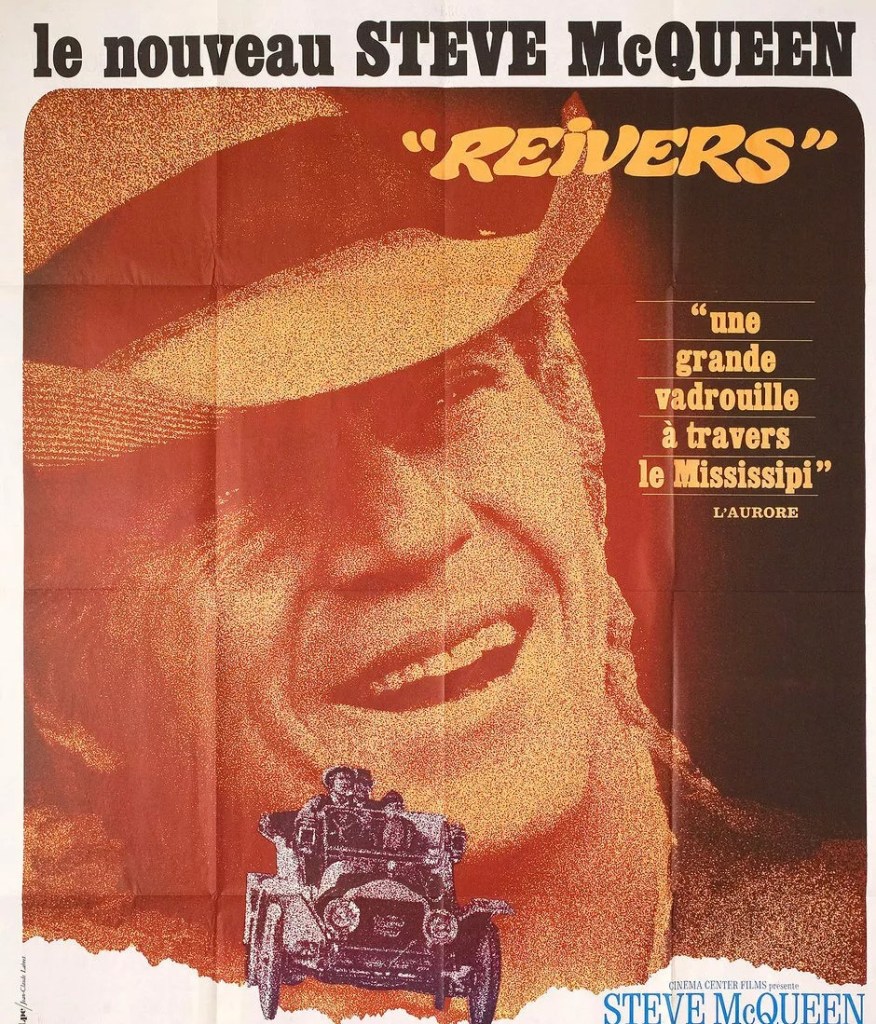
Am sure the pitch wasn’t: “comedy about a thief and a sex worker.” More likely the plus point was William Faulkner, America’s most famous living writer (along with John Steinbeck), winner of the biggest award in literature, the Nobel Prize, whose short story provided the source material. Faulkner also, as it happened, had a decent movie pedigree having adapted Bogart-Bacall vehicles To Have and Have Not (1944) and The Big Sleep (1946) while an adaptation of his short stories into The Long, Hot Summer (1958) hit the box office jackpot.

Admittedly, The Sound and the Fury (1959) and Sanctuary (1961) had been less successful, but Fox had also turned The Long, Hot Summer into a television series that ran for two seasons, so the author’s name would be fresh in the audience mind.  

It’s always a worry when an actor changes his hair style. Means he’s going method or “acting.” Here, Boon (Steve McQueen) sports a bushy blond barnet. And spends most of the time in “aw shucks” mode, whirl-winding his arms, contorting his features, doing most of the things a decent director would have told any other actor to cut it out. It would take a lot more acting talent than Steve McQueen, pushing 40, can tap into to successfully convince as a guy in his 20s
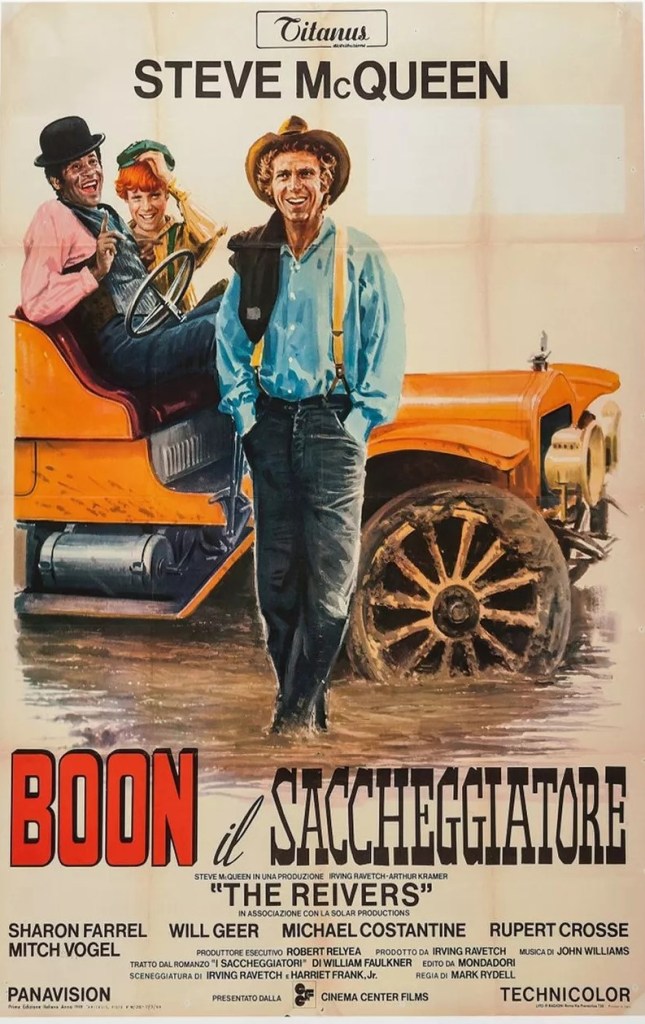
At least, he’s acting enough to allow himself to be covered head-to-toe in mud, something a major star would generally avoid. The comedy is as broad as you can get and director Mark Rydell (The Fox, 1967) shows little aptitude for it, not least in knowing when to stop milking a scene.

Biggest problem is that Boon, in narrative terms, is not the star, merely the conduit. The story actually concerns 11-year-old Lucius (Mitch Vogel) growing up, as he’s lured into a scheme hatched by Boon to borrow his employer’s spanking new automobile (this is 1909, by the way) and head off for the local whorehouse. Along the way, the child becomes a jockey riding a race Boon must win.

Sex worker Corrie (Sharon Farrell) has the other major story strand and the biggest element here is the relationship between herself and the boy. When he brings out her mothering instincts, she is ashamed of her profession and she plans to quit. The boy sees a naked woman for the first time – a painting, not in person – loses his worship of Boon and doesn’t “quit” as if he’s in a hard-tack B picture.

Pretty much glossed over is the rape. You can’t have rape in a comedy, can you? But for various reasons Boon and his black buddy Ned (Rupert Crosse) and the ladies from the whorehouse have ended up in jail. Price of freedom is Corrie having sex with corrupt cop Butch (Clifton James). Corrie has the best scene, the look of humiliation on her face, when released from the cell to be raped by the cop. And this was a film sold as “a lark.”

And, of all things, Boon is purportedly in love with Corrie, but not so much that he doesn’t plan on having sex with one of the other girls, given he visits the whorehouse three times a week and Corrie, in a bit of a tizz, has turned him down.

Small wonder this has never been the subject of an anniversary revival. Hard to see how the attitudes reflected here would connect with the contemporary audience. Scarcely believable that McQueen could get himself involved, even for the privilege of being linked, at some remove, with William Faulkner.

Chances are what originated from the Faulkner pen as a more somber coming-of-age tale was altered by screenwriters Irving Ravetch (doubling up as producer) and Harriet Frank Jr (The Dark at the Top of the Stairs, 1960) to fit in with McQueen’s ambitions. The star had not wanted to make Bullitt, having an aversion to cops, and this looks like his attempt to make up for it.

Actually, it did well at the box office, Rupert Crosse and composer John Williams nominated for Oscars and McQueen and Mitch Vogel for Golden Globes.

A different McQueen, to be sure, but the subject matter is objectionable and the comedy is forced.  
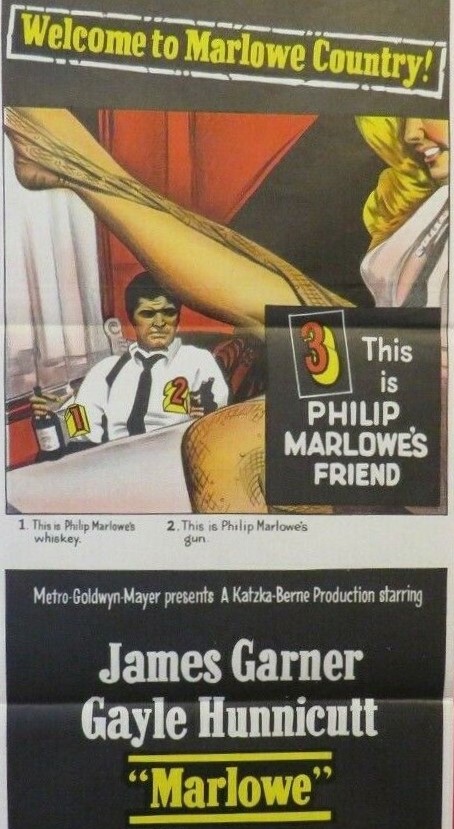
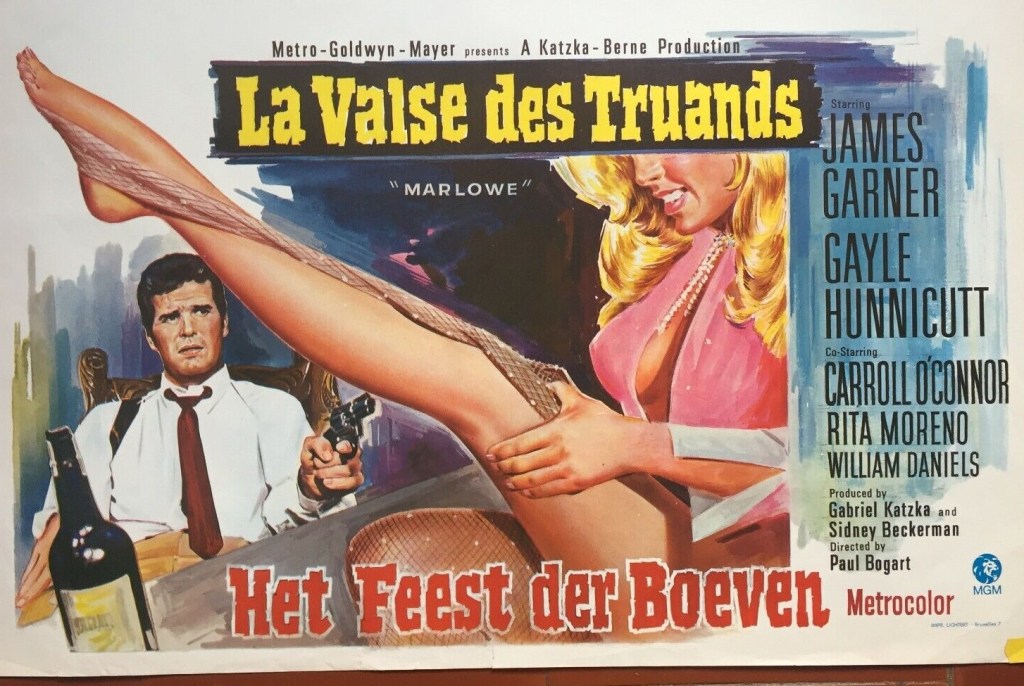
Marlowe (1969) ***

Anyone breaking into the private eye market in the late 1960s had to content not only with the ghost of Humphrey Bogart but a heavyweight slugger name of Harper (1966) whom Paul Newman had fashioned into the most likely contender for the Bogart crown. Ironically, it was growing interest in Bogart that spurred on an imitator. His movies, screened two hundred times a year on television, created an initial cult following, his persona maximized to the full by the reissue on the tenth anniversary of his death of 45 of his pictures plus the half-dozen biographies that appeared in a three-month stretch.

As it happened a couple of Raymond Chandler novels, The Little Sister and The Long Goodbye never before filmed and theoretically at least avoiding comparison with the past, were up for grabs. The Little Sister was the chosen vehicle. But, anyone chancing their arm in the role of Philip Marlowe was likely to be met with jibes of “he’s no Humphrey Bogart.”

That’s not the only problem here. The story is awfully convoluted, it’s been updated to a modern Los Angeles complete with hippies and gym work-outs and screenwriter Stirling Silliphant has chucked away the bulk of the original dialog. So, little remains of what made the character compulsive viewing in the first place.

Marlowe (James Garner) is investigating the disappearance of the brother of Orfamay Quest (Sharon Farrell), a young woman from Kansas, when he stumbles upon a couple of ice-pick murders and a pack of incriminating photos that depict television sit-com star Mavis Weld (Gayle Hunnicutt) – no slouch herself at knocking people out – in a compromising situation with top-line gangster Sonny Steelgrave (H.M. Wynant) whose speciality had been killing people with an ice-pick. So it’s a murder/blackmail double whammy.

The plot thickens when Winslow Wong (Bruce Lee) tries to pay him off and when that fails wrecks his office by demonstrating the kung fu skills that would later make that actor a star.  Detective Lt French (Carroll O’Connor) is the typical dumb cop that Marlowe runs rings round. Also entering the fray is exotic dancer Dolores (Rita Moreno), a friend of Mavis, and to liven things up for the gumshoe a girlfriend Julie (Corinne Camacho) who has some nifty one-liners when Ofamay attempts to seduce her boyfriend. And there’s any number of Steelgrave’s thugs who make any number of attempts to scare Marlow off.

Eventually, after being drugged by Dr Vincent Lagardie, Marlowe finds the missing brother, Orrin, who, while dying, attempts to kill the detective with an ice-pick. Assuming that clears up both cases, Marlowe then discovers that Orrin, Mavis and Orfamay are siblings.

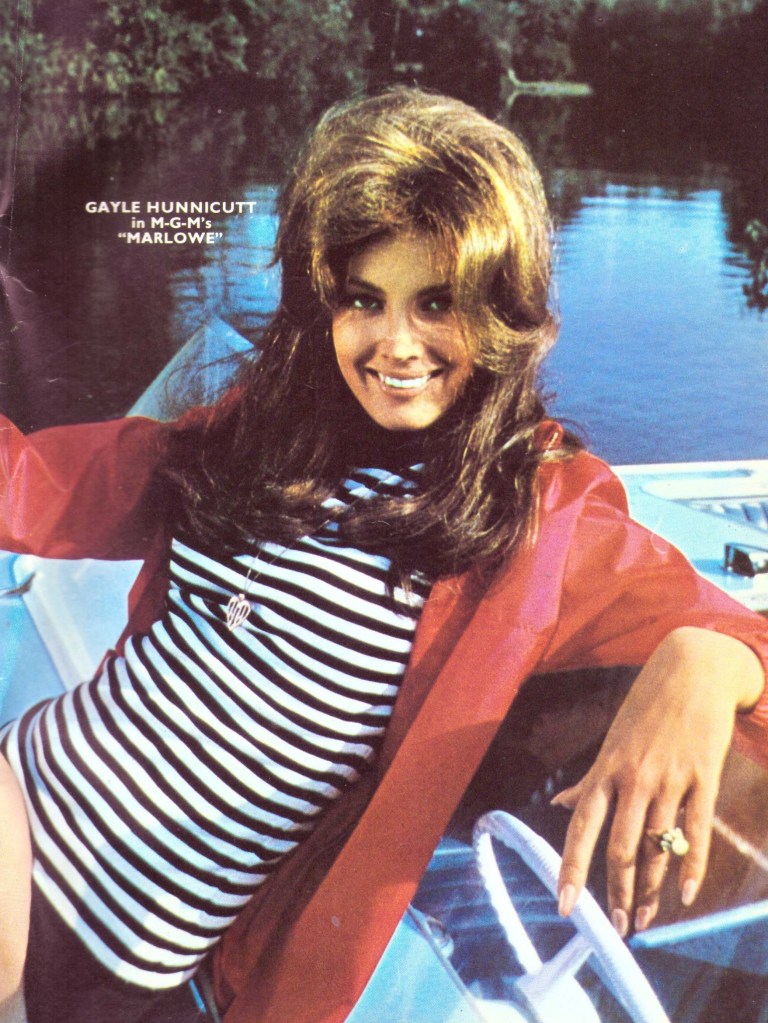
Hunnicutt is given the pin-up treatment in ABC Film Review.

But the tale still has some way to go, uncovering a hornet’s nest of spite and revenge among the warring siblings. There’s way too cute an ending though whether that was Silliphant’s invention or the tack taken by Chandler I have little interest in finding out, exhausted as I am by a seemingly endless series of twists and turns.

I’m not exactly sure what’s missing from this except a femme fatale – Mavis makes no moves on Marlowe, though her sister, who hardly qualifies as a femme fatale, does. It’s unfair in a sense to complain that it’s not following the Chandler template when so much effort has gone in to trying to initiate something new. If it had been called anything else, or the name Marlowe substituted by Smith, then we wouldn’t be thinking so much of the source material or the imitable Bogart.

Confusingly, there is a Bogart involved, director Paul Bogart (The Three Sisters, 1966 – from the Checkov play and no relation to The Little Sister) and although he keeps the plot ticking along – who wouldn’t with so much plot to tick – that’s pretty much all he does, in the cold light of Los Angeles hardly able to emulate the film noir setting.

So, effectively, it’s up to James Garner (Mister Buddwing, 1966) to pull the whole movie together, or put another way, keep it from falling apart. Audiences, much taken with the actor’s reinvention of his screen persona in his previous picture, comedy western Support Your Local Sherrif (1969), didn’t bring sufficient box office support. Garner is okay but sorry to say he’s no Bogart.

Rita Moreno (Night of the Following Day, 1969) is the pick of the supporting cast. Gayle Hunnicutt (Eye of the Cat, 1969), given the type of billing that elevated Lauren Bacall to super-stardom, doesn’t do enough to achieve the same.  Interestingly, both Garner and Hunnicutt went down the shamus route in television in the future, the former in The Rockford Files (1974-1980), the latter in an episode of Philip Marlowe, Private Eye (1983).

If you’re a fan of Garner a reasonable watch. If you’re a fan of Chandler or Bogart you’d be inclined to give it a miss.

The Spy with My Face (1965) ****

Far more enjoyable than I had expected and definitely benefitting from being seen on a small screen – I suspect the effects would show up the worse for wear on the big screen. Certainly, a decent enough plot and Napoleon Solo (Robert Vaughn) as the main Man from U.N.C.L.E. dominating proceedings.  Despite being an expanded version of an episode, The Double Affair from the television series, it doesn’t betray its origins. Female master spies were thin on the ground until Thunderball (1965) and Deadlier than the Male (1967) and here Serena (Senta Berger) masterminding a T.H.R.U.S.H operation to steal a nuclear weapon, steals a march on both. The action is counterpointed by some nice humor.  

While Solo and crew are busy attacking an Australian base of arch-nemesis T.H.R.U.S.H.,  Serena is putting the final plans together to infiltrate U.N.C.L.E. by using a doppelganger of Solo, cosmetic surgery creating an exact double. Solo’s sidekick Ilya Kuryakin (David MacCallum), portrayed as a cold fish – “I’ve got my computer to keep me warm” – is attacked leaving HQ by gas-spraying robots.  

Women here are a good bit more realistic than in Bond. Let down by Solo, his girlfriend Sandy (Sharon Farrell), an airline hostess, proceeds to get drunk. When they go out to dinner, a bandaged man (the double) is at the next booth and when Solo is called to the telephone Serena is there on his return, prompting the jealous Sandy to dump her dinner all over him. In best secret agent style, of course, Solo reckons he can have his cake an eat it, hoping to dupe Serena at the same time as seducing her. However, he is suspicious of her motives – “whenever I go to strange places with strange women I get hid over the head by strange men.”

In Serena’s apartment, suspicion continues, Solo takes his gun into the shower. However, when he answers the door, it’s to his double, and Solo is gassed. Sly sexual elements are brought into play – the double isn’t quite correct, failing the kiss test. While Solo is transported to the Alps where T.H.R.U.S.H plans to hijack a secret nuclear device, the double enters U.N.C.L.E. HQ where he will receive a new password relating to the weapon.

Meanwhile, it transpires the double’s disguise is both convincing – the still jealous Sandy pours a pot of coffee over him and later kicks him. And not foolproof enough – he wears the wrong aftershave. The real Solo is intrepid enough, finding a clever method of delaying a countdown, and a good bit more alert when captured than when not.

The set pieces are well-done, considerable tension built up at various points, the assault on the T.H.R.U.S.H. premises, while lower-grade than James Bond, considerably more realistic with Solo in Special Forces-type camouflage and hiding in the trunk. The climactic fist fight between the rival Solos is convincing and there is an excellent motorcycle chase. Fortunately, the movie steers clear of gadgets and gizmos, presumably for budgetary reasons, and the only let down is a vault which looks as if it is constructed of bits and pieces of leftovers.

I was particularly fond of a quip by Kitteridge (Donald Harron), U.N.C.L.E’s Australian associate. In response to a query from the big boss, Alexander Waverly (Leo G. Carroll), about whether his beard was real, Kitteridge answers “No, sir, it’s fake, I’ve got the real one in my pocket.”

The movie is surprisingly adept at treading a fine line between serious action and playfulness. The notion that the entire conspiracy can be undone by female jealousy or the wrong scent adds an interesting layer to the proceedings. And even the computer-loving Kuryakin finds time for romantic distraction. Serena is something of a secret weapon herself, far from an obvious espionage villainess, and keeps both Solo and the audience in the dark about her real intentions.

Director John Newland, more at home in television, steps up to the plate with a brisk tale that still has time for surprising subtlety. Robert Vaughn (The Venetian Affair, 1966) strides through the concoction effortlessly. The ever-alluring Senta Berger (Bang! Bang! You’re Dead, 1966) creates an intriguing character. Demands of the plot mean that David MacCallum (Sol Madrid, 1968) is somewhat underused. Sharon Farrell (A Lovely Way to Die, 1968) sparkles in a supporting role. Look out for Bardot lookalike Jennifer Billingsley (The Young Lovers, 1964), Harold Gould (The Sting, 1973) and Michele Carey (El Dorado, 1967). Joseph Calvelli (Death of a Gunfighter, 1969) and Clyde Ware (No Drums, No Bugles, 1972) devised the screenplay.

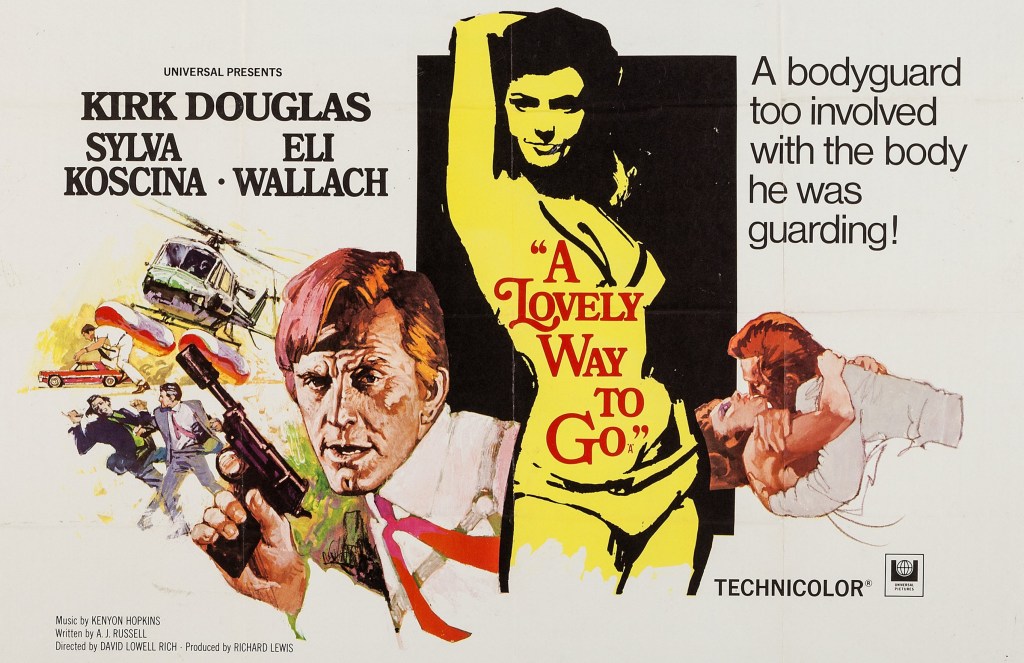
A Lovely Way To Die/A Lovely Way To Go (1968) ****

Woefully neglected detective thriller with a sparkling script and sexy leading stars exuding screen charisma. Like the celebrated William Goldman-scripted opening to Paul Newman private eye picture Harper (1966), the credit sequence here is at least as innovative in that it appears to be little short of a trailer, a highlights reel showing the audience what lies in store.

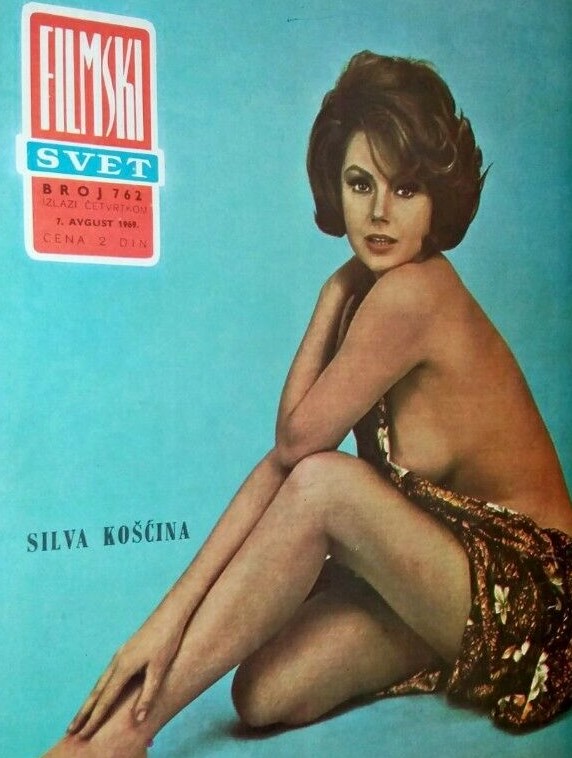
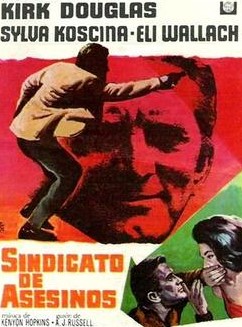
Kirk Douglas is a womanizing cop too handy with his fists, half his arrests making an unexpected detour to hospital. Sylva Koscina is the bored young wife of an older millionaire whose idea of fun is to chuck an expensive scarf out of a speeding car forcing her husband to pull up and go back and fetch. When her husband is shot, suspicion falls on Koscina – inclined  to dress in revealing outfits for the media – and her playboy boyfriend.

At the behest of attorney Eli Wallach with a rich Southern accent and a knack for speaking in parables, Douglas, having resigned from the force one step ahead of being fired, is sent in to provide security and find out whether her alibi stacks up. He soon finds out it doesn’t but by this time he has fallen under her spell. Witnesses disappear, intruders are dealt with, attempts are made on the detective’s life, and the twists come thick and fast. Koscina is the arch femme fatale who is a past master in the twisting department – twisting every male within a 50-mile radius round her little finger.

Harper was a throwback to The Maltese Falcon/The Big Sleep but A Lovely Way To Die knocks that shamus tradition on the head. For a start, Douglas is a high-living high-rolling  character who doesn’t take prisoners. The second time we meet him he has dumped the girl he took to the races for someone he has met while picking up his winnings.  Seducing gorgeous women and dumping them is second nature. This is Douglas as glorious charmer, a part of his screen persona lost after a glut of more serious pictures like Seven Days in May (1964) and Cast a Giant Shadow (1966). Yugoslavian actress Koscina, often little more than eye candy for most of the decade, had vaulted into the higher echelons after a turn as Paul Newman’s squeeze in The Secret War of Harry Frigg (1968).

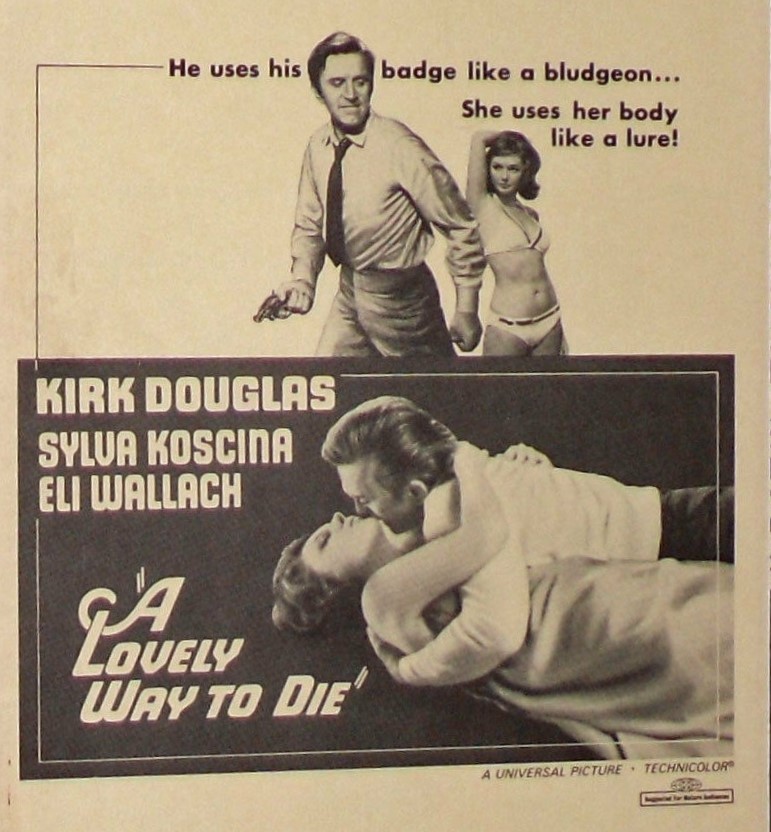
Typical of the cheesecake type of photo used in movie fan magzines in the 1960s – this one of star Koscina appeared in the Yugoslavian magazine “Filmski Svet.”

An inherent part of the attraction of this picture is how deftly she keeps Douglas at bay. Scriptwriter A. J. Russell and director David Lowell Rich (Madame X, 1966) deliver the goods in maintaining the tension in their relationship. There is a wonderful scene where the expectant Douglas follows her up the stairs of her fabulous mansion and three times he ignores the import of her unmistakable “Goodnight,” his uber-confidence taking him to her door – which she shuts in his face.  

Sure, in some ways it is slick, but it is also taut and realistic, Douglas does not win all his fights and he eats with the rest of the help at the mansion. And he does some terrific detection so it doesn’t fall short in that department. He is definitely helped by some choice lines – “police methods are sometimes difficult for an amateur to understand” he tells Koscina after brutally despatching an intruder. Koscina is in her element as the sexy, wealthy suspect, and especially in her banter with Douglas, in which her main aim to disarm his cockiness.

Eli Wallach is also superb, given just enough ham to hang himself, but matching Douglas in arrogance and outgunning the D.A. with his courtroom gymnastics. A couple of the subsidiary characters are well-drawn, a housekeeper who plays the markets for example.   

For some reason this sank like a stone on its initial outing, audiences perhaps being more attuned to the Bogartian sleuth, but I found it highly enjoyable and this could be seen as a  taster for anyone familiar with the antics of the star’s son Michael Douglas who found himself in similar territory in Basic Instinct (1992).

Many of the films from the 1960s are to be found free of charge on TCM and Sony Movies and the British Talking Pictures as well as mainstream television channels. But if this film is not available through these routes, then here is the link to the DVD and/or streaming service   

Discover WordPress

A daily selection of the best content published on WordPress, collected for you by humans who love to read.

The Atavist Magazine

by Brian Hannan

WordPress.com News

The latest news on WordPress.com and the WordPress community.