Banned, Reviled, Ignored: “Never Take Candy from a Stranger” (1960)

Paedophilia was the last taboo according to the Production Code, the self-censorship system organised by Hollywood in 1960. You could talk about rape in explicit detail (Anatomy of a Murder, 1959) and serial killers (Psycho, 1960) were acceptable, but you must not “violate the edict against depicting sex perversion…the only subject strictly forbidden by the code.”

Without the Production Code Seal (of approval), cinema bookings would be hard to come by. Cinemas that relied on the goodwill of their patrons would not dare risk upsetting them by renting a film that had met with such disapproval.

Headline news in “Variety.

Never Take Candy from a Stranger – a.k.a.Never Take Sweets from a Stranger – had been passed as an X-certificate in Britain, where, despite being set in Canada, it had been made. While that meant it could only be seen by adults over 18, there was no objections to it being shown.  It had been shot over six weeks beginning October 1959.

It had even been positively reviewed in the U.S. where Variety called it and “an exceptionally restrained film…directed with considerable skill” and Box Office magazine, another trade weekly, rated it “touching” though warned exhibitors that the “the subject matter is not to be sold as lure.” 

It did not help the case that James Carreras of British studio Hammer  had set out to make a movie that was “explosively exploitable” with the aim of cracking open America on the back of “heavy-exploitation marketing such as sex crimes against children” and that the movie intended to be “as frank with its theme as was Anatomy of a Murder in dealing with rape.”

The case went to appeal. The argument in its defence, as put by Roger Garis, author of the play on which the film was based, was that the movie wasn’t so much about paedophilia but about the public’s resistance to hearing about it, and the battle by two parents to rid the community of such a menace. He pointed out that on the play’s initial opening in New York in 1954 “no review indicated in the slightest degree that the subject matter was distasteful.”

But perhaps the U.S. censors took more note of the review printed in the British Monthly Film Bulletin that complained the “film’s seriousness is dissipated by an unnecessarily horrible climax.”

Hammer appealed the decision, but the Production Code would not budge. 

Despite the cautionary note struck by Box Office magazine, it was almost certain that it would be sold as exploitative, and attract the wrong sort of clientele, and for moviegoers of the wrong disposition it might well be only too big an attraction. In Britain, for example, it had been sold as a sex-shocker double bill, on the ABC circuit teamed up with Brigitte Bardot number Come Dance with Me (1959).

U.S. distributor Columbia could not be seen to be selling a movie that went against the ruling of the Production Code, but it couldn’t just dump it either since it was contractually obliged to release it. So instead it was passed on to its sub-division Lopert, an independent operation with no ostensible links to the parent company, that would find a way to get it into cinemas. Lopert would either sell it through the states rights method, divvying up the picture to a different set of local distributors who would each undertake the release in an individual state, or sell it on to another distributor, perhaps with experience of handling dodgy material. Lopert did both. Distribution was handled in some territories by Omat, which had successfully ushered La Dolce Vita (1960) through the system, and later Pathe-American, and in others by an independent.

The trade magazines had urged exhibitors to enrol the assistance of parental groups in marketing the movie, but these would hold no sway in terms of publicity. A local newspaper which had denied the movie any advertising space – a nationwide ban that followed such extreme Code disapproval –  was hardly going to give it editorial coverage.

But of course there were exhibitors who would take it. Arthouses were one possibility. They had been dealing with the disreputable ever since foreign production companies realized they could bypass the Production Code. If they were not signatories, they did not have to submit their movies for assessment. That was why there was such a flood of movies from France, Sweden and Italy heralding a sensational star like Bardot or Sophia Loren and promising greater leniency towards nudity than would be acceptable to the Code.

And there were many, especially among the more articulate classes, who felt the Code was outdated anyway, and that foreign films were breaking new cinematic ground, and that the directors of such films, Ingmar Bergman, Fellini et al, should be praised rather than condemned. But it was inevitable that movies from abroad with genuine artistic purpose got mixed up with those made with purely salacious intent.

The arthouse had been compromised so much that anything that could lure in the public was fair game. Even so, most arthouses drew the line at a film about child molestation. While Never Take Candy from a Stranger did receive a number of bookings in city center U.S. houses between 1961 and 1962 they were rarely in an arthouse. Most were in cinemas accustomed to offering patrons lurid product. In Chicago, outside of the major cinemas, it went out as a double bill with Sam Peckinpah western Deadly Companions.

Tracking the release through the pages of Variety and Box Office, I discovered it had only occasionally proved a success, a holdover for a second week generally one way of demonstrating that measure.

(Note that cinema capacities were much larger than today in the multiplex era and it was far from uncommon for  moviegoers to be part of a 1,000-plus audience)

In May 1961 in Boston it ran for two weeks at the 689-seater Mayflower, hitting $4,500 in the first week with a relatively small drop to $4,000 the next. In November, most likely as a filler for a movie that failed to hit its targets and was pulled early, it reached the 2,995-seat Palms in Detroit, clocking up a fair $10,000, but only permitted three days the next week, for another $3,000.

But by then a different reelase strastegy was in place. The same month in an “unusual first-run hook-up” it played a couple of drive-ins in Kansas City, those theaters were dragged into the first-run loop in the absence of other available or willing houses. One week at the 900-car Crest and the 700-car Waldo brought in a “mild” $6,000.  Perhaps in a bid to secure a bigger audience it was teamed with Beware of Children (1960). But anyone expecting another dip into perversion would be disappointed for it was a British marital comedy starring Leslie Phillips.

But release was a long drawn-out process, and perhaps to limit expenditure few prints were made. And by 1962, yet another different approach was taken, targeting the arthouses. In February it reached Baltimore, $3,000 at the 860-seat Avalon, In April it lasted one week at the 238-seat Capri Art in Denver taking $900 gross at the box office.

And then, never having not scaled the heights that a movie trading on controversy might expect, it disappeared. Obviously never a contender for television, and no sign of it being shoved out during the VHS boom, when virtually any movie made was revived in the hope of snaring a few extra bucks.

It took a helluva long time for the movie to surface, but when it did, it was to plaudits.

SOURCES:  “Hammer’s Slant,” Variety, October 21, 1959, p4; “Realism Outbreak in Britain,” Variety, October 31, 1959, p3; Review, Monthly Film Bulletin, January 1, 1960, p48; James Carreras, “British Horror Pix As Insurance For That Wide-Open Global B.O.,” Variety, January 6, 1960, p166; Review, Variety, March 16, 1960, p6; “Child-Molesting Theme in Abeyance,” Variety, April 27, 1960, p3; “Candy Story Author Sez Not About Perversion But Public’s Own Laxity,” Variety, May 11, 1960, p4; “Candy Loses Appeal for Code Seal,” Variety, May 18, 1960, p17;  Advertisement, Variety, January 11, 1961, p14; Review, Box Office, August 21, 1961, pA1; “Says Wilmington Press Is Pre-Judging Ads,” Box Office, October 30, 1961, p15; “Set Up Pathe Campaign,” Box Office, December 18, 1961, pNE6. Box office figures from Variety issues: May 31, 1961, p9; November 22, 1961, p8-10; February 14, 1962, p8; April 18, 1962, p9.
The Box Office Equalizer: Part Two

Variety’s revolutionary new box office tracking system, introduced in 1969, allowed it to include far more films in an annual assessment of performance. The “Annual Rentals” chart that appeared every January still covered how much of the box office pie was returned to studios and therefore gave a good indication of potential profit. But that was limited to only those pictures that met that chart’s criteria i.e. they had to return $1 million rentals. That usually meant only 80-odd films.

But now, in addition, from the computerized information gathered every week from hundreds of cinemas, Variety was able to give a pretty accurate estimate of the box office gross for ten times as many movies. In 1969, the survey covered 1,028 pictures. This wealth of information was of enormous value to exhibitors. Not only did it cover the obvious titles – the roadshows and those with top stars – but also the run-of-the-mill movies on which most cinemas now depended. In the current severe product shortage, reissues played a vital role. As did sexploitation.

Among films reviewed so far in the Blog annual grosses were shown for: They Night They Raided Minksy’s $1.9 million, Mafia picture The Brotherhood $1.9 million, Anthony Newley number Can Hieronymous Merkin Ever Forget Mercy Humpe and Find True Happiness $1.3 million, Hard Contract $1 million, Mayerling $980,000, Justine $536,000, Les Biches $391,000, Assassination Bureau $146,000, Fraulein Doktor $114,000 and The Sisters $50,000. (Multiply these figures by 50% for an accurate estimate of their rentals).

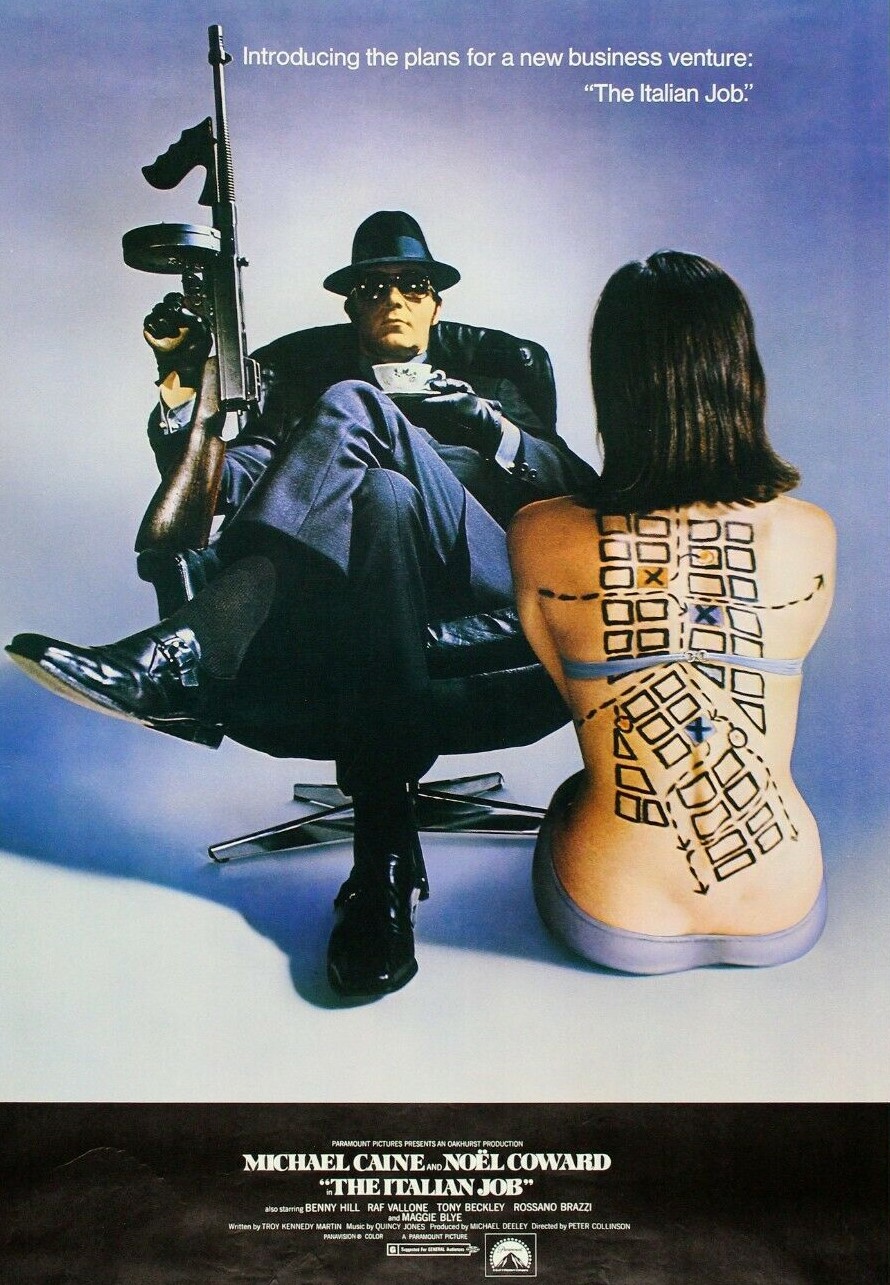
Other figures worth noting were: The Fixer $1 million, Secret Ceremony $1 million, The Italian Job $614,000, Marlon Brando in The Night of the Following Day $424,000, Shalako $78,000 and The Extraordinary Seaman $61,000. Bottom of the box office pile was motor racing documentary Hot Rod Action with just $1,000.

Given it was widely considered a flop, these are interesting figures for Hieronymous Merkin, rentals now estimated as being in the region of $2 million against a budget of $1.6 million – although other sources put the budget as low as $500,000 thus making it extremely profitable. Secret Ceremony had grossed $617,000 the previous year so its rentals would have approached $2.5 million, far more than was previously assumed. Fans of cult British thriller The Italian Job will perhaps be astonished how poorly it did in the U.S.

The top-grossing reissue was Bonnie and Clyde/Bullitt ($1 million) followed by a pair of Clint Eastwood double bills – A Fistful of Dollars/For a Few Dollars More ($912,000) and Hang ‘Em High/The Good, The Bad and The Ugly ($740,000). Also in the mix were Goldfinger/Dr No ($323,000), A Man and a Woman ($226,000), Belle de Jour/A Man and a Woman ($199,000), a revival of Lola Montes from 1955 with $148,000 and less successfully, from 1961, A Cold Wind in August with just $21,000.

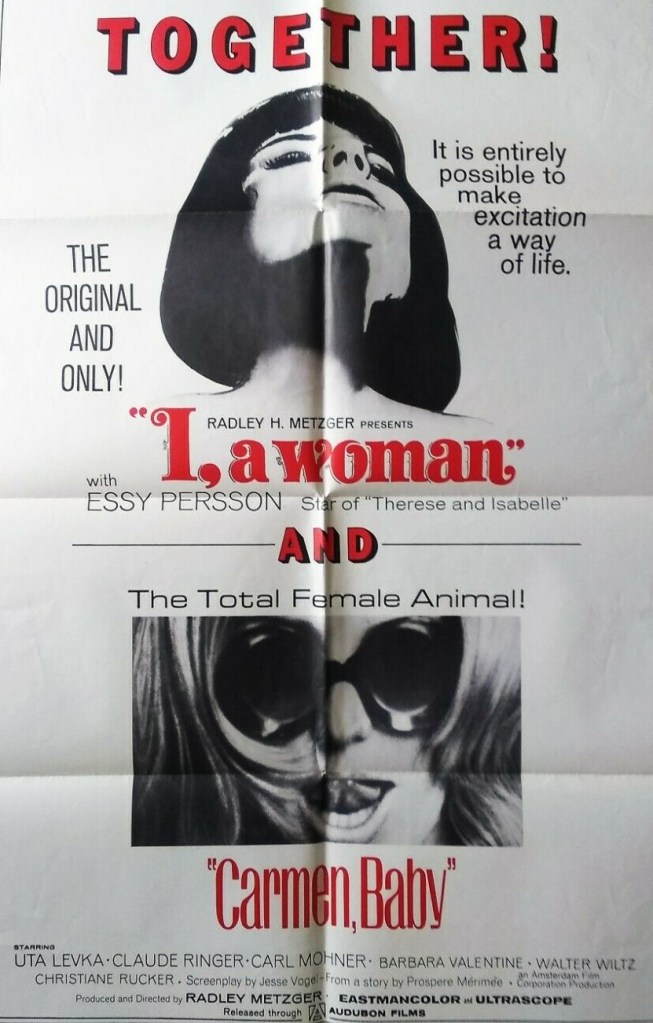
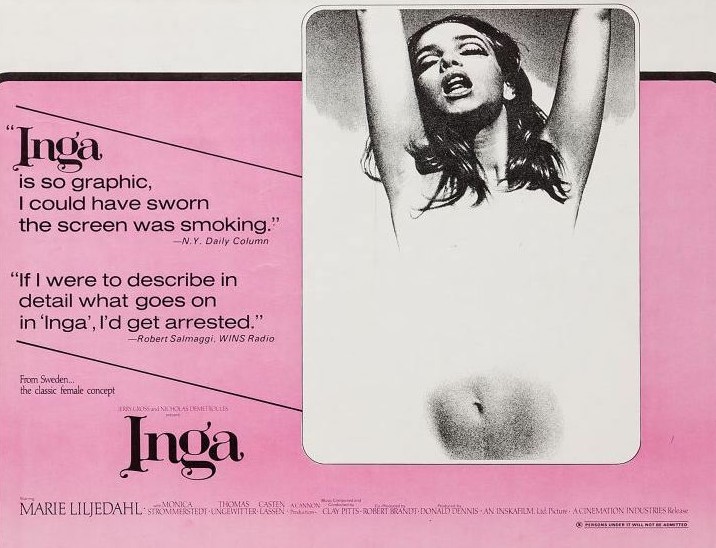
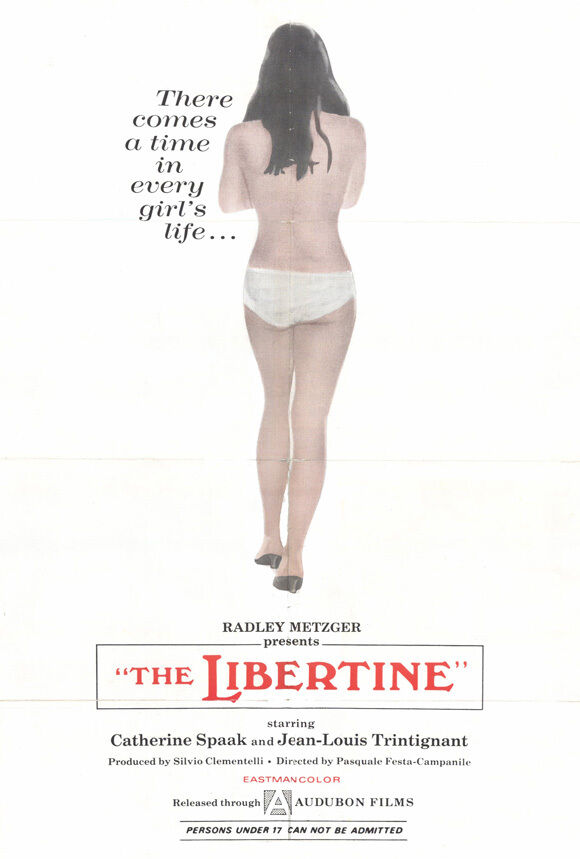
As previously noted, the impact of sexploitation was becoming more obvious. The biggest hit was The Libertine which crossed the $1 million mark followed by Camille 2000 ($868,000), Inga ($819,000) – bringing in three times as much as the previous year – Swedish Heaven and Hell ($458,000) and The Female ($279,000). Others charting included Vibrations, Without a Stitch, Erotic Dreams and The Sex Perils of Pauline. In addition, sexploitation movies were ripe for reissue, I, A Woman/Carmen Baby clocking up $363,000.

More importantly, what the chart did show and what the new weekly Top 50 was beginning to recognize was how often cheaply-made exploitation pictures held their own or even outgrossed big studio pictures for which exhibitors were often held to ransom. If ever there was a sign of the direction in which the business was now heading, this annual survey was it.

SOURCE: “Variety B.O. Charts’ 1969 Results,” Variety, April 29, 1970, p26.   

The Box Office Equalizer

Variety’s experiment in extending its box office coverage beyond main city roadshow and first run showed its first results when analysis of a full year of statistics for 1968 produced data for over 700 pictures rather than the hundred or so that qualified for its annual rentals  chart.

The drawback with the existing annual chart was limitation – films had to earn more than $1 million in rentals (the amount returned to studios from the overall gross) to qualify. The tabulation process simply ignored how hundreds of other films performed and therefore as far as Variety was concerned failed to offer the information exhibitors required to run their businesses in more complicated times when increased product shortage was exacerbated by long runs of either roadshow pictures or movies held over for months on end in first run in the big cities.

The business still primarily operated on a stepped released basis. Movies that opened in roadshow or first run remained in their initial theaters until demand was exhausted and only then moved into second-run or multiple run (Showcase) or the drive-ins, leaving those cinemas further down the food chain crying out for fresh product. What companies were meeting that demand and how their films performed at the box office was generally a mystery.

The expanded chart for 1968 covered grosses rather than rentals (the former the overall take, the latter the part of that that went back to the studios). A sample of up to 800 cinemas nationwide first of all cast light on a whole section of mainstream underachievers. To come to an accurate assessment of how these grosses reflected overall a film’s overall annual performance, Variety suggested tripling the numbers. To reach a rental figure, the measurement of profit, you would need to halve that. (More straightforwardly, add 50% to the figures below to work out the annual amount returned to studios in rentals in 1968 and multiply by eight – for inflation – to put these figures into perspective from today’s point of view.)

Among the films mentioned were Burt Lancaster in The Swimmer which was now shown to have grossed $1.314 million, Burton-Taylor fiasco Boom ($557,000), Albert Finney as Charlie Bubbles ($526,000) and films reviewed in the Blog such as The Shoes of the Fisherman ($611,000), P.J./New Face in Hell($415,000), The Lost Continent ($338,000), Sol Madrid ($268,000), Hammerhead ($233,000), Sebastian ($162,000) and The Girl on a Motorcycle ($104,000).

Others worth mentioning were Duffy ($709,000), Elizabeth Taylor, Mia Farrow and Robert Mitchum in Secret Ceremony ($671,00), Michael Caine in Deadfall ($614,000), Lee Marvin in Sgt Ryker ($417,000), How I Won the War ($321,000), Night of the Living Dead (318,000). When we casually refer to movies as flops, we often have no idea just how big a failure they were – these figures redress that balance.

Reissues pulling in decent business included Thunderball ($867,000), The Carpetbaggers/Nevada Smith ($244,000) and on the back of Sidney Poitier’s elevation to box office peaks the seven-year-old A Raisin in the Sun ($159,000)

Much further down the line came Danger: Diabolik on $24,000 and Subterfuge with just $8,500. At rock bottom, ranked 729th, was Tony Richardson’s The Sailor from Gibralter with $1,000 in the kitty.

The survey also served to highlight the impact of the growing number of foreign imports. While sophisticated fare like Therese and Isabelle ($2.19 million), Francois Truffaut’s The Bride Wore Black ($511,000), Claude Lelouch’s Live for Life ($495,000) and Scandinavian medieval drama The Red Mantle ($396,000) had broken out into the mainstream from their arthouse launchpads, the various strands of the spaghetti western genre would have headed straight for the drive-in or Showcase led by A Minute to Pray, A Second to Die ($865,000) and Any Gun Can Play ($230,000).

In part what Variety sought to show by covering such a wider stream of releases was to assess the growing dominance of the sexploitation picture. Around one-third of the movies featured fell into this category. The Female ($492,00), The Filthy Five ($322,000), Inga ($267,000) and Aroused ($168,000) boasted impressive numbers, especially given the limitations of the survey. The fact that many others – Alley Tramp, Touch of Her Flesh, I, A Woman, Hot Spur, Professor Lust and Brand of Shame – even made an appearance on the extended chart showed inherent demand for this kind of product. That most of these achieved only low grosses in the Variety chart was an indication more of the types of cinemas surveyed. It would be a rare first run house that would book a sexploitationer and even the Showcases steered clear. But that they were mentioned at all was indication of a sea change.

Sources: Syd Silverman, “Computerized Tally of 729 films,” Variety, May 7, 1969, pages 34, 36, 198, 213.

Discover WordPress

A daily selection of the best content published on WordPress, collected for you by humans who love to read.

The Atavist Magazine

by Brian Hannan

WordPress.com News

The latest news on WordPress.com and the WordPress community.