Harley Davidson and the Marlboro Man (1991) *****

I always approach cult with some unease. You never know why a film has fallen into the category. It could simply be awful and resurrected with glee because someone has cleverly constructed a sub-genre called So Bad It’s Good – check out Orgy of the Dead (1965) or Can Hieronymus Merkin Ever Forget Mercy Humpe and Find True Happiness? (1969). Or it’s been a surprising flop first time round and discovered an audience through VHS and DVD – The Shawshank Redemption (1994) the forerunner in that field. But the plusses – well-made, great characters, some standout scenes – in the Stephen King adaptation were so obvious and the studio put a lot of dough behind re-marketing it to the at-home audience that it was not so surprising that it found a better response second time around.

But Harley Davidson and the Marlboro Man did not, as with The Shawshank Redemption, come garlanded with seven Oscar nominations, and the stars had considerably less marquee appeal and peer acceptance than Tim Robbins (The Player, 1992) and Morgan Freeman (Driving Miss Daisy, 1990). Mickey Rourke (9½ Weeks, 1986) and Don Johnson (The Hot Spot, 1990) had not only mostly blown their status in the Hollywood hierarchy but only seemed one newspaper headline away from further notoriety.

That it works – and so well- relies on mix of several ingredients. In the first place it’s a throwback to the buddy movie, the easy camaraderie between Harley Davidson (Mickey Rourke) and the Marlboro Man (Don Johnson) has obvious precedents from Butch Cassidy and the Sundance Kid (1969) and clearly is some kind of homage to the Paul Newman-Robert Redford picture since it pinches three of the elements that made the western such a box office smash.

Secondly, our fellas do bad for a good – if somewhat lopsided – reason so aren’t true criminals and, in any case, earn a get-out-of-jail-free card because it turns out they’ve robbed from proper bad guys. Thirdly, there’s a terrific robbery and street shoot-out. Fourthly, it draws on the spaghetti western in the costume department, repurposing the top-to-toe dusters into black leather, an idea that would be snatched up by the likes of The Matrix and quintet of bad guys toting machine guns and dressed in black picked up not only by The Matrix but also by Men in Black (1997).

You could argue that a better director than Simon Wincer (Harlequin, 1980) would have done more visually with the leather-clad gangsters emerging from a vehicle and producing a solid wall of lead – perhaps through slo-mo or taking more time to concentrate on their sudden appearance – and made it a scene that might stand up to the ambulatory episodes in The Wild Bunch (1969) or Reservoir Dogs (1992). Even so, quite simply, it is a stunningly arresting piece of cinema.

But the real reason this works is that the two main characters are so human. Harley is given to philosophizing and wondering (in the manner, it might be said, of Butch Cassidy) and Marlboro loses out in love. While they fall into the category of endless drifters, an aversion to commitment, living easy, and more in love with their bikes than anything else, they are almost winsome in their innocence, as if everyone else will just fall into line with their world view.

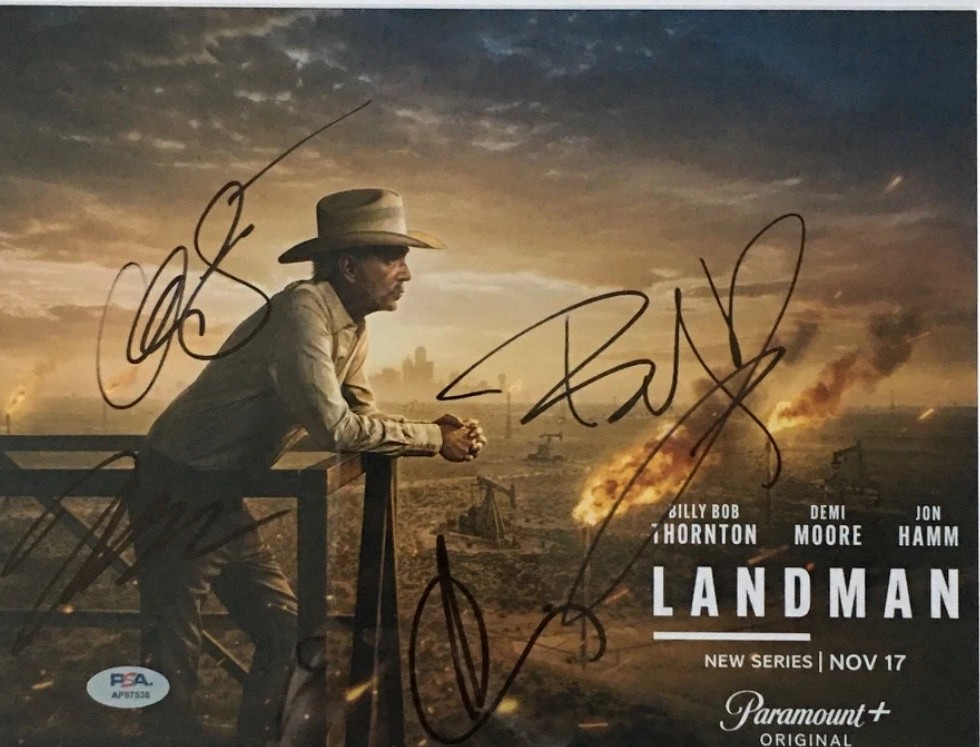
Signed photo of Mickey Rourke in this piacture will set you back three hundred bucks.
That’s cult for you.

Anyways, we are duped into thinking this is going to be a John Wick-Die Hard wild ride from the opening scenes where both dudes prove mighty handy with their fists, Harley preventing a gas-station robbery, Marlboro taking on poolroom cheats in a bar. The plot only kicks in when they discover that the bank is planning to foreclose on their favorite bar. Needing to get their hands on a quick $2.5 million, the boys decide to do a bit of foreclosing themselves, taking the required sum from the bank in question, organizing a neat heist only to discover they’ve not stolen money but drugs.

Being smarter than your average hood, they swap the drugs for the dough but don’t take into account that the villains are smarter than the average thug and aren’t in the business of donating to good causes. The gangsters hunt them down. Harley and Marlboro could just disappear, especially once they dispose of the hidden tracking device, because they are A-grade students in the art of hiding away. Instead, honor is at stake so they set up an ambush in an airplane graveyard.

Since you’re asking, the Butch Cassidy the Sundance Kid grace notes are: Marlboro is the equal of The Sundance Kid is the shooting stakes and, in fact, like his predecessor, Marlboro manages the same trick of shooting off a character’s gunbelt; in the gunfighting stakes, Harley is the equivalent of Butch, never killed a man, absolutely useless with a pistol; and, the piece de resistance, when trapped they jump off an exceptionally high ledge into water.

Mickey Rourke and Don Johnson take the opportunity to shift well away from their existing screen personas and are thoroughly engaging. Simon Wincer keeps to a tidy pace. Written by Don Michael Paul (Half Past Dead, 2002) in his debut.

The action is top-notch, all the characters are well-drawn, the women not just bed fodder, usually brighter than the men. Terrific roster of supporting cast including Chelsea Field (The Last Boy Scout, 1991), Tom Sizemore (Saving Private Ryan, 1998), Robert Ginty (The Exterminator, 1980), Daniel Baldwin (Mulholland Falls, 1996), pop star Vanessa Williams (Eraser, 1996), Giancarlo Esposito (Megalopolis, 2024), Tia Carrere (Rising Sun, 1993) and Kelly Hu (X-Men 2, 2003).

The kind of movie where you wish they would do it all over again. Had the movie been a success a sequel would have been a shoo-in. As it is, we’ve only got this, so enjoy it while you can.

Catch it (for the moment) on Amazon Prime.

Duet for Cannibals (1969) ****

Terrific twist-a-minute thriller. Forget its arthouse origins. The gap of half a century since its initial appearance has worked in its favor and you can now view it as exceptionally gripping entertainment. The Swedish setting doesn’t mean it’s drenched in angst and repression, and instead pivots on that other Swedish contribution to cinema of that decade of sex and nudity.  Though power games these days tend to belong to the horror vernacular where innocents stray into the wrong location – Barbarian (2022), Heretic (2024)  –  outwith such business-set items as Working Girl (1988) and The Devil Wears Prada (2006), this belongs to an earlier version of the cycle which relies on sexual undertones.

This will most likely be touted as worth a look because it was one of the very few – less than a dozen – movies directed by women in the 1960s. While Swedish actress Mai Zetterling was the jointly the most prolific with four films beginning with Loving Couples (1964) and Frenchwoman Agnes Varda, also with four, the most acclaimed following Cleo from 5 to 7 (1962), American Susan Sontag’s debut – she also wrote the piece – was the most highly awaited. Through her writings she was something of an outspoken icon and an intellectual powerhouse.

You can tell it’s arthouse because the poster is only altered minimally.
Instead of holding four figures in her hand the woman now holds on.

Made in Sweden with a Swedish cast and while originally seen as Bergmanesque or perhaps Pinteresque, a contemporary audience is more likely to ignore the other influences and settle for the innocents walking willingly into a trap.  Tomas (Gosta Ekman) goes to work for enigmatic political exile Dr Bauer (Lars Ekborg). His duties mostly involve curating the revolutionary’s life’s work, transcribing diaries and such, but occasionally he is called upon to do what appear to be simple acts of espionage, nothing dangerous just delivering a mysterious parcel.

Dr Bauer is pumped up with his own importance and expects employees at his beck and call – Tomas has to sleep there, in a made-up bed in the library – and enjoys the power surge of bawling people out when minor mishaps occur. But he also enjoys – if that’s the word – a peculiar marriage to younger Italian wife Francesca (Adrianna Asti) who while doe-eyed is far from docile. On her first encounter with Tomas, Francesca breaks a window and it’s not long until she exerts a sexual lure.

Tomas dreams of making love to her and would watch her making love to her husband in a car in the garage except Francesca obscures the windscreen with shaving foam. That scene in itself is one of the most intriguing. She has thrown an almighty sulk, locked herself in the car, ignoring her husband until she starts the engine and nearly mows him down at which point the tempo dramatically changes triggering for a bout of heavy sex.

Nothing so common as a noveliization for Sontag. She gets the full screenplay treatment.
This appeared in 1970.

Theoretically, Dr Bauer is dying from a mysterious illness. You get the sense he’s auditioning Tomas as someone to look after his wife when he’s gone, but all of that could just be part of the game.

There’s a marvelous scene where Tomas is encouraged to continue eating at the dinner table to the soundtrack of Dr Bauer throwing up in the toilet. When the doctor returns, he heaps food on his plate and continues eating.  

Dr Bauer isn’t just paranoid – the cook’s poisoning him, his phone’s tapped, Tomas is a spy, his wife’s planning to kill him – but he’s also a narcissist, studying his face in the mirror, improving his appearance with wigs and a painted-on aesthetic beard. He encourages potential intimacy by having Tomas read poetry to his wife.

She’s the dominant one in her fantasy, rescuing Tomas from an enchanted castle, standing above him on a stool, bandaging his face so that as a mummy he can terrorize her in sexual fashion. She puts her husband’s perennial sunglasses on his eyes. Sometimes her husband’s head is bandaged.

Braun plans to kill his wife because “there’s no point keeping her alive.” Equally, she, apparently is intent on returning the compliment though she wants Tomas to do the dirty deed. Or it could be a murder-suicide pact.

She locks her husband in her bedroom closet so she can make love to Tomas while he listens but he also has key to the door and could let himself out at any time. When Tomas’s girlfriend Ingrid (Agneta Ekmanner) enters the equation Tomas is forced to watch her making love to Dr Bauer. And it’s not long before Tomas is chucked out and Ingrid sucked in. In one of the most erotic scenes you’ll ever witness husband and wife feverishly feed Ingrid with their hands and before you know it she’s sharing their bed.

Even within the confines and the mathematical possibilities of the power play, you still never know which way this is going to turn. You might quibble at the voice-over which attempts to play much of the goings-on through Tomas’s POV and the flirtations with left wing politics, but those are easy to ignore as you are carried along on the twists and turns. It keeps twisting till the very end when the stings in the tail come fast.

These days it would be played at a higher tempo, the melodramatic elements ramped up, but actually the lack of emotional heft works to its advantage. Terrific debut from Susan Sontag. The slinky Adriana Asti (Love Circle, 1969) steals the show.

Rare find.

Catch it on Netflix (great print) or YouTube.

Should you be interested YouTube has an interview with both Sontag and Varda.

Bob & Carol & Ted & Alice (1969) ****

The one with the wife-swapping. Like Easy Rider released earlier the same year, a hymn to freedom, only this time of the sexual kind. Responsible thirtysomethings, well-to-do, married with children, jealous of the younger generation’s counter culture, seek guilt-free irresponsibility. They feel they’ve missed out, despite knocking back cocktails in their heyday, probably remained virgins until marriage. Like the recently-reviewed The Battle of the Villa Fiorita (1965), the problems incurred in marriage appear eternal, and decades later this holds up superbly, not just for taking a measure of its times, but for a screenplay setting up a bold series of reversals, character reaction you would never expect, that will have you in stitches even as it dissects universal truths.

Documentary film-maker Bob (Robert Culp) and housewife Carol (Natalie Wood) “find” themselves at a weekend retreat espousing naked yoga, primal screams, group therapy and emotional intimacy. Carol admits she finds her husband controlling. They return in evangelistic mode, desperate to pass on their new-found knowledge to their stuffier friends, Ted (Elliott Gould) and Alice (Dyan Cannon).

The advertising campaign focused on the tease of wife-swapping.

The film unfolds in a series of long sequences, each sparked by external incident. Bob confesses to his wife that while away on business he had an affair. To his astonishment she forgives him. Expecting this to be a prelude to some new way of tormenting an unfaithful husband, Bob remains skeptical until Carol convinces him that her world-view has changed following the retreat.

But Ted and Alice find it harder to accept. In a brilliant scene that exposes basic gender differences, he sees the problem as his revelation, she as the act of infidelity itself. High after meeting the other couple, Ted wants sex, but Alice, shocked by what she has heard, cannot contemplate it. He exerts so much pressure that she, deeply insecure, is almost on the verge of giving in. The dialogue not just marvelously encapsulates their marriage but sets out opposing views that, I am sorry to say, would probably be as prevalent today.

But the best scene, a superb reversal, occurs when Bob, spurning another night of illicit passion, returns home from a trip early to find his wife in bed with the tennis coach. Gender equality et al. The sequence turns completely on its head when, according to the couple’s new philosophy, Bob should not only accept and forgive, but help the tennis coach out of his predicament, calming his fears of facing an angry husband, in effect consoling his bedroom rival.

Bob and Carol and the Tennis Coach.

What appears to have been just a Ted fantasy, hooking up with a woman he met on an airplane, turns out to be true, creating a crisis in that marriage and when Alice is pacified, acknowledging a new truth, it is she who calls for an orgy. Now this is a revolution for Alice is by far the most repressed, although attractive almost matronly, and still using a childish word to describe her private parts. Her confessions to a psychiatrist reveal a tormented individual.

It’s a stunning debut from Paul Mazursky (An Unmarried Woman, 1978) who also had a hand in the screenplay with Larry Tucker (I Love You, Alice B. Toklas, 1968). He takes a story of endorsed immorality and stamps it as a morality tale. A movie that depended so much on dialogue concludes with a fabulous series of shots where the look on the faces of the characters tells you all you need to know.

Elliott Gould (The Night They Raided Minsky’s, 1968) and Dyan Cannon (The Murder Game, 1965) are the pick of the actors, both stepping up to the plate after less than stand-out performances previously. Both were Oscar-nominated but more importantly here created  screen personas that would define their futures. Natalie Wood (This Property Is Condemned, 1966), in her first picture in three years, revitalized her career after a string of flops. Robert Culp, in a step-up from the I Spy television series (1965-1968), initially takes center stage but cedes ground to the superior acting of the others.  

Where a whole bundle of films by new directors flopped that year and the next by targeting the younger generation, this was a success by painting a wry picture of a slightly older generation, not yet tipping into middle age, but terrified they might be missing out on something.

On Swift Horses (2025) *** – Seen at the Cinema

Authentic story stymied by unlikely plot. Set in a post-Korean War American when the United States is still a land of opportunity even for blue collar workers but sexuality and other forms of self-expression are stifled and the homosexual world is only accessible through secret codes. Married Muriel (Daisy Edgar-Jones) hankers after something of the wilder life apparently enjoyed by the brother Julius (Jacob Elordi) of her staid husband Lee (Will Poulter). Truth be told she hankers after an illicit relationship with Julius.

Muriel harbors two other secrets. Firstly, she wants to gamble, a notion that would never gain approval from her husband, who accounts for every penny in his bid to own his own home and thus move up in society. Secondly, she has lesbian tendencies and gradually, encouraged by the self-confidence generated through successful betting at the racetrack, she assumes a different persona, surprisingly capable of making the first move.

Lee is aware of his brother’s proclivities, though these, too, are measured in guarded tones. Julius lives “in another world”, not just the low-down hustling and gambling and earning a living as a gigolo and card cheat. His homosexuality is repressed but his barriers are broken down by Mexican hustler Henry (Diego Calva). But while Julius is willing to settle for a life of energetic sex with Henry, his lover has greater ambition and plans to move up in society via the scam route.

Muriel’s affection for Julius is not hampered by the fact that he constantly steals from her, pocketing the cash she sends him for a bus fare home, burglarizing their house while they sleep. And while she is happy to indulge in a casual affair with gay neighbor Sandra (Sasha Calle) she’s not whole-heartedly committed to that lifestyle. And it’s hard to see just how committed she is to Lee – the horde of cash she wins at the racecourse she keeps hidden from her husband even though it would miraculously ease their upwardly mobility.

While Muriel negotiates the hidden world with some care – gay people of both sexes meet at a certain hotel or come together under the guise of a book club – Julius is less wary and is beaten up and robbed a couple of times.

This isn’t quite the lush America of 1950s Hollywood with women bedecked in colorful dresses and enjoying cocktails, but there’s still satisfaction to be had in hauling yourself up and owning a tract of land and your own house. And it’s still down’n’dirty. Casinos spy on customers through two-mirror mirrors set in the ceiling and beat the life out of anyone caught cheating.

What wins your heart is the yearning. Muriel is caught in a half-world, even when she finds a willing lesbian partner she still aches for a heterosexual whirl with Julius. And Julius who believes he has found a safe sexual haven with Henry discovers that the latter’s naked ambition will destroy their tryst.

What doesn’t work are the fairy tale aspects. Julius isn’t a particularly good card cheat, a hidden ace or a partner at another table providing him with illicit advantage at the poker table. You’d expect he’d be rumbled quite easily. But the plot says no.

Similarly, Muriel enjoys an unbelievable good run on the horses, able to turn tips overheard from customers in the diner where she works into winning bets. Pretty quickly, and without a stumble, she has amassed a stash of $20,000. As if.

The ending doesn’t work either, Julius galloping on a horse (yep!) from San Diego to Las Vegas – a distance of some 350 miles (that’s some horse!) – after he realizes that, in fact, his heart belongs to Muriel, whose marriage has at last broken up, and she’s decided to follow her heart and become a gambler.

It leaves you wondering what kind of relationship they would have, a lavender marriage, where both are free to indulge in other aspects of their sexuality, no doubt living high on the hog from her racetrack winnings and his cheating at cards.

It looks to me like the director has bottled out of the third act, the one where supposedly they are the person of each other’s dreams and manage to make a life together as happy gamblers, until one or other decides that a person of their own sex is more fulfilling ultimately than a person of the opposite sex.

You didn’t need the barmy plot for this to work. And in fact it’s the barmy plot that gets in the way of it working. Both Julius and Muriel are entirely believable in looking for a love that dare not speak its name but can yet be easily located if you can follow the codes or if your gaydar is sufficiently developed.

Oddly enough, the most heart-breaking scene is the one before the barmy galloping. On the message board inside a gay meeting place are notes revealing the heartbreak caused not just by the dashing of love’s hopes but the destruction of marriages by men unable to conceal their secret desires.

The acting is uniformly good, though Jacob Elordi (Saltburn, 2023) thanks to his vulnerability, wins by a nose from Daisy Edgar-Jones (Twisters, 2024). But Will Poulter (Warfare, 2025) and Diego Calva (Babylon, 2022) also score points. Movie directing debut from Daniel Minahan from a script by Bryce Kass (Lizzie, 2018) based on the novel by Shannon Pufahl.

While you have to admire the actors for taking a gamble on this project – Elordi and Edgar-Jones are down as executive producers so they might also have taken pay cuts. But it has been  an unmitigated financial bomb. Even the leanest movies these days appear to cost upwards of $10 million and this has barely touched the $1 million mark in global box offices. I attended the only daily screening at my local multiplex and there was only one other person in the audience. It probably deserves better and might have an afterlife on a streamer.

Enjoy the performances and ignore the plot.

Honey, Don’t! (2025) ** – Seen at the Cinema

Had I still been in the magazine business I would have welcomed this with open arms because it would have provided an ideal headline – “Honey, Don’t Go.”

I’m not sure what Ethan Coen (True Grit, 2010) thought he was making and even if it was a shaggy dog story as often were the tales he concocted with his brother this has turned out more like a dog’s breakfast. Which is a shame because it’s about time Margaret Qualley (The Substance, 2024) was elevated from indie product to mainstream. She’s certainly got a screen presence and if someone could only fit a movie around what she has to offer she’d be on her way.

Excepting some salty dialog, this comes up short on every front. The narrative is so thin it’s disappeared down every convenient rabbit hole, the characters are equally lacking (though my guess is they’re meant to be slices of cliché, that’s the game) and there’s a deliberate emphasis on keeping emotion to the bare minimum.

The two main characters, private eye Honey Donohue (Margaret Qualley) and cop M G Falcone (Aubrey Plaza), congratulate themselves on being so completely self-centered that all dalliances are strictly confined to one-nighters, such restrictions imposed before the other person gets all weepy and emotional. Honey and MG, both being lesbians, are able to get away with such notions. Imagine a male attempting to classify all females as just too emotional.

I say Honey is a private eye but it’s kind of hard for her to keep clients because they keep on being bumped off before she can take any action. And when she does, she doesn’t prove much cop. In fact, she’s actually that old film noir fallback – the dupe. And she only realizes she’s been played for a patsy when she sees – another old fallback – two cups on a table (it’s an old-fashioned house hence the teacups).

It’s a strange construct. The audience knows what’s going on but poor Honey is kept in the dark and at the climax it looks very much like she’s setting herself up to be the dupe again.

So what the audience knows that Honey doesn’t is that a woman who died in a car accident has had a distinctive ring stolen by a woman on a moped, Chere (Lera Abova), who in another old-time fallback can’t pass a pool without skinny dipping. The ring has a logo that ties in with that of the religious scam being run by uber hunk preacher Rev Drew Devlin (Chris Evans).who uses the church as a cover for some drug-running for Chere and to provide him a harem of submissive females.

A sub-plot that then becomes a main plot sees Honey putting in some time helping out her aunt’s wayward daughter Corinne (Talia Ryder) though you suspect she’s there just to let Honey beat the bejasus out of her niece’s abusive boyfriend.

There’s also an old creepy homeless fella hanging around that starts out as a red herring, looks as though it could dovetail into an emotional scene, but then shies well clear of that because, well heck, Honey doesn’t do emotion.

I’ve got a sneaky feeling that the director wasn’t trying to make a Coen Bros movie so much as a Tarantino one. There’s a helluva lot riding on the word “Macaroni” for example. And the application of lipstick. And there’s a helluva lot of nudges towards the hardcore – in the way of sex not music – a dishwashing scene and a bar sequence come to mind.

Sure, Honey snaps off a few one-liners but mostly you’re going to remember her sashaying along in a tight skirt and clackety high heels – which may well have the director’s intention for all I know.

This feels like a clumsier retread of Drive-Away Dolls (2024), a similar dive into lesbian-led crime, also starring Qualley, directed by Coen and co-written by Tricia Cooke, who performs the same service here.

More a collection of mismatched sequences with a myriad of oddball characters none distinctive enough to make you sit up than anything in the way of a coherent plot.

The Hunting Party (1971) **

Colossal flop and deservedly so. One of the most repellant pictures of a down’n’dirty decade.

It’s not just that rape takes center stage – two completed both supposedly by men in love with her and two attempts by more obvious scum – but that cattle baron’s wife Melissa (Candice Bergen) has to choose between murdering rapist husband Brandt (Gene Hackman) and murdering rapist outlaw Frank (Oliver Reed).

There was an unwelcome trend for consensualizing rape – Straw Dogs (1971) took the  same approach – that a woman in a state of some terror would nevertheless warm to her molester. This is the worst kind of male fantasy fulfilment and that taking a women by force will nonetheless make her fall in love with you.  

Just how keen Melissa is on her rapist is shown by her various attempts to knife him and escape. Which, of course, Frank dismisses in a version of that old trope, “you’re beautiful when you’re angry” in that he likes a spirited woman.

The otherwise cold-blooded Lee Marvin character in Prime Cut (1972) proved likeable because he had an honor code and didn’t take advantage of a vulnerable woman. It’s impossible to feel any sympathy for Frank especially as Melissa, a teacher, has been kidnapped not for ransom but for the sole purpose of teaching Frank to read. Presumably, being an outlaw who robs banks, he can already count. Maybe he needs help writing ransom notes.

Frank should have been taught to read in childhood, we discover in a twist at the end, because his father could read, which suggests he had a different upbringing to the rest of his gang, but, on account of being determined to annoy his old man, he refused to learn. So although he has a yearning to educate himself he’s not educated enough to work out that learning and kidnapping and rape don’t exactly go hand-in-hand.

The only way any attempt at romance is going to work, even theoretically, is if what awaits Melissa when rescued is worse. Husband Brandt is a venal individual. The movie opens with him raping his wife. Compared to his treatment of sex workers, she gets off lightly. And he balks at paying any supposed ransom on the grounds that his wife will most likely have been raped and return with an unwanted bastard son and he’s not going to pay $50,000 for that privilege. Ever since A Fistful of Dollars western heroes have been every amoral shade of grey but Brandt must be the darkest shade ever.

Plus he’s just taken delivery of rifles with telescopic sights that have a firing range of about half a mile so he’s up for a little sport, and with four other rich buddies sets out to hunt humans. The rifle is the equivalent to the Gatling Gun in The Wild Bunch (1969), a weapon of awesome power, and every time it hits home the camera focuses on the gory outcome. The 26 men in the outlaw bunch are soon whittled down.

This might have worked if the narrative had followed a different arc. Had Frank turned out to be Melissa’s protector rather than the most successful of her molesters. If the whole gang had show signs of seeking something maternal rather than just sexual in a woman or were all queuing up for a bit of education. And Frank’s treatment of her from the outset had been protective and she had shared with him her fear of her husband.

The best you can say about Frank is he’s a gentler kind of rapist. But he’s still a rapist and taking advantage when Melissa is at her most terrified, soaking wet from falling into a river while trying to escape. If he had continued just trying to soothe her and comfort her that might have taken the tale in a more acceptable direction, but, no, he decides a bit of rape is in order.

Frank’s too dumb to see that his men are going to turn against him if he doesn’t share out his captive and once he’s aware exactly who she is he should at least, in the eyes of the men, either demand a ransom or hand her back.

Although the long-range rifles tilt the odds heavily in favor of the pursuers, one of them is killed, and two, once they have decimated the outlaws, decide the hunt has gone far enough. Another, later on, takes the same view. But Brandt, determined on revenge, pursues the “lovebirds” into the desert where he kills both.

This was intended to launch British actor Oliver Reed (Hannibal Brooks, 1969) into the Hollywood mainstream but he’s miscast. Candice Bergen (Soldier Blue, 1970) can do little with a role that makes no coherent sense – unlike Michele Carey in The Animals (1971) she shows no sign of accepting an unwelcome protector just to survive. Had it not been for The French Connection (1971) and, taken in conjunction with Prime Cut (1972), Gene Hackman’s career might have spun off into playing a succession of villains.

One other notable turns up on the credits. This is produced by Lou Morheim who originally owned the remake rights to Seven Samurai (1954) and failed to finesse that into a significant credit on The Magnificent Seven (1960).

Discounting To Trap a Spy (1964), a movie combining two episodes of The Man from U.N.C.L.E series, this marked the debut of director Don Medford. Lou Morheim (The Beast from 20,000 Fathoms, 1953), Gilbert Ralston (Willard, 1971) and Bill Norton (The Scalphunters, 1968). contributed to the screenplay.

The bizarre premise set a low bar. Every shade of ugh.

The Swimming Pool / La Piscine (1969) ****

A drunk falls into a swimming pool in the middle of the night and drowns. He has already crashed his car into the gate post of the villa. There’s no sign of foul play. No sign of the fact that his attempts to clamber out are hindered by someone holding his head down under the water until he loses consciousness.

The perfect murder? Well, no, actually, because in the aftermath of the murder, recovering alcoholic killer Jean-Paul (Alain Delon) does about the dumbest thing you’ve ever seen. And that significantly detracts from what otherwise is a superb examination of sexual tension and hidden secrets.

So instead of leaving the corpse of best friend Harry (Maurice Ronet) floating fully clothed in the titular pool, Jean-Paul decides it would look better if it appeared that Harry had foolishly gone for a late night swim. So he pulls the dead guy out, strips off his clothes and decks him out in swimming trunks and slides him back into the watery grave.

He hides the sodden clothes somewhere and at the side of the pool puts a small stack of fresh clothes stolen from Harry’s wardrobe – he was a guest at the villa. But for some reason in pulling off Harry’s shirt he omits to remove his expensive watch which isn’t waterproof. Inspector Leveque’s (Paul Crauchet) suspicions are aroused by that simple fact. Although, theoretically, Harry might have been too drunk to notice, even though, obviously, the watch strap and the bulky watch would have caught on his shirt sleeve as he was taking off the item of clothing.

So the cop, in examining the clothes, is mightily surprised to discover they are fresh, unworn, not a sign of sweat or crumpled-ness, which is odd given Harry had been out dancing and enjoying himself for hours.

Psychologically, most of the aftermath is not just whether the cold-blooded killer – the otherwise very handsome, relatively charming writer Jean-Paul – will get away with it  but whether his girlfriend Marianne (Romy Scheider), who has her own suspicions, will stand by him.

They have enjoyed a very intense sexual relationship and she clearly adores him. But she’s also the ex-lover of Harry and when Jean-Paul’s old pal, who is decidedly smooth with the ladies, turns up, the old sexual jealousy is rekindled. Either to get revenge or because he’s in any case that way inclined Jean-Paul has been making discreet moves on Harry’s eighteen-year-old daughter Penelope (Jane Birkin) who clearly despises her father.

We discover that Jean-Paul owes a great deal of his success to Harry who nurtured him through a severe depression that ended in attempted suicide. Rather than making Jean-Paul eternally grateful, it’s turned him into a spoiled brat, focused primarily on his own needs and without a loyal bone in his body when it comes to women.

For quite a while it looks like record producer Harry is going to steal away Marianne, if only for a brief affair, as Jean-Paul gives in to the sulks. But since Jean-Paul is already eyeing up Penelope, you would have thought any slip by Marianne would provide him with justification.

The murder is spur-of-the-moment. Jean-Paul has been drinking again and when Harry turns up drunk and launches into an attack on Jean-Paul’s character and hidden past, that’s when he ends up in the pool. Every time he tries to get out, Jean-Paul pushes him back in and eventually holds his head down underwater.

And he might have got away with the perfect murder except for stripping the body and forgetting about the watch, but when he decides to end his relationship with Marianne, the focus switches to whether she will betray him or not. There are a couple of twists on that score at the end.

So severely flawed psychological thriller. I’m guessing you could argue that anyone who kills someone out of the blue could easily be suffering from the kind of brain overload that prevents him thinking straight, but I didn’t fall for it. It would have been as easy to continue with the psychological stuff enough with Marianne maybe finding the wet clothes and facing the same choices that she eventually does.

What does elevate it are the performances. Austrian actress Romy Scheider (Otley, 1969), who had previously had an affair with Delon, is superb as a woman not sure if she has any principles given she is so easily in the thrall of attractive men. Although Alain Delon (Le Samourai, 1967) had played bad guys and immoral sorts before, this still feels like a fresh approach, the watchful, withdrawn calculating killer masquerading as something else.

Maurice Ronet (Lost Command, 1966) and Jane Birkin (Blow-Up, 1966) make significant contributions.

And director Jacques Deray (Borsalino, 1970) would have turned out another masterpiece had the movie not stumbled over the oddness of the murder. Written by the director, Alain Page (in his debut) and Jean-Claude Carriere  (Viva Maria!, 1965).

Excepting the murder mishmash, superb.

Blackeyes (1989) *****

Absolutely mesmeric. Would be catnip for contemporary audiences with its shifting time frames, juggling perspectives, narrative sleight-of-hand, and heavily feminist-oriented outlook with its slating of misogyny. Ripe for a remake and with the adventurous directors around these days they should be vying for the opportunity. But I should warn you, steer clear of the version that showed on Amazon Prime which cut the four-part television series in half.

British screenwriter Dennis Potter was something of a national institution before this appeared, the BBC ponying up vast sums (in television terms) for his experimental programs that included the likes of Pennies from Heaven (1978) – remade as a movie three years later with Steve Martin – and The Singing Detective (1986) (remade seventeen years later with Robert Downey Jr) and his blend of pastiche and males struggling with raw emotion had made him not just a household name but accorded him worldwide acclaim.

However, just as Peeping Tom (1960) put the kibosh on the career of Michael Powell, Blackeyes proved a major critical reversal and after the mauling it received and outraged headlines in the national media Potter somewhat lost his mojo and automatic critical favor although Lipstick On Your Collar (1993) helped a certain Ewan McGregor to make his mark.  

In part, Blackeyes is way ahead of its time in the use of the stylistic devices mentioned above which when incorporated into the works of, for example, David Lynch or Christopher Nolan, were hailed as groundbreaking.

So this is a three-hour-plus show setting precedents that not only break all the rules of narrative but blows them sky-high and has so many layers you can hardly keep up and that narrative spinning continues to the very end. You could almost entitle it “Whose Story Is It, Anyway?”

Elderly author Maurice (Michael Gough) has fashioned the experiences of his model niece Jessica (Carol Royle) into a bestselling literary novel. Leading character Blackeyes (Gina Bellman) is taken advantage of so often by men that she commits suicide, wading out dressed in sexy night attire into a lake.  Although Maurice makes a fine specimen suited-and-booted and talking to admiring audiences at book fairs, in reality he’s a sodden old drunk living in a threadbare apartment with a teddy bear. But he’s intellectually adroit as shown with his verbal duels with a smug journalist who spouts artistic jargon.

Jessica is so annoyed that she has not been acknowledged as the source of her uncle’s novel – he claims it is a work of imagination – that she begins to write her own fictional version of her life story, calling into question some of the events in her uncle’s account. So that’s two perspectives already. Stand by for a third, that turns the entire story on its head.

It appears Blackeyes (Gina Bellman) has not committed suicide. Detective Blake (John Shrapnel) is convinced she has been murdered, especially after he finds a list of names stuck in her vagina (yes, despite Blake gamely searching for every euphemism under the sun, the actual word, to add to the shock and horror of an audience and especially critics reeling from the sex and nudity, was used on the BBC) and later finds her diary which provides another version of events.

He’s an old-school detective, and while not beating anyone up, not above handing out a good thump in the ribs to anyone giving him lip. So while following Maurice and his niece, we are also finding out more about Blackeyes via the cop’s investigations and how she was taken advantage of in the advertising profession and world of photographic modeling. She is even the one who gets the blame when someone tries to rape her.

Her life could be viewed in two ways, as a sexually independent woman or as a victim of MeToo.

To counteract what is presented as a sordid existence there comes into her life a gentler soul, advertising copywriter Jeff (Nigel Planer) and he’s writing and rewriting versions of a more old-fashioned romance where they enjoy a meet-cute (of sorts) and get talking and move onto romantic walks along the seaside. But Jeff’s too diffident a fellow to appeal to Blackeyes and he doesn’t even get to first base. But it also turns out that he’s been watching Jessica through binoculars (they live across the street from each other) and there’s a marvelous moment when he realizes that Blackeyes occupies the same apartment as Jessica and that he could at that very moment be watching himself.

All the way through there’s been a male voice-over, measured, commenting on the action, advising on twists in the story, adding a different perspective to characters, offering many polished bon mots, and it takes you quite a while to realize that this is an entirely new voice, and doesn’t belong to either Maurice or Jeff. In the ordinary run of things, this character would turn out to be the Hercule Poirot of the piece, putting the jigsaw together, explaining all.

In fact, he’s another element of the jigsaw. He’s not just the narrator. Everyone we’ve seen are characters in his fiction. But they don’t always obey the rules and at the very end Blackeyes escapes.

So just a stunning piece of television. Although Michael Gough (Batman Returns, 1992) received the bulk of what little plaudits there were, the series is carried by New Zealand actress Gina Bellman (Leverage, 2008-2012, and Leverage: Redemption, 2021-2023) who is simply superb. She rises above what could easily have been a cliché – and in some respects was written as a cliché version of the “dumb blonde” at male beck and call. Her comic timing for a start turns many scenes on their heads. But what’s often been overlooked is her transitional skill. She moves from male fantasy figure to believable human being and from there to rebel. And that takes some doing.

Gina Bellman hates talking about this series, my guess on account of the nudity and the backlash that created for a young actress, but she should be proud of her achievement. This is more than solid stuff.

Writer Dennis Potter also directed and his camera is always prowling around the edges.

The word auteur was over-used but this genuinely fits that category.

A masterpiece.

A Dream of Kings (1969) *****

Sometimes great movies just disappear. Even if they pick up some critical traction on initial release, as here, they flop at the box office. And they are not revived because the production company goes bust or the rights are complicated. Or, more likely, they don’t fit into audience expectation. All three stars here completely play against type, outliers in career portfolios. We have become so accustomed to the attraction of stars according to their screen personas that unless they are known to completely change their screen characters with every outing anything that’s different to the norm becomes unacceptable.

Director Daniel Mann (Ada, 1961) was best known for producing Oscar-winning or Oscar-nominated performances from female stars. He was immensely skilled at making audiences sympathize with the most flawed women. Here, he does the same for Anthony Quinn, in a performance that should have had Oscar voters lining up but was dismissed for all the wrong reasons. Theoretically, one of the film’s problems is the dialog. We are so used to a script full of cut-and-thrust or witty putdowns that we fail to recognize a screenplay, that in much the same way as a stage play – but without that form’s inherent artificiality – lets characters live and breathe, explore depths that are just not possible except in fleeting moments in the normal construction of a movie.

Most scenes here begin one way and then move in all sorts of directions, sometimes ending up back where they started, but most often going somewhere unexpected, not in the sense of a sudden twist, but in digging deeper into relationships and understanding that marriages are built on shifting sands, and not all of them perilous. There’s a lot of dialog and when you get a lot of long speeches it can make the actors look as though they’re hamming it up when in fact what they’re doing is opening up the character.

We shouldn’t like Matsoukas (Anthony Quinn) at all. He’s a gambler, a womanizer, drinks, comes home at sunrise, has nothing you’d call a real job.

And yet.

In his company you enter a world of possibility. By sheer force of personality he lifts gloom, even when it’s his actions that have caused it. He can convince the most downtrodden weaklings that they have something of worth.

When nobody has anything good to say about old drunk Cicero (Sam Levene), Matsoukas tells him he has a poker dealer’s graceful hands and provides solace just by befriending him. He convinces a 72-year-old man that the loss of his libido is not down to the old guy’s age but because in four years of marriage he has lost interest in his 31-year-old wife because she’s the one who has aged, physically less appealing, and then he teaches the desperate soul the gentle art of seduction, how to win a woman’s heart by putting her on a pedestal, treating her like a goddess, kissing her softly on eyes and ears rather than pawing her in frantic passion.

Just what Matsoukas’s job is – on the door it says “counsellor” which would suggest something  legal  – but in fact he’s a male version of an old wife and provides solutions to odd problems, a mother worried that her teenage son masturbates, for example.

He is the sort of guy who can wring triumph from disaster. He has just lost a bundle of dough at poker but the way he tells it you’d think he’d won. Instead, he appreciates the drama of it all, the way it makes a great tale even if he’s the loser. Naturally, wife Caliope (Irene Papas) doesn’t see it his way. She’s on her knees with trying to feed her three children from the scraps that fall from his gambling. Though when he wins big, they live like kings.

Although he still has a lusty sex life with Calope, and can mostly coax her round, he has fallen for widowed baker Anna (Inger Stevens), attracted to her in part to alleviate her grief, pull her out of the darkness.

And he cannot face up to the potential loss of his young son who has three months to live and has it fixed in his own mind that the boy will be cured if Matsoukas can expose him to the sunshine and the ancient gods of his Greek homeland, though he lacks the $700 required for the air fare.

Each sequence is long, carefully calibrated, giving time for the exploration of a wealth of emotions. Outside of the three main narratives are two other stand-out scenes. In his sermon a priest rails against the evils of life insurance that makes people welcome death yet argues, ironically, that death is a great joy and should not be feared. And there’s a party where Matsoukas on the dance floor is a magnet for every woman in the room.

This is an Anthony Quinn (The Shoes of the Fisherman, 1968) devoid of all trademark abrasiveness, the loud voice gone, trying to gouge every ounce of joy from a forbidding world. He has a very tender relationship with his dying son, inventing a game with fake telephones to deal with the boy’s fears, and is very playful with his two daughters. He is constantly wooing his wife, in part to ease the pain he causes her, but mostly because he wants them to get the most out of life.

This is a different Irene Papas (The Brotherhood, 1968) too, not the fiery woman or dutiful wife of her screen persona. Whatever anger she feels is subsumed by sorrow and she is always willing to let her husband fire up her heart as in the old days. Actresses don’t get such complex roles these days.

And all the pent-up fragility of Inger Stevens (Five Card Stud, 1968) is suddenly let loose as she twists her entire screen persona of tough woman in a man’s world – usually a western – on its head. Her scenes with Quinn are breathtaking. Unfortunately, this was her final film – she committed suicide shortly after. But she could not have found a better swansong, one that extended her range.

As he always does, Daniel Mann doesn’t take his main character’s side, but while extracting sympathy for character predicament and perspective, still lets the audience make up his mind. This could easily have gone all maudlin, the child miraculously recovering, the flight to Greece to find a rare cure, all Matsoukas’s delusion revealed as nothing more than true faith, but it’s more hard-edged than that. At the end Matsoukas has his exterior carapace ripped apart, beaten up, ostracized for committing the worst crime of a gambler – cheating – in dire straits.

And yet.

Written by Ian McLellan Hunter (Roman Holiday, 1953) from the bestseller by Harry Mark Petrakis.

I just adored this.

Sinners (2025) ***** – Seen (Twice) at the Cinema

A great movie is more than the sum of its parts. There’s something indefinable, something as they used to say “in the ether”, or “hits the zeitgeist” or, more aptly “hits the spot” because the area in question can never be defined, yet somehow we know it’s there. A writer from several generations past came up with “only connect.” And that’s a pretty food summation. Audiences are not really interested in movies that connect with critics – we’ve been served up too much dross too often to trust critics, Anora (2024) a recent case in point. When movies scarcely drop any percentage of revenue at the box office in the second weekend it’s not because of a ramped-up advertising budget, but because movies have hit the spot, connected with audiences, acquired that elusive word-of-mouth quality. For sure, this is going to be an Oscar contender, which probably means all the fun will be knocked, as its supporters get all preachy on us about its importance as a social document.

But a great movie comes from nowhere and sets up its own tent, creates its world, its own logic. There were gangster pictures before The Godfather (1972), westerns before The Searchers (1956) or Once Upon a Time in the West (1969) and sci fi before Avatar (2009) but what such pictures owe to their genres is derivative in a minor key. And so it here, Sinners takes the vampire movie and tosses it every which way but loose.

You got the blues, the most appealing vampires you’ll ever come across (and not in the svelte style of another game-changer, The Hunger, 1983), the need for community, the duping of the poor through religion, music than can summon up Heaven and Hell, raw sexuality, belonging, mothers, orphans, genius, cotton, a world where African Americans who fought for their country discovered their country didn’t want to fight for them, where the white man is going to take your money and then, for sport, kill you, and the plaintive despair of never feeling the warmth of the sun again as long as you live – which is forever. And connections – there’s myriad connections that will hit home.

In fact, you might not be aware you’re watching a vampire movie for roughly the first half. You might imagine this is more akin to The Godfather Part II (1974) with gangsters trying to go straight. First World War veterans identical twins Smoke and Stack – I have to confess right till the credits I didn’t realize these were both played by Michael B. Jordan (Creed, 2015) – descend on a small southern town intending to make an honest buck from a dance hall, convinced they have acquired the necessary business acumen. The motley bunch enrolled in this endeavor include neophyte bluesman Sammie (Miles Caton), veteran alcoholic bluesman (Delroy Lindo), singer Pearline (Jayme Lawson), storekeepers Grace (Li Jun Li) and Bo (Yao), bouncer Cornbread (Omar Miller), Smoke’s estranged wife Annie (Wunmi Musaki), who has knowledge of the occult, and Stack’s ex-girlfriend Mary (Hailee Steinfeld). Coming a-calling is Irish immigrant Remmick (Jack O’Connell) recruiting new members for his vampire flock.

The movie doesn’t take flight so much in the unwinding of intertwined lives, or with the rocking action, as with two dance sequences that transcend anything you’ve seen before in the cinema, the first conjuring up music of the past, present and future, the second a routine by the vampires. Trying to save himself from vampires, Sammie begins reciting the Lord’s Prayer only to hear the sacred words echoed by the undead. A guitar is buried in Remmick’s head. And there’s a fascinating coda, if you wait through the credits.

Michael B. Jordan is the obvious pick, striding across both characterizations with immense aplomb (the Oscars will be calling) but Miles Caton in his debut, Delroy Lindo (Point Break, 2025), Hailee Stainfield (The Marvels, 2023), and especially the seductive blood-lusting Jack O’Connell (Ferrari, 2023).

Writer-director Ryan Coogler came of age with Creed and the Black Panther duo but this takes him into the stratosphere, a genuine original talent, not just with something to say but the visual smarts to match. He could have harked on a lot more. Too many worthy pictures have turned virtue-signaling into an art form, but one boring beyond belief. Coogler is much more subtle, he slips in his points.  

But all the subtlety in the world wouldn’t count for a hill of beans if he couldn’t tell a story in way that connected big-time with the audience who wanted to tell their friends to go-see.

Discover WordPress

A daily selection of the best content published on WordPress, collected for you by humans who love to read.

The Atavist Magazine

by Brian Hannan

WordPress.com News

The latest news on WordPress.com and the WordPress community.