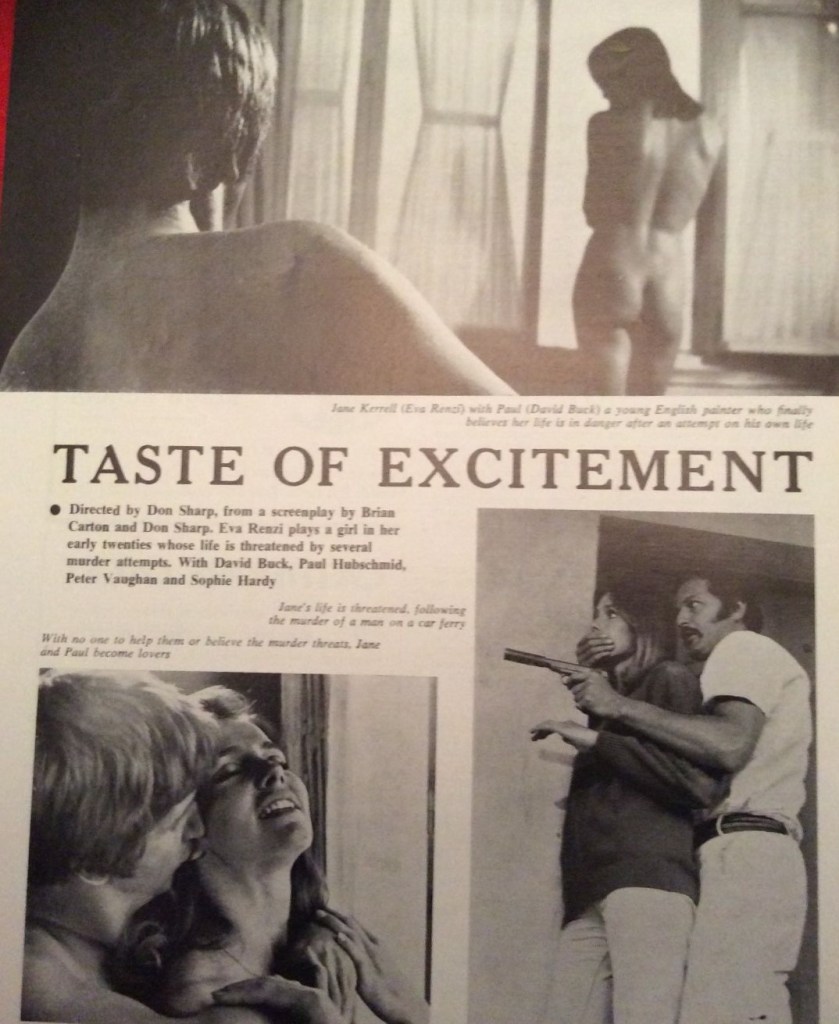
Must-see for all the wrong reasons. An epic of confusion, appalling acting and dodgy accents make this thriller a prime contender for the “So-Bad-It’s-Good” Hall of Fame. Director Don Sharp (The Devil-Ship Pirates, 1964) jibed at star Eva Renzi (Funeral in Berlin, 1966) when he should have concentrated on a script that is over-plotted to within an inch of its life. A couple of kidnaps, casino visit, a sniper, and a vertiginous cliff-top maneuver are thrown in before a truth serum lights up the climax in spectacularly hilarious fashion.
Promising material goes badly awry. English tourist Jane Kerrell (Eva Renzi), floating around the South of France, is being targeted for unknown reasons. A white Mercedes has tried to drive her off the road, mysterious phone calls and visions make her believe she is going mad, that prognosis helped along by handy psychiatrist Dr Forla (George Pravda). And before you can say Surete, Scotland Yard and NATO she is the chief suspect in the murder of a man called Chalker on the ferry to France. Assistance comes in the form of handsome artist David Headley (David Buck) – preposterously famous “I’m David Headley” “The painter?” – who nearly does what’s she’s been complaining everyone else is trying to do, namely knock her down with his car. He specialises in painting nude women and for no reason at all, given he is identified immediately as a lothario, he resists her attempts to take her to bed.
Turns out Jane is something of a boffin, as any self-respecting computer expert would be known in those days, and a millionaire businessman Beiber (Paul Hubschmid), one of Headley’s rich clients, enlists the painter to offer her a job. Of course, he has something else in mind. His company is being accused to shipping unnamed goods to the unnamed opposition, hence the involvement of NATO chap Breese (Francis Matthews).
But nobody is to be trusted, especially as the French police have dismissed her fears as nonsensical. Scotland Yard’s Inspector Malling (Peter Vaughan) throws flames on the fire by not coming to her rescue but planning to arrest her since she is the last person to see Chalker alive. Then it turns out Chalker must have given her a code or secret message before he died. The police take apart her red Mini Cooper in clinical French Connection style but find nothing. That just shows how dumb they are. It never occurred to them, as it does instantly to Headley, to check the carburretor.
By now you’ll have guessed consistency is not this movie’s strong point. You never even know who the sniper Gaudi (Peter Bowles) is targeting his aim is so appalling. There’s even a sinister secretary Miss Barrow (Kay Walsh) with a pronounced Scottish accent in the Jean Brodie class. Headley comes up with an idea to disguise her – by changing her hairstyle (that’ll fool them!! – and astonishingly, in keeping with the bizarre tone, it does).
For someone who is meant to be paranoid Jane is surprisingly trusting, toddling off with clearly-identified villains when fed a line.
Most of the advertising, including this spread in “Films and Filming” magazine, made play of the sight of Eva Renzi’s naked derriere but ignored the unusual gender equality when it came to the nudity since in this scene David Buck gets out of bed and stands as equally starkers by the window.
You won’t be surprised when Jane ends up trussed and gagged, in her bikini naturally, in a fabulous house with an electrified fence. I can’t resist telling you about the truth serum. Before the evil psychiatrist has the chance to question her he is bopped on the head, Headley having sneaking in before (the dolts!) Gaudi thought to switch on the electric fence. (The electric fence is nullified by the police who just switch off all the electricity in the area.) But when she escapes, still full of the truth drug, when Gaudi calls out to find out where she is hiding, the serum forces her to give the correct answer. In the midst of the danger, Headley takes the opportunity to get an honest answer to the question of whether she loves him. And that’s not the best bit. The final line, given there hasn’t been a decent line all the way through, is a cracker. “Never believe a woman when she is telling you the truth” certainly gives you something to ponder.
So much is held back from the audience that there is never a chance, unlike Charade (1963), of genuine tension. Even the one gripping moment, taking a shortcut along a perilous cliff road, which is well done, is undercut by their pursuer beating them to their destination. The whole thing has an air of being improvised or being devised by someone who thought that twists counted more than characterisation, plot development or relationships.
The acting is so uniformly bad that Eva Renzi actually looks good. David Buck (Deadfall, 1968) is miscast in the slick Cary Grant role. While it is entertaining to see Peter Bowles (The Charge of the Light Brigade, 1968) drop his plummy English accent, his Italian accent fails to pass muster. Peter Vaughan (Alfred the Great, 1969), saddled with the bulk of the murky exposition, does his best. In a bit part, veteran Kay Walsh (A Study in Terror, 1965), holds the acting aces but she doesn’t have much competition.
Director Don Sharp also had a hand in the screenplay so it’s difficult to know who must take most blame, him or colleagues Brian Carton and Ben Healey. This was the alpha and omega of this pair’s movie career.
If you want to see how not to handle a potentially classy thriller tune in. Can’t make up my mind whether to give this two stars for being so bad or four stars for being so bad it’s good. You decide.
And you can do so for free on Flick Vault. Be warned that you have to get past some adverts first. And if you’re wondering what happened to the opening credits, there ain’t any.
You ever wonder what triggers criminality? Don’t deny an upper class English civil servant his knighthood, don’t fire an American university lecturer for an anti-war demonstration, don’t humiliate your beautiful wife by making her part of a business transaction. They might all feel robbery is the best revenge.
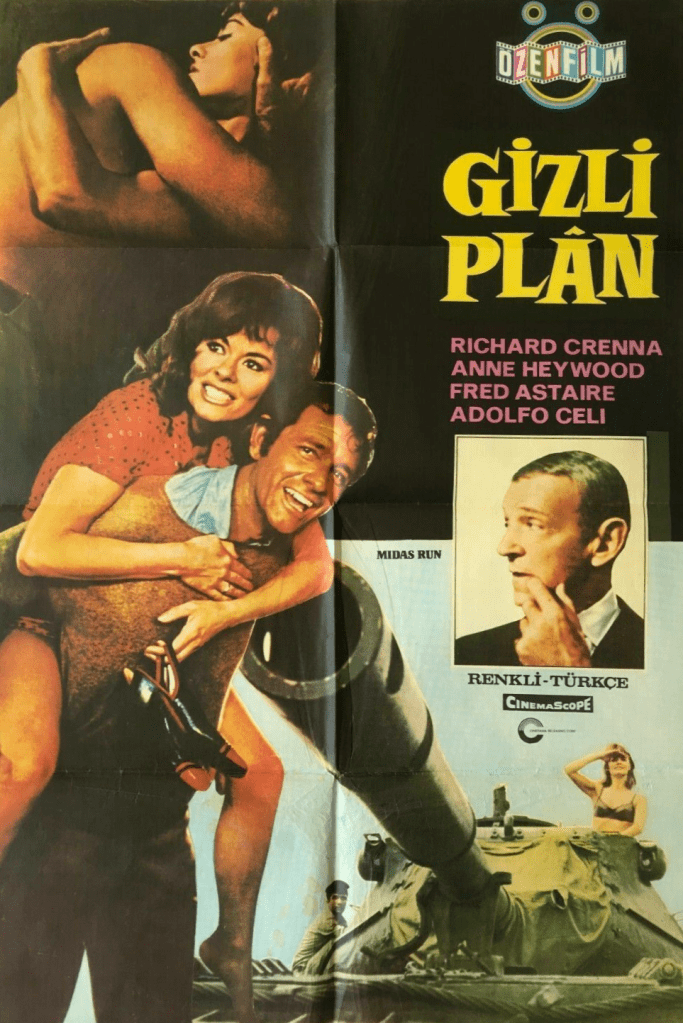
The highly respected Pedley (Fred Astaire) has talked his superiors in government into the notion that the best way to ship a consignment of gold is by passenger rather than commercial airplane. He recruits wannabe author Mike (Richard Crenna) who, in turn, comes to the rescue of glamorous Sylvia (Anne Heywood) when she is being sold off to sweeten a business deal.
The apparently eccentric casting was based on unfulfilled promise. Fred Astaire, who had not starred in a film for over decade, had made a comeback for Finian’s Rainbow (1968). But that had flopped, putting a dent in his marquee credentials and dramatic roles were hardly the forte of this twinkle-toed dancer. Richard Crenna’s bid for leading man status in Star! (1968) had spectacularly derailed at the box office.
Anne Heywood, the only one of the three principles to have a recent hit, in unexpected sleeper The Fox (1967), found no demand consequently for her services except from lover, future husband and biggest fan, producer Raymond Stross who had bankrolled the lesbian drama, and assigned her female lead here. You could extend your incredulity to the involvement of Swedish director Alf Kjellin,who hadn’t made a picture since Siska seven years before, and like most of his countrymen was seen as producing arthouse fare.
The biggest problem in a gold heist, as anyone watching the current television series The Gold will be aware, is shifting loot that weighs a ton. So Mike and Sylvia hire some Italian crooks to supply a couple of petrol tankers to hide and transport the bullion after the airplane has been forced down over Italian airspace by an Albanian fighter plane, Mike driving the World War Two tank that supplies the ground-based pressure.
As with any heist picture, robbery is only the beginning, double-cross the middle and triple-cross the end. Pedley, who has accompanied the shipment, is delegated by the British secret service to recover the gold, aided by suspicious assistant Wister (Roddy McDowall). The twist here is that he not only recovers most of the gold, apart from some secreted away by the now romantically-inclined twosome, but points the finger at his accomplices, including the fence General Ferranti (Adolfo Celi).
It then becomes a question of whether the younger crooks can evade his clutches, whether Wister can confirm his suspicions that the investigation has proceeded a tad too conveniently, and discover what the heck the bowler-hatted Englishman is up to. And, of course, whether Mike can trust Sylvia. It wouldn’t be the first – or last (see Perfect Friday, 1970) – grand theft in which the male has been the dupe.
Along the way there is some clever comedy, a play on the British assumption that everyone in the world naturally speaks English, the implicit trust that the upper-classes place in each other, and the stock view that any Italian, law enforcer or crook, can be distracted by a pretty face or comely derriere.
On the downside, the set-up takes too long coming to fruition, especially a mid-movie interlude that seems intend on channelling the worst romantic notions of the era, idyllic strolls in fields, that I half-expected a burst of slow-motion trotting, or some metaphor for the orgasm. There is some little understood banter about war games. And, for obvious reasons, La Heywood strips down to brassiere in the overheated tank (Mike manages to resist such un-English impulses) though she has previously indulged her innovative ideas about dress, turning a bedsheet into a fashionable toga at a moment’s notice.
There’s nothing particularly new here but Fred Astaire makes a deft impression as a typical upper-class Englishman, accent not found wanting, and successfully reinvents himself as a dramatic actor, that highpoint an Oscar nomination for The Towering Inferno (1974). Anne Heywood, once you realise she is playing all sides against each other, slips easily into the femme fatale role. Richard Crenna’s acting appears limited since his character, despite occasional initiative, is outwitted by all and sundry, and that was scarcely a good look in those days for the leading man to be out-thought by the leading woman.
Pre-dating Hollywood’s love affair with drugs, before sub-culture transformed into counter culture, before smoking a joint marked a generational divide, before marijuana symbolized freedom and was, well, the epitome of cool, before all that heroin was still seen as a scourge.
Addiction had rarely been viewed as persuasive audience fodder with the odd exception of The Man with the Golden Arm (1953) or the less-starry Monkey on My Back (1957). And this was also before Synanon became a byword for cult excess and was eventually closed down for committing the cardinal sin of employing tax exemption to get stinking rich.
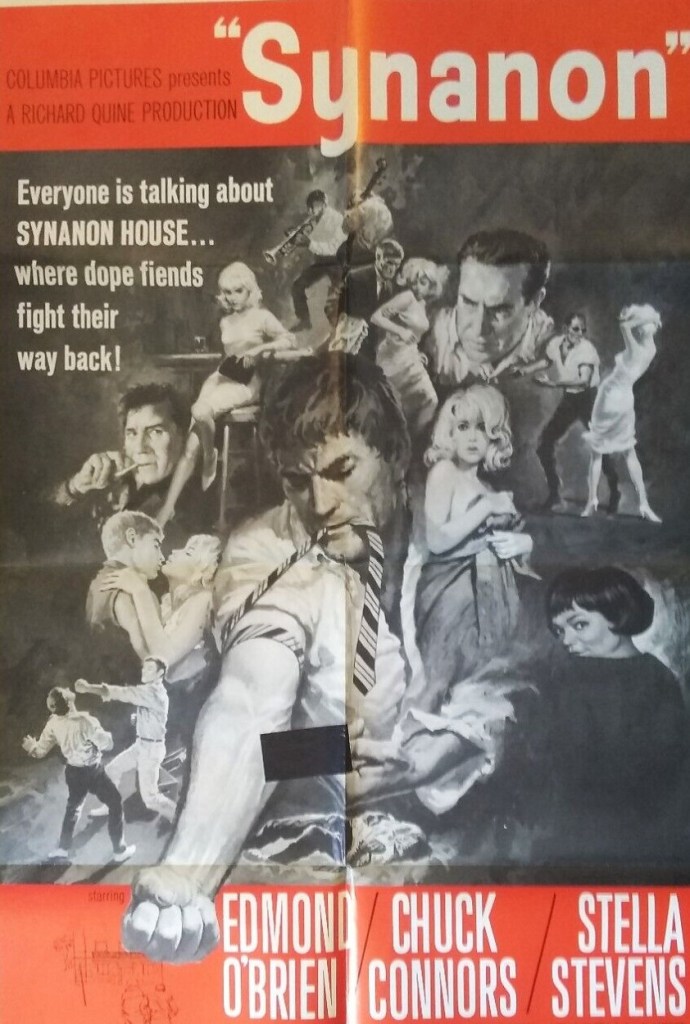
At the time it was a byword for something else – rehabilitation. Its methods might have been controversial given leader Chuck (Edmond O’Brien) had no psychiatric training and was simply an ex-addict looking to find a way back. The main weapon in the community’s arsenal was confrontation. What became known as attack therapy. Rather than being permitted to stew in self-pity, inmates, all voluntary, had their weaknesses spelled out by others until they were ready to acknowledge them for themselves. The key to recovery was talking. Anyone not talking was hiding from their problems. (I’m not so well up on addiction therapy to know whether Synanon invented that kind of counselling of talking out problems in groups that then became the norm.) If patients took to the scheme they were soon addicted to smoking and coffee; sex being considered too dangerous to contemplate.
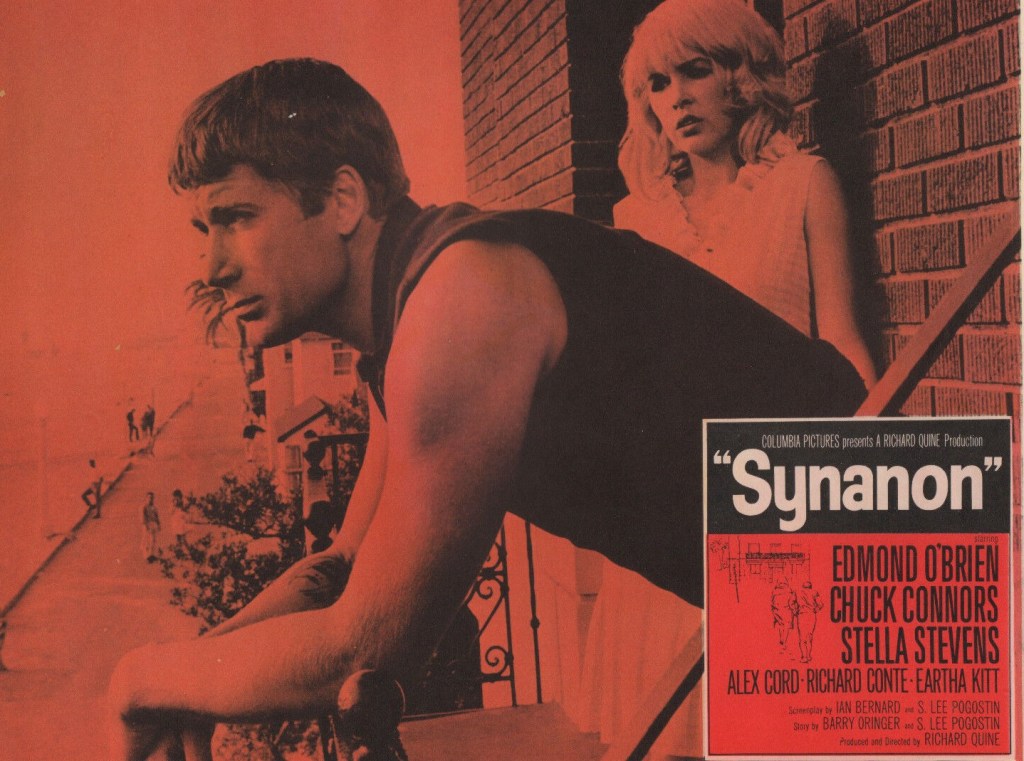
Anyways, heroin addict Zankie (Alex Cord) is a newcomer helped along an entrant’s path by Joaney (Stella Stevens), a single mum so out of kilter with responsibility she kidnaps her son, and confronted by hardass Ben (Chuck Connors), so consumed with guilt over the death of his dope-fiend wife that he spurns all women. There’s a sub-plot of sorts. Chuck is being charged with various minor violations, including permitting convicted criminals out on parole to enter the establishment. But Chuck’s main job is to be sarcastic, challenging anyone’s notions that they could be cured, but occasionally analytically correct. “You put yourself in a position where you could lose control,” he tells Ben.
It’s a hothouse of emotions for sure. Zankie and Ben come to blows over Joaney. Zankie sees little wrong in knocking back some cough medicine. Eventually, Zankie skips out, pursued by Joaney, who goes back to turning tricks to fund her habit. There’s a surprising scene – for the time (likely excised from the British version and possibly the original) – of Chuck going through the whole candle, spoon, injection routine.
Set up as a sanitised public relations package promoting Synanon ideals with overmuch detail on the establishment’s background and conflict with authority, nonetheless it touches far better than most addiction movies on the lack of self-awareness that afflicts users, their creation of fantasy worlds where whatever they do is deemed right. The tension that comes from an entire house of jumpy characters, their dependence on a higher power (Chuck in this case) is well-drawn. Even the incessant smoking and the constant reliance on coffee suggests those with an addictive personality are only too likely to switch to something else.
You might question the casting. Alex Cord (Stagecoach, 1966), Stella Stevens (Rage, 1966) and Chuck Connors (Move Over Darling, 1963) are far too well-groomed to pass for skanky addicts even if on the road to recovery. And Edmond O’Brien (The Man Who Shot Liberty Valance, 1962) and his sidekick (Richard Conte, Lady in Cement, 1968)) come across like tougher versions of the tough priests tackling delinquency that used to be played by the likes of Spencer Tracy.
But Cord and Stevens do suggest the vulnerability of the delusional addict, Stevens little-girl-lost persona at odds with her glamor, actions devoid of the concept of consequence. Although boasting a six-pack, Cord’s portrayal of a man destroyed by weakness did not suggest he would segue from this screen debut into tough-guy leading roles. Better actors might have suggested a greater degree of internal conflict but externally, in the looks department, might have looked like this was always going to be their destination. So the casting works both ways, more surface, less depth, but a warning that even the prom king and queen are not immune from addiction.
Soberly directed by Richard Quine (How To Murder Your Wife, 1965) from a screenplay by Ian Bernard, in his debut, but feels it owes too much from input by the original Chuck Dederich.
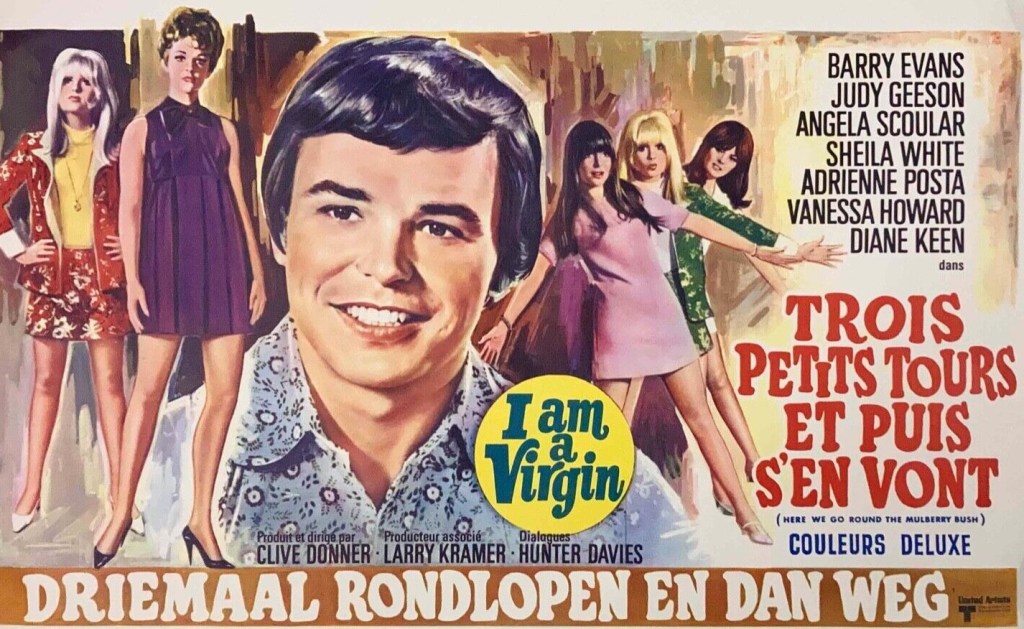
Breaking the fourth wall has become a common conceit these days, especially in television, so you might be surprised to learn it was the key artistic element of this otherwise straightforward British coming of age drama.
Our teenage guide Jamie (Barry Evans), a delivery boy, spends most of his time lusting after any women he meets. Like a junior version of 10 (1979) women are rated according to their physical attributes. Most, of course, are well out of his league, especially as he lacks for what counts as the smooth patter which his cocky pal Spike (Christopher Timothy) has in abundance.
Essentially a series of episodes with the opposite sex as Jamie tries to lose his virginity. But mostly, it’s just Jamie yakking on about how he’s not lost his virginity and what’s up with all those women that they can’t see what a great catch he is. He’s so determined to have sex he will even go out with the dumbest of dumb blondes, Linda (Adrienne Posta).
Naturally, since reality is too cruel, he succumbs to fantasy with a number of scenarios that seem, inexplicably, torn from silent movies, and nothing approaching the imagination of Hieronymus Merkin. For no particular reason, he strikes lucky with the adventurous Mary (Judy Geeson), whose boyfriends usually run to sports cars, but that liaison is nearly interrupted by a wet dog and Jamie’s inexperience.
Apart from the lusting, there’s little else going on, a couple of women in a fish-and-chip shop complain they are fed up with chicken and beef, his younger brother shows more spark, and his home life is pitifully dull. You can’t really blame the movie for lacking the rebelliousness that was potent at the time, there’s no political awareness and no sign Jamie is going to grow up into one of the Angry Young Man so familiar at the beginning of the decade. It’s a quaint version of American Pie.(1999).
But it’s just boring. While Barry Evans (Alfred the Great, 1969) is personable enough he doesn’t have enough in the wit department to keep you hooked for the duration, most of the humor teetering on the side of inuendo..
Unable to recognise the inherent weakness of the script, and assuming that breaking artistic boundaries with the fourth wall is enough, director Clive Donner (Alfred the Great) spends most of his time trying to visually brush everything up, with little success.
That this was a big British hit at the time might have been more to do with the soundtrack – performed and written by Steve Winwood and Traffic – and the fleeting sight of Judy Geeson (Two into Three Won’t Go, 1969) in the buff. The British censor didn’t take too kindly to the actress revealing all, so in fact audiences were treated to very little, but for teenagers at the time very little was more than usually came their way unless willing to sit through a turgid arthouse picture.
About the only thing to commend it is Geeson’s class, she stands head and shoulders above everyone else in terms of screen charisma, and that there’s a roll call of rising British stars. As well as Christopher Timothy who would achieve fame on television in the original All Creatures Great and Small, the supporting cast includes Vanessa Howard (Corruption, 1968), Angela Scoular (On Her Majesty’s Secret Service, 1969), Diane Keen (The Sex Thief, 1973) and Adrienne Posta (Some Girls Do, 1969) and, to show them all how to do it, Denholm Elliot (Maroc 7, 1967) briefly pops up.
Clive Donner (Alfred the Great) directs. Hunter Davies, making his screen debut, wrote the screenplay based on his bestseller. Generally, any film that scores two stars does so out of incompetence. This is well-enough made but never seems to shift into gear.
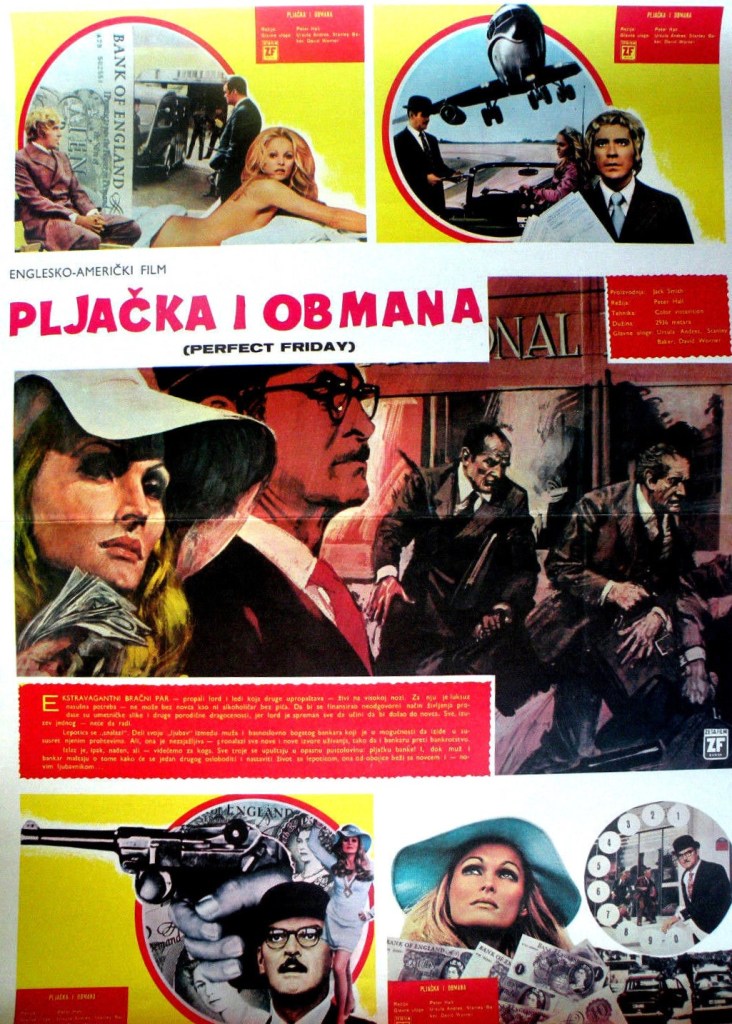
Delicious caper movie. Under-rated and largely dismissed because a) it is very British, b) audiences preferred Stanley Baker in an action film like Zulu (1964) and c) it appeared a year after the action-driven heist picture The Italian Job. So many black marks you might think it was an automatic candidate for relegation.
But, in fact, it is a delight, a gem that never outstays its welcome and, furthermore, elicits tremendously enjoyable performances from the three principals, with the added bonus, I guess, of the costume budget being much reduced by Ursula Andress prancing around so much in the nude.
Mr Graham (Stanley Baker) is an uptight, bowler-hatted, spectacled, unmarried, straitlaced banking executive. That’s too fancy a title for his job. He’s not the manager, he’s not even the deputy, he’s the deputy to the deputy (here called an “under-manager”) and his sole joy in life appears to be granting or refusing overdrafts, an action that might, to one of life’s smidgeons, be construed as an exercise in power.
One of his clients is uber-sexy Lady Britt Dorset (Ursula Andress) who, while living in penury, manages to swan around in the most divine outfits and a swanky sports car, mostly as the result of his overdrafts. Although he believes he is tough and worldly it never occurs to him to wonder how his client has the wherewithal to repay the overdrafts.
She is married, but to the equally poverty-stricken Lord Nicholas Dorset (David Warner) whose sole income derives from a daily payment from sitting in the House of Lords and schemes such as attaching his name to a restaurant chain.
It doesn’t strike Mr Graham as particularly odd that Britt takes a fancy to him, infidelity appearing to be written into her marriage vows. And it’s not long before the deputy deputy manager starts to wonder how he might turn this relationship into something more permanent. So he comes up with a clever caper, a three-man job, or more correctly a two-man one-woman job. He’s going to steal £300,000, split three ways, from his bank. Nicholas will pose as a bank inspector, Britt will be the one who physically removes the cash and Mr Graham, naturally, will take on the role of criminal mastermind, finding a way to get hold of the necessary duplicate keys and over-riding the usual security concerns.
For a good while most of the plan consists of keeping the husband out of the way, sent on various “missions” across the country and abroad, to give Mr Graham time to enjoy making love to the wife. There’s an occasional hiccup to the plan, but mostly it appears to be running smoothly.
Except, as you might imagine, double cross is afoot. Mr Graham would like to purloin the husband’s share, all the more to set up cosy home somewhere abroad with the wife. And, as you might expect, there’s a sting in the tale.
But this is all so effortlessly done, tremendous tension as the robbery is carried out in complete silence (as was by now par for the course), jaunty music intervening at other times, the combination of the three opposites making for a delightful scenario, the stuffy manager at odds with the lazy, louche husband, and an unlikely companion for the sexy, apparently docile, wife.
Some clever directorial touches from Peter Hall (Three into Two Won’t Go, 1967) provide unexpected zest, but primarily this is a comedy of manners shifted onto the heist plane. And the best thing about it is the performances.
Ursula Andress (The Blue Max, 1966), here taking top billing, delivers her best-ever performance, the sexy front concealing a clever brain, easily manipulating lover and husband, deceit embedded in her genes, the hard-coiled core hidden from view, as she indulges both herself and her paramour.
Stanley Baker is superb, almost in Accident (1966) stiff upper lip mode, but without, until sex triggers criminality, that character’s free-wheeling attitude and immorality. He lives his entire life in a glass booth, observing and being observed, working within an arcane code of practices, not believing that he, of all people, could actually break the rules.
But David Warner (Titanic, 1997) steals the show as a bored upper-class lord who wants nothing more than a quiet life paid for by someone else and who almost throws a hissy fit when, as part of his role, he is forced to wear clothes he finds demeaning. If it wasn’t for the prize, this whole enterprise would be so much beneath him, and he doesn’t even have the satisfaction of being able to put this underling in his place.
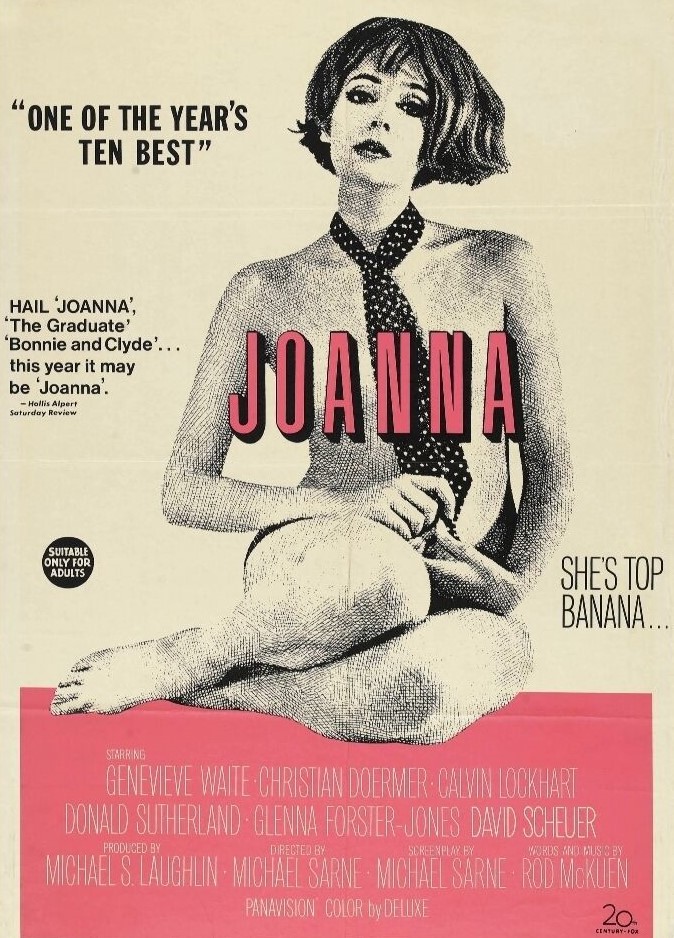
Mike Sarne (Myra Breckenridge, 1970) was one of those talents who ran away with himself, artistic notions indulged by the industry, until he was exposed as having little to say. Joanna is pretty empty of everything except style. And that wouldn’t be so bad if it was consistently stylish or showed a genuine flair for the visual image beyond a woman bathing in a lily pond or chasing an ambulance through a park.
And, of course, it’s never a good idea to park your inexperienced girlfriend upfront and center of your debut feature. Genevieve Waite, a model in the Twiggy fashion, had a thin, whiny baby voice, and lacked the skill to suggest any depth to the titular heroine.
The film stands up today as a shrine to misogyny, for the way in which, in the name of emancipation, women were exploited by men. Sexual freedom, bouncing along from one man to another, is the theme. “All women gained from emancipation is the privilege of being laid,” points out one (male) character. Freedom is expressed as lack of commitment. It’s kind of odd to hear young trendy men going on about commitment and expressing reservations about a flighty lifestyle, but it’s just as if the male authority figure had simply skipped a generation and was determined to keep women in their place.
Joanna, arriving from the countryside laden down with pots of home-made jam, flits through the Swinging London scene, exploring her artistic side through attending an art studio, occasionally working as a model, but more likely living off men, who are as likely to be married, and even then with another woman on the side.
She flits between artist Hendrik (Christian Dormer), nightclub owner Gordon (Calvin Lockhart) and wealthy dying toff Lord Peter Sanderson (Donald Sutherland) with a yacht in Morocco who surrounds himself with talented people because he lacks any talent himself. We don’t learn much about Joanna except her father, whom she fantasizes about cutting his throat, is a powerful enough magistrate that he can intervene when coppers are causing her boyfriend grief.
The other theme explored is racism. Gordon, a Sierra Leone native but a tax-paying British resident for eight years, is subjected to some racial abuse and later given a beating. That’s given more prominence than the miscegenation that would the following year (in 100 Rifles) attract so much controversy.
Lacking a strong narrative – mostly it’s people sitting around talking or getting into bed with each other – the film mostly hangs on a series of fantasies. Any time a new character appears, Joanna has the habit of spiriting them into a fantasy. Gordon’s sister is transformed into a maid in an English country house, Gordon becomes a Regency hero, the minute someone says sex can get you anything you desired even an elephant, lo and behold there’s Joanna sitting atop an elephant.
There’s a self-consciousness that this film can’t quite shake, the idea that somehow Sarne is holding a pillar up to society when in reality it is more a reflection of his own fantasies. The best scene comes at the end when the entire cast sings the theme song along a railway platform. The song, with no sense of irony, rhymes “top banana” with “Joanna.” And, of course, would you believe, this was all a film, director and cameras appearing at the end.
Whimsy is piled upon whimsy and that’s not enough to sustain the film. Waite offers very little except bounce, Donald Sutherland (The Split, 1968) – now coming up on 200 screen and television roles – is sorely miscast. Calvin Lockhart (The High Commissioner, 1968) brings more to the table, a polished performance that avoids the temptation to go too American. Sarne wrote the screenplay.
It’s not as bad as most films that get two stars from me but for the life of me I can’t see how it honestly earns three stars. You can sample it for free – or watch it all the way through – on Youtube.
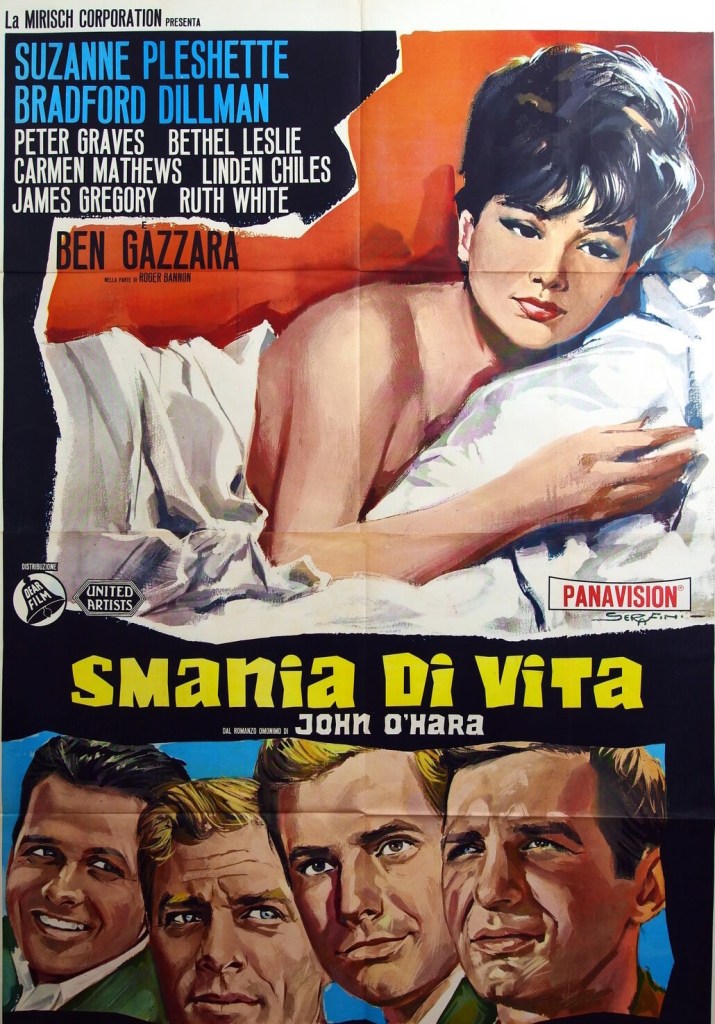
There was one in every town: a woman, rich (Sanctuary, 1961) or poor (Claudelle Inglish, 1961) or in between (Butterfield 8, 1960), with a predilection for sex. There were several men in every town, queuing up to take advantage. The woman was inevitably a shameful creature, the men the envy of their peers. You don’t have to look further than Frank Sinatra’s tom-catting in Come Blow Your Horn (1963) or Omar Sharif as the romantic star of the decade with two women in tow in Doctor Zhivago (1965) for an idea of the double standards in play. Welcome to hypocritical Hollywood.
Grace (Suzanne Pleshette), father dead and stuck with a domineering mother, finds escape and fulfilment in sex, and just to give hypocrisy a final tug discovers that while boyfriends are keen to help her explore such physical needs, they take the hump when they discover they might not be the first – or the only. Parents, naturally, are appalled, and discovery of Grace’s antics – and she’s not particularly particular, a passing waiter will do – leads her mother to collapse.
Having confessed to potential husband Sidney (Bradford Dillman) that he will not be marrying a virgin and almost bursting with gratitude that he is willing to overlook her behavior, Grace becomes a farmer’s wife and then a happy mother, until construction owner Roger (Ben Gazzara) comes on strong. She might well have been able to have her cake and eat it but Roger, having fallen in love, reacts badly to being dumped and it’s only a matter of time before her world implodes.
Made a couple of years later, when the independent woman was being exalted, this would have been a different kettle of fish. Here, the boot on the other foot, the woman who picks and chooses her lovers seemed a step too far for that generation.
Before the big trouble begins, the movie does explore, though somewhat discreetly, the almost taboo notion that a woman might just enjoy sex for the sake of it. Sure, Grace likes being wanted and likes being held, but if she was around today, nobody would bat an eyelid if she just came out and expressed her preference.
Less discreetly, the subject of consensual sex comes up, but not as a question of debate, more as a matter of fact, that when Grace says no she actually means yes. There’s a very uncomfortable moment at the beginning when in a Straw Dogs-scene, though nothing like as violent, Grace appears to welcome a rape. Whether this is as bad as it sounds, or is just Hollywood hiding the blush that a woman would not seek out sex but could only discover its pleasures when forced upon her, is hard to say.
Nor is Grace a walking sex machine. She knows enough about men that she only has to put out feelers and any susceptible male will take the bait. And given the restrained times, she’s got no female pal with whom she can discuss her unseemly desires.
Of course, if this was a man, nobody would be batting an eyelid. Sure, once caught, he’d come up with all sorts of excuses, denials, begging for forgiveness, but an audience would give him a free pass. It’s only because this is a woman that it causes ructions. The movie just about gets close to what does make Grace happy and why she needs the thrill of extra marital sex but by that point the melodrama has taken over and there’s little time left for discussion, what with Roger intent on revenge and another lovelorn wife, mistakenly imagining her husband has fallen victim to Grace’s charms, also on the warpath.
Small town constraints play their part, too. Washing your dirty linen in public the worst of all offences. Author John O’Hara, on whose bestseller this is based – and whose other works Butterfield 8, Ten North Frederick (1958) and From the Terrace (1960) explored similar worlds – knows only too well that while wealth brings freedom and privilege it comes with chains attached.
And there’s some interesting role reversal, an illicit lover falling in love with a married person normally a starting point for a movie to explore happiness and its opposite rather than being the one act Grace will not tolerate in a lover, she wants strings-free sex, not anything with encumbrance. While Grace would like to act like a man, and has the wealth to shield herself from the worst of the fall-out, as a mother she is extremely vulnerable, and in this particular era could risk losing her child if seen as maternally unfit.
While lacking the sexual combustibility of Elizabeth Taylor or Lana Turner or other Hollywood heartbreakers, Suzanne Pleshette (Nevada Smith, 1966) gives a decent enough performance especially when it comes to her straightforward attitude to sex, aware she might be causing upheaval, but finding it impossible to ignore desire, or imagine a life in which that does not play an impulsive part.
Bradford Dillman (Sanctuary) has less room for character maneuver and is mostly called upon to suck it up. He comes into his own in the movie’s latter stages when bewilderment at betrayal and public humiliation clashes with continued love for his wife. Ben Gazzara (The Bridge at Remagen, 1969), trademark leer and smug face kept in check, has a showier role especially when the violent aspects of his character explode.
Director Walter Grauman, while better known for war picture 633 Squadron (1963), had just come off another picture dealing with female trauma (Lady in a Cage, 1964) and does quite a decent job here, the camera intensely focusing on the leading actress and then as the tragic outcome unfolds drawing away from her. There’s one great piece of composition. He had used tree branches and the countryside to frame Grace and Sidney at the height of their love. And he does the same again when Grace is abandoned.
Asks some difficult questions without quite getting to grip with the real subject of female sexuality. There was a sense that Hollywood was just on the cusp of accepting the independence of women, but didn’t want to go the whole hog just yet, because, apart from anything else, where would it leave the guys?
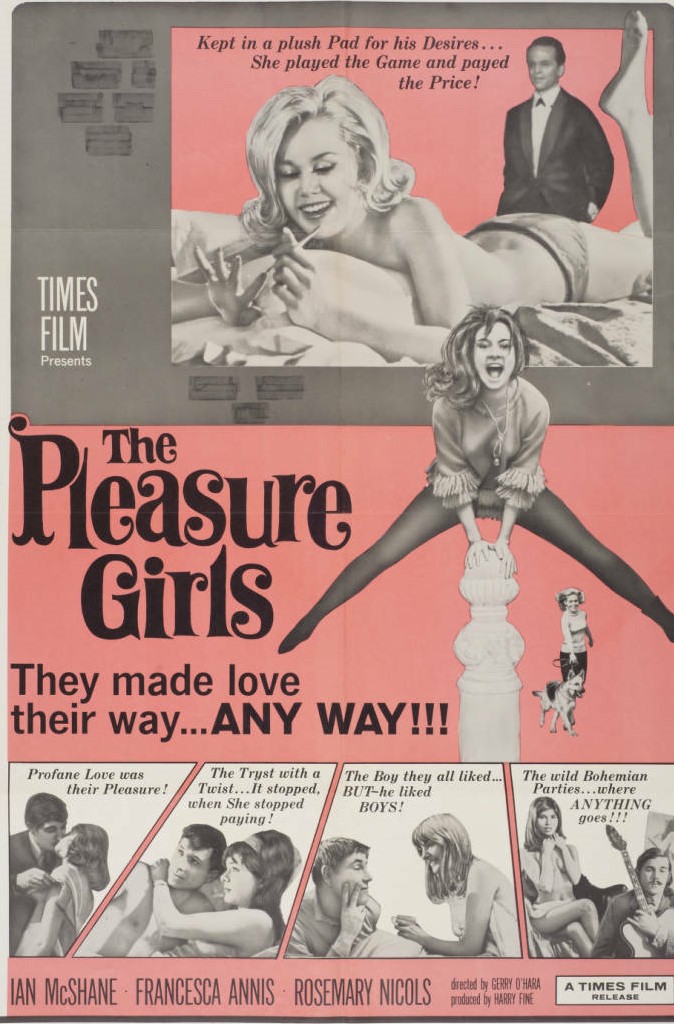
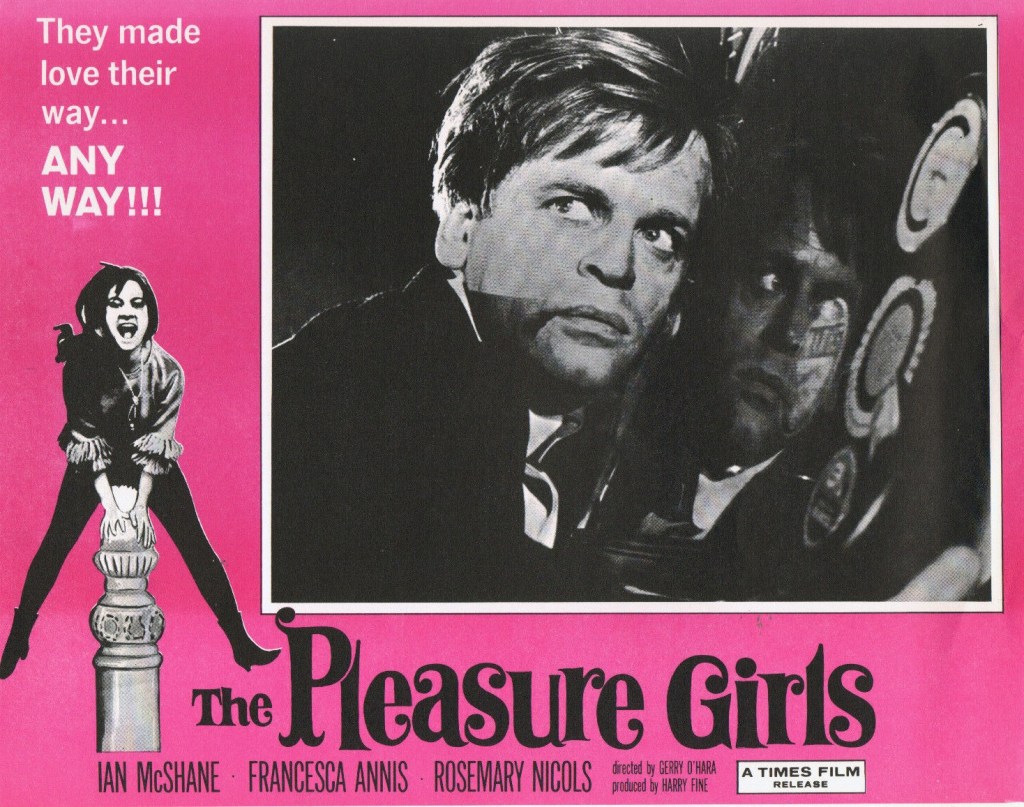
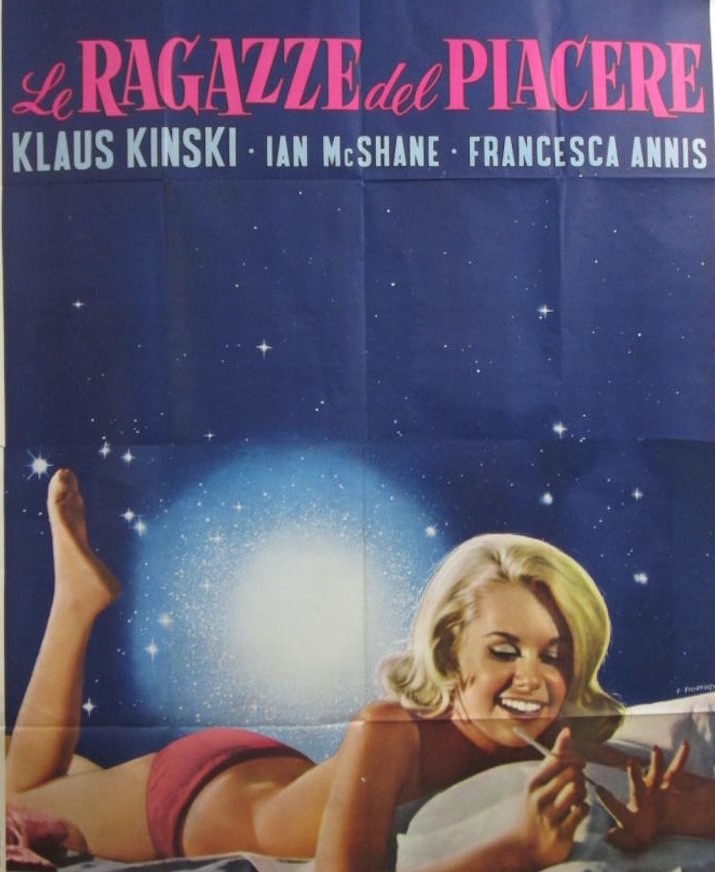
Klaus Kinski and The Pleasure Girls. What depraved mind dreamed up that concoction?
In reality, given this is early onset Kinski, before he was a fully-developed beast, and because it just precedes the British censor throwing off his shackles to accommodate the likes of Blow Up (1966) and The Fox (1967) it’s pretty tame stuff.
Klaus Kinski – what more did any B-picture of the decade need?
The girls might parade in night attire, and, should they happen to sleep in the nude, flash a bit of less rude skin, but that’s as far as it goes although at least couples are permitted to share a bed unlike the U.S. where that was outlawed by the Production Code (hence, in case you didn’t work it out, why there was so much frolicking via censor loopholes such as the outdoors or in the surf a la From Here to Eternity).
And you might find it hard to believe that John Wick’s Ian McShane has been a star for nearly half a century. Though here on the shifty side here and a shade fresh-faced his trademark cynical eyebrow is perpetually raised. He’s one of the suitors of a posse of girls sharing a house in London. A year later and a photographer like him would have had girls throwing themselves at him rather than primly trying to hold onto their virginity.
A weekend of drama awaits model wannabe and suburban lass Sally (Francesca Annis) on her arrival at the house, a whirlwind of parties beckoning, though drugs and booze in little evidence. Among her flatmates glamorous Dee (Suzanna Leigh) is mistress of slum landlord Nikko (Klaus Kinski) and while happy to be wined and dined and presented with jewellery, fur coats and cash, draws the line at being put up in an apartment. Compliant Angela (Anneke Wills) is enmeshed with unscrupulous gambler Priddy (Mark Eden).
While there are plenty good-time girls to hand in casinos and there is some discreet nudity at a party it’s not exactly high-end stuff what with scenes set in launderettes and street markets and girls cutting themselves shaving their legs. And while proclaiming himself sex-mad, Keith (Ian McShane) is rather more romantic than he would like, prepared to wait for Sally, even while spouting self-conscious lines like “surely every girl wants you to want to even if she doesn’t want to,” the kind of hypocritical male double standard of the day.
The Sally-Keith relationship doesn’t get much beyond will she-won’t she so the real drama takes place in the lives of Dee-Nikko and Angela-Priddy and Dee’s very outgoing brother Paddy (Tony Tanner). Nikko collects debts with the help of thugs and an Alsatian, while Priddy sells his girlfriend’s precious brooch.
There’s more violence than sex. One man beaten up and tied to the hood of a car to be whipped with a belt. Another is tied to a chair and hung out a window. And, for the time, one man’s homosexuality is unusually tenderly expressed while the prospect of a career being more attractive than marriage is given a fair airing.
It’s surprisingly well acted, all the characters believable with enough development twists to keep you interested, and of course it’s not the degrading or unseemly world the posters would have you believe although in a pre-Pill world the dangers of unprotected sex are only too obvious.
Producers Tony Tenser (later founder of Tigon) and Michael Klinger (Get Carter, 1971) had made their reputations on exploitation pictures like the previously-reviewed London in the Raw (1964) and this attempts, at least for marketing purposes, to go down a similar seedy route, but is confounded by a storyline that is more Peyton Place than Bad Girls Have Sex.
It’s more an opportunity for rising stars to be put though their paces rather than characters put in their place. Ian McShane’s (Sky West and Crooked/Gypsy Girl, 1966) twinkle is never far from view and he demonstrates the charm that will keep him in demand for the next near-50 years. Klaus Kinski (Five Golden Dragons, 1967) is remarkably restrained given his later work, proving he doesn’t have to over-act to make his mark.
Of the others in the talent shop window, Suzanna Leigh (Deadlier than the Male, 1967) makes the biggest impact. It didn’t make a star out of Francesca Annis though Mark Eden (Curse of the Crimson Altar/The Crimson Cult, 1968) had marginally better luck.
Gerry O’Hara (Maroc 7, 1967) directed from his own script.
100 Rifles was easily the most underrated film of the year. Even if the sum of all its parts did not add up to greatness, it had a lot more going for it than has generally been attributed. For a start, there was the attempt to build Jim Brown into a mainstream African American star. Secondly: the return of the bold female character that had largely disappeared since the heyday of Barbara Stanwyck, and Joan Crawford. Thirdly: the conjunction of these first two elements in a sex scene raised the issue of miscegenation that Hollywood had otherwise sought to avoid.
Fourthly, and perhaps most hard- hitting of all: the issue of genocide, the mass slaughter of the Yaqui Indian population providing an uneasy parallel not just to the United States treatment of its own indigenous Native American population but also to its actions in Vietnam.
But there was a danger that, without both incisive direction and potent performances, the movie would spiral downwards into another simple case of “When Beefcake (Jim Brown) Met Cheesecake (Raquel Welch).” Since nobody had expected Sidney Poitier to ascend the Hollywood ladder so fast, and in so doing set a trend, the industry had nobody lined up to ride in his wake and exploit what now appeared to be, at the very least, acceptance of African Africans as stars in their own right, with an audience ready to embrace a new kind of hero. Although MPAA president Jack Valenti called for more African Americans in more African American films, the number of highly touted big- budget African American–oriented pictures that offered stardom potential rarely made it out of the starting blocks.
But there was one potential crossover star waiting in the wings: Jim Brown. While lacking Poitier’s acting chops, he had the physique, looks and charisma. Cleveland Browns football legend with strong supporting roles in The Dirty Dozen (1967), Dark of the Sun (1968) and Ice Station Zebra (1968), top-billing had been limited to low-budgeters like Kenner (1968), The Split (1968) and Riot (1969).
But Variety had singled him out at the start of 1969 as one of its “new stars of the year” and judged him “the strongest contender to inherit some of Sidney Poitier’s earning power.” 100 Rifles had double the budget of any of his previous pictures.
Raquel Welch was in a similar situation to Jim Brown regarding Hollywood acceptance. However, she was not in a minority as far as female stars were concerned. The 1960s had been dominated by the likes of drama queen (in more ways than one) Elizabeth Taylor, comedy queen Doris Day and musical queen Julie Andrews, not to mention Audrey Hepburn, (Breakfast at Tiffany’s, 1961), Italian import Sophia Loren (El Cid, 1961), Jane Fonda (Cat Ballou, 1965), Natalie Wood (Sex and the Single Girl, 1964) and Shirley MacLaine (Sweet Charity, 1968). There was also an overabundance of new talent in Julie Christie (Doctor Zhivago, 1965), Vanessa Redgrave (Blow Up, 1966), Lynn Redgrave (Georgy Girl, 1965), Mia Farrow (Rosemary’s Baby, 1968) and Faye Dunaway (Bonnie and Clyde, 1967).
But those stars had more to offer than mere beauty, whereas Welch, having made her name primarily as a pin- up and as eye candy in movies like One Million Years B.C. (1966) and Fantastic Voyage (1966), had trouble shaking off the idea that she won more parts on the basis of her body than for the acting skills, appearing in a dry bikini in Fathom (1967) and a wet one in Lady in Cement (1968).
However, like Jim Brown, she was actively looking to fill a niche, and set out her stall as a player of dramatic intensity, and she found it in the most unlikely of places: the western. That she chose 100 Rifles was interesting given her other choices. She was offered the Katharine Ross part in Butch Cassidy and the Sundance Kid when the lead roles had been offered to Steve McQueen and Warren Beatty and again when Paul Newman came into the frame. She was also up for the Faye Dunaway role for The Crown Caper (title later changed to TheThomas Crown Affair), again with McQueen, and a film with Terence Stamp (which was never made). But she clearly felt those roles were more decorative.
At one time, the female western star had been a staple. Claire Trevor was the star of Stagecoach (1939) and Texas (1941). Gene Tierney made her name with The Return of Frank James (1940) and Belle Starr (1941). Barbara Stanwyck carved out her own niche as a western icon after taking top billing in Union Pacific (1939), California (1947), The Furies (1950), Cattle Queen of Montana (1954), The Maverick Queen (1956) and Forty Guns (1957). While Maureen O’Hara took second billing in Rio Grande (1950), McLintock! (1963) and The Rare Breed (1965), she was the star of Comanche Territory (1950), The Redhead from Wyoming (1953) and The Deadly Companions (1961). Yvonne De Carlo headlined Black Bart (1948), The Gal Who Took the West (1949) and Calamity Jane and Sam Bass (1949). Rhonda Fleming had the female lead in The Redhead and the Cowboy (1951), The Last Outpost (1951), Pony Express (1953) and Gunfight at the O.K. Corral (1957). Johnny Guitar (1954) achieved classic status largely on the performance of Joan Crawford.
There had even been modern precedent: Inger Stevens had nearly cornered the recent market after A Time for Killing (1967), Firecreek (1968), Hang ’Em High (1968) and 5 Card Stud (1968) while Claudia Cardinale went from a supporting role in The Professionals (1966) to top billing in the forthcoming Once Upon a Time in the West.
Raquel Welch set out to follow suit. In Bandolero (1968) she proved capable not only of holding her own against veterans James Stewart and Dean Martin but as adept on the pistol- packing side of things. While Welch professed herself “no Anne Bancroft,” she was pleased that she was not “running around half- naked all the time.” After that punched a hole in the box office, she was offered the female lead in 100 Rifles to be directed by Tom Gries who had made his name as a director with his unflinching portrayal of the cowboy in Will Penny (1968).
The basis of the film was Robert MacLeod’s The Californio, published in 1966, and the essence of the story concerned a “reckless stranger” who refused to turn the other cheek while innocent people were being killed. After Clair Huffaker turned in his screenplay, Gries wrote two further drafts. It is safe to assume that the casting of Jim Brown came after the Huffaker script had been handed in. When Huffaker did not like the way his work had ended up on screen, he insisted on using the pseudonym Cecil Dan Hansen, as he had done on The Second Time Around.
For 100 Rifles, he was so upset at the end result that he demanded either his name removed or the pseudonym installed, complaining that the finished product “bears absolutely no resemblance to my script.”
The story of The Californio bears little resemblance to 100 Rifles. Not only is the hero of the book, Steve McCall, white, he is a rawboned young man and not a lawman in his 30s. He is not a gunman either, being more proficient with the lasso. In fact, when forced into bloody action, he discovers that he abhors violence. The book could more aptly be described as a “rite of passage” novel where a young man, sent south “on legitimate business in the interests of the (U.S.) Federal Government,” leaves home for the first time, becomes a man, loses his virginity and kills his first man.
Nor is Yaqui Joe a bank robber in the book, and after meeting up with McCall, they embark on further legitimate business. Maria, named Sarita in the film, is most like her feisty movie counterpart, and although in the MacLeod version she is married, that does not prevent her taking Steve’s virginity. Of the villains, Verdugo (the name means “Hangman”), while not elevated to general, is still as ruthless, but the foreign adviser is not.
Most of the film’s action was invented by the screenwriters, including the concept of the 100 Rifles, Sarita’s sexy shower as a way of stopping the troop train, and the children being taken hostage (although in one episode in the book, children are shot). Trying to reshape the book to suit the new requirements of the characters makes the picture unnecessarily complicated. Burt Reynold’s solution was simpler: “Keep his shirt off and her [Raquel Welch’s] shirt off and give me all the lines,” he reportedly advised producer Marvin Schwartz.
The movie was shot over a ten- week period in Spain beginning in July 1968. Although that country had become a viable alternative for westerns looking to keep budgets low, in part in 1968 due to the devaluing of the peseta against the dollar, the volume of films shot there had declined by nearly a third compared to the previous year.
Despite the popularity of the location, Almeria, the actual area of countryside where most spaghetti westerns were shot, was very small. This resulted in a limited variety of available landscapes compared with films shot in the U.S. such as The Stalking Moon. The actors had to contend with extreme heat, and Gries was laid low for three days after contracting typhus. Gries decided to get the sex scene out of the way on the first day of shooting, probably to ensure that tension about the content was not allowed to linger until later in the shoot. However, it had the opposite effect. Neither Brown nor Welch had been given time to get to know one another nor to adjust to different styles of acting and to understand the perspectives of each other’s characters. Welch was not happy with the scene and tensions between the two stars continued throughout the film, some press reports putting this down to squabbles over close- ups, others to unresolved sexual tension. Welch later complained that scenes edited out of the picture had reduced audience understanding of her motivations. The MPAA also did some judicial trimming, axing Welch’s shrieks during lovemaking.
Critical reception ranged from sniffy to downright hostile. Perhaps like The Stalking Moon, advance publicity, although not this time pointing in the direction of the Oscars, had served to put critics off what sounded like an exploitative film. For the western traditionalist, sex scenes were off- putting, and although naked breasts had started appearing in a handful of movies, there were precious few full- on sex scenes, never mind one that featured miscegenation. Variety judged it a “routine Spanish- made western with a questionable sex scene as a possible exploitation hook.” On the plus side, Welch’s performance was “spirited” as was the Jerry Goldsmith score; Brown and Reynolds were just “okay.” The Showmen’s Servisection took a different view: “Fast pace, fine performances lift western several notches above the ordinary.” Roger Ebert in the Chicago Sun- Times called it “pretty dreary.” Howard Thompson, the New York Times’ second- string reviewer, said it was a “triumphantly empty exercise.”
Twentieth Century–Fox had been affected by recent financial disasters such as Doctor Dolittle (1967) and Star! (1968); the former collecting $6.2 million in domestic rentals on a budget of $17 million, the latter $4.2 million in rentals after costing $14.5 million. To counter mounting exhibitor panic about production being slashed, Fox had drawn up an ambitious program for 1969, promising one new movie every month. The program kicked off with a $7.7 million adaptation of the Lawrence Durrell classic Justine with Dirk Bogarde (January), followed by Michael Caine and Anthony Quinn in the $3.77 million film of the John Fowles bestseller The Magus (February) and the trendy $1.1 million Joanna from new director Mike Sarne (March). British star Maggie Smith in the $2.7 million The Prime of Miss Jean Brodie (April) came next with 100 Rifles (May) and another Marvin Schwarz production, Hard Contract starring James Coburn, costing $4 million (June). Summer highlights were Omar Sharif in the $5.1 million biopic of Che! directed by Richard Fleischer (July) and Gregory Peck in the $4.9 million Cold War thriller The Chairman (August). Come fall it was the turn of Paul Newman and Robert Redford in the western Butch Cassidy and the Sundance Kid coming in at $6.8 million (September), Richard Burton and Rex Harrison as aging homosexuals in The Staircase costing $6.3 million (October) and Warren Beatty and Elizabeth Taylor in George Stevens’ $10 million The Only Game in Town (November). The year ended with John Wayne and Rock Hudson in the $7.1 million Civil War western The Undefeated (December).
The studio needed several box office home runs because the following year it was already committed to three roadshows—Tora! Tora ! Tora!, Hello, Dolly and Patton—costing over $60 million. By spring it was clear that the first two movies in the schedule had been major flops, Justine bringing in only $2.2 million in rentals, The Magus $1 million. Income from Joanna and The Prime of Miss Jean Brodie barely exceeded costs.
By the time 100 Rifles swung into action with two largely untried leads and a director making only his second major picture, the pressure was on. “
At the box office 100 Rifles got off to a great start and Twentieth Century–Fox reported with delight that it had outgrossed Bandolero! by 40 percent in Washington (and by 500 percent in the ghetto areas), and by 300 percent in Philadelphia. In Baltimore it grossed $50,000 from a single theater compared to $80,000 from eight for Bandolero! and in Atlanta first run it had been $61,000 for the new film compared to $38,000 for the previous one. However, while Brown and Welch fans were out in force in certain areas, that did not make up for less interest in regions where westerns were associated with bigger or more traditional names. Ultimately, 100 Rifles fell short of expectations given the budget. U.S. rentals amounted to $3.5 million, and it registered in 29th position on the annual chart— the sixth highest- grossing western of the year and ahead of Mackenna’s Gold, The Stalking Moon, Paint Your Wagon and Once Upon a Time in the West.
But, of course, the domestic performance did not take into account the popularity of westerns overseas and the distinct following Raquel Welch had accumulated. So where some of the studio’s major dramas stumbled in the global market, 100 Rifles hit the ground running.
SOURCES: This is an abbreviated version of much longer chapter devoted to the film that ran in The Gunslingers of ’69: Western Movies’ Greatest Year (McFarland, 2019) by Brian Hannan (that’s me). All the references mentioned can be found in the Notes section of that book.
Highly under-rated but effective western that cemented Raquel Welch’s position as the queen of the genre, established Jim Brown as the first African American action star, scored points for its parallels with Vietnam, and provided the only image of the actress to rival that iconic fur bikini.
Arizona lawman Lyedecker (Brown) arrives in Sonora, Mexico, in 1912 on the trail of half- breed bank robber Yaqui Joe (Burt Reynolds). He finds the Mexican army callously executing Yaqui Indian rebels. To prevent further killing, Joe creates a diversion, which, while failing, permits the captured Sarita (Raquel Welch) to escape. The $6,000 Joe stole buys the titular 100 rifles to help the rebel cause.
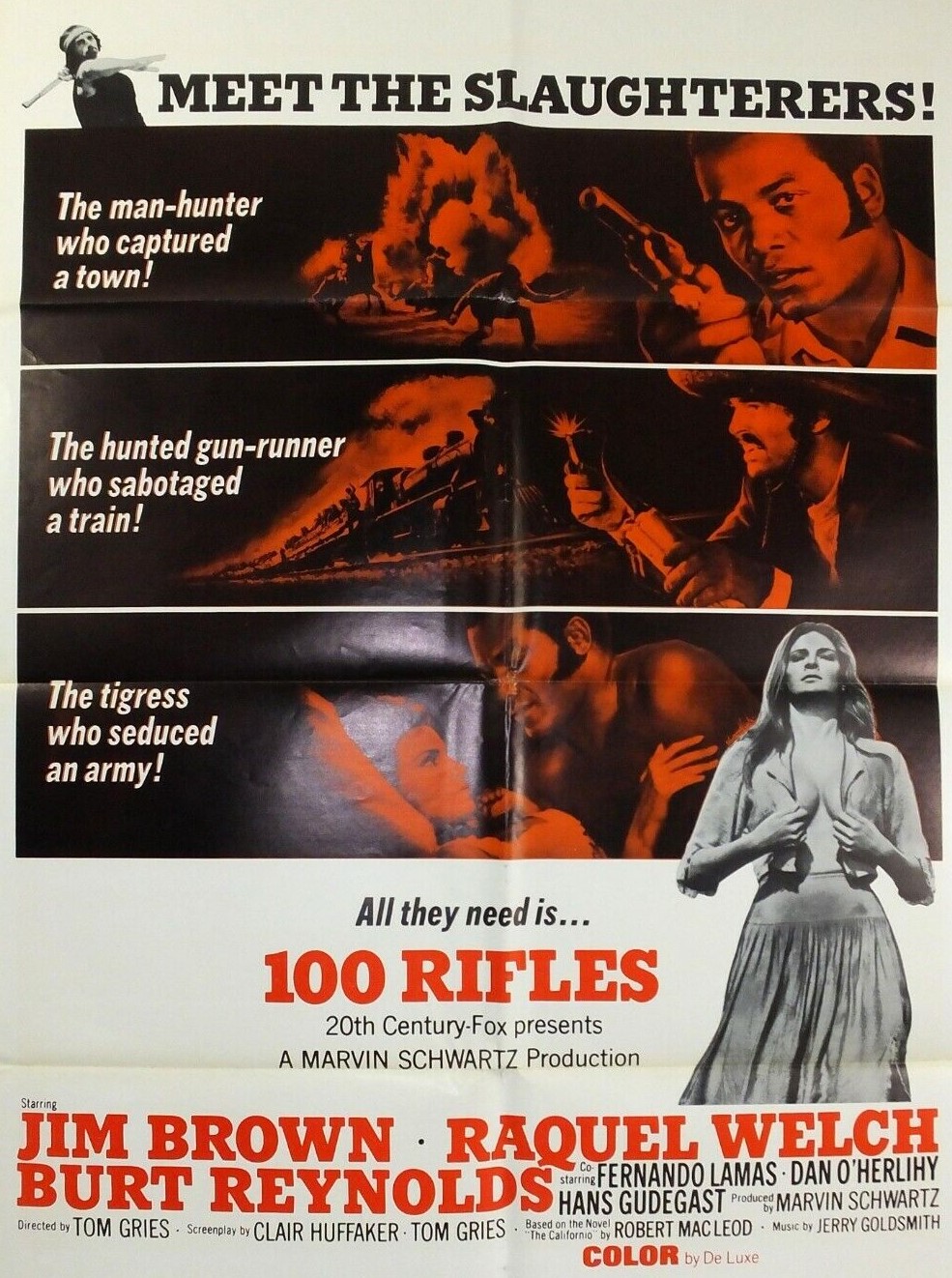
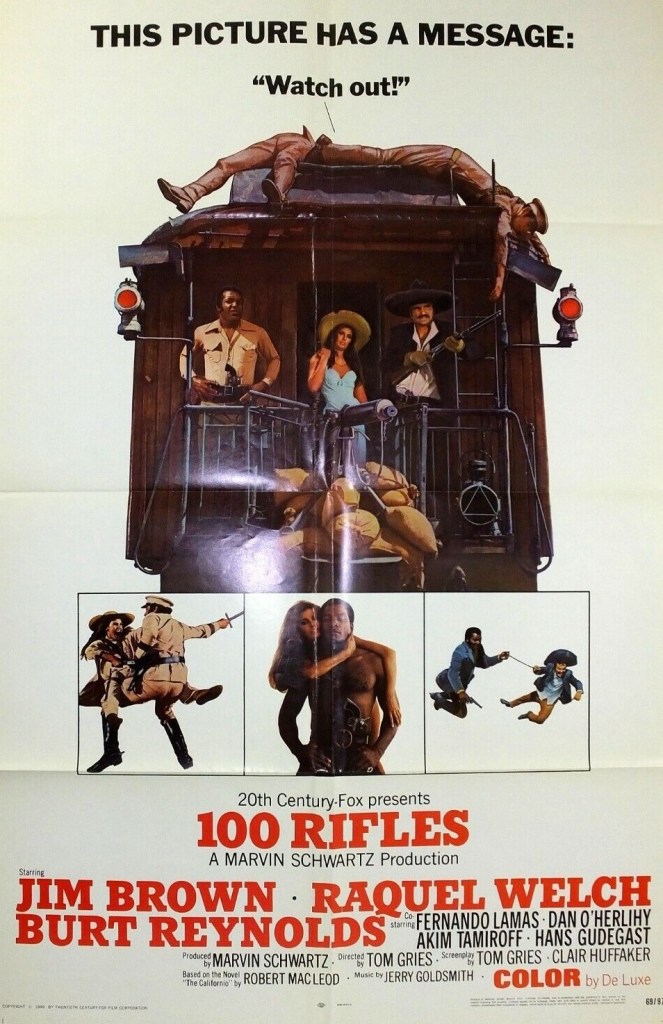
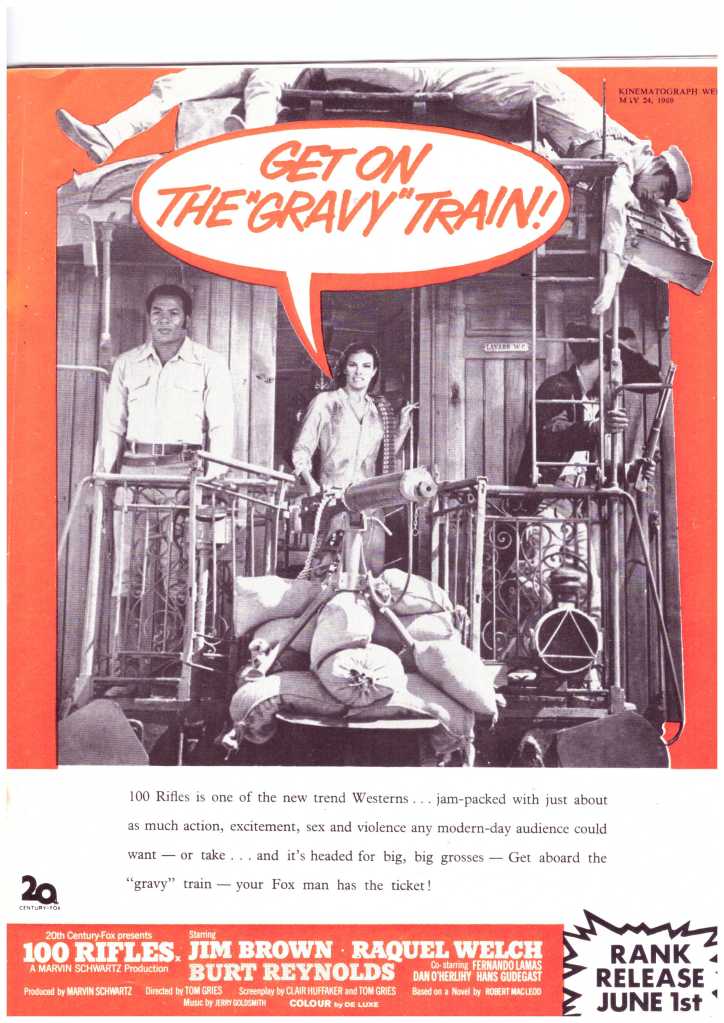
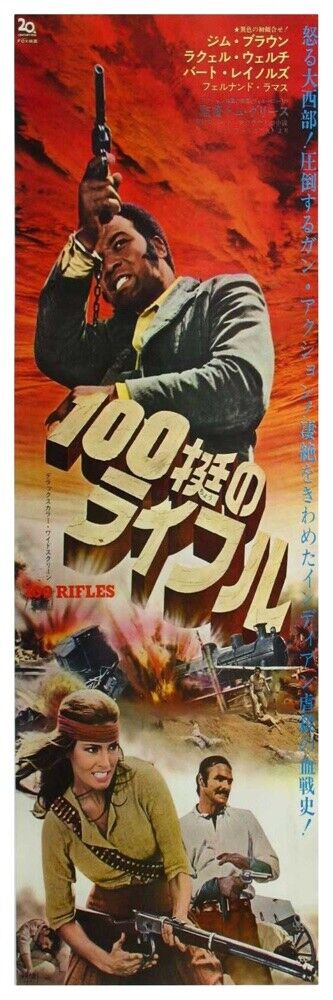
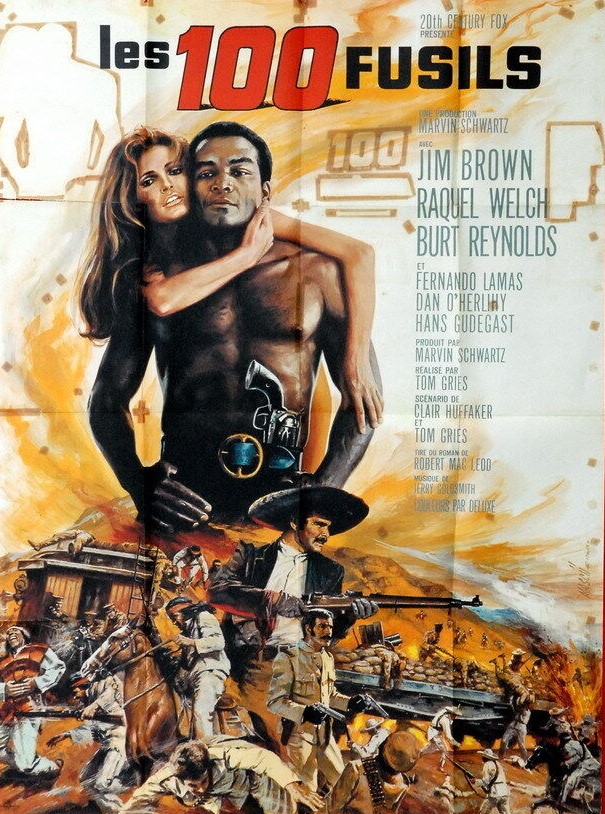
Most posters played up the action but here the emphasis is on La Welch.
Helped by Lyedecker, Joe escapes, picking up Sarita on the way. Both Lyedecker and the Mexicans are in pursuit, and the Mexicans soon recapture Joe and Lyedecker, who is now viewed as a rebel. Sarita again escapes. Lyedecker and Joe are returned to the garrison where the Mexicans have taken possession of the rifles. Just as the pair are put in front of a firing squad, Sarita, leading a group of rebels, frees them and steals the weapons.
In retaliation, the Mexicans attack a village, slaughtering the inhabitants and taking the children as hostages. At night, Lyedecker, Sarita, Joe and some rebels capture the garrison before the soldiers return, freeing the children. Lyedecker has been injured in the battle; after Sarita binds the wound, they make love.
When they take the rifles to the rebel stronghold, they discover the rebel leader is dead. For no particular reason, the rebels elect Lyedecker their new “generale.” Seizing a Mexican troop train is pitifully easy once Sarita creates a diversion by taking a shower under a water tower. The empty train is sent cannoning into the town and in the ensuing battle Sarita is killed. Yaqui Joe takes over leadership of the rebels while Lyedecker rides home.
While the capture- escape-chase-capture formula is overdone, the movie’s biggest structural problem is Yaqui Joe, clearly turned into a drunk to avoid becoming a romantic encumbrance for Sarita, leaving the way clear for Lyedecker. His other contributions are to brawl with Lyedecker and try to get the American to give up his quest and stay and help the rebels. There are other unnecessary characters and touches. We know it is a modern western because a motor car is involved as there would be in The Wild Bunch. The sole purpose of a German military adviser Von Klemme (Eric Braeden) is to act as a sounding board for Gen. Verdugo (Fernando Lamas), whose actions in any case speak louder than words. Railroad magnate Grimes (Dan O’Herlihy) represents equally callous big business. When Americans get drunk in westerns, that usually leads to fisticuffs, but when Indians knock back the liquor in 100 Rifles they act like clichéd drunken Indians, tearing up the town, looting and destroying anything in sight.
These reservations apart, the film has a great deal to recommend it. On the whole, it is well directed, although without much of an eye for landscape. Sarita, wearing a red headscarf, thus continuously color-coded, is accorded the greatest emotional depth, haunted by guilt for sacrificing her father in the name of freedom: “I helped him to die.” But she has another weapon at her disposal: her body. When captured, she distracts a soldier with sight of her breasts before stabbing him, the shock in her eyes suggests this is the first time she has killed a man.
Although the narrative advocates her as feisty leader from the start, this scene, and in particular her reaction, suggests otherwise. More than capable of taking care of herself, it is she, and not the two stronger men, who effects an escape. When she organizes the rescue of the two men, she’s more interested in the guns than them. But when it comes to children, they take precedence.
The genocide theme, pertinent both to American treatment of its own indigenous Native Americans and to the current war in Vietnam, is raised. It is more trouble than it’s worth for Gen. Verdugo to clear the Indians from their lands and ship them elsewhere, as the Americans had done when putting Indians onto reservations. Verdugo has few compunctions. Unlike in The Wild Bunch and Butch Cassidy and the Sundance Kid, here the railroad is a tool of control. Trains loaded with troops and guns (including Gatling guns, also seminal to The Wild Bunch) and artillery can travel with ease across alien territory to keep the inhabitants in check. As exemplified by Grimes, railroads also represent the intrusion of big business into politics and ordinary lives, and the railroad man, while concerned that Lyedecker’s possible execution could jeopardize U.S.- Mexican relationships and, by extension, possible halt the American railroad’s expansion, is ultimately more apprehensive about damage to running stock than the cost in human lives of his partnership with the Mexicans.
There’s a nod to seminal Sidney Poitier picture The Defiant Ones (1958) with Lyedecker and Joe chained together, and the American, initially disinterested in rebellion, only takes up the cause after a child he has befriended is slaughtered.
100 Rifles shares with The Stalking Moon, The Wild Bunch, Mackenna’s Gold, and Butch Cassidy and the Sundance Kid the theme of relentless pursuit, of an implacable enemy, often with justice or morality or power on their side, who will never give up, and, in a twist on this, in True Grit Rooster Cogburn is the one in fearless pursuit.
At the time, in male-dominated society, the sexual centerpiece was Raquel Welch in various states of undress, forgetting that women, too, were apt to be partial to the sight of an unclothed muscular male. It is Jim Brown who is first seen shirtless. And it is Sarita who takes control of the scene, kissing him as a reward “for all the bad things I said to you.” (Another gender twist, for usually it is the man making reparation.) A more tender scene between Lyedecker and Sarita, ostensibly of the more traditional kind, feisty female transformed into docile housewife by cooking her man a steak invited another reading, more in keeping with her character, not, you may notice, clinging to him, desperate for his love, but happy to enjoy the moment and abandon him when it suits (as Katharine Ross will in Butch Cassidy and the Sundance Kid, departing before the outlaws die).
For many, of course, the highlight is Sarita, the leader in all but name, using her body as weapon. As the train approaches the water tower, the soldiers see Sarita standing underneath dressed in only a man’s shirt, taking a shower. The train shudders to a halt for this voyeuristic delight; the camera too, for the audience’s sake, lingering on Sarita’s curves.
Although 100 Rifles is ponderous and improbable in places, with too much emphasis on escape- and-rescue, it certainly achieves its immediate aims, setting up Brown as an action man, giving Welch a role that’s hardly subordinate, ensuring the combination is as sexy as all get-out, while at the same time supplying enough shoot- outs and battle scenes to keep traditionalists happy. As important, director Tom Gries (Will Penny, 1968) is not afraid of using the film to make points, if sometimes a little heavy- handed, about Vietnam and genocide. Clair Huffaker (The Hellfighters, 1968) wrote the screenplay along with Gries based on a Robert MacLeod novel.
All in all, a movie that deserves a good bit more respect.
This review is an edited version of an article that appeared in The Gunslingers of ’69: Western Movies’ Greatest Year (McFarland, 2019) by Brian Hannan (that’s me).












 The Magnificent 60s