Jurassic World: Rebirth (2025) ** – Seen at the Cinema

Director Gareth Edwards (The Creator, 2023) and screenwriter David Koepp (Jurassic Park, 1993) have gone so far back to basics that they’ve skipped some fundamentals. It doesn’t matter how big your monsters are or how fearsome, the audience needs to care about those put in jeopardy and that has to amount to a lot more than a licorice-munching cute kid with a penchant for collecting cute baby dinosaurs.

Audiences are not likely to have forgotten the wealth of characterizations served up as the series kicked off  – jovial misguided philanthropist Richard Attenborough, child-hating scientist Sam Neill who grows to like kids, annoying scientist Jeff  Goldblum who chats up Sam Neill’s squeeze, annoying smartass child Joseph Mazzello, even cheapskate thief Wayne Knight.

Come the reboot we had a latter-day Indiana Jones bad boy in Chris Pratt trying to get on the good side of careerist Bryce Dallas Howard who was stumbling around on high heels and a kicker of a final line where they decide to stick together “for survival.”

The most interesting person in the latest reboot is way down the billing, the pot-smoking laid-back Xavier (David Iacono). Setting Scarlett Johansson up as a rooting-tooting mercenary with a soft heart (boohoo she didn’t make it to her mother’s funeral because presumably she was rooting-tooting for cold hard cash) who decides to set aside her $20 million payday comes across like one of the old-school Miss World contenders determined to help achieve “world peace.” Everyone else has been rounded up from Dullsville and apart from a few pontificating woke speeches nobody else has much to do except duck and dive to escape monsters.

For narrative purposes various rooting-tooting guns-for-hire have to locate a waterosauraus, a flyingosaurus and a walkingosaurus at the same time as trying to avoid a new version of the hybrid beastie that turned up in Jurassic World (2015).
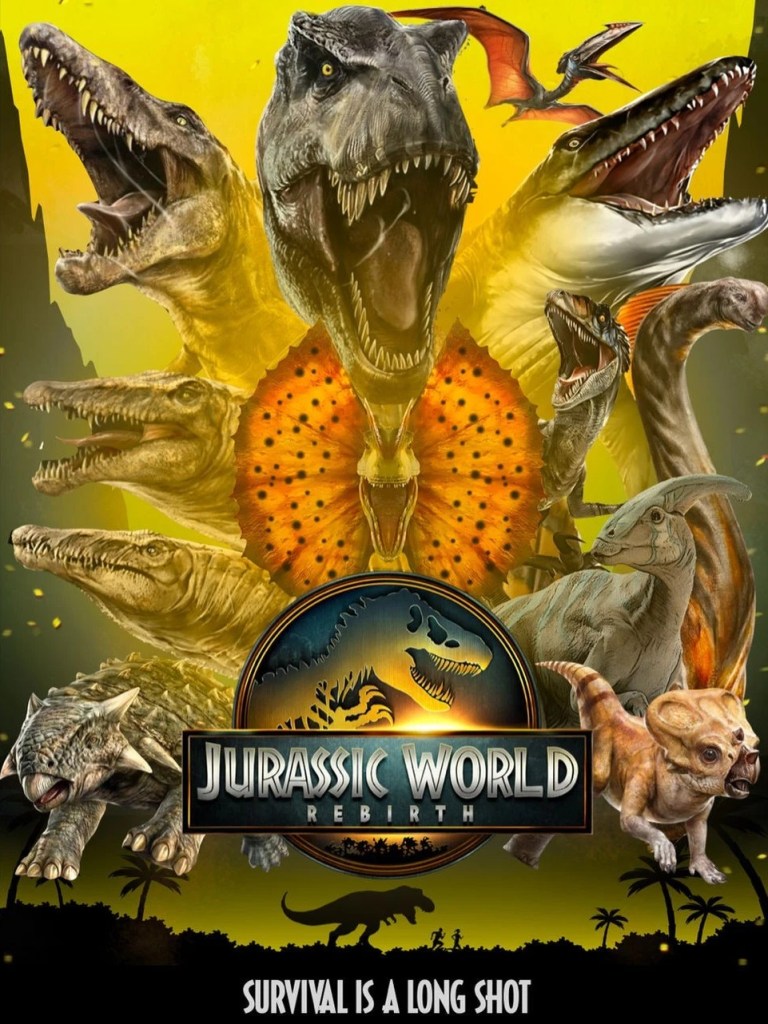
Not only are there no characters to root for, but the movie is mighty low on tension, no attempt to create the Spielbergian trembling water cup or the cracking glass or the motorbike chase and runaway pterodactyls from Jurassic World though there is the standard hiding under a car routine.

There are some groundbreaking effects but they’re not what you think. They’re aural rather than visual. We’ve got a scene when Dr Loomis crunches very loudly on some kind of mint. That’s the soundtrack – Dr Loomis crunching excessively loudly on a mint. Good job they didn’t utilize Imax for this one or it would have blown your eardrums off. Candies/sweets hog a good part of the center stage. Apart from the ear-blasting mints and the cute kid feeding strips of licorice to the cute dinosaur, the Maguffin comes in the unlikely shape of a wrapper from a bar of Snickers which somehow manages to fuse an entire laboratory and cause it to be completely abandoned (17 years before the present time I should add).  

Given the build-up which I accept as an essential part of promoting the reboot, this lands with a thud and the title, unfortunately, lends itself to all sorts of puns. As you know I’m a sucker for monster movies, but this just seems to be a very careless endeavor, like they are trying to squeeze the last juices. Regardless of how dumb the ideas the first Jurassic World trilogy ultimately became, the narrative was underpinned by unlikely romance and likeable characters. Unless, as I suspect, Scarlett Johanssen and Dr Loomis (Jonathan Bailey), the best of the bad guys, are going to embark on a more interesting sequel and develop some personality this could as aptly be called Jurassic World RIP.
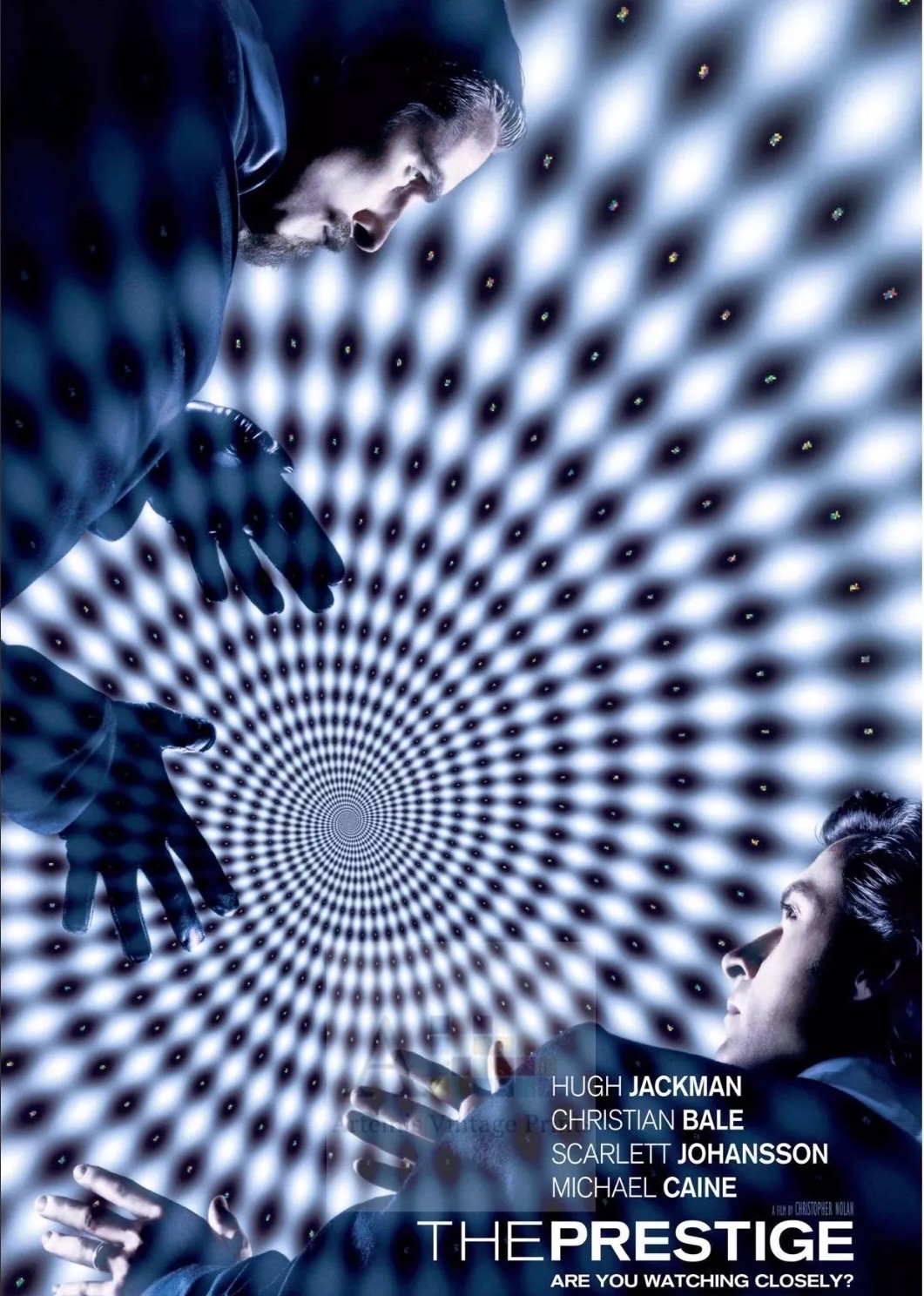
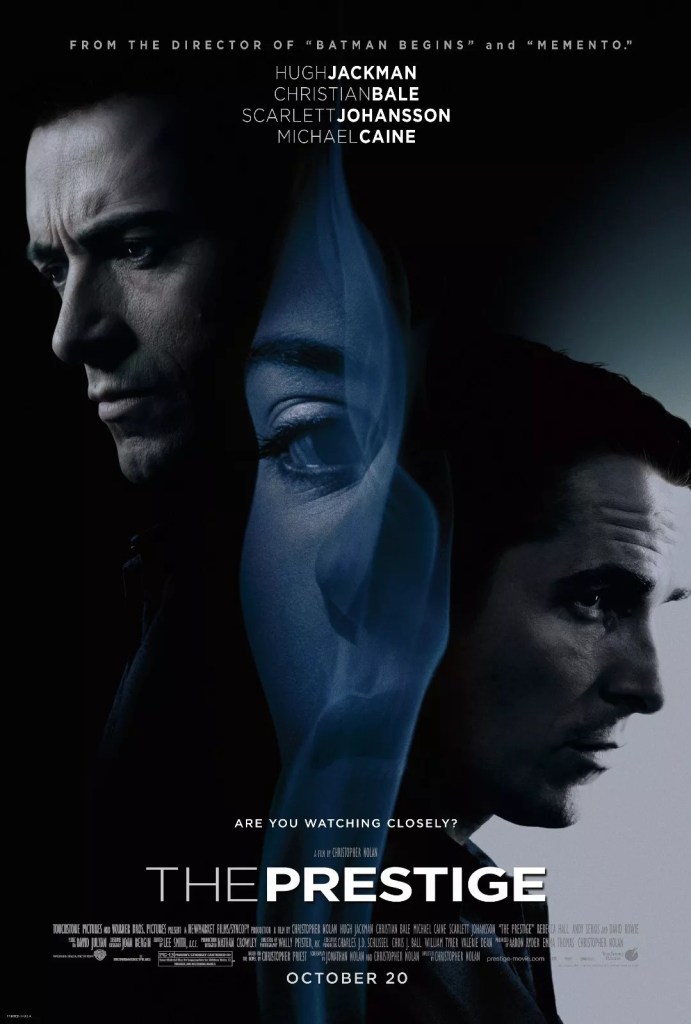
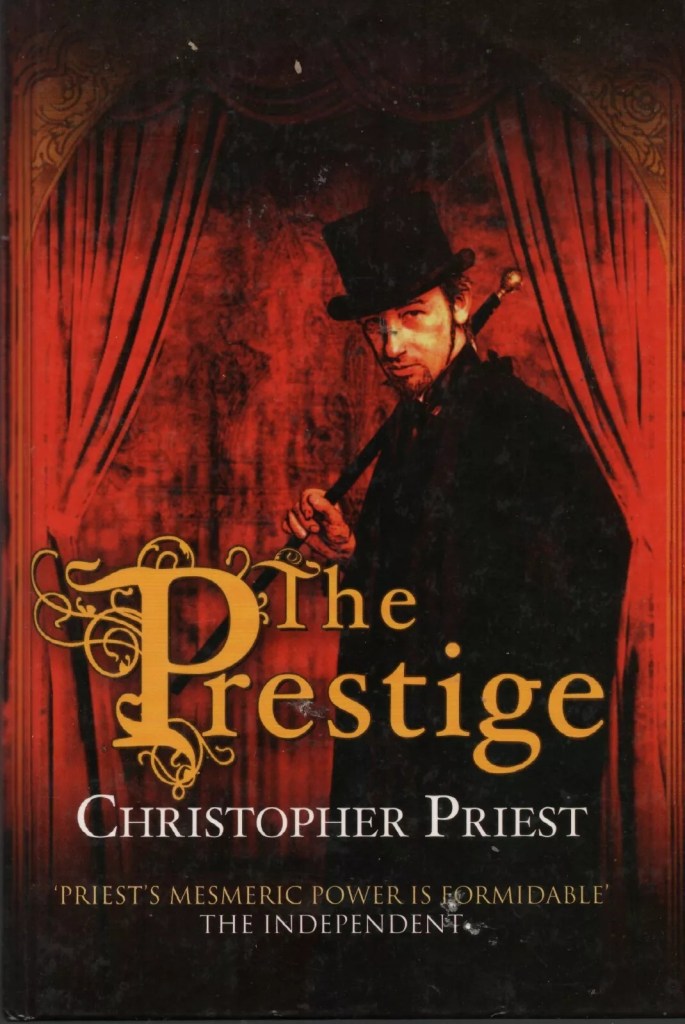
The Prestige (2006) ****

Christopher Nolan (Oppenheimer, 2023) revels in sleight-of-hand, if only by mixing up time frames, but even he isn’t intellectually smart enough to overcome the deficiency that ensured this picture failed to emulate the commercial success of all his other movies. And it revolves not around what you do to dupe an audience. An audience wants to be duped and isn’t so concerned if how the duping is achieved is never revealed, which is, of course, core to the business of the stage magician. Part of the success of this picture is that Nolan gives away stage secrets, even, if you were playing close enough attention, giving away the main reveal of one of the two dueling stage magicians.

But one of these revelations cuts so close to the bone the audience loses its sympathy for both the main characters, Alfred Borden (Christian Bale) and Robert Angier (Hugh Jackman). By the time we understand just how ruthless this pair are to the extent of risking marriage/romantic attachment for the sake of either getting one over on the opponent or maintaining the central deceit of their act, we have already become too squeamish to care overmuch. And the twists which come with increasing regularity which are supposed to take our breath away are defused by the ticking time bomb.

And the miscalculation pivots on who you can kill in a movie. Henry Fonda cold-bloodedly slaughtering an innocent child in Once Upon a Time in the West (1969) set a new high/low for onscreen barbarity, but that was excused because it demonstrated just what a villain this character was. Since then a virtual industry has grown up over inventing more creative ways in which people can be killed.

One of the standard ploys of the stage magician is to make a canary in a cage disappear in front of your very eyes only for said canary, minus cage, to reappear moments later to thunderous applause. Turns out the cage is collapsible and it vanishes into a space hidden in a table. The canary? It is squashed to death in the cage. It’s a different canary that magically reappears.

So all through the picture canaries are squashed, sometimes we see the cages being emptied of dead canaries, and workrooms filled with canaries waiting to be squashed.

What happens after this somehow pales into insignificance. Here we have a business that requires murdering God knows how many canaries every night of the year. It doesn’t take much intelligence among the easily duped moviegoer to work out how many canaries both magicians have ruthlessly despatched.

So when they get around to killing each other’s loved ones, or shooting off each other’s fingers or ruining each other’s acts, your stomach has already been turned and although the darkest of dark narratives has long been a theme of the movies, this, and not fitting into the exploitation B-picture genre where it would more comfortable reside, sucks the sympathy out from under the director’s feet and all his later sleight-of-hand, as ingenious as it is, counts for very little.

There’s certainly tragedy here and of the kind that only Shakespeare could conjure. In order to safeguard the integrity of his act – the secrecy paramount to its success – loving husband Borden is forced to pretend to his loving wife Sarah (Rebecca Hall) that he has a mistress, resulting in distraught wife killing herself. Though discreetly done, scarcely glimpsed in the final sequence, Angier has embarked on the murderous spree essential to concealing the mechanics of his famous trick, The Transported Man.

That it works at all, and splendidly to a large extent, is down to Nolan’s traditional time-shift sleight-of-hand and installing in the middle of this brouhaha the wise Cutter (Michael Caine) whose tempered diction brings the movie unexpected gravitas. When he speaks you tend to believe. The minute the other pair open their mouths you are suspect.

Just for his calmness Michael Caine (Interstellar, 2014) steals the picture from Christian Bale (Ford v Ferrari / Le Mans ’66, 2019) and Hugh Jackman (Deadpool and Wolverine, 2024). Rebecca Hall (Godzilla v Kong: The New Empire, 2024)and Scarlett Johansson (Fly Me to the Moon, 2024) are at opposite ends of the feminine divide, the former unable to cope with deceit, the latter manipulating it to her own ends. The director and brother Jonathan adapted the Christopher Priest award-winning novel.

Setting aside the canaries and the difficulties of presenting all-consuming obsession, this remains an intriguing work, possibly the darkest area into which the director ever ventured.  

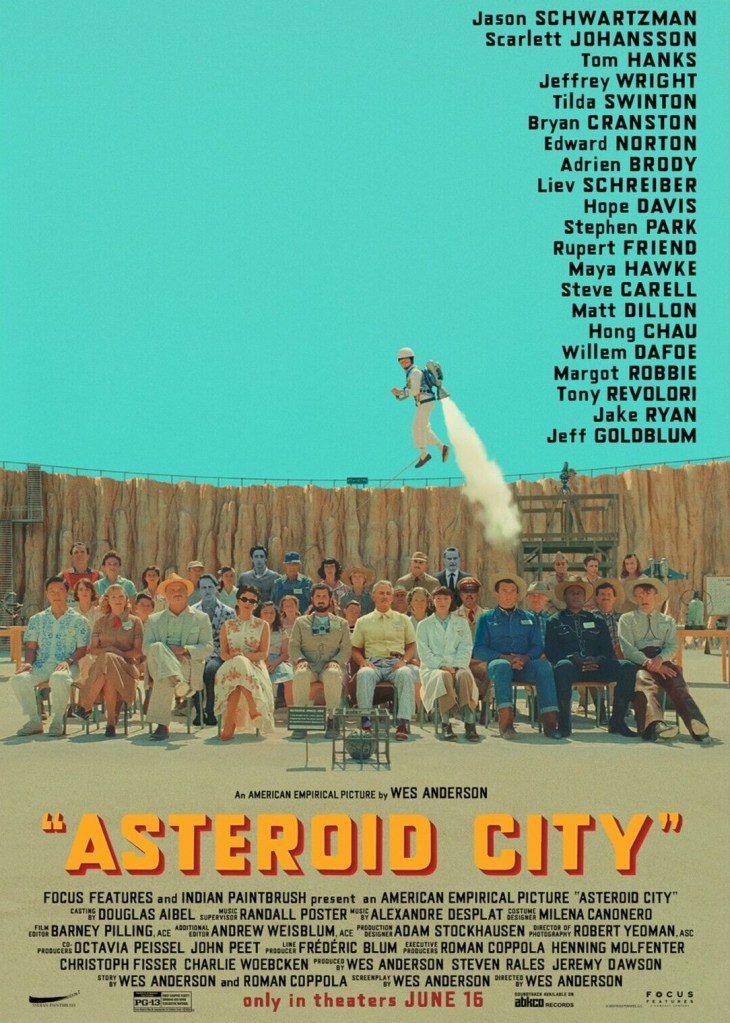
Asteroid City (2023) **** – Seen at the Cinema

“Up to his clavicle in whimsicality,” is the best I can do. While acknowledging that quote is not mine, I should also make clear it could apply to any Wes Anderson picture. He strikes me as critic-proof. With a hard core of fans, whether his movies enter box office heaven depends on the oldest and most elusive of marketing tricks: word-of-mouth.

I am going to be telling everyone to go-see without really being able to explain why they should. I might not be able to describe the plot without putting everyone off. I might get the plot wrong. Ostensibly, it’s about a bunch of disparate characters coming together in the titular city (pop: 87!!) to celebrate in the mid-1950s the gazillionth anniversary of the landing of an asteroid, a pock-marked rock about the size of a giant watermelon.

The motley crowd includes scientists, U.S. Army representatives, schoolkids taking part in a science competition, sightseers and some characters stranded there and, halfway through, an alien who commits the heist of the century, though unlike most caper pictures there’s none of the usual pre-robbery set-up.

While Anderson has a consistency of outlook that delights/bewilders/infuriates critics, he has a stunning sense of originality. He doesn’t repeat himself and reveals an astonishing freshness when it comes to the myriad methods employed to tell a story. At least here, the narrative is, roughly, straightforward not breaking off into various routes (or even cul de sacs) as in his previous outing The French Dispatch, which struggled in the old word-of-mouth department but which I adored.

To help me along here with what the film was all about I looked up the lead review in Imdb. Not only was it no help at all, it was pretty dispiriting. Poor old Wes Anderson gets walloped for lack of plot. I couldn’t care tuppence for plot as long as I’m entertained. And I went along quite happily with the ultra-post-ironic (post-something anyway) notion that we were watching the filmed version of a famous play or possibly the situation which inspired the play but cutting between both and the actors in the movie version not only playing characters but dropping into their genuine personalities – or perhaps not, maybe these were the characters from the play.

And here, the last thing I want to do is put you off. So, yeah, if you think narrative isn’t just watching a bunch of people who’ve never met before interact, a category into which I guess you would chuck movies as different as The Towering Inferno (1974) and Titanic (1997), and think they have to be gathered for a doomsday scenario, and ignore the likes of Bus Stop (1956) then just go ahead and talk yourself out of that rare sighting on the Hollywood hills, an adult movie with nary a superhero (discounting said alien of course, whose back story might include super-heroism for all I know) involved.

This might just be one long litany of jokes, but why would you complain about that? Anyway, for the sake of anyone who has come here for a proper review, here goes.

Grieving widower Augie (Jason Schwartzmann) is unexpectedly stuck in Asteroid City when his car goes into meltdown. His three young children think they are auditioning for Macbeth, constantly casting spells and intent on burying their mother’s ashes, contained in a Tupperware bowl, in the desert, and generally acting weird. His equally widowed father-in-law Stanley (Tom Hanks), dressed as if coming straight from the golf course, turns up to pretty much tell him how much he dislikes him. Augie has a short affair with movie star Midge (Scarlett Johansson) while her science-minded daughter gets to experience first love and proves a whiz at some extremely complicated memory game that I might have played when young but can’t remember the name of or which could equally be a Wes Anderson invention.

Please sir, that’s as much plot as I can remember. Various other characters appear, flitting in and out, and don’t behave as you might expect. Oh, some do, there’s a hotel owner selling plots of real estate, but there’s also the apparently straight from Central Casting General Gibson (Jeffrey Wright) whose speech sounds more like an elevator pitch for a novel. See, I told you, explaining it won’t help. You just gotta go see it.

You might spend the whole picture rubber-necking, spotting stars in cameo roles, but except for Edward Norton and to some extent Tilda Swinton none of them are doing what they are famous/infamous for. Maybe Wes Anderson has a constant queue of A-list applicants for small roles just because a) they get to play someone completely different from normal and/or b) they get to work with the great man.

Roman Coppola (Moonrise Kingdom, 2012) was drafted in to help write the screenplay maybe just so the director can get to share the blame if it’s a critical dog.

Go see.

Did I already say that?

Black Widow (2021) **** – Seen at the Cinema

Like Skyfall, that rarity, an action film with a solid emotional core. Take away the action and you would still have an absorbing story of a loss, family tension, bickering siblings and an ego-driven pompous father. The action brings family together, initially the two girls, Natasha (Scarlett Johansson) and Yelena (Florence Pugh) rescuing papa Alexei (David Horsburgh) from a Russian maximum-security prison then with the addition of brainy mum Melina (Rachel Weisz) tackling criminal mastermind Dreykov (Ray Winstone) in an exceptionally clever secret location.

If you’ve come looking for simple action, this is the wrong movie for you. Family complication, on a par perhaps with the criminal clan of The Godfather and imbued with the darker hues of Christopher Nolan’s Batman, adds far more depth than normal for a superhero picture. And even for Dreykov, the issue is family. He is the repairer-in-chief, on the one hand putting back together as well as he can his own familial loss, and on the other giving a home for countless orphans worldwide, albeit to suit his own plans.

Natasha has run the gamut of raw emotion. Orphaned twice, forcibly ejected from the one place she called home, i.e. The Avengers family, her feelings about being reunited with  adoptive Romanoff parents are noticeably negative.  Yelena is more willing to embrace the errant parents. Never mind that this is the one superhero picture in The Avengers catalogue where the superhero, as fit and agile as Natasha is, has no demonstrable superhero powers. And even those powers are mocked by Yelena who makes fun of the pose we have so often seen Natasha adopt. Nearly stealing the show is the self-pitying Alexei, the over-ripe overweight over-emotional father who would always be embarrassing you, inflated with his own self-importance, as bereft now as his daughters, having been stripped of his own superhero status as the Red Guardian. Whenever any of his family are in danger you can be sure his ego will get in the way.

The story is simple enough. By accident, Yelena, a member of the Dreykov army of female orphans, accidentally discovers she is enslaved, teams up, but only after a knock-down scrap Jason Bourne would have been proud of, with on-the-run Natasha, and eventually her parents. The action is terrific, especially the jailbreak, which has time to steal the central riff from Force Majeure (2014) just to ramp up the tension. And there are plenty surprises along the way, especially apt reward for Natasha’s ruthlessness as a do-gooder.

This is an entire family up for redemption, forced to confront their pasts, and for once it is not action that provides the solution. In some respects it is the family that clings together that stays together. The Avengers aspect is mostly redundant here, so what’s left is a more solid action-fueled thriller with superb characters, each, including villain, with their own emotional story arc. And it’s not always dark either, the family scenario studded with comedy nuggets.   

Visually stunning, as you might expect, this is a welcome big-budget showcase for Cate Shortland (Berlin Syndrome, 2017) who brings emotional intelligence to bear on a genre in which that is often in short supply. Eric Pearson (Godzilla vs Kong, 2021) was the wordsmith.

Johansson (Marriage Story, 2019) has rarely been better and it says a lot for the performance of Florence Pugh (Little Women, 2019) that in their scenes together she is rarely overshadowed. Hopefully, this is the breakout picture for David Harbour (No Sudden Move, 2021), and maybe even the MCU team might recognize the comedic opportunities in a stand-alone based on his character, so effortlessly has it been constructed. And it’s a welcome return for Rachel Weisz, absent from the big screen since The Favourite (2018).  William Hurt (Avengers: Endgame, 2019) makes an expected appearance and Olga Kurylenko (The Courier, 2019) a surprise one and The Handmaid’s Tale’s O-T Fagbenie provides an interesting cameo.

This is definitely not going to work as well on the small-screen so if you’ve got the chance to see it in the cinema – where I saw it on my weekly Monday night outing – grab it while you can.

Discover WordPress

A daily selection of the best content published on WordPress, collected for you by humans who love to read.

The Atavist Magazine

by Brian Hannan

WordPress.com News

The latest news on WordPress.com and the WordPress community.