Thank You All Very Much / A Touch of Love (1969) ***

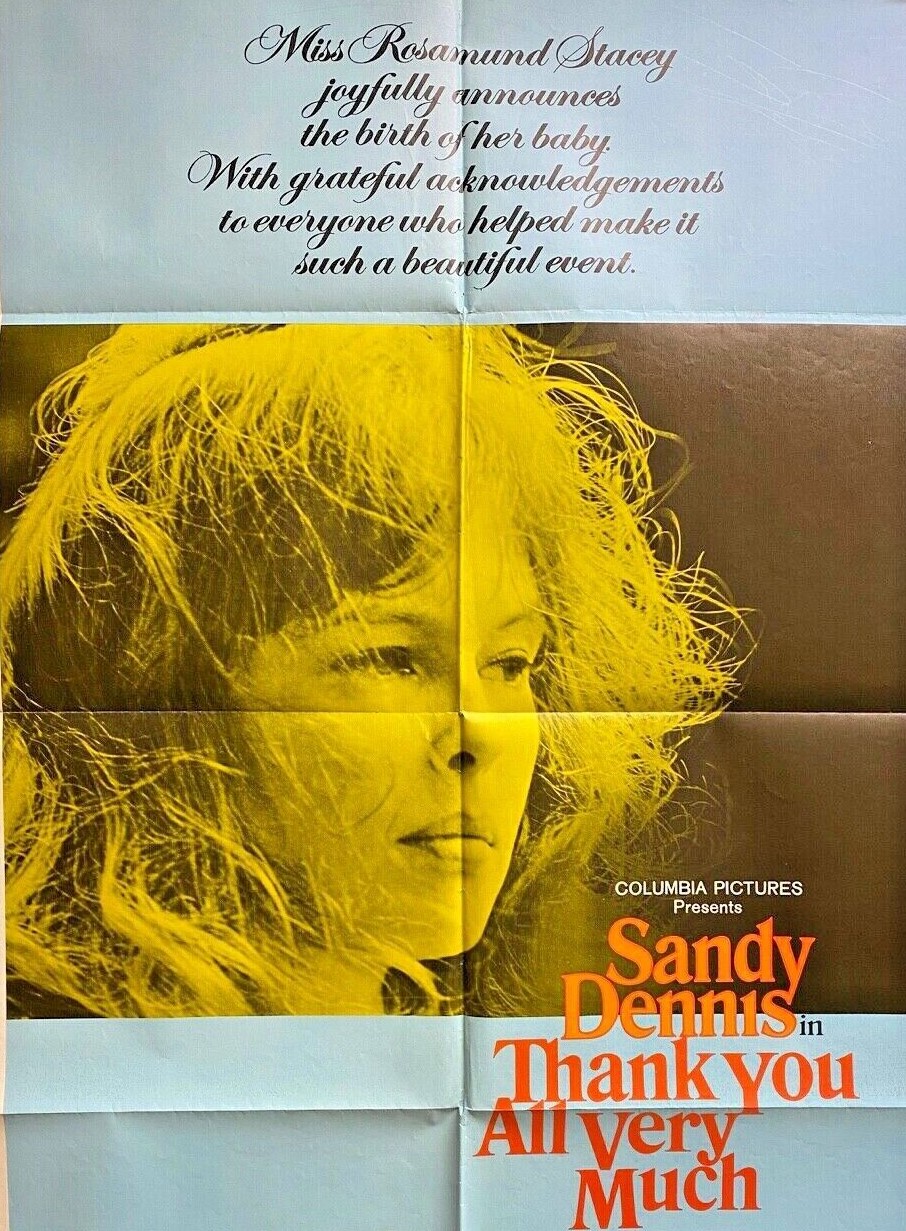
The combination of Amicus and pregnancy might lead audiences to expect a monster baby of It’s Alive (1974) dimensions. Nor would you associate the studio, which made its name in horror pictures where women were either victims or sex objects, with feminism. But producer Milton Subotsky plays it straight, the only concession to the Margaret Drabble source novel is to change the title, from the obvious The Millstone to the more ironic Thank You All Very Much (in the U.S.) and A Touch of Love (in the U.K.).

It doesn’t go down the single mum kitchen sink route either, abandoned female struggling in poverty and desperate for a man. In fact, except in one instance, dependable men are in short supply. Though, it has to be said, female support isn’t much better.

Now there’s counter-programming. A “woman’s picture” supported
by low-budget actioner aimed at men.

Pregnant after a one-night stand with television personality George (Ian McKellen), post graduate student Rosamund (Sandy Dennis), after toying with home-made efforts at abortion, decides to have her baby. Luckily, she can afford it, living in a splendid apartment in what looks like South Kensington rather than a bedsit in a more squalid area of London. Her parents are more remote, tending towards the upper rather than the middle classes, the type who park their offspring in boarding school to minimize a child’s impact on their busy social lives.

Sandy Dennis (Up the Down Staircase, 1967) has quite a trick in her screen persona. She is generally initially presented as weak, whiny, vulnerable, trademark quavering voice helping this along, a potential victim until her inner steel exerts itself and you realize she is not the person you think she is. Almost an actorly version of the Christopher Nolan trope of letting you believe a character is one type of person until he/she turns out to be another.

There isn’t too much of the mother being tormented out of her skull by a baby screaming its head off – or as in Nolan’s latest opus Oppenheimer, a mother unable to cope handing the child over to someone else to look after – but she is very much alone, unable to reveal to the father his part in the pregnancy, despite having another one-night stand with him. So mostly it’s her coping with the system, suffering in silence in the traditional British manner endless bureaucracy, sitting in a long queue in a waiting room, and being beset by the very people you might expect to be more sympathetic.

Supporting feature given more prominence here.

But the nurses seem very much cut from the same pragmatic cloth as her parents. Prior to birth, one nurse informs her that it’s selfish not to give the child up for adoption. When the baby is convalescing in hospital after a heart operation, matron (Rachel Kempson), a graduate from the Nurse Ratchet school of health care, consistently refuses to let the mother see the baby as it’s apparently against hospital rules until in the best scene in the movie, and the one that achieves the Dennis trick, she literally screams the place down.

That nurses on a maternity ward full of little more than I would imagine at times screaming children are so disturbed by the prospect of an adult rebelling against the stiff upper lip conventions of British society says a great deal about the kind of uniformity and subservience expected of the public by those in charge of any large organization. None of the Angry Young Men of earlier in the decade would dream of such a simple solution to a problem.

Eventually, being allowed to sit by her child’s bedside until late into the night permits Rosamund to complete her thesis and win her PhD. She’s not quite as hard-nosed about George as she likes to imagine but since he’s not sufficiently taken with her child to allow it to disrupt a projected trip abroad, she realizes what had been plainly obvious to the audience that she is better off without men – or at least this particular, ineffective, individual – for the time being.

So most of the film is about Rosamund learning to enjoy her independence, able to achieve her goals without male assistance, and that’s generally done by action rather than dialogue or monologue, some heated debate or major crisis. Excepting the incident with Nurse Ratchet, it’s just about coping, and awareness that maternity need not cramp ambition.

Her arty friends (and parents for that matter) are all too keen on having a good time – the males mostly trying to bed her – to lend much support. Some like Lydia (Eleanor Bron) have a warped view of life.

In his movie debut Waris Hussein (The Possession of Joel Delaney, 1972) takes the striking narrative route of not allowing the picture to become tangled up with romantic complication, keeping it squarely focused on feminism, succeeding on your own terms, not reliant on men, embracing both motherhood and career. Margaret Drabble wrote the screenplay.

Sandy Dennis (Up the Down Staircase, 1967) delivers another telling performance, one of the few actresses permitted to be center stage in a non-romantic narrative, because this is the kind of role she can easily pull off. She manages a convincing British accent without falling prey to too much Britishness.

Minus the tell-tale diction that marked his later career, Ian McKellen (Alfred the Great, 1969) has an effective debut as the charming though selfish lover. Eleanor Bron (Two for the Road, 1967) is the pick of the supporting cast as the soft-hearted best friend who is too pragmatic by half. Others popping up include John Standing (Walk, Don’t Run, 1966), Margaret Tyzack (2001: A Space Odyssey, 1968), Maurice Denham (Midas Run, 1969) with Rachel Kempson (The Charge of the Light Brigade, 1968).

Unfussy direction matched with another brilliant turn by Sandy Dennis makes this a must-watch.
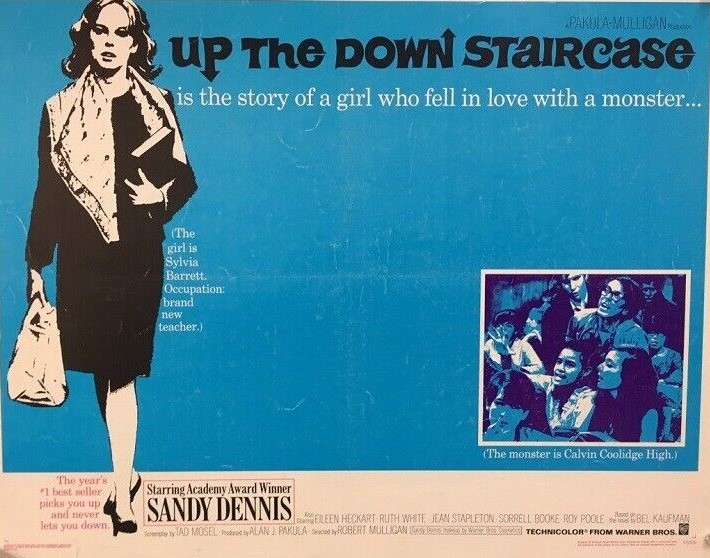
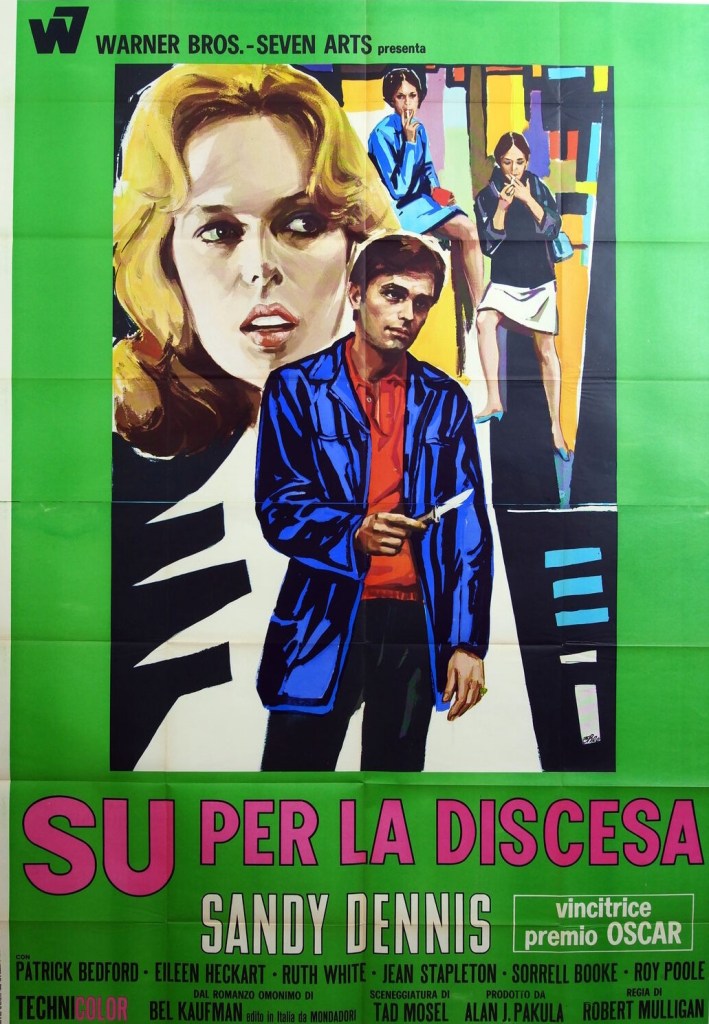
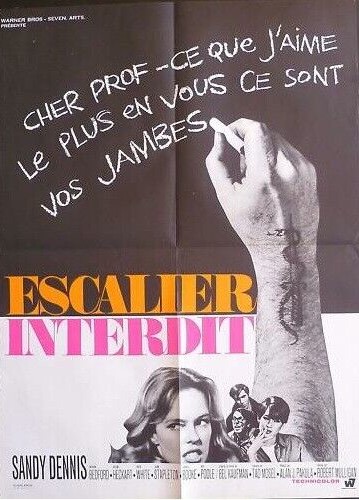
Up the Down Staircase (1966) ****

Impressive impressionistic tale of naïve young teacher and her travails in a rough inner city New York high school, a world away from the preppie hi-jinks of The Group the previous year and a good bit more realistic and less sentimental than To Sir, With Love the same year. If you thought teachers had a tough time these days, it was no better half a century ago.

We get no insight into the home life of idealistic singleton Sylvia (Sandy Dennis) beyond that once a week she gets a phone call from her annoying mother. Outside the school, she is warned to walk slowly in order to show she is not frightened to walk down these mean streets.

The school appears chaotic, hordes of almost-adult kids rampaging along corridors, hellbent on causing anarchy. And it takes some objective observation to realize that the endless rules,  sometimes delivered by intercom and very often improvised on the spot, imposed by the tough headmaster McHabe (Roy Poole) have created a semblance of order.

But if the kids are led astray by inherent attitude, the adults are undone by bureaucracy and petty infighting. A list of rules on the wall forbids the school nurse from actually treating any patients. There’s a marvellous librarian whose reaction to an attempted suicide is to demand the return of an overdue book. Teachers squabble about who has precedence to use a particular drawer. Budding novelist and lothario Barrington (Patrick Bedford) spends his mornings in a local café, an adoring secretary covering for his absence.  

The end-zone in all movies about schools (excepting If…a couple of years later) focuses on a struggling teacher who doubts her abilities but finds worth in her calling. Although that cliché pops up towards the end, mostly it’s an examination of the terrible home lives, seen in snippets, of the pupils and their parents, possibly who had the same experience, of viewing schools as obstacles to life and nothing more than the existing hierarchy’s way of keeping them in their place, education peeceived as akin to a police force exacting penalty.

With her fragile beauty, posh voice, and ideas of converting teenagers to the joys of Chaucer, Dickens and myriad poets, you would expect Sylvia to be gobbled up by the system. And at times, her quivering lip goes into overdrive, but that masks an inner determination not to fall for any sob stories – no matter that the audience will lap them up – and to extricate herself from dangerous situations with the macho Joe (Jeff Howard) who is convinced she won’t hand in him for carrying a switchblade and that she must be in love with him.

Pupils fall into three categories: those who fall in love with their teachers, those who want to kill them and those who are dying of boredom, living day-to-day in catatonic indifference.

Sylvia’s understated refusal to be intimidated carries the day and, while she encourages, realizes that she can’t resolve the endemic social issues – children battered at home or who have to work at night or who are brought up by a series of neighbors – by inflating a pupil’s mark just to help out. There’s none of the grandstanding of Dead Poets Society (1989) or Mr Holland’s Opus (1995) either, no individual or group who, in dramatic fashion, demonstrates allegiance, sides with the teacher or proves a test case for the teacher’s brilliance.

If Sylvia makes any impact, it’s shown in a small way by awkward pupil Alice (Ellen O’Mara) who believes all literature is about love and is humiliated by Barrington. Sylvia hasn’t the personality to collect a coterie of adoring pupils as in Dead Poet’s Society, nor like Robin Williams there have the confidence to chuck away set texts and do it his own way. But it would be a close run thing as to who would be the better teacher. Williams should win by a neck given his exuberance, but Sylvia, the mouse, is actually the better teacher.

It’s pretty bold of director Robert Mulligan (Inside Daisy Clover, 1965) to actually force the audience to watch Sylvia dissect the opening paragraphs of A Tale of Two Cities in order not just to prove what an insightful teacher she is but to demonstrate her command of her once-rowdy class. The show of hands of pupils desperate to ask questions is testimony to her quiet methods.

Superb performance from Sandy Dennis (The Fox, 1969), showy one from Patrick Bedford, touching one from Ellen O’Mara and with Jeff Howard attempting to channel his inner James Dean, but, for the last three, unusually in a film stuffed with newcomers, their roles did nothing for their careers. You might spot Bud Cort (Harold and Maude, 1971),  Eileen Heckart   (No Way To Treat a Lady, 1968), and Jean Stapleton (Emmy award winner for All in the Family, 1971-1979) but mostly it’s cameos in an ensemble picture.

Expertly mounted by Robert Mulligan with a screenplay by Tad Mosel (Dear Heart, 1964) from the Bel Kaufman runaway bestseller.

As much as it has you rooting for the little guy, it doesn’t gloss over the calamities schools are left to deal with.

The Fox (1967) ****

Based on a novella by D.H. Lawrence, The Fox, relocated to contemporary Canada, marked the debut of director Mark Rydell. Originally, Alan Bates (Georgy Girl, 1966), Patricia Neal (Hud, 1963) and Vivien Merchant (Alfie, 1966) were in the frame for the three roles. Instead, the trio were Sandy Dennis, Keir Dullea and Anne Heywood.

Dullea’s career was at a dead end after flops The Thin Red Line (1964) and Bunny Lake Is Missing (1965). Former beauty queen Heywood had been a Rank starlet which resulted in small roles of no distinction until marriage to the film’s producer Raymond Stross improved her prospects. The main marquee attraction was Sandy Dennis who had won the Best Supporting Actress Oscar for Who’s Afraid of Virginia Woolf (1966) and starred in drama Up the Down Staircase (1967). But it was a low-budget enterprise all the way.

Dennis and Heywood play spinsters running a chicken farm in rural Canada, home-body Dennis the more introspective and content, task-oriented Heywood self-sufficient but sexually frustrated. Dullea is a merchant seamen who visits the farm in search of his grandfather, now deceased. Allowed to remain, his presence threatens their lifestyle and forces them to confront the intensity of their suppressed feelings towards each other. Although a real fox is causing trouble, Dullea is the symbolic fox in the symbolic hencoop. Rydell displays considerable confidence in his material.

It is very atmospheric, the natural backdrop, early morning sunsets and wintry chill in the air adding a certain tone, with the isolation providing a thematic template. The tiny cast creates a sense of intimacy as well as tension and the acting is uniformly good. There is no sense of lust, just a gradual emergence of submerged emotion.

Tackling such a bold theme would have brought the movie some attention anyway, but nudity, masturbation and sex brought much more. That such scenes were filmed in good taste and impressed critics was hardly going to deter the salacious. The nervy, whiny Dennis has the showiest role but Heywood’s subdued performance, trapped by her conflicting sexual needs, is the central figure.

George Roy Hill might well have purloined his freeze-frame ending in Butch Cassidy and the Sundance Kid from an idea Rydell employs here, one of only two effective stylistic devices in an otherwise highly-controlled piece. The only directorial downsides are a couple of instances of unnecessary melodramatic music when otherwise Lalo Schifrin’s gentle theme is perfectly in keeping with the picture’s mood. Made on a budget of buttons and reliant entirely on acting skill, this is one of the decade’s low-budget triumphs, not least for its sensitive treatment of its subject matter.

The Fox (1967) ****

Based on a novella by D.H. Lawrence, The Fox, relocated to contemporary Canada, marked the debut of director Mark Rydell. Originally, Alan Bates (Georgy Girl, 1966), Patricia Neal (Hud, 1963) and Vivien Merchant (Alfie, 1966) were in the frame for the three roles.

Instead, the trio were Sandy Dennis, Keir Dullea and Anne Heywood. Dullea’s career was at a dead end after flops The Thin Red Line (1964) and Bunny Lake Is Missing (1965). Former beauty queen Heywood had been a Rank starlet which resulted in small roles of no distinction until marriage to the film’s producer Raymond Stross improved her prospects. The main marquee attraction was Sandy Dennis who had won the Best Supporting Actress Oscar for Who’s Afraid of Virginia Woolf (1966) and starred in drama Up the Down Staircase (1967).

Despite the film-makers attempts to treat the subject matter with subtlety, this did not prevent film reviewers and the most sensational newspapers by pumping up the sex angle.

But it was a low-budget enterprise all the way. Dennis and Heywood play spinsters running a chicken farm in rural Canada, home-body Dennis the more introspective and content, task-oriented Heywood self-sufficient but sexually frustrated. Dullea is a merchant seamen who visits the farm in search of his grandfather, now deceased. Allowed to remain, his presence threatens their lifestyle and forces them to confront the intensity of their suppressed feelings towards each other.

Although a real fox is causing trouble, Dullea is the symbolic fox in the symbolic hencoop. Rydell displays considerable confidence in his material. It is very atmospheric, the natural backdrop, early morning sunsets and wintry chill in the air adding a certain tone, with the isolation providing a thematic template. The tiny cast creates a sense of intimacy as well as tension and the acting is uniformly good.

It was quite a feat for a small budget picture to achieve a circuit release in Britain – in this case on the ABC chain. No doubt in part due to the sensational images used in the poster.

There is no sense of lust, just a gradual emergence of submerged emotion. Tackling such a bold theme would have brought the movie some attention anyway, but nudity, masturbation and sex brought much more. That such scenes were filmed in good taste and impressed critics was hardly going to deter the salacious. The nervy, whiny Dennis has the showiest role but Heywood’s subdued performance, trapped by her conflicting sexual needs, is the central figure.

George Roy Hill might well have purloined his freeze-frame ending in Butch Cassidy and the Sundance Kid from an idea Rydell employs here, one of only two effective stylistic devices in an otherwise highly-controlled piece. The only directorial downsides are a couple of instances of unnecessary melodramatic music when otherwise Lalo Schifrin’s gentle theme is perfectly in keeping with the picture’s mood.

Made on a budget of buttons and reliant entirely on acting skill, this is one of the decade’s low-budget triumphs, not least for its sensitive treatment of its subject matter.

Discover WordPress

A daily selection of the best content published on WordPress, collected for you by humans who love to read.

The Atavist Magazine

by Brian Hannan

WordPress.com News

The latest news on WordPress.com and the WordPress community.