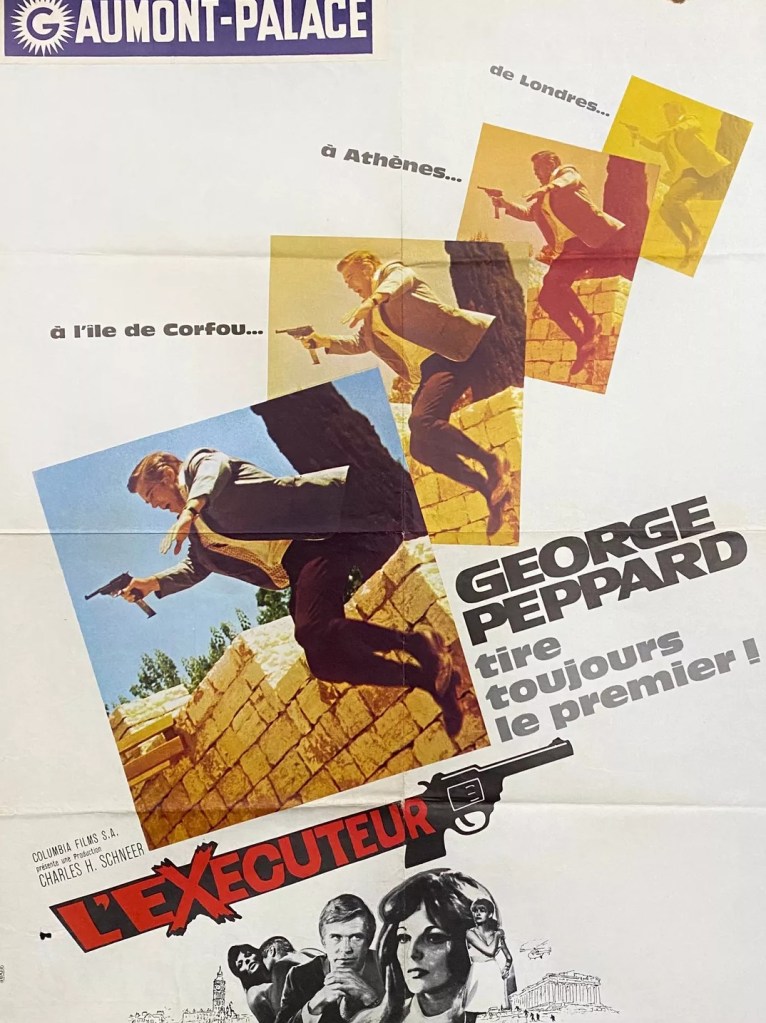
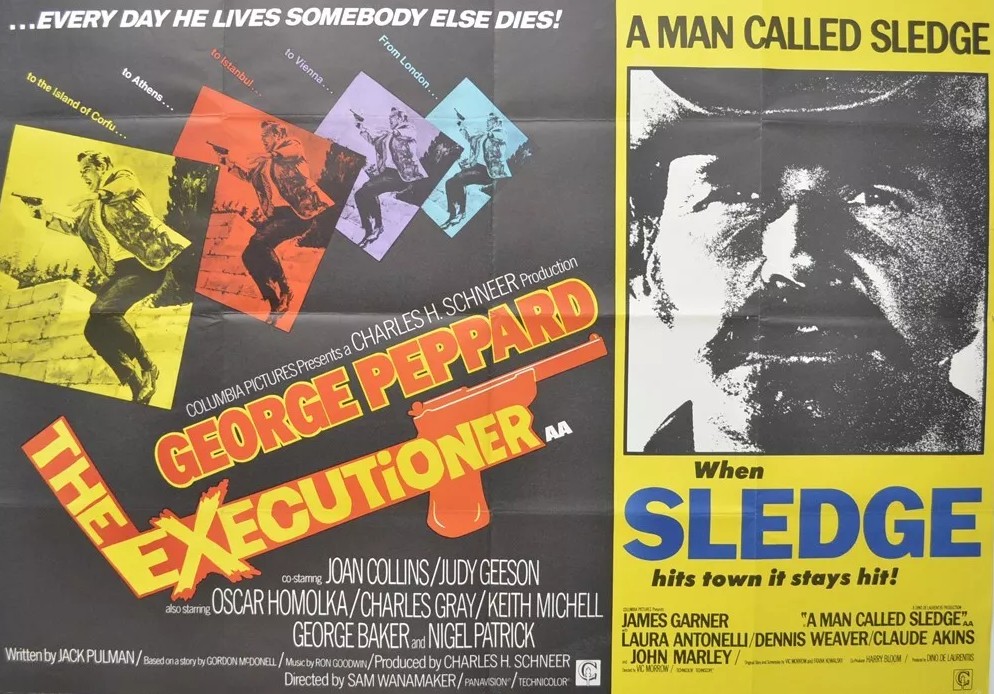
The Executioner (1970) ****

Minor gem. One of the espionage films of the era ignored by audiences because it lacked the verve of James Bond, no car chases or bedhopping hero to maintain interest when the narrative stretched credulity. Ignored by critics because it starred the vastly underrated George Peppard. Yet if you wanted an actor to show pain, to suffer from humiliations to his dignity, there was no one better, in part because on screen (and apparently in real life) arrogance was key to his persona. Here, you can add confusion to that mix of unwelcome emotions.

Beginning a scene with the aftermath of slaughter has become a modern thriller trope – see The Equalizer 3 (2023),  The Accountant 2 (2025) for the most recent examples –  but this is where the idea began and it’s how this picture opens, the only survivor of the massacre being the wife Sarah Booth (Joan Collins) whom our hero John Shay (George Peppard) covets. An immediate flashback shows them consummating their love. So you’re guessing there’s something of the James Bond in Shay, carrying on an illicit love affair.
But in fact that’s just one of the clever titbits of misdirection director Sam Wanamaker (The File of the Golden Goose, 1969) throws our way. And, gradually, we realize this is not so much about dirty dealings in the espionage business, the usual hunting down of a double agent, our hero clashing with disbelieving and frosty upper class bosses, but more about how the flaws in human nature turn characters inside out.

It’s no surprise that Shay is an outsider, not with that American accent standing out a mile in the British secret service run by the cut-glass accents of the likes of Col Scott (Nigel Patrick) and Vaughn Jones (Charles Gray). He’s not a member of the club, old boy. He bristles at not belonging – “belong to me!” wails girlfriend Polly (Judy Geeson). And he’s been passed over  by love of his life Sarah for another agent Adam Booth (Keith Michell) not because the latter has wealth and status but because Shay’s mind is too often elsewhere.

Though you are initially led to believe that Shay is having an affair with Sarah, that turns out to be far from true, although the glances he casts at her are enough to make Polly think they still are. And part of the reason his superiors distrust his assertion that Adam is a double agent is because they think he just wants rid of his rival so he can make another play for his former lover.   
Shay is so convinced that he is right that he gets Polly, who also works in the secret service but in the backroom department, to sneak out top secret files. When he stitches up enough information to make the case against Adam, it backfires and he’s suspended. But then, egged on by a discovery by top boffin Crawford (George Baker) working on some top secret stuff,  he decides to kill Adam and chuck the body out of a plane into the English Channel – hence becoming the executioner of the title.

Then the twist is truly in when Shay takes Adam’s place on a mission to Greece, which has also been planned as a second honeymoon for Adam and Sarah. This latter fact doesn’t dissuade Shay from making a romantic play for Sarah. However, there are nefarious dealings afoot espionage-wise but in what proves the first of many miscalculations Shay comes unstuck and is beaten up by the opposition and Sarah kidnapped. The ransom the Soviets demand is Crawford.

The massacre that we saw at the start solves that problem.

But it turns out Shay has let desire for Sarah muddle his brain for Adam was not a secret agent. Shay has been further duped into that belief by Crawford who also has romantic designs on Sarah, though it has to be said in her defense that Sarah has encouraged neither of these potential suitors.

There is one final twist but that’s just another nail in the coffin.

So what sets out to be a different kind of spy thriller turns into the polar opposite of what audiences might have expected, playing more on the human frailty of the hero than hitherto in the genre.

George Peppard is excellent, especially when expressing emotional pain and confusion, continuing a superb run of acting roles – ignored by the critics of course but tossing his screen persona away – that ran from Rough Night in Jericho (1967) and P.J. (1967) to Pendulum (1969). Judy Geeson (Brannigan, 1975) has the better female role as the disgruntled but faithful girlfriend. Aside from the occasional acidic remark, Joan Collins (Subterfuge, 1968)  is strictly there for the glamor.  Written by Jack Pulman (Best of Enemies, 1961) from a story by Gordon McDonnell (Shadow of a Doubt, 1943).  

Well worth a look.

Danger Route (1967) ***

If the producers had not signalled Bond-style ambitions with a big credit sequence theme song by Anita Harris, moviegoers might have come at this with more fitting expectations in the Harry Palmer and John Le Carre vein. So although slipping into the late decade spy boom flourish don’t expect villains planning world domination, gadgets or a flotilla of bikinis.

Seth Holt’s bread-and-butter espionage thriller sets government agent Jonas Wild (Richard Johnson) – on his “last assignment” no less after eight licensed murders in five years – to kill off a defector in the far from exotic location of a Dorset country house not realizing that he is also being set up. That his liquidator will be a woman puts the mysterious Mari (Barbara Bouchet) in pole position.  

Wild gains access to the heavily-guarded mansion by seducing housekeeper Rhoda (Diana Dors) but after completing his mission is captured and tortured by Luciana – pronounced with a “k” – (Sam Wanamaker) who explains he is a patsy and that there is a mole in M.I.5. When his boss Tony Canning (Harry Andrews) disappears and another friend is murdered, Wild goes on the run with Mrs Canning (Sylvia Syms) and eventually makes his way back to his bolt-hole in Jersey to solve the mystery.

There is a decent amount of action, including a fight with a guard dog and a battle on a fog-bound yacht. Clever maneuvers abound – a bug is planted in a bandage. Treachery is always just round the corner and there is no shortage of suspects.

The film’s down-to-earth approach is somewhat refreshing after half a decade of spy thrillers and spoofs. Wild doesn’t employ anything more hi-tech than masquerading as a brush salesman to win over Rhoda. And although that relationship ends up in bed, there is no sex, Wild having drugged her to avoid that complication. Tony Canning is nagged by his wife. Wild’s girlfriend (Carol Lynley) is a sweet girl, sexy in a languid rather than overt fashion.  And Luciana takes enormous pride in telling Wild just how stupid he has been.

But that comes with a caveat. The plot doesn’t quite hang together and the movie sometimes fails to connect.

That said, Johnson (Deadlier than the Male, 1967) is excellent, quite an accomplished actor rather than a brand name. Both Barbara Bouchet (Casino Royale) and Carole Lynley (Harlow, 1965) play against type while Sylvia Sims (East of Sudan, 1964) and Harry Andrews (The Hill, 1965) present variations to their normal screen personas. Sam Wanamaker (The Warning Shot, 1967) has a peach of a role and Gordon Jackson (The Long Ships, 1964) and Maurice Denham (The Long Duel, 1967) are afforded small but critical parts. 

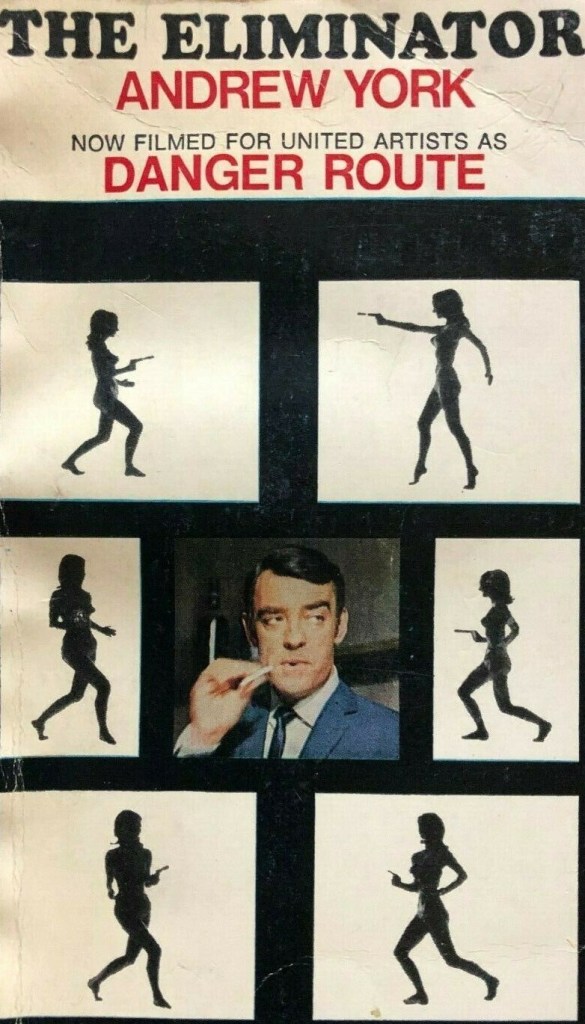
Seth Holt (Station Six Sahara, 1963) directs from a script by Meade Roberts (In the Cool of the Day, 1963) and Robert Banks Stewart (Never Mention Murder, 1965) based on the bestseller by Andrew York.

Competent with interesting touches.

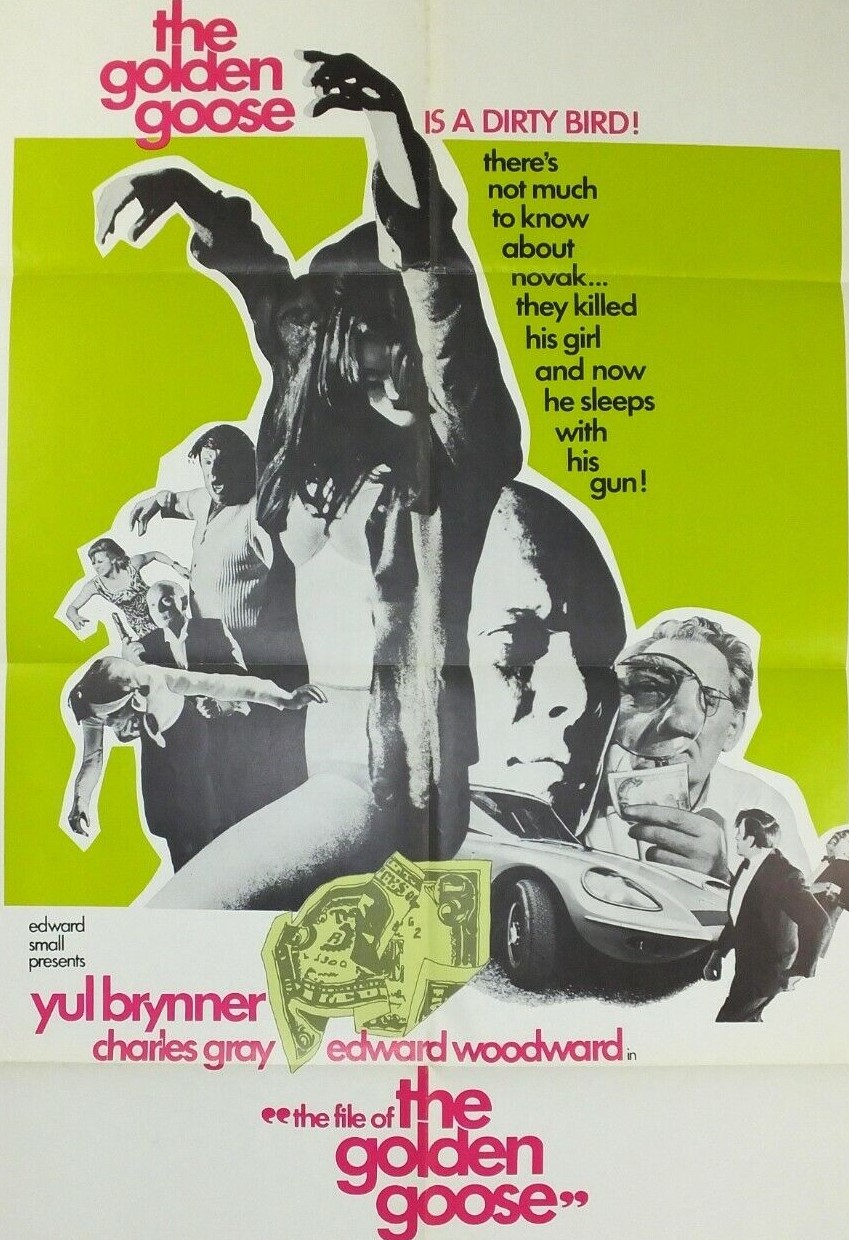
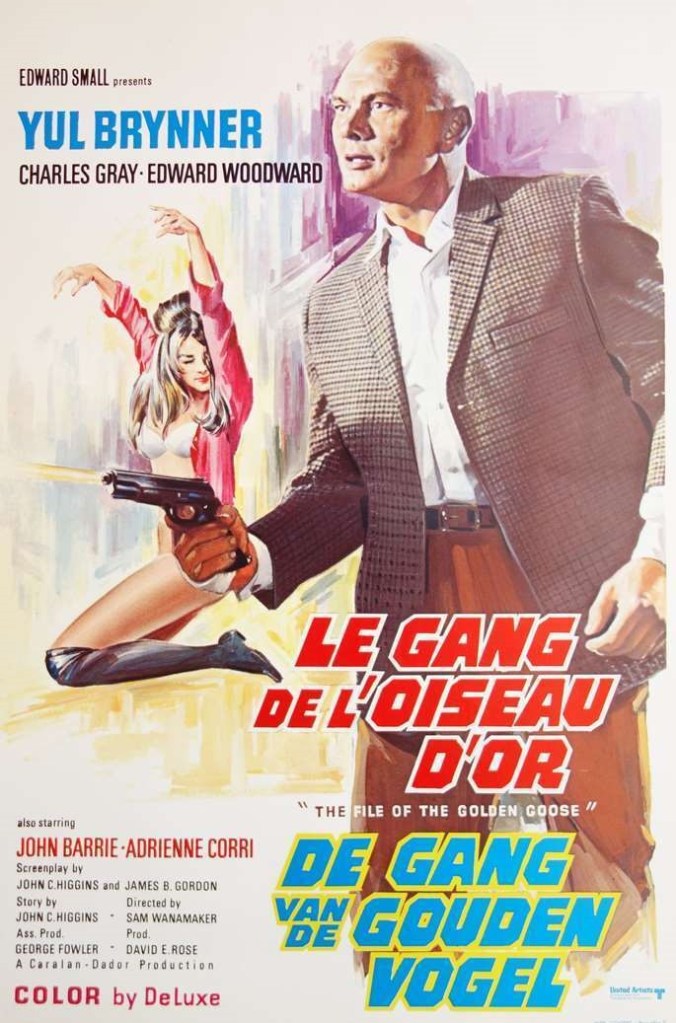
File of the Golden Goose (1969) **

A dud. Not even Yul Brynner, whom I pumped up as under-rated yesterday in Escape from Zahrain (1962), can save it, nor a camped-up Charles Gray (The Devil Rides Out, 1968). Takes too long to get started, meanders all over the place while suspension of audience disbelief breaks new ground.

The first ten minutes or so via voiceover are wasted telling us stuff that one character could deliver in a single line. That is, there’s a worldwide counterfeit operation in place and London is the next target. Hence, American Treasury Agent Novak (Yul Brynner) being seconded to Scotland Yard where he is saddled with ineffective British sidekick Thompson (Edward Woodward).

For no particular reason, they head off to Liverpool where they attempt to infiltrate the gang. The mobsters are so dumb they fall for their lame story, though without first giving them routine warehouse work (cue montage of the pair falling asleep on the job and doing the wrong thing). Novak, it has to be said, is pretty slick at avoiding any traps, cleverly talking himself out of dodgy situations, pinning any blame on whoever is convenient.  

But, eventually (thank goodness), they reach London. And if you have been waiting virtually the whole movie with bated breath for the appearance of female lead Adrienne Corri (Africa Texas Style, 1967)  you can stand easy for now she turns up as ostensibly the gangster queen-pin.

The journey to here is enlivened by hitman Smythe (Graham Crowden), as English as they come, bowler hat and all,  whose weapon of choice is a blade embedded in a walking stick, and The Owl (yep, The Owl, played by Charles Gray) with every fetish under the sun whose presence seems to demand an orgy.

By the time you get to the final shoot-out you couldn’t care less. With a bit more care and attention to detail, this could have been a reasonably thrilling picture. Novak is two-fisted enough to cut the mustard, and naturally treats the English cops as dumb-as-they-come, what with their lily-livered aversion to weapons. Surprisingly, Thompson takes to mobster life and quite enjoys dishing it out in a most un-English fashion.

There’s quite a nice twist when the chief counterfeiter leads Novak into a soundproof vault because he can’t be overheard spilling the beans on his colleagues and seeking witness protection.   

But the movie appears to have been not made for a contemporary audience. Given Lee Marvin has reinvented the movie tough guy in Point Blank (1967) and Clint Eastwood the hardnosed cop in Coogan’s Bluff (1968), Novak doesn’t come close, and since British gangsters are slick enough to pull off Robbery (1967) and The Italian Job (1969), it seems the criminals here have lived a very sheltered life.

There’s not even the old reliable comedic standby of American fish out of British water, such as occasionally helped along pictures like Brannigan (1975). In fact, all the humor rests upon the dry-witted Owl.

Television director Sam Wanamaker (Catlow, 1971) makes his movie debut. John C. Higgins (Impasse, 1969) wrote the screenplay along with Robert E. Kent (The Fastest Guitar Alive, 1967).

For Yul Brynner completists only.

Hard to find, but Talking Pictures has this, but only until Dec 10. Strangely enough, I can’t see any rush.

https://www.tptvencore.co.uk/Video/The-File-of-the-Golden-Goose?id=8a918a69-adf1-4db0-938c-921eaa6494e9

Warning Shot (1967) ****

So underrated it doesn’t even feature on Wikipedia’s chart of 1960s crime pictures, this tight little gem, with an early reflection on police brutality, a dream cast, violence in slow motion  (prior to The Wild Bunch, 1969, mind you) and a stunning score from Jerry Goldsmith, is definitely in need of resurrection. Astonishing to realize that cop pictures had fallen so out of fashion, that this was the first Hollywood cop film of the decade – outside of a drama like The Chase (1966) – the entire previous output focusing on gangsters with a rare private eye (Harper, 1966) thrown in. With none of the vicious snarl of Madigan (1968) or the brutality of Coogan’s Bluff (1968), this was more in keeping with the later In the Heat of the Night (1967) in terms of the mental and physical barrage endured by the cop.

In thick fog on a stakeout for a serial killer at an apartment block Sgt Tom Valens (David Janssen) kills a potential suspect, wealthy Dr Ruston. Valens claims the suspect was reaching for his gun. Only problem – nobody can find the gun. Up on a potential manslaughter charge, Valens is pressured by boss (Ed Begley), lawyer (Walter Pidgeon) and wife (Joan Collins) to take the rap and plead guilty.  The public and media rage about police brutality. Putting Valens’ testimony in doubt is a recent shooting incident, which left Valens with a stomach wound, and which may have clouded his judgement.

Although suspended, Valens has no alternative but to investigate, interviewing elderly patient Alice (Lillian Gish) whom the doctor was visiting, patient’s neighbour playboy pilot Walt (George Grizzard), doctor’s assistant Liz (Stefanie Powers), doctor’s wife   Doris (Eleanor Parker) and doctor’s stockbroker (George Sanders) without nothing to show for his efforts but a savage beating, filmed in slow motion, inflicted by the doctor’s son and pals, and a further attempt on his life. He gets into more trouble for attempting to smear the doctor as an abortionist (a crime at the time).

The missing gun remains elusive though the direction at times suggests its existence is fiction. The detection is superb, red herrings aplenty, as Valens, the odds against him cheating conviction lengthening by the day, a trial deadline to beat, everyone turning against him, openly castigated as the killer cop, struggles to uncover the truth. And it’s clear he questions reality himself. He has none of the brittle snap of the standard cop and it’s almost as if he expects to be found guilty, that he has stepped over the line.

Along the way is some brilliant dialogue – the seductive drunk wife, “mourning with martinis” suggesting they “rub two losers together” and complaining she has to “lead him by the hand like every other man.”  Cinematography and music combine for a brilliant mournful scene of worn-down cop struggling home with a couple of pints of milk. The after-effects of the stomach injury present him as physically wounded, neither the tough physical specimen of later cop pictures not the grizzled veteran of previous ones.

David Janssen (King of the Roaring 20s, 1960) had not made a picture in four years, his time consumed by the ultra-successful television show The Fugitive, but his quiet, brooding, internalized style and soft spoken manner is ideal for the tormented cop. This also Joan Collins (Esther and the King, 1960) first Hollywood outing in half a decade.

Pick of the supporting cast is former Hollywood top star Eleanor Parker (Detective Story, 1951) more recently exposed to the wider public as the Baroness in The Sound of Music (1965) whose slinky demeanor almost turns the cop’s head. Loading the cast with such sterling actors means that even the bit parts come fully loaded.

In the veteran department are aforementioned famed silent star Lillian Gish (The Birth of a Nation, 1915), Brit  George Sanders (The Falcon series in the 1940s), Walter Pidgeon (Mrs Miniver, 1942) also in his first film in four years, Ed Begley in only his second picture since Sweet Bird of Youth (1962) and Keenan Wynn (Stagecoach, 1966). Noted up-and-coming players include Stefanie Powers (also Stagecoach), Sam Wanamaker (The Spy Who Came in from the Cold, 1965), George Grizzard (Advise and Consent, 1962) and  Carroll O’Connor (A Fever in the Blood, 1961). American television star Steve Allen (College Confidential, 1960) plays a hypocritical pundit.

A sophomore movie for noted television director Buzz Kulik (Villa Rides, 1968), this is easily his best picture, concentrating on character with a great eye for mood. Screenwriter Mann Rubin (Brainstorm, 1965) adapted the Whit Masterson novel 711  – Officer Needs Help. The score is one of the best from Jerry Goldsmith (Seconds, 1966).

Has this emanated from France it would have been covered in critical glory, from the overall unfussy direction, from the presentation of the main character and so many memorable performances and from, to bring it up once again, the awesome music.

Worth catching on Amazon Prime.

Danger Route (1967) ***

If the producers had not signalled Bond-style ambitions with a big credit sequence theme song by Anita Harris, moviegoers might have come at this with more fitting expectations in the Harry Palmer and John le Carre vein. So although slipping into the late decade spy boom flourish don’t expect villains planning world domination, gadgets or a flotilla of bikinis.

Seth Holt’s bread-and-butter espionage thriller sets government agent Jonas Wild (Richard Johnson) – on his “last assignment” no less after eight licensed murders in five years – to kill off a defector in the far from exotic location of a Dorset country house not realizing that he is also being set up. That his liquidator will be a woman puts the mysterious Mari (Barbara Bouchet) in pole position.  

The Eliminator was the source material for Danger Route.

Wild gains access to the heavily-guarded mansion by seducing housekeeper Rhoda (Diana Dors) but after completing his mission is captured and tortured by Luciana – pronounced with a “k” – (Sam Wanamaker) who explains he is a patsy and that there is a mole in M.I.5. When his boss Tony Canning (Harry Andrews) disappears and another friend is murdered, Wild goes on the run with Mrs Canning (Sylvia Syms) and eventually makes his way back to his bolt-hole in Jersey to solve the mystery.

There is a decent amount of action, including a fight with a guard dog and a battle on a fog-bound yacht. Clever maneuvers abound – a bug is planted in a bandage. Treachery is always just round the corner and there is no shortage of suspects.

The film’s down-to-earth approach is somewhat refreshing after half a decade of spy thrillers and spoofs. Wild doesn’t employ anything more hi-tech than masquerading as a brush salesman to win over Rhoda. And although that relationship ends up in bed, there is no sex, Wild having drugged her to avoid that complication. Tony Canning is nagged by his wife. Wild’s girlfriend (Carol Lynley) is a sweet girl, sexy in a languid rather than overt fashion.  And Luciana takes enormous pride in telling Wild just how stupid he has been.

Sylvia Sims in a ticklish situation.

But that comes with a caveat. The plot doesn’t quite hang together and the movie sometimes fails to connect.

That said, Johnson (Deadlier than the Male, 1967) is excellent, quite an accomplished actor rather than a brand name. Both Barbara Bouchet (Casino Royale) and Carole Lynley (Harlow, 1965) play against type while Sylvia Sims (East of Sudan, 1964) and Harry Andrews (The Hill, 1965) present variations to their normal screen personas. Sam Wanamaker (The Warning Shot, 1967) has a peach of a role and Gordon Jackson (The Long Ships, 1964) and Maurice Denham (The Long Duel, 1967) are afforded small but critical parts. 

This is not easy to come by, so you are best looking for a secondhand copy.

Discover WordPress

A daily selection of the best content published on WordPress, collected for you by humans who love to read.

The Atavist Magazine

by Brian Hannan

WordPress.com News

The latest news on WordPress.com and the WordPress community.