Shock Corridor (1963) *****

Sam Fuller’s (The Naked Kiss, 1964) masterpiece, targeting every conceivable taboo subject – incest, sexual abuse, racism, the atomic bomb – under the guise, as with the later Shock Treatment (1964), of a sane man entering a mental asylum with the aim of uncovering criminality. In this case, uber-ambitious journalist Johnny Barrett (Peter Breck), with his eyes on a Pulitzer Prize, undergoes training from psychiatrist Dr Fong (Philip Ahn) to pass himself off as insane in a bid to find the killer of an inmate called Sloane.

Apparently, in those days in the U.S., incest, while viewed as sexual deviation, was also considered a mental illness. So when Barrett’s girlfriend, stripper Cathy (Constance Towers), turns up at a police station masquerading as his sister and complaining of sexual molestation, he is packed off to the nearest asylum. That he passes muster is not only down to his acting (or over-acting) but to the release of his own inner demons.

Tormented by jealousy and insecurity, he imagines Cathy, dancing as a demonic miniature in his dreams, her mouth a “lush tunnel,” will abandon him for another man or just play the field, no shortage of unsuitable suitors in her line of work. For her part, Cathy finds it hard to maintain the pretence, and clearly starts to crumble under the pressure, almost giving the game away, and soon enough almost compelled to do so after seeing the impact of incarceration – and its various treatments including electric shock therapy – upon her lover.

But what a difference a director with an agenda and a knack for stunning imagery makes. While Denis Sanders with Shock Treatment (1964) and George Englund in Signpost to Murder (1964) take the melodramatic tack to mental illness, which robs the subject matter of some of its power, Sam Fuller takes a two-fisted approach. Sure, there are shades of noir in the lighting, and the internal corruption of personality, but this is a world twisted upside down, filled with intentional and accidental malevolence, often from people who don’t know the difference.

The simmering violence can explode from a minor tiff over vitamin pills, or from the wrong man entering the female quarters at the wrong time, or from deep-seated hatred, while torture is visited upon inmates from the best of intentions as psychiatrists attempt to subdue or quell the worst instincts. Best of all is the depiction of obsession. People are only committed to an asylum because they are a danger to themselves or others, in other words when what is going on in their minds has got out of control and they can think of little else but the thoughts that consume them and are condemned to play out again and again perverse versions of reality.

So we have the patient constantly singing opera who likes to stab inmates with his hands and stuff their mouths full of chewing gum, another obsessed with hide-and-seek, a third with the Civil War, yet another who steals pillowcases in order to turn them into Ku Klux Klan masks. Mental warping renders some relatively harmless and others lethal. But there are also those with nothing left on the surface, reduced to catatonic state, arms stretched out, bodies draped over a bed or a chair, and you can guess that those who still act out will eventually end up silent, helpless and rigidly comatose.

Soon you realize, as Barrett clearly does not, the futility of attempting to carry out an investigation under these circumstances. He has three witnesses to pursue, none of whom a prosecutor would ever consider putting into the witness box in a court, and eventually of course Barrett does find the murderer – the victim killed for threatening to expose an attendant preying on female patients – but by that point his mind is so jumbled up by a combination of treatment and his own psychiatric problems that he either can’t locate the name in his memory or finds himself struck dumb and hallucinating.

When he is mauled by a pack of predatory females he can just about retain his dignity, but once he visualises water pouring in from the ceiling and almost drowns in the subsequent flood, and struck by imaginary lightning to boot, he has only a few shreds of his personality left.

This is brutal stuff and even now an incredible shock to the cinematic system so you wonder how it ever managed to get released. In retrospect, not so much an expose of the treatment methods in asylums as an insight into the power of mental illness once it exerts control on hapless humans.

You won’t forget the long corridor either empty or filled with individuals bent out of shape, or Barrett battered by torrential downpour or buried under a mob of savage women, or the African American white supremacist hunting for a victim or the agony of the outsider Cathy forced into playing this terrible game.

One of those films that creates its own visual grammar. I remember the rediscovery of Sam Fuller by the cognoscenti, a director whose work stood so far outside the accepted masters of cinema like John Ford or Sergei Eisenstein or Howard Hawks that he was the very definition of cult. Critics (Phil Hardy in 1970 and Nicholas Garnham in 1972) even had the temerity to write books about him as if he was fitting company for directors who produced acknowledged masterpieces and he was lionised, in the words of Peter Cowie, “by a posse of film commandos at the Edinburgh Films Society” who hailed him as a cinematic god.

All that acclaim, driven by the French New Wave, was hard to accept because his movies were impossible to find outside of a festival retrospective, unlikely to be screened on television and in the days before VHS and DVD just nowhere to be seen. But eventually, as the books and critical articles accumulated and the films became more readily available, the attraction was obvious.

Without much in the way of Stuart Whitman’s sensitivity in Shock Treatment, Peter Breck (The Glory Guys, 1965) delivers a stunning performance, perhaps all the more so because he is blatantly on the make at the start. There’s nobody to equal Lauren Bacall for ice-cold heart in the later film, but Constance Towers (The Naked Kiss, 1964) quivering with vulnerability runs her close. Special mention in the acting stakes for Hari Rhodes (Mirage, 1965) as Trent.

Ever the multi-hyphenate, Fuller dreamed up the whole thing.

A must see.

PREVOUSLY REVIEWED IN THE BLOG: Sam Fuller’s Underworld USA (1961) and The Naked Kiss (1964); and Constance Towers in The Naked Kiss.

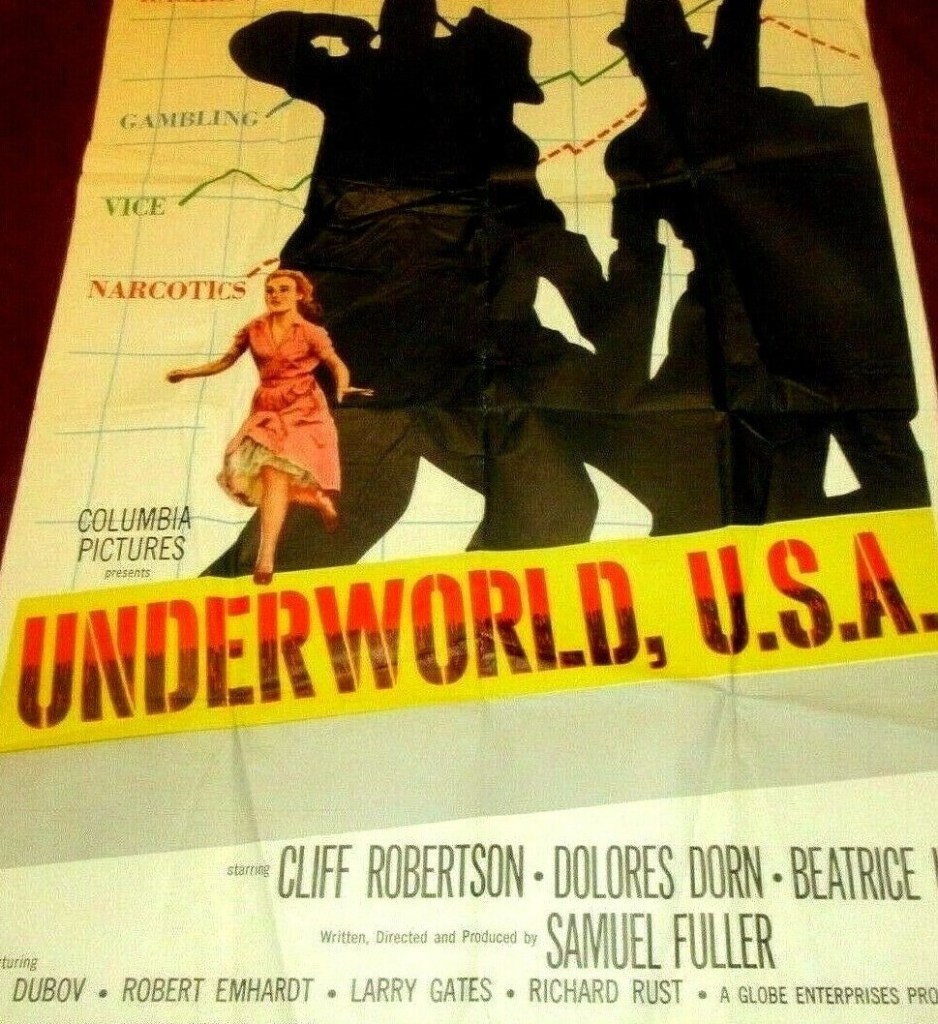
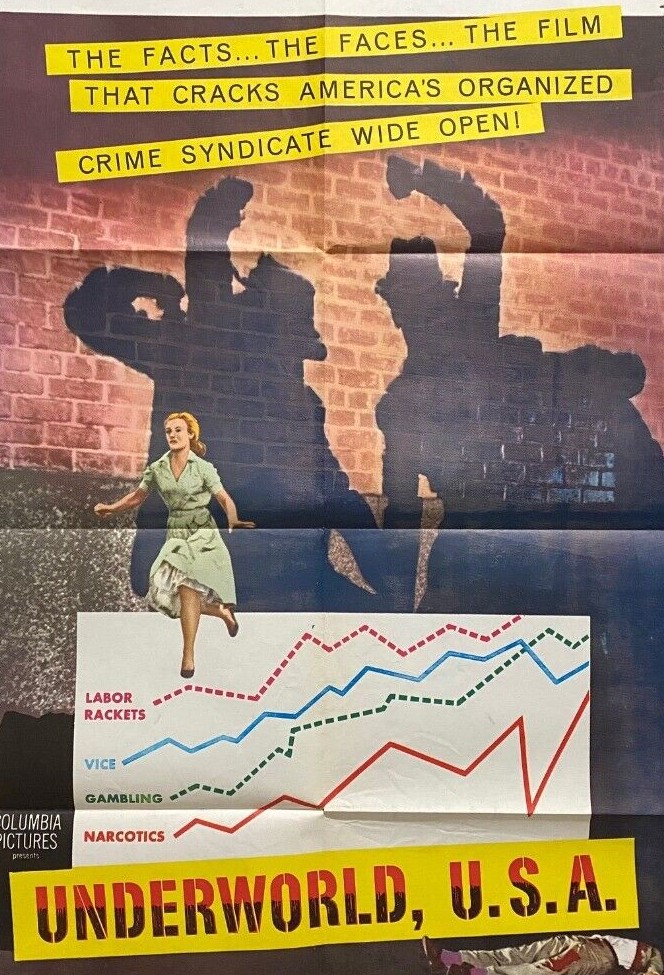
Underworld U.S.A. (1961) ***

Could be a companion piece for The Oscar (1966). Dumb punks with scarcely a redeemable feature. Treat women like garbage. Obsessed by an unachievable aim. In this case it’s revenge for the death of a no-good hoodlum father that provides an expose of the Mob. Sam Fuller opts for a documentary approach, rather than delving into the soap opera of The Oscar, and at times info dumps threaten to run away with the picture. While raw enough, lacks the emotional kick of The Naked Kiss (1964).

When habitual jailbird Tolly (Cliff Robertson) comes across one of his father’s murderers in gaol he tricks him into revealing the names of the three others – Gela (Paul Dubov), Gunther (Gerald Milton) and Smith (Allan Gruener) – who are now high-ranking gangsters. Having gained entrée to the hoodlum kingdom, he becomes an unlikely ally of top cop Driscoll (Larry Gates), devising a clever plan to suggest to Mob boss Connors (Robert Emhardt) that his lieutenants are so untrustworthy they should be rubbed out.

Along the way he enjoys a dalliance with a Mob runner Cuddles (Dolores Dorn) who draws the lines at handling drugs, and ruthlessly pulls her into his scheme. Motherless Tolly’s mother figure Sandy (Beatrice Kay) does her best to put him off his skulduggery.

When he’s not robbing or working on his scheme, he’s either seething or dashing Cuddles’s dreams of living together, not as his moll, put up in an apartment, but as an honest couple. He’s not remotely interested in doing the right thing or imagining himself as a public-spirited hero and would rather be executioner than laboriously bringing his targets in to face justice.

But the cops are equally ruthless, fully aware of the dangers facing informants, but so intent of catching the gangsters they do little to minimize the peril. Characters pop up in bit parts to make points about police corruption and when Fuller lurches away from Tolly to deliver lectures about the extent of the Mob’s tentacles it loses focus.

See what I was saying about stats. When did they ever sell a picture?

But all the statistics and operational details count for a lot less than venal assassin Gus (Richard Rust) cold-bloodedly running over a young girl to deliver a warning to others and Connors intending to turn schoolkids into drug addicts.

You can see why Fuller fell back on stats because there was hardly anything new to say about gangsters after a three-year crime biopic spree kicked off by Machine Gun Kelly (1958). Every major crime figure had been given the treatment – Al Capone (1959), Ma Barker’s Killer Brood (1960), Murder Inc. (1960), Pretty Boy Floyd (1960), The Rise and Fall of Legs Diamond (1960), King of the Roaring 20s: The Story of Arnold RothsteinMad Dog Coll (1961) and Dutch Schulz in Portrait of a Mobster (1961).

There wasn’t much new about Tolly except he believed his killings were sanctioned by a complicit police force and his own ideas about justice.

That said, Cliff Robertson (The Devil’s Brigade), before his twisted grin got the better of him, and he resorted to scene-stealing, is excellent as a driven dumb thug who lets anything worthwhile, namely the courageous Cuddles, slip through his figures. And Robert Emhardt has a ball running his empire from the poolside. But mostly, it’s tough guys talking tough, sometimes with the aid of a cigar.

You can’t not have seen most of this before. Sure, Fuller is a bit more stylish. The death of the father, all shadow, might be a homage to film noir. But, like all gangster films with the exception of Bonnie and Clyde (1967) and The Godfather (1972) and the Scorsese movies, it loses audience empathy because Fuller is unable to make likeable his unlikeable characters.

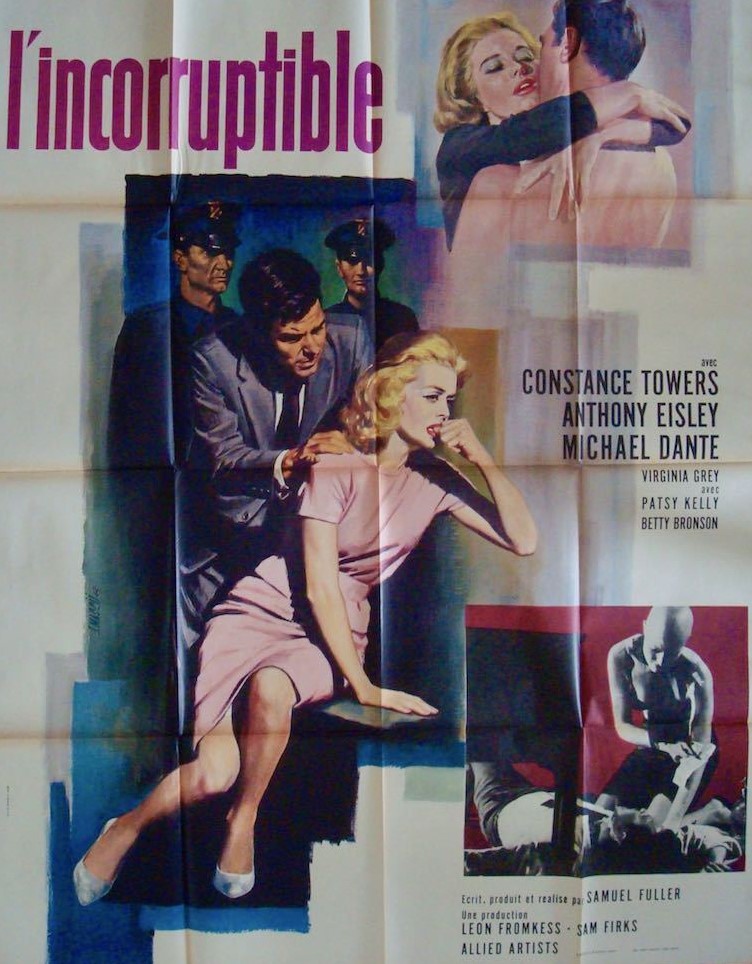
The Naked Kiss (1964) ****

Certainly doesn’t start off as your standard entry to the criminal-trying-to-go-straight mini-genre when a bald woman beats up and robs her pimp.  Kelly (Constance Towers), who knows “your body is your only passport,” nonetheless sets out to create a new life for herself as a salesperson (hawking overpriced champagne) in a small town where prostitution is outlawed.

She could easily settle for being the mistress of corrupt cop Griff (Anthony Eisley), but he’s something of a pimp, sending girls-off-the-bus across the river to the joint run by Candy (Virginia Grey). Instead, she takes up nursing, in an institute for crippled children, providing tough love to the kids. In due course, she hooks up the town’s handsome philanthropic millionaire Grant (Michael Dante), a relationship which Griff threatens to wreck.

However, she fesses up to Grant, now her fiancé in double-quick time, about her past and, remarkably, he forgives her. And you think, my goodness, she’s going to get away with it, new life, new career, a job she loves in which she is adored by the kids. You could be tootling along Sentimental Boulevard: Kelly forms the kids into a choir, she coaxes slightly mad  landlady Josephine (Berry Bronson) back to reality, determines to make her own wedding dress rather than be beholden to the millionaire, and takes under her wing nurses Buff (Marie Devereux) and Dusty (Karen Conrad) who have fallen victim to life’s traps.

You could be in Movie of the Week territory, another hooker with a heart of gold, except while she’s been turning her life around, there’s the inherent tension that she must fail. But this being a Sam Fuller (Shock Corridor, 1963) picture, Kelly is one tough cookie, outsmarting for a start Griff, who sees her as another in his assembly line of sex workers, and beating up Candy for daring to seduce Buff away from nursing by the promise of big money. Kelly ain’t sentimental. She views herself as a “broken down piece of machinery” with a future beckoning of “nothing but the buck, the bed and the bottle.” This is partly a shrew observation of herself but also of the production line nature or prostitution.

So there’s a catch. And it’s just plain awful. Grant is a paedophile. He has chosen Kelly because, as a sex worker, she is a deviant who will “understand my sickness.” And she’s sickened that despite her best efforts, that’s how she’s viewed, as a woman who would condone such behavior, and that he somehow believes she is complicit, in encouraging young girls from the hospital to visit him.   So she kills him.

And then reality strikes with a vengeance. She finds herself embroiled in the worst kind of small town corruption. Griff, who’s gunning for her anyway, refuses to believe her accusation against Grant, his best pal. Candy, who’s also gunning for her, says Kelly planned to blackmail Grant. There’s money missing, so she’s branded a thief as well. And nobody can find the little girl Grant had lined up.

An absolutely terrific film, constantly switching gear, twist after twist, but incredibly humane. There’s probably never been a better portrayal of the working girl, here all shown as vulnerable rather than predatory, as victims caught in a man-made web, and although dealt with in subtle fashion many clearly suffering from mental illness.

Kelly is cultured, reads Byron and Goethe, embraces the classical music education a relationship with Grant promises, but is unusually self-analytical. When she looks in a mirror she’s not seeking physical flaws but shortcomings of character. She understands all too well how men play women. Her tragedy is that when she sets aside her inbuilt cynicism, the man she trusts turns out to be as untrustworthy as they come.

Constance Towers (Shock Corridor) carries the picture, revealing several shades of personality, from hard-bitten woman to tender nurse, from avenger to pragmatic problem-solver. Michael Dante (Harlow, 1965) pulls off the difficult role of being persuasively a good guy gone bad. Veteran Virginia Grey (Jungle Jim, 1948) is all veneer.

But it is Sam Fuller’s movie. He was a triple hyphenate, writer-producer-director, so his vision was never in doubt. The dialog is terrific – the explanation of the title alone is extremely creepy – often cutting to the bone, but the best sequences lack words at all, the black-and-white photography bringing an air of film noir, and for all the striking toughness of the heroine, several moving scenes.

It’s not shocking in Fuller’s normal manner. As I can testify, it suggests to the viewer it’s going one way, and the core terrible act creeps up upon the audience. But it is brilliantly directed, even with a B-picture cast. Pulp reinvented as art. You could possibly argue in its vision and subject matter this was the birthplace of the indie.

Discover WordPress

A daily selection of the best content published on WordPress, collected for you by humans who love to read.

The Atavist Magazine

by Brian Hannan

WordPress.com News

The latest news on WordPress.com and the WordPress community.