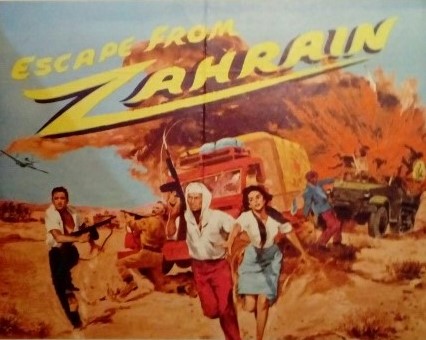
Escape from Zahrain (1962) ***

After being attacked by armored cars and strafed by airplanes, stranded in the desert, and overcome various tensions within the small group of escapees, there is still considerable life left in this picture at the end as Jack Warden, making his departure, comes up with a classic last line: “We must do this again sometime.”

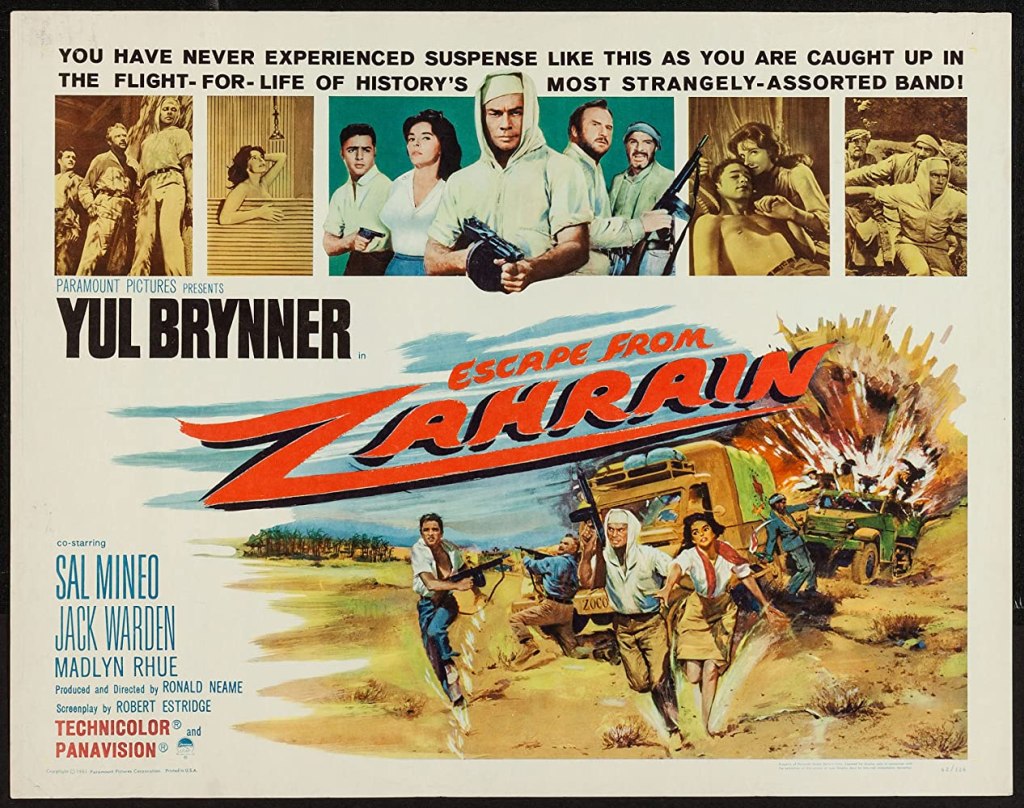
In truth, the picture has far more going for it than a mere outline would suggest. In rescuing rebel leader Sharif (Yul Brynner) from a lorry bound for jail, the escapees led by Ahmed (Sal Mineo (Exodus, 1960) in a stolen ambulance also scoop up three convicts including American fraudster and loudmouth Huston (Jack Warden) and all-purpose thug Tahar (Anthony Caruso) plus nurse Laila (Madhlyn Rhue) as a hostage. Like most stranded-in-the-desert films, the storyline is on who will survive and how.
Action is one constant. The threat of failure is another. Supplies are rationed and, of course, someone steals more than their fair share. The members regularly switch allegiance. At various points someone is about to give up Sharif. Their gas tank is punctured so, thanks to Huston’s engineering skills, they just make it to a remote pumping station where they encounter maintenance man (James Mason in an uncredited cameo). Their numbers diminish and despite his recalcitrance Huston’s engineering skills save them again when they reach an oasis.

What makes the film different is that the characters all change. In a country where “half the wealth is stolen by Europeans and half by corruption,” Sharif is the altruistic leader whose ideals are shattered. Laila,  a Muslim, drinks alcohol and questions the number of deaths necessary for a revolution but declines to leave when the opportunity arises. Ahmed who thinks “women should be as free as men” reacts badly when Laila enjoys such freedom. Huston, who has embezzled $200,000, and has loyalty to no one stands by the shambolic crew.

I had always believed Brynner had enjoyed a rare case of beginner’s luck when he won the Oscar for his debut in The King and I (1956) and that once Hollywood became wise to his acting schtick he would never be nominated again – as proved the case. But after watching Brynner in The Magnificent Seven (1960) and its sequel and Invitation to a Gunfighter (1964) and Flight to Ashiya (1964) I have become convinced he is under-rated as an actor. He acts with his eyes and his delivery is far more varied than I had supposed. Here, clothed in Arab costume, there is no bald pate to distract. 

Sal Mineo (Exodus, 1960) can’t compete in the acting stakes with the canny Jack Warden (Blindfold, 1966). Anthony Caruso (a television regular) is lost in the mix but Madhlyn Rhue (A Majority of One, 1961) certainly looked a good prospect.

British director Ronald Neame (Tunes of Glory, 1960) holds the enterprise together, keeping to a tidy pace but allowing tension and character to emerge. Screenplay was courtesy of Robin Estridge (Eye of the Devil, 1966) based on the Michael Barrat novel and with an injection somewhere along the line by Dudley Nichols (Heller in Pink Tights, 1960).

Tight script, taut direction.

https://amzn.to/3Td6m1d

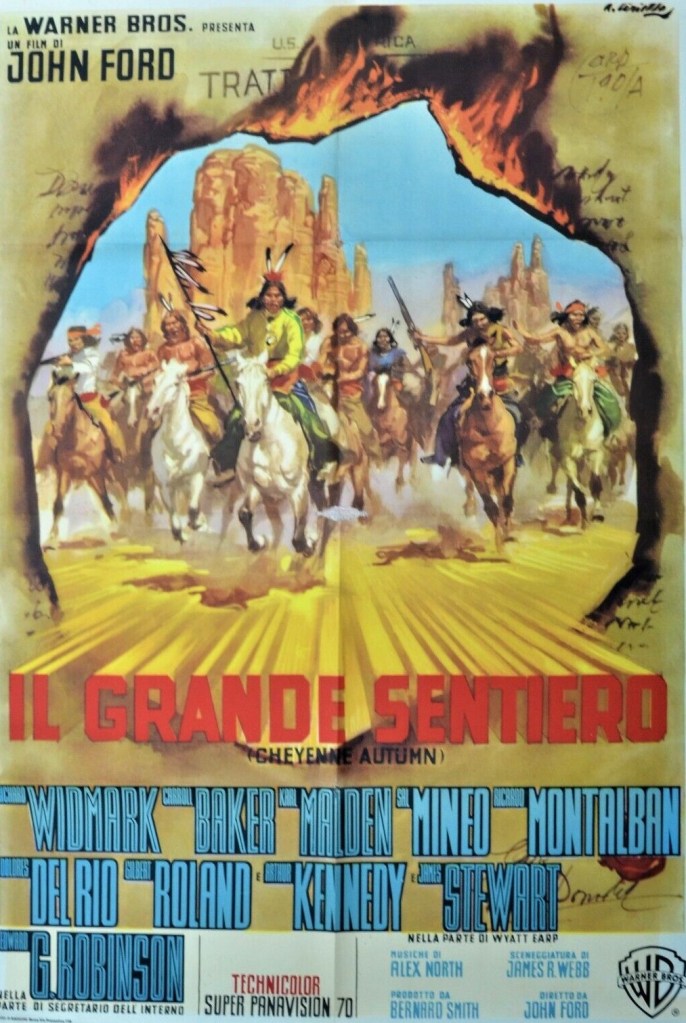
Cheyenne Autumn (1964) ***

Lack of narrative energy and focus sabotages well-meaning atonement epic. John Ford’s final western, made half a decade before Dee Brown’s seminal Bury My Heart at Wounded Knee was published, is not the epitaph he might have envisioned. For a start, it’s just not rigorous enough. You might accept there’s no mention of the word “genocide” since until Vietnam the United States was hardly capable of mea culpa.    

But that we learn very little about the Native Americans trekking 1500 miles from their Oklahoma reservation to their Wyoming homeland beyond that it’s an exhausting trek. Although the Native Americans are treated in a positive manner, and the U.S. Cavalry and Government are seen as inefficient and corrupt, little has been invested in the Native American characters.

The crux of their story is that the two brothers – Dull Knife (Gilbert Roland) and Little Wolf (Ricardo Montalban) leading the journey – eventually go their separate ways, and that a younger headstrong Native American steals one of the brother’s wives. Instead, more attention is paid to a young do-gooding Quaker teacher Deborah Wright (Carroll Baker) who opts to join them on their quest in order to look after the children attending her classes.

Caustic Captain Archer (Richard Widmark), either in person or through voice-over, is the most notable character, fighting his superiors to allow the wanderers unrestricted passage and eventually winning over Secretary of the Interior Carl Schurz (Edward G. Robinson) to ease the last stages of their journey.

The plot diverges from the Exodus-style mission for a totally irrelevant sequence set in Dodge City featuring a gambling Wyatt Earp (James Stewart) and Doc Holliday (Arthur Kennedy) and a spurious bunch of townspeople getting over-excited at the prospect of being attacked. More to the point, when Little Wolf splits from Dull Knife and heads for the sanctuary of Fort Robinson in Nebraska they are imprisoned by authoritative Captain Wessels (Karl Malden), gunning for promotion and in an echo of German apology for the Holocaust “only obeying orders,” with savage consequence.

The couple of action sequences show the fighting skills and tactical ability of the Native Americans but this is undermined by also showing them as sly and cunning, hiding weaponry under campfires and in baby’s clothing.

You might also be asking just how big is Monument Valley for it seems to be the location for about half the picture.  Sure, it’s a terrific backdrop and possibly never been better utilized but it’s an example of the creative lethargy not to follow in more authentic manner the actual route of the Cheyenne. Adding to that disgruntlement you might also note the omission of any Native Americans in the leading roles, those parts being taken by Mexicans or dark-skinned Americans.

While John Ford clearly had his heart in the right place, his fans weren’t ready for this kind of revisionist approach – the movie, a 70mm roadshow, was a big flop at the box office – and the result just doesn’t do the subject justice. And in fact a corrective correlative to How the West Was Won (1962) perhaps entitled How the West Was Stolen has yet to be made.

For a long time Bury my Heart at Wounded Knee was considered the landmark historical work depicting the ruthless conquering of the Native Americans but the more recent The Earth Is Weeping by Peter Cozzens, which I read a couple of months back, offers a more authoritative look at the sorry saga, but, without, I hasten to add, a mention of the scary word “genocide.”

I wouldn’t normally be in favor of editing the work of a director as legendary as John Ford but the omission of the Dodge City sequence would have considerably shortened the movie and retained the focus and perhaps improved the picture.

As it stands, a valiant effort. None of the stars is provided with sufficient narrative to make their acting stand out and it feels like they have all stumbled into a documentary.

Escape from Zahrain (1962) ***

After being attacked by armored cars and strafed by airplanes, stranded in the desert, and overcome various tensions within the small group of escapees, there is still considerable life left in this picture at the end as Jack Warden, making his departure, comes up with a classic last line: “We must do this again sometime.”

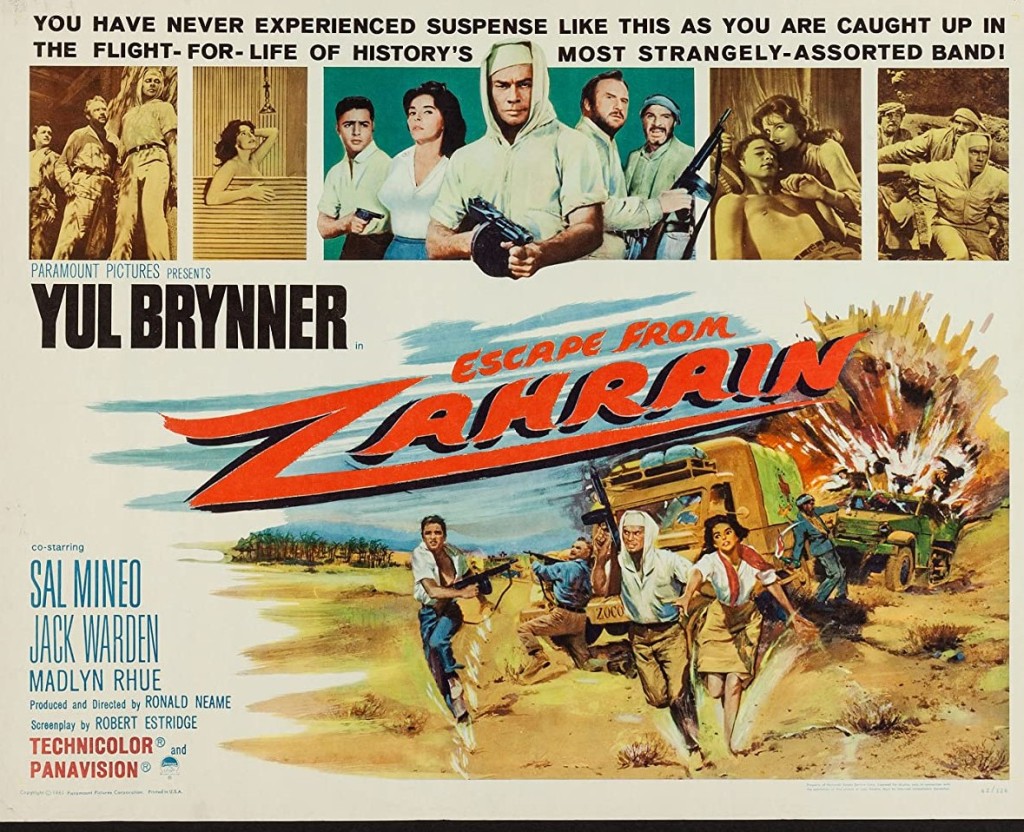
In truth, the picture has far more going for it than a mere outline would suggest. In rescuing rebel leader Yul Brynner from a lorry bound for jail, the escapees led by Sal Mineo (Exodus, 1960) in a stolen ambulance also scoop up three convicts including American fraudster and loudmouth Jack Warden (That Kind of Woman, 1959) and all-purpose thug Anthony Caruso (a television regular) plus a nurse Madhlyn Rhue (A Majority of One, 1961) as a hostage. Like most desert films, the storyline is on who will survive and how.

Action is one constant. The threat of failure is another. Supplies are rationed and, of course, someone steals more than their fair share. The members regularly switch allegiance. At various points someone is about to give up Yul Brynner. Their gas tank is punctured so, thanks to Warden’s engineering skills, they just make it to a remote pumping station where James Mason pops up in a cameo as a maintenance man. Their numbers diminish and despite his recalcitrance Warden’s engineering skills save them again when they reach an oasis.

This was originally intended as a starring vehicle for Clark Gable with Edward Dmytryk in the director’s chair.

What makes the film different is that the characters all change. In a country where “half the wealth is stolen by Europeans and half by corruption,” Brynner is the altruistic leader whose ideals are shattered. Rhue, a Muslim, drinks alcohol and questions the number of deaths necessary for a revolution but declines to leave when the opportunity arises. Mineo who thinks “women should be as free as men” reacts badly when Rhue enjoys such freedom. Warden, who has embezzled $200,000, and has loyalty to no one stands by the shambolic crew.

I had always believed Brynner had enjoyed a rare case of beginner’s luck when he won the Oscar for his debut in The King and I (1956) and that once Hollywood became wise to his acting schtick he would never be nominated again – as proved the case. But after watching Brynner in The Magnificent Seven (1960) and its sequel and Invitation to a Gunfighter (1964) and Flight to Ashiya (1964) I have become convinced he is under-rated as an actor. He acts with his eyes and his delivery is far more varied than I had supposed. Here, clothed in Arab costume, there is no bald pate to distract.  

British director Ronald Neame (Tunes of Glory, 1960) holds the enterprise together, keeping to a tidy pace but allowing tension and character to emerge.

Many of the films from the 1960s are to be found free of charge on TCM and Sony Movies and the British Talking Pictures as well as mainstream television channels. Films tend to be licensed to any of the above for a specific period of time so you might find access has disappeared. But if this film is not available through these routes, then here is the link to the DVD and/or streaming service.

Discover WordPress

A daily selection of the best content published on WordPress, collected for you by humans who love to read.

The Atavist Magazine

by Brian Hannan

WordPress.com News

The latest news on WordPress.com and the WordPress community.