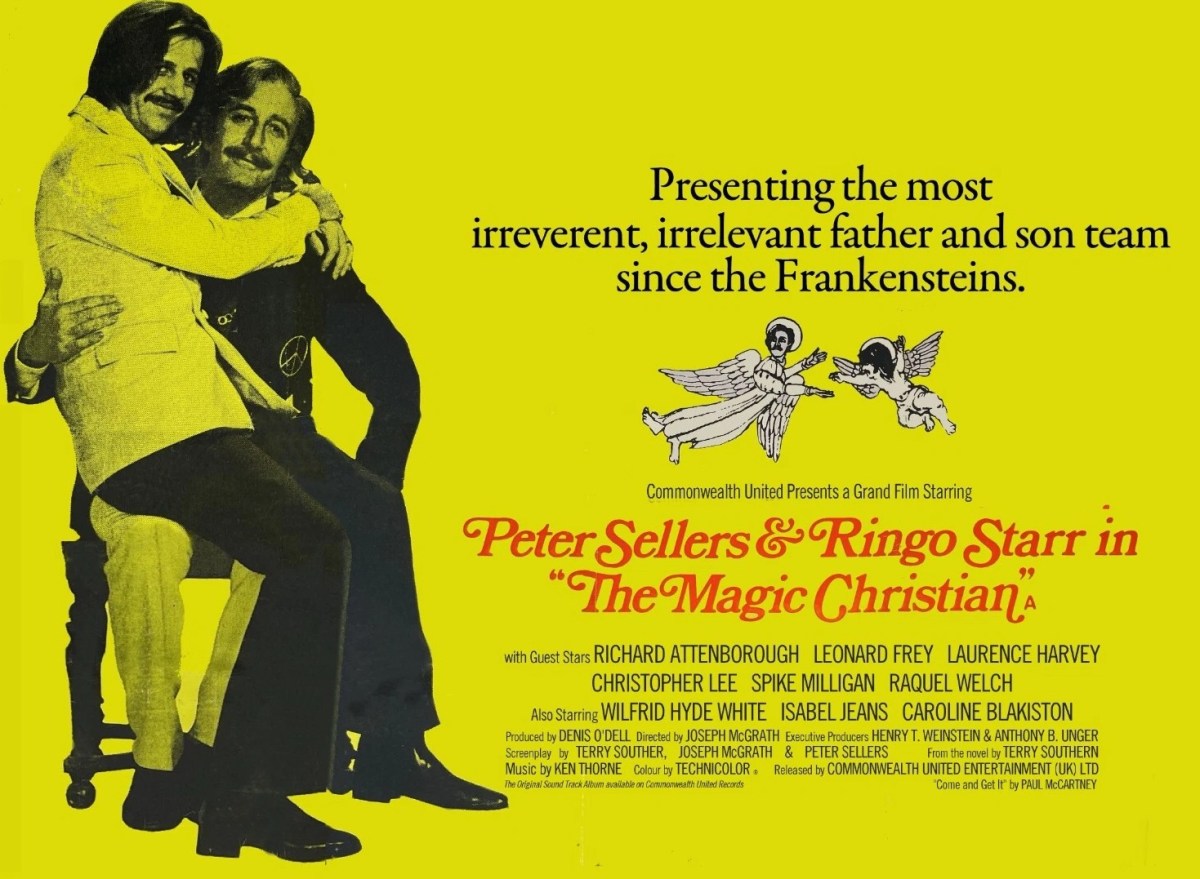
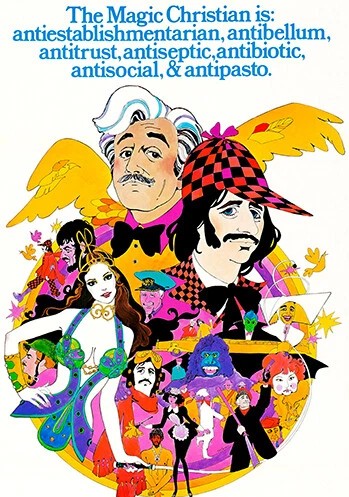
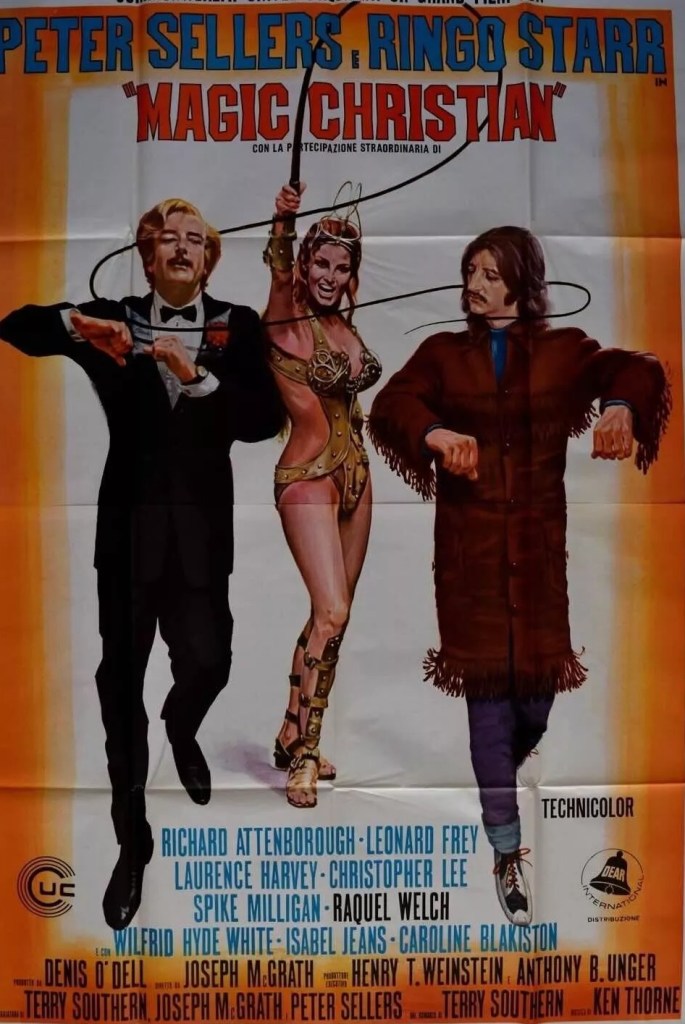
Substitute contemporary artwork/installation/performance art for practical joke and this will come up trumps. Taken in the artistic sense, where artists are pillorying society, there are gems – a stage Hamlet performing a striptease, feeding scraps of money to the ducks, ship passengers experiencing an apparent voyage when the vessel hasn’t left land, cutting up a famous work of art. Although I have to point out this will inevitably be remembered by some for a bikini-ed Raquel Welch cracking the whip over a galley of topless oarswomen.
Effectively a series of comedy skits loosely tied together under the theme of money, mostly in the form of bribery. Billionaire Sir Guy Grand (Peter Sellers) sets out to teach adopted son Youngman (Ringo Starr) just what money can buy. Could you pay one of the teams sufficient dough in the annual Boat Race for them to ram the other? Would a parking warden (Spike Milligan) eat the parking ticket he has just issued? In the spirit of fair play is it okay to down a pheasant with an anti-aircraft gun?
When the going slows down, surrealism enters the equation: ship’s captain kidnapped by a gorilla, vampire waitperson, black head on white body, urine-soaked banknotes given away to a crowd, the occasional nun or Nazi, newspapers where apologies are written in Polish.
Plot-wise, there’s not much to it and the satire is merely repetitive as Sir Guy embarks on educating Youngman on the perverse uses of money. It has the feeling not of following a storyline but of “what can we get up to next” and attempting to layer shock upon shock in the manner, it has to be said, of some contemporary directors.
But there’s neither sufficient bite to the satire nor punch to the shock so it remains an elaborate series of disconnected sequences. Luckily, nobody’s having to pretend to put in an acting shift which is just as well because Ringo Starr proves he can’t act.
And it’s not much helped by a host of cameos – Laurence Harvey (A Dandy in Aspic, 1968), Richard Attenborough (Guns at Batasi, 1964), Christopher Lee (Dracula, Prince of Darkness, 1965), Raquel Welch (Bandolero!, 1968), director Roman Polanski (Rosemary’s Baby, 1968), Wilfred Hyde-White (P.J. / New Face in Hell, 1967), comic Spike Milligan and various members of the future Monty Python team including John Cleese (A Fish Called Wanda, 1988) and Graham Chapman. Harvey and Welch make the biggest splash.
Excepting Dr Strangelove, Hollywood had failed to capture the essence of offbeat novelist Terry Southern (Candy, 1968) and despite input from Chapman, Cleese and Sellers, this never really gets off the ground.
Peter Sellers (The Pink Panther, 1963) was in something of a career rut where very little struck home at the box office and he would continue a dismal losing streak until resuscitating The Pink Panther franchise in 1975.
Director Joseph McGrath’s (The Bliss of Mrs Blossom, 1967) record was spotty. Best known for music videos for The Beatles, he was only well served when his cast was filled with strong actors.
No more than an occasionally humorous trifle with an equally occasional target hitting the bullseye.
Rather than write about the best films I have seen this year, I thought I would look at the four best books about films that I have read over the last twelve months. However, I’m beginning with an older book. I was so taken with Kirsten Stewart’s portrayal of actress Jean Seberg in the biopic Seberg (2019) that I sought out Garry McGee’s Jean Seberg – Breathless, Her True Story first published in 2007 and reprinted in 2018 in time for the movie.
The film concentrates on Seberg’s mental disintegration as she discovers she is on J. Edgar Hoover’s hit list. But the biography has a far wider remit.
This is a startling and ultimately a very sad book of the star as an American tragedy who shot to the heights in her first film and spent the rest of her life with a couple of exceptions falling earthwards. She took her own life, aged 40, in 1979. She was seen as both calculating and a victim, a woman of great strength and immense vulnerability, who used her popularity to espouse unpopular causes.
Her career followed no pattern anyone could understand, least of all Hollywood. Thrust into the limelight as a teenager when hand-picked as Saint Joan (1957) by director Otto Preminger – an experience that scarred her physically and mentally – she quickly shifted to France where she was enshrined in Jean-Luc Godard’s New Wave masterpiece Breathless (1960), but remained in France too long appearing in less prestigious productions. She was a vivid Lilith (1964) in Robert Rossen’s dissection of mental illness, but disappeared off the Hollywood map again until reappearing at the end of the decade in roadshow musical Paint Your Wagon (1969) – in which she stole the show from Lee Marvin and Clint Eastwood. After blockbuster Airport (1970) and western Macho Callahan (1970) she departed Hollywood for good, her final films being made in Europe.
Why her career was so apparently topsy-turvy is explored in this excellent biography, the final departure from America propelled by the discovery that she was under investigation by the FBI.
Chinatown (1973) is one of the greatest noir thrillers ever made but with its director Roman Polanski now persona non grata in Hollywood, it remains to be seen whether the film will retain its high status. Sam Wasson’s The Big Goodbye, Chinatown and the Last Years of Hollywood leaves any discussion of the director’s sexual mores until the last chapters when the shock of the allegations against him threaten to overwhelm the entire book. That said, up till then, it is a riveting book, not just the convoluted process of making this particular movie, but especially fascinating when discussing the screenplay, the working methods of writer Robert Towne, and the tangled dealings with agents.
After The Godfather (1972), Paramount was on a high and studio boss and wunderkind Robert Evans was apparently untouchable – the studio had given him his own production company – but his wife Ali McGraw had run off with Steve McQueen and he was at war with studio president Frank Yablans. Jack Nicholson, however, was approaching a box office peak. Polanski was hot and if his touch was anywhere as good as Rosemary’s Baby (1968) it would be a slam dunk. But as the movie approached its premiere, it was looking more like a stinker. Preview audiences hated it. The original score was dumped, Jerry Goldsmith brought in to make the music more evocative of the period.
The author takes a wider view than the normal “making of” book and his portrayal of Hollywood at a time of massive change and the corrosive and often self-destructive nature of many of the personalities involved gives the subject material greater bite. A film of this book is being greenlit with Ben Affleck’s involvement.
According to Stephen Rebello, Valley of the Dolls (1968) is in a class of its own. It was top of the class in Bad Movies We Love, the book he co-wrote with Edward Margulies. Rebello has now accorded to his “making of” one of the longest book titles in history – Dolls! Dolls! Dolls!, Deep Inside Valley of the Dolls, The Most Beloved Bad Book and Movie of All Time. Rebello, of course, is famous for his opus on Psycho. Valley of the Dolls was based on the bitchy bestseller by Jacqueline Susann and the movie itself fell into a similar category. Director Mark Robson had been twice Oscar-nominated, once for his adaptation of Peyton Place, a novel occupying the same trashy ground as Valley of the Dolls. Although Natalie Wood, Lee Remick, Bette Davis and Kim Novak were at various times in the running, the book was such a huge bestseller that Twentieth Century Fox thought it would get away with a less-than-stellar cast. The best known of the stars Judy Garland was fired over her alcoholism. Rebello has an irreverent style, but a forensic eye for detail and has produced a highly-readable book of a film now termed a camp classic.
If Valley of the Dolls was in a class of its own, then so too was Ryan’s Daughter (1970), filmed on location in Ireland. In the David Lean canon, none of his pictures have been so maligned. While not approaching the sensational box office of Doctor Zhivago (1965) it was still a massive audience favorite. In Glasgow, where I lived, it ran as a 70mm roadshow presentation at the first-run ABC2 for an entire year. But it was mauled by the critics who felt it was clearly within their rights to dole out to Lean a public humiliation after inviting him to a meeting of the National Society of Film Critics where Pauline Kael and Richard Schickel in particular tore his film to shreds.
Quite why the book has taken so long to be published is another mystery given the author says he did the bulk of the research in 1999-2003. Maybe the publishers were counting on a 50th anniversary revival. Certainly, he has no shortage of material from the drunken and pot-smoking shenanigans of star Robert Mitchum to the miscasting of Christopher Jones and the director’s own haphazard personal life. MGM, which was going through a financial tsunami, backed the director to the hilt even as the budget continued to soar -it ran 135 days over schedule. Because of the overages Jones took home more than this £200,000 contracted salary and John Mills nearly double his original $200,000. Lean’s legendary perfection endangered the lives of the crew and actors during the storm sequence while the sex scene between Jones and Sarah Miles caused particular problems. The author alleges that Jones’ food was spiked. For some reason the author has dubbed this “one of the great movie follies” and while I would not agree with that estimation it remains an interesting read.


 The Magnificent 60s