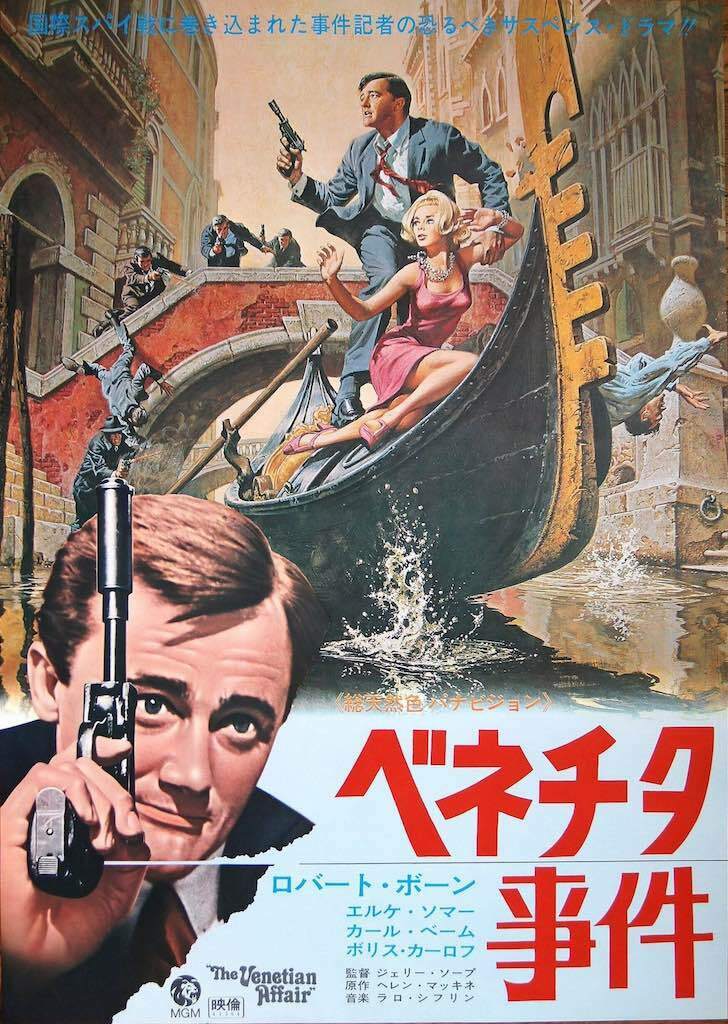
Robert Vaughn gives a terrific performance as a numbed alcoholic ex-C.I.A. journalist Bill Fenner drafted into Venice to investigate a plot involving ex-wife and Communist defector Sandra Fane (Elke Sommer). He’s the spy who lost it rather than a flashy contemporary of James Bond. This occasionally very stylish number kicks off with a terrific credit sequence that concludes with a suicide bomber blowing up a nuclear disarmament conference. Unshaven and with a Columbo cast-off overcoat, Fenner discovers Fane was key to the bombing, the bomber an otherwise distinguished diplomat with no known proclivities in the area of mass murder.
Although sold as an action picture, nobody is ripping through the canals as in a Bond film, and it is altogether a more somber, reflective, intelligent movie. Fenner’s feelings for his ex-wife are palpable when, in her apartment, he tenderly touches her clothes and smells her perfume. Far from being party to the plot, it appears Sandra has had a change of heart and wants to defect back, leaving Fenner in a perilous dilemma. Does he believe her or is she just using him? It is beginning to sound like a modern-day film noir, except he is already being used by the C.I.A., his presence in Venice a device to draw Sandra out, C.I.A chief Rosenfeld (Edward Asner) every bit as ruthless as the villains.
His investigations lead him to Dr Pierre Vaugiraud (Boris Karloff) and power broker Robert Wahl (Karl Boehm) who has a mind-altering drug that can make a man terrified of a mouse, send him into a trance and on his way to deliver savage retribution. There is death aplenty, fisticuffs and chases and Sandra, in hiding disguised as a nun, is worth waiting for.
Based on the bestseller by Scottish novelist Helen MacInnes, who challenged Alistair MacLean in her day, the project was at one point to be directed by Guy Hamilton. Coincidentally, David McCallum, Vaughn’s co-star in The Man from U.N.C.L.E. television series, was in Venice at the same time shooting Three Bites of the Apple.
Television stalwart Jerry Thorpe making his debut contributes some interesting moments. Interpreters listening in to the conference hear the magnified ticking of the bomb moments before explosion. The sequence on a train is well done and the activity surrounding the mouse is first class. Vaughn is superb in a downbeat role – shaking off his Napoleon Solo television persona- never sure if he is being duped, on the rack from falling back in love, and emerging from an alcoholic haze with a few decent ruses up his sleeve.
There’s a solid cast, Asner menacing even as a good guy, Karl Boehm a charismatic villain, Karloff memorable in his last performance in a non-horror picture, and interesting appearances by Felicia Farr as a C.I.A agent masquerading as the murderous diplomat’s unsuspecting mistress and Luciana Paluzzi as the girlfriend of an agent. Lalo Schifrin produces an outstanding score.
It was a flop first time round because audiences, partly duped by the title (all Uncle episodes incorporated the word “Affair” although the book, in fairness, was written long before the television series was envisioned) expected to pay to see Napoleon Solo, or something quite like him, on the big screen, with all the pizzazz and gimmickry of the small-screen show. Unfairly under-rated, this is a really satisfying thriller set against a murky Cold War background with Vaughn, trapped between love and redemption, the only character with a streak of morality.
One of the joys of writing this blog has been the opportunity to reassess stars that I’ve had a tendency to under-rate. You’ll maybe forgive me for putting Doris Day in that category especially as I’ve had ample reasons now to take a different, Please Don’t Eat the Daisies (1960) just one of the many instances where the actress has confounded my expectations.
Until I started on the Blog I’d never gone out of my way to watch a Doris Day picture with the exception of musical Calamity Jane (1953) when it became a camp classic as well as Hitchcock’s The Man Who Knew Too Much (1956) and films where she happened to be co-starring with Cary Grant.
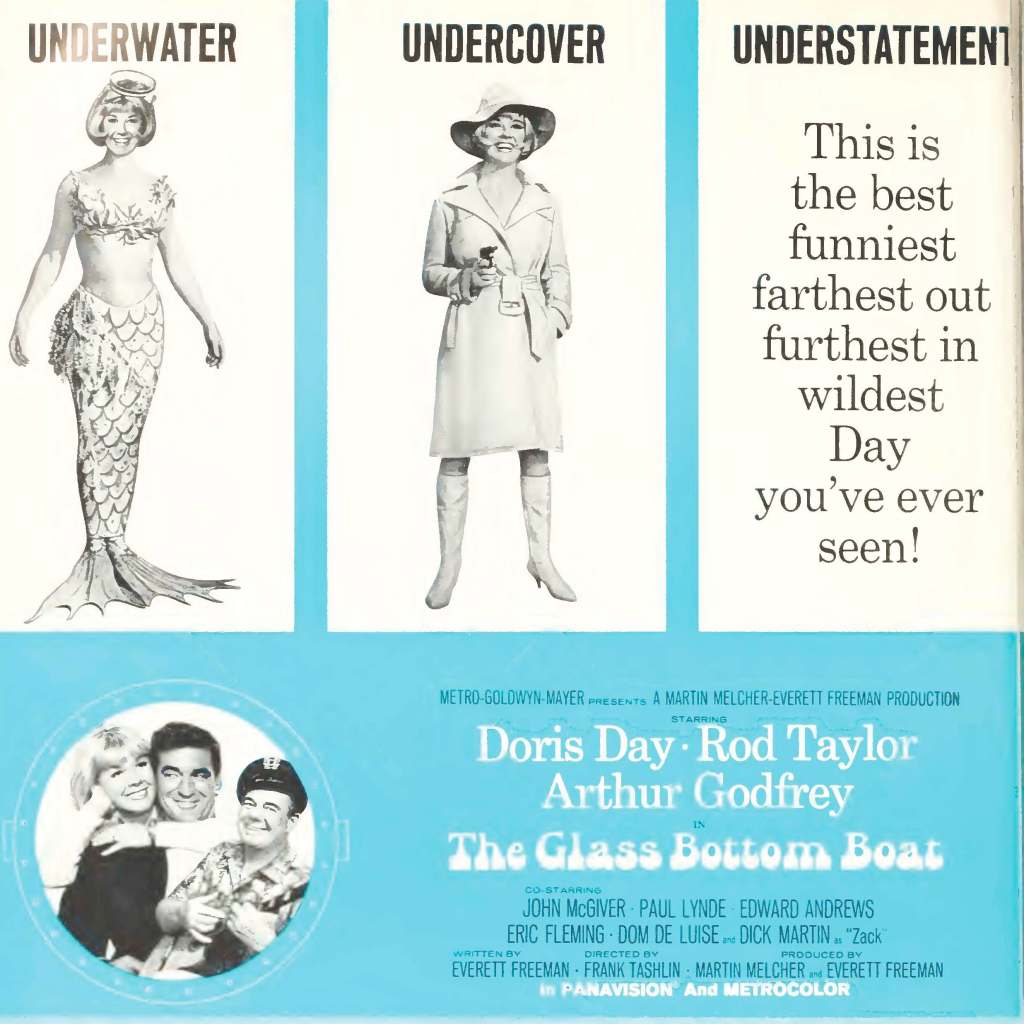
So I came to The Glass Bottom Boat with low expectations, especially as this was towards the end of her two-decades career and her co-star was Rod Taylor, a different level of star to Grant and Rock Hudson. By now, she had dropped the musical and dramatic string to her bow and concentrated on churning out romantic comedies and also been supplanted by Julie Andrews as Hollywood’s favorite cute star.
But it was in part on the evidence here that I changed my tune regarding Day. This is entertaining enough. And she sings – the theme song, one other and a riff on one of her most famous tunes “Que Sera Sera.” Unless there’s a symbolism I’ve missed, the title is misleading since the boat only appears in the opening section to perform the obligatory meet-cute with Taylor as a fishermen hooking Day’s mermaid costume.
The plot is on the preposterous side. The occasionally hapless Jennifer (Doris Day) is suspected as a spy after infiltrating Bruce Templeton’s (Rod Taylor) aerospace research operation. It’s partly a James Bond spoof – when her dog is called Vladimir you can see where the movie is headed – with all sorts of crazy gadgets. But mostly the plot serves to illustrate Day’s substantial gifts as a comedienne. For an actress at the top of her game, she is never worried about looking foolish.
And that’s part of her appeal. She may look sophisticated even when, as here, playing an ordinary public relations girl, but turns clumsy and uncoordinated at the first scent of comedic opportunity. There’s some decent slapstick and pratfalls and some pretty good visual gags especially the one involving a soda water siphon. A chase scene is particularly inventive and there’s a runaway boat that pays dividends. But there are a couple of effective dramatic moments too, emotional beats, when the romance untangles.
She’s in safe hands, director Frank Tashlin responsible for Son of Paleface (1952) and The Girl Can’t Help It (1956). I also felt Rod Taylor (Dark of the Sun, 1968) was both under-rated and under-used, never given much to do onscreen except stick out a chiseled jaw and turn on the charm. Although he had been Day’s sparring partner in her previous picture Do Not Disturb (1965) he’s not in the Cary Grant-Rock Hudson league.
It’s also worth remembering that the actress had her own production company, Arwin, which put together over a dozen of her pictures, including this one, so she would be playing to her strengths rather than those of her co-star. On the bonus side, watch out for a blink-and-you-miss-it cameo by Robert Vaughn (The Man from Uncle), and a featured role by Dom DeLuise as a bumbling spy.
Everett Freeman (The Maltese Bippy, 1969) wrote the screeplay.
I’ve never gone out of my way to watch a Doris Day picture with the exception of musical Calamity Jane (1953) when it became a camp classic as well as Hitchcock’s The Man Who Knew Too Much (1956) and films where she happened to be co-starring with Cary Grant.
So I came to The Glass Bottom Boat with low expectations, especially as this was towards the end of her two-decade career and her co-star was Rod Taylor, a different level of star to Grant and Rock Hudson. By now, she had dropped the musical and dramatic string to her bow and concentrated on churning out romantic comedies and also been supplanted by Julie Andrews as Hollywood’s favourite cute star.
But on the evidence here I can certainly see her attraction. This is entertaining enough. And she sings – the theme song, one other and a riff on one of her most famous tunes “Que Sera Sera.” Unless there’s a symbolism I’ve missed, the title is misleading since the boat only appears in the opening section to perform the obligatory meet-cute with Taylor as a fishermen hooking Day’s mermaid costume.
The plot is on the preposterous side, Day suspected as a spy infiltrating Taylor’s aerospace research operation. It’s partly a James Bond spoof – when her dog is called Vladimir you can see where the movie is headed – with all sorts of crazy gadgets. But mostly the plot serves to illustrate Day’s substantial gifts as a comedienne. For an actress at the top of her game, she is never worried about looking foolish.
And that’s part of her appeal. She may look sophisticated even when, as here, playing an ordinary public relations girl, but turns clumsy and uncoordinated at the first scent of comedic opportunity. There’s some decent slapstick and pratfalls and some pretty good visual gags especially one involving a soda water siphon. A chase scene is particularly inventive and there’s a runaway boat that pays dividends. But there are a couple of effective dramatic moments too, emotional beats, when the romance untangles.
She’s in safe hands, director Frank Tashlin responsible for Son of Paleface (1952) and The Girl Can’t Help It (1956). I also felt Rod Taylor was both under-rated and under-used, never given much to do onscreen except stick out a chiseled jaw and turn on the charm. Although he had been Day’s sparring partner in her previous picture Do Not Disturb (1965) he’s not in the Cary Grant-Rock Hudson league.
It’s also worth remembering that the actress had her own production company, Arwin, which put together over a dozen of her pictures, including this one, so she would be playing to her strengths rather than those of her co-star. On the bonus side, watch out for a blink-and-you-miss-it cameo by Robert Vaughn (The Man from Uncle), and a featured role by Dom DeLuise as a bumbling spy.
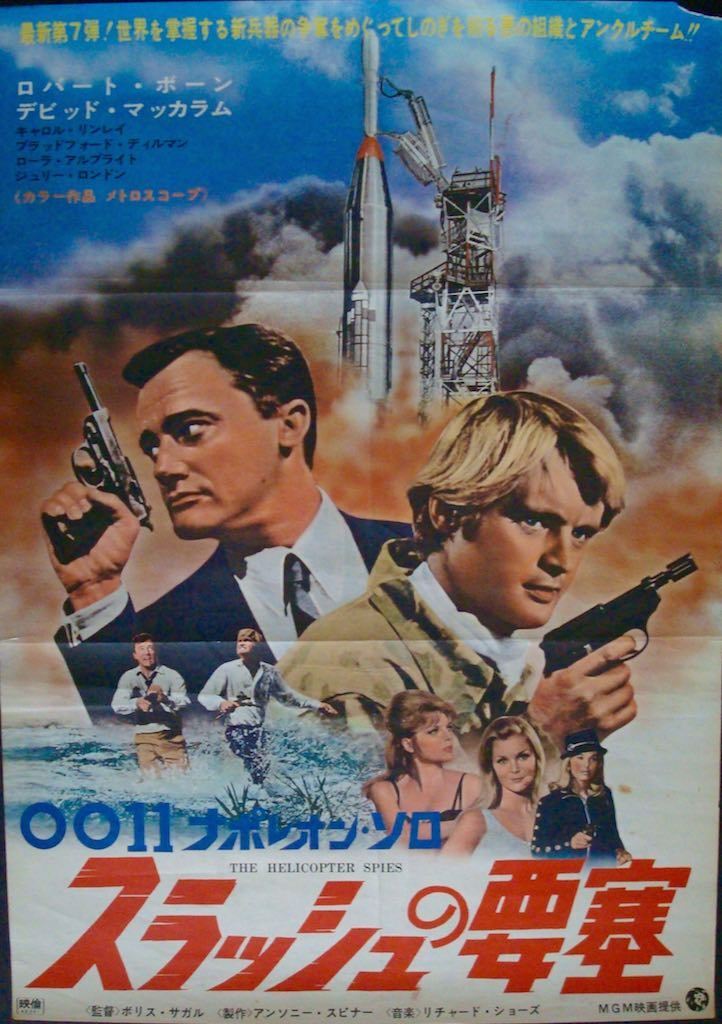
Takes a little while to come to the boil what with disreputable women, a crew of platinum-white-haired thugs, a religious cult, some very dry dialog, a high priestess with her own chorus line of psychedelic dancers, four identical brothers, and a female lead parading a prize shaggy dog story. Our intrepid heroes appear more capable this time round, the previously inept Napoleon Solo (Robert Vaughn) not beaten up quite so often, though he does end up being drowned in sand (water too precious to spare, apparently).
This time round, too, the good guys are taken for a ride by mad scientist Luther Sebastian (Bradford Dillman) who hoodwinks the U.N.C.L.E. organisation into stealing a “thermal prism” from the fortress of another mad scientist Dr Kharmusi (John Dehner). To put his own grand plan into operation Sebastian just has to hijack a rocket. And you should be aware going into this that there’s not the amount of helicoptering you might expect given the title.
This time round, too, there’s hardly a good gal in sight. Azalea (Lola Albright), aforementioned high priestess of cult The Third Way, has betrayed the good doctor in favor of Sebastian. Sebastian’s wife Laurie (Julie London) pretends to a) be out of contact with him for years and b) maintain a virtuous existence. And that’s before we come to the plainly bonkers, but still traitorous, Annie (Carol Lynley) who will make up any story in a bid to free an imprisoned unseen husband.
Sebastian has some neat touches as a leader, rewarding his team of thugs with booze and women as a prelude to killing them all off. He’s got an ejection seat in his car for getting rid of troublesome passengers. He prefers efficiency, to the point of iciness, to sexiness in his paramour and female underlings. And he has a very dry manner, which elicits a good few laughs.
But some of his thugs just ain’t that bright, the one instructed to follow Solo has just allowed him access to Laurie’s house. Laurie ain’t that bright, either, falling for an old trick by Solo who, as usual, is less bright that Ilya Kuryakin (David McCallum).
Some of the set pieces are excellent. Sebastian’s followers meet in an abandoned movie theater where Azalea gives the lowdown on the grand plan assisted by her bevy of dancers. Infiltrating the organisation by the simple device of dying his hair, Solo ‘s disguise is uncovered after being sprayed with champagne.
There are a surprising number of human touches. Head henchman Carl (Roy Jenson) vowing to take “Mom” away from her dingy life running her eponymous diner finds she enjoys too much her dingy life. Carl, appreciative of the disguised Solo’s efforts, apologises for making him ride in the baggage train. Annie can stretch innocence to breaking point, to an extent where nobody cares about her problems.
But where The Karate Killers had a straightforward storyline – find the five daughters of a dead scientist – this gets a tad lost in the first section introducing the thermal prism, the cult, doubling down on mad scientists, and giving Annie all the importance of a red herring.
I thought for a moment that this was the end of the line in my appreciation of the U.N.C.L.E. franchise, the one where it all fell flat on its face and we could see the joins, but after the shaky start it picked up and became quite enjoyable in the series’ inimitable barmy fashion. I suppose I should applaud the initial narrative boldness, audience pretty much fooled from the off, the fortress assault not much more than an extended MacGuffin, with neither Sebastian nor Azalea what they seemed.
I could quibble about the guest stars but in fact this is a superb deadpan performance from Bradford Dillman (Sanctuary, 1961) and quite a departure for the Carol Lynley of Bunny Lake Is Missing (1965). And you could say the same for Lola Albright, previously seen essaying a different kind of character in The Way West (1967).
Boris Sagal (The Omega Man, 1971) directed from a screenplay by Dean Hargrove (One Spy Too Many, 1966).
I’ve only got a couple to go to wrap up the entire series and for your sake I will persevere. If you’ve not already done so, it’s back to the box set.
What a hoot! A sheer blast! The most brilliant yet of the madman dominating the world schemes, autogyros to out-Bond Bond, a fabulous cast and of course the most incompetent spies this side of Get Smart.
You can’t get better than a scientist inventing a way of turning water into gold. Takes chutzpah to even think of that as a plot. No having to batter your way into Fort Knox as poor Bond did in Goldfinger (1964), you just turn on the tap. But, wait, the formula is lost and our intrepid heroes have to – heaven forbid! – track down five gorgeous women to find it. Was there ever a more onerous proposal?
I never saw any of these films when they came out. At the time I guess they would have been viewed as small screen rivals to James Bond. But although 007 in every picture would eventually be trapped in the madman’s lair, he spent most of the film beating the sh*t out of the bad guys. In sharp contrast, The Men from U.N.C.L.E. seem always to be on the wrong side of a beating, number one hero Napoleon Solo (Robert Vaughn) more hapless than number two Ilya Kuryakin (David McCallum).
With hindsight, it looks like this was never meant to be taken seriously and without going into over-spoof plays exceptionally well as a light-hearted romp. Solo seems to be constantly outwitted with Kuryakin invariably coming to the rescue, the former too often duped by beauty, the latter a bit more discerning. There’s a lovely moment here in their reactions to the instruction by boss Mr Waverley (Leo G. Carroll) to hunt down a dead scientist’s quintet of daughters/step-daughters; Solo gives a knowing smirk, Kuryakin shows disdain.
Must be the best cast yet assembled: legendary Joan Crawford, suddenly hot again after Whatever Happened to Baby Jane (1962) and Strait-Jacket (1965), Curd Jurgens (Psyche ’59, 1964), Herbert Lom (Villa Rides, 1968), Telly Savalas (The Dirty Dozen, 1967), Kim Darby (True Grit, 1969), Terry-Thomas (How To Murder Your Wife, 1965) and Jill Ireland (Mrs Charles Bronson) as you’ve never seen her before.
The U.N.C.L.E. duo are in a race against T.H.R.U.S.H. operative Randolph (Herbert Lom) to track down the missing formula. Randolph has a head start. He has been having an affair with the scientist’s wife Amanda (Joan Crawford) who is shocked to discover his charming exterior conceals a ruthless interior.
Solo and Kuryakin track down the scientist’s daughter Sandy (Kim Darby), a good bit brighter than your average eye-candy spy girl, who points the way to the step-daughters and to the possibility that each has one part of the missing formula. Was there ever an easier justification for introducing such a random set of characters?
First up is stark naked Countess (Diane McBain) locked away by jealous impoverished husband (Telly Savalas) in a castle in Rome. Then we’re onto Imogen (Jill Ireland), a flamboyant lass shaking her booty at any opportunity, arrested by a constable (Terry-Thomas) for indecent exposure, and involved in a punch-up in a London night-club where Solo is nearly drowned (yup!) and Randolph instructs the band to keep playing since the ruckus is nothing to do with them.
Then we’re off to Switzerland and Yvonne (Danielle De Metz) and a machine-gun ski chase down a mountainside (beat that, Mr Bond). And so on until all the clues, contained in photographs of the dead father, have been found and, wait for it, the puzzle remains incomplete. Eventually it’s unravelled and the final showdown is on.
But what a way to go. Never mind the ski chase, the picture opens with the duo being attacked by a fleet of autogyros (one-man mini helicopters, the “Little Nellie” of the later You Only Live Twice, 1967 ), and as usual someone, this time Kuryakin, is trapped on a low-tech machine, this time on a ice-block travelator where blocks of ice are smashed to bits by nasty spikes.
Randolph is the most droll villain alive. “Don’t be so melodramatic, my dear,” he informs Amanda when she uncovers his villainy and is about to be murdered. The whole jigsaw is exceptionally appealing, the global whizzing about, Japan also included not to mention one of the poles where T.H.R.U.S.H. has established its HQ.
The action is a good bit more thrilling, the aerial and ski sequences very well done on a budget a fraction of the Bonds, and there’s more than enough going on to keep interest levels high, not just where to go next, and who to encounter, but the gathering of the clues, and working out of the final mystery, which offers a nice emotional touch.
Kim Darby is more of a typical ingenue here, sparkier than you might expect but not offering the originality of character expressed in True Grit, while Jill Ireland is a good bit more sassy than she ever appeared thereafter. Barry Shear (Wild in the Streets, 1968) directed.
This is the best so far that I have seen on the series. My interest had begun to flag but, thus fortified, I will continue with my endeavors to watch them all. on your behalf, of course.
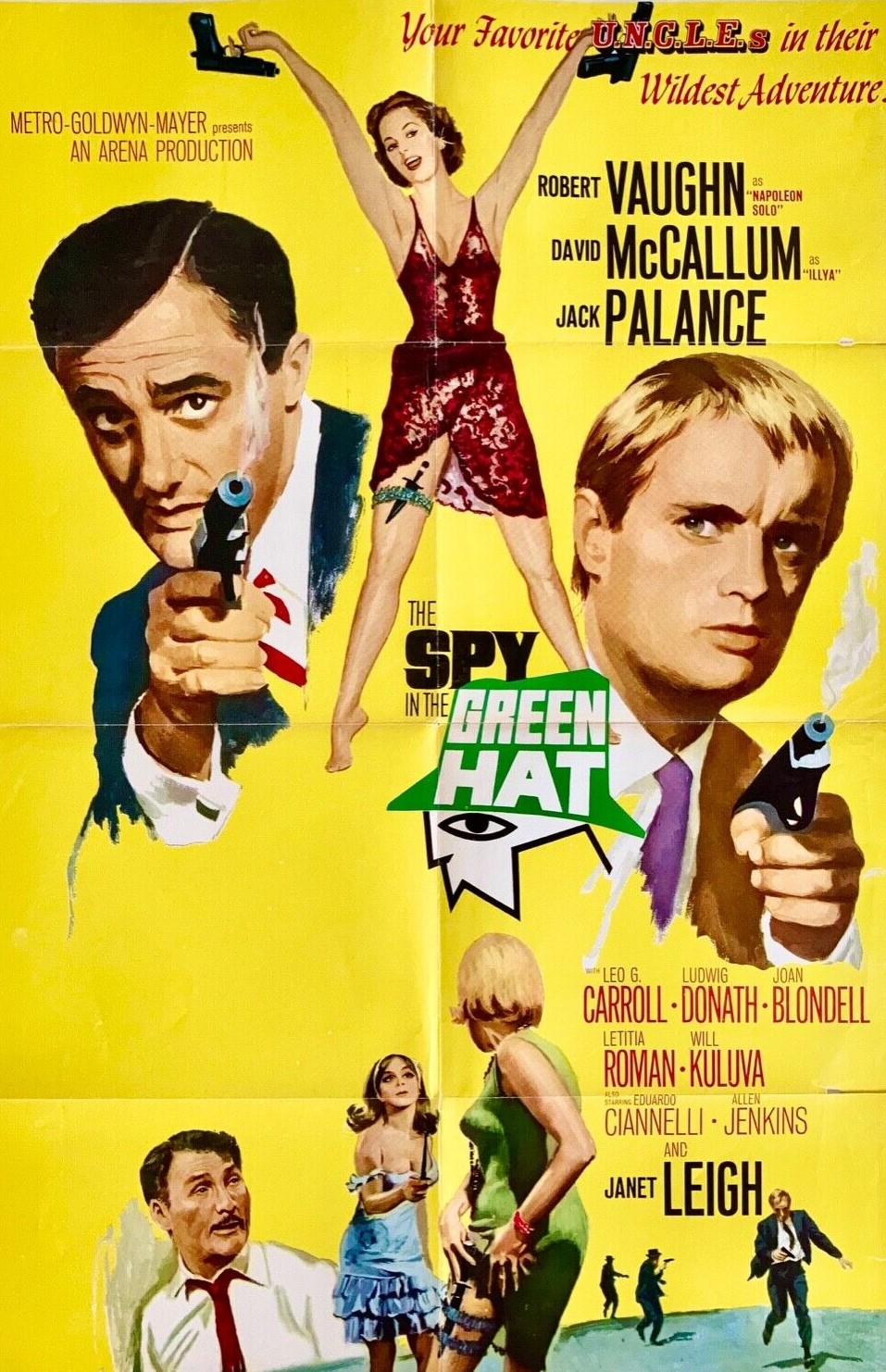
Unable to compete with the influx of big budget espionage pictures, The Man from U.N.C.L.E. throws in the action towel and comes out fighting as a comedy, and a more preposterous storyline you would be hard to find. As if spoofing a genre it helped create, our intrepid heroes find themselves in captivity one way or another, outwitted by a posse of retired Mafia hoods or sadistic females.
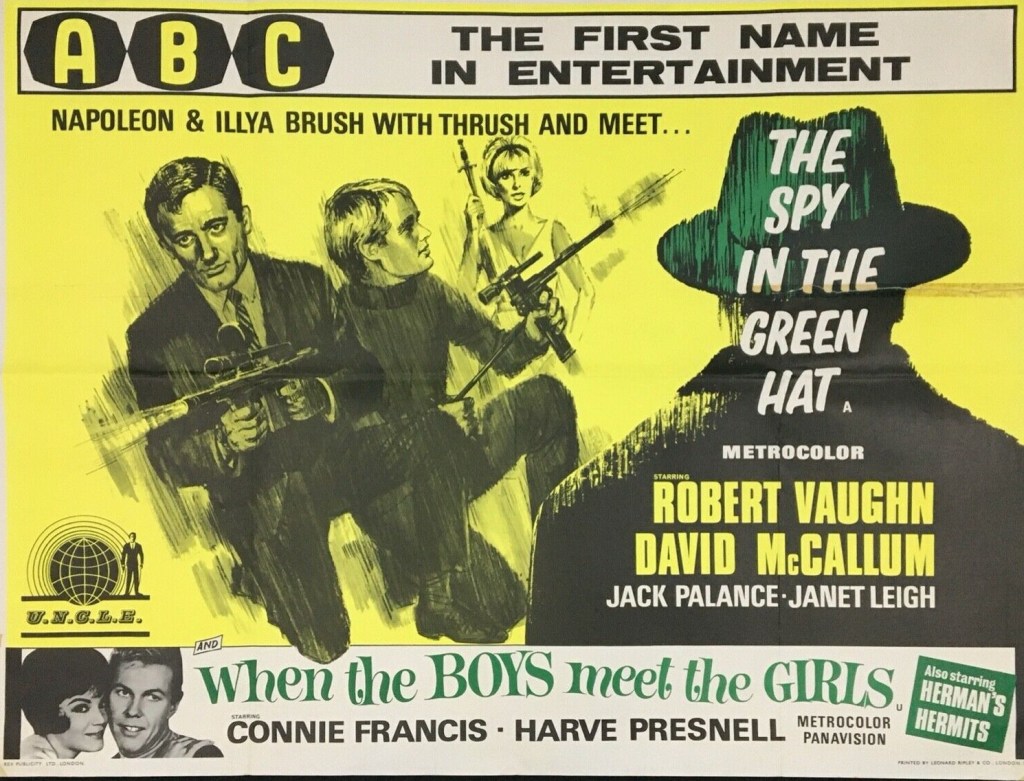
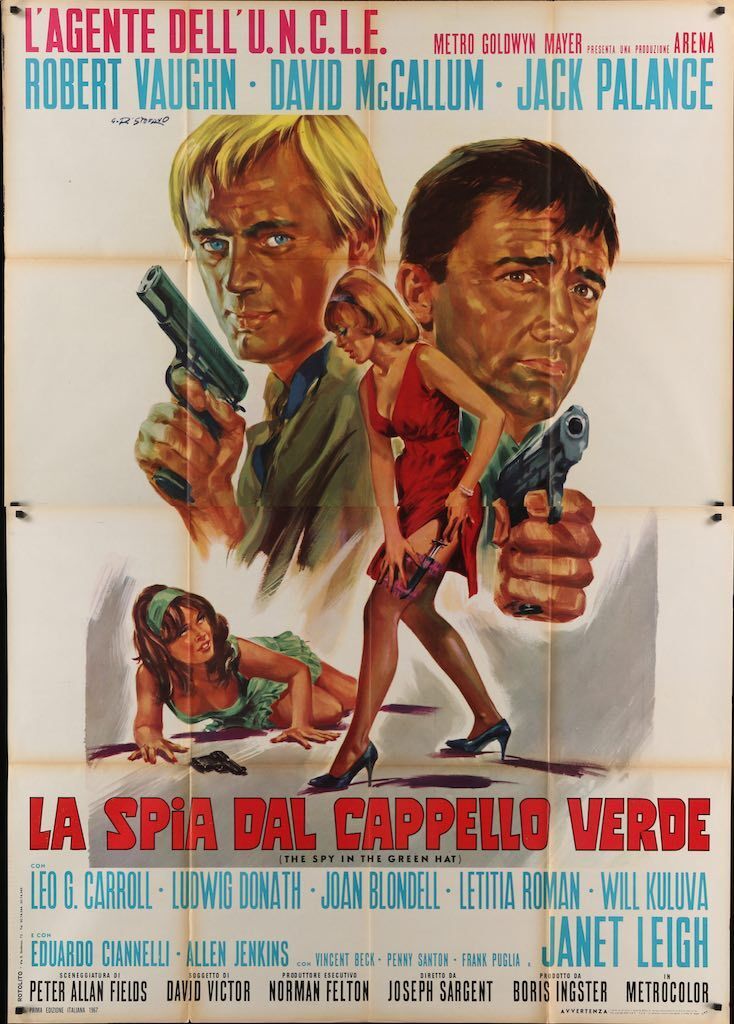
Napoleon Solo (Robert Vaughn) and Ilya Kuryakin (David McCallum) can’t even manage a chase, crashing the car in pursuit of former Nazi scientist Dr Von Kronen (Ludwig Donath). The trail leads to Sicily where Solo, again incapacitated, meets the sultry Pia (Leticia Roman) and as a result of a romantic misunderstanding is forced into a shotgun wedding in Chicago by her Mafia uncles, the famed Stilletto Brothers.
Meanwhile, Kuryakin makes the acquaintance of the deliciously sadistic Miss Diketon (Janet Leigh), assistant and masseuse to highly nervous Thrush boss Louis Strago (Jack Palance). The action finally shifts to the Gulf Stream, where Pia is imprisoned and the usual missiles are set to be launched in the presence of head Thrush honcho Mr Thaler (Will Kuluva) in the usual global takeover scenario.
Abandoning any attempt at serious drama, this is just a hoot, a score of sight and visual gags, references to Little Caesar and the St Valentine’s Day Massacre abound. Any time one of our heroes needs speedy access to a villain hideout along comes a guard to be bumped off and uniform purloined. Solo caught hiding under Pia’s bed is let off when discovered by a Thrush operative because he’s not the Uncle agent they are looking for. Not only is Solo constantly whacked over the head, but Kuryakin ends up as the plaything of Miss Diketon.
Solo and Kuryakin look as if they stepped onto someone else’s parade, trying to keep the narrative on an even keel, while the Mafia gang and Thrush personnel effectively play it for laughs. Pia has Wanted posters of her uncles on her wall on the assumption they are just wonderful guys. Von Kronen gets the hots for Miss Diketon because he admires her skill at torture, although a spurned Miss Diketon turns traitor leading Kuryakin to mutter to Solo when all three meet, “I brought Lucrezia Borgia, you brought the Mafia.”
What makes it work so well are the fabulous performances of the supporting cast. Jack Palance (The Professionals, 1966), completely playing against type, still a villain sure, is a masochistic sweaty bag of nerves. Janet Leigh (Psycho, 1960) camps it up as the deadlier-than-the-male luscious female, dress slit at the thigh to reveal a hidden knife, whose pulse races at the mere thought of the cruelty she can inflict and the slower the better. Will Kuluva (To Trap a Spy, 1964) is a bonus, the boss who just wants to party and has no idea of the technicalities of firing a missile.
Nobody even bothers to dress it up any more. The missiles look like something you would buy your kid for Xmas, the backdrops are as fake as anything on a backlot. But somehow it all works, as long as you weren’t expecting the original take on The Man from Uncle. And even so, director Joseph Sargent (One Spy Too Many, 1966) adds a few dabs of genuine cinematic icing, characters viewed from the ground-up, a fist fight that’s either in slo-mo or speeded-up freeze frame, the wife (Joan Blondell) of one of the Stiletto Brothers receiving a grapefruit in the mush.
After watching the original movie which came up better than expected in terms of action and spy malarkey, the last thing I anticipated that this would be headed in an entirely different direction. When that quickly became obvious, I feared the worst. Instead, I enjoyed a fun 90 minutes.
Of course, this wasn’t released theatrically in the U.S. just abroad with some added sex and violence, an expanded version, and in color, of a double black-and-white episode of the television series.
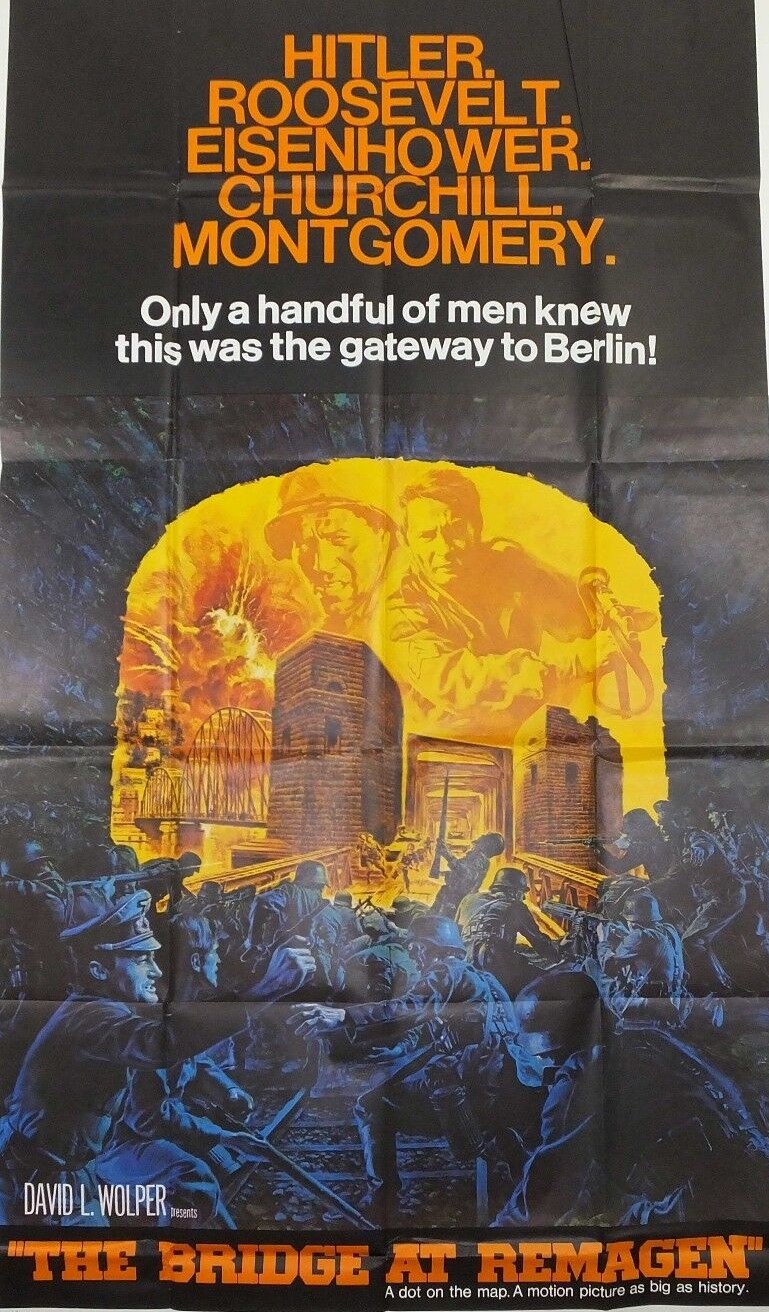
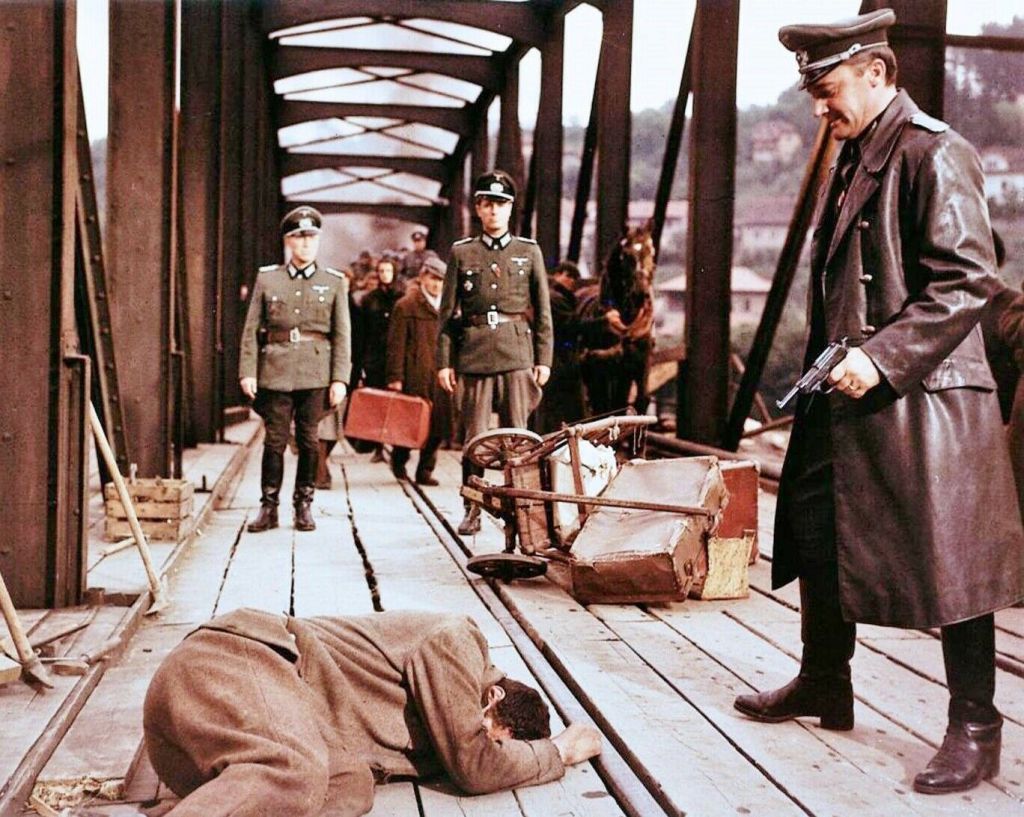
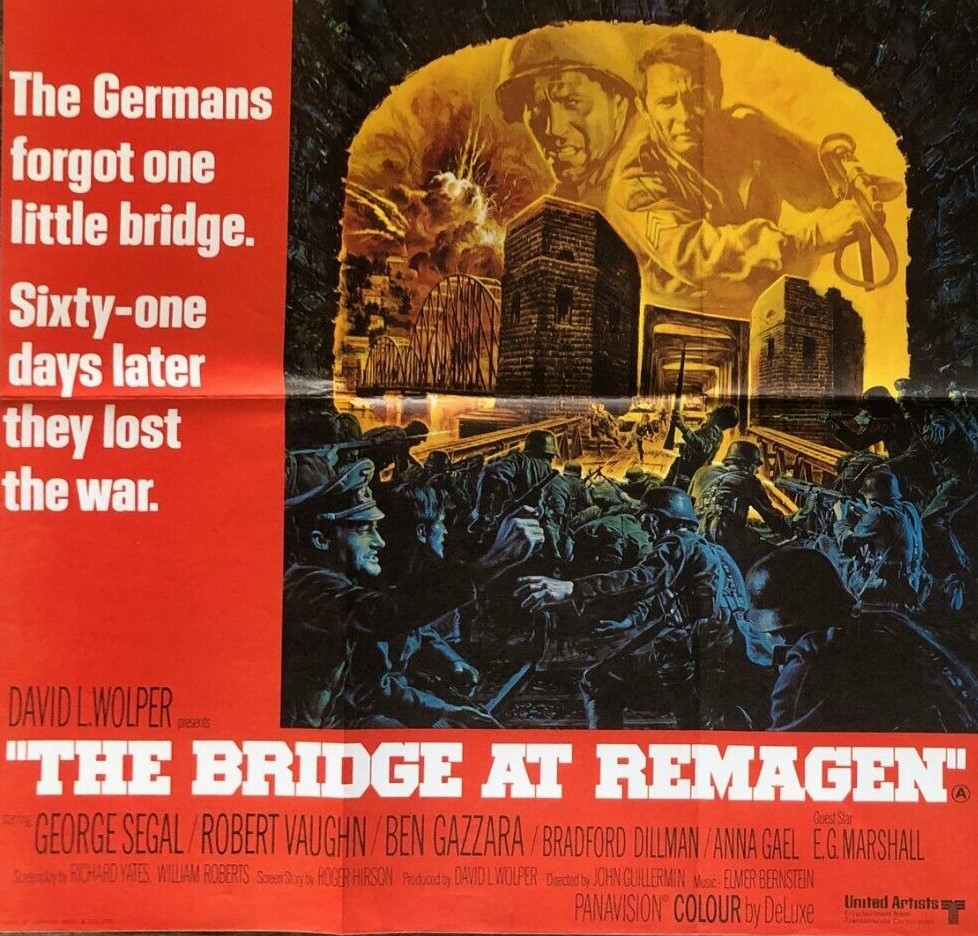
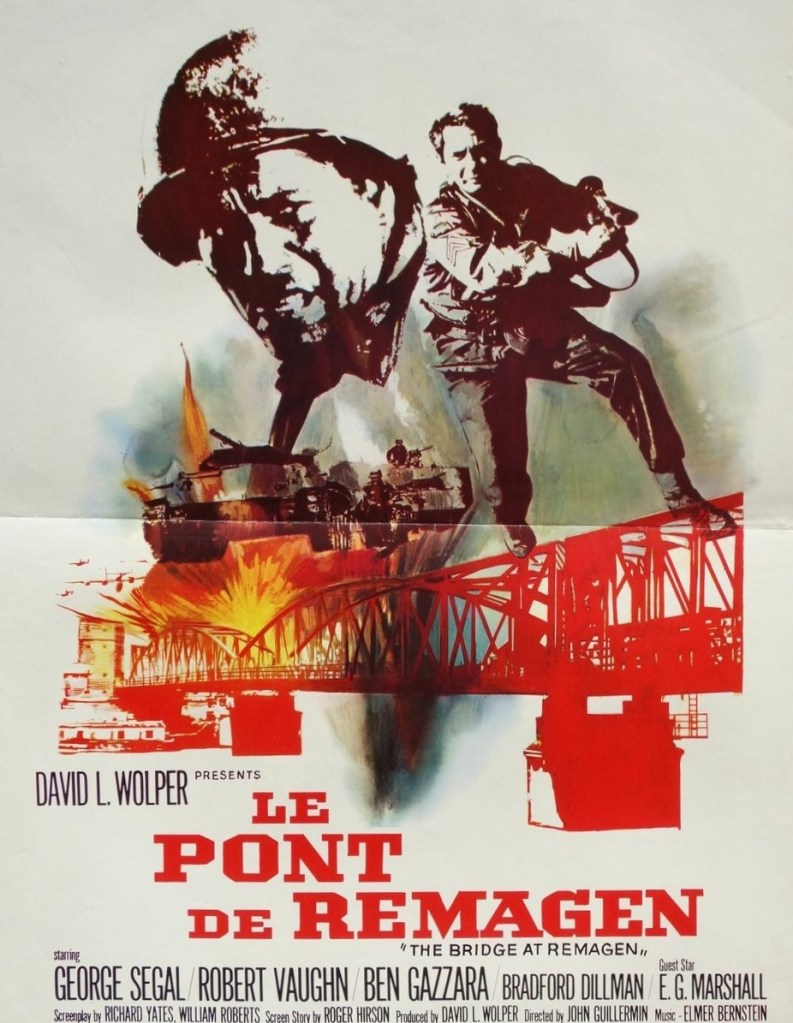
A million-and-a-half dollars potentially went down the drain when, thanks to the Russian invasion two months into production, producer David L. Wolper had to shift location shooting of World War Two picture The Bridge at Remagen from Czechoslovakia to Italy and Germany. Actors and crew woke up on August 21, 1968, to find their hotel surrounded by Russian tanks. Only quick action saw 80 personnel ferried in a taxi convoy through the only remaining open checkpoint to the airport, their departure coinciding with the arrival of the Russian paratroopers.
This had not been the first international incident for the movie, based on the destruction of the Ludendorff Bridge over the Rhine at Remagen in Germany. Previously, Wolper had been accused of being a C.I.A. spy and reports were circulating that armaments were being brought in to support Czech leader Dubcek while rumours flew of “busloads of American troops…arriving in Prague disguised as tourists and film technicians.” Matters were so bad that the Czech army placed under lock and key the film’s entire TNT and dynamite inventory amounting to over 6,000 sticks of the former and 800lb of the latter.
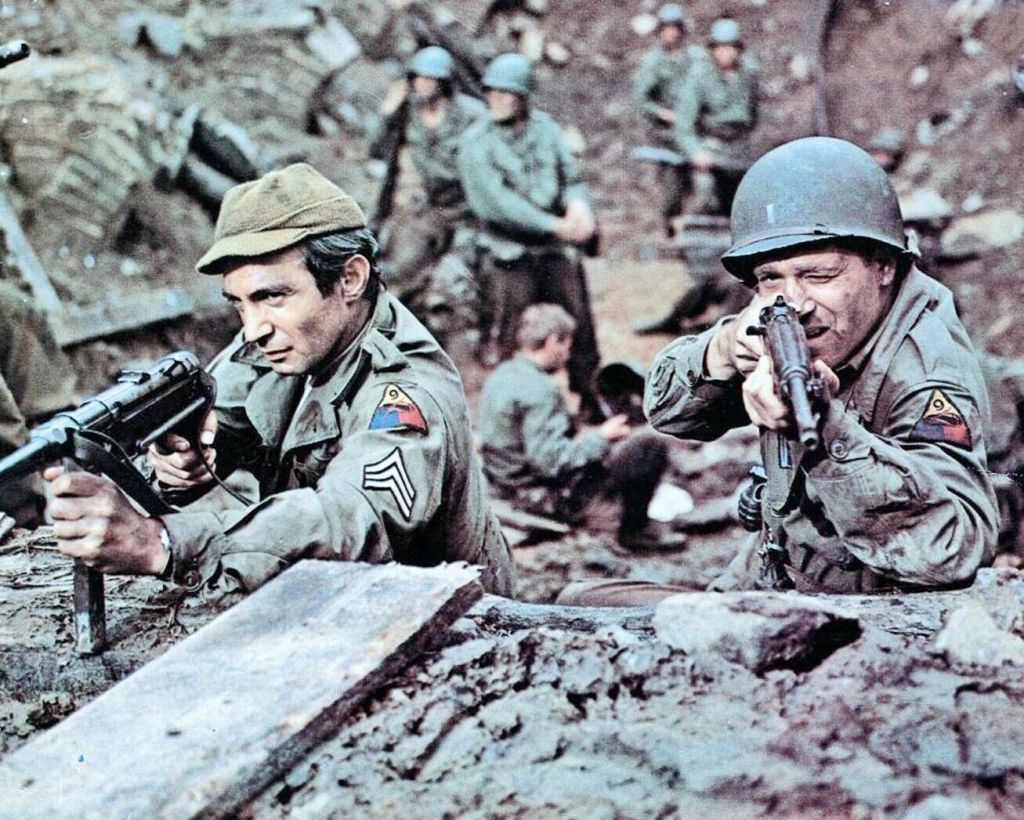
Ben Gazzara and George Segal open fire.
Small wonder the Russians were alarmed because the production had arrived with a massive cache of weaponry – an inventory over 1,000 pieces strong – including eight Sherman tanks and over 130 Browning and Thompson machine guns, MI rifles and carbines and Colt pistols as well as 300 dummy rifles. Luckily, most of the film’s battle scenes action had been completed when production was interrupted but that still meant a month of interiors and exteriors.
Wolper was something of a Johnny-come-lately to the Remagen scene. Budd Schulberg (On the Waterfront, 1954), who had fought at Remagen, and his brother Stuart were first into the frame, planning in 1958 to film for Warner Brothers Ken Hechler’s 1957 bestseller on the battle, as a follow-up to their first production, Wind Across the Everglades (1958). Stanley Kubrick was being lined up to direct. When WB bowed out the Schulberg Brothers moved it first to Columbia and then United Artists. When that gamble failed to come off, United Artists assigned Phil Karlson (The Secret Ways, 1961) as director but that also hit the buffers. Although Wolper started work developing a treatment in 1965 – Irvin Kershner in his mind as director – he had Ihe had to deal with another contender in Flaum and Grinberg Productions which in 1966 announced this as their debut production.
Wolper had come to movies on the back of documentaries. Using his Metromedia outfit as an umbrella, he had struck a six-picture deal with United Artists. The first movie had been the documentary Four Days in November (1964). But the next was intended to be a “plotted dramatic film based on fact with a big star cast” known at the time as The Remagen Bridge. From the outset this was seen as a “harsh recreation of actual slogging combat with some four letter words and not a glorification of war but underlining its hellishness.”
In the event, this was overtaken on the Wolper schedule by another war movie The Devil’s Brigade (1968). Further pictures planned were Europe U.S.A. (a.k.a. If It’s Tuesday It Must Be Belgium, 1968) and All the Conquerors (never made). Wolper had also in 1965 purchased the source material for The Green Beret, that proved to be a war movie too far and the project ended up with Warner Brothers and John Wayne.
After Roger Hirson delivered a story treatment for Wolper in 1965, the screenplay of The Bridge at Remagen went through the hands of Richard Yates, paid $25,000, the uncredited Ted Strauss (a Wolper executive with writing credits on documentaries) and Sam Watson who stiffened the treatment, with input from Wolper determined to “reinforce the image of Michaels (Segal) as one of the walking dead.”
While veteran William Roberts (The Magnificent Seven, 1960) finalized many of the film’s elements, Wolper also turned to Ray Rigby (Operation Crossbow, 1965) to “deepen the characters and create scenes with more punch” and Rod Serling (another $25,000). But Hirson could lay claim to setting up the movie’s dynamic. “This is the story of two men and a bridge,” he wrote. Initially, the American was called Earl Ammerman then Floyd Love before hitting on Michaels and finally Hartman, although that first name went from Curt to Vic to Phil. The German originally Hans Heller transitioned to Major Krueger, based on the real-life Hans Scheller.
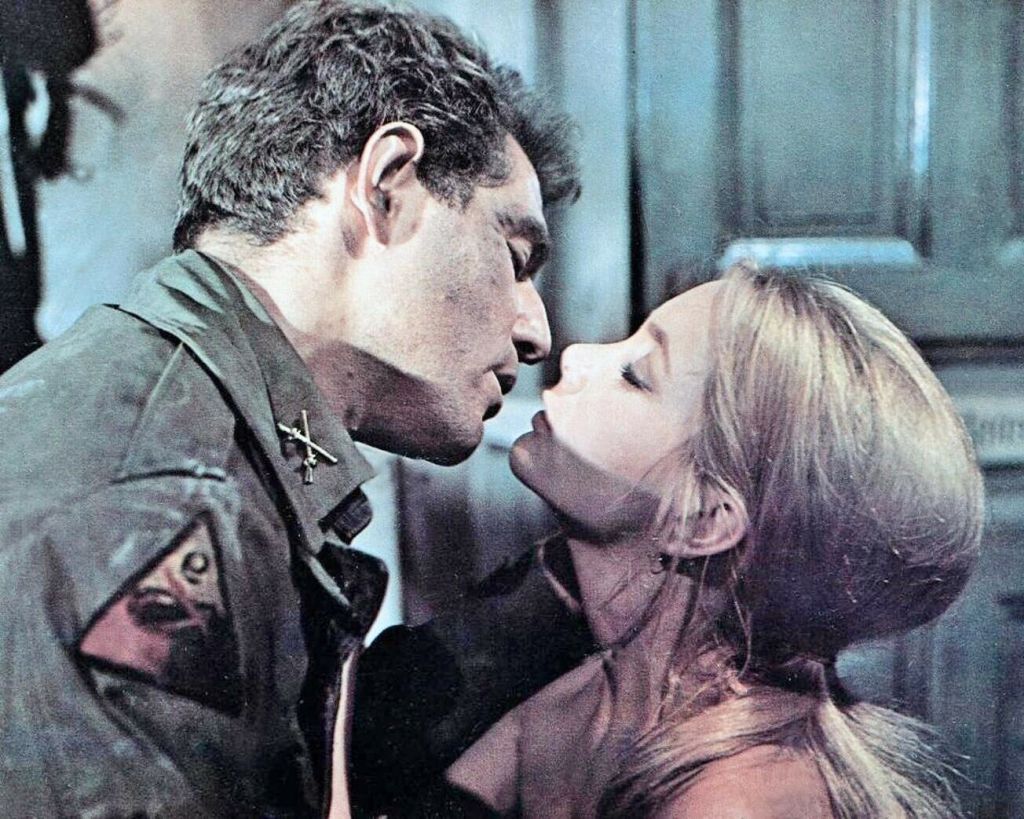
Early drafts contained references to German secret weapons, a chaplain, a group of Polish sex workers and a brief glimpse of the woman (Anna Gael) at the end. Anthony Hopkins, then unknown, and Robert Vaughn were considered for the role of Major Krueger. Vaughn could read German and had an Oscar nomination and was a leading television star. George Segal faced no competition for his starring role, having already been in uniform for King Rat (1965). But Alex Cord (Stagecoach, 1966) declined a supporting role and Robert Blake (Tell Them Willie Boy Was Here, 1969) was considered
Filming on the original Rhine bridge was no longer possible given it had fallen ten days after the battle. Depending on which report you read, finding a replacement took around three years or 18 months or maybe just six months and involved a global search. One usable bridge was found in Washington State but with bare hillsides rather than town and mountain. John Frankenheimer on The Fixer (1968) had set a precedent for filming behind the Iron Curtain by using Budapest in Hungary to represent Russia.
Robert Vaughn about to open fire.
Not far from Prague in what was then known as Czechoslovakia the production unit alighted on the Davle road bridge, and struck a deal in October 1967. It was almost a perfect match for Ludendorff once towers had been added at either end, the bridge itself raised by 14ft and been augmented for authenticity by wooden and steel girders. To complete the transformation an 80ft tunnel was blasted out of the surrounding mountains. And a false church, another key scene, was built on a hill.
For $20,000 Wolper also bought a village called Most which the government had marked for demolition, allowing him to blow up designated buildings in a three-square block, providing the location for a key sequence in which the town was devastated by tank bombardment. (As I mentioned in my review, the collapse of these buildings looked incredibly real, and no wonder given they were not plaster-and-lathe imitations but genuine stone.)
Prague’s Barrandov Studios supplied 188 crew, up to 5,000 extras, interiors and transport. As part of the deal Czech labs would carry out the processing but not the synching or mixing. The decision to shoot in Czechoslovakia was primarily financial. Wolper reckoning shooting there could be done for $3.5 million, saving the production an estimated $2 million-$2.5 million if filmed in Hollywood. For the Czechs The Bridge at Remagen was a “test situation.” Should the country’s movie industry prove amenable to Hollywood it could result in an influx of hard currency and a stampede of U.S. productions. Already The Reckoning was heading for Bratislava.
Ironically, the success of a Communist-ruled country like Czechoslavakia in embracing Hollywood business lay in its acceptance of capitalism. It was ironic that what Wolper demanded of his Czech counterparts would have been impossible to achieve in a democratic country. “No western society could suspect traffic from a public thorough fare for three months to benefit a private enterprise.” Motorists were forced to use a temporary ferry and river traffic was held whenever required.
Englishman John Guillermin, a World War Two veteran, was hired on the basis of World War One picture The Blue Max (1966). That he had completed A New Face in Hell (1968) by the time shooting began was a bonus. Vaughn credited Guillemin with the film’s success. “I think he did a lot of research to make it more than just another war movie.”
George Segal concurred, “That was a movie constructed by John Guillermin and cinematographer Stanley Cortez. They shot a war and Guillermin made sense out of it – the angles were so dramatic….It was an epic… (P.J./A New Face in Hell) was a tough-as-nails movie at that time and I knew that’s what Remagen needed…Developing the war-weary character of Hartman was a little bit of me and a little bit of working it out with Guillermin…He brought so much texture to it that you fed off him and his attitudes and the way he conducted himself… Very focused, very concentrated, Guillermin was very economical in his shooting…He was a great influence on me in that film because I was the one who had to take charge and he demonstrated to me how to take charge.”
There was another side to Guillermin that almost caused him to be fired. “He was kind of a martinet,” explained Vaughn, “but I got along very well with him.” Added Segal, “I know sometimes he was implacable and I know that Wolper had problems with him.” That was putting it mildly. “The first day of shooting,” recalled Bo Hopkins, “John Guillermin hollered so loud his veins stuck out.” But when Guillermin attempted to bar Wolper from the set for a complicated battle scene, the producer promptly fired him. “When he realized I was serious,” Wolper recollected, “he apologized so I rescinded his firing. But I wasn’t kidding. Without that apology, he would have been gone. I had learned early that, as a producer, you have to be tough and you have to be tough right away.”
That it was truly a war out there can be judged from the armoury. The rolling stock came courtesy of the Austrian army by way of a sale from the U.S. in 1947. These included eight M-24 Chaffee tanks, three M-3 half-tracks, three M-8 armoured cars, eight 2½ ton trucks and six jeeps. The German actors and extras were armed with 250 Mauser rifles, 28 M-P machine guns, 14 P-38 pistols, 14 Lugers and eight Bren machine guns on top of four 88mm anti-aircraft guns, eight troop carriers and a dozen assorted armoured vehicles. In total the picture drummed up 150,000 rounds of ammunition, and in addition to the TNT and dynamite consignment mentioned above over three tons of smoke-producing powder.
The German and American stories were filmed separately, with little crossover between the two units. Remagen battle tank veteran Col Cecil E. Roberts, retired, oversaw the training of extras as U.S. and German soldiers. Hal Needham took charge of the stunts.
Part of the Czech Hollywood education was understanding the hospitality needs of the stars. Usually for a long shoot abroad, principals would be lodged in private houses, but here the 35 most important personnel were pup up in hotels. To the Czech way of thinking “deluxe hostelry was inappropriate” was actors who would be playing tough soldiers so the worst of the modern hotels, The International, was where many ended up.
The mollycoddled Hollywood contingent, wherever accommodated, found service uniformly slow, water supplies liable to vanish at short notice, no water at all one day, and drycleaning facilities that took two days. The normal contingent of wives had little confidence in the Czechs reaching the necessary standards. Janice Rule (Mrs Ben Gazzara) lasted three weeks before skipping off to Paris. Mrs Segal and her child remained in Switzerland for the duration. Although the three top stars dined each night Segal drank little on the grounds that “it interferes with my suffering.”
The stars were suddenly newsworthy when they became the first refugees from Czechoslovakia. Robert Vaughn and most of the world had expected a different outcome when Alexander Dubcek took over, a basic form of democracy heralded as the “Czech Spring.” Recalled the actor, “By the time we started filming (on June 6, 1968) it was a joyous time to be in Prague…the smiles (the public) wore and their exuberant anything-is-now-possible mood exemplified the socialism with a human face then making headlines the world over.” Ben Gazzara commented: “They were closing down the borders. If one of our people hadn’t called the U.S. Embassy we would have gone to the wrong border checkpoint, one already closed by the Russians.” Gazzara smuggled out a local waitress. The taxi convoy was met at the border by a fleet of buses organized by Wolper.
Stuck with an incomplete movie, and having to come to terms with the volume of equipment equipment left behind, Wolper took three weeks to reorganize. Most of the action sequences had been completed, but the vast arsenal borrowed from Austria would require substantial compensation if not returned. In addition, also lost were 40 reels of unprocessed colour negative worth $250,000 and crucial plates for rear projection work. In the end, the Russians were not willing to go to war with a Hollywood studio and returned 5,200 items of materiel, arms, costumes and film as well as 47 heavy-duty military vehicles straight to Vienna. .
Wolper found two locations to replicate the lost Dalve bridge – a crossing near Hamburg employed to represent the underside of the historic bridge for a key scene and at Castel Gandolfo close to Rome in Italy he built a half-scale replica. The addition of a small part of the bridge and a tunnel allowed the director to complete a number of vital sequences including when Hartman runs under enemy fire.
A second unit under the direction of William Kronick was permitted to return to Czechoslovakia to film 12,000 feet of “critical shots that couldn’t be duplicated.” These comprised long shots of the Germans trying to blow up the bridge and the eventual crossing of the bridge by 600 American soldiers – played by Czech Army personnel in the relevant uniform – and tanks and half-tracks. This was done, however, under the watchful eye of 500 armed Russian troops. Wolper had to pony up an extra $1 million for reconstructing sets originally used in Prague, for building the new bridge in Italy, for transport and for an extraq five weeks in salary.
“We defy anyone to identify what was shot near Prague and what was shot near Hamburg or outside Rome,” boasted Wolper (although in fact such mismatches provoked negative comment). He was especially proud of the scene of George Segal running across the bridge which was begun in Czechoslovakia nine weeks before it was completed at Castel Gandolfo on the reconstructed bridge. “You cannot tell the difference,” he said. Considering the unexpected interruption, he could be justifiably smug that the movie completed shooting in just 93 days.
Wolper had no illusions about the movie business and did not believe in the notion that any studio or producer possessed a magic touch, much though that was a line given out by any filmmaker enjoying a bout of success. “Audiences are very selective nowadays,” he said. “The moviegoer has an antenna that goes up if they like a film. If the antenna doesn’t go up nothing will drag him in.”
Wolper decide to launch the picture with an old-fashioned “local” world premiere. Ever since Cecil B. DeMille premiered The Buccaneer (1938) in New Orleans, this had turned into a major marketing device, with movies having first showings in a variety of small towns and cities all over America linked to a location shoot or birthplace of a star. The idea had long been out of fashion but since the original author was now a respected West Virginia Congressman, the movie premiered at the Keith-Albee cinema in Huntingdon, the mayor declaring a “Remagen Week” and tanks rolling through the streets as part of a publicity blitz.
By the time The Bridge at Remagen appeared, Wolper was a big-time indie producer, having splashed out $500,000 pre-publication on John Updike’s Couples to be directed by Joseph L. Mankiewicz (never made). Also on his agenda were: The Confessions of Nat Turner to star James Earl Jones with first Norman Jewison at the helm then Sidney Lumet, an original screenplay by Mort Fine (The Pawnbroker, 1964) called The Blessed McGill, The Great Cowboy Race from a screenplay by Abe Ginnes, Three Women (renamed I Love My Wife, 1970) and King, Queen Knave (1972) based on the Nabokov novel.
It’s axiomatic of the vagaries of Hollywood for even the most successful producers that two of these films never saw the light of day. Wolper stopped making movies after 1972, concentrating on television mini-series and documentaries for over two decades before returning to Hollywood in triumph with L.A. Confidential (1997).
SOURCES: Steven Jay Rubin, The Making of The Bridge at Remagen, Cinema Retro, Vol 12, Issue 33, pages 26-37 and Vol 12, Issue 34, pages 18-25; “Schulberg Next for WB Rhine Crossing Saga,” Variety, August 13, 1958, p7; “Schulberg Freres Will Roll Book by Congressman,” Variety, June 3, 1959, p7; “Rolling in Germany,” Variety, November 16, 1960, p5; “Phil Karlson Will Direct Mirisch Film in Europe,” Box Office, Jul 26, 1961, pW4; “Remagen Bridge As Plotted Film for UA,” Variety, March 3, 1965, p17; “Wolper Purchases Rights to GreenBeret,” Box Office, July 5, 1965, pW2”; “Flaum and Grinberg Form Production Firm,” Box Office, May 30, 1966, pW1; “Wolper Forms New Company To Produce Features, “ Box Office, February 27, 1967, p5; “Borrow Span, Blow Up Town,” Variety, November 8, 1967, p7; “UA Signs Wolper for Couples Release,” Box Office, February 26, 1968, p5; “Representative Hechler Is Adviser on Bridge at Remagen,” Box Office, April 22, 1968, p8; “Czechs Learn Fast What Yanks location Wants,” Variety, July 3, 1968, p31; “E Germans: Remagen a C.I.A. Front,” Variety, August 14, 1968, p14; “Czechs Want Western Production,” Variety, August 21, 1968, p16 – astonishingly this story ran on the day the Czechs ended any chance of Western movie investment when the Russians invaded the country; “Remagen Crew Safe, Will Finish at Hamburg Studio Site,” Variety, August 28, 1968, p3; “Remagen Weapons List,” Variety, August 14, 1968, p14; “Actors Cross Borders in Nick of Time,” Box Office, September 2, 1968, p12, “Wolper Retreat From Prague Costs Him Vast Arsenal for Remagen,” Variety, September 25, 1968, p32; “Remagen, 2nd Unit Shoots with USSR Troops Watching,” Variety, November 6, 1968, p2; “Despite Reds Czech Invasion, Wolper Winds His Remagen,” Variety, November 27, 1968, p28; Advertisement, Variety, January 15, 1969, p33; Advertisement. “Bridge at Remagen, The Incredible Log of the Motion Picture that Became An International Incident,” Variety, May 7, 1969, p132-133. “Audiences Still Puzzle for Producer David Wolper,” Box Office, July 14, 1969, pWC2; “Photograph,” Box Office, August 18, 1968, pB2.
Superior war film, somewhat underrated. Not just realistic battle scenes, but realistically weary soldiers and taking an even-handed approach to war in the manner of Battle of the Bulge (1965). The Americans want to destroy the bridge to trap 75,000 German soldiers on the wrong side of the Rhine, the German Major Krueger (Robert Vaughn) overrides his orders to also destroy the bridge and prevent the Allies with a direct route to Berlin. Instead with depleted forces – think Zulu (1963) – and hugely outnumbered he attempts to keep the bridge open so the cornered Germans can escape.
Unlike most war films there’s no time for comedy to lighten the spirits, it’s gruelling non-stop action. Even when the advance company, headed by grizzled Lt. Hartman (George Segal) find an abandoned village where the exhausted squad could rest up for a bit, they are ordered to keep going until they find more enemy to engage. Unlike the humane Krueger, the Allied high command are merciless, gung-ho Major Barnes (Bradford Dillman) and glory-hunter Brigadier Shinner (E.G. Marshall) drive their troops on, the latter not bothered how many of his men die in an attempt to blow up the bridge – “it’s a crap shoot” is the closest he gets to apology, claiming his actions will shorten the war.
When Allied attempts to blow the bridge fail and with the enemy so close Krueger has to proceed with detonating the explosives littering the bridge and that plan is also scuppered, it’s a battle to the death to secure the crossing. And the story itself is accentuated by nods to the grisly cost of war – on both sides. Heartless Sgt Gazzaro (Ben Gazzaro), whose freebooting Hartman despises, is brought up short when he kills a youth commandeered into action by Krueger in a bid to bolster his meagre outfit – barely 200 men when he expected a force of around 1600. Krueger is sickened to see a German firing squad executing deserters, but has little sympathy for an innkeeper who has lost a son to the fighting when four million Germans are already dead.
While reining in the worst excesses of Angelo, preventing him taking advantage of a captured woman (Anna Gael) and refusing himself to accept her offer of sex, Hartman does not rail (like Patton, 1970) against those of his men who succumb to pressure. Finding one soldier collapsed, he sympathizes, “sometimes it hits you like that,” and he refuses to put his men in unnecessary line of fire, prompting Barnes into almost killing him. Unlike Battle of the Bulge, however, there is no arrogant German commander (like Robert Shaw) nor complacent Americans.
The action is not only non-stop but hectic and the film begins brilliantly with tracking cameras scarcely able to keep up with American tanks barrelling along the road and aerial shots showing the destruction of another bridge over the Rhine. American tanks and German artillery exchange fire over the river. Buildings are blown out or majestically collapse (turns out these were real buildings, not mock-ups). Bridge stanchions fall in slow motion into the water. Refugees are collateral damage, the camera hardly registering a crying child or an abandoned doll.
As in the best war pictures, strategy and tactics are laid out for the audience, the American blunderbuss approach compares poorly to Krueger’s desperate attempts to utilise every advantage to the point of arming a barge in the river. Hartman and Krueger are well-matched in courage, the former thrown endlessly into action by cynical superiors, the latter, having discharged himself from hospital to fight on, landed with the task of rallying defeatist troops, and leading them into harm’s way in a manner that the American’s immediate superior, Barnes, point-blank refuses to do. Pride drives on the German, the war is almost lost, but surrender would be tantamount to humiliation. All Hartman has to fall back on is an inner core and the chain of command, soldiers obey orders.
Both George Segal (The Quiller Memorandum, 1966) and Robert Vaughn (The Venetian Affair, 1966) are well outside their acting comfort zone. Two stars whose hallmarks are cocky characters and suave charm turn into determined men who barely crack a smile. Segal has done cynical before but not to this degree and what catches the eye more is his sheer physical exhaustion. This is an early career highlight for Vaughn, rarely offered such juicy roles.
Although associated in the general audience mind for playing creepy, not to mention sleazy, characters, Ben Gazzara (Capone, 1975) had not made much impact on 1960s moviegoers, and beyond a handful of supporting roles best known to Americans for a starring role in television series Arrest and Trial (1963-1964). The general untrustworthy screen persona he would come to inhabit is given a good work-out here except for two scenes where his character takes unselfish action. Bradford Dillman, also best known for television (Court Martial, 1965-1966), portrays a largely one-dimension character lifted out of the ordinary in a couple of scenes.
E.G. Marshall (The Defenders, 1961-1965) and Peter Van Eyck (Station Six Sahara, 1963) are the opposing commanders. You can also spot Hans Christian Blech (Battle of the Bulge), Anna Gael (Therese and Isabelle, 1968), Sonja Zieman (The Secret Ways, 1961) and Bo Hopkins (The Wild Bunch, 1969).
John Guillermin (The Blue Max, 1966) directs with aplomb from a screenplay by William Roberts (The Devil’s Brigade, 1968) and novelist Richard Yates (Revolutionary Road, 2008) in his only work for the screen.
MGM wasn’t the first studio to hit upon the idea of re-editing episodes of a television series into a movie for cinema release. Small-screen The Lone Ranger had spawned The Legend of the Lone Ranger (1952) and Disney had stitched together episodes from its Davy Crockett franchise to create Davy Crockett, King of the Wild Frontier (1955) and Davy Crockett and the River Pirates (1955). The Challenge for Rin Tin Tin (1957) derived from The Adventures of Rin Tin Tin, Frontier Rangers (1959) born out of Northwest Passage, the Texas John Slaughter series the basis for five movies shown between 1960 and 1962, Crimebusters (1962) originated from Cain’s Hundred and Lassie’s Great Adventure (1963) from five episodes of the eponymous series.
But all these movies had one major disadvantage. Like their source material, they appeared in black-and-white. The Disney pair mined some box office gold, but primarily as matinee material. The rest were fillers, scheduled for the bottom half of a double bill and aimed at suburban and small-town cinemas and drive-ins desperate for anything to fill out a program. And all were nothing cruder than editing two or more episodes together to make a feature film.
MGM took a different approach. Instead of merging two different episodes, albeit starring the same stars, the studio decided to take one episode and expand it, filling out the story with subplots and extra characters and spicing up proceedings with levels of sex and violence that would not be tolerated on mainstream television. As important, it would be shot in color to make it stand out from the television series being shown in black-and-white.
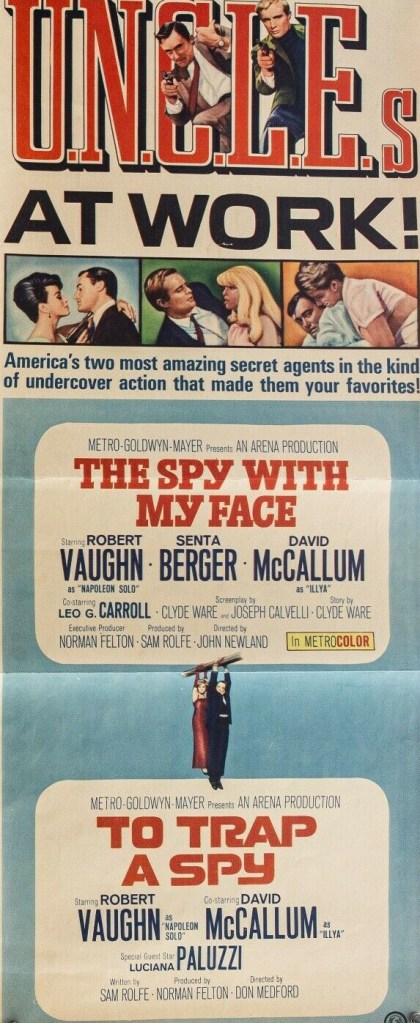
First picture in the trial scheme was To Trap a Spy (changed form the initial To Catch a Spy), an expanded version of the television pilot known as The Vulcan Affair, and as well as series leads Robert Vaughn (The Magnificent Seven, 1960) and David McCallum (The Great Escape, 1963) toplined future Bond femme fatale Luciana Paluzzi (Thunderball, 1965). A second movie was culled from The Double Affair which had been screened on November 17, 1964, with an European star with a considerable pedigree in Senta Berger (Major Dundee, 1965).
Since MGM had no idea whether the spy series, launched in the U.S. on NBC on 22 September 1964, would catch on abroad, where in any case stations paid comparatively little to screen top American shows, its initial idea was to release films only for the foreign market.
In fact, the studio didn’t wait to see if the BBC could make a hit out of the debuting The Man from U.N.C.L.E. series and shunted out To Trap a Spy before the series even screened in Britain. And lacking momentum from television, it went out as the support on the ABC circuit in Britain to The Americanization of Emily (1965) starring Julie Andrews and James Garner.
At that time, the ABC chain was not beholden to the double bill idea. In fact, more than half the annual weekly releases went out as solo affairs. A double bill was more likely to suggest that there were doubts over the pulling power of the main film. There was no way of judging the box office appeal of any film put out in the lower half of a double bill.
The odd thing was that if MGM had held off pressing the button on the circuit release, To Trap a Spy would have demonstrated box office success. At the same time as the double bill was simultaneously released at nationwide first run theaters, To Trap a Spy opened in London’s West End in May 1965 at the 529-seat Ritz and delivered the best business MGM had enjoyed there for two years. It returned to the 556-seat Studio One, also in the West end, in October that year as the top attraction in a double bill that included Glenn Ford-Henry Ford western The Rounders (1965) and in its fifth week took in an excellent $5,600 and a few weeks later shifted back to the Ritz.
Between released the first and second Uncle pictures, MGM had launched a major marketing campaign on the back of the launch of the series on BBC. One marketing gimmick, inviting the audience to write in for The Man from U.N.C.L.E. certificates, brought in over half a million applications. MGM splashed out $85,000 marketing The Spy with My Face (1965). Again, the movie went out in an ABC circuit release – in July 1965 – as part of a double bill, with Son of a Gunfighter (1965), but this time the Uncle film topped the bill. Launched in the West End at the much larger 1,330-seat Empire it took $22,000 in its opening week. Nationally, “it was far and away above average for a top-grossing picture in the UK.”
To Trap A Spy and The Spy with My Face each grossed $2 million in the UK market. By January 1996, a third Uncle film had launched in the British market, One Spy Too Many, based on the two-episode Alexander the Great Affair which had screened in America in September 1965. This time MGM held off from ABC circuit release until mid-February until One Spy Too Many had cleaned up in January in the West End, $25,000 at the Empire, helped along by a Xmas merchandizing bonanza that saw the country flooded with memorabilia, paperbacks, three singles and an album. It broke studio records in 91 of the 125 situations it first played.
The success of the first pair pointed up the potential U.S. box office from these featurized episodes and MGM put together the double bill The Spy with My Face/To Trap a Spy on the assumption that the films at the very least would pick up business outside first run venues where bigger-budgeted pictures dominated and provide respite for showcase (wide release) theaters, drive-ins and small cinemas suffering from product shortage. The bigger a hit a movie became, whether roadshow or not, the longer it took to move down the food chain.
MGM was also inspired by the merchandizing boom generated by the television. A toy gun was well on its way to notching up sales of two million, and there were in addition, games, puzzles, trading cards, costumes and masks and chewing gum.
The MGM was entering a very crowded espionage market. Not only had Thunderball taken the top off the box office with an explosive debut in Xmas 1965, but any new entrant into the field in 1966 would come up against such spy behemoths as Columbia’s Our Man Flint (1966) and The Silencers (1966) from Twentieth Century Fox as well as more offbeat spy numbers like Paramount’s The Spy Who Came in from the Cold (1965) and other pictures aiming for a slice of the cake like Where the Spies Are (1966) with David Niven and That Man in Istanbul (1965).
Variety magazine was sniffy about the double bill’s prospects – “for the least discriminating audiences” was its take on To Trap a Spy although Box Office deemed it “far better story-wise” than The Spy with My Face.
Advert in “Variety” (May 27, 1964, p41) announcing the new series.
The Spy with My Face/To Trap a Spy gained surprising traction in first run, even though MGM was demanding a 50 per cent share of the box office. In some cities it ran smack bang into the openings of one or other of the biggies while Thunderball played for months on end. Even so, the results were surprisingly good. Leading the single cinema first run bows was $24,000 – equivalent to $214,000 now – in Chicago (and a second week of $18,000). Boston audiences delivered $16,000 (plus $11,000 second week), Detroit $18,000 (and $12,000). It ran for three weeks in Washington D.C., Philadelphia and Providence and two weeks in St Louis, Buffalo, St Louis, San Francisco and Cleveland.
There were one-week bookings at other major cities like Seattle, Pittsburgh, Minneapolis and Cincinnati. Except in Portland (“drab” first week and “dull” the second) and Seattle (“okay”) the box office verdict varied from “potent,” “virile” and “sock” to “nice,” “fine,” and “pleasant.” Box Office magazine reckoned that in Hartford the duo produced revenues over three times the average and in Memphis twice the average.
Following first run, it would go into wider breaks in these various cities. Some cities ignored first run and opted for a straight “showcase” (wide release) bow, New York leading the way with $104,000 – $928,000 equivalent today – from 25 cinemas, Kansas City bringing in $35,000 from 10 in week one and $25,000 from 10 in week two, and Baltimore good for $40,000 from 18. In new England cinemas and drive-ins united for a multiple run release hat “rang up some of the briskest business of the winter months despite the adverse weather conditions.” The only downside was the Pacific chain of drive-ins refusing to show the double bill on the grounds that previous experience of showing movies adapted from television series had “brought patron beefs” and that its own tests had not worked.
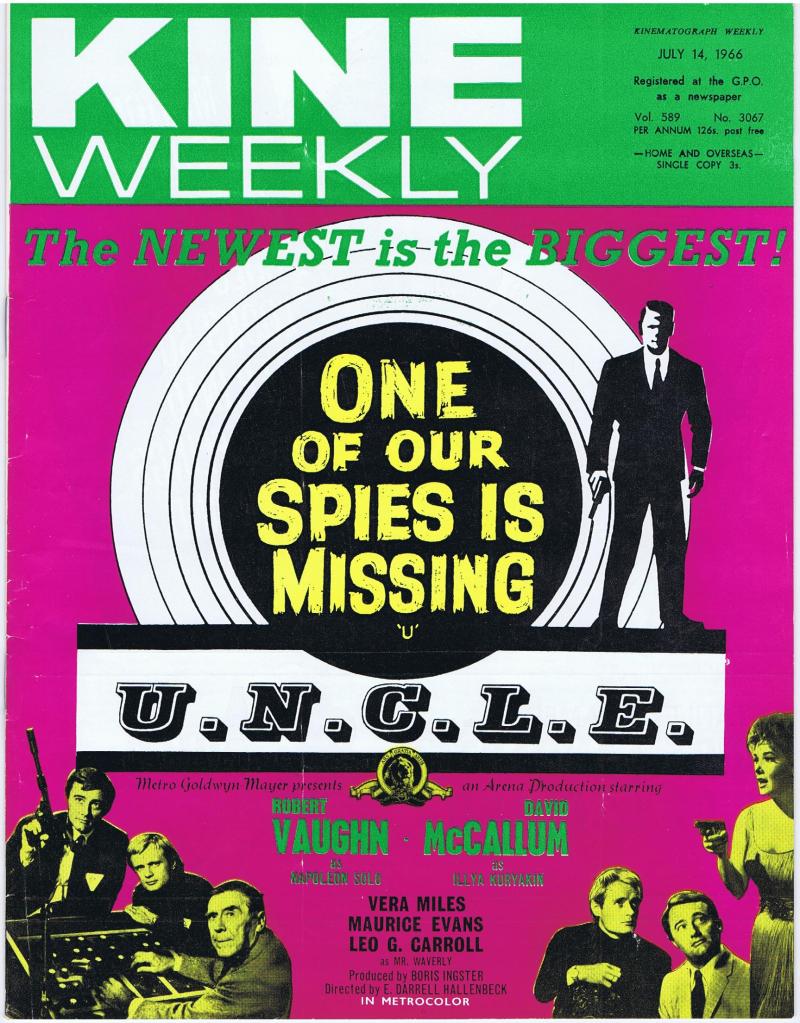
Even when The Man from U.N.C.L.E. series ended after three-and-a-half seasons, MGM continued bringing out movies, eventually totalling eight in all. The others were: One of Our Spies Is Missing (1966), The Spy in the Green Hat (1966), The Karate Killers (1967), The Helicopter Spies (1968) and How to Steal the World (1968).
Towards the end of the decade the Easy Rider (1969) phenomenon prompted a brief vogue for box office analysts to point to low-budget pictures generating the biggest profit. Nobody tended to include the first three Uncle films in this equation regardless of the fact that, costing an original $200,000 per episode plus extra for reshoots and editing, they were, on a profit-to-cost basis, extraordinarily successful, easily bringing home revenues in the region to 10-15 times their budgets.
SOURCES: Allen Eyles, ABC: The First Name in Entertainment (CTA, 1993), p123; “Another Uncle Sequel As O’Seas Theatrical,” Variety, September 23, 1964, p79; “Uncle Gets 3rd Whirl As O’seas Feature,” Variety, January 27, 1965, p26; “International Soundtrack,” Variety, May 26, 1965, p26; “Toys from Uncle,” Variety, June 30, 1965, p42; “Uncle Stunt in London Is Metro Hit,” Variety, December 8, 1965, p23; “Metro Sees Uncle TV Stanzas As B.O. Kin to James Bond in Theaters,” Variety, February 2, 1966, p1; Review, Variety, February 16, 1966, p18; Review, Box Office, February 21, 1966, pB11; “Box Office Barometer,” Box Office, March 14, 1966, p22; “One Spy Looms MGM Leader in Britain,” Variety, March 20, 1966, p29; “Drive-Ins in New England Preparing To Solve Springtime Problems,” Box Office, March 21, 1966, pNE4; “Pacific Prefers Not To Follow Video,” Variety, April 20, 1966, p24; “Box Office Barometer,” Box Office, June 20, 1966, p14; “How Uncle in Great Britain Clicked Via Tie-Ups with Tele,” Variety, June 22, 1966, p17; “Uncle TV Conversions Boffo at B.O. Theatrically O’Seas,” Variety, March 20, 1968, p4; Box Office figures taken from the weekly edition of Variety in the “Picture Grosses” section on the following dates: in 1965 on November 10 and December 8, in 1966 from February 2 until June 1; and August 18, 1966.
This isn’t my choice of the top films of the year, but yours, my loyal readers. This is a chart of the films viewed the most times over the full calendar year of January 2021 – December 2021.
The Secret Ways (1961). Richard Widmark in spy thriller set in Hungary during the Cold War and adapted from the Alistair MacLean novel. Senta Berger has a small role.
Ocean’s 11 (1960). Frank Sinatra, Dean Martin and the Rat Pack embark on an audacious Las Vegas robbery.
Pharoah(1966). Epic Polish picture about political shenanigans in ancient Egypt.
Age of Consent (1969). Helen Mirren stars as the nubile muse of jaded painter James Mason returning to his Australian roots.
The Venetian Affair (1966). Robert Vaughn hits his acting stride as a former CIA operative turned journalist investigating suicide bombings in Venice. Great supporting cast includes Elke Sommer and Boris Karloff.
The Golden Claws of the Cat Girl (1968). Cult French movie starring Daniele Gaubert as a sexy cat burglar.
Moment to Moment (1966). Jean Seberg is caught up in a Hitchcockian murder plot in the French Riviera. Also features Honor Blackman.
It’s Not All Rock’n’Roll (2020). Ageing rocker Dave Doughman aims to mix a career with being a father in this fascinating documentary.
4 for Texas (1963). Frank Sinatra and Dean Martin face off in a Robert Aldrich western featuring Ursula Andress and Anita Ekberg with Charles Bronson in a smaller part.
Once a Thief (1965). Trying to go straight ex-con Alain Delon is coerced into a robbery. Ann-Margret is a revelation as his wife. Jack Palance, Van Heflin and Jeff Corey add up to a great supporting cast.
Stiletto (1969). Alex Cord as a Mafia hitman wanting to retire is pursued by tough cop Patrick O’Neal. Britt Ekland heads a supporting cast which includes Roy Scheider, Barbara McNair and Joseph Wiseman.
Subterfuge(1968). C.I.A. operative Gene Barry is called to London to uncover a mole in M.I.5. Joan Collins provides the romance. Richard Todd, Tom Adams, Suzanna Leigh and Michael Rennie lend a touch of class.
The Swimmer (1968). Burt Lancaster delivers a superlative performance as a man whose life is falling apart.
The Rock (1996). Blistering thriller starring Sean Connery as an ex-inmate of Alcatraz helping Nicolas Cage infiltrate the island to prevent mad general Ed Harris destroying San Francisco. Michael Bay directs.
The Sicilian Clan (1969). Alain Delon joins forces with Jean Gabin to pull off an daring jewel heist with tenacious cop Lino Ventura on their trail. French thriller directed by Henri Verneuil.
The Naked Runner (1967). With his son held hostage, Frank Sinatra is forced to carry out an assassination in East Germany.
A House Is Not a Home (1965). Biopic of notorious madam Polly Adler (played by Shelley Winters) who rubbed shoulders with the cream of Prohibition gangsters.
Pressure Point (1962). Prison psychiatrist Sidney Poitier must help racist Nazi Bobby Darin.
Genghis Khan (1965). Omar Sharif plays the legendary warlord who unites warring Mongol tribes. Stellar cast includes Stephen Boyd, James Mason, Francoise Dorleac, Eli Wallach, Telly Savalas and Robert Morley.
A Twist of Sand (1968). Beleaguered smuggler Richard Johnson spars with Jeremy Kemp in thriller about hidden diamonds in Africa. Honor Blackman is along for the voyage.
Jason and the Argonauts (1963). Ray Harryhausen special effects dominate this legendary tale of the hunt for the Golden Fleece.
Dr Syn Alias the Scarecrow (1963). Disney movie that was turned into a mini-series in the U.S. starring Patrick McGoohan as the eponymous Robin Hood-type character who assists smugglers.
The Hitman’s Wife’s Bodyguard (2021). Ryan Reynolds and Samuel L. Jackson reunite for wild sequel also featuring Salma Hayek and Antonio Banderas.
Dark of the Sun / The Mercenaries (1968). Rod Taylor leads a private army into the war-torn Congo to rescue a cache of uncut diamonds. Jim Brown, Yvette Mimieux and Kenneth More co-star. Based on the Wilbur Smith bestseller.
The Guns of Navarone (1961). Classic war mission picture with an all-star cast of Gregory Peck, David Niven, Anthony Quinn, Stanley Baker, Irene Papas and Gia Scala. Adapted from the Alistair McLean bestseller.
Maroc 7 (1967). Gene Barry infiltrates a gang of jewel thieves in Morocco operating under the cover of a fashion shoot. Dazzling female cast includes Elsa Martinelli, Cyd Charisse, Tracy Reed and Alexandra Stewart.
The Satan Bug (1965). John Sturges adaptation of Alistair MacLean pandemic thriller stars George Maharis, Richard Basehart and Dana Andrews.
Five Golden Dragons (1967). Cult thriller with Robert Cummings as the playboy caught up in an international crime syndicate. Klaus Kinski and Christopher Lee head an exceptional supporting cast that also includes Margaret Lee, Brian Donlevy, George Raft, Dan Duryea and Maria Rohm.
Claudelle Inglish (1961). Diane McBain as the poor farmer’s daughter who wants to get rich quick.
Jessica (1962). Angie Dickinson plays a young widow who turns so many heads in a small Italian town that their wives seek revenge.











 The Magnificent 60s