Behind the Scenes: Selling the New-Look Paul Newman – Pressbook for “The Hustler” (1961)

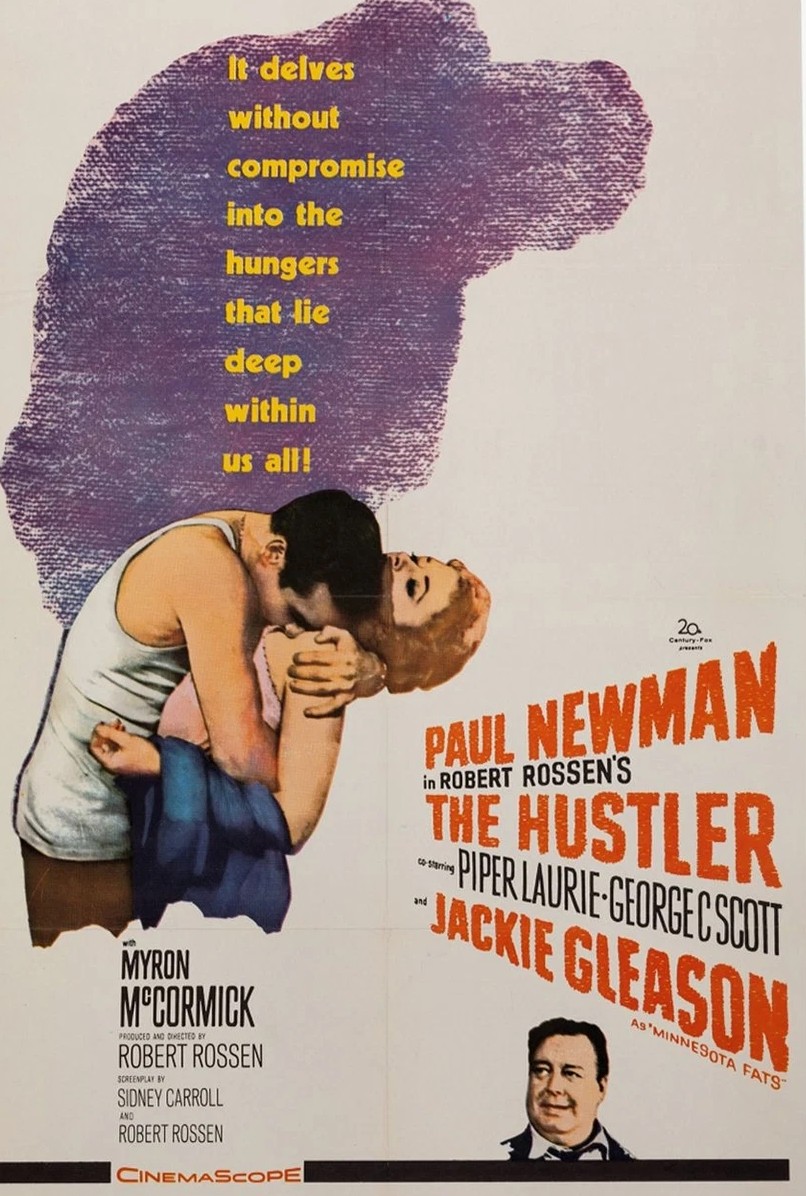
While Twentieth Century Fox head honcho Spyros Skouras initially balked at the title, with its connotations of prostitution, by the time the movie appeared that subject matter was less contentious thanks to critical and commercial big hitters Butterfield 8 (1960) and Never on Sunday (1960). Given that the idea of a movie set in a poolroom was going to be a hard sell to a female audience, despite the marquee lure of Paul Newman, the studio gave marketeers free rein to pitch it as a raw, sex-oriented drama.

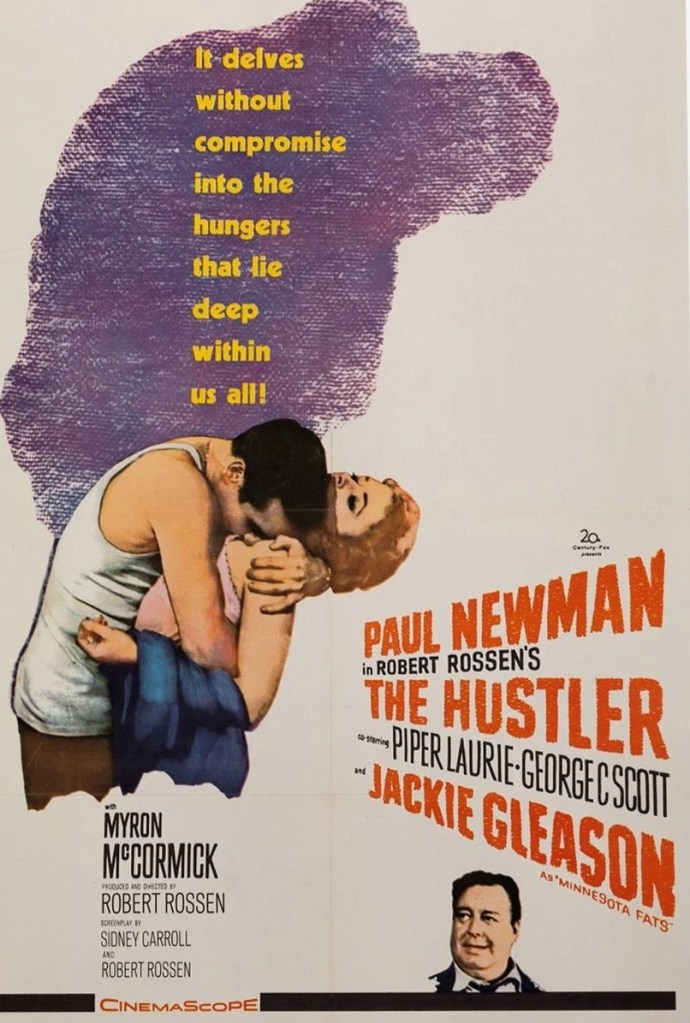
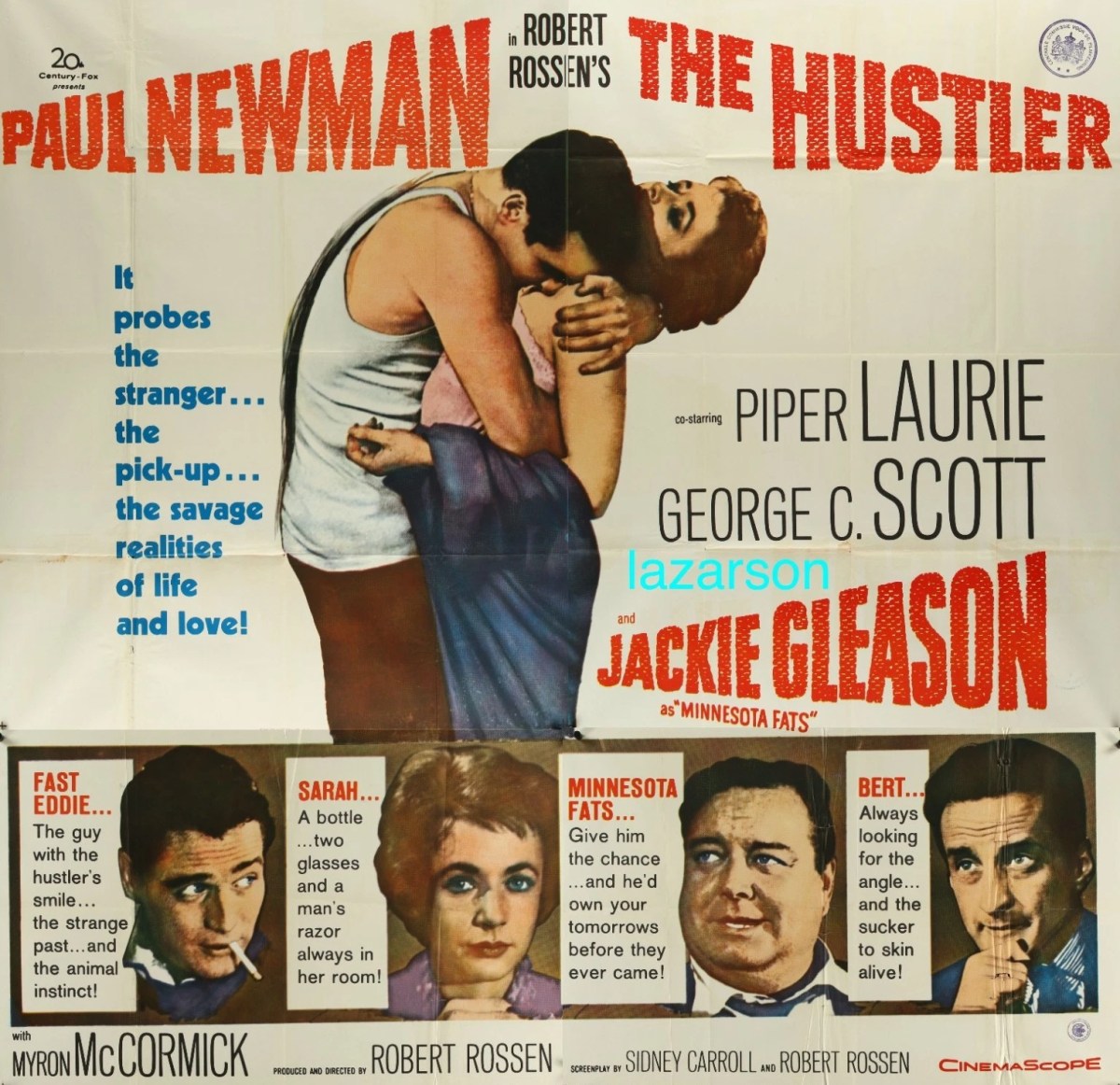
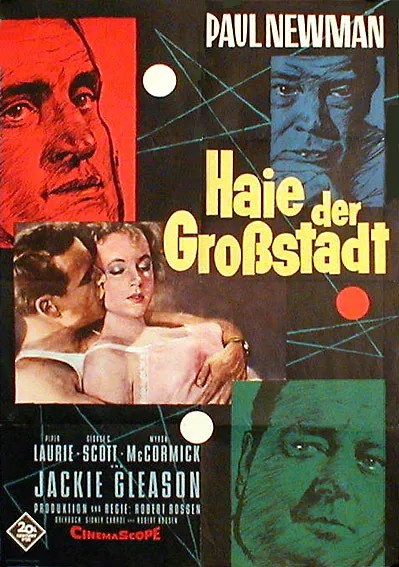
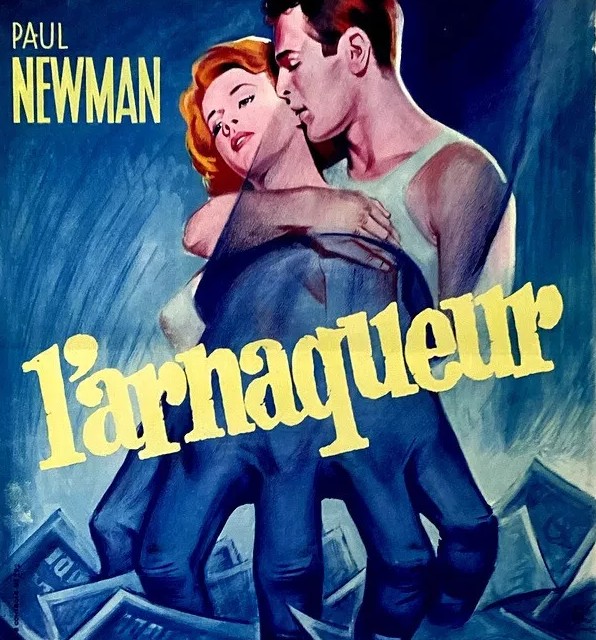
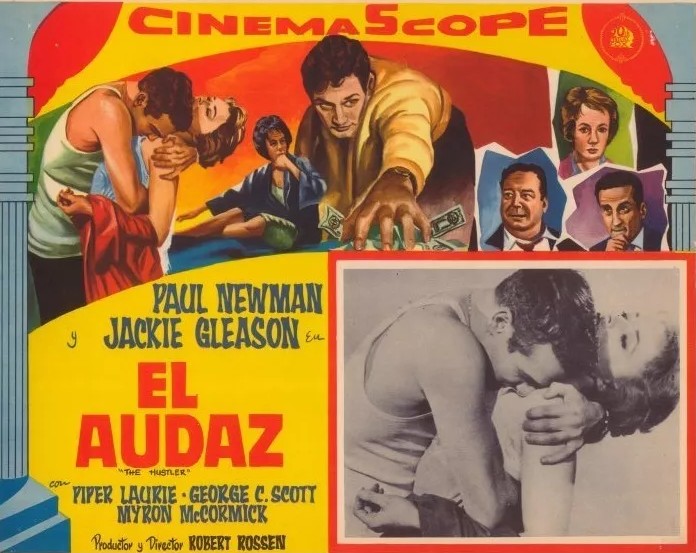
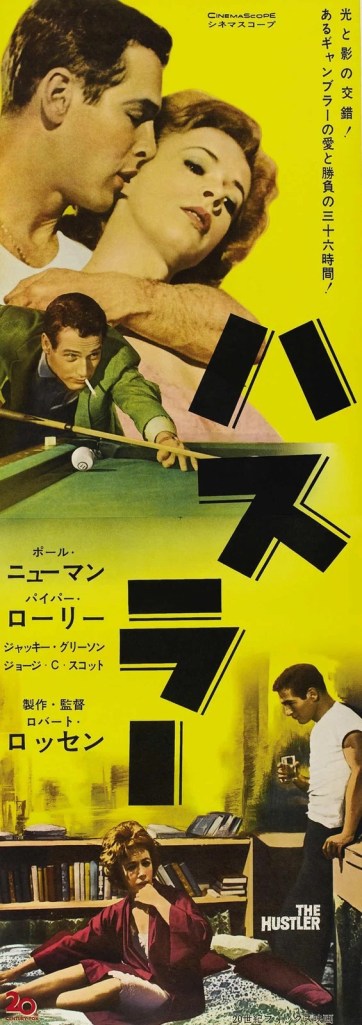
There’s little sign of a pool cue in some of the artwork. Instead, we have Paul Newman lustily nuzzling Piper Laurie’s neck or bosom. The taglines promise something far removed from a sports picture.
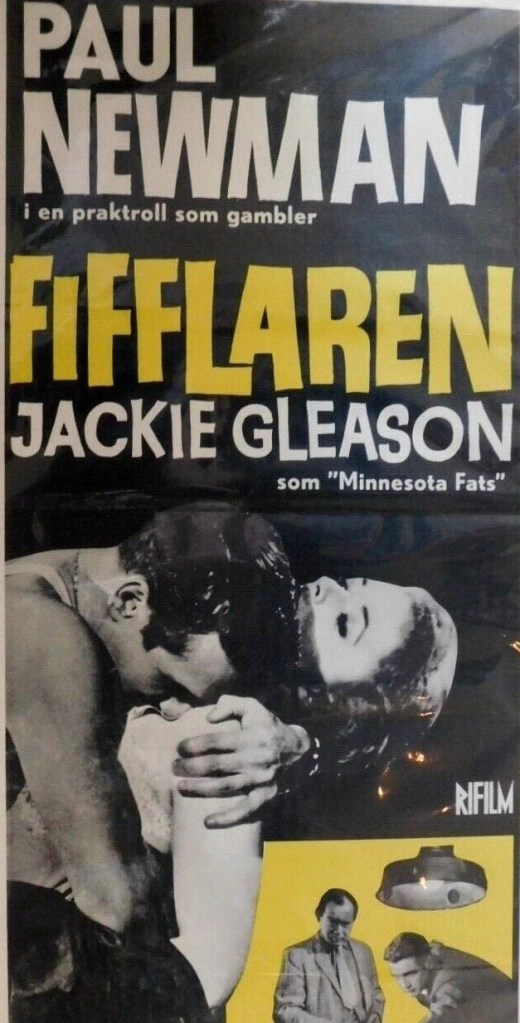
“It probes the stranger…the pick up…the  savage realities,” screamed the main tagline. Another tempted with: “It delves without compromise into the inner loneliness and hunger that lie deep within us all!” In other words we’re talking about sex, not love, and casual sex at that, the world of the one-night stand between consenting adults for whom marriage is the last thing on their minds. “The word for Robert Rossen’s The Hustler is prim-i-tive” suggested out of control lust.

Fast Eddie Felson (Newman) has “the animal instinct.” Sarah (Piper Laurie) has a “bottle, two glasses and a man’s razor always in her room.” Bert (George C. Scott) is on the look-out for the “sucker to skin alive.”

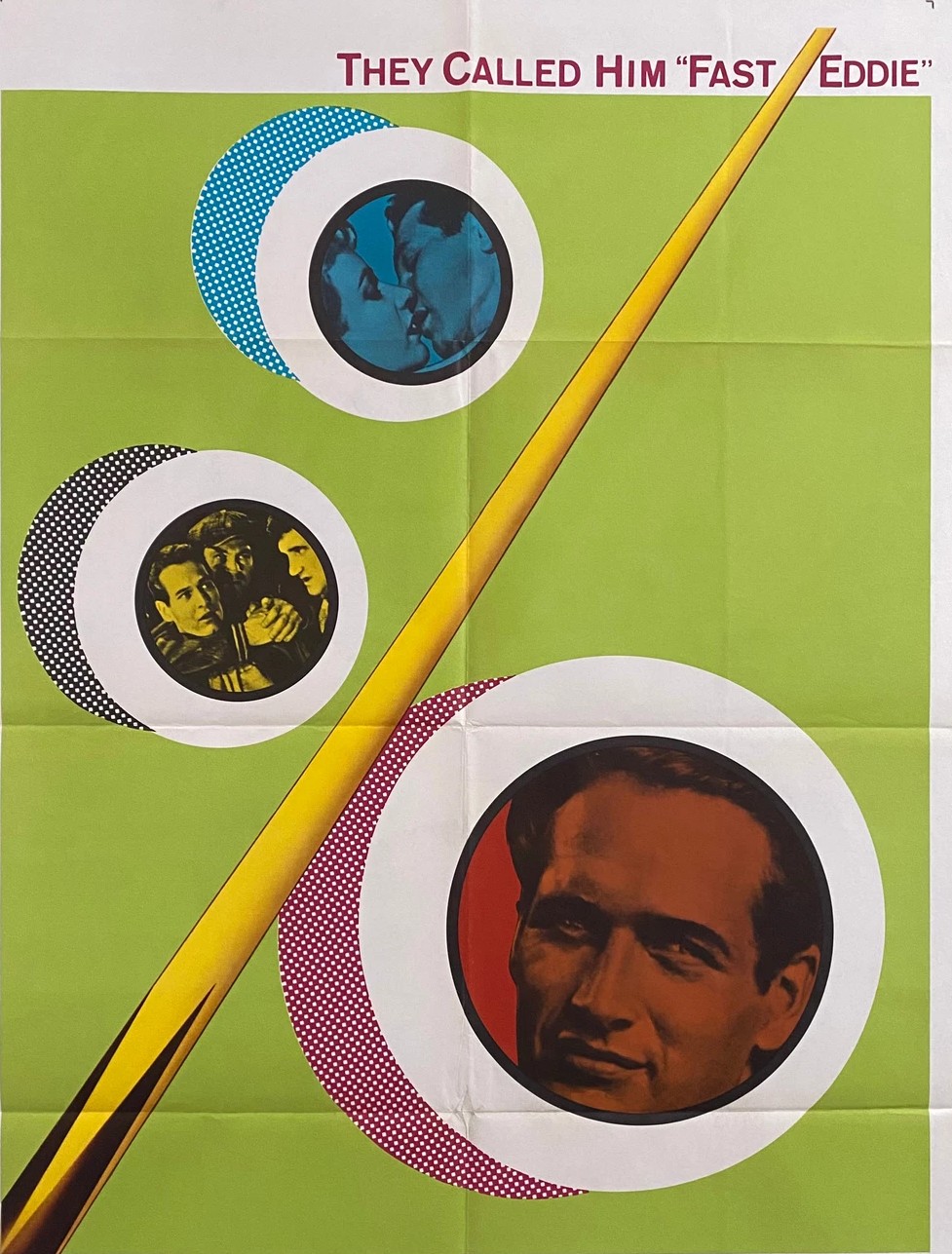
Those images which did show a cue and pool balls did not suggest an august sport like football or baseball, not with a tagline like “he was a winner, he was a loser, he was a hustler.”
With such talented actors to hand, the Pressbook wasn’t short of good stories relating to the actual movie rather than the kind of snippets that might appeal to an editor on a slow news day. So we learn that Piper Laurie continually limped, Method-style, around on the set. “When I limp in the picture, I don’t want to act it. It’s something that has to be a part of me, something of which I am no longer conscious, apart from its being a physical defect. I must be able to limp as if I had a bad foot from birth.”

Laurie had made so few pictures that her name wouldn’t be on any director’s wanted list and what she was best known for – ingénue roles when a contract player for Universal (who gave out that she bathed in milk to keep her skin soft) opposite  the likes of Tony Curtis – wouldn’t have inspired confidence. Robert Rossen might well have spotted her in two Emmy-nominated performances in successive years including Days of Wine and Roses (1958), but instead said he remembered her for “a sensitive characterization” from a stage production of Rosemary.

Ames Billiards Academy had once been a Chinese restaurant so boasted a balcony. This was unseen in the picture but allowed director Robert Rossen to shoot from widely varied overhead angles. The crew took over the Manhattan Bus Terminal for a day and a night. A row of lunch booths was constructed in front of the existing lunch counter. “It looked so real,” we are told, “that passers-by sat down and waited for their orders to be taken.” A nice story, and the kind often furnished by Pressbook journos, but rather fanciful, since it would be obvious what with the crew milling around and the lights and cameras and miles of cable that this was a movie set with security posted to prevent trespassing.

Just how good a pool player was Jackie Gleason, who came to the picture with a reputation for handling a cue? Well, at one point, the affable television comedian with a top-rated show, potted 96 consecutive balls.

Paul Newman plays the iconic hero as a “figure cut from the fabric of our time.” He had a firm grasp of the character. “With him it’s a question of commitment. He is so wrapped up in his drive to win and be somebody that he has no time to give of himself that which others need. It is a disease of our time, both the ambition and the isolation. I want him to be understood.”

Needless to say there was no mention of author Walter Tevis. That wasn’t so unusual in the make-up of Pressbooks, but if the marketeers these days were looking for something to write about the eclectic Tevis would be prime. He followed up The Hustler, published in 1959, four years later with sci fi The Man Who Fell to Earth, filmed in 1976 with David Bowie. A sequel to The Hustler, The Color of Money, was directed in 1986 by Martin Scorsese with Newman reprising his role and managing Tom Cruise. Tevis also wrote The Queen’s Gambit, turned into an acclaimed television mini-series in 2020 with Anya Taylor-Joy.
Behind the Scenes: “The Hustler” (1961)

It should have been Frank Sinatra in the leading role, not Newman. Sinatra acquired the rights to the Walter Tevis semi-biographical novel published in 1959. When Sinatra moved onto something else and director Robert Rossen took up the slack still Newman should have been ruled out courtesy of a planned re-teaming with Elizabeth Taylor – they had worked together on Cat on a Hot Tin Roof (1959) – for the screen adaptation of Broadway hit Two for a Seesaw. Bobby Darin (Pressure Point, 1962) was being lined up instead. When illness put paid to Taylor’s involvement, Newman would have remained tied to Two for the Seesaw except he had co-star approval and none of the actresses suggested measured up.

Based on reading half the script, Newman, calling his agent at six o’clock in the morning to confirm interest, jumped at the role. Though Exodus (1960) had been a success, and he had managed to ease himself out of his contract with Warner Bros, he was not considered hot box office and he needed a part not just to consolidate his commercial standing but to provide a professional springboard that would shape his career. His previous outing, Paris Blues (1961), hadn’t carved out a clear path. As well as his salary, the actor was in line for ten per cent of the profits.

Initially, the picture was backed by United Artists and it featured in their adverts in the trade magazines in 1959. The studio had shelled out an advance to Rossen to option the rights. But when the director couldn’t find a “box office star as insurance” UA pulled out. By this point, the end of 1959, there was at least a screenplay, Rossen having called upon the services of Sydney Carroll (Big Deal at Dodge City, 1966).

Rossen shopped the package to Twentieth Century Fox which, somewhat surprisingly, signed up to the project when no major star was attached, especially as, according to Rossen, the picture “pulled no punches” with its “frank approach to people and life.” UA had promoted itself as the go-to studio for independents but by Rossen’s reckoning Fox was superior in that department because backing the movie “took some guts.”

Fox chief Spyros Skouras wasn’t keen on the title, believing, understandably, that The Hustler might signal to audiences that it was a story about prostitution. It was changed first of all to A Stroke of Luck and then to Sin of Angels. However, UA objected to the latter title on the grounds it had already registered a similar title The Side of the Angels and with some reluctance Skouras agreed to go with the original title.

It was a critical picture for Rossen, who hadn’t had a solid hit in a decade and hadn’t made a picture that could be mentioned in the same breath as All the King’s Men (1949). In part his low output was due to being blacklisted during the anti-Communist witch hunt of the early 1950s, although finally cleared. But it was as much due to his unusual method of working. “You gamble time which is money,” he said, “because you may work for six months or a year then realize the property is not quite right and your drop the while idea.” That ran counter to the general Hollywood practice where studios would press ahead with inferior product precisely because so much time and money had been spent on it. Rossen’s office was littered with abandoned projects.

Female lead Piper Laurie was also in the market for a comeback. She had bowed out of the business after Until They Sail (1958) – also starring Newman – fed up with ingénue parts, although the director had initially favored daughter Carole Rossen (The Arrangement, 1969) for the role. At one point Rossen identified Yves Montand for a top supporting role. Co-star Jackie Gleason (Soldier in the Rain, 1963), known at this time as a television comedy actor, was already a decent pool player and Newman was coached by Willie Mosconi, a fourteen-time world billiards champ. Except for one maneuver the two actors managed to achieve all the shots caught on camera. Newman believed he was good enough to beat Gleason and it cost him $50 to be proved wrong.

George C. Scott, primarily known for his work on the stage, had attracted attention with an Oscar-nominated turn in Otto Preminger courtroom drama Anatomy of a Murder (1959).

The film, budgeted at $2.1 million, was shot on location in New York City in the winter and spring of 1961. “You get certain values,” noted Rossen, “ in New York that you can’t get on the Coast (Hollywood).” The pool scenes were filmed at Ames Billiard Academy, established in 1946, near Times Square and McGirr’s. Other locations included a townhouse on East 82nd St which doubled as the Louisville home of the billiard player Findley and the Greyhound Bus Station in Manhattan even though it lacked a dining area and the one built on the premises confused regular customers.

Rossen spent five weeks of the 10-week schedule on the pool action. Sarah’s apartment, however, was located on a sound stage. The director, under pressure to revive his career and suffering from diabetes, was tough on the crew but went easy on the cast. He hired street thugs as extras to add authenticity. He fell foul of electricians and they fell foul of him after he exposed a blackmail scam whereby the electricians responsible for inspecting the unit  complained of code violations when it was the same inspectors who should have ensured everything complied with regulations. .

The part was custom-made for Newman. “I spent the first thirty years of my life looking for a way to explode,” recalled the actor. He found an outlet for that problem through acting and he reckoned for Fast Eddie Felson it was pool. “It was one of those movies when you woke every day and could hardly wait to get to work because you knew it was so good that nobody was going to be able to louse it up.”

Though studio 20th Century Fox did its best to louse it up, originally objecting to the location shoot, looking to cut down the running time, especially telescoping the pool sequences it felt might bore the female audience. Desperate to hold onto his vision, Rossen hired Arthur P. Jacobs, then a top-flight PR honcho (and later producer of Planet of the Apes, 1968), who contrived to set up a celebrity screening where the positive response stopped Fox in its interfering tracks. Due to the Actors Strike the previous year, product was in short supply, so although The Hustler was one of 19 pictures opening in September 1961 it didn’t face tough competition, the biggest movies it contended with were Rock Hudson-Gina Lollobrigida comedy Come September and upscale horror The Innocents with Deborah Kerr.

Reviews were positive although in an editorial Box Office magazine railed against a picture which cinemas could not sell to a family audience for a matinee performance.

A surprise box office hit, at least initially, in first run in the big cities, The Hustler creamed  a “wow” $64,000 in opening week at the 3,665-seat Paramount in New York. There was a “boffo” $36,000 in Chicago, a “fast” $20,000 in Detroit, a “hotsy” $15,000 in Cleveland, a “wow” $14,000 in Pittsburgh and a “smash” $11,000 in Providence. The poster which effectively showed Paul Newman thrusting his head into Piper Laurie’s bosom attracted adverse criticism and caused Chicago newspapers to take a stronger line on movie ads.

It was nominated for nine Oscars with Newman, Laurie, Gleason and Scott all earning acting nods, and Rossen up for two gongs in his capacity as director and producer, as well as potentially sharing one with Sydney Carroll for the screenplay. In the event the only winners were for Eugen Schufftan for Cinematography and Harry Horner and Gene Callahan for Art Direction. At the Baftas it was named Best Film while Newman won Best Foreign Actor and Piper Laurie was also nominated.

Oscar nominations ensured the picture went out on speedy reissue in February and March 1962 resulting in domestic rentals of $2.8 million and a decent run abroad.

Robert Rossen only made one more picture. Paul Newman reconfigured his career and George C. Scott added to his lustre. Jackie Gleason got a shot at top billing with Gigot (1962) but Piper Laurie didn’t make another movie until Carrie (1976).

SOURCES: Daniel O’Brien, Paul Newman (Faber & Faber, 2005) pp79-85; Shawn Levy, Paul Newman, A Life (Aurum, 2009) pp 175-182; Aubrey Solomon, Twentieth Century Fox, (Scarecrow Press, 2002) p229 and p253; Advertisement, United Artists, Variety, June 24, 1959, p21; “New York Sound Track,” Variety, August 12, 1959, p17; “Gleaned on a Gondola,” Variety, August 26, 1959, p20; “New York Sound Track,” Variety, November 16, 1960, p17; “Fox Nicer to Indies than UA,” Variety, March 8, 1961, p3; “New York Electrical Inspectors,” Variety, March 29, 1961, p5; “Sins of Angels Tag disputed,” Variety, March 29, 1961, p7; “Artistic Comeback,” Variety, May 24, 1961, p4; “Skinpix Can’t See,” Variety, October 18, 1961, p17; “Hustler Re-Release,” Box Office, January 22, 1962, pSW8. Box office figures: Variety October-November 1961.  

The Hustler (1961) ****

You get the impression this is the kind of movie that contemporary “visionary” directors think they are making when they focus on an unlikeable obsessive character causing chaos all around. It’s not just star quality they are missing – who wouldn’t give their eyeteeth for a Paul Newman to get behind a movie with poor commercial prospects, especially one tackling a sport that is guaranteed to put off the female element of the audience. Without Newman’s involvement you didn’t have a hope in hell of getting anywhere near the female audience.

And this was quite a different Paul Newman. In the first of his iconic roles, he’s far from the traditional hero. He’s an obsessive loner. But you are drawn towards him because of both the intensity and vulnerability of this character. He could as easily be the loser, the last thing an audience wants, he’s often accused of being, the bottler looking for an excuse for not going the extra mile it takes to win. And even when he does win, triumph comes with loss, of love and his avowed profession.

And it takes a heck of a confident director – Robert Rossen (Lilith, 1964) – to lock us into the dark prison of a pool room for virtually the first 30 minutes of the picture. If you don’t know the rules of American pool – as opposed to billiards and snooker – you’re not going to learn them here. “Fast” Eddie Felson (Paul Newman) has spent years on the road, hustling in small town poolrooms, to built up the kind of cash stack he requires to take on the greatest name in pool, Minnesota Fats (Jackie Gleason) whose unbeaten run stretches back a decade and a half.

And the movie should be over in that first half hour – or at the very least turned into a very different kind of picture, the one where the champ squanders his fortune – because Felson has thumped Fats. He’s $18,000 ahead at one point. In any other sport that should be mean he’s not just won but he’s won in style. Except it doesn’t work that way here. Fats has to concede. And Fats won’t concede because this is a marathon and despite his bulk Fats is better built for a 40-hour match than his slimmer opponent. And so it proves.

Felson is back to the beginning, welshing on his business partner Charlie (Myron McCormick) and heading out into the night. Where he meets alcoholic Sarah (Piper Laurie) who’s sitting in a bus station in the early morning sipping coffee until the liquor stores open. She’s not your usual easy pick-up, she knocks him back easily and in an idiosyncratic manner. She nearly does the same again, but relents and they start a relationship that’s built on nothing except ships passing in the night. She’s a lush, he’s a has-been. She’s a bit of a cultured lush, reads, writes short stories, but still booze is her first love.

If he’s not down enough, here comes the kicker. Thugs in a poolroom object to being hustled and break his thumbs. But she’s not very maternal and he’s not the kind of man who wants to be looked after in that fashion.

Eventually, he hooks up with another backer, a shady underworld character, Bert Gordon (George C Scott) whose first move is to break up Felson’s relationship, attempting to belittle Sarah, getting her smashed and putting the moves on her as if free sex is part of the deal. Felson gets badly hustled by wealthy Louisville Findley (Murray Hamilton), duped into playing billiards instead of pool, and the potential loss might well have slammed the door on the deal with Gordon. But Gordon gets his pound of flesh, literally, and Sarah, clearly better versed in the ways of the world than Felson, gives in to her lover’s manager and then is so disgusted with herself that she commits suicide.

Felson gains his revenge on both Minnesota Fats and Gordon but at a cost, lover lost, and kicked out of his profession. Victory has never been so negative.

While the acting all round is superb, all four principals plus the director Oscar-nominated, it’s the feel of the piece and the obsessiveness of the characters that resonates. Robert Rossen makes no concessions to the audience. He doesn’t explain the game and he doesn’t, as would be par for the course anywhere else, show how Felson learned how to handle a cue a different way after his thumbs were broken and there’s a distinct lack of the triumphalism that generally comes with the territory.

Behind the Scenes article tomorrow.

Lilith (1964) *****

You couldn’t make this now. What top-ranked actor would be willing to play a character who takes sexual advantage of a vulnerable young woman? You’d find it even harder to get a marquee name to play a female with paedophiliac tendencies, predatory sexual instincts and thinks it fine to drive a lovelorn young man to suicide.

That it was feasible back in the day was largely due to the restraints imposed by the much-maligned Production Code. Most of the issues are delicately probed, the problematic themes only touched upon, so that the result is quite amazing, the director turning to the lyrical,  rendered by its intensity a metaphor for internal conflict.

War veteran Vincent (Warren Beatty) takes a job as an occupational therapist at an upmarket mental institution, the kind that looks more like a country club or grand hotel with extensive manicured grounds. Few of the inmates are of the type found in the normal hospitals for the insane, the worst cases a woman with a maniacal laugh and another who treats a doll like a baby, but he is warned insane women are more “sinister” than crazy men.

One of his charges is the withdrawn Lilith (Jean Seberg) whom he gradually coaxes out of her shell, soon believing that it is his innate skill that brings about the possibility that such a high-risk individual could possibly achieve something akin to cure, or at least a greater degree of normality. You can hardly blame him for missing the obvious – that Lilith is using him – for the young woman is every inch the winsome innocent seeking guidance from the more mature responsible male.

It’s mostly shorn of obvious metaphor but there is one scene, compelling in itself, where Vincent plays the knight on horseback, complete with lance, winning a contest of skills for his lady, that completes his idealisation in her eyes. But he is already halfway there, with unexpected dexterity he frees her hair caught in loom, the kind of scene that in an otherwise more romantically-inclined movie would be the meet-cute.

And this isn’t one of those films about a madwoman in an attic or an apparently sane person turning demented. Instead, considerable time is spent analysing the condition of the schizophrenic, either through clinical lead Dr Lavrier (James Patterson) expounding his theories or through Vincent discussing individual patients with his boss Dr Brice (Kim Hunter). The idea of opening up a new realm to an audience is crystallised in one scene where Lavrier explains that even spiders go mad, resulting in asymmetrical webs rather than the typical formations to which we are more accustomed.

And by using one of the oldest tricks in the book, an inexperienced young man negotiating a new world, disbelief is suspended. But just when we think we are seeing everything from Vincent’s perspective, we are thrown into a heightened intensity linked to the lyrical – a river, a waterfall – the madness of ecstasy, what used to be called rapture, as Lilith stares and stares at nature.

But there are warnings about the personality of both characters. Lilith bears a startling resemblance to Vincent’s dead mother. He has difficulty committing, lack of communication while away at war resulting in girlfriend Yvonne (Anne Meacham) marrying someone else.

And there is plenty that is disconcerting about Lilith that only the besotted would overlook. She leads on lovelorn Stephen (Peter Fonda) to potential disasters he cannot foresee. Angry at Vincent, “I show my love for all of you and you despise me,”  she seduces vulnerable older patient Laura (Jessica Walter). But the worst aspect of her character is that she perceives no boundaries to behavior. She exhibits inappropriate attitudes to young boys, inviting one to rub his finger along her lower lip.

However, for most of the film the skilful direction of Robert Rossen (The Hustler, 1961) has you rooting for the young lovers. Even while never falling back on the cliché of the doctor-type saving the ill person, there is enough in Vincent’s earnestness and Lilith’s innocence to make that a distinct possibility, were it not for the other discordant elements of her character.  The picture is wrapped in natural sound – the river, waterfall, a flute playing mournful tune, ping-pong ball hitting bat, reeds or branches parting, rain, footsteps, a ticking clock, and the bulk of the music emanates from Stephen’s radio. And then he will twist it slightly, reflections are seen upside-down in the river, or a shot of the waterfall is held for too long, the sound of water increasing, or Lilith standing in the river bends down to kiss the surface, or at a picnic she eats a leaf irrespective of whether it might be poisonous.

Usually, when you get so much detail it’s a surfeit, and ends up drowning the viewer. But that’s not the case here. Either it builds or expands. And there is even a throwaway that mocks the notion of containing madness in an institution. The best, most revealing, line in the  picture is not spoken by either of the two principals, but secondary character Yvonne, seen only at the beginning and end. When for unspecified reasons Vincent turns up at her house and her husband (Gene Hackman) leaves them on their own, she says, “I told you I’d never really let you make love to me until I was married,” (pause), “well, I’m married now.”

Jean Seberg (Moment to Moment, 1966) is just superb, coming across as a young woman entering adulthood full of fears and insecurities, only suggesting the darker side of her character, and never giving in to the temptation of overplaying. Warren Beatty (Kaleidoscope, 1966) can’t quite match her for subtlety or kick those acting mannerisms – lowered head, looking away – but his stupefied expression towards the end as he realizes just what he has taken on is priceless.

There’s an outstanding cast of rising stars. Peter Fonda (Easy Rider) as the preppy insecure victim is excellent while Jessica Walter suggests the qualities that would make her the prime candidate for the femme fatale in Play Misty for Me (1971). Gene Hackman, in his movie debut and still working on his trademark chuckle, provides early evidence of his immense talent.  

Robert Rossen, who wrote the screenplay (from the novel by J.R. Salamanca) and also produced, couldn’t have wished for a better epitaph. This was his final film in a relatively short career – he only directed 10 films.

Despite contemporary reservations about the content this is a beautifully observed piece and well worth a look.

Discover WordPress

A daily selection of the best content published on WordPress, collected for you by humans who love to read.

The Atavist Magazine

by Brian Hannan

WordPress.com News

The latest news on WordPress.com and the WordPress community.