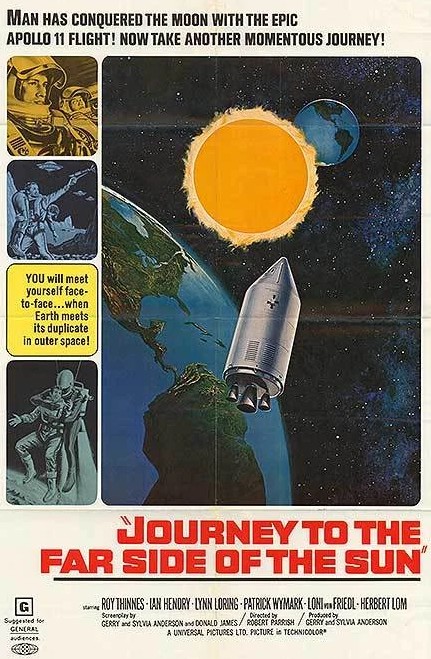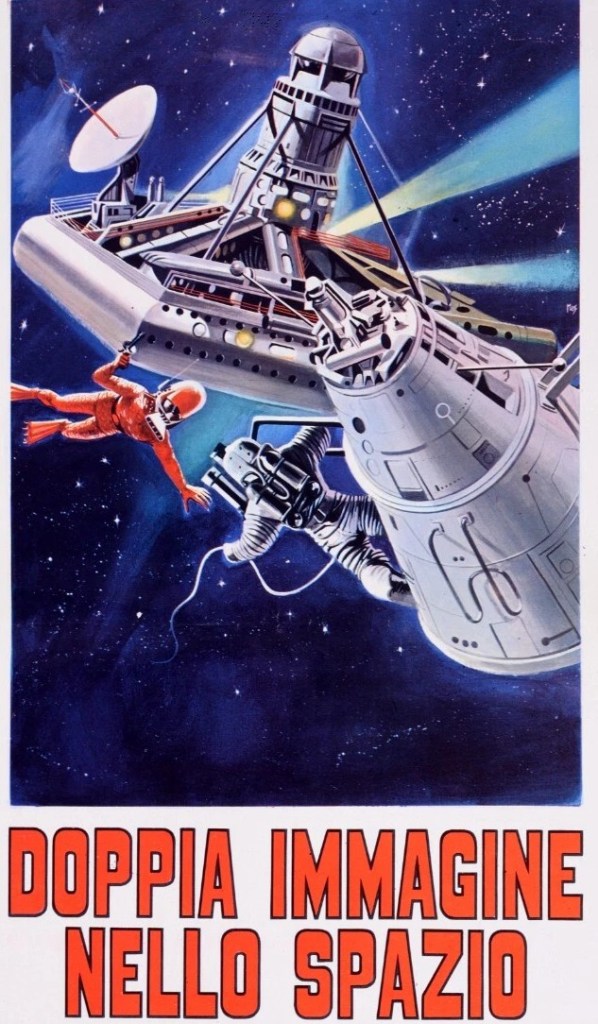
Journey to the Far Side of the Sun / Doppelganger (1969) ****

Bring Gerry and Sylvia Anderson into the equation and it’s a straightforward free pass of the cult kind. For the fanboys, the inventors of Supermarionation (Thunderbirds Are Go!, 1966) live on an exalted plane immune from criticism. however, sci fi buffs have tended to be less than impressed by the pair’s first venture into (to use a Walt Disney phrase) “live-action.” So response swings between these extremes. I fit into neither category so I come at this with something of an open mind and for a variety of reasons found it a far more enjoyable experience than I had anticipated, though I hazard a guess that on the big screen the flaws in the special effects would have been more obvious.

Some aspects even have a contemporary chime, the X-ray security screening machines, for example, and the fact that there’s no such actual entity called Europe and if you want to advance a project you have to navigate your way through the representatives of several countries as well as the hovering financial weight of the United States, bristling at being asked to pay more than its share but worried about being excluded.

And there’s no ice-cool scientific boffin. Instead we have the choleric, not to mention bombastic, Jason Webb (Patrick Wymark). Nor do non-combatants scoot through training. The rigors potential astronauts are put through in the likes of The Right Stuff (1983) or Apollo 13 (1995) are nothing to the body-wringing and mind-blowing experience of John Kane (Ian Hendry).

His companion space buddy Col John Ross (Roy Thinnes) is well-drawn for a sci fi adventure. He’s worried that exposure to radiation and worse in space has knocked his masculinity on the head, his wife Sharon (Lynn Loring) complaining it has left him sterile. Though it turns out she’s a wily creature, secretly using contraception.

We also get a spy, Dr Hassler (Herbert Lom), and it’s not so much that he has a gadget – a mini camera secreted in a false eyeball – than the detail involved in him retrieving the film. In most movies there would be no gap between the reveal of the gadget and the production of its secrets. But here Dr Hassler has to go through a whole procedure, dipping the eyeball into four solutions and dabbing it with this and that, before he can view a single frame.

The picture breaks down into a straight three-act vehicle. The first section getting to lift off, then the journey including the kind of phantasmagorical event you found in 2001: A Space Odyssey (1968) and which even Christopher Nolan relied upon in Interstellar (2014), and arrival.

Most sci fi movies play fast and loose with audiences, rarely remaining true to the logic of their invented worlds or concepts. This sticks to its original notion even if that means ending up with a distinctly downbeat ending. Initially, the astronauts are searching for a new planet, whose orbit is similar to Earth, but on the other side of the sun. This being the year 2068, distance is no object and they reckon it’s a six-week return trip.

But what the astronauts discover on arrival at the new planet is a nightmare situation, that in terms of ability to drive you mad skews close to enigmatic British TV series The Prisoner (1967) or Lost (2004-2010) before it jumped the shark. Ross and Kane have landed on a doppelganger planet and the movie takes this world to its logical conclusion. It’s the real parallel universe, or multiverse in the current vernacular, except everything happens the same as on Earth.

So the choleric Webb initially accuses the astronauts of cowardice, to have turned back and failed to complete their mission which would have led them to our Earth. Doppelganger literally means mirror image which eventually explains why writing goes left to right and everything is a step out of normal kilter. Identical except not quite. And stuck in a world where everything that seems real is one step away from your known reality. The kind of situation that would have been created by a mad scientist intent on torturing minds.

Ross determines to attempt to return to Earth but that means connecting what remains of his spaceship with a space vessel made on the new planet but the parts that should fit exactly don’t fit because they have designed in mirror fashion. So that’s it for your chances of a happy ending.

Left me with a nightmare feeling, the ultimate what if. As far as stings in the tail go, comparable with Planet of the Apes (1968).

For the concept as much as the clever detail, I’ve given it a higher mark than maybe it deserves.

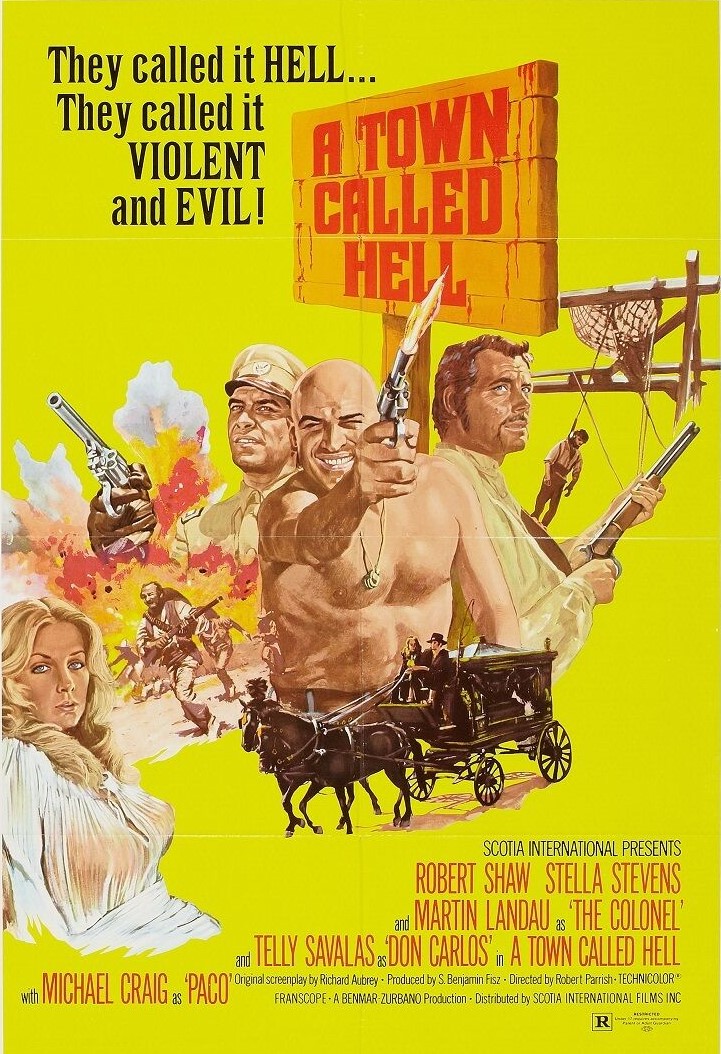
A Town Called Hell / A Town Called Bastard (1970) ***

You think you’re in for something quite stylish when widow Alvira (Stell Stevens) rides into town asleep in a coffin in a hearse. Or when she turns up in a dream as an avenging angel. Or when a rebel, entrusted with funds to buy guns, squanders the cash on women and booze. Or when a Mexican general is so disgusted by informer Paco (Michael Craig) that he refuses to face him. But these are about the only highlights in a bloody, sadistic confusing affair.

And diversity rules. Not only do we have a deaf mute going by the apocalyptic name of The Spectre (Dudley Sutton), there’s also an unnamed blind man (Fernando Rey) who comes in handy because he can recognise people by fingering the contours of their faces.

We begin straightforwardly enough with the massacre in a church of the well-to-do by Mexican rebels led by two unnamed characters (Robert Shaw and Martin Landau). Turns out that’s only the prologue and we cut to a decade later to a town ruled by sadistic sun worshipper Don Carlos (Telly Savalas) who has a tendency to string people up at the drop of a hat. Keeping a low profile is another unnamed character known only as the Priest (Robert Shaw) who may always have been a cleric or who has turned to God after being involved in the massacre. Even so, religion doesn’t prevent him having a mistress.

Alvira is offering a $20,000 reward for the killers of her husband, Montes, a victim of the earlier massacre. To get the money, Don Carlos employs the typical wheeze of framing a couple of villagers, husband and wife, hanging them before their tongues run so loose they can confess it wasn’t them. In a bid to save his own skin, the husband blames his wife.

Don Carlos’s luck turns bad when his sidekick La Bomba (Al Lettieri) decides it might be fun to take over, beginning by shooting off his boss’s fingers before hanging him in the sun. But just when you might think you are getting the hang of what’s going on, the unnamed Colonel (Martin Landau) appears. He’s also looking for information, but not inclined to pay for it. He’s hunting for a rebel leader with, wait for it, an actual name, though this still sounds like a pseudonym, Aguila (Eagle, get it?). For no reason whatsoever, it takes the priest a little while to work out this is his former comrade from the church massacre.

The Yanks were the ones who changed the title from the above. Interesting double bill, though, with Alain Delon as “Le Samourai.” Stella Stevens looks far more provocative
on the poster than she does in the film.

It doesn’t take long for the Colonel to get a grip on the hanging malarkey and with as much relish as Don Carlos, determining to continue hanging the townspeople until they tell him where Aguila is. The two narratives don’t quite mesh, but then what do you expect, this is high on atmosphere, sweating bodies, raw emotions, blazing sun. The Colonel, equally obviously, has given up on being a rebel, presumably because as a government official, he can officially murder people any time he likes without having to round up a gang of rebels to do so.

Every now and then the movie dips into flashback or Paco appears to confuse matters further.

There’s an odd sensibility at work. Maybe this is intended to be one of those down’n’dirty westerns trying to show us how mean the actual West really was (although given it’s set in Mexico, we only need to go as far back as The Wild Bunch, in 1969, to get that point). It doesn’t fit so easily into the spaghetti western canon, either, despite the uniform malevolence.

The oblique tone reminds you more of something that could have been put together by Luis Bunuel, but that would be ranking it far higher than it deserves.

The cast are the biggest plus points, though you might be asking whether Robert Shaw (Battle of the Bulge, 1965) and Stella Stevens (The Mad Room, 1969) were sold a different film entirely. Stevens doesn’t have much to do, except look beautiful and soulful. But Shaw is about the only leading man you’ll come across who so puts his heart into a part that he doesn’t mind being seen actually drooling at the prospect of massacre. In fairness, Telly Savalas (The Assassination Bureau, 1969) and Martin Landau (Nevada Smith, 1966), while not exactly dripping spit, drool in different ways.

There’s enough brooding going on stylistically that you are almost willing it to turn into something not just better but more definable. Alas, no such luck.

Robert Parrish (In the French Style, 1963) does his best with a screenplay  by Robert Aubrey (The One-Eyed Soldiers, 1967) and Benjamin Fisz, in his only writing gig, he was better known as a producer. My guess is they were more script doctors than anything else, the original damage having been done by the uncredited Philip Yordan (Battle of the Bulge).

Could a been something.

https://amzn.to/46Jpk2D

In the French Style (1963) ***

Short stories can be an excellent starting point for movies because usually they are lean and narrative driven, a screenwriter needing basically to fill out the characters and add a subplot. But short stories have one weakness. They require a pay-off,  a twist, something the reader doesn’t see coming. And short of a twist of the caliber of Jagged Edge (1985) or The Sixth Sense (1999), these don’t usually come off, the audience feeling duped.

This one falls down due to a twist. Two actually, because it comprises a pair of initially unconnected short stories, A Year to Learn the Language and In the French Style. Which is a shame because the movie itself  with its Parisian setting is in general charming and conveys the development of young American Christine (Jean Seberg) as she moves from innocent wannabe artist to promiscuous model while worrying she is throwing her life away on transient pleasures.

Writer Irwin Shaw (Two Weeks in Another Town, 1962), who doubles as producer, has used Christine as the link between two of this best-known short stories. So it’s – to dip into soccer parlance – a film of two halves and I’ll let you know right away co-star Stanley Baker (Sands of the Kalahari, 1965) is consigned to the second part, when he meets an older and perhaps more rueful Christine.

So, young, not exactly starving (an allowance from her father funds her lifestyle), artist meets a young Frenchman Guy (Phillipe Forquet) determined to be the antithesis of the standard Frenchman. He doesn’t drink because alcohol is ruining his country. He won’t kiss her in public because not all Frenchman are insanely romantic. He’s severely lacking it has to be said in the romantic gene. Seduction is abrupt. He’s got the key to a friend’s apartment. Let’s go. Is as much subtlety as he can summon up.

So no sex this time and she decides she’ll be the one doing the asking, which upsets his notion of the biddable girlfriend. Anyway, they end up touring Paris on his scooter looking for a suitable no-questions-asked hotel. Surprisingly, the city, according to Guy, isn’t full of them.

And end up in a freezing hotel room. He can’t open the champagne bottle. He insists she undress last, as apparently that’s the done thing. And then he springs his surprise. He’s not only a virgin, he’s not the 21-year-old he told her he was, but still at school and just 16.

If this had been done The Graduate-style, with his awkwardness to the fore, or if she had just been as clumsy, it would probably have worked. There would have been nothing illegal in their coupling, or cringe-worthy (she’s 19 after all), but it just makes her out to be an idiot, fooled because she effectively fell for the first handsome Frenchman to come her way. It just drops a bomb of the wrong kind halfway through the movie.

Cut to four years later and she’s much more the lady-about-town, independent or of questionable morals depending on your point of view, self-sufficient or relying on male companionship to see her through depending on your point of view. Having been dumped by Bill (Jack Hedley), she hooks up with itinerant flamboyant journalist Walter (Stanley Baker) but while he’s off on some important story she’s made hay with more sober American Dr John Haislip (James Leo Herlihy, yes that one, author of Midnight Cowboy) and chooses security over culture and fun.

The problem with this section is that the short story was originally written from Walter’s point of view, as he comes to realize that long-term commitment is not compatible with globe-trotting.

All told, a pretty odd concoction. That it works at all is largely due to Jean Seberg (Breathless, 1960). I’m not totally convinced by her transition. You get the impression that had she met a more worldly Frenchman in the first half she would have quickly shaken him off for another lover. As it is, her rootlessness is meant to be the result of being disappointed by a schoolboy lover. Hmmm!

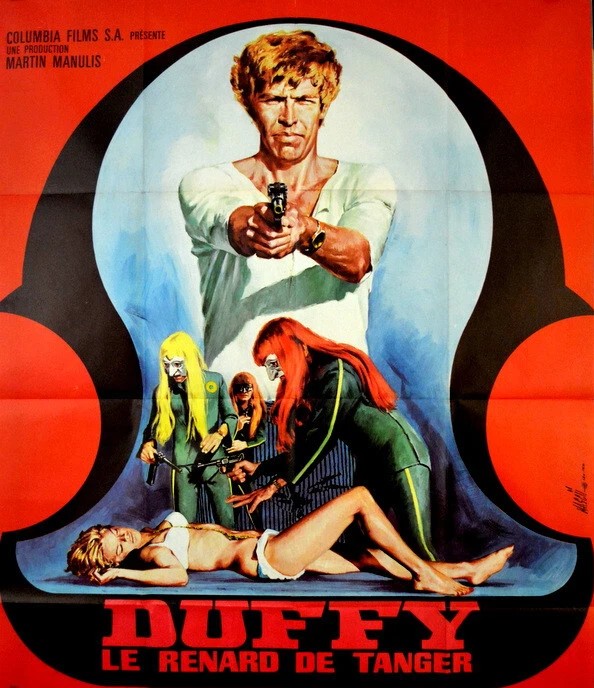
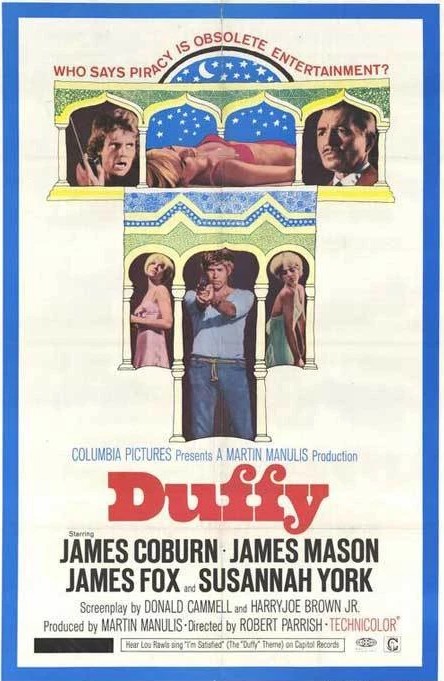
Although there’s over-reliance on Paris atmosphere – jazz club, Arc de Triomphe, restaurants where waiters transport flambe dishes halfway across a room, a “happening” where the art crowd lets it all hang out – and we rely on other characters telling us about Christine’s personal situation, it remains an interesting view of the French capital from the point-of-view of an American ex-pat, who, less successfully than Hemingway perhaps, offers a different perspective on the city. Robert Parrish (Duffy, 1968) directed.

Worth it, though, to see Seberg transformed.

https://amzn.to/470agOY

https://amzn.to/49n6Xmv

Discover WordPress

A daily selection of the best content published on WordPress, collected for you by humans who love to read.

The Atavist Magazine

by Brian Hannan

WordPress.com News

The latest news on WordPress.com and the WordPress community.