Come September (1961) ***

The quite superb concept that underpins the traditional unsettling of Rock Hudson is sabotaged by the inclusion of an unnecessary generation gap element and because one of the youngsters is singer Bobby Darin that throws a musical spanner into the works. The basic set-up is that Lisa (Gina Lollobrigida), the Italian lover of wealthy American Robert (Rock Hudson), is fed up with the part-time nature of their relationship. Although their affair dates back six years, it only lasts for the one month (September) he vacations each year in his luxurious villa on the Ligurian coast.

She’s so annoyed at his lack of commitment that she’s about to marry posh Englishman Spencer (Ronald Howard), that imminent event only put off by the unexpected earlier-than-usual arrival of Robert. Matters are further complicated because his enterprising Italian butler Maurice (Walter Slezak) hires out the villa to paying guests for the other eleven months. To explain the owner’s sudden arrival, Maurice persuades his guests to go along with the notion that Robert is a former owner fallen on hard times deluded into thinking he still possesses the property.

The guests are a gaggle of young women, including psychology major Sandy (Sandra Dee) who proceeds to analyze Robert, and they are herded around by formidable chaperone Margaret (Brenda de Banzie) who prevents Lisa sneaking into her lover’s bedroom.

So enough plot to be getting on with. You’d assume Spencer is going to turn up, maybe with his equally formidable sisters, to cause ructions at the villa. Lisa appears to enjoy making Robert wait the way he has kept her wait, so a gentle shift in power, and there’s going to be an inevitable bust-up so we expect a quick shift into the will-she-won’t-she scenario. Plus, there’s the whole issue of Robert claiming back his villa and dealing with the over-entrepreneurial Maurice.

Instead, the second act enters a whole new realm. Unless one of the girls was going to make a play for Robert, there’s not much reason for them to be there except for the nuisance value and to allow Margaret to flex her authority. An unwelcome quartet of young men, led by Tony (Bobby Darin), embark on the equally unwelcome task of wooing of the young ladies, Tony having his eyes on Sandy. Although various romantic entanglements are enacted, that’s not what takes center stage.

Instead, the bulk of the middle section scarcely involves the Robert-Lisa quandary and instead it’s devoted to an endless battle between Tony and Robert as the younger specimen attempts to prove he is mentally and physically superior. Now the one element that had made these Rock Hudson comedies work was his helplessness. He may occasionally be smart or wealthy but the whole point of these stories was for a woman to run rings around him or at the very least drag him way out of his comfort zone.

Seeing Robert best Tony – endlessly – takes the shine off the picture and it’s not until Robert is revealed as a sanctimonious hypocrite, living by a double standard, that the movie catches fire again as Lisa storms off in a huff and we can settle down to some good old-fashioned will-she-won’t-she.

This proves a very successful change of pace for Gina Lollobrigida, and she reveals herself to be such a splendid comedienne that it became part of her repertoire – reunited with Hudson for Strange Bedfellows (1965) and leading a pack of men a merry dance in Buona Sera Mrs Campbell (1968).

There’s nothing particularly wrong with Rock Hudson. He’s good comedy value, but the second act ruins it. Bobby Darin (Pressure Point, 1962) and Sandra Dee (A Man Could Get Killed, 1966) act as if they’re in a completely different movie, of the frothy beach variety. Walter Slezak (The Caper of the Golden Bulls, 1967) is an adept scene-stealer. Look out for Joel Grey (Cabaret, 1972) in an early role and Brenda de Banzie (I Thank a Fool, 1962).

Directed by Robert Mulligan (The Stalking Moon, 1969) with a screenplay by Oscar-winning Stanley Shapiro (Bedtime Story, 1964) and Maurice Richlin (All in a Night’s Work, 1961).

A hybrid that rocks the wrong boat.
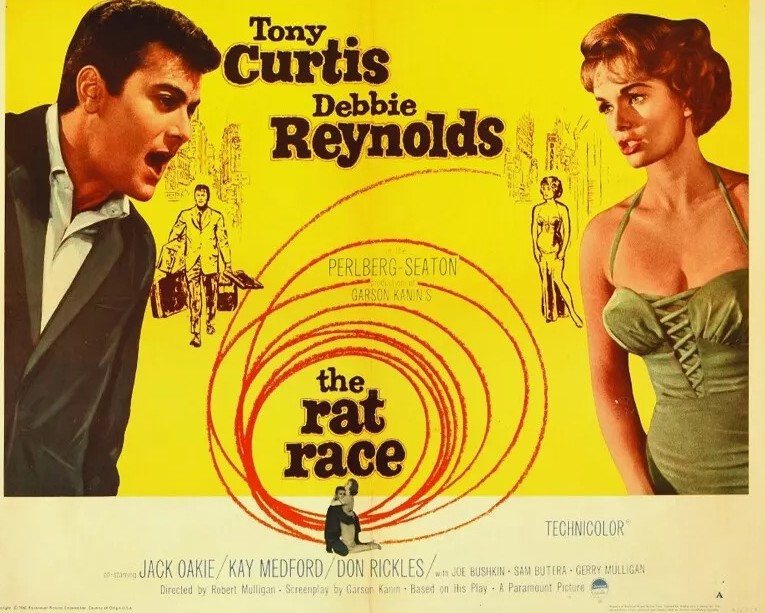
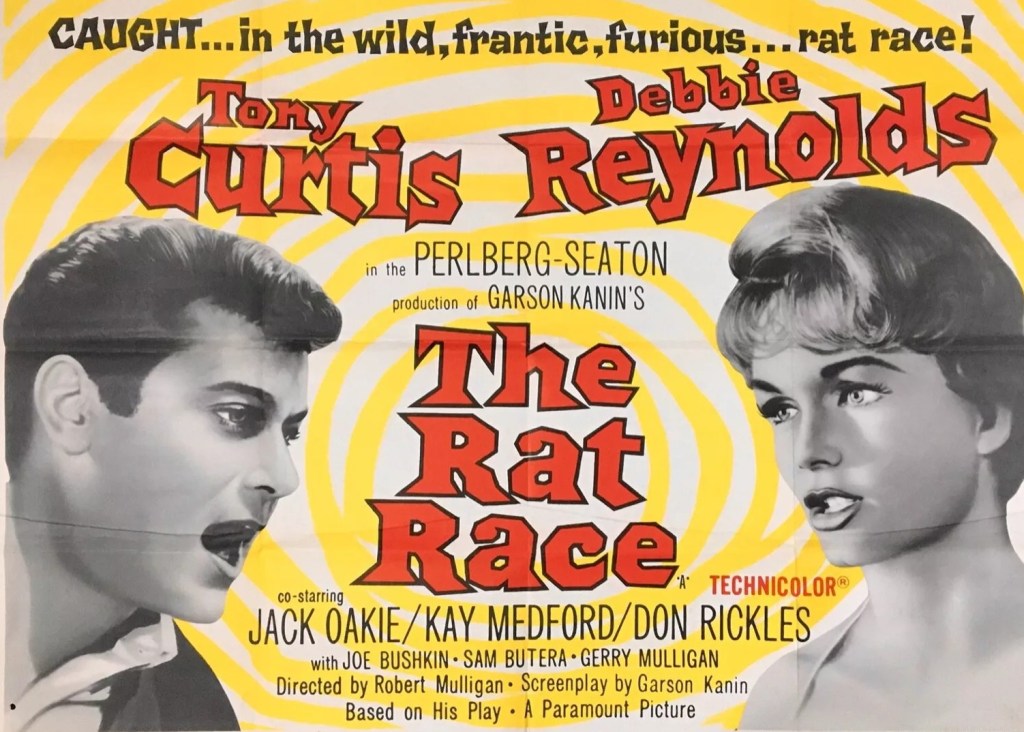
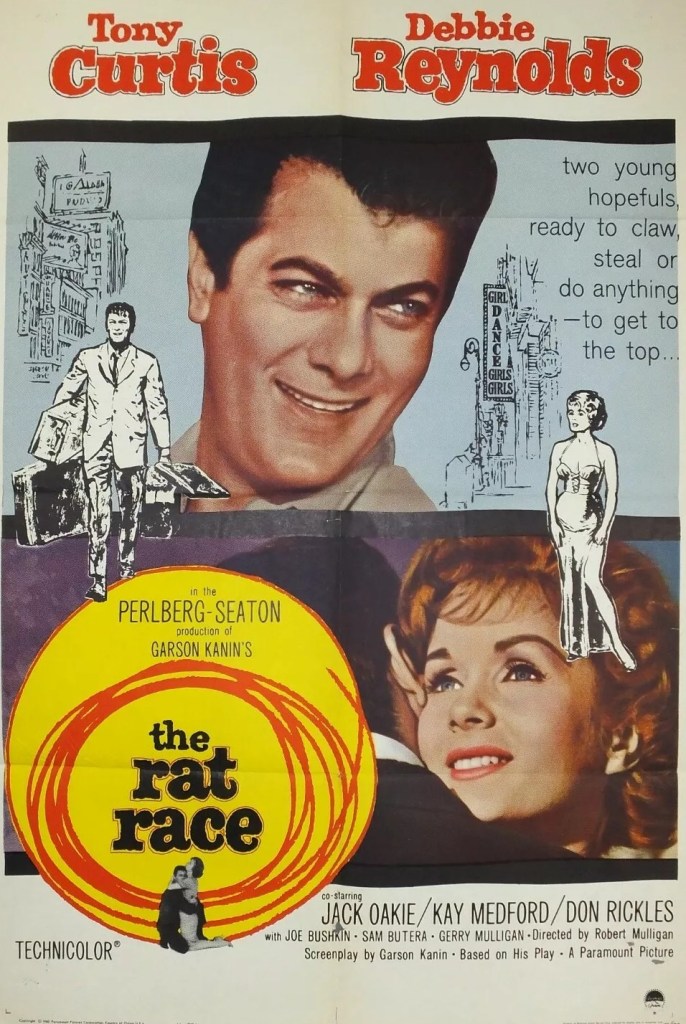
The Rat Race (1960) ****

Surprisingly hard-edged tale with Debbie Reynolds giving the performance of her career and with a steely contemporary relevance. Snookers the audience into thinking it’s a standard romance, mismatched characters thrown together by circumstance, various rows and incidents to keep them apart before the expected happy ending. If screenwriter Garson Kanin had held his nerve, there wouldn’t be the get-out of a happy ending. As it is though, a formidable drama that doesn’t pull its punches.

From the title I expected a movie set in the world of big business, but instead we’re looking down on the lowest tiers of the entertainment business and, effectively, it’s a piece about the price paid for dreams. There are laffs, some good one-liners, but even these have a sourness to them.

Pete (Tony Curtis) leaves Milwaukee for New York seeking fame and fortune as a saxophonist, not realizing he’s more likely to join the thousands of out-of-work musicians already resident, dreams dashed but determined to avoid the ignominy of going home with their tails between their legs, not just to face the mundane life that awaits but seared through with the guilt of failure. Through circumstance he ends up sharing an apartment with model-cum-dancer Peggy (Debbie Reynolds), who’s already given up on her dream once, but couldn’t stand more than a few minutes of the home she’d clearly been desperate to leave.

Peggy is clean out of modelling assignments and hasn’t made it to Broadway, either, not even to a chorus line. Instead, she earns not much of a living as a taxi dancer, more innocent than it would be now in the era of the lap-dancer but still seedy enough with roving male hands. She’s paid to dance with complete strangers, the kind of deadbeats unlikely to ever get on the dance floor with a beautiful woman in the normal course of events.

She’s about to lose her phone, but not above leading on the creepy repairman (Norman Fell) to believe he’s onto a promise should he give her a break. Only pride prevents her solving her financial problems – as well as not making her rent she owes cash to her sleazebag boss Nellie (Don Rickles) – by going down the sex worker route.

Pete thinks he’s got the smarts but in fact he’s afflicted with dumbness and gets ripped off for a mink coat made of cat fur and then loses a complete set of brand-new musical  instruments to another scam. When he’s thrown the lifeline of a gig on a cruise ship, Peggy stumps up to buy him a new sax and the requisite tux. She’s paying for this with a promise to Nellie to enter the prostitution game, not quite spelled out as that but as close to the knuckle as you’re going to get in this era, the kind of soft-soap approach that worked for Butterfield 8 (1960).

When Peggy fails to deliver, Nellie humiliates her in the worst possible way. Beginning with her jewellery he strips her down to undergarments to show how much he owns her and just how good he is at playing hardball. It’s a gut-clenching scene. Sure, you know there’s not going to be any nudity, not in this period before the Production Code got flattened, but even so, it works extraordinarily well, especially as clearly Peggy doesn’t know just how far he will go and that he might not, in his quiet fury, be above turning her out into his club starkers.

Meanwhile, to ensure we get to the ending that audiences expected, Pete, on board the ship, has been ignoring any other romantic opportunities, and sending her a heartfelt letter a day, which she appears determined to ignore, knowing that the “rat race” isn’t the kind of world that accommodates long-term romance.

Suffice to say, when Pete manages to bail her out, that changes her mind, though the genuine Peggy would still have balked, knowing that, with their levels of talent, they were only going to become more wasted by lack of fulfilment.

So, yeah, happy ending, but you feel that’s been grafted on to allow audiences to take the rest of the tougher storyline. The MeToo campaign has exposed the pitfalls of the entertainment business, so what happens to Peggy wouldn’t come as a surprise to a contemporary audience.

By this point Debbie Reynolds (Goodbye Charlie, 1964) wasn’t known for drama, more for a spunky or sparky screen persona in a series of lightweight comedies or romances, this showed Hollywood what it was missing. Tony Curtis (Goodbye Charlie) had proven he could do comedy or drama and here he mostly plays it straight.

Director Robert Mulligan (The Stalking Moon, 1968) is probably responsible for maintaining the harder edge. This was originally a Broadway number, so I doubt if the sharpness would have worked so well in that medium. Garson Kanin (Where It’s At, 1969) and an uncredited John Michael Hayes (Nevada Smith, 1966) knocked out the screenplay based on the former’s play.

Worth it for Reynolds alone.

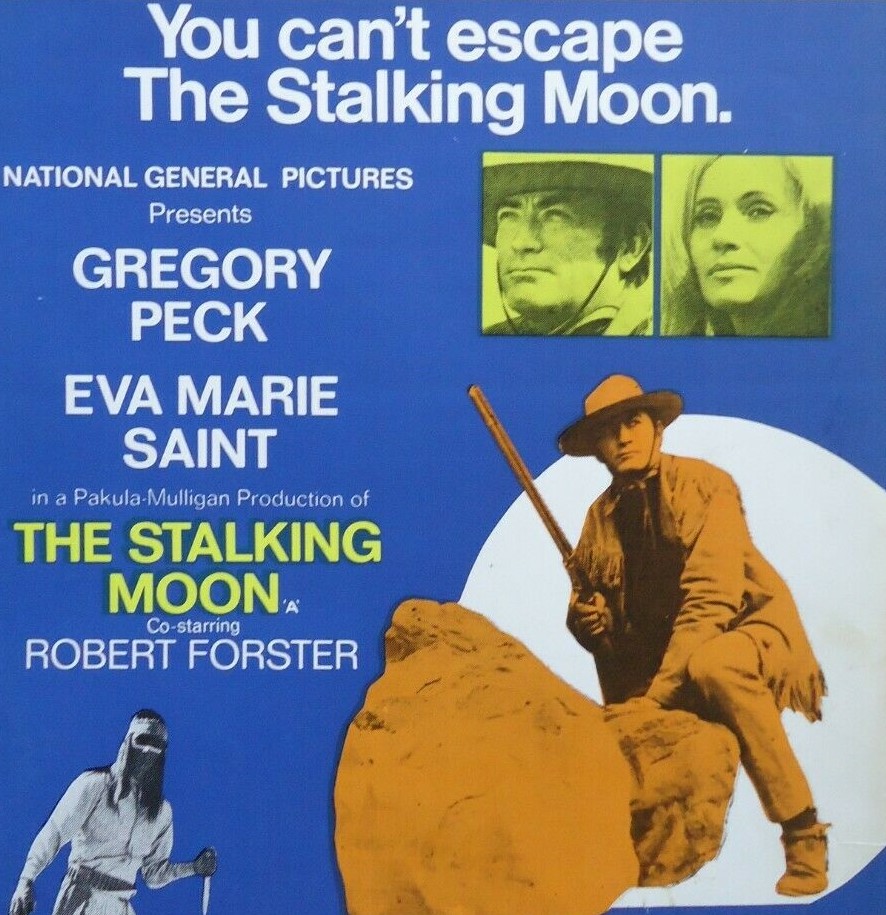
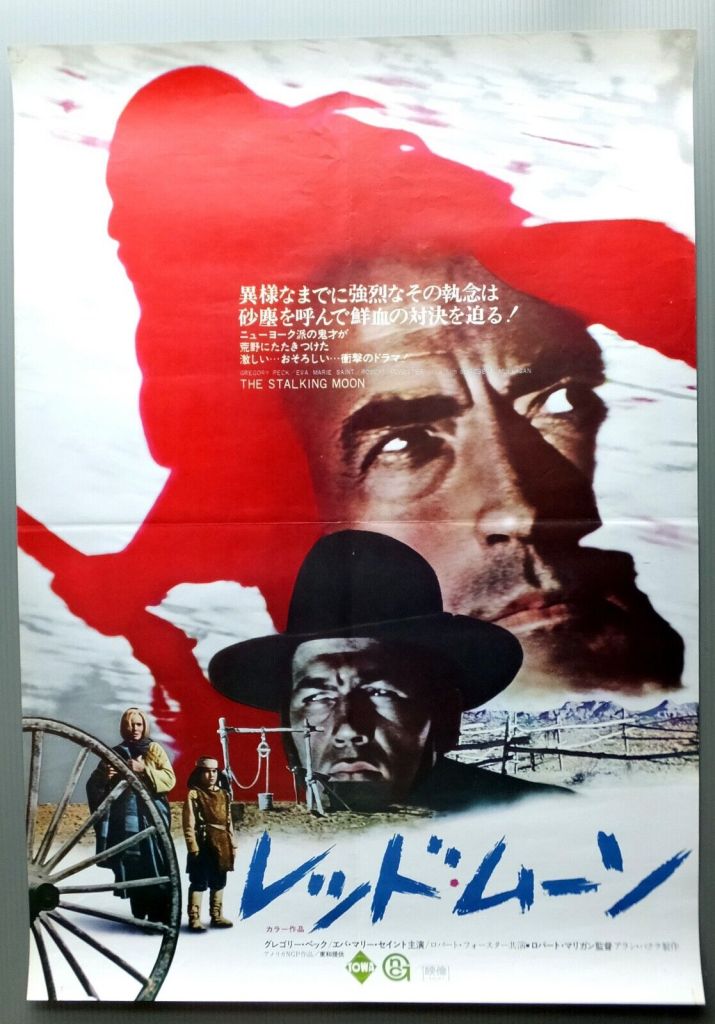
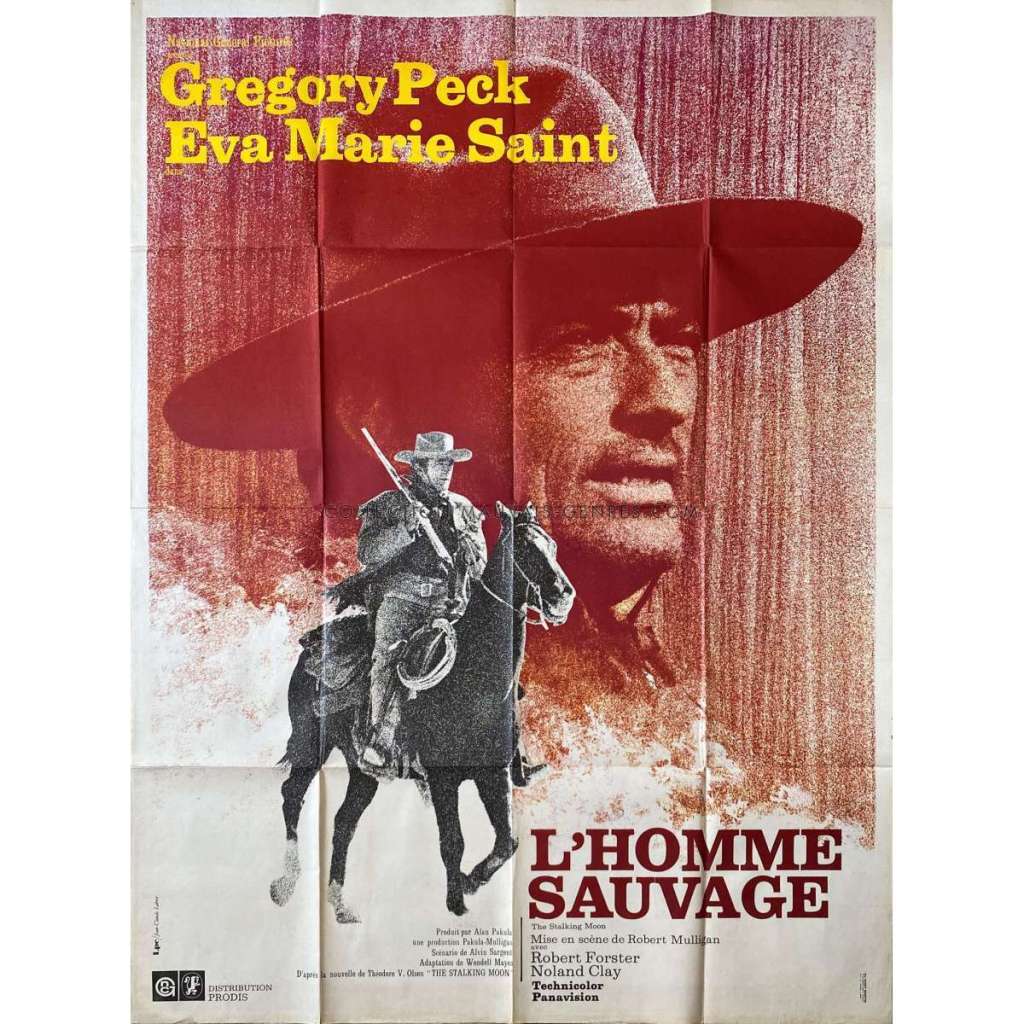
The Stalking Moon (1969) ****

About-to-retire Indian scout Sam Varner (Gregory Peck) helps the U.S. Cavalry round up Indians to take to reservations. One of these is American Sarah Carver (Eva Marie Saint) who, with her Apache son, is attempting to escape her vengeful Apache husband Salvaje (Nathaniel Narcisco). Varner agrees to take her to the nearest stage coach post, and then to a train depot, and, finally, to his ranch in New Mexico where they enjoy a period of security. But wherever she goes, death follows, culminating in a shootout in the hills around his ranch.

But the treatment by director Robert Mulligan (Up the Down Staircase, 1967) is far more complicated, often asking questions that cannot be answered, and placing the principals in situations that cannot be easily resolved. Sarah Carver has not gone running in order to find a man to save her; she does not think she can be saved and accepts the inevitable. She feels guilty for “lacking the courage to die,” of accepting Salvaje as her husband instead of dying along with the rest of her family when attacked a decade before by Indians.

She is weak in other ways, hiding the identity of her husband from the Army and everyone else in case she is abandoned. She shows no great bond with her son, who, several times, attempts to escape.

Sam Varner is very much an ordinary guy, just wanting to quit the Army and work his ranch. He is not the traditional extrovert western hero, nor the man who reluctantly takes up arms.  He has no wish to get involved with Carver and each time he does agree to help it is with a time-limited condition attached and these scenes lack any sense of meet-cuteness, no romantic interplay hastening him to a decision, little expectation that either party is angling to fall in love.

It is practicality rather than intimacy that makes them share a blanket during a dust storm and he asks her to come to his ranch because he will get on with the work quicker if he has someone to cook. In fact, his honesty prevents that: he confronts her over the fact that she “put us out here knowing all the time that he’d come after us” and making her face the corpses of men who died because she hid the truth. He is honest with his emotions and he is determined (“I got a place to go and I’m going”). But he bears none of the normal western hero’s traits, neither a hard drinker, loner, or gunman. He is not gauche like James Stewart or malevolent like Clint Eastwood. 

Even more unusual is the treatment of Salvaje. Despite the savagery of his actions, there is within him a sense of honor. He only chases his wife because she has stolen his son; there could be no greater affront to his dignity. The story is told from the point of view of the pursued i.e. Sarah Carver. But, by turning that perspective on its head, The Stalking Moon more easily fits into the category of revenge western, characteristically a picture concerning chase and pursuit by someone who has been wronged.

The director takes a bold step in the presentation of Salvaje. He is not seen at all in the first hour, then in just a few glimpses of a shape, his face only revealed at the climax. He is a ghost and a killing machine combined. Like a latter-day “Terminator,” he cannot be stopped, so skilful he evades capture, and relentless.

It is also, unusually for a western, a thriller. The tension mounts from the discovery, at the 10-minute mark, of Salvaje’s first three victims, all fully-armed soldiers, and the news, one minute later, that he single-handedly killed four troopers previously. At Hennessy, a staging post, when Varner and Carver go out into a dust-storm to search for her son who has run away, they return to find all dead. Everyone they left behind at Silverton, a train depot, is also killed.

Initially, Carver appears impatient, not willing to wait five days for an Army escort, but once she reveals who the boy’s father is, the reason becomes clear, and her desire for speedier transition creates more tension. Even in New Mexico, the death toll mounts, once Salvaje arrives. Now the trap closes in on them. Even the ranch house cannot prevent Salvaje from sneaking in and kidnapping his wife, leaving her for dead outside.

When Varner and a fellow scout, the half-breed Nick Tana (Robert Forster), attempt to turn the tables on Salvaje and track him down, it ends in Tana’s death. Although most of the tension comes from the will- he-won’t-he dynamic, there are number of Hitchcockian touches such as offscreen sound cues triggering alarm in characters. In two instances, a door provides shock.

Far from providing the expected relief, the ranch house merely provides a claustrophobic setting for the characters. Varner is trapped with an inarticulate pair. Instead of arrival at the ranch house precipitating emotional response and romantic interlude, as would be par for the course for other westerns, Varner finds himself stuck with a woman who refuses to talk and a boy who does not understand a word he says. The seven-minute scene where he sits down to eat and then has to virtually command mother and son to join him and encourage them to talk even if it is just to say “pass the peas” is one of the most awkward ever filmed. 

The movie is so darned awkward that you never laugh even at the few moments of comedy, the complicated issuing of train tickets, Varner keeping up a one-sided conversation at the table, Nick’s attempts to teach the boy poker. Relationships are more likely to remain in limbo than move on to any romantic or sentimental plane.

The film has a tight structure, the first 40-odd minutes setting up the story and tracing Varner and Sarah’s journey to the ranch house, the next 20 minutes at the ranch alternating between comfort and discomfort as emotional release battles with restraint, the final 40 minutes the physical battle between the mostly unseen enemy and the farm occupants. 

Stylistically, it is exceptional. The first section is all open vistas, characters minute figures on vast landscapes, the middle section suggests harmony with nature, and the final battle alternating between being the hunter and the hunted. When we first see Varner he is picked out along the edges of the screen as he leaps up or down or across rocky hillsides. That he appears and disappears at will could almost be the motif for the film.

Virtually everyone is in long shot or medium shot for the first half. Varner appears on the periphery of the screen and the action. He enters scenes where something important is being discussed, such as Sarah’s pleading to be allowed to leave the Army camp quickly. Most directors present Gregory Peck with aura intact, keeping him motionless on the screen to maintain his authority, but here he is always on the move, walking across open ground or confined spaces or darting across hillsides or through bushes, dashing on foot down slopes or racing on horseback.

Although the script – by Alvin Sargent (Gambit, 1966) and Wendell Mayes (Von Ryan’s Express, 1965) based on the T.V. Olson (Soldier Blue, 1970) novel –  was viewed in many quarters as being underwritten, in particular Sarah’s role, and that there were too many silences for comfort, in the view of many  that is the strength of the picture. There is none of the easy dialogue, crackling lines, coarse confrontation, sentiment or raw emotion of other westerns.

The movie hardly even skirts a cliché. This is in a class of its own in terms of the distance characters maintain between each other. Varner has very little to say, Sarah’s guilt restricts her vocabulary. In one regard the thriller element gets in the way of a study of two remote characters.

If I have any reservations about The Stalking Moon it is that is neither enough of a thriller nor enough of a character study. George Stevens might have sought emotional resolution and producer Alan J. Pakula, who later went on to direct Klute (1971) and The Parallax View (1974), might have proved more adept at marrying the thriller elements to personal anguish. Although The Stalking Moon may not have entered the pantheon of the greatest westerns, it is a very noble effort indeed, its slow pace and lack of dialogue providing it with a very modern appeal.

Baby, The Rain Must Fall (1965) ***

Nothing to live on but dreams and, in those days, no social media to bail them out. Spare sad lives in Small Town U.S.A. told with an occasional grand guignol touch. Look elsewhere for the laconic loner of Steve McQueen legend, to, for example, The Cincinnati Kid, out the same year.

This has the feel of a vanity project, the actor’s Solar outfit taking a production credit, as if the star felt he wouldn’t properly be recognized as an actor unless he had a ton of lines to chew through. And he might be right to feel aggrieved, wildly contrasting roles from Daniel Day-Lewis in movies that opened the same day in New York two decades later had critics reaching for the superlatives. 

By my reckoning, this was the last year, save for occasional outliers like In Cold Blood  (1967), when studios accepted the hi-falutin’ notion that filming in black-and-white added artistic luster regardless of the damage it might do to a picture’s commercial prospects. The mono approach is taken to extremes from time to time, the contrast so sharp it might have emanated from the Ingmar Bergman school of cinematography. And given the desultory lives picked over, this might have fared better with subtitles, the kind of foreign picture that arthouse audiences fawned over.

Prison parolee Henry (Steve McQueen), entitlement hormone running amok, has got it into his head that if only he had the funds to reach Hollywood or Nashville (either would do) his singing and song-writing talent would be recognised. This puts wife Georgette (Lee Remick), newly arrived with small daughter, in the position of going out to work to keep the family, altering her domestic situation from independent single mother to wife in thrall to waster husband.

She’s supposedly no dupe either, rejecting the kindness of strangers, as if aware it usually comes with strings attached. It’s a given that any time a child enters a romantic equation you can be sure the narrative will turn on parenthood and responsibility. And that’s pretty much all the story there is.

You can guess from the outset that while Henry’s singing might set a few female hearts zinging, it’s not likely to win him a contract. So the question is, really, whether Henry can settle down and not be so swift to resort to his knife when confronted with a messy situation.

It’s marred by a couple of truly terrible scenes, a poorly-choreographed fight and a really odd sequence that has Henry declaiming with his back to a tableau of motley characters with the contrast at its sharpest. And in what looks like nothing more than an old haunted house.

It’s well-meaning enough and for the most part McQueen dispenses with the tough-guy attitude, but he doesn’t really offer enough in its place. It’s the kind of role that could easily have been delivered as effectively by any number of actors with nothing approaching his star quality. And that’s a shame because he really is trying – though it’s the trying that gets in the way, you keep on waiting for the real Steve McQueen to turn up.

If director Robert Mulligan (Up the Down Staircase, 1967) hadn’t been so determined to paint it in downbeat arthouse tones, the actor might have felt free enough to come up with a genuinely original turn. Though I accept it’s a bit unfair to complain about McQueen attempting something different, there’s no real excuse for him creating the worst singer ever to hit the screen.  

You might also note, by the way that whereas McQueen takes pole position on the poster, in the screen credits Lee Remick (Days of Wine and Roses, 1962) is top-billed. Remick is better than McQueen because she has a deeper well of emotions and wider range of characterizations to choose from. You never feel she is acting to save her career or hope that Oscar voters might nod in her direction.  

The movie makes more sense once you understand it really belongs to the 1950s –  the Horton Foote (To Kill a Mockingbird, 1962) Broadway play on which it is based was staged in 1954. The movie fatally switches focus from Georgette to Henry before working out which actor was likely to best convey the happiness drought on which the work depends. There’s more than enough sadness to go round but it just seems solidified from the outset. No great harm – that may well be the truth of it – but it prevents the movie taking off, stuck as it is in recycling Henry’s weary past. Don Murray (The Viking Queen, 1967) makes a good fist of a widowed sheriff.

Worth a look to see McQueen tackling something different. You decide whether he succeeds or fails.

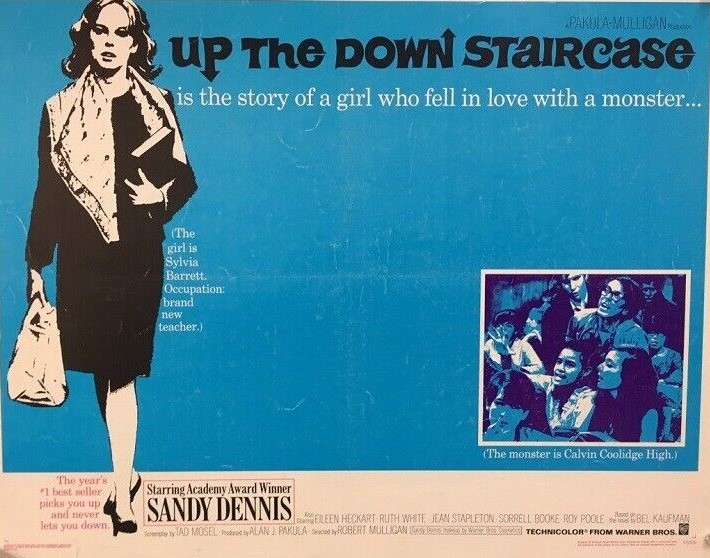
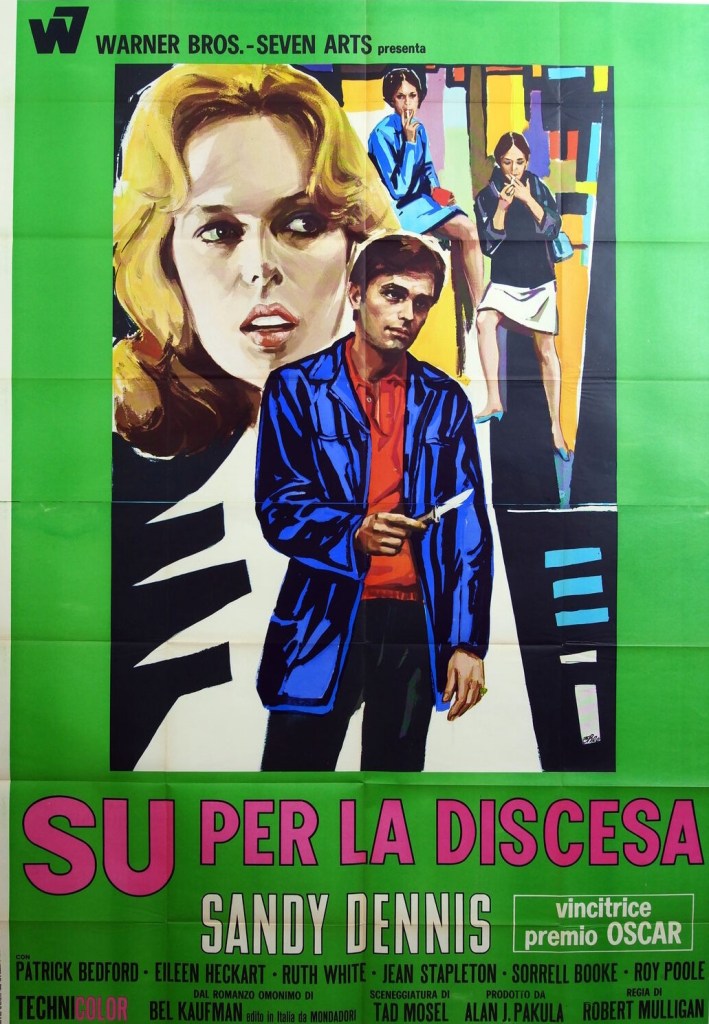
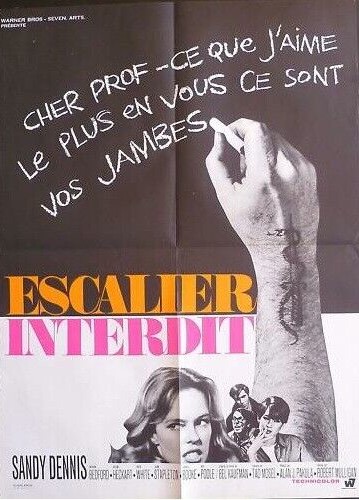
Up the Down Staircase (1966) ****

Impressive impressionistic tale of naïve young teacher and her travails in a rough inner city New York high school, a world away from the preppie hi-jinks of The Group the previous year and a good bit more realistic and less sentimental than To Sir, With Love the same year. If you thought teachers had a tough time these days, it was no better half a century ago.

We get no insight into the home life of idealistic singleton Sylvia (Sandy Dennis) beyond that once a week she gets a phone call from her annoying mother. Outside the school, she is warned to walk slowly in order to show she is not frightened to walk down these mean streets.

The school appears chaotic, hordes of almost-adult kids rampaging along corridors, hellbent on causing anarchy. And it takes some objective observation to realize that the endless rules,  sometimes delivered by intercom and very often improvised on the spot, imposed by the tough headmaster McHabe (Roy Poole) have created a semblance of order.

But if the kids are led astray by inherent attitude, the adults are undone by bureaucracy and petty infighting. A list of rules on the wall forbids the school nurse from actually treating any patients. There’s a marvellous librarian whose reaction to an attempted suicide is to demand the return of an overdue book. Teachers squabble about who has precedence to use a particular drawer. Budding novelist and lothario Barrington (Patrick Bedford) spends his mornings in a local café, an adoring secretary covering for his absence.  

The end-zone in all movies about schools (excepting If…a couple of years later) focuses on a struggling teacher who doubts her abilities but finds worth in her calling. Although that cliché pops up towards the end, mostly it’s an examination of the terrible home lives, seen in snippets, of the pupils and their parents, possibly who had the same experience, of viewing schools as obstacles to life and nothing more than the existing hierarchy’s way of keeping them in their place, education peeceived as akin to a police force exacting penalty.

With her fragile beauty, posh voice, and ideas of converting teenagers to the joys of Chaucer, Dickens and myriad poets, you would expect Sylvia to be gobbled up by the system. And at times, her quivering lip goes into overdrive, but that masks an inner determination not to fall for any sob stories – no matter that the audience will lap them up – and to extricate herself from dangerous situations with the macho Joe (Jeff Howard) who is convinced she won’t hand in him for carrying a switchblade and that she must be in love with him.

Pupils fall into three categories: those who fall in love with their teachers, those who want to kill them and those who are dying of boredom, living day-to-day in catatonic indifference.

Sylvia’s understated refusal to be intimidated carries the day and, while she encourages, realizes that she can’t resolve the endemic social issues – children battered at home or who have to work at night or who are brought up by a series of neighbors – by inflating a pupil’s mark just to help out. There’s none of the grandstanding of Dead Poets Society (1989) or Mr Holland’s Opus (1995) either, no individual or group who, in dramatic fashion, demonstrates allegiance, sides with the teacher or proves a test case for the teacher’s brilliance.

If Sylvia makes any impact, it’s shown in a small way by awkward pupil Alice (Ellen O’Mara) who believes all literature is about love and is humiliated by Barrington. Sylvia hasn’t the personality to collect a coterie of adoring pupils as in Dead Poet’s Society, nor like Robin Williams there have the confidence to chuck away set texts and do it his own way. But it would be a close run thing as to who would be the better teacher. Williams should win by a neck given his exuberance, but Sylvia, the mouse, is actually the better teacher.

It’s pretty bold of director Robert Mulligan (Inside Daisy Clover, 1965) to actually force the audience to watch Sylvia dissect the opening paragraphs of A Tale of Two Cities in order not just to prove what an insightful teacher she is but to demonstrate her command of her once-rowdy class. The show of hands of pupils desperate to ask questions is testimony to her quiet methods.

Superb performance from Sandy Dennis (The Fox, 1969), showy one from Patrick Bedford, touching one from Ellen O’Mara and with Jeff Howard attempting to channel his inner James Dean, but, for the last three, unusually in a film stuffed with newcomers, their roles did nothing for their careers. You might spot Bud Cort (Harold and Maude, 1971),  Eileen Heckart   (No Way To Treat a Lady, 1968), and Jean Stapleton (Emmy award winner for All in the Family, 1971-1979) but mostly it’s cameos in an ensemble picture.

Expertly mounted by Robert Mulligan with a screenplay by Tad Mosel (Dear Heart, 1964) from the Bel Kaufman runaway bestseller.

As much as it has you rooting for the little guy, it doesn’t gloss over the calamities schools are left to deal with.

Inside Daisy Clover (1965) ***

Exploitation Hollywood. Cautionary tale of young singer in the 1930s seduced by the movies only to discover she is regarded as a plaything and a profit center rather than a human being. Not highly regarded at the time despite being directed by Oscar-nominated Robert Mulligan (To Kill A Mockingbird, 1962), gained greater traction since #Me Too!

At the time the central performance by Natalie Wood (Cash McCall, 1960) seemed too much one-note, but on reflection, despite the endless popping and swivelling of her eyes (you can always see the whites, often to her detriment in acting terms), it appears a much truer reflection of a teenager caught in the headlights of the fame- and money-making machine. Christopher Plummer (Lock Up Your Daughters, 1969) delivers a devilishly restrained performance and there’s the bonus of an over-the-top turn by Robert Redford (The Chase, 1966), named Most Promising Newcomer in some parts.

The odds are stacked against Daisy Clover (Natalie Wood) from the start, living in a shack on a beachfront with an insane mother (Ruth Gordon), earning a living forging signatures on movie star portraits, but with a secret yen to become a singer. After sending a demo disk, cut in a fairground booth, to Swan Studios she finds doors opening. Raymond Swan (Christopher Plummer) turns her into a star. Having committed her mother to an institution, and for public consumption announced her dead, greedy Aunt Gloria (Betty Harford), now her legal guardian, signs her niece’s life away.

It’s almost docu-style in the telling, very few close-ups, most long shots, even in groupings the camera seems awfully far away, and the Hollywood we are shown is mostly the giant empty barns of shooting stages and the never-seen elements, like post-synching in a booth. Daisy never seems to be enjoying herself, except when, although underage, is seduced by movie idol Wade Lewis (Robert Redford) who abandons her the morning after their wedding and can’t resist a “charming boy.”

Mostly, she is the puppet, dressed in glamorous outfits, her life re-invented for the fan magazines, freedom curtailed, living in a suite in the grand mansion of Swan and wife Melora (Katharine Baird), who, it transpires, is an alcoholic and at one point cut her wrists. Most of the time Daisy just seems frozen, locked into a character she doesn’t recognize, kept at one remove from her mother, turned into a money-making machine.

She’s too young to be a Marilyn Monroe and too old to be a Shirley Temple. The most likely template in Deanna Durbin (Mad About Music, 1938), who after being rejected by MGM, struck gold with Paramount as a 15-year-old, but, ironically, in terms of this picture, proved as hard as nails, not only negotiating contracts that turned her into the highest-earning star in Hollywood but quitting the business before it ate her up.

Except she doesn’t put anyone down. She’s nobody’s idea of a winner despite this clever piece of publicity.

Daisy shifts from being able to fend off unwelcome attention from an erstwhile boyfriend while poor to being seduced, while rich and theoretically more powerful, by anyone who shows her the slightest kindness, including her boss after she’s dumped by Wade. Swan bears a close resemblance to Cash McCall, making no bones about his money-making intentions and viewing every employee in terms of profit, but using charm to mask his ruthlessness. When the façade breaks, it’s one of the best scenes.

The odds are also stacked against anyone looking good. This is a parade of the venal, everyone destroyer or destroyed. The fact that actors with no other talent earned vast fortunes from a business that was willing to underwrite their flops (Natalie Wood, herself, a classic example) and must have enjoyed some aspect of their wealth, if not in just being rescued from abject poverty, doesn’t enter the equation.

Although there is no doubt there is a Hollywood publicity machine, a lot less attention is paid to the power of the Actors PR which has managed to convince the public that no matter how much the stars earn ($20 million a picture for some) they are still poor wee souls at the mercy of terrible studios  willing to gamble enormous sums ($295 million on the latest Harrison Ford, more for Fast X) on their box office potential.

But let’s not digress.

While the picture-making style is unusual, it’s worth appreciating the deliberate effort Robert Mulligan has put in to de-glamorize the star system. Brit Gavin Lambert (Sons and Lovers, 1960) wrote the screenplay from his own, more brutal, bestseller.

This cold-hearted expose is just what Hollywood deserves. That Daisy is a minor when taken advantage by Wade is mentioned just in passing, and from the actor’s perspective (it could damage his career). That vulnerable women are kept in that position was no more heinous then than it is now.

Discover WordPress

A daily selection of the best content published on WordPress, collected for you by humans who love to read.

The Atavist Magazine

by Brian Hannan

WordPress.com News

The latest news on WordPress.com and the WordPress community.