The Wrong Box (1966) ***

Somewhere between SBIG (So Bad It’s Good) and WAL (Worth a Look), The Wrong Box is a black comedy in the wrong directorial hands. Better known for thriller Seance on a Wet Afternoon (1964) and POW drama King Rat (1965) Bryan Forbes struggles to bring enough comedy into the proceedings or to wring sufficient laughs out of what he has.

Neither the wit nor the slapstick is sharp enough. But it does exhibit a certain charm. Essentially an inheritance story, it pivots on the notion that the two potential inheritors are on their last legs and putting one, Joseph Finsbury (Ralph Richardson), out of action will benefit dastardly nephews Morris Finsbury (Peter Cook) and John Finsbury (Dudley Moore) of the sole survivor Masterman Finsbury (John Mills).

It turns out Joseph Finsbury is not dead. That does not cue as much hilarity as it should., as the nephews plot to send him to his grave. Given the idea was dreamed by none other than Robert Louis Stevenson of Dr Jekyll and Mr Hyde fame, you can imagine it was written less with comedy in mind.

With so much dependent on set-pieces, it’s rather a hit-and-miss affair, with the conspirators’ failures not matching the humor of watching potential victims escape their proposed doom. Only occasionally does it sparkle.

Surprisingly, the film relies on affecting performances from the shy, retiring Michael Finsbury (Michael Caine), a gentle soul, who enjoys a very innocent romance with Julia Finsbury (Nanette Newman), a young woman terrified of being murdered, which condition provides ample opportunity for her to be rescued/consoled. who enjoy a very innocent romance.

Ralph Richardson steals the movie as a dotty pedant, weighted down with erudition and a knack, equally, for boring the pants off anyone within earshot and for escaping from the jaws of death including a massive train pile-up and several murderous attempts.

Michael Caine, in a follow-up to The Ipcress File (1965) and Alfie (1966) convincingly plays against type. John Mills (The Family Way, 1966) also plays against type as a villain rather than Hitherto, I had been rather sniffy about Nanette Newman (Deadfall, 1968),wife of the director, but here she is delightful.

Peter Cook (A Dandy in Aspic, 19680 and Dudley Moore, in his movie debut, let the show down by being so obviously the personalities from their comedy series Not Only…But Also (1964-1970), a partnership that works so well on television just frittered away here from what looks like characterization with nowhere else to go. But there is a nice cameo from Peter Sellers (The Millionairess, 1960) as an inebriated doctor.

Hard to say whether the blame lies with Larry Gelbart (The Thrill of It All, 1963) for his screenplay or Bryan Forbes for his direction.

Michael Caine got it spot-on when pointing out in his autobiography that it was a “gentle success in most places except Britain” precisely because to foreigners it represented an acceptably stereotypical view of a country full of eccentrics while to Brits it was all too stereotypical. So if you’re from America or other points global you might like it and if you are British you might not. On the other hand, the score by John Barry is one of his best with a wonderful theme tune.

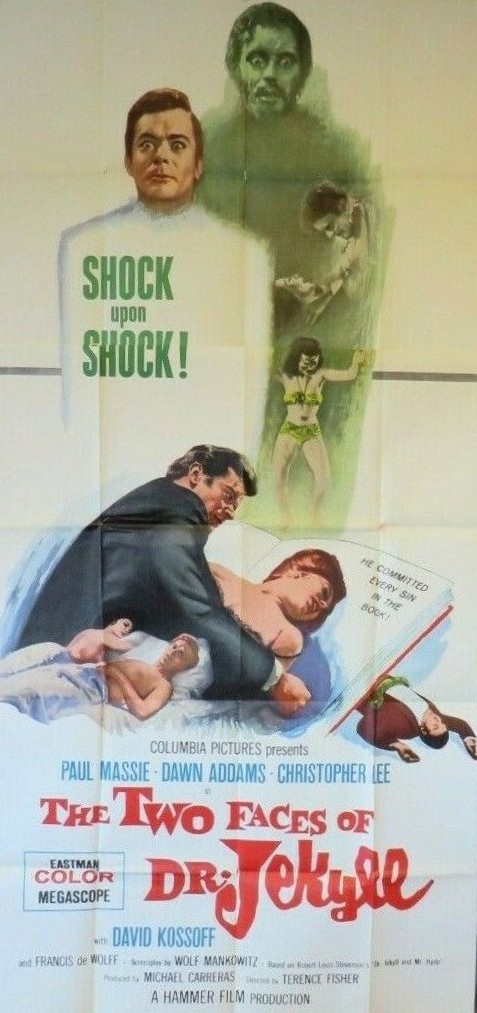
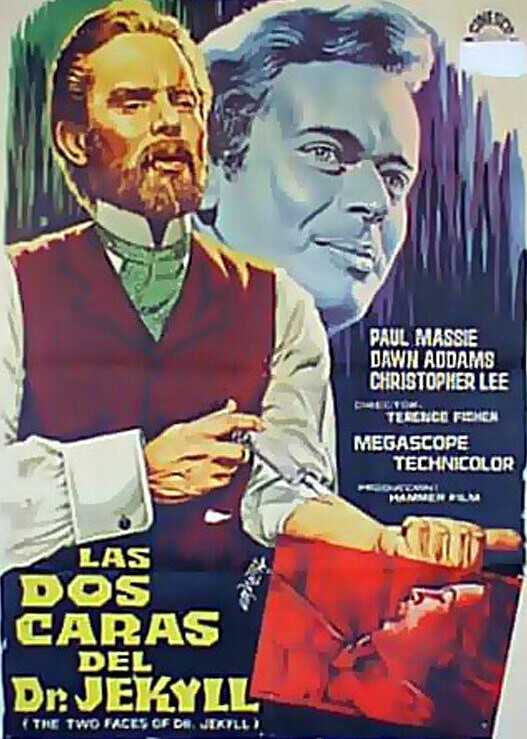
The Two Faces of Dr Jekyll / Jekyll’s Inferno / House of Fright (1960) ****

One of the most shocking films of its day with its unusual focus on sex and violence, this takes the famed Robert Louis Stevenson tale down a different direction in that Dr Jekyll enjoys the base animal instincts he has unleashed with his experiments rather than expressing remorse or guilt. Evil has never been more demonstrably enjoyed.

Dr Jekyll (Paul Massie) is a shy cuckolded scientist when he takes the magic elixir that diverts his dull personality towards a more dynamic, if ultimately perverted, destination. From being fearful of life, he begins to sample its more exotic pleasures under the guidance of louche best friend Paul (Christopher Lee) who is carrying on an affair with the good doctor’s wife Kitty (Dawn Addams).

Not only does the reincarnation of Jekyll as the lusty Hyde consort with prostitutes and manage to snare exotic dancer Maria (Norma Marla), a beautiful woman who would normally be way out of his league,  he develops a fetish for violence, almost beating to death a hooligan (Oliver Reed) in a dodgy club, only prevented from committing his first murder by the intervention of his friend.

Sure, there’s some philosophising about the nature of good and evil and whether violence is inborn or nurtured and there are moments when guilt rears its ugly head, but these are pretty fleeting to be honest, and most of the time he can hardly wait for another draught of his poison in order to shake off his insipid persona and revel in the new creation.

But magic will only take you so far. Believing he is now irresistible to women he fancies his chances with Paul’s amour, who is of course none other than his wife, but she will have none of it, finding him a poor alternative to the charming Paul. In one of the most controversial scenes of the day, and perhaps only ironically acceptable at the time, Hyde proceeds to rape the resisting Kitty. This skirts so close to the edge of taste, not just the worst type of domestic abuse (though husband assaulting wife would be no less unusual in Victorian times than it is now), but almost the neanderthal man taking what he wants, that it makes for uncomfortable viewing, especially as it is presented as a come-uppance for the adulterous hoity-toity Kitty.

Perhaps more interesting is that having won over the cold Maria, a trophy lover on a par with the higher-born Kitty, that’s not enough for Hyde.

Also, for the time, is an extremely risqué scene involving Maria and her snake, especially when having completed the usual survey of her curves, the reptile ends up down her throat. That the Victorians were masters of the art of hypocrisy comes as little surprise, but the extent of it takes the viewer aback.  

There’s another twist. When it becomes apparent that his crimes are about to catch up with him the cunning Jekyll attempts to blame Hyde.   

Sumptuously mounted by Terence Fisher (Dracula, Prince of Darkness, 1966) and with nary an attractive character in sight – none of the innocent victims of the vampire sagas, for example – to leaven the sight of such unmitigated wickedness, the director offers an unique vision of how easy human beings will degenerate given the chance. At the outset Paul appears the most obvious villain, leeching on his friend to pay his gambling debts, while at the same time making hay with his wife. But initial audience sympathy for a wife, presented as a beautiful woman who for the sake of security has made a bad marriage and who needs an outlet for passion, soon dissipates as her true character is revealed.

The refusal to temper the ongoing degeneracy with one good character is a bold choice. Budgetary restrictions eliminated the usual transformation scene but that was probably for the best, since Hyde merges as though from a chrysalis into a stronger personality rather than undergoing some body-wracking physical change. It’s almost as if the director is determined to show how easy, given opportunity, a good but essentially weak man will embrace the dark side.

Accusations that Fisher has failed to bring sufficient suspense to the film I find unfair. Certainly, there’s not the tension of the will-he-be-found-out vein, but since the story is so well-known that appears a redundant course sensibly avoided. The director replaces that with ongoing friction between Jekyll and his friend on the one hand and his wife on the other, both of whom are unaware that the man they know as Jekyll is aware of just what a fool has been made of his alter-ego.

The emphasis instead falls on how and when the cuckold will take his revenge. And although the rape scene is unwelcome, there’s a certain ironic sadness for Jekyll to discover that his new persona is no more attractive to his wife than his old one.

Paul Massie (Call Me Genius, 1961) is of course far removed from an actor like Spencer Tracy (Dr Jekyll and Mr Hyde, 1941) and he relies overmuch on rolling the eyes but even so this is a decent performance. Christopher Lee (Dracula, Prince of Darkness) is the revelation, creating a very believable insidiously charming man who never quite approaches outright villainy. Dawn Addams is excellent as the spoiled entitled wife.

One of the unusual aspects of the picture is that where Hammer had been and would remain a breeding ground for new stars – Christopher Lee a most obvious example – everyone else featured here came to, in cinematic terms only I assure you, an untimely end.

This turned out to be Paul Massie’s only starring role – he only made another three films during the entire decade – and was soon relegated to television. Dawn Addams only managed another nine and, apart from House of Sin/The Liars (1961), spy flick Where the Bullets Fly (1966) might be counted the peak.

David Kossof only made another four, and none beyond 1964. And this was the final film in an extremely brief two-picture career for Norma Marla. Only the uncredited Oliver Reed (Women in Love, 1969) and of course Christopher Lee (Dracula, Prince of Darkness, 1966) went on to bigger and better things.

As did Terence Fisher who helmed most of the best Hammer pictures of the decade. Wolf Mankowitz (The Day the Earth Caught Fire, 1961) wrote the script.

Generally dismissed at the time, this has for good reasons acquired a substantial following and is well worth a look.

Discover WordPress

A daily selection of the best content published on WordPress, collected for you by humans who love to read.

The Atavist Magazine

by Brian Hannan

WordPress.com News

The latest news on WordPress.com and the WordPress community.