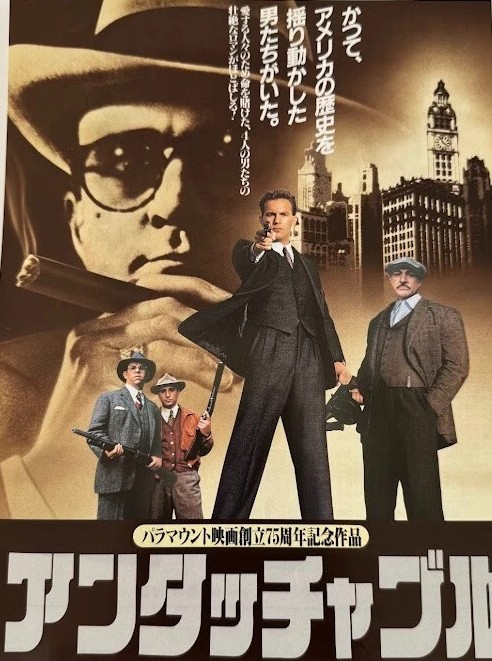
The Untouchables (1987) *****

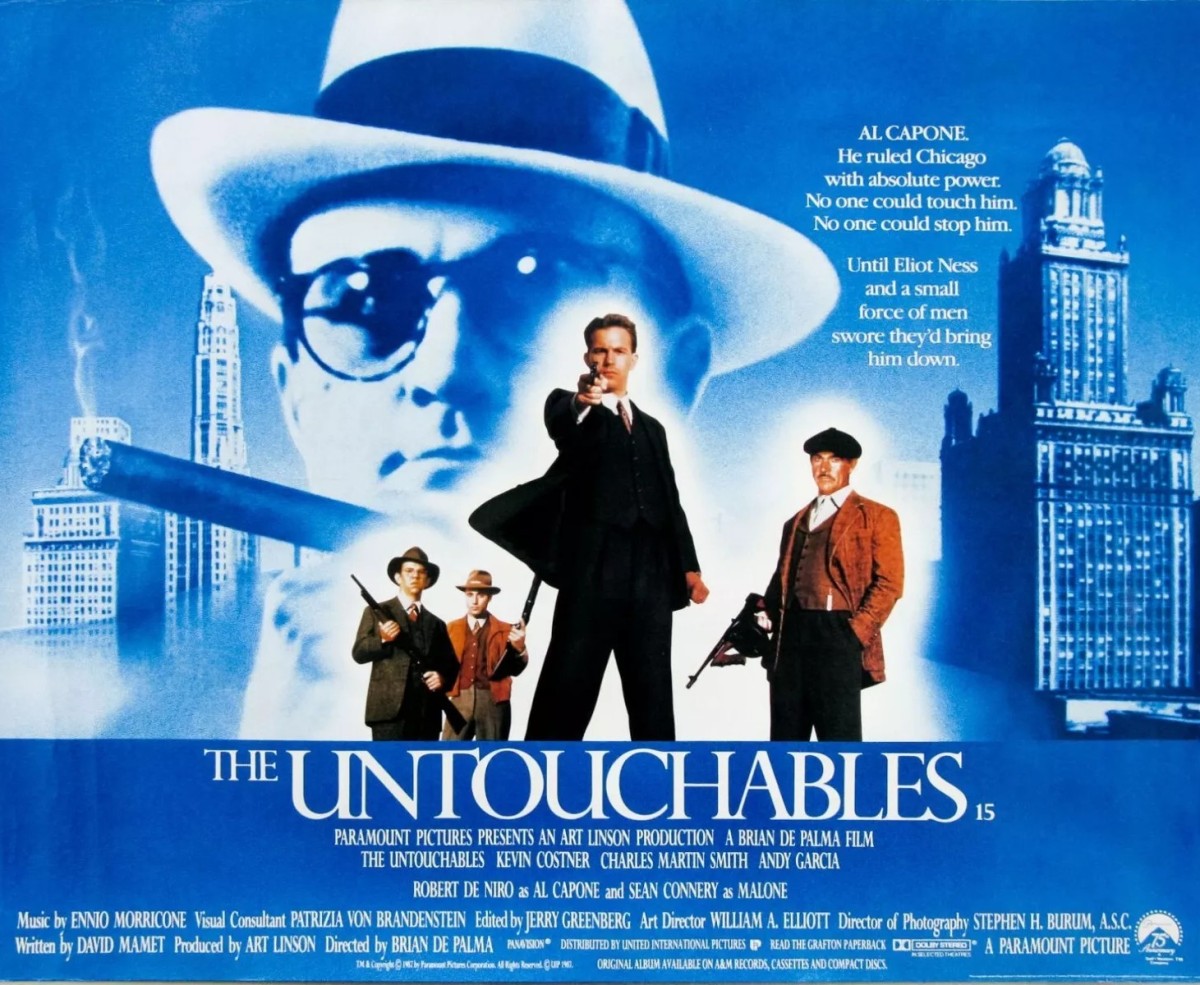
The greatest crime picture ever made, outside of The Godfather Parts I and II (1972/1974). A sledgehammer of a narrative that moves like an express train, only slowing down for a number of bravura sequences. Riddled with fabulous lines, built on great performances, and seeded early on with subsidiary characters who will later play significant roles. In any analysis it reads like a greatest hits.

The bloodied finger of Al Capone (Robert DeNiro) holding court to fawning journalists; the little girl’s plaintive cry of “Mister” before she’s blown to kingdom come; the love note included in the lunch of Elliot Ness (Kevin Costner); “poor butterfly” as the first raid goes wrong; the introduction of Malone (Sean Connery) “here endeth the lesson”; the trading of racist insults with recruit George Stone (Andy Garcia); Capone bludgeoning an associate to death with a baseball bat; in the safety of a church, Malone explaining “the Chicago way”; the first big cinematic sequence – the shootout at the border with meek accountant Oscar Wallace (Charles Martin Smith) making his bones and sneaking a drink of beer; Malone “killing” the dead man; “touchables” smeared in blood in the lift; Malone’s fistfight with crooked boss Dorsett (Richard Bradford); Malone’s murder by hitman Frank Nitti (Billy Drago); the second, and greater, bravura sequence – the shootout on the steps of the railway station; Ness pushing Nitti off the rooftop; the disbelieving Capone sentenced.

And those are just the broad strokes. Peppered throughout is the issue of Capone’s tax evasion, the crime that brings him down, with virtually all Wallace’s contribution being reading from documents relating to this. Nitti appears in the second scene, leaving the bomb that will blow the little girl to kingdom come, and again at Ness’s house.

And this is so old-fashioned that not only are we rooting for the good guys but none of those involved has marital or alcohol problems. Cops like Malone may be disillusioned but they don’t take their disenchantment out on the bottle. Anyone who talks about marriage agrees it is a good thing.

Character introduction doesn’t go down the iconic route of The Magnificent Seven (1960) or The Dirty Dozen (1967). Chicago’s Finest sneer at Ness behind his back. Another director would have been tempted into a bolder entrance for Malone. But he’s a loser, still a beat cop in middle age, and on the late shift at that. He doesn’t just know his job, detects Ness is packing a gun, but he’s capable of a sardonic quip or two. Who’d claim to be working for the humiliated Treasure Dept is they weren’t? And he’s not so stand-up as he appears, playing with a key chain like worry beads, keeps a sawn-off shotgun in his record player.
And that’s before we go into the dialog. Screenwriter David Mamet (Glengarry Glen Ross, 1992), revered as America’s greatest living playwright, turns on the style. “You can get further with a kind word and a gun than with just a kind word”;  “They pull a knife, you pull a gun”; “do you know what a blood oath is?”; “team!”; “brings a knife to a gun fight”; “all right, enough of this running shit;” “can’t you talk with a gun in your mouth?” “his name wasn’t in the ledger,”  “did he sound anything like that?”

And that’s before we get to the score by Ennio Morricone, his best in terms of the consistency of theme (rather than just one standout tune) since Once Upon a Time in the West (1969). Or the rocking title sequence.

Turned Kevin Costner (Horizon, An American Saga – Chapter 1, 2024) into a star, a position, with dips here and there, he’s maintained for half a century. Andy Garcia (Black Rain, 1989), too, though for a shorter duration. Not everyone was impressed by Robert DeNiro’s (The Alto Knights, 2025) florid interpretation, but I wasn’t one of them. Brought Sean Connery (The Russia House, 1990) long overdue recognition for his acting, though it’s worth remembering that the Oscar voters who gave him a standing ovation could have handed him the gong a good time before for any number of excellent portrayals.

Director Brian DePalam (Carrie, 1977) was an Oscar shut-out. And when I look at the films that took precedence in the Best Film nominations, there’s only one, Moonstruck, that I’d seek out.

This is a thunderous achievement, and I can’t wait for 2027 when Paramount surely will bring it back to the big screen for a 40th anniversary celebration.

Unmissable.

Behind the Scenes: Sean Connery, Robert De Niro, Kings of the Flop

Big names were rarely immune to box office upset. Top stars like Sean Connery, Robert Redford, Jack Nicholson, Meryl Streep, Al Pacino and Sylvester Stallone had their fair share of clinkers while the careers of the likes of the much-touted Mickey Rourke fizzled out in the face of audience indifference. Of course, it was the supposed marquee pull of big stars that got them attached to sometimes dodgy projects in the first place, the idea that their presence would be sufficient to generate box office heat.

You’ll probably be surprised to discover that Highlander (1986) – especially given its cult status and the various sequels – was an out-and-out flop in the U.S., rentals of just $2.8 million on a budget of $17 million. But that was a comparative hit compared to other Connery items, Fred Zinnemann’s Five Days One Summer (1982) with only $100,000 in the kitty on a $15 million budget. The Red Tent (1969) was covered in so much red ink it could have qualified as a horror picture, a return of $900,000 on a $10 million cost. Martin Ritt’s mining saga The Molly Maguires (1968) dug out only $1.1 million, around 10 per cent of its budget. Comparatively speaking, Meteor (1979) was a success, $6 million taken in on a $20 million budget.

Connery wasn’t the only big name cashing in on the disaster picture only to encounter disaster at the box office. Income from When Time Ran Out (1980), another in the $20-million range, barely covered Paul Newman’s fee. Other than a big fat check who knows what Jack Nicholson saw in an octet of calamities. The Border (1982) generated just $4.6 million rentals from a $22 million investment, the joke was on Martin Scorsese for King of Comedy with $1.2 million from $19 million, and even the $30 million Midnight Run (1988) failed to cross the line with just $18 million. Prayers and good reviews couldn’t save The Mission (1986) its $8.3 million take barely one-third of its cost, Angel Heart (1987) took about the same level of hit, $6.5 million from an $18 million expenditure.

A dream teaming with Oscar fave Meryl Streep proved a nightmare, not once but twice, Ironweed (1987) smoking out $3.5 million from $27 million, Falling in Love (1984) marginally better with $5.8 million out of $14 million, but all hope dashed on Once Upon a Time in America (1984), $2.5 million retrieved from $30 million spent. Streep on her own, and even with a dark wig, could do little to save A Cry in the Dark (1988) from picking up a paltry $2.5 million from a $15 million undertaking.

When you realize Angel Heart was one of Mickey Rourke’s better performers you can guess at the scale of his problem. The heavily-touted 9½ Weeks (1986) went straight down the plughole, recovering a distant $2.5 million from hot $17 million. Crime didn’t pay either, Michael Cimino’s Year of the Dragon (1985) flamed out at $7.3 million, less than one-third of cost.

Few were exempt. Richard Gere might as well have worn a crown of thorns in King David (1985) – $2.5 million return on $22 million forked out. And he was impotent to revive Sidney Lumet’s Power (1986), $1.7 million from a $14 million handout. Al Pacino served up $200,000 for Revolution (1985), a $28 million turkey. Burt Reynolds was stuck on $3.4 million for his directorial debut the $22 million Stick (1985). Steve Martin billed just $2.3 million for Lonely Guy, a $14 million no-hoper.

Even Clint Eastwood could not always work his box office magic, The Dead Pool (1988), his fifth iteration on Dirty Harry, coming up $1 million shy of its $20 million budget. Bruce Willis in Sunset (1988) lost $17 million. Sylvester Stallone was down $30 million for Rambo III (1988) and $16.7 million for Over the Top (1987).

Michael Keaton in The Squeeze (1987) lost $21 million, Sidney Poitier and River Phoenix in Little Nikita (1988) lost $14.3 million, The Adventures of Baron Munchausen (1988) lost a colossal $48 million hit, Heaven’s Gate (1980) $34.5 million, Honky Tonk Freeway (1981) $23.5 million, Bette Midler in the appropriately-named Jinxed (1982) $13.1 million. The Big Town (1987) starring Matt Dillon lost virtually all its $17 million budget, as much as prehistoric drama Clan of the Cave Bear (1986). Sheena (1984) roped a $23.1 million loss, Supergirl (1984) $24 million, the original Dune (1984) $25.4 million

Francis Coppola will be hoping his forthcoming self-financed $120 million Megalopolis doesn’t go the way of The Cotton Club (1984) – $12.9 million in rentals from $51 million – or One from the Heart (1981) – $400,000 back out of $26 million.

Of course, the best stars have longevity, a bad run doesn’t always spell the end. Connery bounced back big style with The Untouchables, The Hunt for Red October, Indiana Jones, Rising Sun and The Rock. Stallone went back to basics and drew on more Rocky and Rambo and flexed his muscles with The Expendables franchise.

SOURCE: “Film Costs vs Rentals,” Variety, February 21, 1990.

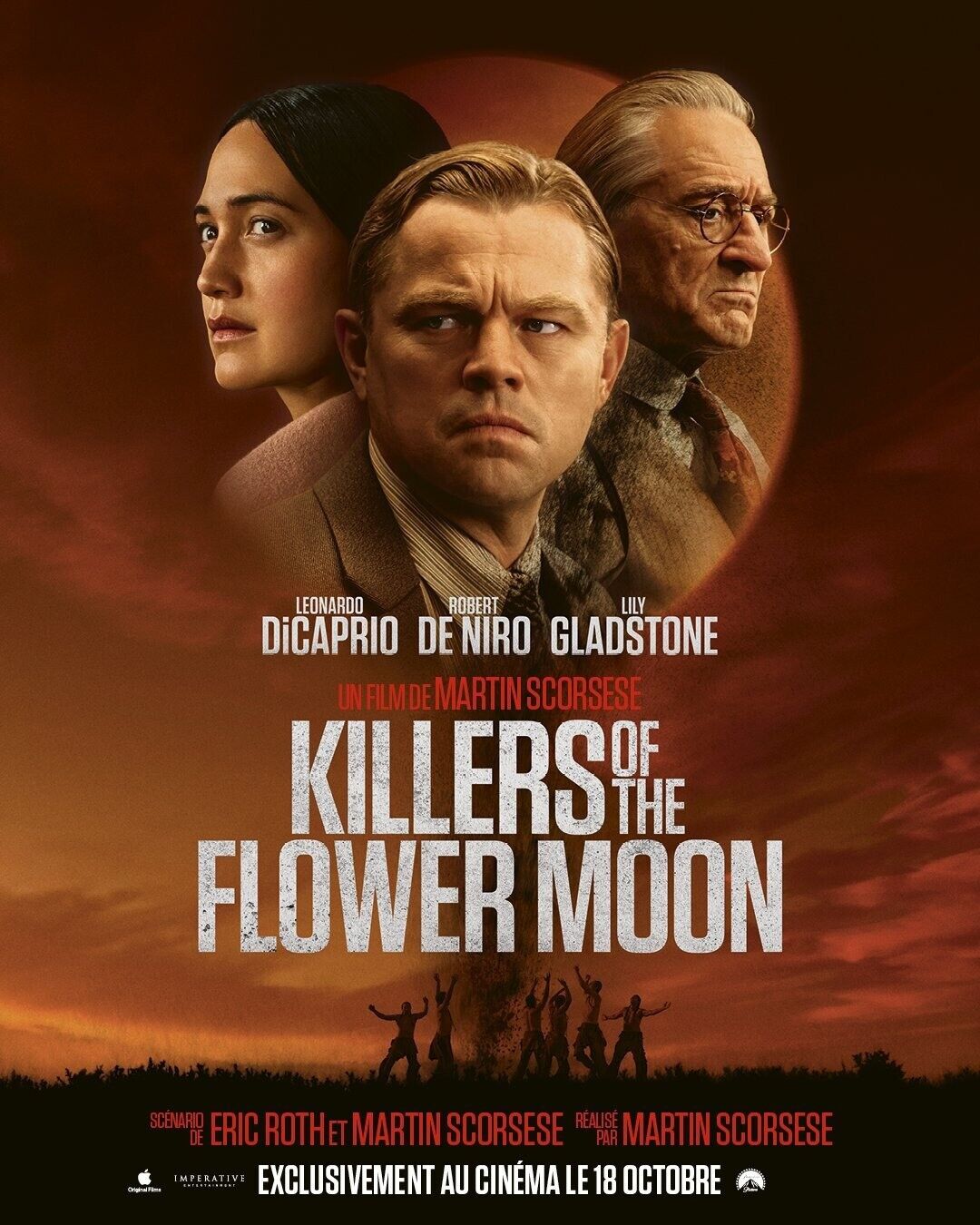
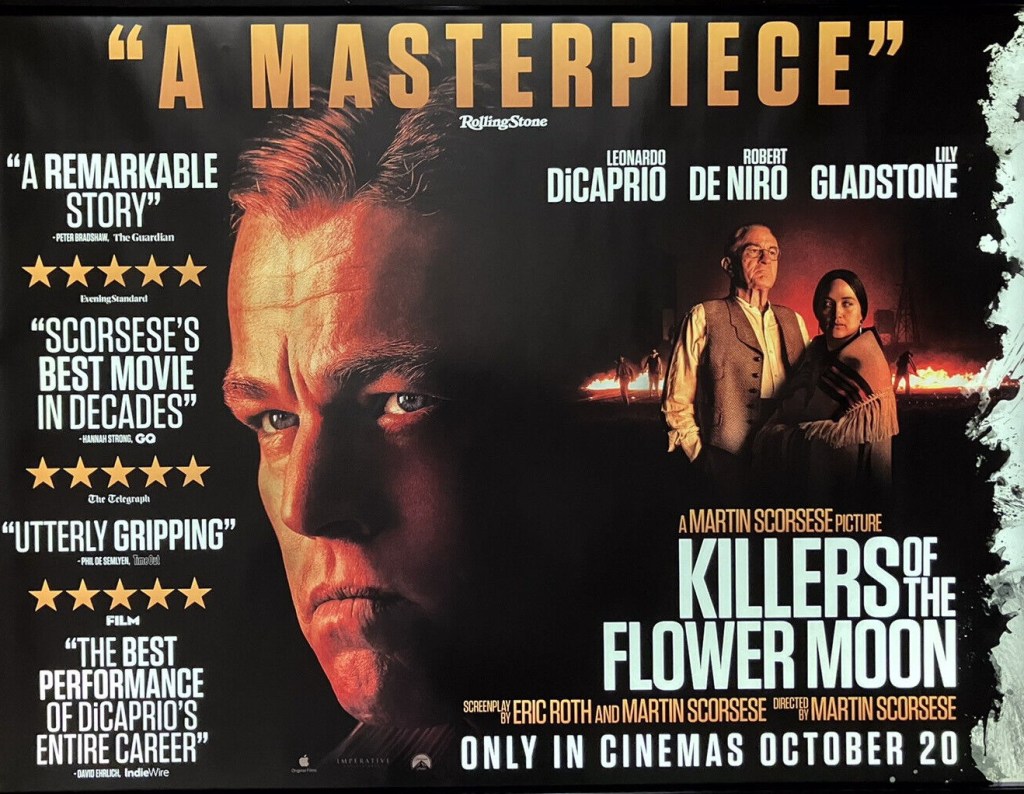
Killers of the Flower Moon (2023) *****

Let me stop you right there. This isn’t a review of this particular movie, you’re probably sick to death of those already, and it’s not some kind of Scorsese retrospective, but an expression of what it’s like to live through the transformation of one of the greatest directors Hollywood has ever produced. That zipping excitement when you first encounter a new Hollywood animal and when he charges down a different track or seems to lose control.

Catching up on a director’s life work via a carefully-curated retrospective hasn’t got an ounce of the flavor of living through it, from the days when film festival break-outs were not the carefully-orchestrated distribution and publicity machines they are now.

I first encountered Scorsese before a clever journalist had coined the rather derisory notion of a  Brat Pack, when the director was just another new voice clamoring for attention in a world of considerably more cinematic noise than exists today, when MCU and streaming didn’t exist, and audiences could find massive variety every time they attended the cinema.

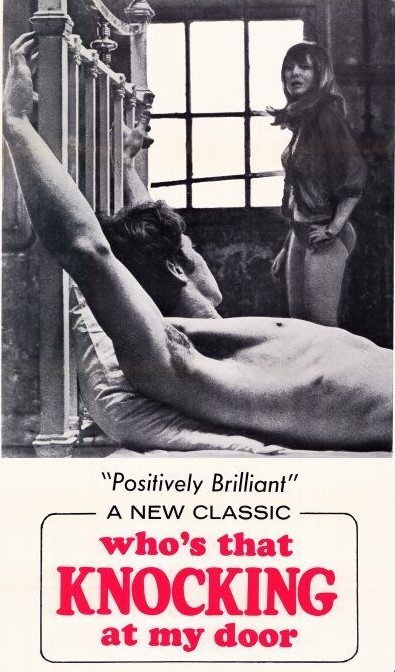
Who’s That Knocking at My Door slipped through the arthouse cracks in 1967 – the year of The Graduate, Guess Who’s Coming to Dinner, In the Heat of the Night, The Dirty Dozen and El Dorado. I didn’t see it then. I would be surprised if anyone did. Nobody was ready for that brash style with its insistent use of pop/rock music. I caught up with a few years later when the Scorsese we know now was still in embryo form.

Sure, Mean Streets (1973) gave strong indication of the gangster path towards which Scorsese was inclined, but it wasn’t so obvious then that he would make that genre his own, not when he interspersed that with a tale of Depression-era hobos, Boxcar Bertha (1972), and Alice Doesn’t Live Here (1974), a proto-feminist narrative whose stunning tracking opening set out his technical directorial credentials. And it was anybody’s guess which way he’d go from here. 

And I doubt if anyone expected Taxi Driver (1976), the moody glimpse of the New York underbelly with a psychopath hero, and certainly after that exploded at the box office and had critics purring, nobody would guess his career would take a musical turn, New York, New York and The Last Waltz in consecutive years. You might consider Raging Bull (1980), prototypical Scorsese. But the truth is, he was never typical. He jumped from project to project in a manner that only appeared to make sense to himself.

Some choices were so atypical you wondered if there had been any through-thread – what possibly connected King of Comedy (1982) to The Age of Innocence (1993) and Hugo two decades later. Certainly, when he imbibed a deep spiritual draft, you could make a thematic connection between The Last Temptation of Christ (1988), Kundun (1997), and Silence (2016).

But by this point he had achieved Hollywood nirvana, the mixture of critical adulation that put him top of the hitlist of those studios with one eye on the Oscars and bouts of box office glory that kept the same studios sweet. If he ever felt the need to revive a fading career he could churn out the likes of apparently mainstream but dark-tinged Cape Fear (1991), The Aviator (2004), Shutter Island (2010) and The Wolf of Wall Street (2103). And at the back of your mind, as a fan, was the question of how long would it take him to return to the gangsters. If you had Goodfellas (1990) forever etched on your mind, Casino (1995), Gangs of New York (2002), The Departed (2006) and The Irishman (2019) seemed almost always within reach.

Of course, he can hardly be separated from Robert DeNiro, his go-to star, ten teamings in all including the current number. And for a DeNiro substitute, Scorsese didn’t go far wrong with Leonardo DiCaprio, six including the new one. Stars with an edgy side were attracted to Scorsese and vice-versa.

It’s perhaps no coincidence that DeNiro and DiCaprio play murderous relatives in Killer of the Flower Moon, but the performances both deliver are so subtle, so far removed from what Scorsese’s asked of them before, as to point them both in the direction of the Oscar.

You think you kind-of know what you’re going to get with Scorsese, but, more than any other director, he whips the ground out from under you. Killers of the Flower Moon is bereft of the Scorsese trademarks, voice-over, exuberant violence, thumping soundtrack.

So when you’ve been watching his movies for over half a century, you look on him as you might a favored son, delighted in his achievement. But you don’t want him to stop, you want him to keep going. There must be one more film in him. Like Ridley Scott, he’s more bankable than ever, especially if the streamers are looking for a short-cut to hooking up with the best talent available.

Like Oppenheimer, this one is unmissable.

https://amzn.to/3MeEe9U

https://amzn.to/3Q6Lw0p

Discover WordPress

A daily selection of the best content published on WordPress, collected for you by humans who love to read.

The Atavist Magazine

by Brian Hannan

WordPress.com News

The latest news on WordPress.com and the WordPress community.