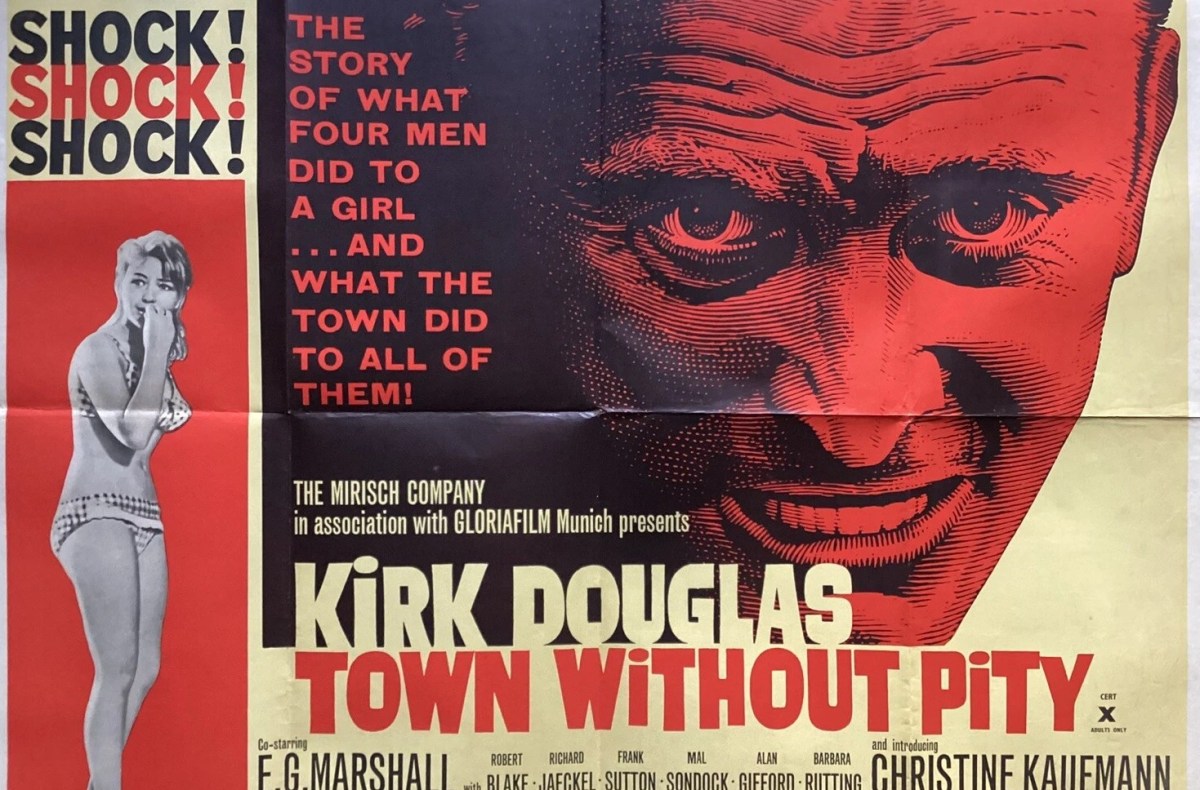
Town Without Pity (1961) ****

Long-forgotten courtroom picture that deserves urgent reassessment in the wake of Jeffrey Epstein and especially the casual destruction of Virginia Giuffre. We’re so accustomed to attorneys being shown in a good light – defense lawyers rescuing the innocent, prosecutors putting away the evasive guilty – that we forgot just how brutal a trial is for the unprepared. Even a “fair trial” permits a lawyer to brutalize a witness. Until recently, rape trials came apart once the prosecution could prove the victim was “asking for it.”

Four American soldiers rape a young girl in Occupied Germany at the start of the 1960s. Major Steve Garrett (Kirk Diouglas), defending the quartet, goes on the attack, attempting to demolish the reputation of  banker’s daughter Karin (Christine Kaufman). Unusually, the stakes are the highest they could be. Under a quirk of German law, the soldiers could face the death penalty. Under another quirk, for that to have any chance of occurring, Karin has to take the witness stand. If Garrett can place her and her family under sufficient pre-trial duress she might excuse herself from court.
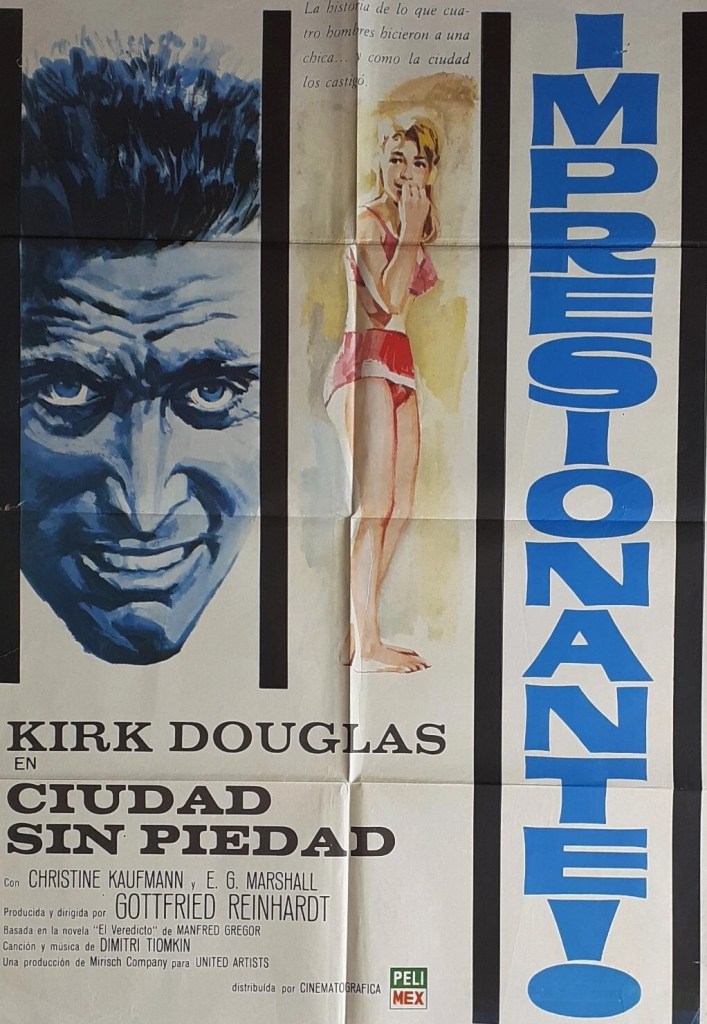
Turns out Garrett finds many willing accomplices among the townspeople. It’s not so much a town without pity as a town called malice. Some dislike her father, others feel she has already brought the town into disrepute, and there’s the usual generation clash. A voyeuristic neighbor reports that she stands boldly naked at her window. Another has seen Karin and her boyfriend Frank (Gerhart Lippert) spend a weekend together. Her shamed father Karl (Hans Nielsen) discovers a lot he didn’t want to know about his adored daughter, though, even so, he backs her, willing to suck up the humiliation and finger-pointing.

Everyone knows the men are guilty although one of them, Corporal Larkin (Robert Blake), might be technically innocent because he proves to be impotent. Even so, he was present and did nothing to prevent the assault. The men’s defense is that they came upon her naked and, having quarrelled with Frank, she flaunted herself, desiring the sexual attention of men. Since it would be embarrassing to admit that she stood around naked beside the river, she lies and says she was wearing a bikini at the time.

Kirk Douglas was such a dab hand at playing the action hero – Gunfight at the O.K. Corral (1957), The Vikings (1958), Spartacus (1960) – and the misunderstood, as in Lust for Life (1956), that audiences tended to forget his cynical turn in Ace in the Hole (1951) and that he could transition into mean at the drop of a hat. Here, he has the excuse of only doing his job.
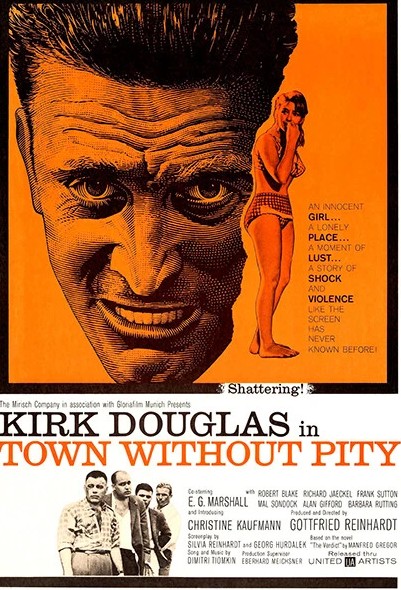
But it’s vicious stuff and once Garrett has Karin in the courtroom there’s only going to be one winner at the expense of destroying the loser. She is torn apart as he sets her up as a woman who enjoys showing men her naked body and proves false her contention that the men ripped the bikini from her.

She can’t take the gruelling attack and faints, her father removing her from the witness box, rendering the death penalty inapplicable. There’s a sad coda, which would not have been unexpected.

German director Gottfried Reinhardt, who had worked with Douglas before on The Story of Three Loves (1953), takes an unusual approach, to some extent shielding the audience from Garrett with a voice-over narration from local reporter Inge (Barbara Rutting), with whom Garret initially flirts. But there‘s little grandstanding, any references to the law are not in recognition of its contribution to justice, but in pointing out that it’s not a good idea to get caught in the legal maw because you will be destroyed one way or another.

There’s one shot at the end where Garrett realizes that he’s been instrumental in driving Karin to suicide, but mostly he views himself as a victor, a legal warrior who will do anything to win. He excuses his behavior because he’s not trying to get his clients off the charge of rape but merely determined to avoid them hanging. But you know he’s still belongs to the tribe of men who can brutalize the innocent on the witness box and never feel remorse.

Kirk Douglas is superb, as is Austrian-born Christine Kaufman (Taras Bulba, 1962) in her debut. And although the rest of the cast has little to do, the collection of wannabes includes Robert Blake (Tell Them Willie Boy Is Here, 1969) and Richard Jaeckal (The Dirty Dozen, 1967). Scripted by George Hurdalek (Tread Softly, 1965) and Sylvia Reinhardt (Situation Hopeless But Not Serious, 1965) from the book by Manfred Gregor.

Watching it now, the case of Virginia Giuffre hangs over this. She was reviled on all fronts before reaching an out-of-court settlement but never recovered from the ordeal and took her own life.

Worth reassessment.
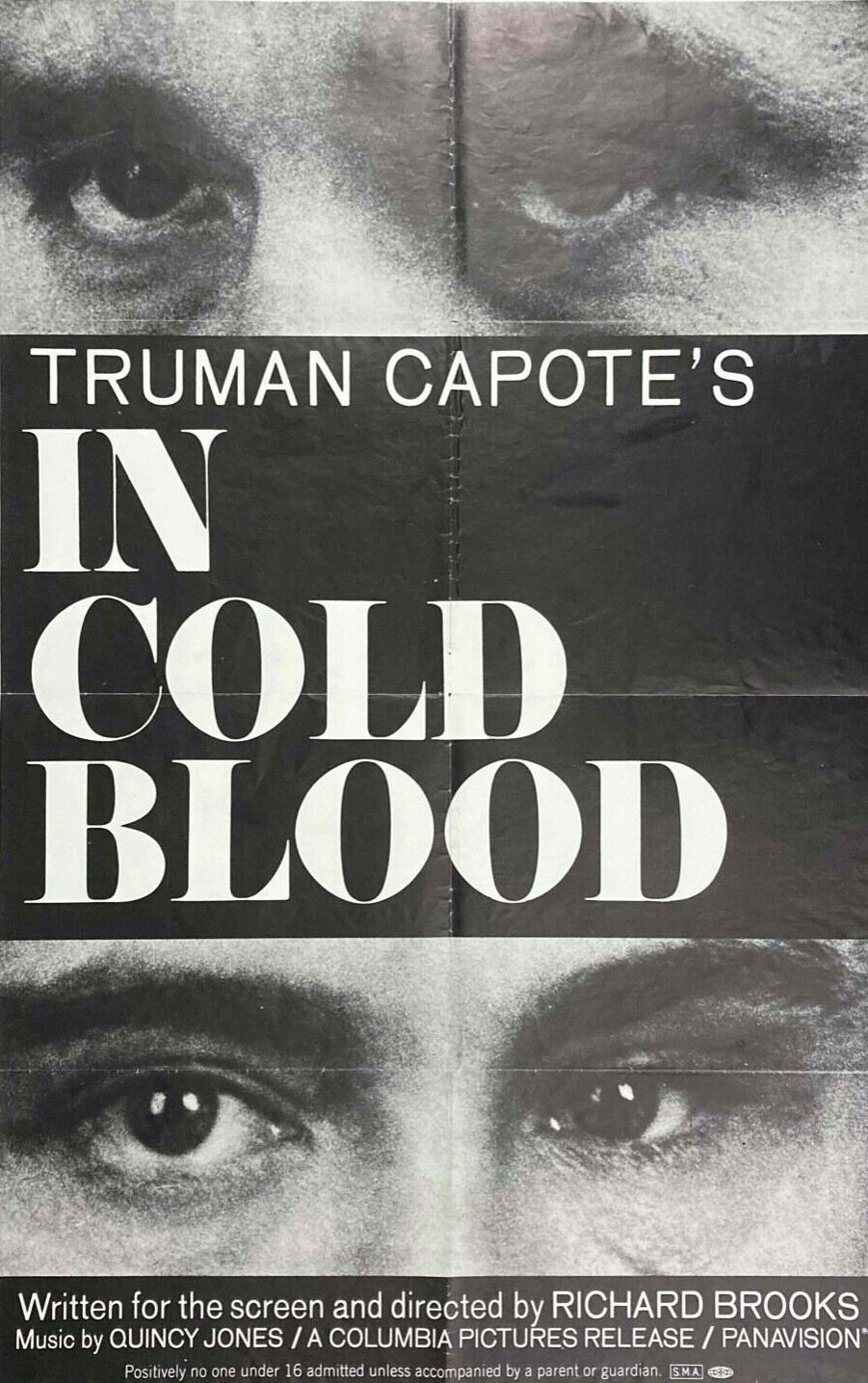
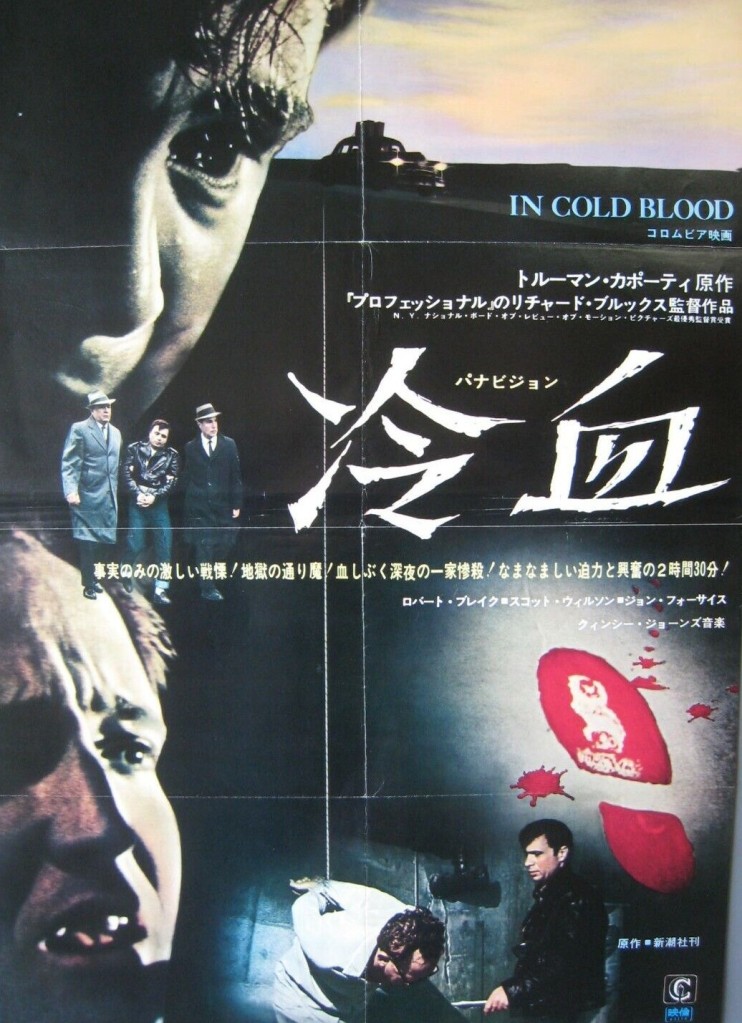
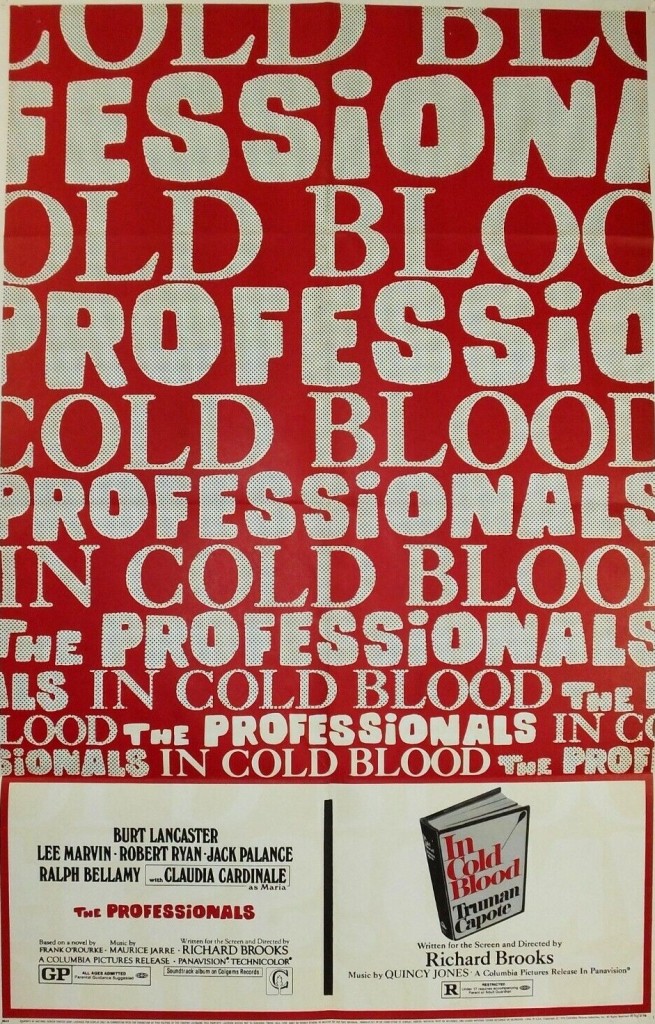
In Cold Blood (1967) *****

Unfairly overlooked in favor of the Coppola/Scorsese grandiose perspective on gangsters, this changed the shape of the crime picture as much as the best-selling book altered the way readers regarded murderers. Neither whodunit, whydunit nor film noir, nonetheless it invites us into the world of the senseless crime, providing an extremely human portrayal of two men if not natural born killers then their pitiful lives always going to lead them in the wrong direction.

Although Perry Smith (Robert Blake) is a fantasist, dreaming of becoming a singing star in Las Vegas, determined to find the lost treasure of Cortez, and convinced a giant bird protected him from vicious nuns in an orphanage, his life did already verge on the fantastical. His mother, a Cherokee, was a star rodeo performer, his father a gold prospector in Alaska, but the mother, an alcoholic, choked to death on her own vomit and the father (Charles McGraw), a hobo in all but name, is astonished that the child he brought up, so he believes, to recognise right from wrong, would stoop to crime. As a child Perry and siblings watched his mother have sex with clients and his father viciously beat her with a belt. Perry is addicted to aspirin to minimize pain from a leg injury, and you can’t help but feel sorry for this otherwise fit young man massaging the massive disfiguring scar, the result of a motorbike accident.

Dick Hickock (Scott Wilson) is a very charming cocky personable con man, leaving a trail of bad checks behind him as he masquerades as a best man who has come out without enough cash to buy a wedding outfit for his buddy and, with his convincing patter, hoodwinking store clerks not just into accepting a check for the goods, later to be sold, but also cashing a personal check. His father, too, is stunned to hear his son had criminal tendencies.

Fatherhood is represented as a holy grail. Hickock enjoyed being a parent until he was caught with another girl and had to do “the decent thing” i.e. abandon existing wife and child. The parents of both boys have wonderful, emotion-filled, memories of loving and being loved by their children.

From another prisoner, Hickock has been told of the “perfect score,” a rich farmer called Clutter in Kansas with $10,000 in his safe. The plan, to which Smith has only momentary objection, is to leave no witnesses. Even muttered in grandiose manner, this phrase surely, in anybody’s mind, conjures up slaughter, Smith’s only saving grace that he prevents Hickock raping the daughter Nancy (Benda C. Currin). Their haul amounting to $43 and a radio, you could imagine the thieves wiping out the family in a fit of fury. But that’s not the case, it’s just cold-blooded thinking, an element of leaving no trace behind.

And that’s just what they do, committing an almost perfect crime, no fingerprints, just the mark of the sole of a shoe imprinted in blood. There’s a red herring – old man Clutter had just signed off on an insurance policy worth $80,000. But detective Alvin Dewey (John Forsythe) has to solve the crime the old-fashioned way, with inter-state cooperation and months (years in reality) of footslogging. Dewey could have been straight out of film noir with his nippy one-liners and epigrams.

Other than Alfred Hitchcock, it was unusual for a reissue double bill to comprise
two films by the same director.

Unlike the novel which concentrated as much on the aftermath among the shocked townspeople, the film focuses on the manhunt and Dewey’s deft way with newspapermen and colleagues. The four murders occur off-camera, but by that point we already know the outcome. There’s a virtue-signalling coda that shows the inhumane conditions in which murders were kept on Death Row, but that is countered by a marvellous speech by Dewey on the inequities of being a cop: hounded by media and public for letting someone get away with heinous crime, generally getting a tough time over police methods, lambasted after catching them for not doing it quickly enough, and then having to stand by while media and public launch an outcry to prevent the killers being executed.

All shade, the documentary style achieves the contradiction of appearing sparingly told yet with a wealth of character detail (location and time are ignored) and none of the grandeur and faux community spirit invested in gangsterdom by the likes of Coppola and Scorsese. Smith and Hickock would never pass the entry test for the Mafia given that at least required discipline and the ability to follow orders. Minus the killing spree, these characters might have survived a little longer in the underclass before ending up inside again.

All three principals are brilliant in the understated manner demanded. Robert Blake (Tell Them Willie Boy Is Here, 1969) is the pick, tormented by future dreams and past nightmares, but Scott Wilson (In the Heat of the Night, 1967) has the stand-out scene, gulling store salesmen with his finely worked con, and there is a sense of the big brother in the way he looks after his friend. This might well be the best work by John Forsythe (Topaz, 1969).

And it certainly is one of the finest movies made by writer-director Richard Brooks (The Professionals, 1966) who handles a very difficult subject with at times such delicacy it is almost a complete departure in style.

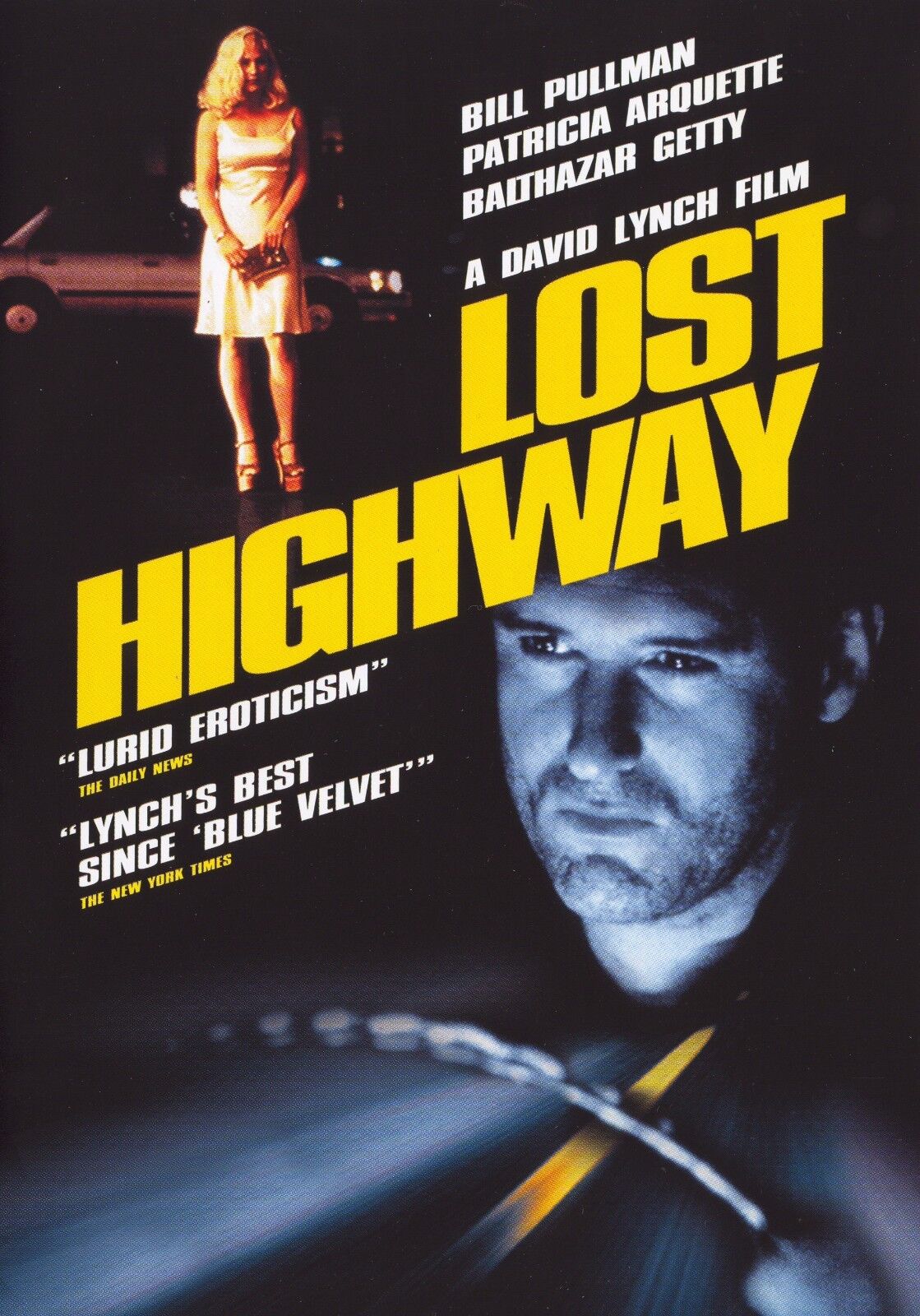
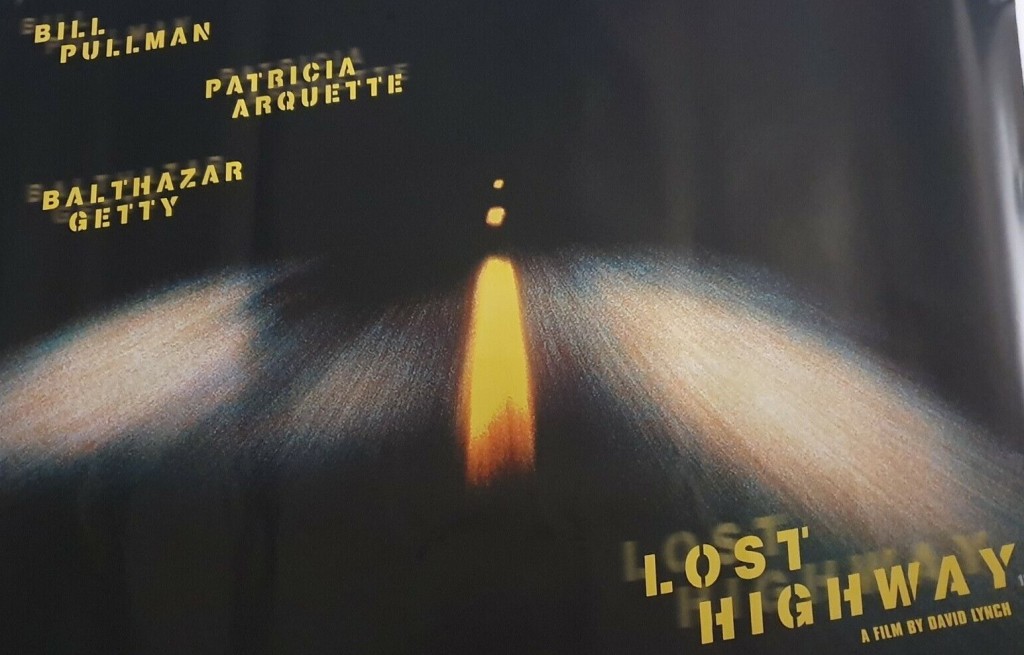
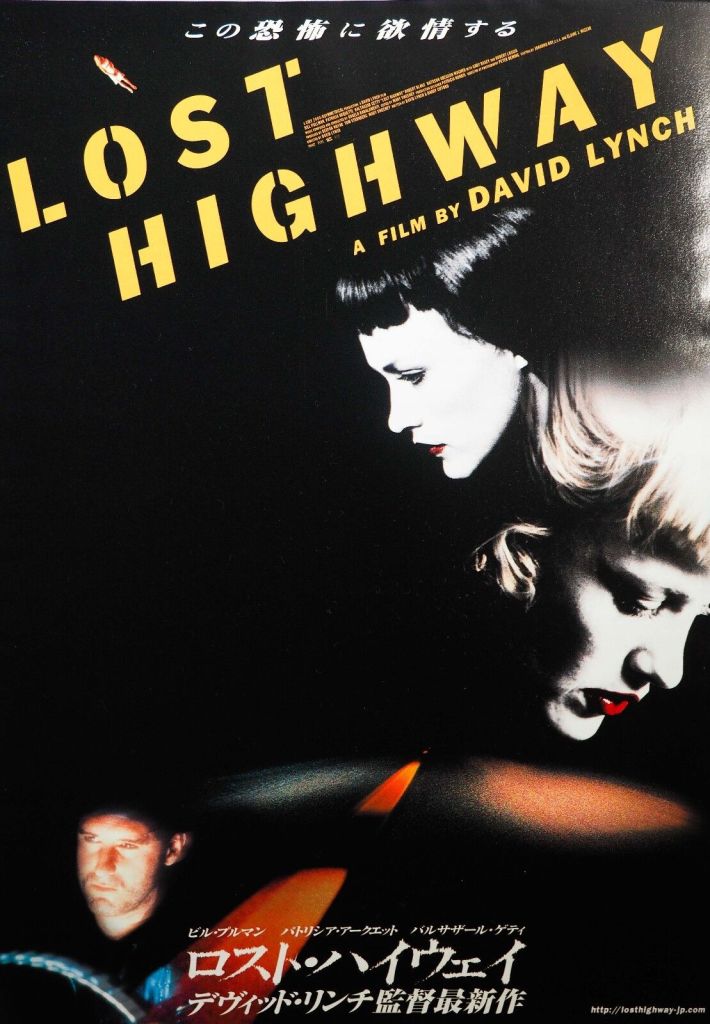
Lost Highway (1997) *** – Seen at the Cinema

One of these films with bits missing. Where you are fated to fail to join the dots the director didn’t put there in the first place. Or so it seems. But when you work it all back from the end appears to make some kind of sense.

But that’s only while you are of a mind, given the directorial credentials, to stick it in the cult category rather than the direct-to-video vault where its companions might be any erotic thriller featuring Shannon Tweed. And that might be appropriate in  another way because this was such a flop on initial release, despite David Lynch’s reputation courtesy of Blue Velvet (19860 and Twin Peaks, that it owes much of its current cult status to rediscovery on DVD.

Mysterious message, mysterious video, mysterious man (Robert Blake) resembling Lindsay Kemp from The Wicker Man (1973). What connects jazz saxophonist Fred (Bill Pullman) and garage mechanic Pete (Balthazar Getty) except the women in their lives, brunette and blonde, respectively, and the fact that the former’s high-pitched music gives the latter a headache.

In fact, sorry to spoil it for you, though you’ve no doubt already seen this, this is really a story told, however opaquely, from the perspective of blonde/brunette Alice/Renee (Patricia Arquette), a commodity du jour looking for a dupe du jour. Because it’s, don’t you know, about a young woman lured into debauchery, forced to strip at gunpoint for gangster Mr Eddy (Robert Loggia), act in porno and become his squeeze, and naturally looking for a way out. Enter Pete, an easy enough snare, just turn up at his garage looking blonde and sexy. Not that Pete in any way resembles the introspective jealous Fred, Pete can make out in the backs of cars with other willing women like Sheila (Natasha Gregson Warner).

Into Fred’s dull life – he doesn’t seem that excited by being an avant garde jazzman and his sexy wife has given up on sitting adoringly in nightclubs gazing at her idol – comes the mysterious trilogy. “Dick Laurent is dead” is the mysterious message. The video contains footage of their apartment, with some footage shot when they were asleep. The mysterious man, unless he’s a ventriloquist, has the mysterious ability to be two places at once and then just turn up, like a subconscious, out of the blue.

That’s not the only switcheroo. At times Fred turns into Pete. And the two women turn up in the same photograph. And nobody seems much alive except when it comes to villainy. The gangster has a neat method of teaching tailgaters the error of their ways and likes his goodies (women) to unwrap themselves in the presence of others.

And it’s a nightmare of sorts, hallucinatory, or at least the characters exist on a surreal landscape. The audience never quite knows where it is. Instead of the usual twists of the thriller genre, this has mind-bending twists. It may make sense, I tried to make sense of it, but I’m not sure that’s necessary and it may even be folly, the whole idea I guess being to go with the flow and just enjoy what the director puts in front of us.

The forced strip sits uneasily in these times, though the beating up of the tail-gater always geta a great audience response, as if of course gangster violence has the imprimatur of Martin Scorsese, and in the world of a lost woman seeking a way out any man, no matter how innocent (Pete refuses loan of a porno video), is there to be used.

David Lynch is one of the few directors of the last 30/40 years to be considered a true auteur, his movies full of strange exotic images, and characters who would not exist outside his imagination, and it was quite rewarding to see that he has at least garnered an audience for I saw this in the largest cinema in a triple-screen arthouse and it had attracted a sizeable audience.

Peak enjoyment for the head-scratching fraternity, red meat for arthouse hounds, it certainly has the Lynch trademarks in camerawork and music and the parcelling up of the illicit into digestible fragments.

Discover WordPress

A daily selection of the best content published on WordPress, collected for you by humans who love to read.

The Atavist Magazine

by Brian Hannan

WordPress.com News

The latest news on WordPress.com and the WordPress community.