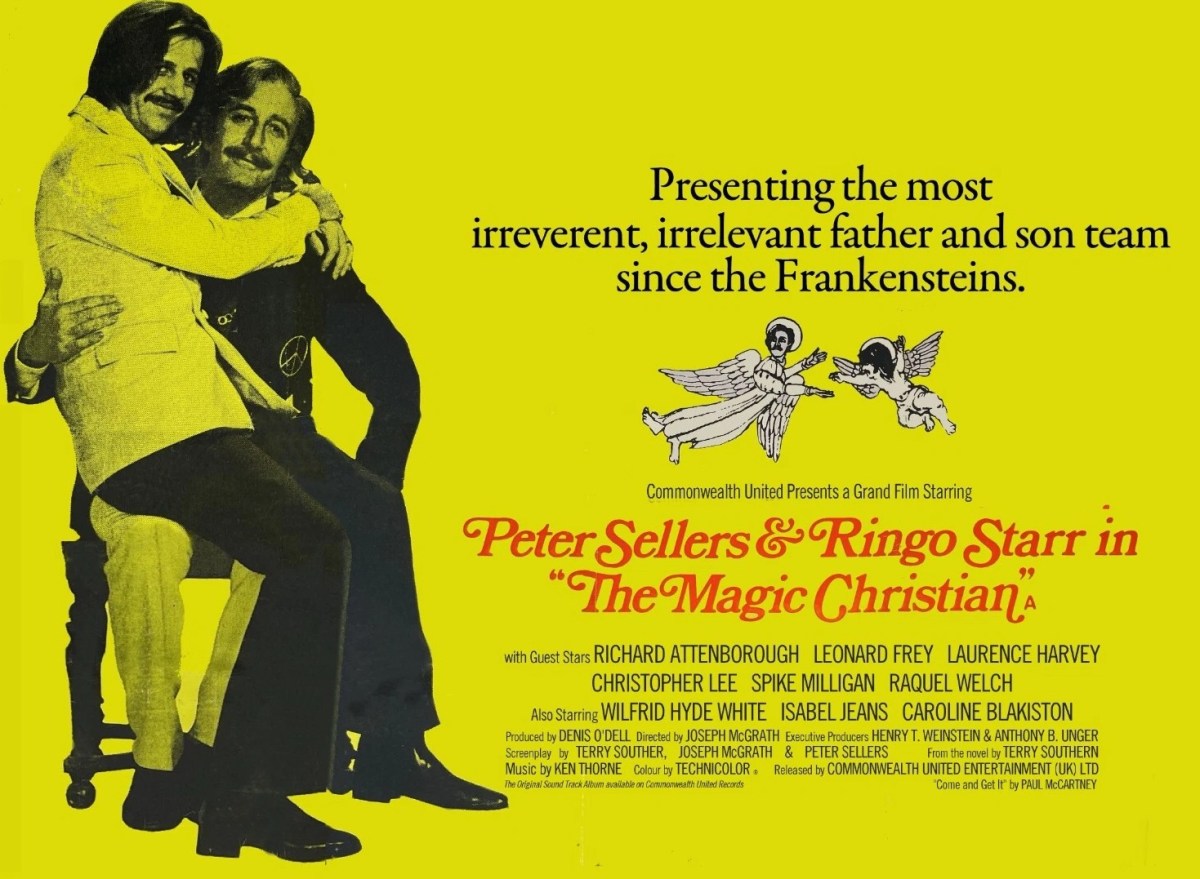
The Magic Christian (1969) ***

Substitute contemporary artwork/installation/performance art for practical joke and this will come up trumps. Taken in the artistic sense, where artists are pillorying society, there are gems – a stage Hamlet performing a striptease, feeding scraps of money to the ducks, ship passengers experiencing an apparent voyage when the vessel hasn’t left land, cutting up a famous work of art. Although I have to point out this will inevitably be remembered by some for a bikini-ed Raquel Welch cracking the whip over a galley of topless oarswomen.

Effectively a series of comedy skits loosely tied together under the theme of money, mostly in the form of bribery. Billionaire Sir Guy Grand (Peter Sellers) sets out to teach adopted son Youngman (Ringo Starr) just what money can buy. Could you pay one of the teams sufficient dough in the annual Boat Race for them to ram the other? Would a parking warden (Spike Milligan) eat the parking ticket he has just issued? In the spirit of fair play is it okay to down a pheasant with an anti-aircraft gun?
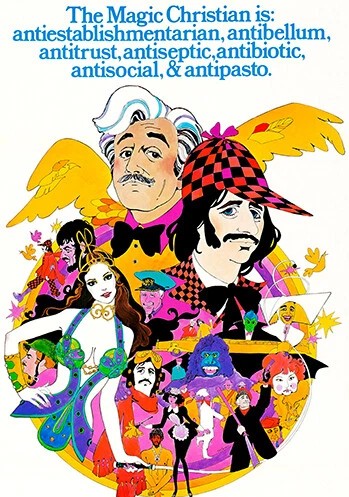
When the going slows down, surrealism enters the equation: ship’s captain kidnapped by a gorilla, vampire waitperson, black head on white body, urine-soaked banknotes given away to a crowd, the occasional nun or Nazi, newspapers where apologies are written in Polish.

Plot-wise, there’s not much to it and the satire is merely repetitive as Sir Guy embarks on educating Youngman on the perverse uses of money. It has the feeling not of following a storyline but of “what can we get up to next” and attempting to layer shock upon shock in the manner, it has to be said, of some contemporary directors.

But there’s neither sufficient bite to the satire nor punch to the shock so it remains an elaborate series of disconnected sequences. Luckily, nobody’s having to pretend to put in an acting shift which is just as well because Ringo Starr proves he can’t act.
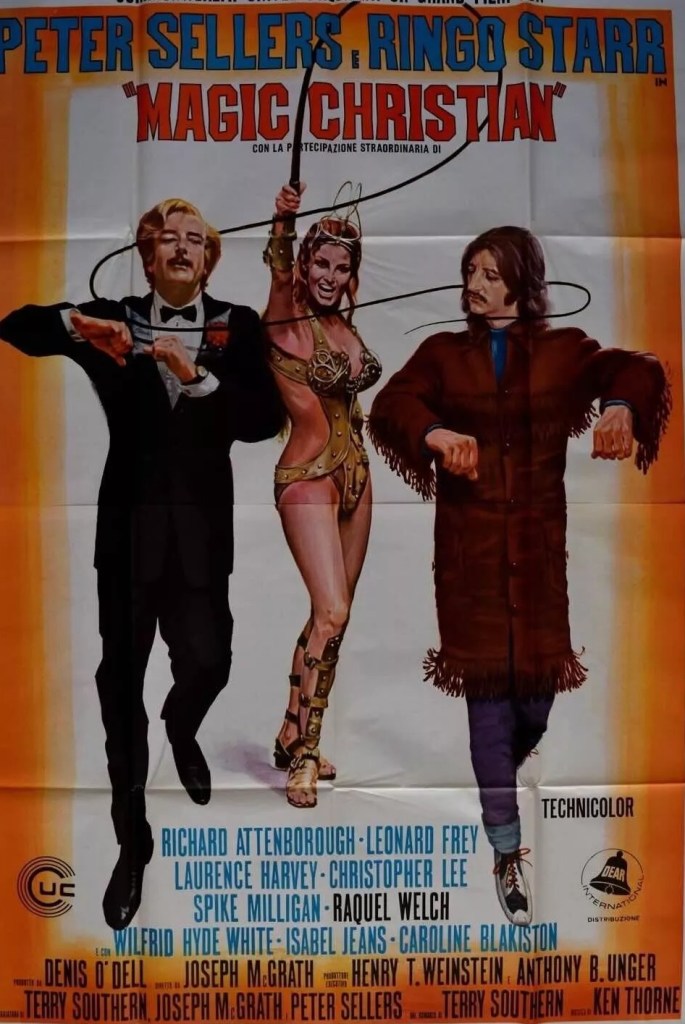
And it’s not much helped by a host of cameos – Laurence Harvey (A Dandy in Aspic, 1968), Richard Attenborough (Guns at Batasi, 1964), Christopher Lee (Dracula, Prince of Darkness, 1965), Raquel Welch (Bandolero!, 1968), director Roman Polanski (Rosemary’s Baby, 1968), Wilfred Hyde-White (P.J. / New Face in Hell, 1967), comic Spike Milligan and various members of the future Monty Python team including John Cleese (A Fish Called Wanda, 1988) and Graham Chapman.  Harvey and Welch make the biggest splash.

Excepting Dr Strangelove, Hollywood had failed to capture the essence of offbeat novelist Terry Southern (Candy, 1968) and despite input from Chapman, Cleese and Sellers, this never really gets off the ground.

Peter Sellers (The Pink Panther, 1963) was in something of a career rut where very little struck home at the box office and he would continue a dismal losing streak until resuscitating The Pink Panther franchise in 1975.

Director Joseph McGrath’s (The Bliss of Mrs Blossom, 1967) record was spotty. Best known for music videos for The Beatles, he was only well served when his cast was filled with strong actors.

No more than an occasionally humorous trifle with an equally occasional target hitting the bullseye.

Candy (1968) **

Ode to the male gaze. Once a cult vehicle, this will struggle to find favor these days what with its backward attitudes. Virtually impossible to excuse the rampant self-undulgence. The sexually exploited naïve Ewa Aulin in the title role didn’t even have the benefit of being turned into a star. The satire is executed with all the finesse of a blunderbuss. And while, theoretically, picking off a wild range of targets, if this movie has anything to say it’s to point out how easy it is for men to deify themselves at the slightest opportunity.

Not much of a narrative more a series of sketches slung together with the slightest connecting thread. Most its appeal lies in watching huge marquee names make fools of themselves. Or, if you’re that way inclined, seeing how much nudity will be imposed on the star, intimacy  rarely consensual, clothes usually whipped off her.  

Teenager Candy (Ewa Aulin) has father issues, daddy (Jack Austin) being a dumb angst-ridden teacher. Randy poet McPhisto (Richard Burton) drives a class of schoolgirls into a frenzy with his lusty reading, inveigles Candy into his chauffeur-driven car, ends up in her basement drunkenly humping a mannequin while Mexican gardener (Ringo Starr) with an accent as coruscating as that of Manuel from Fawlty Towers assaults her on pool table.  Scandalized father packs her off to his twin brother in New York, that notoriously safe haven for nymphettes, while on the way to the airport they are almost driven off the road by the gardener’s vengeful biker sisters (Florinda Balkan et al).

For no apparent reason she is hitching a lift on a military plane commanded by randy Brigadier Smight (Walter Matthau) who, on the grounds that he hasn’t had sex for six years, commands her to remove her clothes for the good of the nation. In the Big Apple, rock star surgeon Dr Krankheir (James Coburn), entering the operating theater to the same kind of waves of acclaim as McPhisto, finds an excuse to have her undress and submit to him, this just after she’s managed to avoid the attentions of her randy uncle. It should come as no surprise that Krankheit treats women as his personal property to the extent of branding them like cattle.

In due course, she encounters a gang of mobsters, an underground movie director and a hunchback (Charles Aznavour) who, in return for her showing pity for his condition, proceeds to rape her. She is arrested. Guess who wants to frisk her. Naturally, when she escapes she runs into a bunch of drag queens.   

Then she finds sanctuary in a semi-trailer truck, home to guru Grindl (Marlon Brando). He’d be convincing enough as a mystic except he, too, finds an excuse to rip her clothes off. There are more cops to contend with and another guru, facial features obscured by white clay. If they’re going to have sex then naturally it must be in a Hindu temple. Turns out the latest person to take advantage of her is her father but he’s been handed a get-out-of-jail-free card because by now he’s brain damaged.

This might all be a dream/nightmare. Candy might even be an alien. It’s dressed up in enough psychedelia to sink a battleship and its highly likely that any lass as gullible as Candy will find herself at the mercy of any man, so in that context it carries a powerful message. I’m sure many beautiful young girls will attest to the truth that men feel they have the right to paw anyone who comes their way without asking permission. And the other message is just as powerful – how many young actresses have been seduced by thoughts of fame to disport themselves in this fashion only to find that all the industry wants is their nudity not their acting talent.

You might say that the target is so obvious it hardly needs pointing out but the MeToo campaign will beg to differ and you would hope that Hollywood has wised up. It’s just a shame that the satire is so heavy-handed. The military and the medical profession are sorely in need to answering tough questions. Unfortunately, this picture doesn’t ask any. It’s like an endless casting couch.

Directed by Christian Marquand (Of Flesh and Blood, 1963) in, thankfully, his final picture, from a screenplay by Buck Henry (The Graduate, 1967) and Terry Southern (Dr Strangelove, 1962) based on the novel by Southern and Mason Hoffenberg. Nobody comes out of this well and it’s rammed full of cameos from the likes of Elsa Martinelli (The Belle Starr Story, 1968), John Huston (Myra Breckenridge, 1970), Anita Pallenberg (Performance, 1970), Marilu Tolo (Bluebeard, 1972) and boxer Sugar Ray Robinson.

Ewa Aulin (Start the Revolution Without Me, 1971) isn’t given much of chance, her character whimsical, pallid and submissive and she didn’t become a major marquee name.

A mess.

Discover WordPress

A daily selection of the best content published on WordPress, collected for you by humans who love to read.

The Atavist Magazine

by Brian Hannan

WordPress.com News

The latest news on WordPress.com and the WordPress community.