The Cardinal (1963) ****

Would appear resolutely old-fashioned except for Forrest Gump (1994) adopting same premise of the main character present at major events. Here it’s issues affecting the Catholic Church between last century’s two world wars and the protagonist is an American priest, Father Stephen Fermoyle (Tom Tryon) of Irish stock,  who rises to the position of Cardinal.

So we move at a relatively stately pace through abortion, inter-denominational marriage, racism, a miracle, challenging church philosophy, and Hitler’s annexation of Austria on the eve of the Second World War, in which the church played an inglorious part. Along the way Fr Fermoyle is afflicted so badly by doubt that he takes a sabbatical only for his flesh to be sorely tempted.
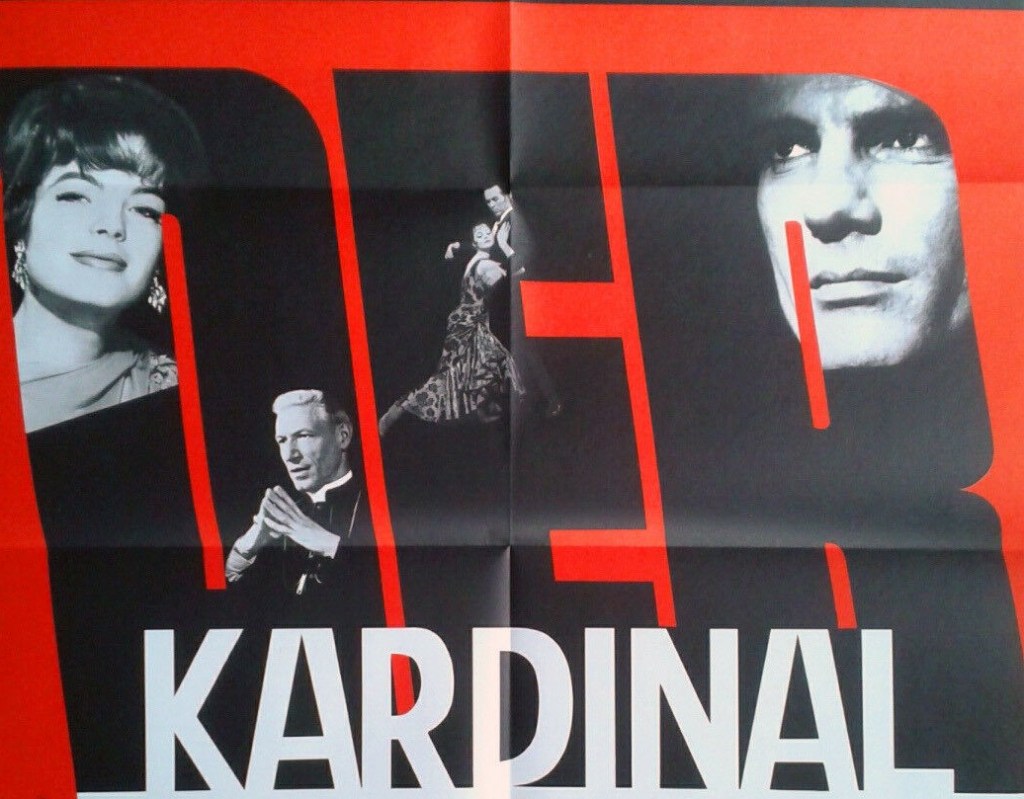
Astonishingly, I saw this on YouTube (it’s still there) in a beautiful 70mm print preserved by the National Film and Television Archive. The roadshow print, to be exact, which begins with a marvellous five-minute overture. Oddly enough there’s something very settling about sitting in the darkness with the curtains drawn watching a blank (black) screen and listening to the majestic score by Jerome Moross (The Big Country, 1958).

And then it’s another few minutes of a stunning credit sequence, all sunlight and shadow, before the movie begins. The movie itself is over three hours long, so if you are put off by this kind of epic now’s the time to check out. But if you do, you will miss something genuinely to be savored.

For Otto Preminger (Hurry Sundown, 1967) certainly knows how to tell a story, even one as sweeping as this. For all its pomp, he manages to retain intimacy.

Immediately after his ordination just as America enters the First World War, Fr Fermoyle faces a crisis. His sister Mona (Carol Lynley) wants to marry a Jewish dentist (John Saxon) who refuses to convert to Catholicism. Fermoyle’s advice, in keeping with the church’s stringent rules: give him up.

A noted intellectual, Fermoyle is astonished to be sent by the worldly piano-playing cigar-chomping Archbishop Glennon (John Huston) to an impoverished parish to learn humility. There, he encounters the blind faith of parishioners and a pastor, Fr Halley (Burgess Meredith), so inclined to put others first that he will not seek help for a debilitating disease.

Meanwhile Mona, now a dancer and drinker, has become pregnant, and not by the dentist. But complications arise and she is forced to choose between herself and the unborn child. According to Church doctrine, as Fermoyle, advises, abortion being illegal, the mother must die to save the baby. Mona, not the sacrificial kind, does the opposite. Fermoyle, racked with guilt, wants to quit the church. Instead, he is promoted to Monsignor, and given a two-year timeout which he spends lecturing in Vienna.

There he falls in love with Annemarie (Romy Scheider). In the nick of time, he is recalled to the States and sent to the Deep South to help the black Fr Gillis (Ossie Davis) who is being harassed by the Ku Klux Klan. In standing by his colleague, Fermoyle undergoes a brutal whipping. Promoted to bishop, he is despatched to Austria “to instruct the princes of the church in the realities of the modern world.” Unfortunately, the clergy, siding with the Nazis, presides over the marriage of Germany and Austria.

Meanwhile, he is reacquainted with Annemarie, who has married a Jewish banker, and witnesses at first-hand Nazi treatment of the Jews, her husband so fearful of his future he jumps out a window.   When a mob ransacks a church, Fermoyle isn’t so intent on facing up to them and instead, with Annemarie, manages to escape.

At its best and its worst by the narrative being forced through the prism of an individual. His reactions to issues are regulated by his employers, the Church, which exerts as much control over personal thought as the Communist Party, so, in effect, it becomes a tale of a person initially bristling against authority until, it turns out, the Church shares the same antipathy to the worst of the century’s scandals, the Ku Klux Klan and the Nazis.

Father Fermoyle hardly seems suited to high office, given he is so often inclined to temptation, either in a sexual sense, or in taking the opposite view of the Church. And it’s almost as though the splendid backdrop as represented by the immense wealth of the Church has only been achieving by subjugation of the individual. That the worldly Glennon appears as the poster boy for the Church hierarchy is almost Preminger playing with the audience.

It might be sumptuously mounted, but once again Preminger takes no prisoners, showing up an institution that while purportedly set up for the benefit of mankind so often sabotages noble endeavor.

Tom Tryon (In Harm’s Way, 1965) is excellent in the leading role, personal conviction getting in the way of the easy path to the top. But the pick of the performers are the supporting stars, especially John Huston, more famous as a director (The Night of the Iguana, 1964) and here making his acting debut, and Romy Scheider (Triple Cross, 1966). Look out for Carol Lynley (Bunny Lake Is Missing, 1965), silent film star Dorothy Gish in her final movie appearance, Maggie McNamara (The Moon Is Blue, 1953) in her first picture in eight years, and John Saxon (The Appaloosa, 1966) before he was typecast as a heavy.

Otto Preminger (In Harm’s Way) directs in stately fashion from a screenplay by Robert Dozier (The Big Bounce, 1969) and Ring Lardner Jr. (The Cincinnati Kid, 1965).

Thoughtful and striking.

Book into Film – “The Cincinnati Kid” (1965)

Richard Jessup’s brilliant 1963 novel was so short – barely 150 pages – it was almost custom-made for the movies. While it built up the tension to the confrontation between young stud poker contender The Cincinnati Kid (Steve McQueen in the film) and the reigning world champ Lancey Hodges (Edward G. Robinson) and covered the on-off relationship between the Kid and Christian (Tuesday Weld), a large chunk of the novel was in effect an insider’s guide to the world of poker and its unwritten rules.

As appeared always to be the case in translating novels to films, there were some incidental changes. The Kid was 26 in the book, but clearly in his 30s in the film. Lancey’s surname became Howard. In the book he was thin, in the film well-upholstered. Melba (Ann-Margret), the girlfriend of Shooter (Karl Malden) is not given a name in the book. The book is set in St Louis, the film in New Orleans.

But the book lacks sub-plots. It’s a straightforward narrative. The Kid decides to take on Lancey and while waiting for the game to be fixed up, having effectively broken up with Christian, he takes a 20-hour bus journey out to see her at her farm, returns on his own and for the rest of the book is involved in the poker duel with Lancey. Incidental characters make an appearance, Shooter as the dealer, some others including Pig (Jack Weston) making up the poker table.

The book doesn’t open with the Kid hustling, playing in a run-down part of town against inferior players, being accused of cheating, getting involved in a punch-up and being chased across a railroad yard. That’s all the invention of the scriptwriters Terry Southern (Barbarella, 1968) and Ring Lardner Jr. (Mash, 1970). The young shoeshine boy who interacts with the Kid several times throughout the movie doesn’t appear in the book either. And there was no cockfight in the book, that was also added by the screenwriters.

These were small devices to develop screen character. The punch-up showed that the Kid could take care of himself. The scenes with the shoeshine boy suggested that the Kid had begun early as a compulsive gambler, always measuring himself against an older player. And those scenes also demonstrated that gambling was not a sport for the kind-hearted. An actor with less confidence in his screen persona than McQueen might have insisted that he did not take the boy’s losing bet. (Such considerations are not rare – Robert Redford, for example, refused to play lawyer Frank Galvin in The Verdict unless the character was changed from being an alcoholic). The cockfight revealed that the characters mostly lived in an illegal world – the cops might turn a blind eye to a poker game in a private room in a hotel but would frown upon a bloody and brutal sport like cockfighting.

Sometimes, the screenwriters had to embellish certain scenes to bring them alive. The sequence where the Kid won over Christian’s parents with his card tricks is nothing more than a sentence in the book and characters like Pig are fleshed out.

But the most significant alterations to the book were the additions of two sub-plots. The first had Shooter, while acting as dealer, risk his reputation by agreeing to flip the Kid an occasional good card. This comes from being blackmailed by wealthy businessman Slade (Rip Torn) who threatens to call in Shooter’s marker, his gambling debt. Not only is this idea a screenwriter creation, but the character of Slade does not exist in the book. In fact, the whole idea runs against the unwritten code of honor among big-time poker players. And it would be extremely unlikely that Shooter would stoop so low. Even if broke, he would be able to eventually win back a stake. But if caught facilitating cheating his name would be mud and he would never play poker again in his life.

The second sub-plot concerns Melba (Ann-Margret). She exists on the periphery in the book. But she is something of a character, a genuine class act among the women who follow the game or are in relationships with the players. In the book, she was believed to have had a college education because “she read thick books and she dressed New York”  and she attended arthouse cinemas. She was also admired for sticking with Shooter when his luck turned bad.

That’s not the character in the film. While not a gambler per se, she has a competitive streak and cheats at ordinary games – solitaire, jigsaw puzzles – where it makes no sense to cheat. In the book she is merely “beautiful;” in the film she turns into a man-eater, seducing the Kid, an action that went against her character in the book.

You would harldy argue that these sub-plots impaired enjoyment of the film. Perhaps those who read the  book first might object. But, as ever, in examining what happens to books once they are bought up for the movies, each film examined is an example of the difference between a book and a film and how screenwriters compensate for perceived flaws. Some books, Blindfold, for example, required wholesale changes. Here, while the key storyline works like a charm, what was missing were the extra beats to ramp up the tension, otherwise there would be too long a wait in hanging around for the poker game to start. As a result of the sub-plots, what is put in jeopardy is the Kid’s relationship with Christian and his purity of involvement in the game itself, not just that any hint of cheating would bar him from the game, but that he wanted to beat Lancey fair and square so that, should he achieve that ambition, he would never have cause to doubt how he managed it.

The Cincinnati Kid (1965) *****

Steve McQueen had little trouble identifying with this role. He was the Hollywood contender, trying to knock current kingpin Paul Newman off his perch, and in Norman Jewison’s tense, often heart-stopping, drama he has the ideal vehicle. For the most part this is a winner-take-all face-off, as much a showdown as any western shootout, in darkened rooms under the harsh light of a New Orleans poker table between a rising star always referred to as The Kid (Steve McQueen) and the unofficial world champion, the urbane cigar-smoking Lancey Howard (Edward G. Robinson).

Broadened out in the initial stages to include scenic diversions – the Mississippi at dawn, a cockfight, some jazz – plus romance and intrigue, this is essentially pure sport, a game of stares, where bluff holds the ace and women exist on the perimeter only to fill in the time before the next hyped-up encounter. There’s no trophy to be won, not even glory, just the right to call yourself “The Man.” The Kid feels the pressure of punching above his weight, Lancey of getting old.

Farmer’s daughter and arty-wannabe Christian (Tuesday Weld) is the Kid’s main squeeze until she gets between him and his game. When she takes off, he makes do with Melba (Ann-Margret), girlfriend of dealer Shooter (Karl Malden) who was somewhat preoccupied with giving the Kid more than a helping hand to satisfy the vengeful Slade (Rip Torn), a rich businessman.

Although it finally comes down to a confrontation between the Kid and Lancey, subordinate characters like sweating poker player Pig (Jack Weston) and stand-in dealer Ladyfingers (Joan Blondell) help dissipate the tension. But in fact anything that occurs only seems to increase the tension as it comes down to the one big final hand. 

This is McQueen (The Magnificent Seven, 1960) in transition, from the loner in The Great Escape (1963) to an actor exuding charisma and on top of his acting game. While on the face of it little more than a sporting lug, the Kid is an appealing character, engaging with a little shoeshine boy, winning over Christian’s truculent parents with what appears a card trick but is actually a demonstration of the phenomenal memory necessary to excel in his chosen field. There’s a winsome child in there among the macho persona. The poker face that McQueen developed would become one of his acting traits over the years.

Edward G. Robinson (Seven Thieves, 1960) gives a rounded performance as the reigning poker champ accepting emotional loss as the price for all his financial gains. Tuesday Weld is an appealing waif. Karl Malden (Pollyanna, 1960) essays another tormented soul and Rip Torn (Judas in King of Kings, 1961) a sleazy one. Also look out for a host of great character actors including Jack Weston (Mirage, 1965), Oscar nominee Joan Blondell (Advance to the Rear, 1964) and Jeff Corey (Once a Thief, 1965) plus composer and bandleader Cab Calloway.

Ann-Margret, all eye-shadow and cleavage, is in her best man-eater form. But, thankfully, there is more to her character than that. It is unclear whether she simply latches on to a potential winner or is pimped out by Shooter, but just hooking up with that older man (i.e. Shooter) makes her interesting, since looks are far from his attraction. Her ruthlessness is spelled out in simple fashion. She is determined to win, cheating at solitaire and she slams the wrong pieces into a jigsaw just for the satisfaction of making it look complete. You can sense a depth in this character which the film does not have time to fully explore.

Although often compared to The Hustler (1962), and in many eyes considered both its inferior and a crude rip-off, this is in some respects a greater achievement. At least in The Hustler, there actually was action, players moving around a pool table, clacking balls racing across the surface.  Poker is all about stillness. Any gesture could give away your thoughts. Unlike any other sport, poker requires silence. There is no roaring crowd, just people dotted round the room, some with vested interest if only through a wager, some wanting to say they were there when a champion was toppled.

So the ability to maintain audience interest with two guys just staring at each other, interspersed with minimal dialog, takes some skill. Building that to a crescendo of sheer tension is incredible.

The first four pictures of Canadian director Norman Jewison (Send Me No Flowers, 1964) did not hint at the dramatic chops, confidence, composure and understanding of pacing required, especially as he was a last-minute replacement for Sam Peckinpah, to pull this off. That he does so with style demonstrated a keen and versatile talent that would come to the boil in his next three films: The Russians Are Coming, The Russians Are Coming (1966), In the Heat of the Night (1967) and The Thomas Crown Affair (1968).  

The former blacklisted Ring Lardner Jr. (Tracy-Hepburn comedy Woman of the Year, 1942) was credited with his first screenplay since The Forbidden Street in 1949 and he shared the chore with another iconic figure, Terry Southern (Dr Strangelove, 1964), basing their work on the original novel by Richard Jessup. Not sure who contributed the classic line: “Read ’em and weep.” Mention should be made of a terrific score by Lao Schifrin.

Discover WordPress

A daily selection of the best content published on WordPress, collected for you by humans who love to read.

The Atavist Magazine

by Brian Hannan

WordPress.com News

The latest news on WordPress.com and the WordPress community.