They Shoot Horses, Don’t They (1969) *****

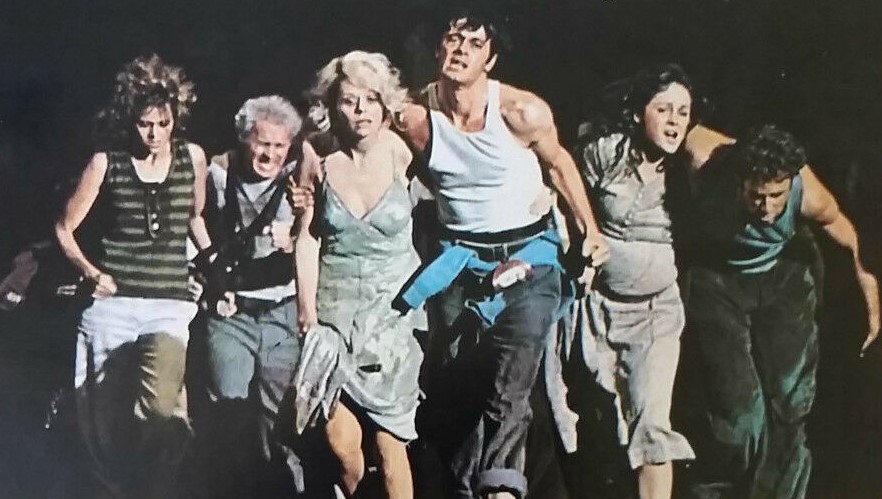
Fans of reality television shows will be only too aware how participants volunteer for ritual humiliation, but swallowing a few locusts and being stuck with a couple of snakes has nothing on the realities facing individuals during the Great Depression who would literally dance non-stop for days on end with a ten-minute break every two hours. It’s impossible to imagine that anybody could think of dreaming up such a degrading circus to take advantage of the desperate. But then this is America, land of opportunity and the MC Rocky  (Gig Young) continues to spout aphorisms and continues to promote the American Dream even as it disintegrates in front of him.

When the partner of Gloria (Jane Fonda), out-of-work actress and one of the more physical and cynical of the candidates hoping to scoop the $1,500 first prize (no prizes for coming second, of course), is ruled out through bronchitis – in case he passes it on to others rather than more any humane consideration – she pairs up with dreamer Robert who initially wanders in as spectator rather than participant. Glamorous platinum blonde aspiring actress Alice (Susannah York) is already coming apart. Sailor (Red Buttons) is a former war hero and James (Bruce Dern) drags his heavily pregnant wife (Bonnie Bedelia) around the dance floor.

There is not a great deal of story except to watch everyone grow mentally and physically incapacitated. There is betrayal and lust and survival instinct leads characters into sexual situations. When Alice seduces Robert, in retaliation Gloria dumps him and then has sex with Rocky, while attempting to retain control of that situation, but clearly needing at the very least consolation and confirmation of her attractiveness and at best some sign of favoritism.

As well as non-stop dancing, Rocky throws in stunts to keep the audience, who can sponsor a pair, interested. So there are 10-minute races, the last three to be eliminated. So determined are some of the competitors they will even lug their dead partner over the finishing line. Another of Rocky’s wheezes is to have Gloria and Robert marry, worth $200 in terms of the gifts they will receive from a sentimental audience, in the middle of the dance floor.

They are literally dancing for hours, over 1,000 in over 40 days so gradually the dance floor becomes less crowded as dancers collapse from exhaustion or cannot take it anymore. The spectators, we are reminded, are only there because “they want to see someone worse than them.” Just when you think nothing can shock you any more, it is revealed that the first prize is minus the cost of feeding, sheltering and looking after the winner.

Those who think they are tough find that the demands of mental and physical endurance are beyond them. This is a shocking film and there’s no doubt it will stay with you for a long time. I saw it first when it came out but not again until now and thank goodness for forgetfulness otherwise I doubt if I would have chosen to sit through it again.
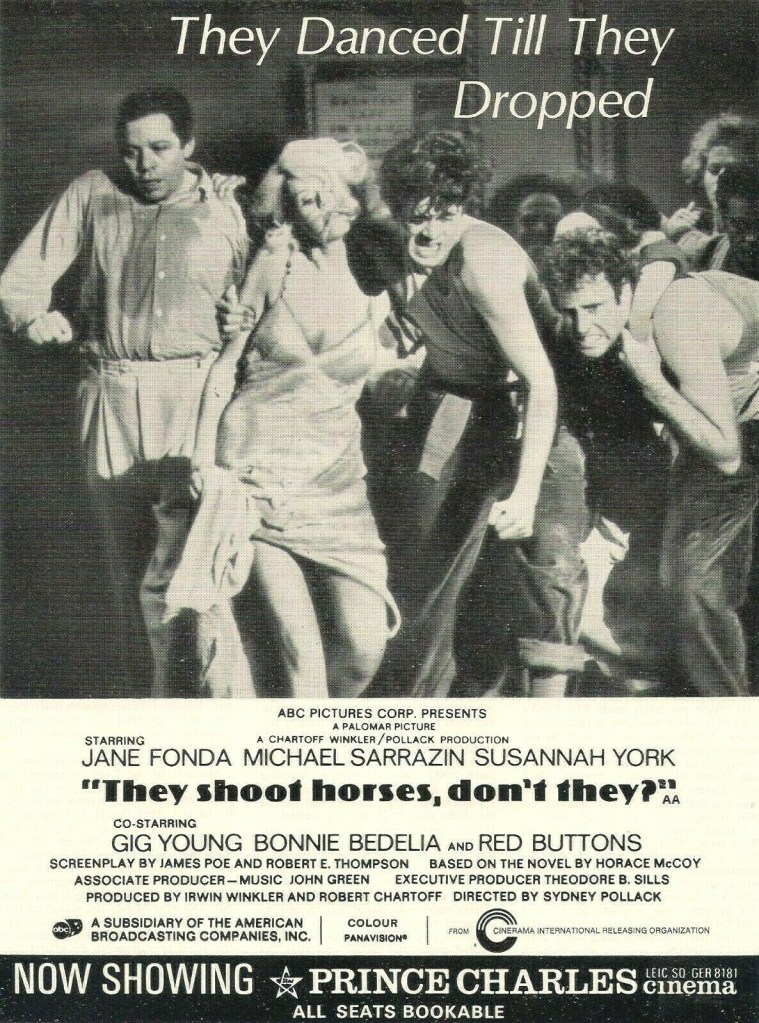
It’s doubtful if any actress had achieved such a speedy transition from glamorous leading lady to serious actress as Jane Fonda. From stripping in space in Barbarella (1968) to stripping away the last vestiges of her humanity here. Suddenly, she appears in a brand-new screen persona with the grating voice, the chip on the shoulder, the feistiness and worthy inheritor of father Henry’s acting genes. It’s also a bold role for Susannah York, in an extension of the weak character she essayed in Sands of the Kalahari (1965) but far more delusional, believing in a rainbow that will never appear. Michael Sarrazin (In Search of Gregory, 1969) initially appears out of his league but his character calls for a gentle innocence that is well within his scope.

Gig Young steals the picture, offered the opportunity to bring alive a multi-faceted character, as big a spiel-merchant who ever crossed the screen, but engaging in a marathon of optimism, and at some points, such as when coaxing a demented Alice out of the shower, earning our sympathy.  Red Buttons (Stagecoach, 1966), Bruce Dern (Castle Keep, 1969) and Bonnie Bedelia (Die Hard, 1988) also put in sterling work.

The movie received nine Oscar nominations but was ignored in the Best Picture category. Only Gig Young won for Best Supporting Actor.  Jane Fonda and Susannah York both received their first Oscar nominations, for Fonda the first of many, for York the one and only. It was also a debut nomination for Pollack, a future winner.

Sydney Pollack directs with simplicity, concentrating on the indignities of the event and focusing mostly on the personalities draining away, and even the drama is undercut, most of those scenes directed in straightforward style. However, Pollack plays around with the innovative fast forward – flashes into scenes that have not yet taken place. James Poe (Lilies of the Field, 1963), at one time down to direct, and Robert E. Thompson, a television writer making his first venture on the big screen, wrote the screenplay from the Horace McCoy novel.

Check out the Behind the Scenes article on this one.
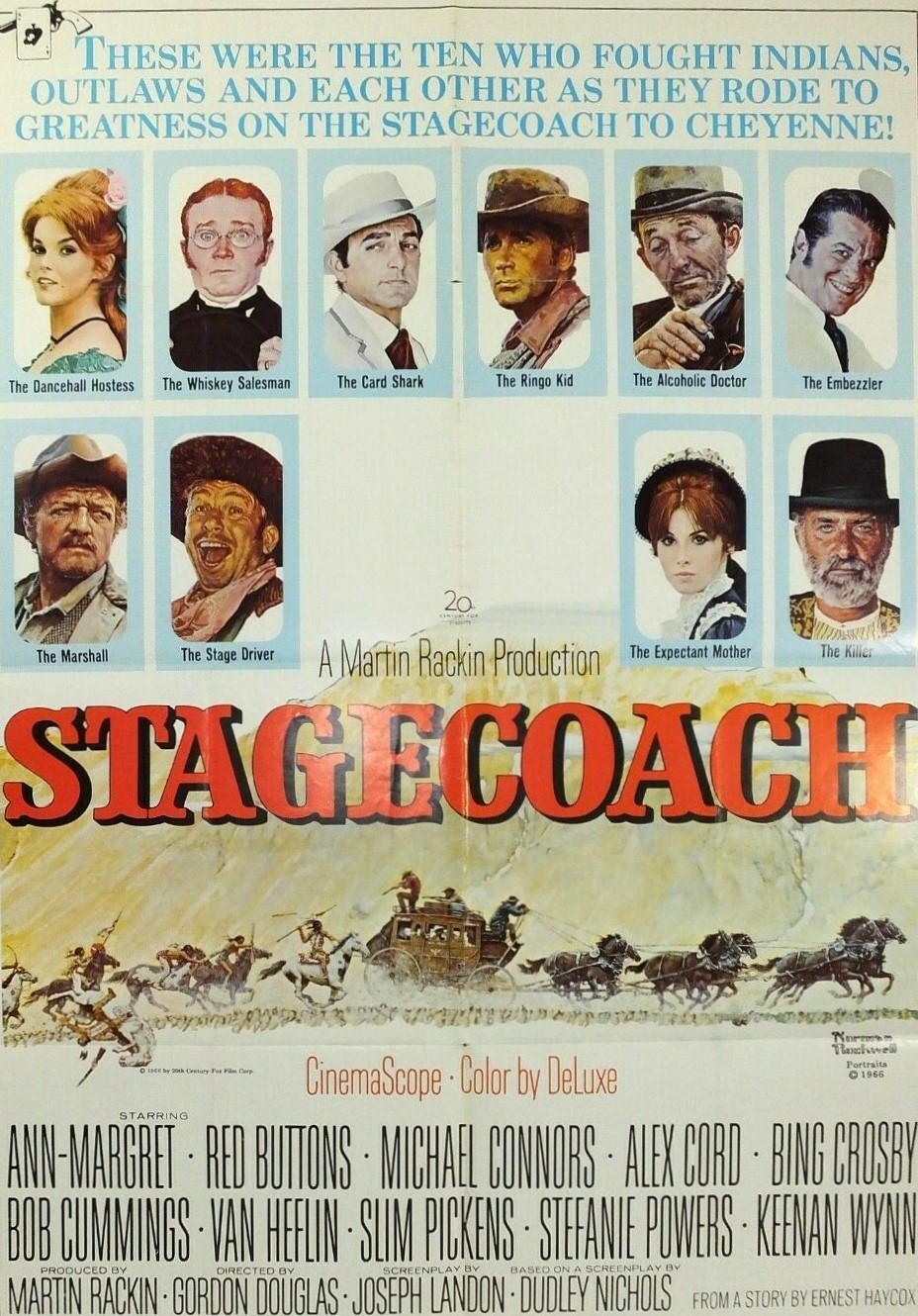
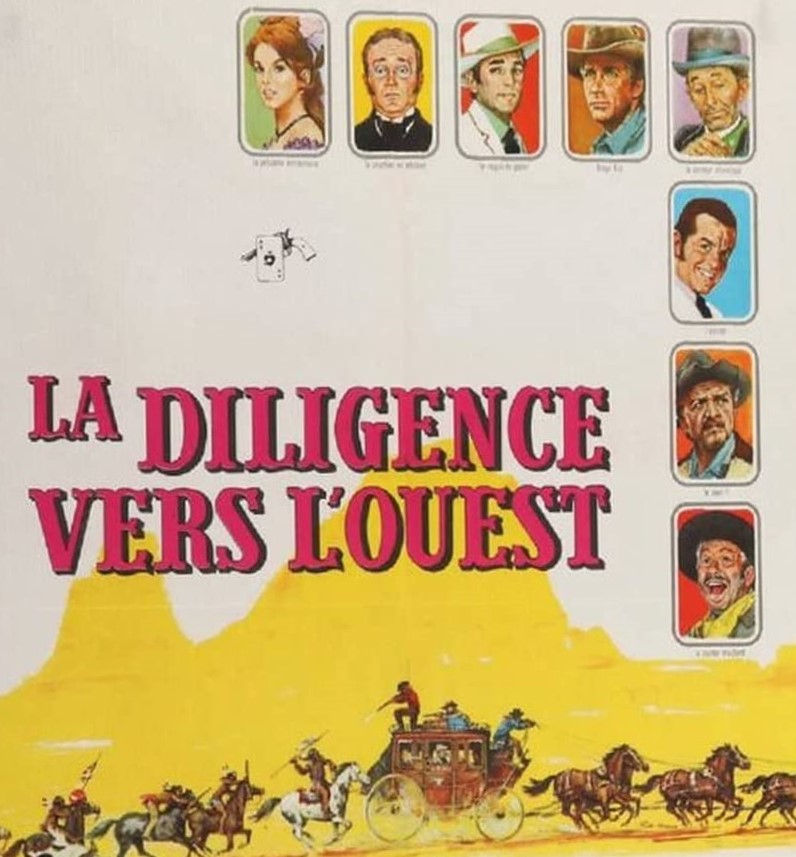
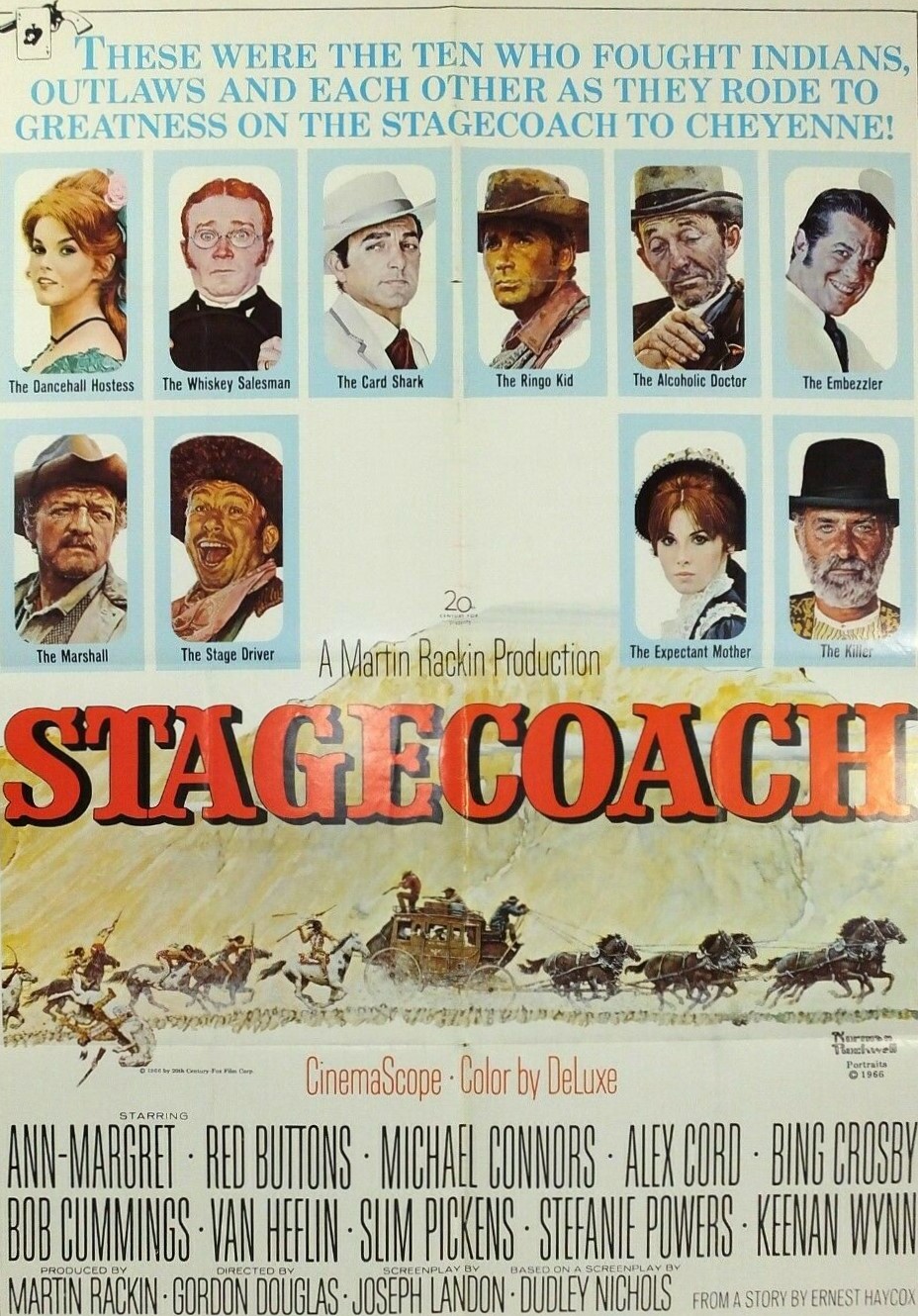
Stagecoach (1966) ****

It’s probably sacrilege to admit that I quite enjoyed this. Also it’s been so long since I’ve seen the John Ford original that I could remember very little of the specifics and I haven’t seen the remake before so this was just like watching a new movie. Basically, it’s the story of a group of six passengers taking the stagecoach to Cheyenne for different reasons who are joined by an escaped murderer and shepherded along by the driver and a town marshal. There is some excellent action but mostly it’s a relationship picture, how the characters react to one another and their response to crisis.

Good-time girl Dallas (Ann-Margret) is on the run, banker Gatewood (Bob Cummings) is hiding a stash of stolen money, alcoholic doctor Boone (Bing Crosby) is penniless, liquor salesman Peacock (Red Buttons) is a coward, gambler Hatfield (Mike Connors) has Civil War secrets, pregnant Lucy Mallory (Stefanie Powers) is meeting her cavalry husband in Cheyenne. The ornery Buck (Slim Pickens) is the driver and Curley (Van Heflin) is riding shotgun and when he comes upon stranded escaped murderer the Ringo Kid (Alex Cord) promptly arrests him.

The passengers have heard rumors of the Sioux on the warpath. The audience knows it’s not a rumor because the picture starts with the Sioux slaughtering camped cavalry. Soon enough, the passengers know it, too, coming across a patrol dead at a staging post, and of course they are soon battling for their lives when ambushed.

The drama unfolds as the characters confront each other or their own weaknesses. Dallas, who has a high old time as a saloon girl, is way out of her depth in respectable company, feeling out of place even dining with the others, hiding the secret of her affair with the married Gatewood. Ringo coaxes her along, bringing her out of her shell, giving her back self-respect, and of course falling in love. Curley, with his eyes on the $500 reward for bringing Ringo in, has no intention of letting the gunslinger take his revenge in Cheyenne on Luke Plummer (Keenan Wynn) who killed his family. Boone and Peacock are the most fun, the doctor spending most of his time separating the salesman from his cargo of booze.

There are endless permutations with a story like this, the kind of material that was mined in the disaster movies of the 1970s like Airport (1970) and The Towering Inferno (1974), a group of disparate characters forced to battle for survival. The action is only part of the deal. The picture only truly works if the characters are believable. For that, you need a heap of good acting. The audience could certainly rely on old dependables like Bing Crosby (The Road to Hong Kong, 1962) in his big screen swansong, Van Heflin (Shane, 1953), Red Buttons (Oscar-winner for Sayonara, 1957), Robert Cummings (Saboteur, 1942) and cowboy picture veteran Slim Pickens to put on a good show. But the main dramatic load was to be carried by relative newcomers Ann-Margret and Alex Cord.

Ann-Margret has made her name with sassy light-hearted numbers like The Pleasure Seekers (1964) and had only just stepped up to the dramatic plate with Once a Thief (1965). This was Alex Cord’s sophomore outing after Synanon (1965) and he was stepping into some mighty big boots, the odds stacked against him playing the role John Wayne made famous – and which turned John Wayne into a star. 

Amazingly, the casting works. Ann-Margret moves from feisty to restrained, meek to the point of being cowed, and for most of the film, far removed from the false gaiety of the saloon, seeks redemption. The trouble-making minx emerges only once, to knock the wind out of Mrs Mallory, but, after taking a tumble down the humility route, gradually steers her way towards a better self, preventing Gatewood from causing chaos, nursing Mallory and inching her way towards true feelings for Ringo. As in the best movies, it’s not for her to open up about her woeful life but for another character, in this case Ringo, to identify her flaws: “What you doin’ about your scars, you got ‘em even if they don’t show…when you goin’ to stand up and stop crawlin’?” When they finally kiss it is one of the most beautiful tender kisses you will ever see and most of that is down to Ann-Margret’s reaction.

I had already taken back all my reservations about Alex Cord’s acting skills that were mostly due to his moustachioed performance in Stiletto (1969) after seeing him in The Scorpio Letters (1967) and this is another completely different portrayal. As much as he can deliver on the action front, it’s in the dramatic scenes that he really scores, gentle, vulnerable, caring. He certainly matches the Duke’s trademark diffidence in terms of romance. There’s a point where the camera just holds on their faces to nine depth of expression and we are not disappointed.

Gordon Douglas (The Detective, 1968) is the director who had the gall to take on the remake, and he delivers a character-sensitive picture shaded with action. Written by Joseph Landon (Von Ryan’s Express, 1965) based on the original by Dudley Nichols and Ernest Haycox.

Pretty damn good effort.

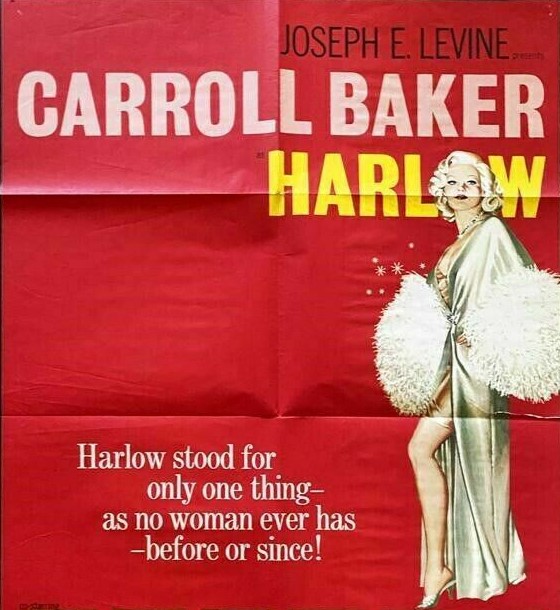
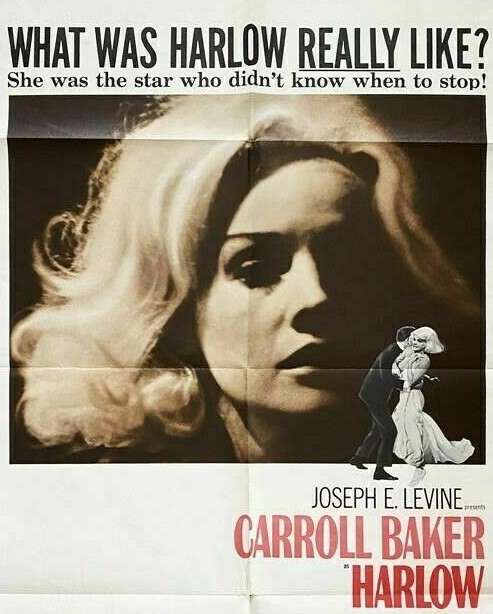
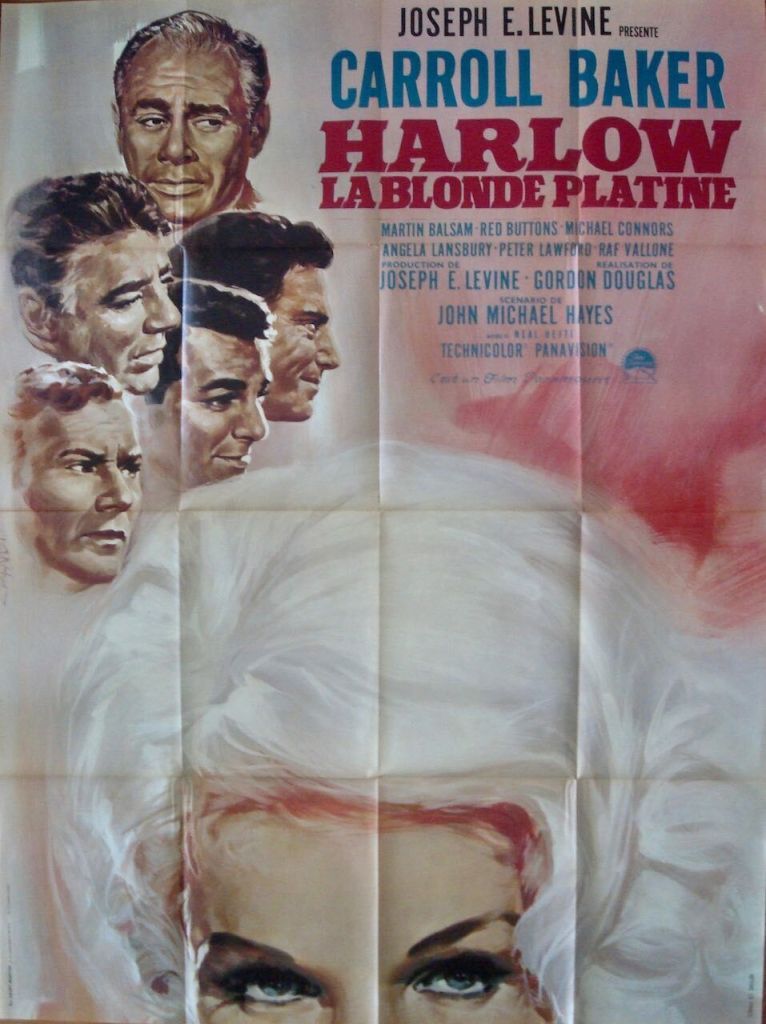
Harlow (1965) ***

Harlow presents such a convincing picture of Hollywood abuse that I was astonished to discover that it was not entirely truthful where the title character was concerned.

Jean Harlow was a hugely popular star in the 1930s before her untimely death at the age of 36. This film depicts her as a virgin (not true) who turns neurotic (not true) after her impotent husband commits suicide (debatable) on their wedding night (not true) leading to her go off the rails and die from pneumonia (not true). But in terms of the Hollywood system a great deal rings true and if the Me Too movement had existed in the late 1920s the finger would be pointed at a huge number of men.

The film is at its best when dissecting the movie business. A five-minute opening sequence demonstrates its “factory” aspect as extras and bit players clock in, are given parts and shuffle through great barns to be clothed and made up, often to be discarded at the end of the process.

No sooner has this version of Jean Harlow (Carroll Baker) been given a small part than she encounters the casting couch, operated by a lowly assistant director, who bluntly offers five days’ work instead of one if she submits to his advances. When she turns him down, work is hard to come by and she resorts to stealing lunch before rescued by agent Arthur Landau (Red Buttons). After tiny parts that mostly consist of her losing her clothing, receiving pies or eggs in the face and displaying her wares in bathtubs, she geta a big break only for that producer to demand his pound of flesh – “I’ve already bought and paid for you.” Here she has “the body of a woman and the emotions of a child” and ends up choosing the wrong suitor which leads to a calamitous outcome.

However, the pressures of stardom are well-presented: she is the breadwinner for her unemployed mother Jean (Angela Lansbury) and lazy stepfather Marino (Raf Vallone) and soon box office dynamite for studio chief Everett (Martin Balsam) who sees in her the opportunity to sell good clean sex. The negotiations/bribery/blackmail involved in fixing salaries are also explored.

But the film earns negative points by mixing the real and the fictional. The agent and husband Paul Bern (Peter Lawford) existed but most of the others are invented or amalgamations of different people. MGM is represented as “Majestic” and among her films there is no Red Dust (1932) or China Seas (1935) but lurid inventions like Sin City

Director Gordon Douglas was a versatile veteran, with over 90 films to his credit, from comedies Saps at Sea (1940) and Call Me Bwana (1963) to westerns The Iron Mistress (1952) and Rio Conchos (1964) and musicals Follow That Dream (1962) and dramas The Sins of Rachel Cade (1961) and Sylvia (1965) which also starred Baker. The opening scene apart, which is a seamless construction, he is adept at this kind of helter-skelter drama. John Michael Hayes (Rear Window, 1954) has produced a punchy script based on the book by Arthur Landau and Irving Shulman.

In the title role Carroll Baker (Sylvia) has probably never been better, comedian Red Buttons (Stagecoach, 1966) excellent in a straight role while the smarmy Raf Vallone (Nevada Smith, 1966) is the stand-out among an excellent supporting cast that also includes Angela Lansbury (In the Cool of the Day, 1963), Peter Lawford (Sylvia), Leslie Nielsen (Beau Geste, 1966), Martin Balsam (Seven Days in May, 1964) and Mike Connors (Stagecoach, 1966).

Except that virtually none of the movie is true, I would have given it four stars for its portrayal of Hollywood but I have come to expect that biopics, while moving facts around for dramatic purposes, are required to be good more faithful to their subjects than this. 

Behind the Scenes: “They Shoot Horses, Don’t They” (1969)

Dream Team Number One: Clark Gable and Jean Harlow. This was of course a good 30 years before the movie actually got made. The Horace McCoy novel was purchased in 1935 by MGM as a big-budget project teaming Clark Gable and Jean Harlow. This was despite Variety proclaiming it was “not screen material.” The premature death of Harlow put paid to the idea. Next, actor Wallace Ford (Freaks, 1932) bought it with Broadway in mind. A production was scheduled to open in 1939, but never did.  

Dream Team Number Two: Charlie Chaplin and Marilyn Monroe. When the comedian purchased the rights in the early 1950s he intended Marilyn Monroe to play the leading female. Although she was a mere starlet Chaplin had form in building up newcomers. Author McCoy had by that point become an accomplished screenwriter with over 30 credits including Gentleman Jim (1942), film noir Kiss Tomorrow Goodbye (1950) and The Lusty Men (1952) That concept fell by the wayside when Chaplin was effectively banished from America while launching Limelight (1951) in Britain.

It was another 14 years before interest in the novel was revived by screenwriter James Poe, who purchased the rights from the McCoy estate. Although most famous within the trade for being accused of fraudulent behaviour in relation to his screenplay for Around the World in 80 Days (1956). Despite an Oscar for the film he was sued for $250,000. However, he had a sterling body of work including Cat on a Hot Tin Roof (1958), Sanctuary (1960), Lilies of the Field (1963), The Bedford Incident (1965) and Riot (1969) and two other Oscar nominations.

In 1965 he had signed a multi-picture writer-director deal with Columbia. He was either going to make his directorial on The Gambler or They Shoot Horses, Don’t They. It turned out to be the latter. Failing to get the movie off the ground with Columbia or under his own steam, he turned to new studio Palomar, which was a production entity set up by the ABC television network, which bought over his rights as well as his script but kept Poe on as director.

Dream Team Number Three: Faye Dunaway. Yep, one big star, not two. Poe’s screenplay, while not eliminating the male lead, spun on a female star. Dunaway, hot after Bonnie and Clyde (1967), was offered $600,000 to play the role. Mia Farrow was also in contention, for $500,000. The only problem was, the budget could not remotely stretch to that. As helmed by Poe, it was to cost no more than $900,000. The film was scheduled to begin shooting in spring 1968 but a month later the start date shifted to June.

Two relative newcomers Robert Chartoff and Irwin Winkler were brought in as producers to move the project along. Later they would be responsible for such classics as Rocky (1976), The Raging Bull (1980), The Wolf of Wall Street (2013) and The Irishman (2018), but at this point they had just three pictures under their belt, although that included Point Blank (1967), Their first task: persuade Poe to rewrite the script. They felt the third act needed work with restructuring elsewhere to make the pay-off work.

But Poe, believing his position was sacrosanct, refused to discuss a rewrite. He refused to discuss anything, period, treating the producers as his assistants rather than people with some power within the studio. According to Irwin Winkler, “Poe seemed unaware of the of the normal process of preparation, even though he’d been around movie sets for decades.”

Realising that getting a star on their budget was impossible, Chartoff and Winkler changed tack and talked to good actors, but even then few were interested. A less dramatic star than Jane Fonda you could not imagine, her resume filled with light comedies, French films that utilised her sexuality or the extravaganza that went by the name of Barbarella (1968). But the pregnant Fonda was keen on change. The film was delayed until after she had given birth. Michael Sarrazin should have been out of the equation. John Schlesinger had lined him up for the Jon Voigt role in Midnight Cowboy (1969) but Universal, to whom he was under contract, asked too much to send him out on loan.

With no sign of the rewrites, the producers became antsy about the director. However, they showed their true mettle as producers, convincing Palomar there was no way the original budget would cover the ballroom set, huge number of extras, live orchestra and salaries. It would need to at least triple.

In a picture of one predicament following another, there was one crisis the producers had not foreseen. They were going to be fired. Apart from anything else, they were only executives on the picture with any experience, it being not only Poe’s first movie but that of Chartoff and Winkler’s superiors at the studio. The outcome – the guy who had told the pair they were being fired was shown the door instead.

Susannah York was cast after the producers saw a sneak of The Killing of Sister George (1969) at the Robert Aldrich studios. She had committed to Peter O’Toole vehicle Country Dance/Brotherly Love (1970), written by her cousin James Kennaway (Tunes of Glory, 1960). After too many delays on They Shoot Horses she planned to pull out in favour of the other film. Although Sally Kellerman (Mash, 1970) was set as a last-minute replacement, the issue was resolved by asking MGM to delay the start on the rival picture.

Believing Poe was in no position to helm such a big-budget picture enterprise, Chartoff and Winkler began the process of removing him only for Jane Fonda to dig her heels in. She changed her mind after witnessing first-hand Poe’s directorial skills – or lack of them – when she took part in a screen test for Bonnie Bedelia. Winkler recollected, “On the set Jane asked Poe questions about the blocking of the scene, why she moves in one direction rather than another, why in front of a sofa rather than behind it etc. He couldn’t answer her questions and told her to talk to the cameraman.” Exit Poe.

In terms of a replacement, Chartoff and Winkler set their sights of Sydney Pollack (The Scalphunters, 1968) with whom they had previous dealings, and William Friedkin, then being hailed for The Homecoming (1968) – luckily The Night They Raided Minsky’s (1968) had yet to be released. But studio executives had a third director in mind, Jack Smight (No Way to Treat a Lady, 1968). Friedkin should have been in pole position, having only received $75,000 for The Homecoming. His agent, sensing an opportunity, demanded $200,000. Jack Smight’s agent also got greedy and wanted $250,000. Pollack’s agent was happy with the $150,000 on offer.

When Poe was eased out, filming was announced as beginning on February 17, 1969, the budget having now increased to $3.2 million – including $400,000 for extras. However, acoustic issues – seawater had eaten away the bottom of the pier – prevented use of the old Aragon ballroom in Santa Monica. That set was constructed on the Warner lot.

Pollack then turned it down. He had reservations about the script, which had still never been rewritten. When Robert E. Thompson, a television writer but “a Horace McCoy expert,” was mooted, Pollack changed his mind. The new script contained the “flash forward” scenes that prepared audiences for the shock ending. However, the new scenes and delays in starting increased the budget which now ballooned to $4.7 million.

It turned out the director was the best actor of all. “I was impressed with Sydney Pollack’s ease on the set,” recalled Irwin Winkler. “He never seemed to be working hard and yet was able to get marvelous performances out of the actors. Everybody in the company adored him.” Asked by Winkler how he remained so calm dealing with the actors and all the extras and the complicated camera set-ups, he replied, “it was really quite easy.” That same afternoon he collapsed on set and was diagnosed with “nervousness.”

The studio, the stars, the producers, all seemed confident about the picture. All they had to do was convince the audience. But at the first preview in San Francisco the audience roared with laugher at the climactic scene. That shocked the studio to the core until the producers were able to reassure the head honchos that the “fast forwards” would smooth over that problem. Which they did.

It was nominated for nine Oscars – Best Director, Best Screenplay, nods for Jane Fonda, Gig Young and Susannah York among others. Only Gig Young won.  

SOURCES: Irwin Winkler, A Life in Movies, (Abrams Press, New York, 2019) p34-47;  “Tough Stuff,” Variety, August 7, 1935, p59; “Ford Buys for B’Way,” Variety, September 11, 1939, p42; “Dance Marathon Reprise,” Variety, August 3, 1966, p24;  “IT&T In No Way Slowing Down Theatrical Feature Program of ABC,” Variety, January 10, 1968, p4; “Crowded Slate for Palomar,” Variety, February 28, 1968, p18; “Bob Evans Chips-Service To Writers As Stars At Paramount,” Variety, May 1, 1969, p19; “Jane Fonda Gets Top Role in Palomar’s Horses,” Box Office, July 22, 1968, pW1; “Palomar Horses on W7 Space,” Variety, October 23, 1968, p3; “Jan 6 Filming Date for They Shoot Horses,” Box Office, December 16, 1968, pW5; “Cheery Side of Delay on Horses,” Variety, January 15, 1969, p21; “Winkler Wants Films With Social Comment,” Box Office, January 19, 1970, pW1.

Stagecoach (1966) ****

It’s probably sacrilege to admit that I quite enjoyed this. Also it’s been so long since I’ve seen the John Ford original that I could remember very little of the specifics and I haven’t seen the remake before so this was just like watching a new movie.

Basically, it’s the story of a group of passengers taking the stagecoach to Cheyenne for different reasons who are joined by an escaped murderer and shepherded along by the driver and a town marshal. There is some excellent action but mostly it’s a relationship picture, how the characters react to one another and their response to crisis.

Good-time girl Dallas (Ann-Margret) is on the run, banker Gatewood (Bob Cummings) is hiding a stash of stolen money, alcoholic doctor Boone (Bing Crosby) is penniless, liquor salesman Peacock (Red Buttons) is a coward, gambler Hatfield (Mike Connors) has Civil War secrets, pregnant Lucy Mallory (Stefanie Powers) is meeting her cavalry husband in Cheyenne. Ornery Buck (Slim Pickens) is the driver. Curley (Van Heflin) is riding shotgun and when he comes upon stranded escaped murderer the Ringo Kid (Alex Cord) promptly arrests him.

The drama unfolds as the characters confront each other or their own weaknesses. Dallas, who had a high old time as a saloon girl, is way out of her depth in respectable company,  concealing the secret of her affair with the married Gatewood. Ringo coaxes her along, bringing her out of her shell, giving her back self-respect, and of course falling in love. Curley, with his eyes on the $500 reward for bringing Ringo in, has no intention of letting the gunslinger take his revenge in Cheyenne on Luke Plummer (Keenan Wynn) who killed his family. Boone and Peacock provide the fun, the doctor spending most of his time separating the salesman from his cargo of booze.

There are endless permutations with a story like this, the kind of material favoured in  disaster movies like Airport (1970) and The Towering Inferno (1974) where disparate characters battle for survival. The action is only part of the deal. The picture only truly works if the characters are believable. For that, you need a heap of good acting. The audience could certainly rely on old dependables like Bing Crosby (The Road to Hong Kong, 1962) in his big screen swansong, Van Heflin (Shane, 1953), Red Buttons (Oscar-winner for Sayonara, 1957), Robert Cummings (Saboteur, 1942) and cowboy picture veteran Slim Pickens to put on a good show. But the main dramatic load was to be carried by relative newcomers Ann-Margret and Alex Cord.

Ann-Margret has made her name with sassy light-hearted numbers like The Pleasure Seekers (1964) and had only just stepped up to the dramatic plate with Once a Thief (1965). This was Alex Cord’s sophomore outing after Synanon (1965), the odds stacked against him making any impact in the role which turned John Wayne into a star. 

Amazingly, the casting works. Ann-Margret moves from feisty to restrained, meek to the point of being cowed, and for most of the film, far removed from the false gaiety of the saloon, seeks redemption. The cocky trouble-making minx emerges only once, to knock the wind out of Mrs Mallory, but, after taking a tumble down the humility route, gradually steers her way towards a better self, preventing Gatewood from causing chaos, nursing Mallory and inching her way towards true feelings for Ringo. As in the best movies, it’s not for her to open up about her woeful life but for another character, in this case Ringo, to identify her predicament: “What you doin’ about your scars, you got ‘em even if they don’t show…when you goin’ to stand up and stop crawlin’?” When they finally kiss it is one of the most tender kisses you will ever see.  

My reservations about Alex Cord’s acting skills were based on his moustachioed performance in Stiletto (1969) but I reversed my opinion after seeing him in The Scorpio Letters (1967) and this is another revelation. As much as he can deliver on the action front, and sports on occasion a mean-eyed look,  it’s in the dramatic scenes that he really scores, gentle, vulnerable, caring. He certainly matches the Duke’s trademark diffidence in terms of romance. That the camera can mine depths of expression from both faces proves the calibre of their acting.

If director Gordon Douglas (Rio Conchos, 1964) had more critical standing, his bold long opening aerial tracking shot over rugged forest, mountain and plain before reaching the stagecoach would have received the acclaim accorded Stanley Kubrick for a similar shot in The Shining (1980). The opening also makes it clear how far removed this is from the original, not just in colour obviously, but (although filmed in Colorado) in a different locale, Wyoming, rather than the arid Arizona of Monument Valley. After a brief glimpse of the stagecoach, Douglas switches to a cavalry troop making camp. A soldier going into a wagon is met by a hatchet in the head. The camera tracks the corpse’s blood as it flows down a stream where it alerts another soldier washing clothes. Before he can raise the alarm, he gets a lance in the back.

Where the passengers have heard rumors, quickly dismissed (“nobody got scalped by an old rumor”) of the Sioux (Apaches in the original) on the warpath, the audience has seen the cavalry troop slaughtered, so (in effectively a Hitchcockian device) provides the movie with the tension the on-screen characters initially lack The passengers soon grasp reality when they come across another patrol dead at a staging post, and eventually are battling for their lives when ambushed. But prior to that there is a tense sequence of leading the stagecoach across a narrow mountain ridge during a storm.

There’s a clever reversal before the Sioux onslaught. The passengers think they have seen soldiers approaching, but it is the Sioux wearing cavalry uniforms. There is no river to cross as in the original, but the chase along a mountainous path is breathtaking, aerial and tracking shots given full rein, ending in a shoot-out without (as in the original) the cavalry riding to the rescue.

Douglas has his work cut out with the drama, as various characters confront their issues, and his staging is superb, characters always given reason to move. Screenwriter Joseph Landon (Rio Conchos) borrowed material from the Dudley Nichols original but added and subtracted quite a bit.

At the time critical deification of John Ford had not begun and Hollywood was in a cyclical remake mood – new versions of Beau Geste and Madame X appearing the same year – so Gordon Douglas didn’t quite face a critical backlash, although praise was generally sparse. Judging by the box office it received an audience thumbs-up – as it does from yours truly.

You can rent this on Amazon Prime.

Discover WordPress

A daily selection of the best content published on WordPress, collected for you by humans who love to read.

The Atavist Magazine

by Brian Hannan

WordPress.com News

The latest news on WordPress.com and the WordPress community.