Mister Moses (1965) ***

The “lost” Robert Mitchum picture, never seen on VHS or DVD, but now turning up on YouTube.

Elephants have little proven appeal for audiences. From Dumbo (1941), Hannibal (1960), Billy Rose’s Jumbo (1962) and Hannibal Brooks (1968) through to Dumbo (2017) and Babylon (2022), the story is one of negative impact on box office. Baby elephants are maybe a different story – see Hatari! (1962)  – but there’s very little that’s cuddly about the adult version and their main purpose appears to be to annoy a major stars initially and then go on a rampage that either hinders or helps said star. If you’re acquainted with elephants, you’ll notice this is of the tameable Asian variety rather than the untamed African.

The unnamed beast here would fall into the former category except the eponymous Mister Moses (Robert Mitchum) – real name Joe – can talk to the animal in a language it understands and persuade it to show off its parlor tricks, enhancing Moses’s status among a small  community in Kenya. Moses is a con-man-cum-diamond smuggler, rescued from a river, specifically the reeds growing there that offer a Biblical connection to the natives.

The Bible plays a significant role here, though the natives don’t fall for the Noah story as explained by missionary (Alexander Knox). They are, like Native Americans, being driven off their land by the arrival of a dam which will flood their traditional grounds. Their cattle have not been included in the grand plan to airlift the entire community. So they refuse government help, hence the need to embark on a 300-mile trek.

Moses, a dodgy character with “an allergy to badges of authority”, is blackmailed by the missionary’s daughter Julie (Carroll Baker) and ends up doing the job of her fiancé, district commissioner Robert (Ian Bannen), to shift the natives off their land. He’s got some parlor tricks up his sleeve, too, including a flame-thrower which, again the old Biblical touch, he can employ to burn a bush, thus endearing himself as a leader.  

Naturally, enough, though staid, Julie finds herself attracted to Moses, a somewhat laid-back character with quite a line in hip patter. But it’s quite a stretch for Julie to be seduced by his knowledge of classical literature, namely the Andromeda-Perseus tale. Not everyone takes to Moses’ leadership, saboteurs steal the map and the compass.  And it’s no surprise when someone finds another purpose for the flame-thrower. There’s a bad witch doctor Ubi (Raymond St Jacques) to be put in his place, and Joe rises out of his lethargy long enough to dispose of a couple of villains.

With the emphasis on the Biblical, Joe is called upon to “part the waters” Exodus-style. Disappointingly, this is a bit of a parlor trick. It had me wondering how the heck he was going to do that,  with just a flame thrower and an elephant at his disposal, and also given that the sole purpose of rivers in African movie vernacular is so that the leading lady can bathe in one. Since the aforementioned river is nothing more than the outcome of another dam, Moses is clever enough to simply persuade the dam superintendent to – miracle of miracles – to turn off the water.

There’s enough going on to maintain interest and the will-she-won’t-she element is well-handled and there’s a good final line, “What’ll I do for laughs?”

Robert Mitchum has been here before (Rampage, 1963) but this time is on the side of the animals. Of course, the main interest is not how well he gets on with the elephant but whether he strikes sparks with a Carroll Baker (Harlow, 1965) eschewing her normal sexy persona. A cross between Hayley Mills and Deborah Kerr, Baker doesn’t quite suggest bottled-up sexual energy fizzing to get out, but then that wouldn’t be in character. It’s not in The African Queen league in terms of screen partnerships but it’s certainly workable enough.

Ian Bannen (The Flight of the Phoenix, 1965) is at his scowling best although Raymond St Jacques (Uptight, 1968) gives him a run for his money. Director Ronald Neame (Gambit, 1966) proved as adept at handling the big-name stars as the animals without it being acclaimed as a famous “lost” work of Mitchum. The screenplay by Charles Beaumont (Night of the Eagle/Burn, With, Burn, 1962) and Monja Danischewsky (Topkapi, 1964) was based on the novel by Max Catto (Seven Thieves, 1960).

A pleasant enough diversion.

The Comedians (1967) ***

Over-long, over-hyped and over-cast. Pretty much an early example of virtue-signalling, exposing corruption in a dictatorship (Haiti), but offering more through the singular self-deception of the main characters. An element of sleight-of-hand is also practiced on an audience enticed by four big stars “above the title” comprising three Oscar winners and one multiple nominee. Luckily, the ironic in-joke of naming characters with traditional English names – Smith, Jones and Brown – would probably pass most people by.

Brown (Richard Burton), a hotelier, is present throughout but Major Jones (Alec Guinness) appears only briefly at the beginning then disappears until late on to spike the plot. Martha (Elizabeth Taylor), the adulterous love interest, pops up sporadically as does her husband Ambassador Pineda (Peter Ustinov). There’s not much of a story, Brown, cynical about the dictatorship, is friendly with a rebel leader, Jones is an ineffectual arms dealer, and missionary couple the Smiths (Paul Ford and Lillian Gish) offer comic relief until barbarity rears its head.

Great play is made of naivete but the film suffers from the Hollywood curse of only being able to examine foreign politics through the prism of a (white) American or Englishman. At the time it might have been shocking to see brutality so convincingly dispensed, and there is, also, in Mondo Cane fashion, too much time spent on strange ritual, but at the same time, of course, the U.S. was inflicting its own barbarities on the Vietnamese.

On the other hand, Brown is exactly the kind of foreigner who believes things must improve because, damn it all, he’s British and bad things can’t happen to a Brit in a strange land. He is convinced he will be able to sell a hotel located in a war-torn country, persists in believing Martha will abandon husband and son, and convinces himself he is the very man the rebels have been looking for.

Jones mistakenly believes everyone is taken in by his hail-fellow-well-met routine and his tales of heroism in World War Two jungles, thinks he is in with a chance with Martha and that his gun-running activities will avoid detection. The ambassador thinks his wife will not leave him as long as he turns a blind eye to her affairs. And Martha, probably wondering why she married such a buffoon, can’t work out to dump him. Everyone who has much to lose appears to be continually on a precipice and it’s hard to see what they could gain from their actions. 

They are all misfits, “comedians,” stuck in the rut of their own destiny, unable to change.

Nobody is more gullible than those who dupe themselves and the film comes into its own when it sets personal delusion against political naivete. In narrative terms Jones is the most obviously unmasked but the others are no less shown to be foolhardy in their expectations.

This had all the hallmarks of a prestige picture, initially planned as a roadshow,  around $2 million spent on the above-the-line cast, another chunk on buying the rights to the Graham Greene bestseller and assigning the author the screenplay, location shooting in Dahomey.

Don’t expect oratorical fury from Richard Burton (The Bramble Bush, 1960) nor outbursts of angst from Elizabeth Taylor (Secret Ceremony, 1969). There’s something almost comically homely in their deception and in the outwardly confident Brown perceiving Jones as a love rival.  Alec Guinness (The Quiller Memorandum, 1966) is the big treat, an upmarket con man, his boisterous voice and mannerisms far removed from his more usual introspective performances. Peter Ustinov (Topkapi, 1964), a bit too fidgety for my liking, nonetheless attracts sympathy as the man who is batting above his weight in snaring a trophy wife he knows he cannot hold onto.

Burton was the odd one out in the Oscar rankings. Despite five nominations by this stage, he had never taken home the statuette. Elizabeth Taylor, by contrast, had won twice, for Butterfield 8 (1960) and Who’s Afraid of Virginia Woolf (1966), Guinness once for Bridge on the River Kwai (1957) and Ustinov also twice Spartacus (1961) and Topkapi.  

However, in some senses if you remove the star turns, you are left with a rawer picture, and director Peter Glenville (Becket, 1964) captures much of the personal intensity of the novel. Taylor, in particular, misses the mark. Although playing a German, she never once bothers attempting an accent. Had Burton been the sole star, the movie would have worked much better since his low-key playing would not have been so much at odds with other actors.  

There’s a host of striking turns from supporting stars, ranging from silent film star Lillian Gish (The Unforgiven, 1960) to Roscoe Lee Brown (Topaz, 1969), James Earl Jones (The Great White Hope, 1970), Raymond St Jacques (Uptight, 1968) and Cicely Tyson (Sounder, 1972).

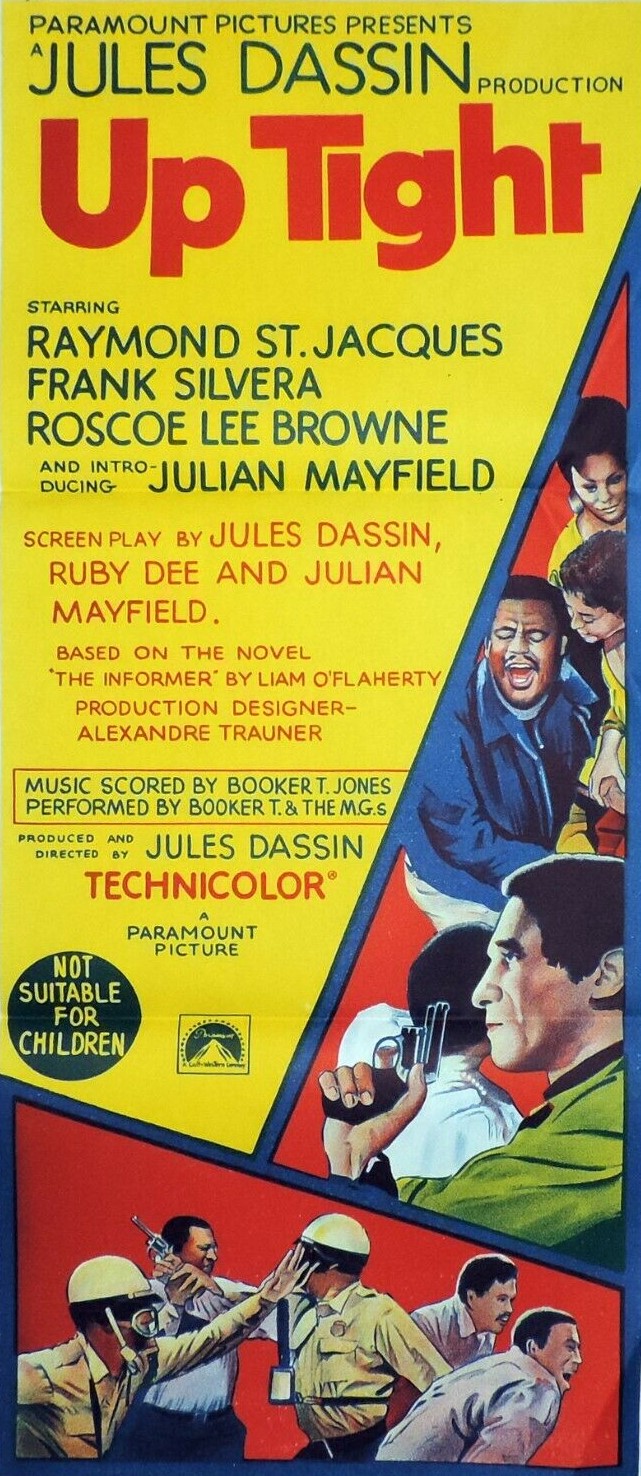
Uptight (1968) ****

While a misplaced attempt to relocate John Ford’s Oscar-winning The Informer (1935) to Cleveland, Ohio, after the funeral of Martin Luther King, director Jules Dassin more than makes up for it with his exploration of black militancy and racial conflict. The basic story of unemployed alcoholic Tank (Julian Mayfield) trying to regain the favor of local activist committee led by B.G. (Raymond St Jacques) is less interesting than the revolutionary backdrop.

Dassin was suited to uncovering the seamy side of life having helmed film noirs Brute Force (1947) and The Naked City (1948) and while in the 1960s concentrating on dramas he remained best-known for heist pictures Rififi (1955) and Topkapi (1964) so it was almost a given that this movie would feature a robbery.  Tank was supposed to be part of a team, led by Johnny Wells (Max Julien), hijacking guns, but he’s too drunk to help, and during the robbery after a guard is killed the finger points at Johnny. 

Above: American poster. Below: the French version.

Assailed for his lack of maintenance by Laurie (Ruby Dee), mother of his kids, who subsists on welfare and prostitution, Tank considers informing on Johnny and picking up the $1,000 reward. So the story becomes a question of whether he will succumb to temptation.

But that’s really just a MacGuffin for an insight into the problems facing the poverty-stricken black population and the armed response many feel is the only way to resolve such issues. Several outstanding scenes depict the raw emotions of people trapped in this lifestyle. The opening scene, showing the funeral of Martin Luther King, became a clarion call for violence. Laurie is humiliated by a welfare officer. Police attempting to arrest Johnny are met with a fusillade of bottles.

The case for armed insurrection is made abundantly clear. The black population is continually oppressed, not just by police violence, but being told they lack the skills for a rewarding job. “When you’re born black, you’re born dead.” B.G. rejects the offer of assistance of white civil rights activists. Not all the locals are underdogs. Clarence (Roscoe Lee Brown), with an apartment lined with bookshelves and wearing fine clothes, does very well out of his arrangements with the police and the black welfare officer clearly gets a kick out of his power to possibly disbar Laurie from receiving financial assistance. While it might have proved more incendiary at the time, it’s impossible to miss the injustice portrayed. It was almost a wake-up call for the ruling authorities that there existed a growing underground force determined to achieve equality through violence if necessary. The idea of an organised group, rather than a shambolic mob, is the other clear message.

Any actor would baulk at the prospect of matching the Oscar-winning performance of Victor McLaglen in the Ford original and surely no director would entrust the task to an inexperienced actor like Julian Mayfield whose only previous screen credit was a decade before in Virgin Island (1958). Mayfield finds it impossible to conjure up the pathos required and mostly appears as a bumbling fool.

This is despite the movie going out of its way to make Tank appear more sympathetic. He could easily claim he was blackmailed into informing by wealthy stool pigeon Clarence who holds compromising photographs. But, equally, the brotherhood, should it become aware of Clarence’s activities, would surely come down on him hard. Johnny absolves Tank of responsibility for not participating in the robbery, recognizing that while the man’s bulk was useful in the past, he lacks the mind-set for robbery. And he must stay away from Laurie otherwise she will lose her welfare.

But the rest of the cast is outstanding. Raymond St Jacques (If He Hollers, Let Him Go, 1968) stands supreme as an imposing Malcolm X figure. Roscoe Lee Brown (Topaz, 1969) is persuasive as a confident gay informer. Activist Ruby Dee (The Incident, 1967) is good, too. And there is strong support from Frank Silvera (Guns of The Magnificent Seven, 1969), Max Julien, best known later for The Mack (1973), and in her movie debut Janet MacLachlan giving a hint of the acting skills that would win her an Oscar nomination for Maurie (1973)

Perhaps the most important element of the picture was the screenplay, a collaboration between Julian Mayfield, Ruby Dee and Jules Dassin, the involvement of the first two ensuring that the main targets were well and truly hit. Dassin ensures that the movie never loses its way, tension kept high by the hunt for Johnny, the personal dilemma of Tank and the various confrontations with B.G. Great contemporary score by Booker T.

This is a movie that still stands up, not just because of its fearless delineating of the times, but from the suspicion that not enough has changed in the abject poverty to which so many are condemned.

There’s a very decent print available on Youtube.

Discover WordPress

A daily selection of the best content published on WordPress, collected for you by humans who love to read.

The Atavist Magazine

by Brian Hannan

WordPress.com News

The latest news on WordPress.com and the WordPress community.