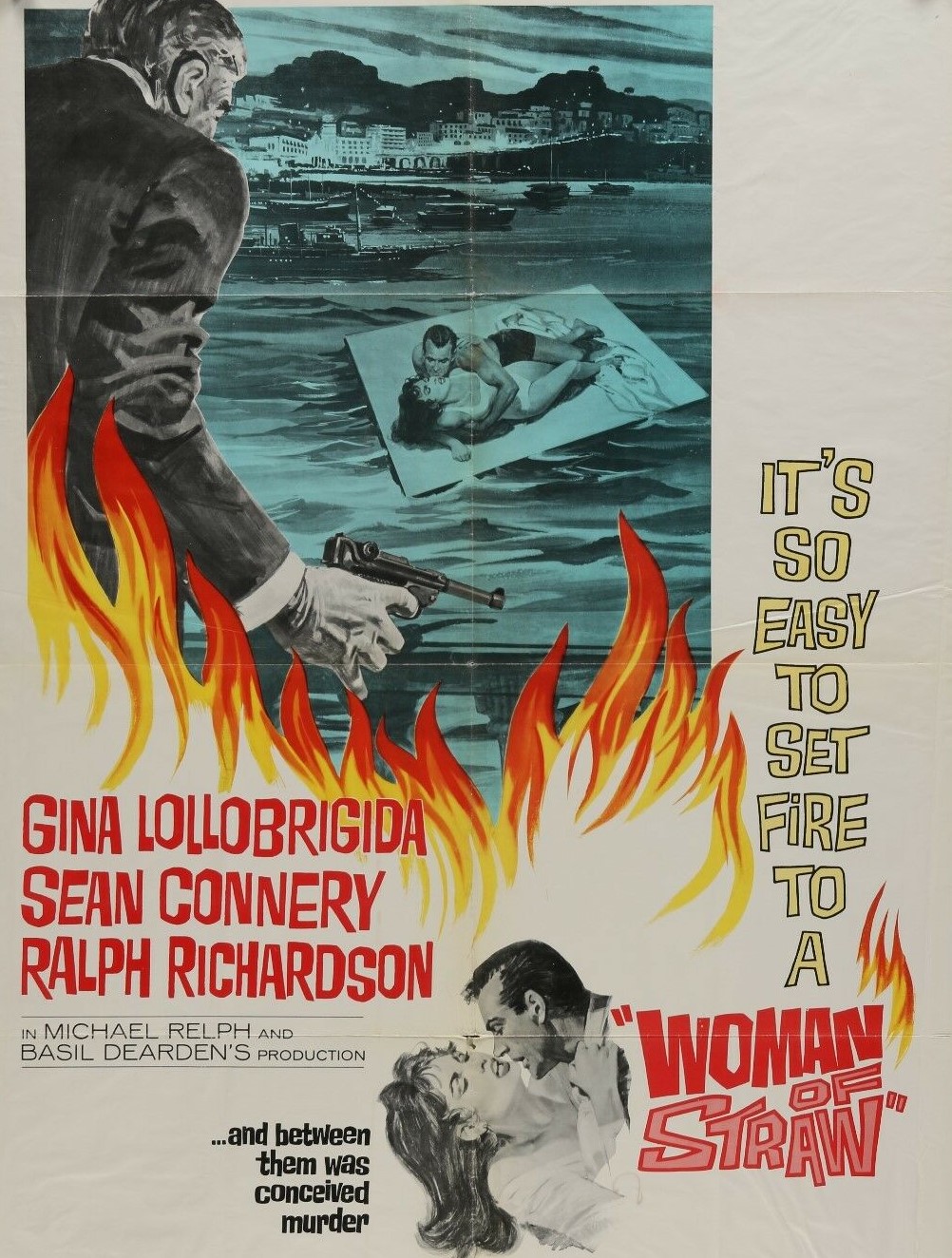
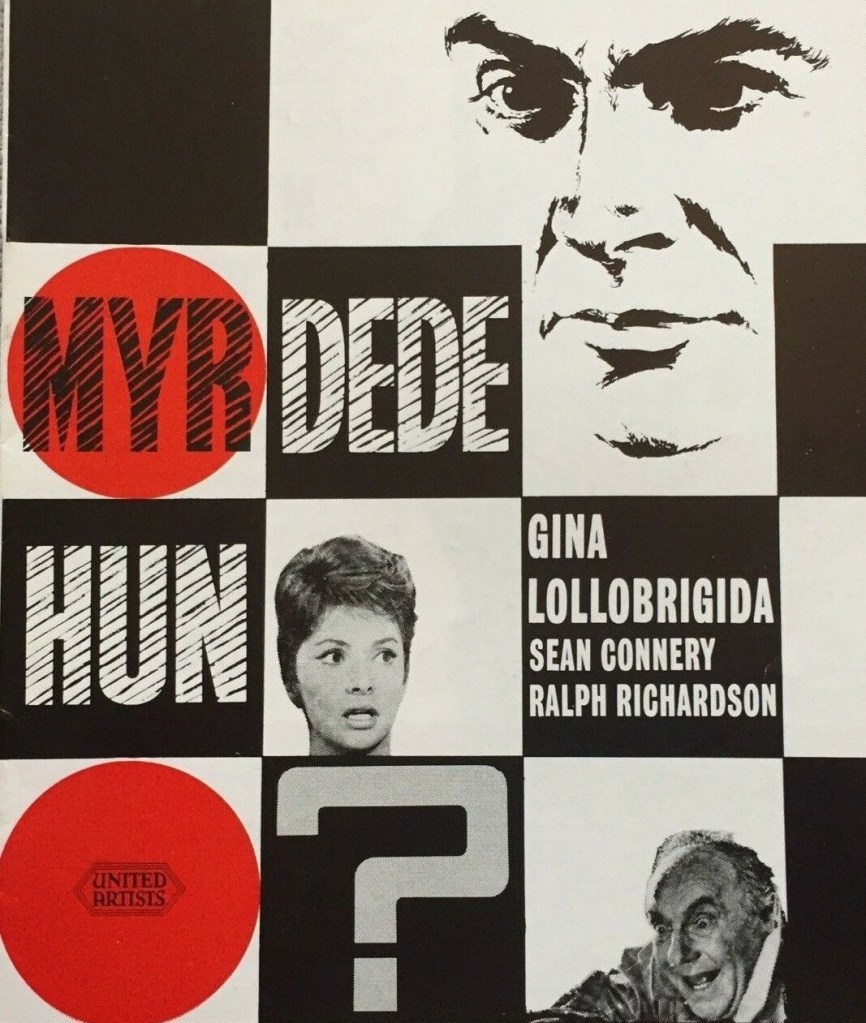
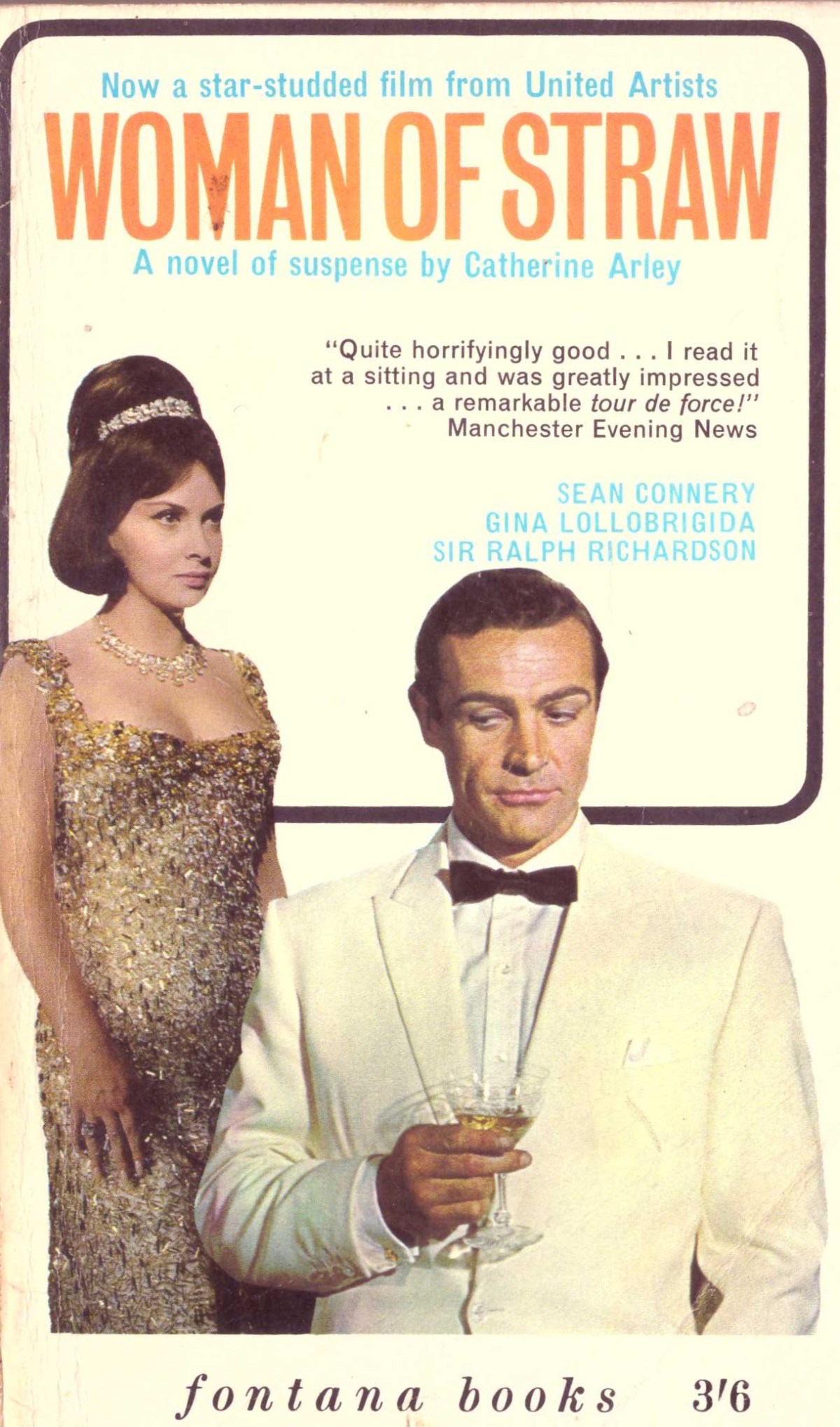
In a plot worthy of Hitchcock without that director’s sly malice, rich playboy Tony (Sean Connery) conspires with not-so-innocent nurse Maria (Gina Lollobrigida) to rid himself of heinous upper-class racist misogynistic bully Charles (Ralph Richardson), his uncle. Beyond a savage case of entitlement, Tony has good reason to hate the wheelchair-bound multi-millionaire, blaming him for his father’s suicide and for seducing his widowed mother, now dead. Tony’s ploy, in part by opposing the very idea, is to get Maria to marry Charles, inherit his fortune and provide himself a £1 million finder’s fee when the seriously ill old man dies.
Maria’s refusal to kowtow to the old man and her initial resistance to Tony make her all the more desirable to both. When Maria saves the old man from a potential heart attack, he is moved enough to marry her and draw up exactly the will the pair want. But when he suddenly dies, Maria surprises herself by the depth of emotion she feels.
But that soon changes when she comes under suspicion. A bundle of complications swiftly change the expected outcome. A police inspector (Alexander Knox) doubts cause and place of death.
The first half is the set-up, the various figures being moved into place, not quite as easily as might have been anticipated, which adds another element of tension. Charles is such a hideous person nobody could lament his passing, but still his vulnerability, not just his wheelchair confinement but his love of music, his better qualities coming to the fore as the result of Maria’s presence, accord him greater sympathy than you would imagine.
That the otherwise gallant Tony’s entitled life depends entirely on his uncle’s good wishes lends him an appealing frailty. The nurse’s principles safeguard her against being taken in by riches alone, but there is a sense that she has used her physical attraction in the past to her advantage.
After the first two James Bond pictures, this was Sean Connery’s first attempt to move away from the secret agent stereotype and in large part he is successful. As amoral as Bond, he could as easily be a Bond villain, smooth and charming and larger than life and superbly gifted in the art of manipulation, the kind of putting all the pieces in place that Bond villains excelled in.
It will come as a surprise to contemporary viewers that he is merely the leading man, not the star. Gina Lollobrigida (Go Naked in the World, 1961) receives top-billing because she carries the emotional weight, initially perhaps as cold as Tony, but her attitude to Charles changing after marriage, meeting a need that Tony would not consider his to fulfill, and beginning to regret going along with any devious plan. That she then discovers she may merely be a pawn rather than a partner creates the dilemma on which the final section of the film depends for tension.
Both actors are excellent, exuding star wattage, the screen charisma between them evident, and audiences craving the pairing of Connery with an European female superstar will be well satisfied. Lollobrigida has the better role, requiring greater depth, but it is romance as duel most of the way. Ralph Richardson (Khartoum,1966) has never been better as one of the worst human beings ever to grace a screen. Johnny Sekka (The Southern Star, 1969) brings dignity to the maligned servant and Alexander Knox (Khartoum) is a crusty cop.
A slick offering from Basil Dearden (The Mind Benders, 1963), with one proviso – see seaparate article for the racism in this film. Written by Robert Muller (The Beauty Jungle, 1964) and Stanley Mann (The Collector, 1965) based on the novel by Catherine Arley.
Could have done with expending less time on the set-up and getting to the meat of the thriller quicker.
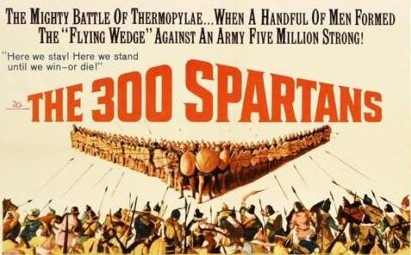
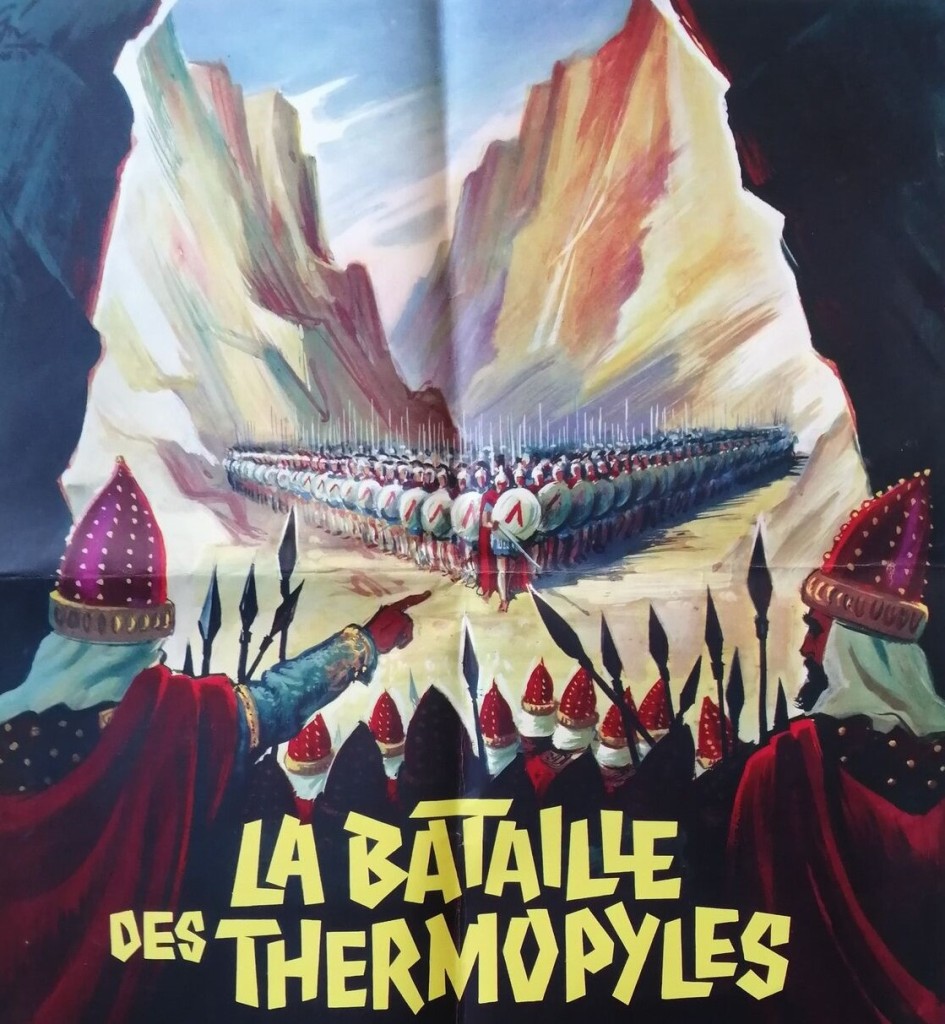
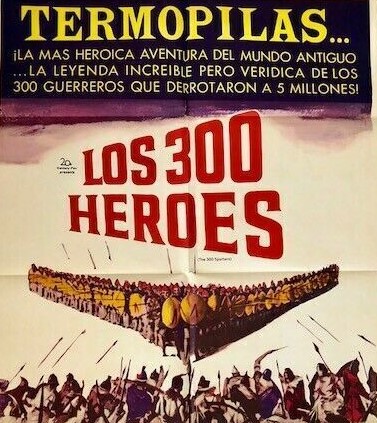
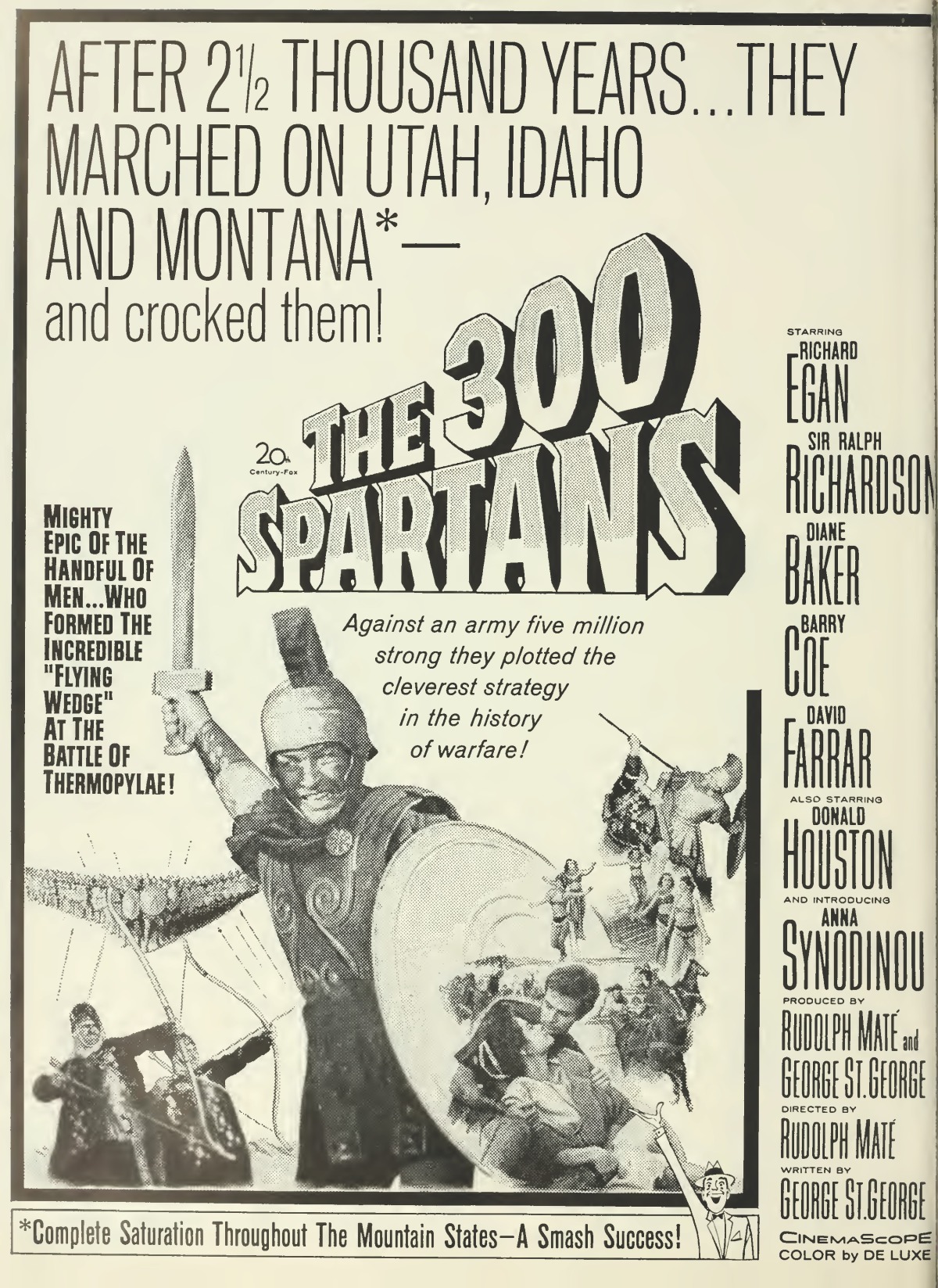
Doomed for half a century to be seen as Saturday television matinee material and then purportedly put into the shade by the Zack Snyder’s stylish 300 (2006), The 300 Spartans is in sore need of re-evaluation. Lacking the big budget of an El Cid (1961) or Lawrence of Arabia (1962) and released during an era when historical drama – Barabbas (1961), The Mongols (1961), Sword of the Conqueror (1961), The Trojan Horse (1961), and The Tartars (1961) – was at a peak, this is a stripped-down version of the famous Battle of Thermopylae in 480 B.C. and none the worse for it.
Clever camerawork suggests thousands of warriors involved and there is little sign of scrimping the wardrobe department, and there is more than enough action. But this is a surprising literate picture, with great lines for cynical politicians as much as for warriors and peasants. Themistocles (Ralph Richardson) comments: “Some day, I may enter religion myself. It’s better than politics. With the gods behind you, you can be more irresponsible.”
Told that the invading Persian army has “arrows that will blot out the sun,” Spartan King Leonides (Richard Egan) retorts, “then we will fight in the shade.” And there’s sexist banter typical of the period between a peasant couple: wife – “goats have more brains than men”; husband – “who can understand the ways of the gods, they create lovely girls and then turn them into wives.”
Quite how Leonides ends up fighting the massive army on its own is down to a mixture of politics and religion. Oracles foretell doom. The various Greek states refuse to join together, although Athens lends Sparta its fleet (“Athens’ wooden wall”). Even Sparta officially refuses to participate on the grounds that battle would interrupt a major religious festival. Leonides’ “army” of 300 men is comprised of his bodyguard.
A romantic subplot involving a young couple results in catastrophe. Just how ruthless is the opposition is shown when Persian king Xerxes (David Farrar) slaughters all his soldiers’ wives to make the men more determined to get to Greece where doubtless they will enslave the female population. When his archers fire, he doesn’t care if the arrows hit his own men.
What marks out the best historical action pictures is the intelligence behind the battle. Strategy is key. The first weapon, of course, surprise, so the Spartans sneak into the Persian camp from the sea and burn their tents. During battle, to counteract the Persian cavalry, the front row of the Spartan army lies down and allows the horses to jump over them, then rising up, trap the cavalry and drive them into the sea. (A ruse later employed by Richard Widmark in The Long Ships, 1964).
Other wily measures are used deal with the Persian crack infantry regiment, The Immortals. Even at the end, the Spartans continue to confound the enemy with clever ruses.
Richard Egan (Pollyanna, 1960) is effective as Leonides, Ralph Richardson (Woman of Straw, 1964) excellent as the crafty but honorable Themistocles while Alfred Hitchcock protégé Diane Baker (Mirage, 1965) – “glaringly miscast” according to Variety – has the female lead though Anne Wakefield (The Singing Nun, 1966) as a Persian queen the more interesting role. Former British matinee idol star David Farrar (Beat Girl / Wild for Kicks, 1960) Meet Sexton Blake, 1945), in his final movie, proves a handful as the intemperate Xerxes.
Five-time Oscar-nominated cinematographer Rudolf Mate delivers the directorial goods, his handling the dramatic scenes as confidently as the action and masking the holes in his budget by making clever use of trees as the invaders march, suggesting an army far bigger than he could afford to put on the screen. Color-coding the Spartans – they were in red – made the action clearer to follow. George St George (Invasion 1700, 1962), doubling up as producer, wrote the script with his usual collaborators Ugo Liberatore (A Minute to Pray, A Second to Die, 1967) and Remigio del Grosso (Wanted, 1967).
Originally titled The Lion of Sparta, the film could not have been made without the wholesale cooperation of the Greek army which supplied over 2,000 soldiers. Those playing Spartans had to be over six foot tall. Since the Greeks had no cavalry and few knew how to ride, around 200 were given a crash course. It was a bonanza for the soldiers – their normal wage of $2 was supplemented by $5.50.
Thermopylae no longer looked like the area immortalised by the battle, so the action was shot at Loutraki, near Corinth and 80 miles from Athens.
Thoughtful drama with striking action deserves reassessment.
Somewhere between SBIG (So Bad It’s Good) and WAL (Worth a Look), The Wrong Box is a black comedy in the wrong directorial hands. Better known for thriller Seance on a Wet Afternoon (1964) and POW drama King Rat (1965) Bryan Forbes struggles to bring enough comedy into the proceedings or to wring sufficient laughs out of what he has.
Neither the wit nor the slapstick is sharp enough. But it does exhibit a certain charm. Essentially an inheritance story, it pivots on the notion that the two potential inheritors are on their last legs and putting one, Joseph Finsbury (Ralph Richardson), out of action will benefit dastardly nephews Morris Finsbury (Peter Cook) and John Finsbury (Dudley Moore) of the sole survivor Masterman Finsbury (John Mills).
It turns out Joseph Finsbury is not dead. That does not cue as much hilarity as it should., as the nephews plot to send him to his grave. Given the idea was dreamed by none other than Robert Louis Stevenson of Dr Jekyll and Mr Hyde fame, you can imagine it was written less with comedy in mind.
With so much dependent on set-pieces, it’s rather a hit-and-miss affair, with the conspirators’ failures not matching the humor of watching potential victims escape their proposed doom. Only occasionally does it sparkle.
Surprisingly, the film relies on affecting performances from the shy, retiring Michael Finsbury (Michael Caine), a gentle soul, who enjoys a very innocent romance with Julia Finsbury (Nanette Newman), a young woman terrified of being murdered, which condition provides ample opportunity for her to be rescued/consoled. who enjoy a very innocent romance.
Ralph Richardson steals the movie as a dotty pedant, weighted down with erudition and a knack, equally, for boring the pants off anyone within earshot and for escaping from the jaws of death including a massive train pile-up and several murderous attempts.
Michael Caine, in a follow-up to The Ipcress File (1965) and Alfie (1966) convincingly plays against type. John Mills (The Family Way, 1966) also plays against type as a villain rather than Hitherto, I had been rather sniffy about Nanette Newman (Deadfall, 1968),wife of the director, but here she is delightful.
Peter Cook (A Dandy in Aspic, 19680 and Dudley Moore, in his movie debut, let the show down by being so obviously the personalities from their comedy series Not Only…But Also (1964-1970), a partnership that works so well on television just frittered away here from what looks like characterization with nowhere else to go. But there is a nice cameo from Peter Sellers (The Millionairess, 1960) as an inebriated doctor.
Hard to say whether the blame lies with Larry Gelbart (The Thrill of It All, 1963) for his screenplay or Bryan Forbes for his direction.
Michael Caine got it spot-on when pointing out in his autobiography that it was a “gentle success in most places except Britain” precisely because to foreigners it represented an acceptably stereotypical view of a country full of eccentrics while to Brits it was all too stereotypical. So if you’re from America or other points global you might like it and if you are British you might not. On the other hand, the score by John Barry is one of his best with a wonderful theme tune.
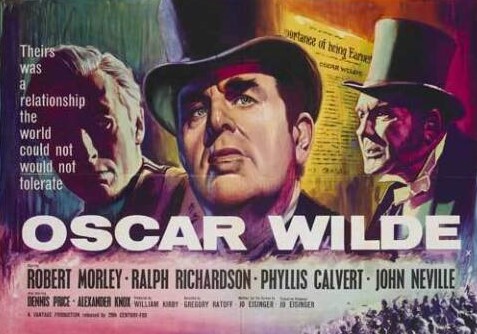
You might be surprised to learn there were two Oscar Wildes. Not the famed writer and a doppelganger of course but two films on the same subject that were released in the same month. This is the low-rent version, costing a fraction of the rival The Trials of Oscar Wilde directed by Ken Hughes. It’s easy to be disdainful of the cheaper effort, with little cash available for scenery and costumes, but somehow it rises above budget limitations. Structurally, both movies focus on the trial – or in the case of The Trials of Oscar Wilde the three trials he endured – but the glossier pictures it has to be said glosses over a great deal.
While I enjoyed it at the time, I now find that in trying to make a modern martyr out of Oscar Wilde, the Ken Hughes picture built him up so much that it was difficult to find any flaw in his character. We never find out what was the actual slur the Marquis of Queensbury made on Wilde, resulting the playwright taking him to court for libel. And that version begins with Wilde and Alfred Lord Douglas (“Bosie”), son of the Marquis, already deep into their affair.
On the other hand, Oscar Wilde, the final film of Hollywood veteran director Gregory Ratoff (Intermezzo, 1939), starts at the beginning of their relationship with greater emphasis on Wilde’s practicality rather than his wit and Bosie’s (John Neville) tortured relationship with his hypocritical father (Edward Chapman) who, while taking the moral high ground, keeps a mistress. On Wilde (Robert Morley) being described as a sodomite by the Marquis, Bosie’s desire to see his father humiliated in court verges on revenge. “You weren’t looking for a friend,” Wilde astutely tells his lover, “You were looking for a weapon.” Bosie is big on humiliation – he is the one to break the news of Wilde’s duplicity to the author’s wife (Phyllis Calvert). So determined is he on the court case that he fails to tell Wilde that his father has private detectives scouring London to find evidence.
While in court Wilde can keep the jury in stitches with his epigrams, he soon comes up against the Marquis’s formidable lawyer Sir Edward Carson (a quite stunning performance by Ralph Richardson). From Carson we learn a great deal more of Wilde’s practices, some of which nowadays would be termed grooming. Essentially, Carson paints a portrait of a predator, an older man (Wilde was 41) whose uses his wealth and wit to court many lovers, mostly aged around 20, but some as young as 16, barely the age of consent.. And when he felt his secret life was in danger of being exposed, he went so far as to pay for the passage to America of one of his lovers, Alfred Woods, to get him out of the way.
No matter that Wilde at the start can gloss over his promiscuity, complaining that Carson is misinterpreting innocent gestures of friendship, the cunning attorney soon has the author tied in knots as he wheels out one by one information regarding the various lovers.
It’s quite odd to realise that The Trials of Oscar Wilde in presenting the more accurate truth – that the author underwent three trials – fails to provide little more than a surface treatment of the man’s real-life affairs. Oscar Wilde perhaps delves too deeply for audiences brought up to consider the author a martyr who deserves the free pass allocated all writers of genius. I found Oscar Wilde the more riveting watch because, of course, I already knew the outcome, but the sight of the famed writer, encouraged by the vengeful Bosie, hung out to dry by his own hubris, and for a man of such wit to be outwitted in the courtroom by Carson was an exceptional watch.
Of course, the imprisonment of Wilde for the crime of being a homosexual is detestable. Even at the point this film was made homosexuality was a crime. So it’s fascinating to see how much The Trials of Oscar Wilde skirts round issues that Oscar Wilde had little problem in spelling out.
I was surprised how much I enjoyed Robert Morley’s performance. I may be wrong, but I think this was the only time he was accorded leading man status. Mostly, he was a supporting actor (The African Queen, 1951, say, or Genghis Khan, 1965) and often just playing a version of his self. Of course, he is outshone by a simply brilliant Ralph Richardson (Khartoum, 1966). John Neville (A Study in Terror, 1965) presents a more in-depth performance than in the rival picture. One-time British box office star Phyllis Calvert (The Golden Madonna, 1949) does well in a small but pivotal role. You might also spot Dennis Price (Tunes of Glory, 1960) and Alexander Knox (Mister Moses, 1965).
Lacking a budget to do much more, Gregory Ratoff sticks to the detail and draws out two superb performances, aided by a tight script by Jo Eisinger (Gilda, 1946; Cold Sweat, 1970) based on the play by Leslie and Sewell Stokes and the work of Frank Harris. As swansongs go, this is hard to beat.
Vastly underrated.
Catch it on YouTube.
NOTE: Oscar Wilde appeared in first run in Glasgow at the La Scala cinema in June 1960 one week ahead of The Trials of Oscar Wilde at the first run ABC Regal and ABC Coliseum.
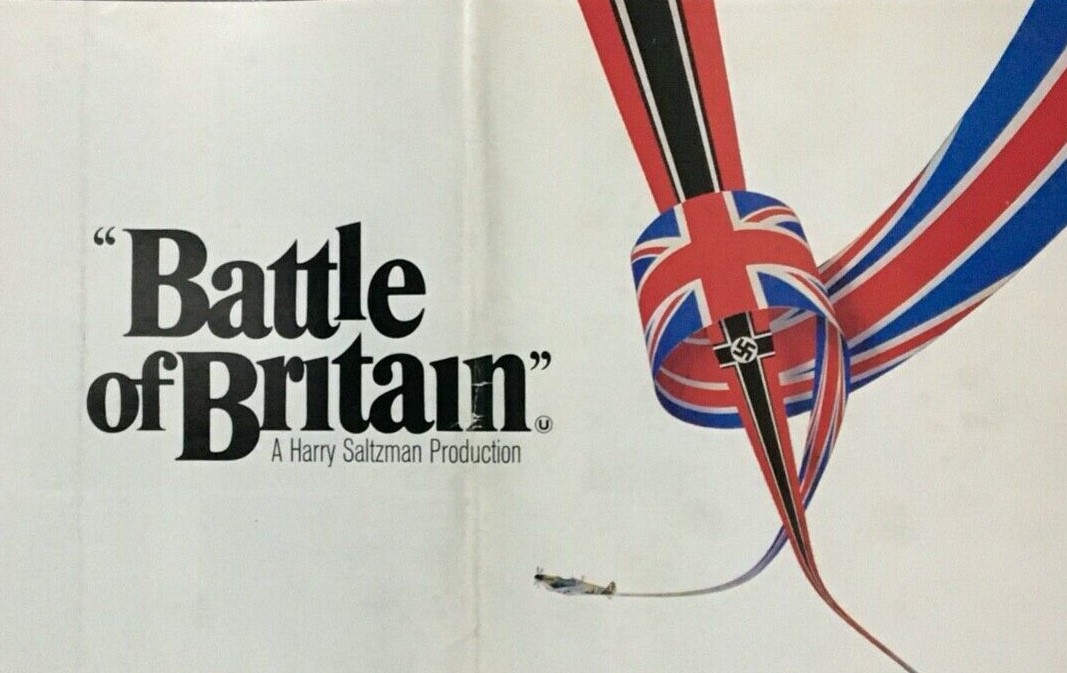
Fabulous aerial sequences countered by grim reality. Like The Longest Day (1962) and Battle of the Bulge (1965) even-handedly doesn’t treat the Germans as the evil enemy, but unlike those films victory is somewhat obscure, no rattling of spears as in Zulu (1964) to announce opposition departure, just clear skies indicating an absence of foe. Anyone going into this – persuaded by Dunkirk (2017) that this retreat was a triumph – and with little knowledge that after Hitler had overrun Europe invasion was imminent might be surprised to discover that this was a campaign lasting over three months rather than one conclusive battle.
That’s to the benefit of the movie, allowing it space to breathe, for characters to develop, rather than everything crammed in pell-mell. Given the situation changed from day-to-day, the one constant, which we’re scarcely allowed to forget, is that the British are heavily outnumbered in the sky. It’s a war of attrition. The Germans can lose hundreds of planes, the British nary a one.
But it’s far from gung-ho, the British coming in for criticism for their unpreparedness, surprised when the Germans bomb airfields, even more astonished when the opponent starts dropping bombs on London. Perhaps, given the relatively short running time for an epic – 46 minutes shorter than The Longest Day, 35 minutes down on Battle of the Bulge – it might have been better to avoid slipping in a section on the impact of the Blitz on Londoners, though that is counteracted by panic in Berlin when that city is also bombed.
But, by and large, it’s an engrossing tale. And bold, too, in the version I saw no subtitles for German dialog, leaving audience reliant on facial and body expressions. To slow down the action, I guess, and add some class, several scenes involve people walking down long corridors.
All the salient points are covered, pilots thrown into battle with barely a few hours experience of flying a Spitfire, the lack of pilots, in-fighting at the top, checkers moved across the board at mission control indicating German aerial advance, the inability of getting aircraft up quick enough or repaired quick enough. Above all, the reality of death is shown in astonishing detail; once the pilot was shot or the airplane destabilized, there was almost no escape, fire enveloped anyone inside, hatches failed to open, planes burst into flame or crashed into the sea. And it was the same death, regardless of nationality. And there were no scenes of callous Germans shooting down a British pilot parachuting to safety.
The aerial sequences are quite astonishing. I’ve seen this on big screen and small, but even on a small screen, the camerawork is quite extraordinary, even getting this number of workable planes in the air must have been some feat, then flying in formation and peeling off in attack. It is kind of hard from time to time to work out who is shooting at who since the planes are all the same grey color and only distinguished when the camera is close enough to identify them by RAF roundel or Nazi swastika. But the overall effect is a sense of sorrow rather than triumphalism, young lives of any nationality brought to a brutal close. There is no scene, as in Battle of the Bulge, of the over-zealous Nazi, the singing that made them appear such an implacable foe. Here, there’s no need to play up implacable. Unless they abandon the fight, the Germans, courtesy of superior numbers, will inevitably win. All the British can do is stave off defeat for as long as possible.
The all-star cast is only an all-star cast if you’re British. Without a Hollywood star in the vein of John Wayne, Robert Mitchum and Henry Fonda, and in the absence of British superstars like Sean Connery and Peter O’Toole, it’s an all-star cast by default. The biggest name, Michael Caine (Deadfall, 1968), has one of the smallest parts. But the equality of the cast works in its favor, there’s none of the rubbernecking that got in the way of The Longest Day.
Christopher Plummer (The High Commissioner/Nobody Runs Forever, 1968) has the biggest role as a squadron leader determined to force his wife out of the front line working on the airfields and into a safer position. But the best acting comes from Laurence Olivier as the dry Air Chief Marshal Sir Hugh Dowding who has no truck with interfering politicians. Accused of inflating figures of German casualties he replies that if he is wrong the Germans will be in London in a week.
But it’s a close-run thing between him and Susannah York (They Shoot Horses, Don’t They, 1969) as the aforesaid wife with a growing streak of independence and Ian McShane (The Pleasure Girls, 1965) as a lowly pilot called upon to express grief more than most. There’s certainly a sense of solidarity among the cast, no show-boating from the usual scene-stealing culprits like Trevor Howard (Von Ryan’s Express, 1965) and Robert Shaw (Battle of the Bulge) whose normal determination to bristle at the slightest opportunity is dropped for the good of the cause.
The great and the good appeared to be happy with the slightest role just to take part. The roll-call includes Ralph Richardson (Khartoum, 1966), Michael Redgrave (The Hill, 1965), Kenneth More (Dark of the Sun/The Mercenaries, 1968) and a hatful more.
Guy Hamilton (Goldfinger, 1964) directs with some distinction, his biggest achievement to concentrate on fact rather than flag-waving, no better demonstrated than by my realization that the stirring theme tune that I remembered so well by Ron Goodwin (Where Eagles Dare, 1968) does not make an appearance until the very end. The screenplay by James Kennaway (Tunes of Glory, 1960), Wilfred Greatorex (The High Commissioner) and, in his only movie work, Derek Dempster, displays more finesse than you might expect.
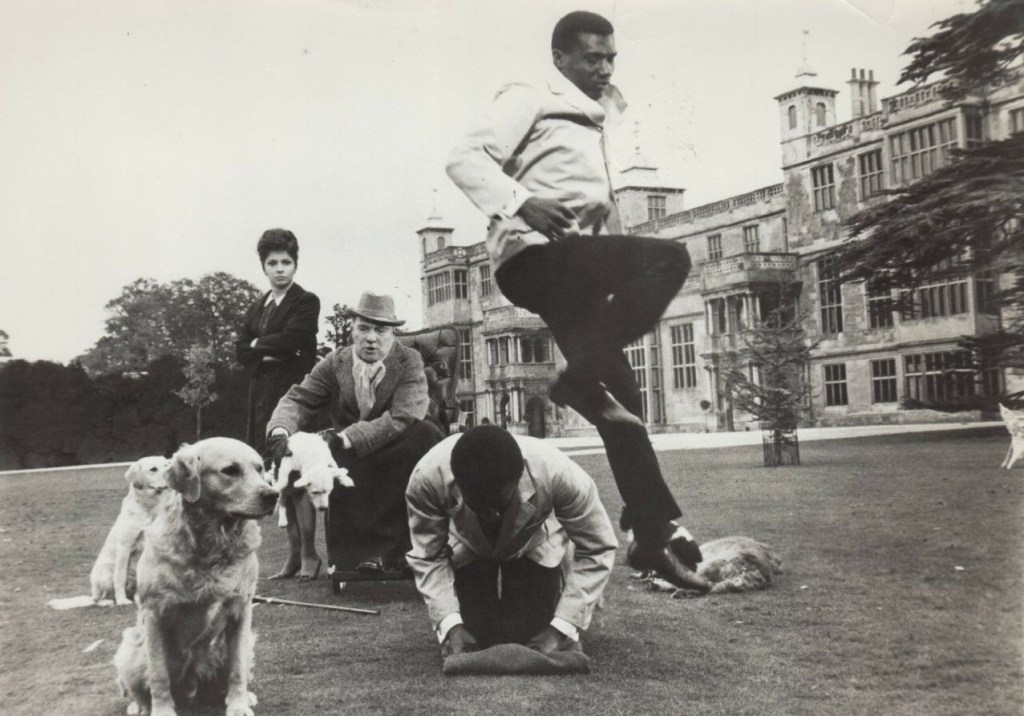
You can blame one of the screenwriters, either Robert Muller (Contest Girl, 1964) or Stanley Mann (The Collector, 1965), for coming up with the scene in Woman of Straw where the grotesque millionaire Charles Richmond (Ralph Richardson) forces his two black servants to pretend to be dogs to show his own dogs how to jump over each other. It’s not in the book. However, in fairness to the screenwriters they must have thought this preferable to the scene in the original book by Catherine Arley where Richmond offers a gold watch to the best imitation of a dog by his servants. This includes them getting down on all fours and eating food like a dog. Disgusting though this is, it is tempered by being a competition with a more than decent reward (a gold watch) for the winner.
The offensive scene in “Woman of Straw.”
And now we get into a difficult position since one of the most highly-praised episodes of Succession involved employees of grotesque millionaire Logan Roy (Brian Cox) being forced to get down on the floor and pretend to be boars and eat sausages like a boar (Boar on the Floor, Succession, Season Two, Episode Two). This sequence has a 94% rating on Rotten Tomatoes, the critical accumulation website. The episode won an Emmy for director Andrij Parekh. Scott Tobias of Vulture gave it five stars and Randall Colburn of The A.V. Club an A-minus. Various commentators referenced the Stanford Experiments, the culture of fear inherent in working with wealthy individuals, and the animalistic collapse of civilization.
So that has left me wondering if my objection to Woman of Straw was merely on racist grounds and to wonder if there would have been an outcry if the Succession episode had featured a black person grovelling on the ground.
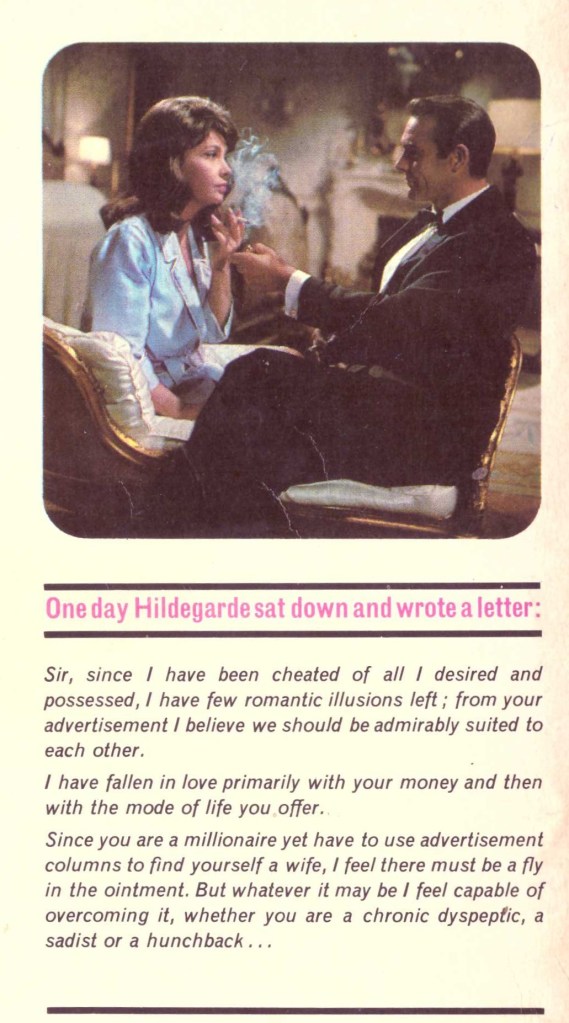
The screenwriters made significant changes to the source novel. For a start in the book both the woman and the millionaire were German. Hildegarde Meiner in the book becomes the Italian Maria (Gina Lollobrigida) in the film. But Hildegarde is not a relatively innocent nurse as in the film. Instead, she is an out-and-out gold-digger, determined to marry a wealthy man in order to make up for a desperate life in the aftermath of the Second World War.
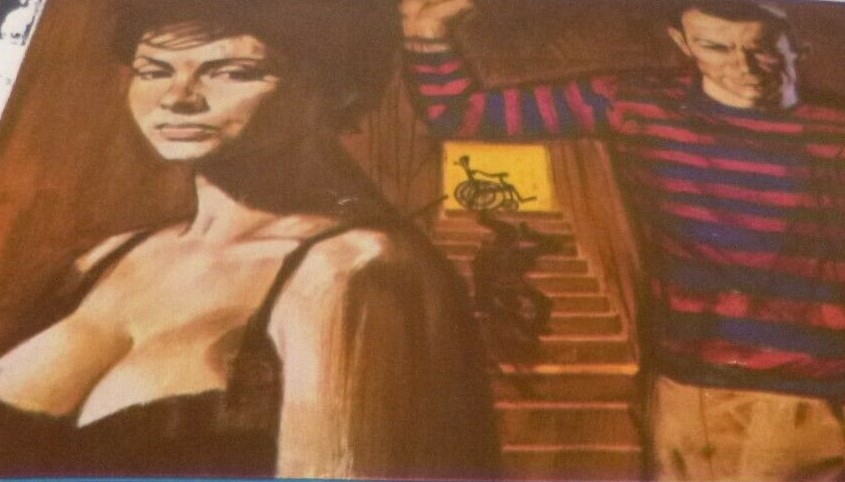
Back cover of the movie tie-in edition of the British paperback.
In the book the villain of the piece is also German, Korff, not British like Sean Connery. And he is simply the millionaire’s secretary not his nephew. The pivotal element of the story is the same, Tony Richmond (Connery) feeling he is owed much more of the old man’s fortune than the pittance provided for him in the will. Korff is also 60 years old and although Hildegarde makes a play for him, any romantic liaison is out of the question because the secretary wants to adopt her as his daughter. Korff sets Hildegarde up as the nurse and instructs her to play it aloof and principled. Hildegarde does not fall into the category of beauty but, with better clothes and professional make-up, oozes class.
The rest of the story plays out much like the film except there is no rescue at sea and the millionaire does not listen to classical music. The novel narrative, while not in the first person, is told from the woman’s perspective. However, Korff is more devious than Anthony Richmond, ensuring in several ways that the nurse will take the rap.
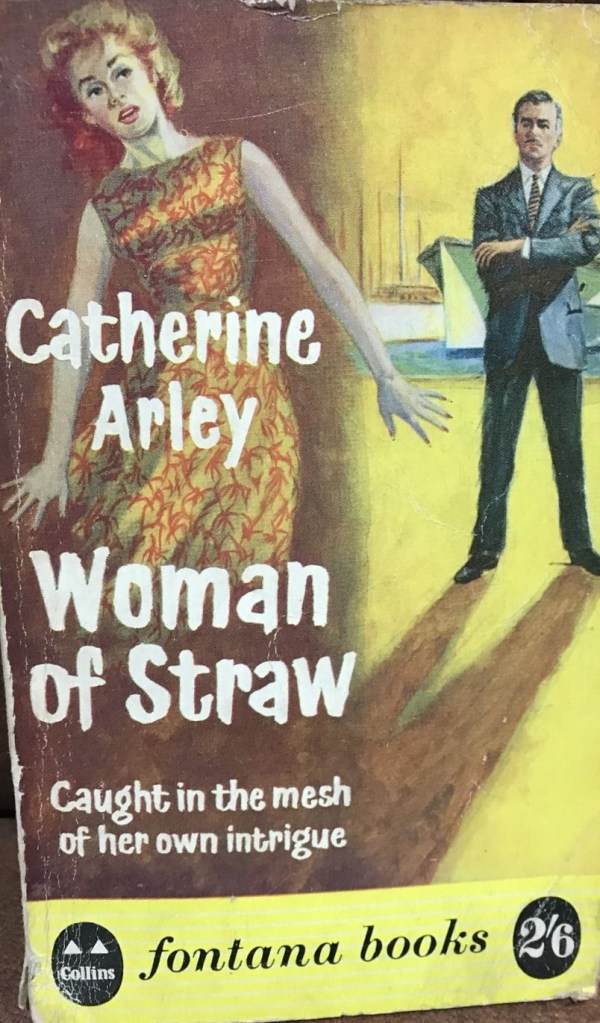
Front over of earlier British paperback, not a movie tie-in.
The film’s ending is driven by the need for some kind of happy resolution, for the guilty to be brought to justice, the dupe exonerated to some extent. But the book belongs more to the film noir genre and the ending is quite different, the villain getting away with and Hildegarde seeing no way out but to commit suicide.
The deprivations that Hildegarde has undergone as a consequence of her Hamburg family being killed during the war and her struggle for survival thereafter and her desperation to find a wealthy white knight make her a more sympathetic character.
The book is an excellent thriller in its own right.
Of course racism was endemic in Britain and the remainder of the British colonies in the 1960s where people of whatever color were treated as inferiors, underlings and at times with a brutality that bordered on slavery. So I’m not intending to say anything new here. But I was incredibly shocked by one scene of racism in Woman of Straw (1964) that I reviewed yesterday, a thriller in the Hitchcock mould starring Sean Connery and Gina Lollobrigida with Ralph Richardson as the wealthy man the subject of a murder plot.
Richardson’s character, Charles, is completely heinous, treating everyone badly, and they being in his thrall cannot bite back, unlike his dogs.
This is a still from the picture showing the offensive incident and would have been used to promote the movie. As good an indication as any of the prevalent racism is that clearly nobody believed this to be in bad taste.
For reasons best known to himself, Charles wants his dogs to be able to jump over each other. And when they fail to obey his commands, he instructs his two black servants, played by Johnny Sekka and Danny Daniels, to show them how it is done. One has to kneel on the grass like a dog and the other to jump over him. In due course, the dogs get the hang of it, leaping over the humiliated man on the ground.
There are enough other instances in the film to ensure the audience gets the right idea about Charles without this.
But I was shocked to the core. I have seen many instances of black people treated much worse in films, but in 1964 I guess such treatment would not have been permitted by the censor and this was the closest they could get to the abject degradation required. I can’t have been the only person shocked by it. But nobody was in 1964 otherwise it would not have got past the British censor – eliminating the scene would not have affected the plot – not a murmur from a critic, and certainly no sign of audiences leaving in droves.
But why should it be left to post-production? Did Sean Connery really think there was nothing untoward in the script? If it had been a Scotsman being used in this fashion might he have complained? Did Gina Lollobrigida think nothing of the scene? Similarly, had it been an Italian servant might she have objected? Connery and Lollobrigida either individually or collectively had far more box office cachet than the director – in fact this was Dearden’s move into the big time – so could easily have asked for the scene to be eliminated.
And what of Sir Ralph Richardson, at the time considered one of the great theatrical triumvirate (Olivier and Gielgud the others) who played the character? A forthright person in many other ways, but not here. Perhaps the most surprising person to be blind to the offensiveness of the scene was director Basil Dearden, especially since a previous film Victim (1961) was sympathetic to gay men. I would like to know if the scene was in the source novel by Catherine Arlay.
Whatever, one of the reasons that racism remained so endemic in the 1960s and far beyond was because people failed to see it when it was right in front of their eyes. I’ve no idea who owns the rights to this otherwise good thriller but it might be a good idea for them to take a look and excise this scene or at least give warning that it exists.
The British Board of Film Censors gave this a “12” rating when it came out on DVD. I contacted the BBFC to see if anybody had ever re-watched the film to come to the ratings conclusion. Naturally, I am still waiting to hear back.
You can check out what I’m referring to on YouTube which has a reasonable print. This incident occurs at the 16-17 minute mark.
At the age of 19 while working on the “Glasgow University Magazine” I managed to gain an audience with director Lindsay Anderson just after the release of “O Lucky Man!”in 1973. That was at the same time as I did an interview with Albert Finney (previously printed in the Blog). While Finney graciously agreed to a sit-down interview in a nearby café, Anderson was not quite so obliging and the interview was more of a guerrilla affair as I kept on ambushing him while he was working on a new play by David Storey at the Royal Court Theatre in London. To consider Anderson as a film director first and foremost that would be to ignore his exceptional work on the stage – at that time he had completed three full-length feature films compared to five times as many stage productions. This article was published in the October 1973 edition of “Glasgow University Magazine” and runs here in an edited version.
“AROUND LINDSAY ANDERSON: LIVE AT THE ROYAL COURT”
Lindsay Anderson, one of Britain’s foremost film directors, co-founder of the short-lived film magazine Sequence, pioneer of the “Free Cinema” movement, maker of Corn Flakes commercials, was back at work in the theatre – where for over a decade he has established a notable reputation – working on The Farm, the fifth David Storey play to be under his direction.
“When Lindsay Anderson comes to the Royal Court, it’s an event,” says his assistant Hugh Thomas, who had roles in If.. and O Lucky Man!. “He makes everyone work three times as hard. He’s an impossible perfectionist, but he’s very fair.”
Many times during the day you will hear Anderson asking the rehearsing staff: “Why can’t it be better?” and demanding of the photographer John Haines, who is taking the photographs for the official press release, if he is satisfied with the lighting. And if the photographs are okay, how okay is that? Anderson demands precision, concision, honesty, loyalty, total commitment. If you don’t possess these, then don’t go near him. Garrulousness is not tolerated; once a conversation has been milked of its essence, Anderson will cut it short, turning his attention to something else. That is not to say he is not capable of carrying on two or three conversations at once.
If you are clumsy or nervous, Anderson’s attitude will exacerbate your condition. Hugh Thomas is nervous: there is a little dance when they are talking a few feet away from each other – when Thomas speaks he moves quickly, a couple of steps forward; when he stops, he jumps back. There is not, however, any bowing. When he questions you there can be no dishonesty. He will shoot a question at you without warning, demanding an answer which will satisfy him. When Thomas told Anderson I had seen the actor’s performance in Diary of a Madman at the Close Theatre in Glasgow), the director asked if I like it. I said I thought it was good. What did that mean, Anderson demanded. Okay? No, I said, I enjoyed it. Good, was it? Quite good, yes.
Later he demanded to know of me who Rosa Luxemborg was (there is a reference to her in the Storey play). Can you say, yes, I know, and hope that you will not be pursued? Or do you say no, realising that he brooks no lie. And even though he is mildly contemptuous that as a student I am unaware of this personality, he is willing to explain to me her importance. (She was a socialist revolutionary and economist).
Anderson is a great general: he has lunch while working, refusing to let any minor details slip past him. If his army is not good, he will make it so. If it is good, he demands better. He chases after production staff to ensure all the cast get tea. The production is midway through its run so his work today is tightening up various aspects. The previous night had seen a couple of calamities. First was a delay in an actor changing costume. Anderson demanded to see the dresser but was informed that she was not present that afternoon because she was not paid to work until evening. Anderson berated the management. “If they wish to put on plays of the calibre with this cast, they have to pay for it. A change of costume is as important as anything else,” he said. At the previous night’s performance, the man whose task was to raise the theatre curtain had fallen asleep at his post. Anderson told me that had the curtain not been raised in time he would have gone on stage and apologised to the audience.
“I’m very pernickety about detail on the stage. I think it draws the audience out to you.” A David Storey play usually requires a great deal of detail. For The Contractor (1969), Anderson painstakingly rehearsed his cast in the erection of a tent that was the basis of the action. Home (1970) was more austere, but a completeness, because the details had been filled in. The Changing Room (1971), set in the dressing room of a rugby league team, was a masterpiece of naturalism.
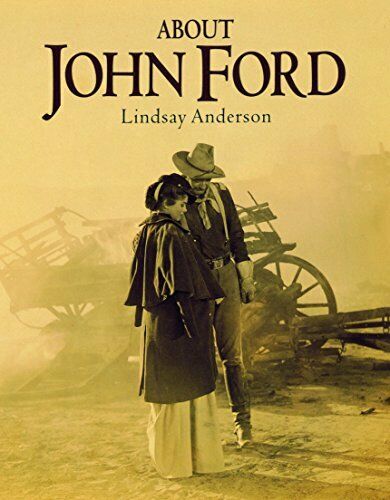
Born in Bangalore, India, 1923, son of a British officer, but three-quarters Scottish – to which he attributes his moral intransigence and refusal to compromise. In the magazine Sequence he lashed out at the British cinema and swore blind by John Ford (he would later write a book on the director). He won an Oscar for the documentary short Thursday’s Children. In 1956 he organised a season at the National Film Theatre (the precursor of the BFI) in London to show the work of new film makers, incurring a great deal of hostility in the process.
But initial acclaim came from the stage. His second production (the play) The Long and the Short and the Tall (by Willis Hall and Keith Waterhouse) at the Royal Court (in 1959) was a major success and he remained there for the next few years, directing plays like Serjeant Musgrave’s Dance (by John Arden, 1959) and an adaptation of Gogol’s Diary of a Madman (1963).
With the commercial success of Tony Richardson’s Saturday Night and Sunday Morning (1960), the commercial cinema was ready to accept his powerful film This Sporting Life (1963) from a screenplay by David Storey based on his own novel. Although the rugby background to the film was rough and hard, Anderson was up to it, producing a movie about the ambiguity of Frank Machin (superbly played by Richard Harris) who has a tortured impossible affair with his landlady – as bleak as the puritan frustrated north in which it is set.
Anderson continued working in the theatre, in television commercials, venturing into cinema only when he found it possible to do so without losing artistic freedom. He emerged with two short films, The White Bus, from a Shelagh Delaney screenplay, and The Singing Lesson, made in Poland, by which period he was already work of the script of If… with David Sherwin. He was originally attracted to the script’s original title The Crusaders with its overtones of “idealism, struggle and the world well lost.” He also had the guiding lights of John Ford, Jean Vigo and Bertolt Brecht. “When I worked on the original script with David Sherwin,” he said, “we divided it into chapters. I think we felt from the beginning that If… would be an epic film in the Brechtian sense of the word.”
The basic tensions between hierarchy and anarchy, independence and tradition, liberty and law were highlighted in that semi-autobiographical account of a public school and the three rebels, old-fashioned heroes without being aware of it – who spout “we must be free or die” – who arrive at their own beliefs and stand up for them against the world, if necessary. There are symbolic instances of love and war before the final action set against the ritual of the (school’s annual) Crusaders Day. Mick (played by Malcolm MacDowell) and friends are fighting with their backs against the wall when the Establishment counter-attacks. It is one of the most liberating sequences ever shot, this defeat.
The decision to shoot some of the sequences in monochrome was partly a financial one since the director of photography Miroslav Ondriceck felt he could not guarantee on his lighting budget to produce an overall colour scheme. Anderson incorporated this into the artistic structure of the film, creating the necessary atmosphere of poetic licence while preserving a classic shooting style. Anderson believes it is his job to create the film, his prerogative as an artist. He refuses to go along with modern ideas that the audience creates a film for itself. What interests him most are the qualities of rhythm, balance and composition with a simple technique.
With a Cannes Grand prix for If… Anderson returned to the theatre of David Storey. “We have a very easy relationship and a very good one. I don’t work with him on the writing of his plays and we make very few changes. The first of his plays I did (In Celebration, 1969) was cut a great deal and Home was cut in rehearsal. But David knew that was necessary and we did it with the actors. On a production like The Farm, he comes to the rehearsals and attends the auditions and he enjoys that and if I ever need to refer to him I do. Sometimes he has suggestions to make which are very good and actually he can cut corners for us, certain things he understands better and can explain to us more quickly. There are other things he doesn’t particularly understand because he writes intuitively, too, and we just have to work them out.”
In Celebration and The Farm are plays about families and very obviously about Storey’s own family. Anderson commented: “I remember when we were doing In Celebration it was most painful. On the evening when his parents came to see it David was very worried. I went to Constance Chapman who was playing the mother sand said ‘play her nice.’ How much is from real life I wouldn’t like to guess. Jesus Iscariot, the first novel by his brother (Anthony Storey, also a rugby player), is a cruder form of In Celebration with the child that died at birth etc.”
After lunch the cast comes in to be given notes on the previous evening’s performance. Anderson is very thorough. He told me: “It’s very difficult to tell people they’re good. It’s a director’s failing.” A couple of minutes later, he added, “I think the beginning of Act Three was very good – there you are.” As the actors go away to get changed, Anderson does comment on Bernard Lee who plays the working-class father. “I think he’s brilliant. Bill Owen (who played a similar role in The Contractor and In Celebration) wasn’t convincing enough. It’s hard to cast this (kind of) part because all the elderly actors in England come from a different class, a pre-war class when the working-class weren’t actors. Larry (Olivier) can put on accents but it’s all acting. But John (Gielgud) is very human, very warm. When he comes on he is the character; when he cries in Home it is John crying.”
He is not too pleased with the treatment meted out by Warner Brothers to O Lucky Man! and there is a sense he is reining himself in. “Since I signed a contract to make a film that was two hours and seven minutes long and delivered one that was three hours long I wasn’t in a very good position. It wasn’t my picture. It belonged to Warner Brothers.” Perhaps he is being a bit unfair. He had a budget of $1.5 million for O Lucky Man! as opposed to the £250,000 from Paramount for If…which arrived 56 hours before shooting was about to begin after Columbia suddenly withdrew their support. Perhaps he had a better time than he supposes.
Like the black leather jacket he has been wearing since If… Anderson works with people he can rely on, with whom he has worked before. Malcolm MacDowell who played Mick in If… plays Mick again in O Lucky Man! this time as a naïve coffee-salesman who strikes it lucky in several veins and each time a prospect collapses shifts to new ground, ending up with a smile that is an acceptance of reality but not necessarily compromise. The faces Mick meets are the same actors playing multiple roles, actors Anderson has used before – Ralph Richardson from Home, Arthur Lowe from If… and This Sporting Life, Rachel Roberts from the latter film. Cinematographer Miroslav Ondricek from The White Bus and If… is also on board.
Much of what Anderson brings to bear in constructing a film bears comparison to his stage work and vice-versa. “When I read a play for the first time, I don’t spend an awful lot of time analysing it. I just read it and receive an impression. I usually choose things instinctively anyway. Naturally, if a play is good it’s worth experiencing a number of times but certainly I hope that anyone coming to see a production for the first time is going to have a clear and full understanding of the play than just by reading it or certainly than I did when I read it for the first time. The process of putting a play on the stage is the process of understanding and interpreting it. That is very different from experience of actually sitting and seeing a play directed and performed in front of you.”
The brusque, short, thick-set man whose teeth you never see is still on the ball as the afternoon draws to a close and, eclectic to the last, starts whistling the theme tune of John Ford’s 1944 war picture They were Expendable.
After I had written my review of East of Sudan, I discovered the action scenes that open the picture were filched from Zoltan Korda’s The Four Feathers (1939) so, out of curiosity rather than intent to stray from my designated decade, I took a look to see how much had been stolen and, to my surprise, kept on watching.
Setting aside the outdated attitudes, this is a pretty amazing picture to have come out of Britain at a time when color was in its infancy and when the Brits were not known for producing watchable historical epics with full-blown battles and thousands of extras on a desert location. Released on the eve of the Second World War, it also takes a remarkably sympathetic view of conscientious objectors. The story mostly concerns the fall of Khartoum (1885) and then a decade later events surrounding the Battle of Omdurman (1898).
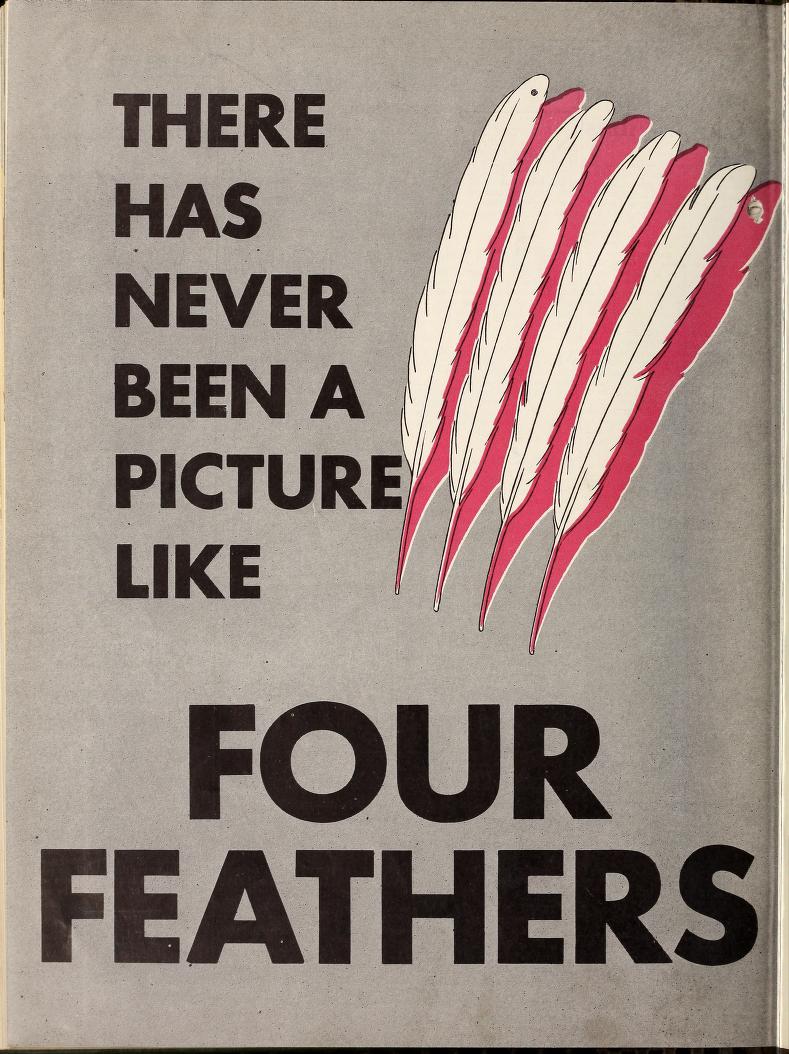
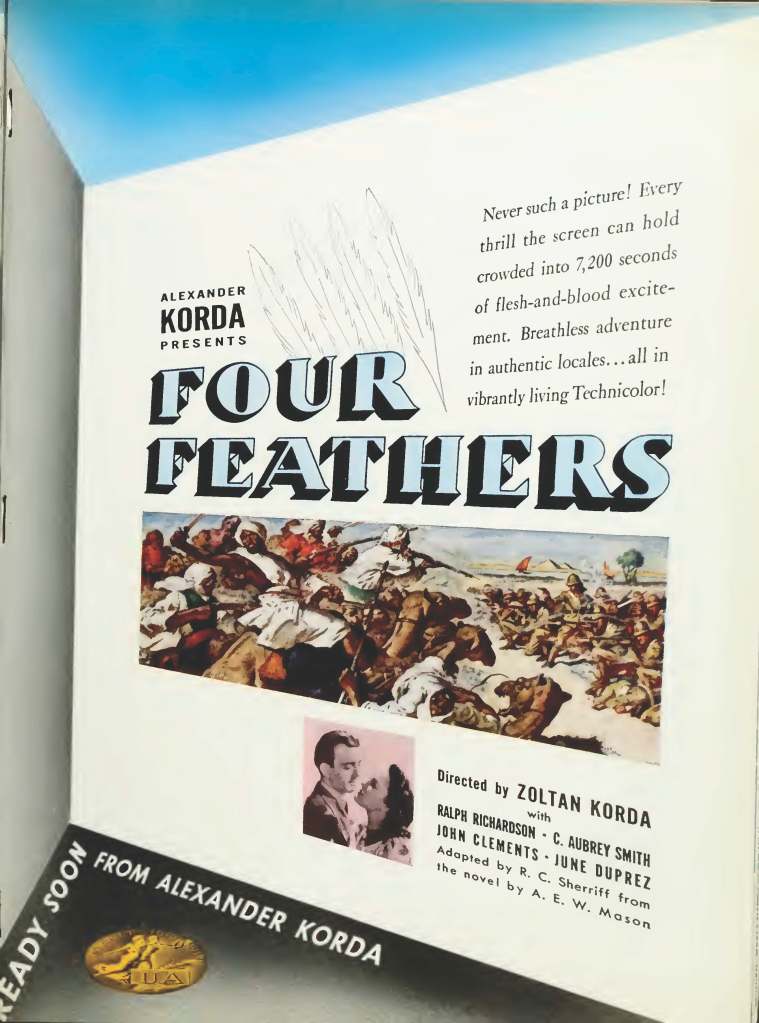
Advert that appeared in American trade magazine “Box Office” in 1939.
Story concerns Harry Faversham (John Clements), pacifist scion of a military family who, having being called into war, tears up his commission and is branded a coward by three army friends and by implication his fiancée Ethne (June Duprez), daughter of a general (hence the four white feathers). Eventually, Faversham determines to make amends and, donning a disguise, spies on the enemy, enduring endless hardship and torture before finally rescuing his friends and contributing to the battle. While it all sounds too stiff-upper-lip for its own good, it’s still quite a feat of direction, tracking cameras measuring the battle charges, the enemy racing forward on thousands of camels, the traditional British square reminiscent of Waterloo holding firm. While Korda lacks David Lean’s visual flair, and Miklos Rozsa’s score too often intrudes on intimate moments, there are still plenty of stunning sequences, boats being towed up the Nile by slaves on shore, the prison sequences, the destruction of the arsenal, the blaze of color on military parade and ballroom, and the sheer wonder at the desert and an innate cinematic understanding of its perils.
Ralph Richardson steals the show as an officer blinded by the sun in the desert and there are a couple of good twists at the end, the fiancée realizing that she, too, was guilty of immoral act in branding Faversham a coward because he objected to the senselessness of war, and a crusty old general of Crimean vintage getting his come-uppance.
It’s always difficult to come to a proper assessment of the 1930s British movie, since so many of the voices sound upper class and the directors lack the skills and understanding of pace of their American counterparts, while the actors too often fall short of Hollywood standards. This was the year of Stagecoach, Gone with the Wind, The Wizard of Oz and Wuthering Heights, for example, and no British picture came close to that quartet, but this is an exceptionally decent effort especially in terms of historical detail. It was a commercial and critical success at the time (nominated for the Palme d’Or at Cannes, Oscar nomination for cinematography) and more recently reappraised by Criterion.
Doomed for half a century to be seen as Saturday television matinee material and then put into the shade by the Zack Snyder’s stylish 300 (2006), The 300 Spartans is in sore need of re-evaluation. Lacking the big budget of an El Cid (1961) or Lawrence of Arabia (1962) and released during an era when historical drama – Barabbas (1961), The Mongols (1961), Sword of the Conqueror (1961), The Trojan Horse (1961), and The Tartars (1961) – was at a peak, this is a stripped-down version of the famous Battle of Thermopylae in 480 B.C. and none the worse for it.
Clever camerawork suggests thousands of warriors involved but there is little sign of scrimping in the wardrobe department and there is more than enough action. Also, this is a surprising literate picture, with great lines for cynical politicians as much as for warriors and peasants. Themistocles (Ralph Richardson) comments: “Some day, I may enter religion myself. It’s better than politics. With the gods behind you, you can be more irresponsible.” Told that the invading Persian army has “arrows that will blot out the sun,” Spartan King Leonides retorts, “then we will fight in the shade.” And there’s sexist banter typical of the period between a peasant couple: wife – “goats have more brains than men”; husband – “who can understand the ways of the gods, they create lovely girls and then turn them into wives.”
Originally titled” The Lion of Sparta”, the film could not have been made without the wholesale cooperation of the Greek army which supplied over 2,000 soldiers. Those playing Spartans had to be over six foot tall. Since the Greeks had no cavalry and few knew how to ride, around 200 were given a crash course. It was a bonanza for the soldiers – their normal wage of $2 was supplemented by $5.50.Thermopylae no longer looked like the area immortalised by the battle, so the action was shot at Loutraki, near Corinth and 80 miles from Athens.
Quite how Leonides ends up fighting the massive army on its own is down to a mixture of politics and religion. Oracles foretell doom. The various Greek states refuse to join together, although Athens lends Sparta its fleet (“Athens’ wooden wall”). Even Sparta officially refuses to participate on the grounds that battle would interrupt a major religious festival. Leonides’ “army” of 300 men is comprised of his bodyguard. A romantic subplot involving a young couple results in catastrophe. Just how ruthless is the opposition is shown when Persian king Xerxes slaughters all his soldiers’ wives to make the men more determined to get to Greece where doubtless they will enslave the female population. When his archers fire, he doesn’t care if the arrows hit his own men.
What marks out the best historical action pictures is the intelligence behind the battle. Strategy is key. The first weapon, of course, is surprise so the Spartans sneak into the Persian camp from the sea and burn their tents. During battle, to counteract the Persian cavalry, the front row of the Spartan army lies down and allows the horses to jump over them, then rising up, traps the cavalry and drives them into the sea. Other clever measures are used deal with the Persian crack infantry regiment, the Immortals. Even at the end, the Spartans continue to confound the enemy with clever ruses.
Richard Egan is effective as Leonides, Ralph Richardson excellent as the wily but honourable Themistocles while Hitchcock protégé Diane Baker (“glaringly miscast” according to Variety) has the female lead though Anne Wakefield as a Persian queen the more interesting role. Former British star David Farrar (Meet Sexton Blake, 1945) is the intemperate Xerxes.
Five-time Oscar-nominated cinematographer Rudolf Mate delivers the directorial goods, his handling of the dramatic scenes as confident as the action and masking the holes in his budget by making clever use of trees as the invaders march, suggesting an army far bigger than he could afford to put on the screen. Color-coding the Spartans – they were in red – made the action clearer to follow. George St George, with few credits of notes (and few at all) doubling up as producer, wrote the script. This thoughtful drama with striking action deserves reassessment.










 The Magnificent 60s