Behind the Scenes: “Two Weeks in Another Town” (1962)

Until a technological invention first used in Once a Thief (1965) it was impossible to shoot “day for night” without it appearing very obvious. So when director Vincente Minnelli aimed for as much verisimilitude as possible for the Rome-set drama it meant half the shoot took place at night. “Minnelli could sleep easily during the day,” recalled star Kirk Douglas (The Arrangement, 1969), “sometimes till six o’clock in the evening, but I couldn’t so there were three unpleasant weeks of night shooting and not much sleep.”

But the movie suffered, Douglas later complained, by studio interference at the editing stage. When the movie fell foul of the Production Code, change of MGM management vetoed the more salacious aspects of the movie – the worst aspects of “La Dolce Vita” including a sequence in a nightclub where guests watched an unseen sexual act. Fifteen minutes were cut including a scene that showed Cyd Charisse’s character in a more sympathetic light. In an ironic reflection of the film’s narrative, Minnelli played no part in the editing, not due to production deadlines as in the movie, but out of choice.
The actual producer John Houseman – producer of Douglas starrers The Bad and the Beautiful (1952) and Lust for Life (1956) though later best known as an actor in Rollerball (1975) etc –  backed out of any tussle with MGM head honcho Joseph Vogel. Douglas implored Vogel and editor Margaret Booth, to no avail. Consequently, in Douglas’s opinion, the film was “emasculated.” He argued MGM had turned an “adult” picture into a “family” film. Quite how this could be squared with marketing that promised a “shocking intimate view of Rome’s international film set” (see below) was not mentioned.

Following the commercial and artistic success of Spartacus (1960), Douglas was at the peak of his career, though his last three pictures had been flops. After nabbing an Oscar for Gigi (1959), Minnelli also enjoyed a career high, and although best known for musicals like Meet Me in St Louis (1944) and An American in Paris (1951) was equally adept at drama like The Bad and the Beautiful,  Lust for Life (1956) and Some Came Running (1958). But he, too, was running empty, his last three serious films – Home from the Hill (1960), All the Fine Young Cannibals (1961) and big-budget roadshow The Four Horsemen of the Apocalypse (1962) coming up short at the box office.

Douglas earned $500,000 and a percentage of the profits (though none were forthcoming – it made a loss of $3 million) and top-billing. Although co-star Edward G. Robinson (Seven Thieves, 1960) appeared above the title, Douglas refused to accord female lead Cyd Charisse (Maroc 7, 1967), on one-tenth of his salary, that concession.
Douglas recalled that he build up his acting skills through wrestling. A college wrestling champ, he barnstormed across the country in a carnival, playing the cocky person reputedly from the audience who challenged the giant resident wrestler. “My job was to make the audience think he was going to murder me,” Douglas told the Pressbook/Campaign Manual. “And the way to do this was by expressions on my face. To yell out in pain would seem cowardly. But I learned a hundred and one ways of showing it through use of my eyes and the muscles in my face.”

The actor escaped serious injury when lightning, preceding one of the worst thunderstorms in a  decade,  struck a 200-year-old clock on the top of the church in Santa Maria Square. Four huge iron numerals were torn off and crashed to the ground, one grazing Douglas’s head.

In fact, the movie’s authenticity owed much to being filmed on the streets of Rome rather than reconstructed on the studio lot. In particular, scenes utilizing the Via Veneto, two long blocks of sidewalk cafes where the movie industry socialized, created a realistic atmosphere, especially when a hundred or so of the extra employed were actually people who would naturally populate the location. So, for example, when the script called for an opera star among the extras, casting director Guidarino Guidi used Bostonian Ann English, an opera singer studying in Rome. Among those sitting in the background at café tables were a promising young painter, a poet and a librettist.

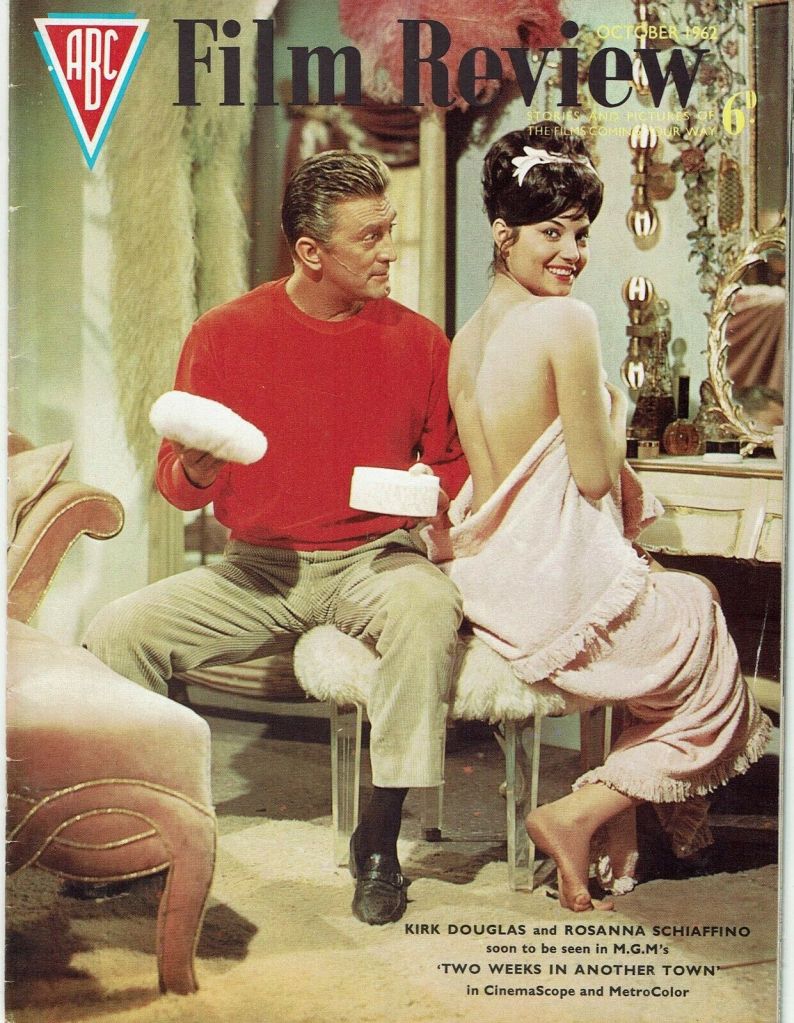
George Hamilton (Act One, 1963), who had worked in Home from the Hill and just finished Light in the Piazza (1962) also shot in Rome, reckoned he couldn’t have been more miscast given his role called for a “funky James-Dean type.” He got the role through the influence of Betty Spiegel, wife of producer Sam, and her friend Denise Gigante, the director’s current girlfriend (later wife). Hamilton drove around in a red Ferrari costing $18,000 (ten times that at today’s prices) and, as he put it, “Italians knew how to worship” Hollywood stars.

Hamilton reckoned part of the problem of the film was that Minnelli was so “besotted with Denise that he had lost his vision.” Jumping to the defence of Cyd Charisse against a tirade from journalist Oriana  Fallaci at the Venice Film Festival won Hamilton, unexpectedly, the cover of Paris-Match.

Daliah Lavi owed her career break to Douglas. As a nine-year-old in Hiffa, Israel, she struck up a friendship with the actor when he was filming The Juggler there in 1952. The actor and other stars attended her birthday party, Douglas presenting her with a ballet dress. Later a dancer and then an actress, this was her Hollywood debut. Erich von Stroheim Jr, making his movie acting debut, had his head shaved to make him appear more like his famed director father. Originally employed as an assistant director on the picture, Minnelli decided he would make a good Ravinski, the “fast-talking press agent.”

Chauvinism reared its ugly head, especially when women had to apologise for being on the receiving end. “What goes on in the minds of beautiful women when they get slapped for the cameras?” mused the editor of the Pressbook/Campaign Manual. Rossano Schiaffino’s response regarding being whacked on the behind by Douglas: “He hits hard so charmingly I didn’t mind standing up for a day of two.”

The actress proved tougher than many of her colleagues. She turned down the offer of a double for a scene in which she jumped into a lake. That might not have been such an undertaking had the sequence been shot in the hot Italian sunshine at the height of summer. But the MGM studio tank on Lot 3 was a different – and much colder – proposition. “She shrugged off her stunt with the remark that heated pools are unknown where she comes from.”

Irwin Shaw, author of the best-selling source novel, wasn’t too upset at the way the movie turned out. “An author who wants complete control of his work on the screen is in something of a cleft stick,” he observed. “He can either go into production himself, which is often neither possible nor desirable, or he can refuse to sell his work to the movies. Minor deviations in screen conception don’t send me reeling back a stricken man. I think I’m sufficiently realistic to know that even in the most enlightened films there must be some compromise if they are to be a success.  What does matter very strongly to me is that the theme of the novel…should come over on the screen.”

Music trivia: Kirk Douglas was the first big Hollywood star to perform “The Twist” on screen and the song “Don’t Blame Me” was reprised from The Bad and the Beautiful, sung here sung by Leslie Uggams and in the older film by Peggy King.

French designer Pierre Balmain created the dresses, allowing a marketing campaign to be built around those stores which supplied his clothes. TWA, which flew directly to Rome, was suggested to cinema owners as an ideal tie-in. Not only did New American Library issue a new movie tie-in paperback/soft cover but cinemas were encouraged to build a campaign around a director, many of whose films would be well-known to audiences. The marketeers also had material to tie in with stores retailing music, women’s sportswear, menswear, men’s sweaters, beauty and hair styling.

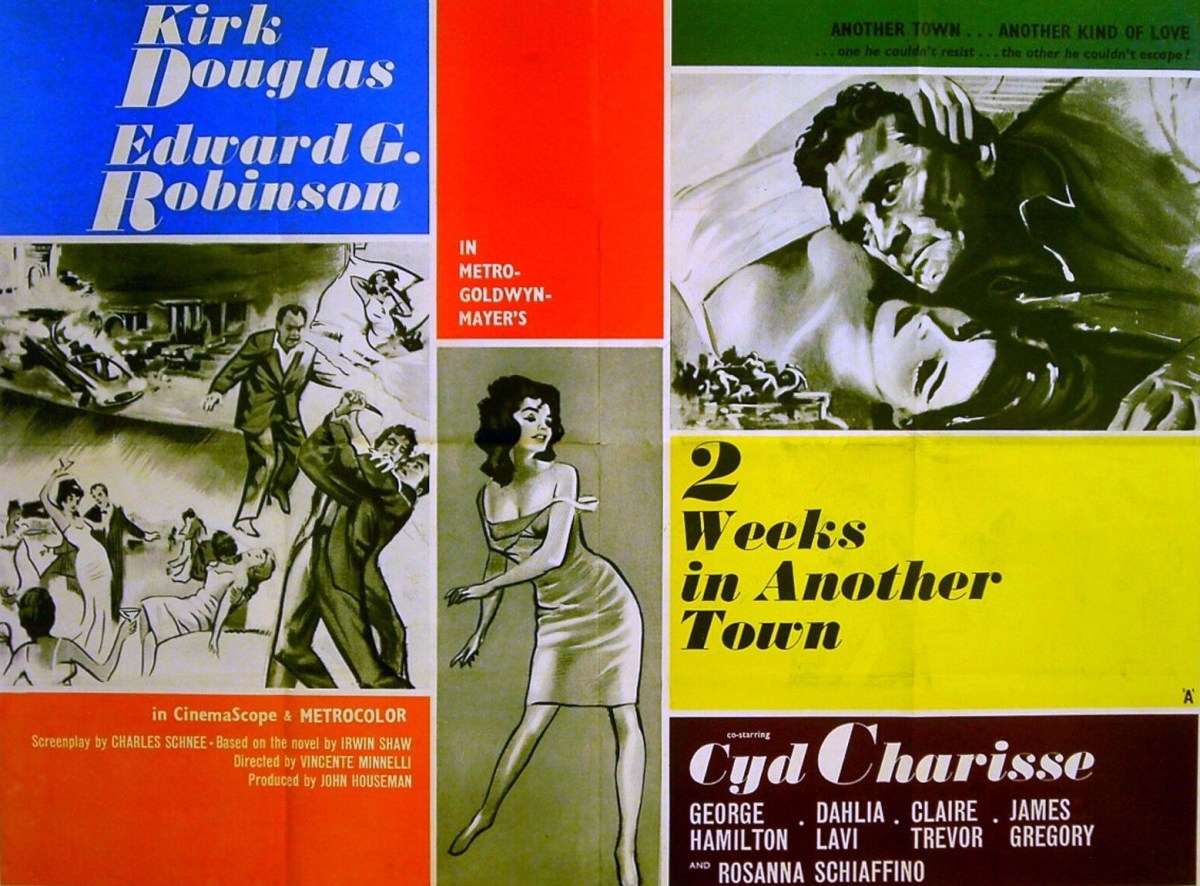
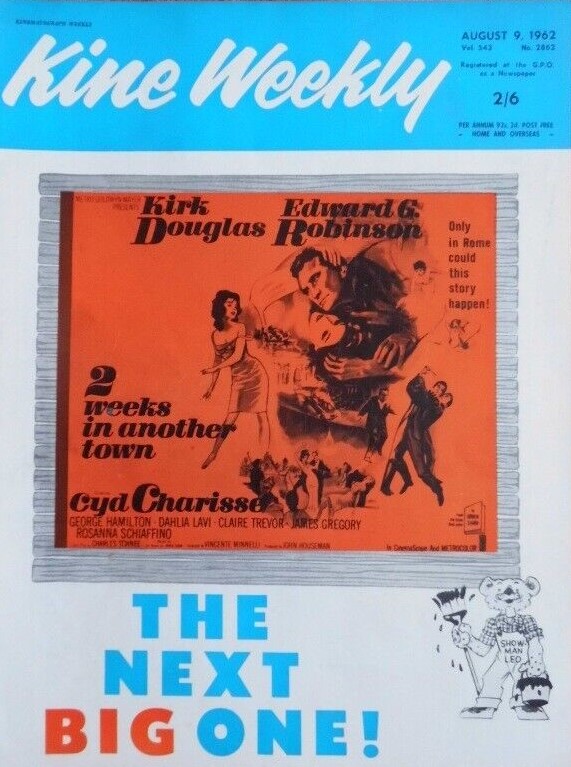
The 16-page A3 Pressbook/Campaign Manual offered a selection of advertisements and taglines. The key advert tagline ran “Another town…another kind of love…one he couldn’t resist…the other he couldn’t escape.” But there were alternatives: “Only in Rome could this story be filmed/Every town has women like Carlotta and Veronica and the kind of man they both want!/From Irwin Shaw’s great best seller.”

Or you could opt for: “Irwin Shaw’s shocking intimate view of Rome’s international film set. The world only sees the glamor. This is the drama behind it!.” Or: “Only in Rome could this story happen. Only in Rome could this story be filmed!”

SOURCES: Kirk Douglas, The Ragman’s Son (Simon and Schuster paperback, 2010) p342-344;  George Hamilton, Don’t Mind If I Do (JR Book hardback 2009)pp 155-159; Pressbook/ Campaign Manual, Two Weeks in Another Town (MGM).

Banned, Reviled, Ignored: “Never Take Candy from a Stranger” (1960)

Paedophilia was the last taboo according to the Production Code, the self-censorship system organised by Hollywood in 1960. You could talk about rape in explicit detail (Anatomy of a Murder, 1959) and serial killers (Psycho, 1960) were acceptable, but you must not “violate the edict against depicting sex perversion…the only subject strictly forbidden by the code.”

Without the Production Code Seal (of approval), cinema bookings would be hard to come by. Cinemas that relied on the goodwill of their patrons would not dare risk upsetting them by renting a film that had met with such disapproval.

Headline news in “Variety.

Never Take Candy from a Stranger – a.k.a.Never Take Sweets from a Stranger – had been passed as an X-certificate in Britain, where, despite being set in Canada, it had been made. While that meant it could only be seen by adults over 18, there was no objections to it being shown.  It had been shot over six weeks beginning October 1959.

It had even been positively reviewed in the U.S. where Variety called it and “an exceptionally restrained film…directed with considerable skill” and Box Office magazine, another trade weekly, rated it “touching” though warned exhibitors that the “the subject matter is not to be sold as lure.” 

It did not help the case that James Carreras of British studio Hammer  had set out to make a movie that was “explosively exploitable” with the aim of cracking open America on the back of “heavy-exploitation marketing such as sex crimes against children” and that the movie intended to be “as frank with its theme as was Anatomy of a Murder in dealing with rape.”

The case went to appeal. The argument in its defence, as put by Roger Garis, author of the play on which the film was based, was that the movie wasn’t so much about paedophilia but about the public’s resistance to hearing about it, and the battle by two parents to rid the community of such a menace. He pointed out that on the play’s initial opening in New York in 1954 “no review indicated in the slightest degree that the subject matter was distasteful.”

But perhaps the U.S. censors took more note of the review printed in the British Monthly Film Bulletin that complained the “film’s seriousness is dissipated by an unnecessarily horrible climax.”

Hammer appealed the decision, but the Production Code would not budge. 

Despite the cautionary note struck by Box Office magazine, it was almost certain that it would be sold as exploitative, and attract the wrong sort of clientele, and for moviegoers of the wrong disposition it might well be only too big an attraction. In Britain, for example, it had been sold as a sex-shocker double bill, on the ABC circuit teamed up with Brigitte Bardot number Come Dance with Me (1959).

U.S. distributor Columbia could not be seen to be selling a movie that went against the ruling of the Production Code, but it couldn’t just dump it either since it was contractually obliged to release it. So instead it was passed on to its sub-division Lopert, an independent operation with no ostensible links to the parent company, that would find a way to get it into cinemas. Lopert would either sell it through the states rights method, divvying up the picture to a different set of local distributors who would each undertake the release in an individual state, or sell it on to another distributor, perhaps with experience of handling dodgy material. Lopert did both. Distribution was handled in some territories by Omat, which had successfully ushered La Dolce Vita (1960) through the system, and later Pathe-American, and in others by an independent.

The trade magazines had urged exhibitors to enrol the assistance of parental groups in marketing the movie, but these would hold no sway in terms of publicity. A local newspaper which had denied the movie any advertising space – a nationwide ban that followed such extreme Code disapproval –  was hardly going to give it editorial coverage.

But of course there were exhibitors who would take it. Arthouses were one possibility. They had been dealing with the disreputable ever since foreign production companies realized they could bypass the Production Code. If they were not signatories, they did not have to submit their movies for assessment. That was why there was such a flood of movies from France, Sweden and Italy heralding a sensational star like Bardot or Sophia Loren and promising greater leniency towards nudity than would be acceptable to the Code.

And there were many, especially among the more articulate classes, who felt the Code was outdated anyway, and that foreign films were breaking new cinematic ground, and that the directors of such films, Ingmar Bergman, Fellini et al, should be praised rather than condemned. But it was inevitable that movies from abroad with genuine artistic purpose got mixed up with those made with purely salacious intent.

The arthouse had been compromised so much that anything that could lure in the public was fair game. Even so, most arthouses drew the line at a film about child molestation. While Never Take Candy from a Stranger did receive a number of bookings in city center U.S. houses between 1961 and 1962 they were rarely in an arthouse. Most were in cinemas accustomed to offering patrons lurid product. In Chicago, outside of the major cinemas, it went out as a double bill with Sam Peckinpah western Deadly Companions.

Tracking the release through the pages of Variety and Box Office, I discovered it had only occasionally proved a success, a holdover for a second week generally one way of demonstrating that measure.

(Note that cinema capacities were much larger than today in the multiplex era and it was far from uncommon for  moviegoers to be part of a 1,000-plus audience)

In May 1961 in Boston it ran for two weeks at the 689-seater Mayflower, hitting $4,500 in the first week with a relatively small drop to $4,000 the next. In November, most likely as a filler for a movie that failed to hit its targets and was pulled early, it reached the 2,995-seat Palms in Detroit, clocking up a fair $10,000, but only permitted three days the next week, for another $3,000.

But by then a different reelase strastegy was in place. The same month in an “unusual first-run hook-up” it played a couple of drive-ins in Kansas City, those theaters were dragged into the first-run loop in the absence of other available or willing houses. One week at the 900-car Crest and the 700-car Waldo brought in a “mild” $6,000.  Perhaps in a bid to secure a bigger audience it was teamed with Beware of Children (1960). But anyone expecting another dip into perversion would be disappointed for it was a British marital comedy starring Leslie Phillips.

But release was a long drawn-out process, and perhaps to limit expenditure few prints were made. And by 1962, yet another different approach was taken, targeting the arthouses. In February it reached Baltimore, $3,000 at the 860-seat Avalon, In April it lasted one week at the 238-seat Capri Art in Denver taking $900 gross at the box office.

And then, never having not scaled the heights that a movie trading on controversy might expect, it disappeared. Obviously never a contender for television, and no sign of it being shoved out during the VHS boom, when virtually any movie made was revived in the hope of snaring a few extra bucks.

It took a helluva long time for the movie to surface, but when it did, it was to plaudits.

SOURCES:  “Hammer’s Slant,” Variety, October 21, 1959, p4; “Realism Outbreak in Britain,” Variety, October 31, 1959, p3; Review, Monthly Film Bulletin, January 1, 1960, p48; James Carreras, “British Horror Pix As Insurance For That Wide-Open Global B.O.,” Variety, January 6, 1960, p166; Review, Variety, March 16, 1960, p6; “Child-Molesting Theme in Abeyance,” Variety, April 27, 1960, p3; “Candy Story Author Sez Not About Perversion But Public’s Own Laxity,” Variety, May 11, 1960, p4; “Candy Loses Appeal for Code Seal,” Variety, May 18, 1960, p17;  Advertisement, Variety, January 11, 1961, p14; Review, Box Office, August 21, 1961, pA1; “Says Wilmington Press Is Pre-Judging Ads,” Box Office, October 30, 1961, p15; “Set Up Pathe Campaign,” Box Office, December 18, 1961, pNE6. Box office figures from Variety issues: May 31, 1961, p9; November 22, 1961, p8-10; February 14, 1962, p8; April 18, 1962, p9.

Behind the Scenes: “The Night of the Living Dead” (1968)

Easy Rider, more acceptable artistically, stole Night of the Living Dead’s thunder the following year as the poster boy for a low-budget phenomenon that would, temporarily at least, usher in a new way of Hollywood thinking. But Night of the Living Dead – initially entitled Monster Flick and Night of the Flesh-Eaters – was movie-making as fairy tale, virtually a throwback to the old trope of doughty characters putting on a show in a barn.

Using guerrilla production techniques, the movie took an astonishing six months to make starting July 1967.  Bronx-born George A. Romero specialised in advertisements and industrial shorts through his Latent Image company before branching out in Pittsburgh with some work colleagues from Hardman Associates to form a movie production company Image Ten, the name indicative of the initial ten investors.

But don’t make the mistake of thinking Romero and his gang were movie neophytes out of their depth. Technically, they were pretty accomplished, churning out adverts and shorts at a steady pace, the kind of education the likes of Ridley Scott and Adrian Lyne enjoyed on the London advertising scene. According to Variety, Hardman was “the largest producer of record and radio shows in Pittsburgh…(running) the most completely equipped sound and film studio in the area” while Latent Image was the city’s “biggest producer of video and industrial shorts.”

The principals of both companies proved instrumental to the movie. While Romero took on directing, cinematography and editing duties, the screenplay was down to business partner John A. Russo while another partner Russell Streiner took on the role of producer. Hardman provided actors Karl Hardman, a former RKO contract player, and Marilyn Eastman, who also supervised make-up, costumes and special effects, while Kyra Schon, the dying daughter in the film, was Hardman’s real-life daughter. The rest of the cast were unknowns, Duane Jones in the lead had at least some stage experience, female lead Judith O’Dea had worked with the producers before, while Judith Ridley was a receptionist for the production company. Romance blossomed between O’Dea and Streiner.

Romero’s debut was heavily influenced by Powell and Pressburger’s British bizarre fantasy The Tales of Hoffman (1951) but the final film clearly draws on Richard Matheson’s celebrated 1964 sci-fi novel The Last Man on Earth – filmed in 1971 as The Omega Man and in 2007 as I Am Legend. Where Matheson’s book begins at the end, Romero wanted to show the beginning of how the undead came to rule the world. Since Matheson had used vampires, Romero needed an alternative.

Explained Romero: “I couldn’t use vampires because he did, so I wanted something that would be an earth-shaking change. Something that was forever, something that was really at the heart of it. So I said, what if the dead stop staying dead?” That tapped into the attractive notion of living forever – until you realized what that entailed.

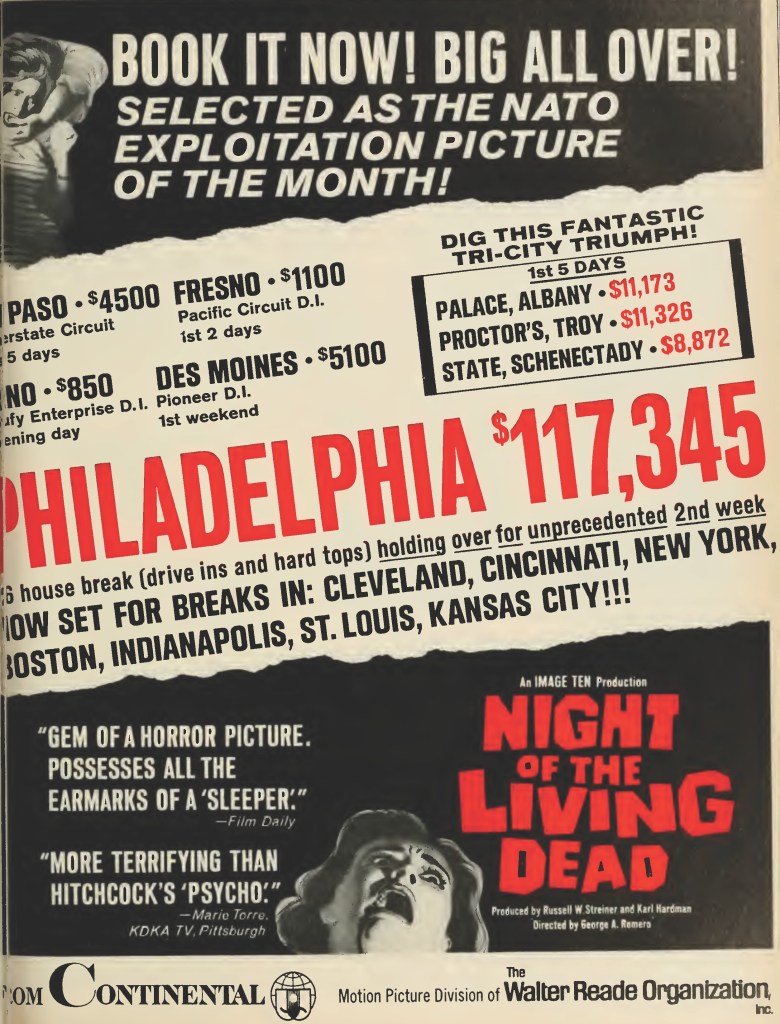
Contrary to expectation – and myth – it didn’t exactly stumble at the box office. A month after initial release its opening salvoes were advertised in “Box Office” magazine (November 25, 1968)
accompanied by some of the better reviews harvested.

Shockerama pictures would be the easiest way to find a foothold on the distribution ladder. Initially devised as a horror comedy it took several drafts, the first couple involving aliens, before arriving at the concept of flesh-eating re-animated corpses.

Ben was originally envisaged as a blue collar truck driver and evolved into the more educated character as a result of rewriting by Duane Jones who objected to playing such a cliché. But improvisation was very much the order of the day. Recalled O’Dea: “I don’t know if there was an actual working script. We would go over what basically had to be done and then just did it the way we each felt it should be done.”

The initial investors ponied up $600 each but that proved insufficient as production developed, the company eventually raising $114,000. (The  average cost of making a movie at that time was $1.6 million.) Budget dictated location be as remote as possible, the main locale a house scheduled for demolition.  Chocolate syrup doubled as blood, human flesh was roasted ham and entrails supplied by one of the actors who was also a butcher. Clothing was anything the cast possessed that they didn’t mind being ripped. Color film was too expensive, and the resulting black-and-white footage has the effect of newsreel, almost a documentary rather than a work of fiction.

Although a myth has arisen that the movie struggled to find its way into the distribution food chain, that was not the case. Studios were desperate to find product and happy to hang their shingle on anything that could keep their clients, cinemas starved of movies, happy. Columbia and American International were both interested, but demanded a happy ending. When Romero stuck to his guns, the movie ended up with the Walter Reade organisation, a noted distributor of foreign and cult pictures, better suited to this kind of fare.

Nor was it sneaked out into cinemas as has been usually assumed. Given that by 1968 cinema managers owners were in part reliant on low-budget shockers, the National Association of Theater Owners instigated a nationwide “Exploitation Picture of the Month” campaign of which Night of the Living Dead was one of the early beneficiaries, as a result of its involvement scooping, for example, $117,000 from 26 houses in Philadelphia. and other pretty decent figures shown in the advertisement above.

Nor did it go out below-the-wire in Pittsburgh. A full-scale black-tie premiere was held on October 1, 1968, at the Reade-owned Fulton attended by Mayor Barr and the city’s safety director Norman Craig and various councillors. It rang a heavy box office bell, knocking up $62,000 – over $500,000 at today’s prices – for 11 theaters, outpointing Rosemary’s Baby (1968) which had played the same houses the week before. The distributor came up with a clever marketing ploy of taking out a $50,000 insurance policy with Lloyds of London against adverse audience reaction.

The film attracted controversy for going out un-rated. There was nothing unusual about that either. Only studios aligned with the MPAA Production Code had to submit their movies for the censor’s rating. Reade, which wasn’t involved in the Code, often imported movies from Europe and part of their attraction was that they were unrated, containing levels of nudity or violence that the official censor at the time would find impossible to pass. Lack of the vaunted Production Code Seal of Approval did not prevent a movie being shown, it just meant certain cinemas would not book it.

Chicago critic Roger Ebert made journalistic hay by complaining that kids were being allowed in to watch the movie. That he might be on hand to witness their shock at the images they saw seems hard to believe since critics usually viewed pictures in advance of opening at special screenings. In any case, in Chicago, Night of the Living Dead didn’t slip through the censorship net, but was passed by the local censorship board. His beef was with them, complaining that while the censors drew the line at nudity they had nothing against cannibalism. And it seems pretty odd that the management wasn’t aware of the film’s shocking content – presumably that being the reason it was booked in the first place – and permitted youngsters to troop in.

Although New York critics gave it the thumbs-down at least the New York Times (Vincent Canby no less), Post and Daily News took the trouble to see it, so it would at least benefit from editorial exposure. The trade press were mixed. While Variety railed that it “set a new low in box office opportunism,” its trade press competitor Box Office reckoned there was “an audience for this particular brand of sadism especially in drive-ins.”

Perhaps surprisingly given critical disapproval Night of the Living Dead enjoyed first-run outings in a variety of cities, though its main target was showcase (wide local release) and drive-ins. In Los Angeles it picked up a “hip” $10,500 at the 1,757-seat first-run Warren. (Multiply by ten to get an idea of how inflation would treat the gross and bear in mind this is pre-multiplex when cinema capacity could reach 5,000 and most city center emporiums seated 500-plus). In Boston it registered a “cool” $8,000 at the 1,250-seat Center. New York’s Broadway had to wait a year when the prestigious roadshow house the DeMille, in the week before it hosted 70mm extravaganza The Battle of Britain (1969), booked Slaves (1969)/Night of the Living Dead, grossing $21,000 in an eight-day fill-in run.

In its first New York showcase, when Night of the Living Dead was the main attraction with Dr Who and the Daleks in support, it scorched through $286,000 from 39 cinemas, the joint top result for the week. Returning a year later, as the support to Slaves put another $125,000 in the kitty from 26 plantations, again the top showcase performer for the week. Among notable wider releases were $14,300 from three in Dayton where it was “weekends at capacity in ozoners” (industry jargon for drive-ins). There was $10,000 from three houses in Minnesota.

Not being a contender for sale to television extended its screen life at a time when even big hits landed on small screens within a few years. As well as Slaves it was revived as the supporting feature to newer items Brotherhood of Satan (1971), Lust for a Vampire (1971) and The Nightcomers (1971). The teaming with Slaves racked up a “rousing” $82,000 in Detroit at the 5,000-seat Fox, and $55,000 the following week. The double bill with Brotherhood of Satan beat the previous week’s pairing of the reissued Butch Cassidy and the Sundance Kid/Mash. It formed part of an interesting triple bill at the 500-seat Plaza arthouse in Boston where it was teamed with Dutchman (1966) and Ulysses (1967).

But it was also building up a head of steam on the midnight screening circuit and began a record year’s run in that slot at the Plaza in Boston. Gradually, as it acquired more artistic credibility it turned up at prestigious New York 538-seat arthouse the Beekman with Invasion of the Body Snatchers in support (gross $5,000), ironically acting as trailer for a six-week programme of revivals based on “Ten Best” selections from critics which had avowedly spurned the movie. And it was chosen as the ideal companion for the once-banned Freaks (1932). Perhaps proof of the breakthrough into respectable cult territory, six years after initial release, was a New York showcase pairing with Pink Floyd: Live at Pompeii (1972), drumming up $63,500 from 29 bandstands.

By the end of December 1970, rentals (the amount the studio collects from cinemas as opposed to overall gross) stood at $1 million – which probably indicated a gross of around  $3 million. It found a British distributor in Crispin and eventually rolled out successfully around the world with an estimated $18 million in global gross.

SOURCES:  John Russo, The Complete Night of the Living Dead Filmbook (Imagine, 1985), p6,7, 31, 61, 70;  Joe Kane, Night of the Living Dead (Citadel Press, 2010) p23; Jason Paul Collum, Attack of the Killer B’s (McFarland, 2004) p3; Roger Ebert, Chicago Sun-Times, January 5, 1969; Brian Hannan, In Theaters Everywhere, A History of the Hollywood Wide Release, 1913-2017 (McFarland 2019), p161; “Pittsburgh Premiere Held for Walter Reade Thriller,” Box Office, October 8,1968, p8;  “Pittsburgh’s Hometown Horror to Reade: Surprise Boff BO,” Variety, October 9, 1968, p17; “Review,” Variety, October 16, 1968, p6; “Big Success Claimed for Image Ten Film,” Box Office, October 21, 1968, pE1; Advert, Box Office, November 25, 1968, p7; “N.Y. Critics: A Shooting Gallery,” Variety, December 11, 1968, p19; “Sun-Times Wants Chicago ‘Absurd’ Censorship Brought to Halt,” Box Office, March 14, 1969, p10; “Pittsburgh’s Latent Image Make 2nd Film,” Variety, December 3, 1969, p4; “Pittsburgh’s Cannibal Film Big Box Office,” Variety, April 8, 1970, p13; Advertisement, Kine Weekly, June 16, 1970, p61; “Big Rental Films of 1970,” Variety, January 6, 1971, p11; “Year of Friday Midnight Showings,” Variety, August 16, 1972, p6.

Box Office Figures from Variety: December 4, 1968, p13; December 11, 1968, p10-p11; December 18, 1968, p8-p13; July 9, 1969, p8; March 4, 1970, p12; October 13, 1971, p8-p12; October 20, 1969, p9;  October 27, 1971, p16;  Mar 17, 1972, p10; April 12, 1972, p10; May 12, 1971, p8; July 19, 1972, p12; August 9, 1972, p8; September 25, 1974, p8.

Discover WordPress

A daily selection of the best content published on WordPress, collected for you by humans who love to read.

The Atavist Magazine

by Brian Hannan

WordPress.com News

The latest news on WordPress.com and the WordPress community.